Where Your Flight Hours Go: 16 Pilot Resume Templates and Examples
- ATS Friendly
- Flight Hours Table
- 16 Operations Covered
A pilot resume example should carry five things, in this order: a summary naming your certificate, total time and current seat, a flight time table broken out by category near the top, a certificates and ratings block with your medical class and date, employment written around the operation you flew, and all of it on one page. Find the example below that matches the flying you want next, then swap in your own logbook figures.


540k+ resumes created
Pilot resume templates sorted by the certificate and the operation
A 310-hour commercial pilot, a regional first officer bidding captain, and a Part 137 ag pilot are screened on three different lines of a logbook. Each template below is a complete one-page resume for one of those jobs, built with the certificate, ratings, and hour categories that posting actually names. Pick the closest one and replace the figures with yours.
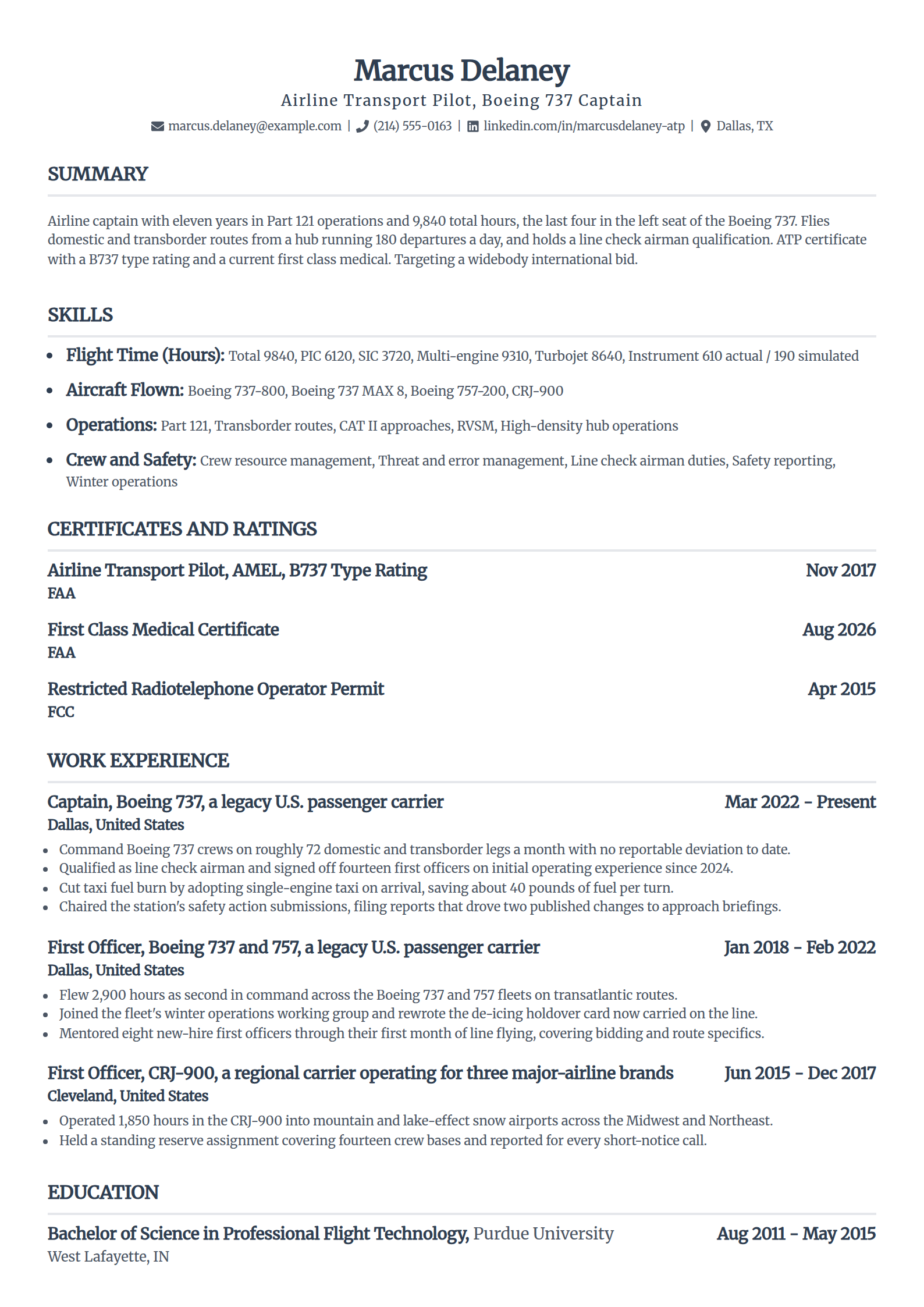
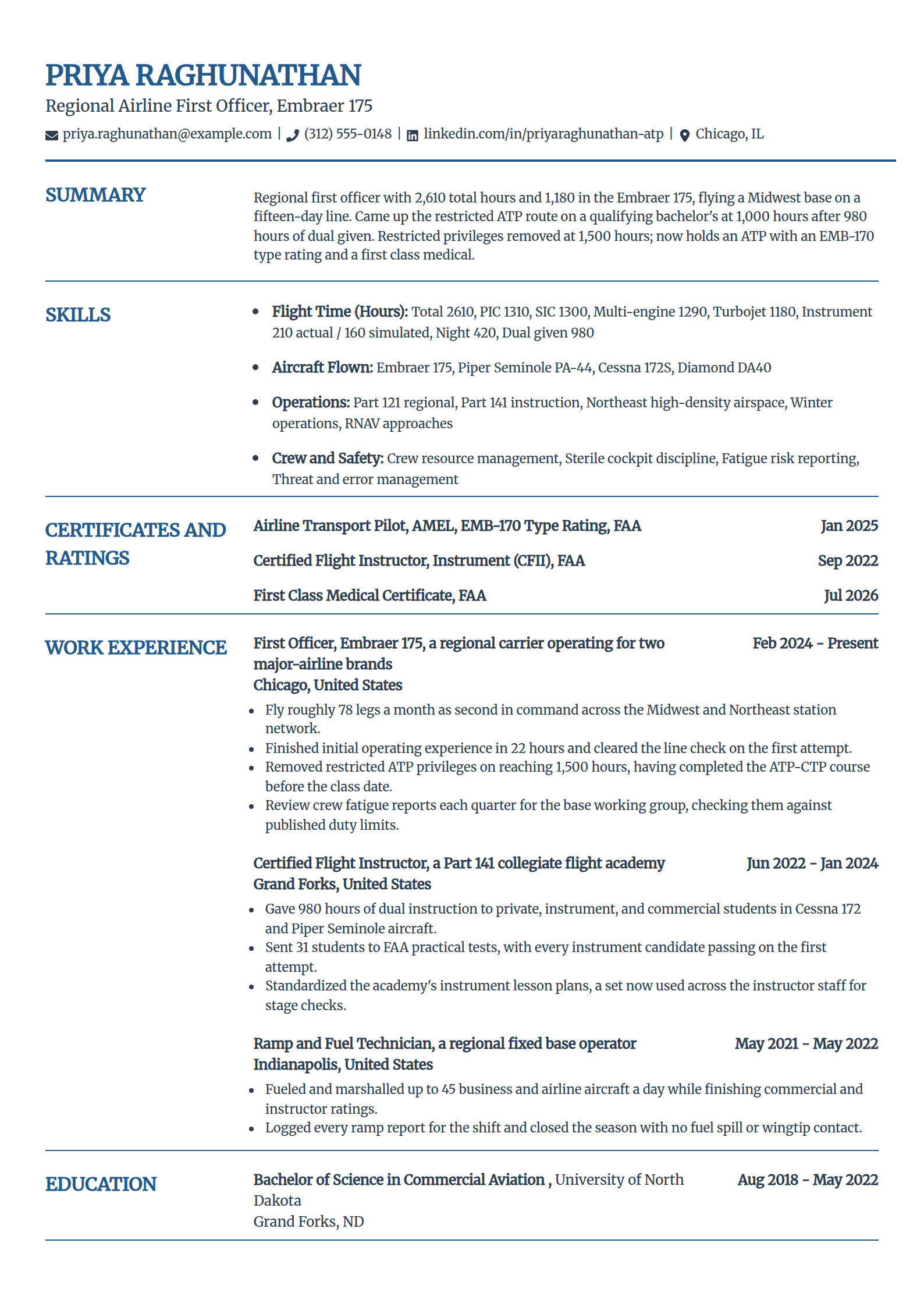
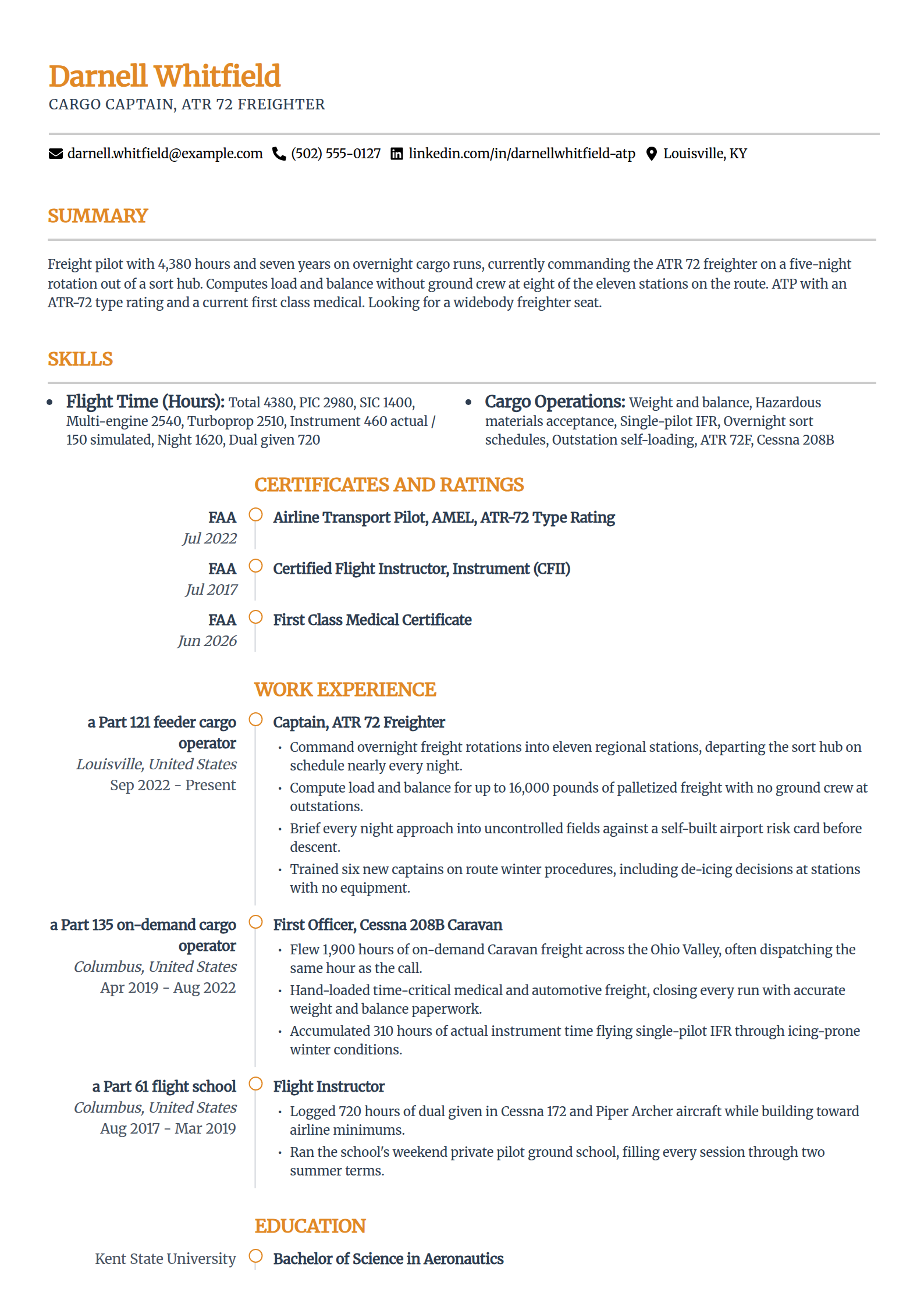
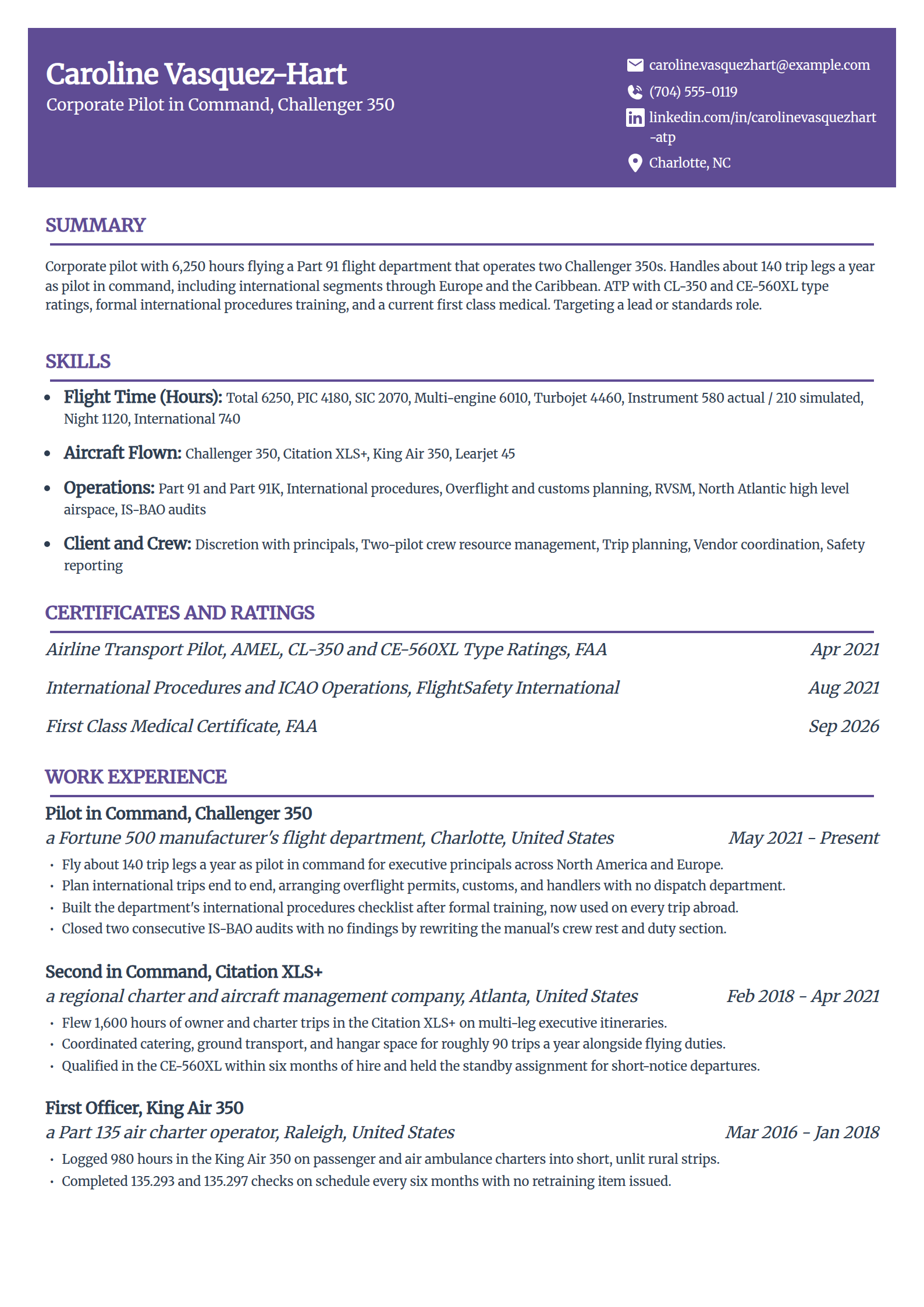
Airline Pilot Resume Template
Why this resume example works?
- Opens with the certificate, the total time, and the seat, which is the first thing a recruiter checks against the posting.
- Breaks the flight time into the categories a Part 121 posting publishes minimums for, instead of giving one total.
- Splits instrument time into actual and simulated, so nothing in the table has to be taken on trust.
- Counts the flying as legs a month rather than claiming to be a safety-minded professional, which every applicant writes.
- Puts the line check airman qualification near the top, since that is the line a chief pilot reads as leadership.
Regional Airline First Officer Resume Template
Why this resume example works?
- States the qualification route outright, a restricted ATP at 1,000 hours on a qualifying degree, which answers the recruiter's first question.
- Says when the restriction came off at 1,500 hours, so there is no ambiguity about what the certificate allows today.
- Keeps dual given visible in the hours table, because instructing time is how most first officers reached the minimums.
- Reports training performance in concrete terms, finishing initial operating experience inside the syllabus hours.
- Shows the pre-airline ramp job without apology, which reads as someone who paid for the ratings while working.
Cargo Pilot Resume Template
Why this resume example works?
- Leads with the schedule, overnight rotations out of a sort hub, because tolerance for night freight is what cargo postings screen.
- Names the work a freight captain does that a passenger captain does not, computing load and balance with no ground crew.
- Carries a high night total in the hours table, which is the single most persuasive figure on a cargo resume.
- Shows single-pilot IFR into uncontrolled fields, the condition that separates freight flying from airline flying.
- Keeps turboprop and turbojet time split, so an operator can check the type of experience and not just the amount.
Corporate Pilot Resume Template
Why this resume example works?
- Names both type ratings up front, since a flight department hires for the aircraft in its hangar and not for total time.
- Shows trip planning without a dispatch department, which is the part of the job that surprises pilots coming from airlines.
- Carries international time as its own hours line, the figure a department buying overseas trips wants to see.
- Mentions closing IS-BAO audits with no findings, a credential a flight department recognizes and an airline resume never shows.
- Handles the client-facing side plainly, with catering and ground coordination listed as work rather than as personality.
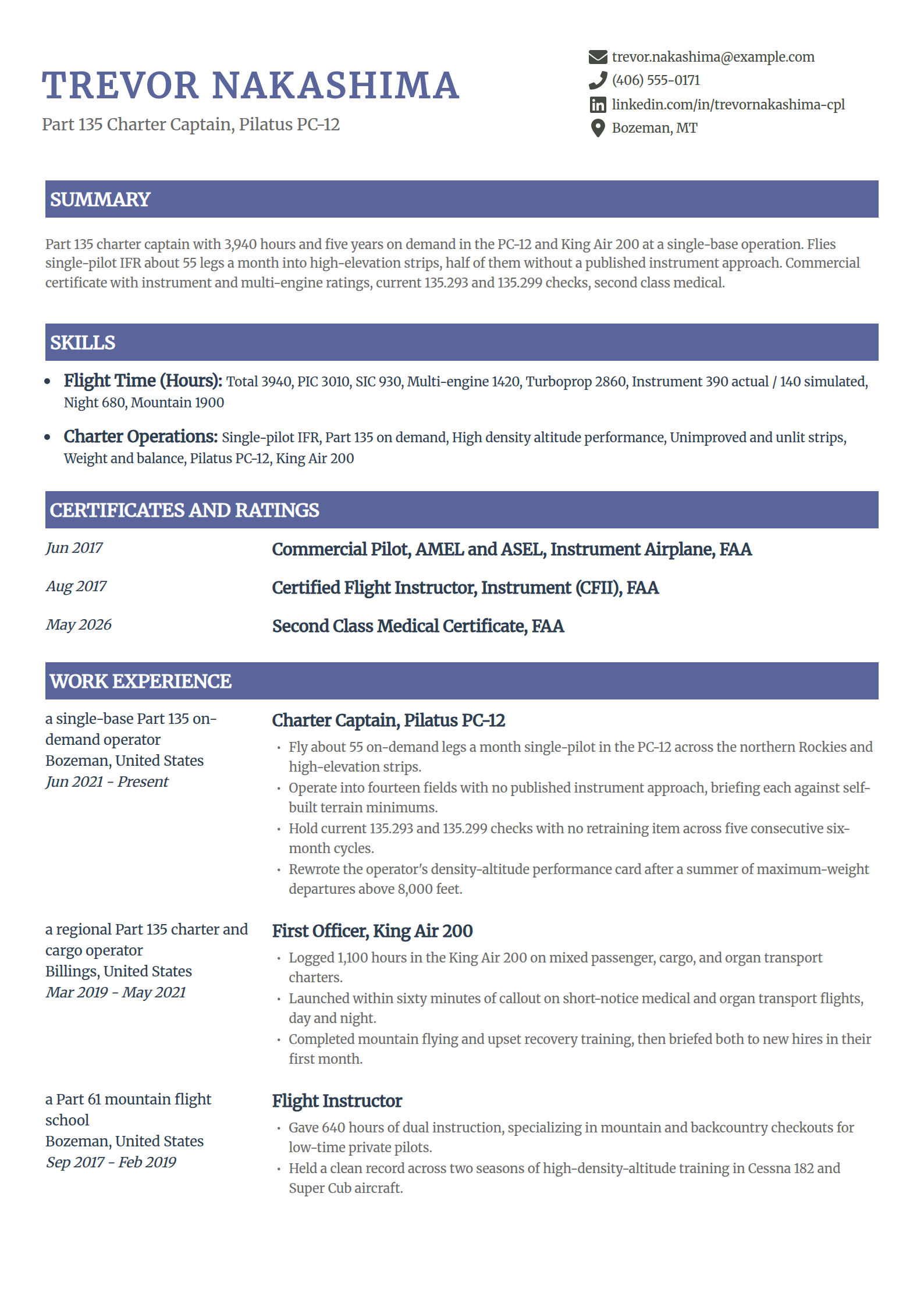
Part 135 Charter Pilot Resume Template
Why this resume example works?
- Cites the checks by regulation number, 135.293 and 135.299, which is how a chief pilot confirms you are current.
- Builds the whole page around single-pilot IFR, the qualification that decides whether an on-demand operator can use you.
- Quantifies the hard part of the flying, fields with no published instrument approach, instead of calling it challenging.
- Carries a mountain hours line, which is a real screen for operators in high terrain and appears on no generic template.
- Holds a commercial certificate rather than an ATP and says so, which is accurate for single-pilot Part 135 work.
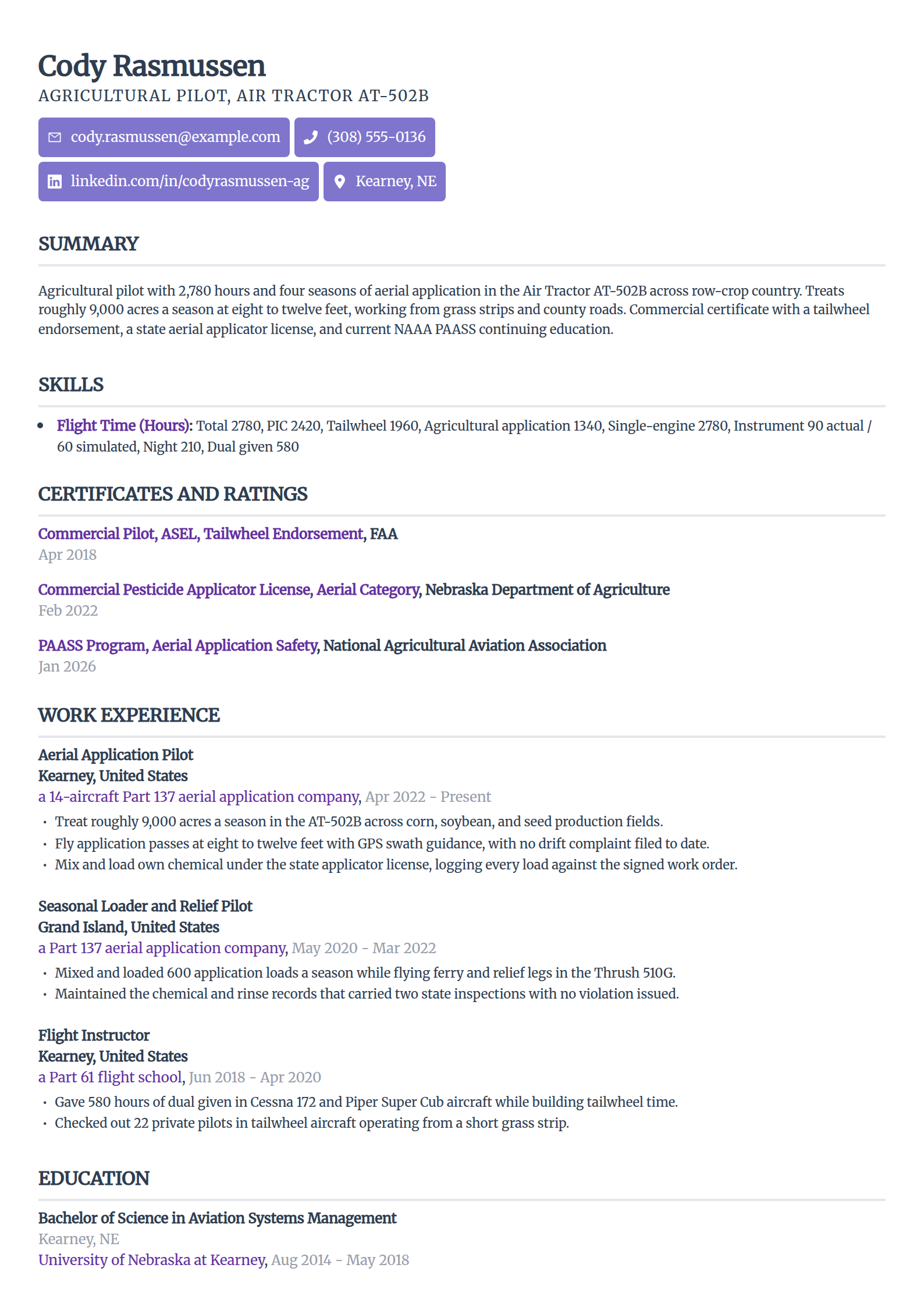
Agricultural Pilot Resume Template
Why this resume example works?
- Puts the state aerial applicator license beside the pilot certificate, because an ag operator cannot hire without both.
- Measures the season the way the industry does, in acres treated, not in hours or in flights.
- Carries tailwheel and application time as their own hours lines, which no airline-shaped resume template has room for.
- Names the NAAA PAASS program, the continuing education an ag operator recognizes immediately.
- Shows the loading and record-keeping side, which is most of the job and what a state inspection actually examines.
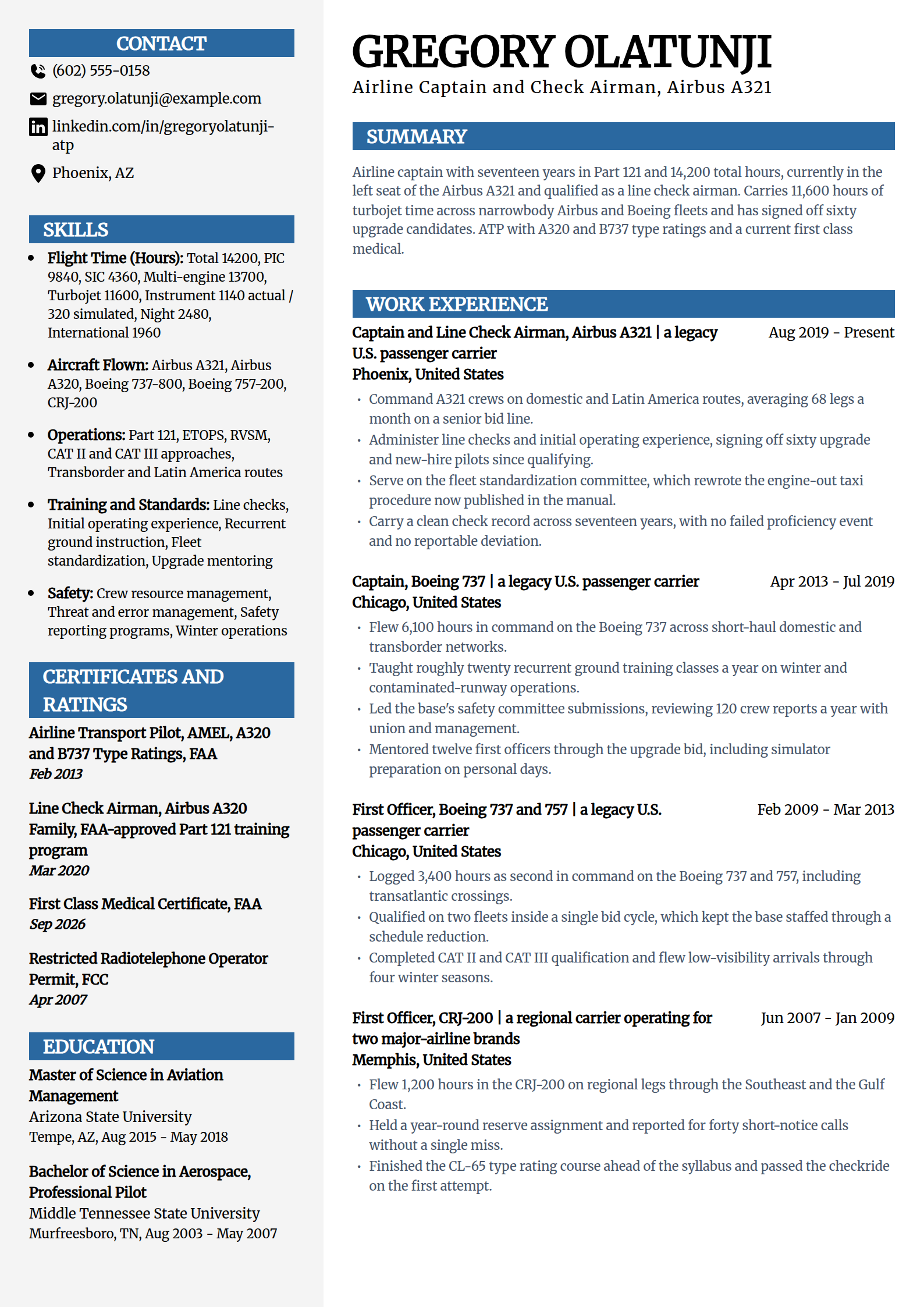
Experienced Airline Captain Resume Template
Why this resume example works?
- Fits seventeen years onto one page by cutting the oldest entries to three bullets instead of shrinking the type.
- Leads the training work with a number that can be checked, sixty upgrade and new-hire pilots signed off.
- States the clean check record plainly, which is the claim a chief pilot is quietly looking for on a senior resume.
- Carries two type ratings and a check airman qualification in the certificates block where a recruiter scans for them.
- Uses a two-column layout that keeps education, certificates, and the hours table visible beside a long work history.
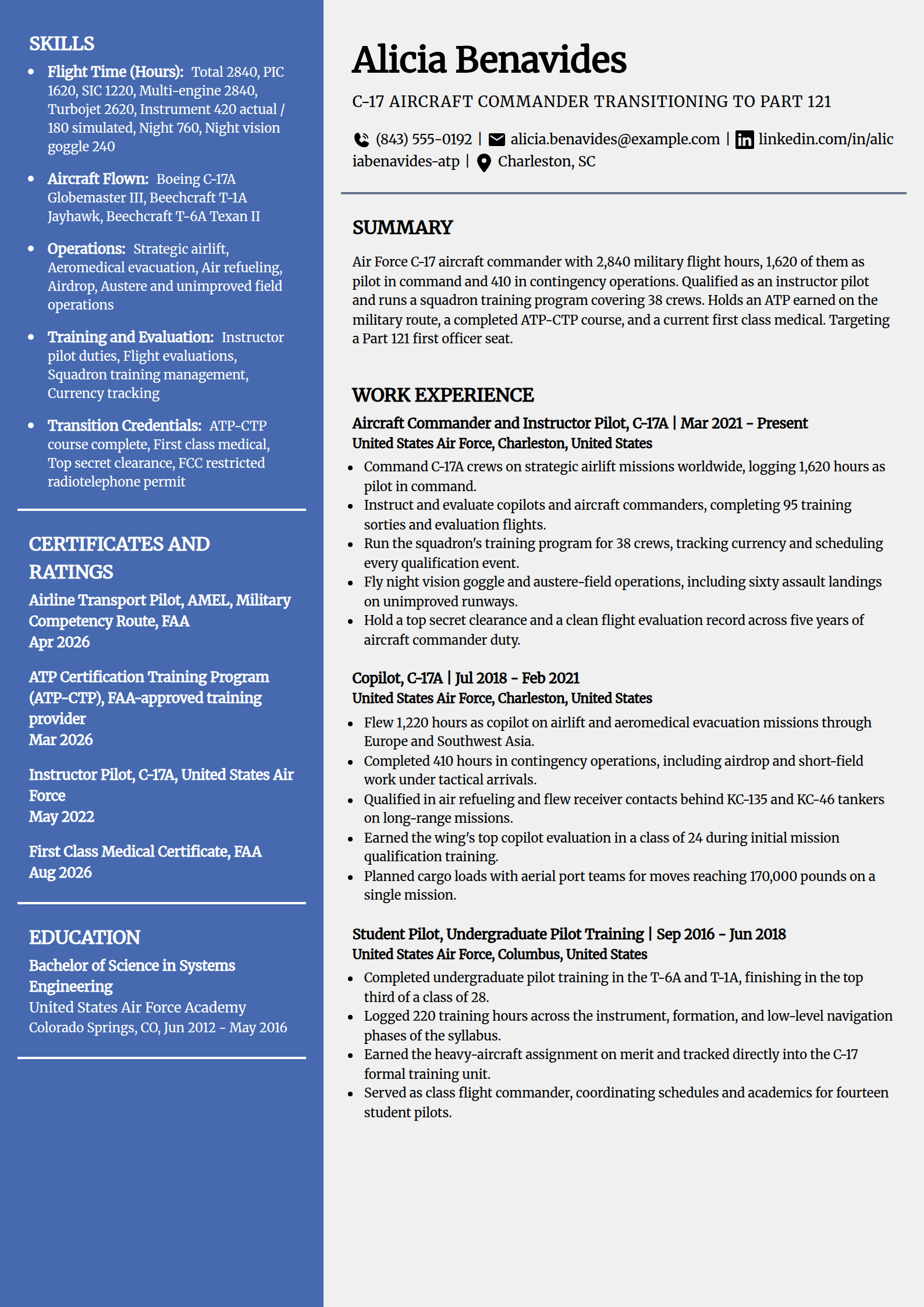
Military to Civilian Pilot Resume Template
Why this resume example works?
- Translates military flying into civilian hour categories, so a recruiter does not have to interpret a sortie record.
- Names the ATP route taken and the ATP-CTP course completion, which is the gate between military time and an airline class date.
- Keeps the instructor pilot and evaluation work visible, because that is the experience airlines value most from military crews.
- Says what the aircraft was in plain terms, a C-17A, rather than leaning on unit names and program acronyms a civilian will not know.
- Carries night vision goggle time as its own line instead of burying it, since it is genuine experience few civilian applicants have.
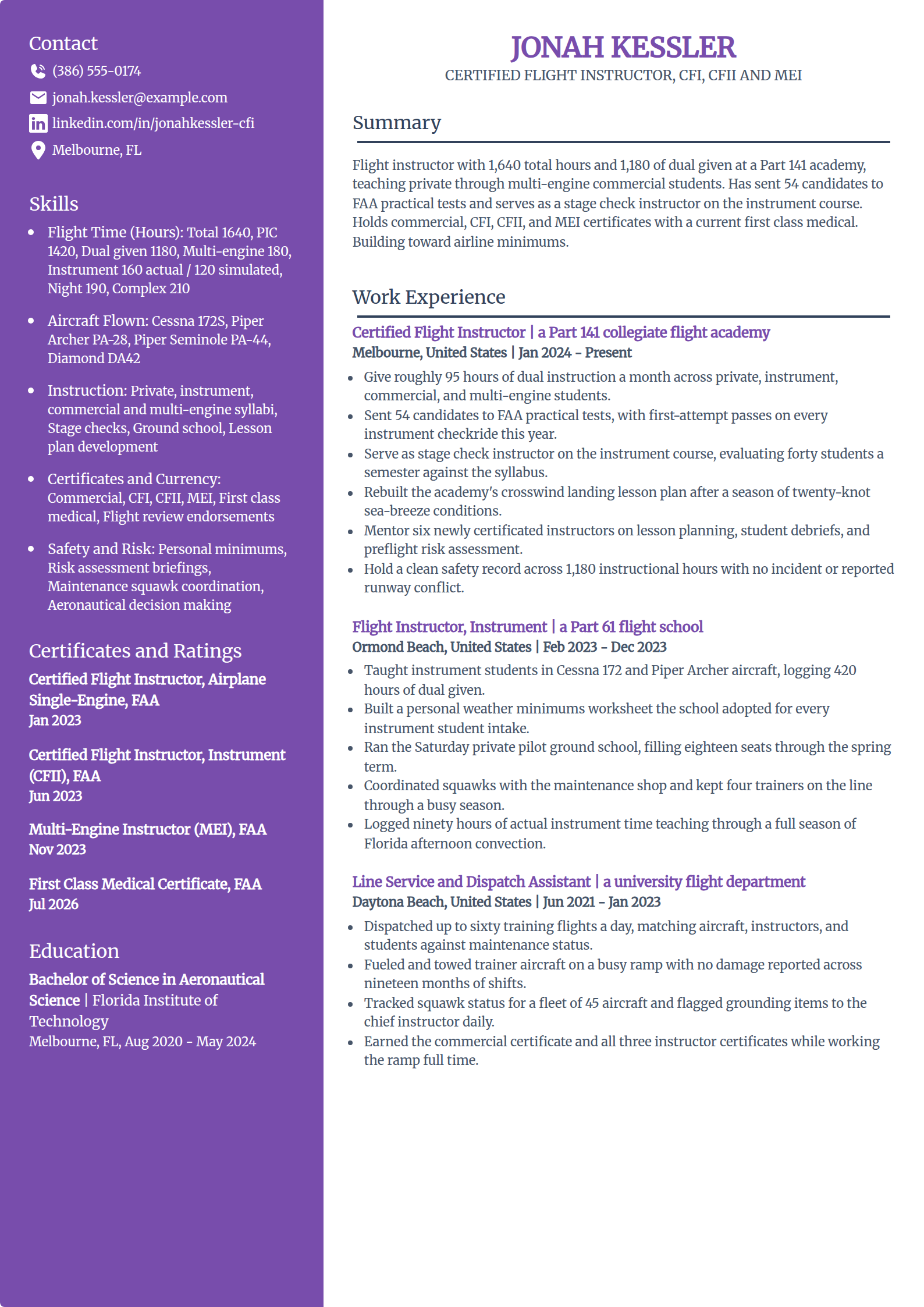
Flight Instructor Resume Template
Why this resume example works?
- Puts dual given at the top of the hours table, which is the number a flight school hires on.
- Counts student outcomes rather than lessons taught, with candidates sent to practical tests and first-attempt passes.
- Lists all three instructor certificates separately, because a school staffing an instrument course searches for the CFII.
- Shows curriculum work, a lesson plan set the academy adopted, which is what separates a senior instructor from a new one.
- Keeps the pre-instructing ramp and dispatch job, which explains how the ratings were paid for and shows operational awareness.
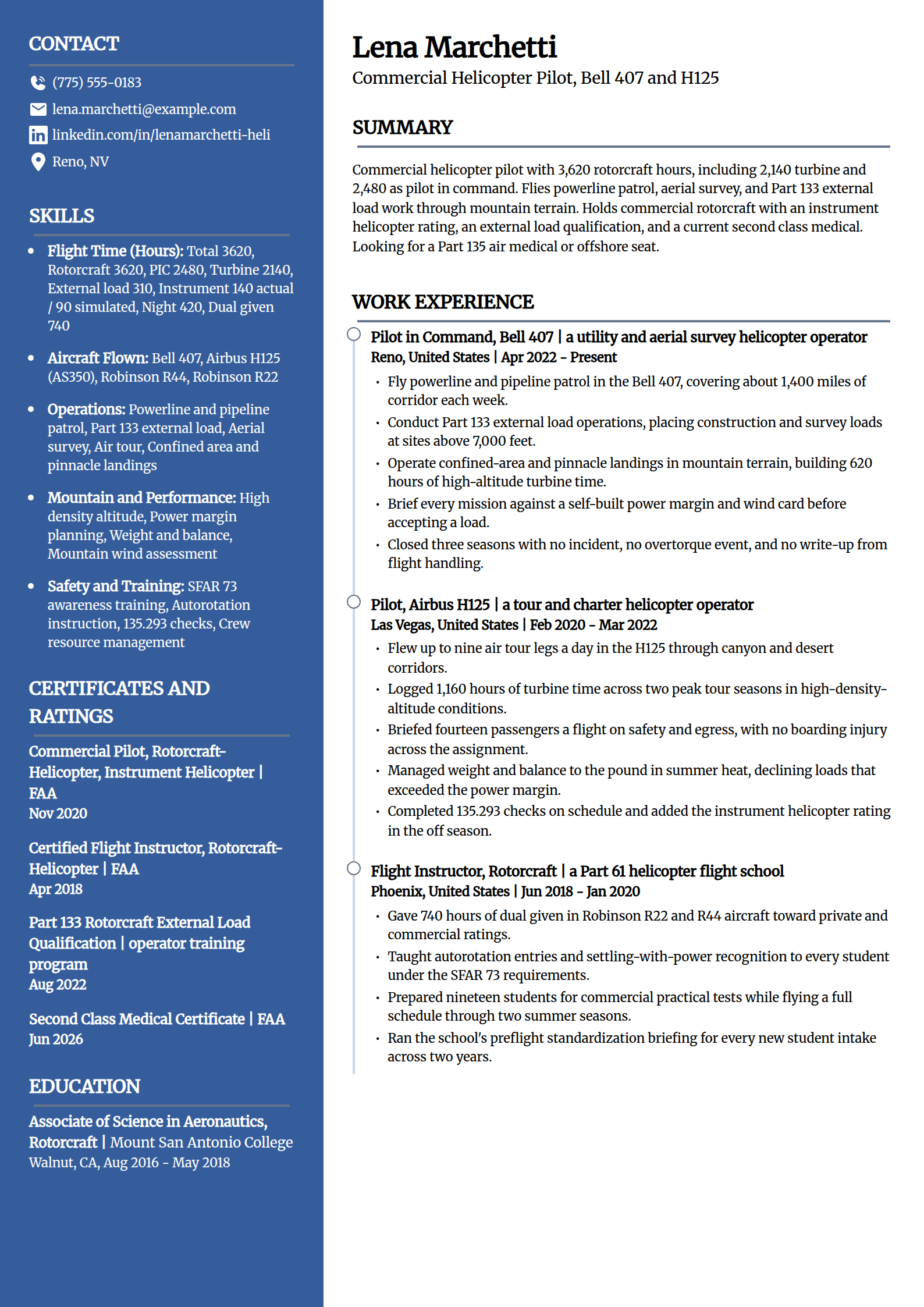
Helicopter Pilot Resume Template
Why this resume example works?
- Uses rotorcraft hour categories rather than airplane ones, with turbine and external load broken out separately.
- Names the regulation the external load work happens under, Part 133, which is how a utility operator filters applicants.
- Shows mountain and confined-area flying as specific tasks, not as a claim about handling difficult conditions.
- Lists the SFAR 73 awareness training, which anyone who has instructed in Robinson aircraft will expect to see.
- Points the resume at the next job openly, air medical or offshore, so the reader knows which pile it belongs in.
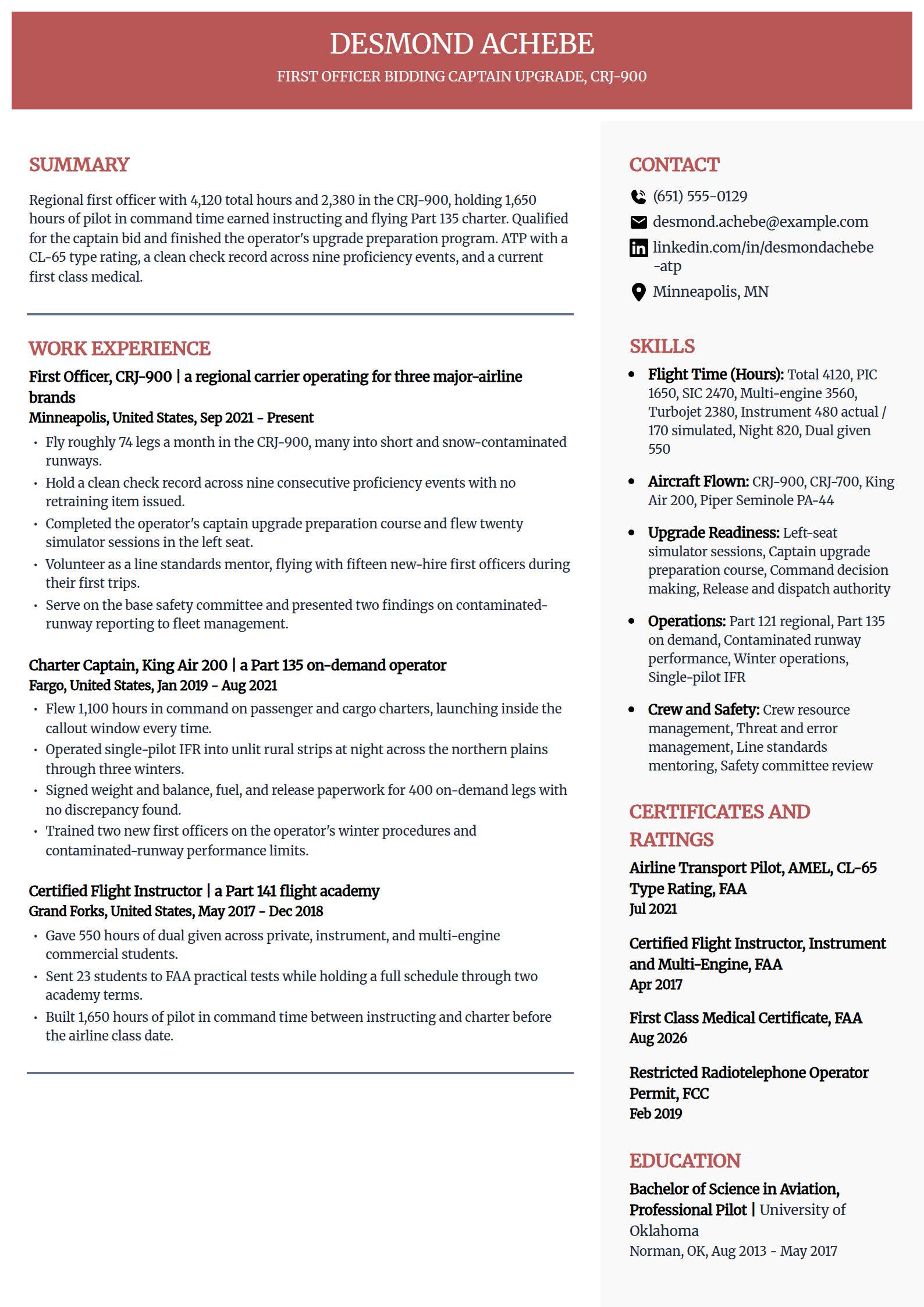
Captain Upgrade Resume Template
Why this resume example works?
- Leads with pilot in command time, not total time, because that is the number an upgrade board weighs.
- Explains where the PIC time came from, instructing and Part 135 charter, so the figure holds up to a question.
- Puts the clean check record across nine proficiency events in writing, which is the quiet requirement for an upgrade.
- Shows left-seat preparation concretely, with the upgrade course finished and simulator sessions flown.
- Adds line standards mentoring and safety committee work, the two things that mark a first officer already acting like a captain.
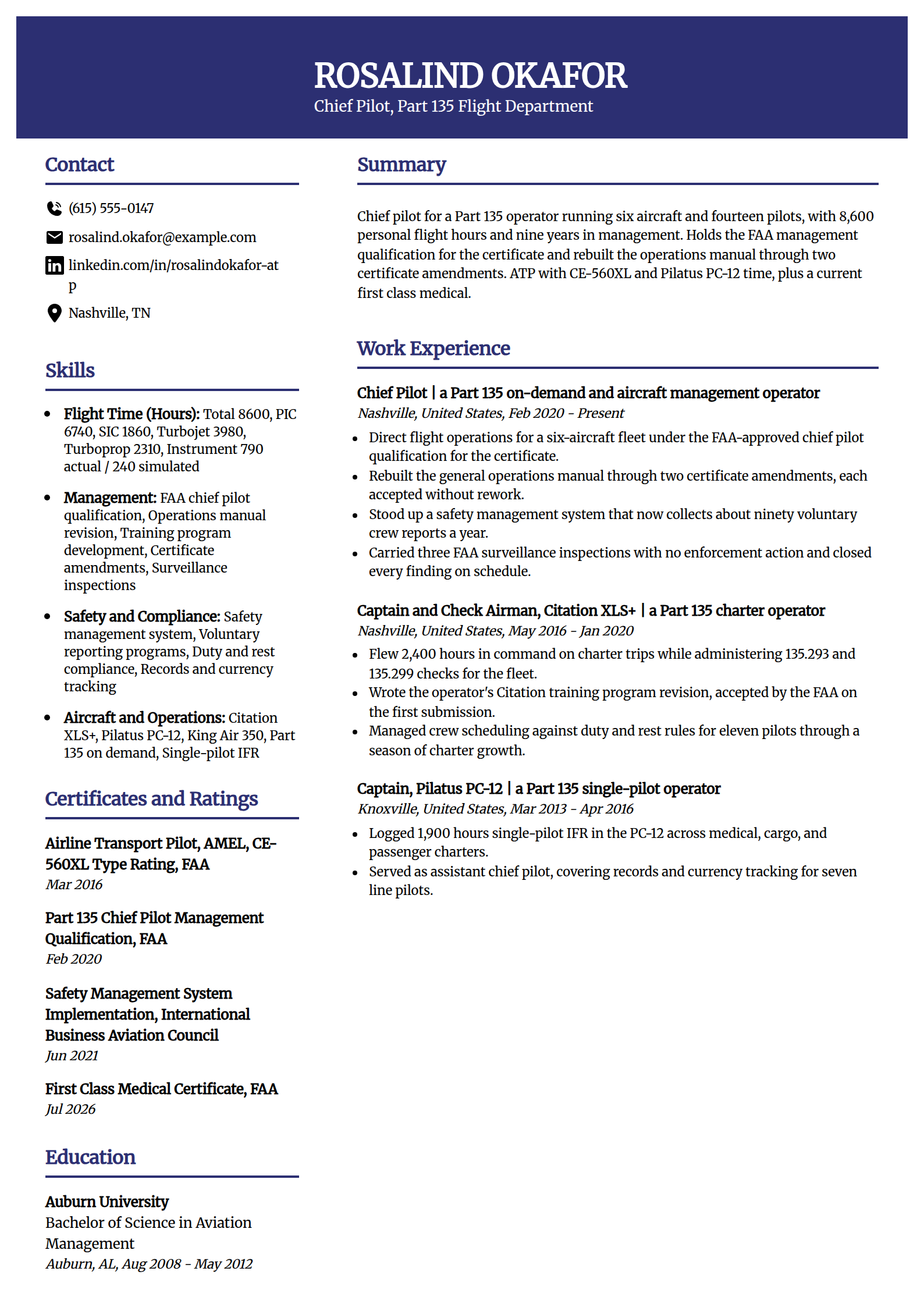
Chief Pilot Resume Template
Why this resume example works?
- Names the FAA management qualification for the certificate, which is the line that makes this a management resume.
- Reports regulatory outcomes rather than duties: amendments accepted without rework and inspections closed with no action.
- Keeps a full hours table, because a chief pilot who no longer flies much still gets screened on currency.
- Shows the safety management system being stood up and the reporting volume it produced, not just that one exists.
- Covers crew scheduling against duty and rest rules, the compliance task that occupies most of the job.
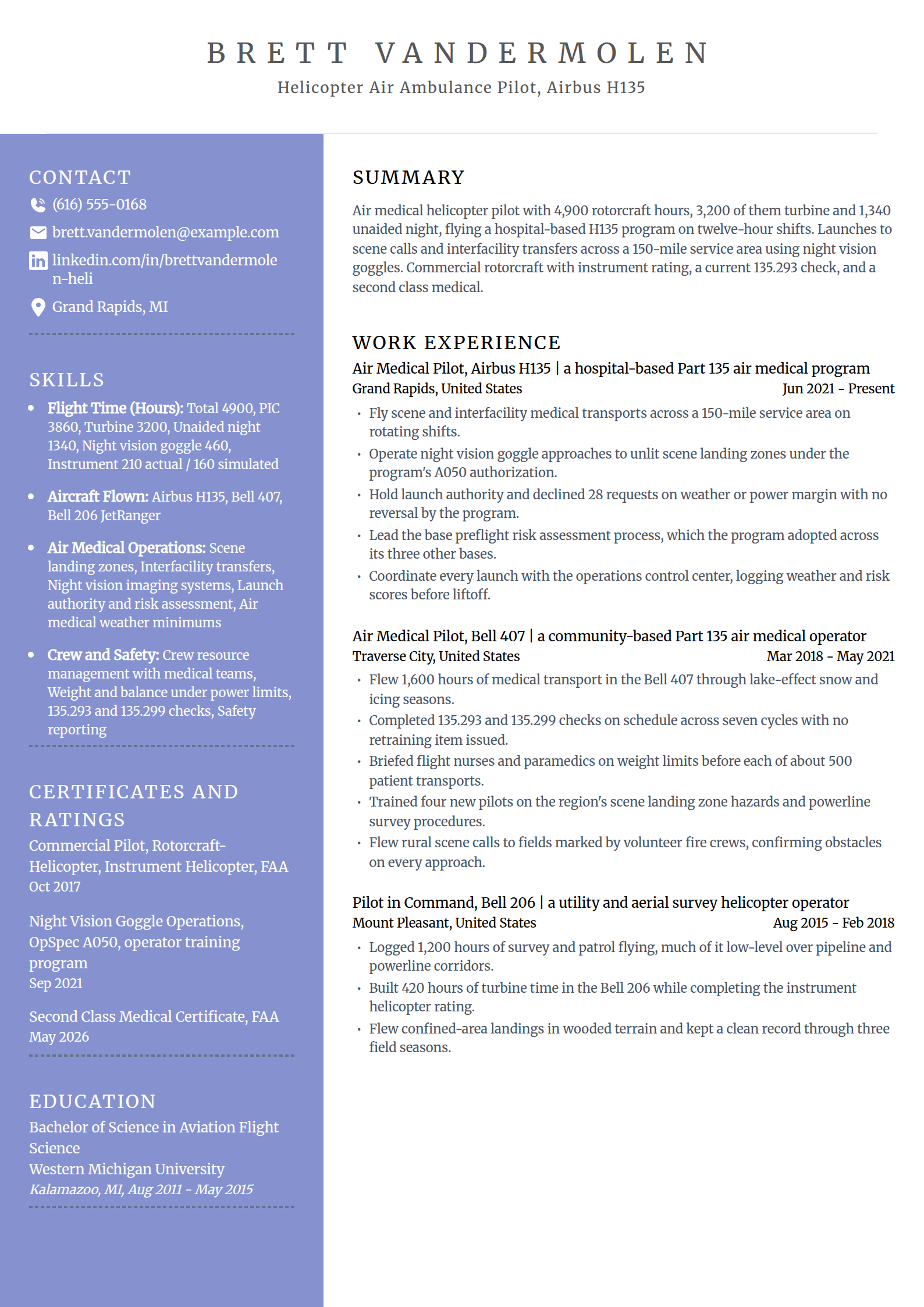
Air Ambulance Pilot Resume Template
Why this resume example works?
- Breaks out unaided night and night vision goggle hours, the two categories air medical operators publish minimums for.
- Cites the goggle authorization by its operations specification, A050, which tells an operator exactly what you have flown under.
- Leads the safety record with declined launches, because an air medical program hires for the flights you do not take.
- Keeps the medical crew relationship accurate: the pilot owns the launch decision, the clinicians own patient care.
- Shows the utility and survey background that built the turbine time, which is how most air medical pilots get there.
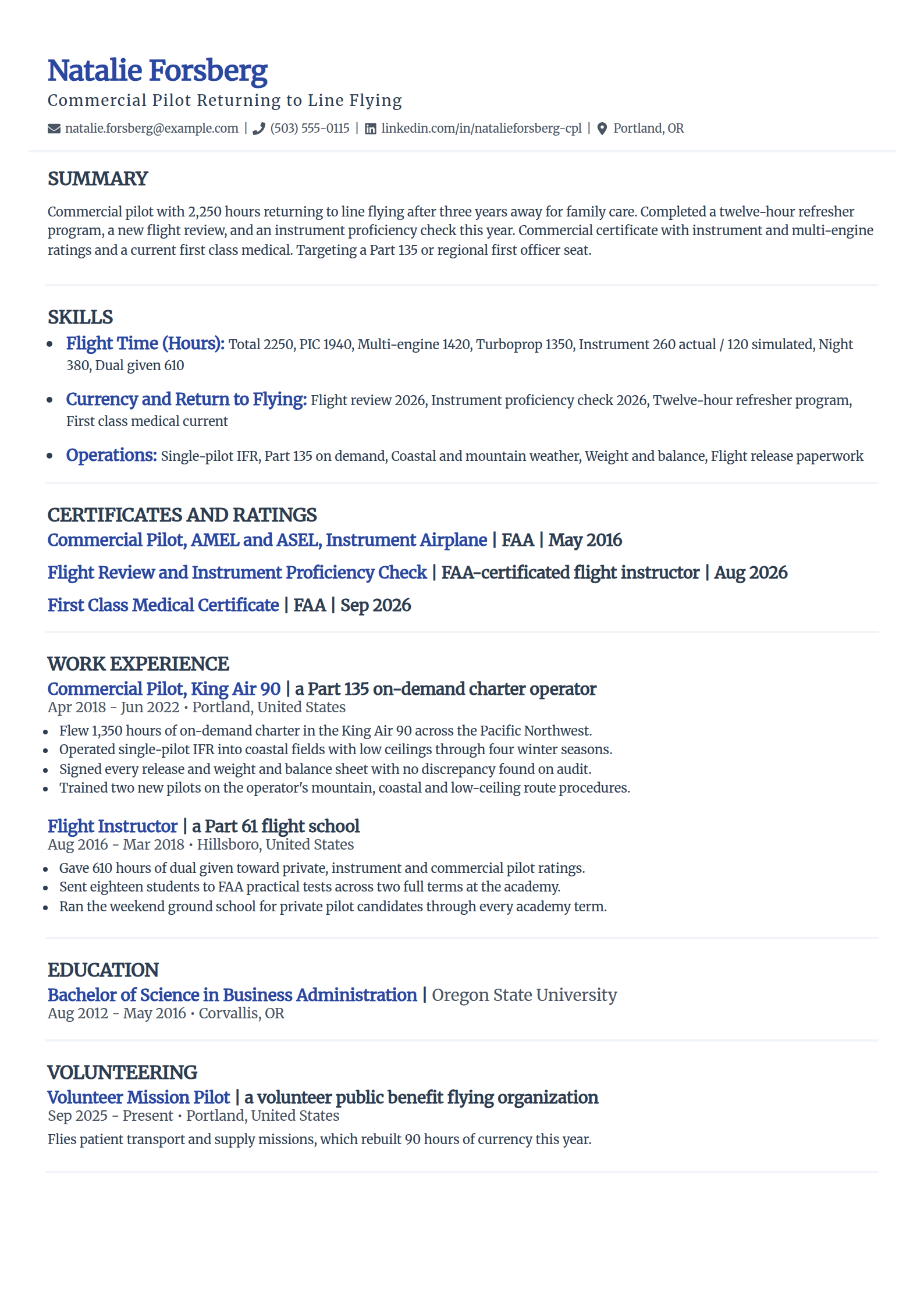
Returning Pilot Resume Template
Why this resume example works?
- Names the gap and its reason in the summary, which stops a recruiter guessing at the three-year space in the dates.
- Answers the currency question immediately with a dated flight review, instrument proficiency check, and refresher program.
- Gives the medical certificate a current date, since a lapsed medical is the first thing an operator assumes after a break.
- Uses volunteer public benefit flying to show recent hours, which is the fastest honest way back to currency.
- Keeps the pre-gap charter record intact rather than hiding it, because 1,350 hours of on-demand flying still counts.
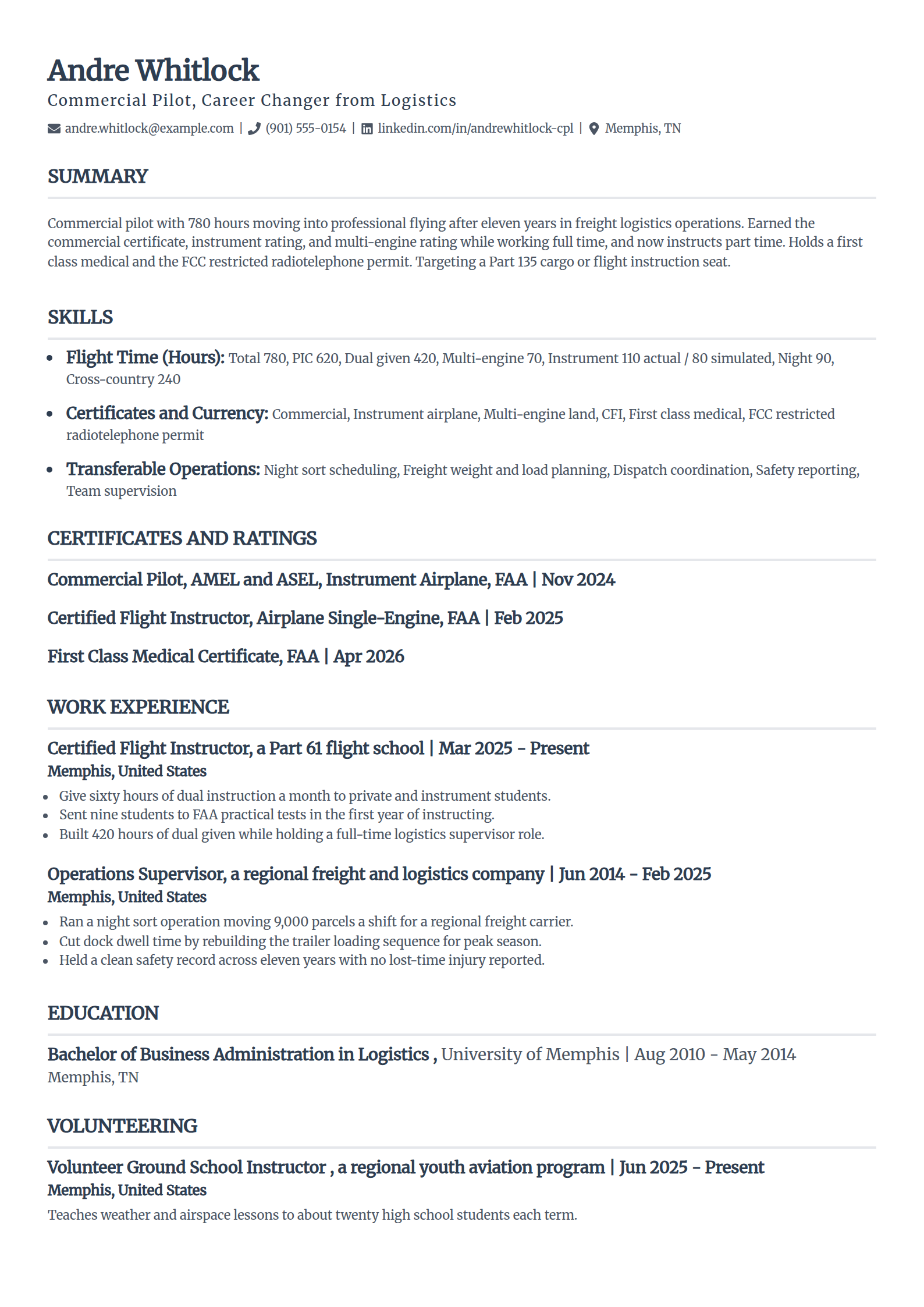
Career-Change Pilot Resume Template
Why this resume example works?
- Headlines the move as a decision, with the ratings earned while working rather than after walking away from a job.
- Puts the current instructing role above the eleven-year logistics career, so the page reads forward and not backward.
- Keeps the strongest number from the old field, a night sort moving 9,000 parcels a shift, which maps onto freight flying.
- Does not inflate a 780-hour logbook, and the hours table shows exactly where the time came from.
- Adds volunteer ground school teaching, which is credible evidence of commitment at this stage of a switch.
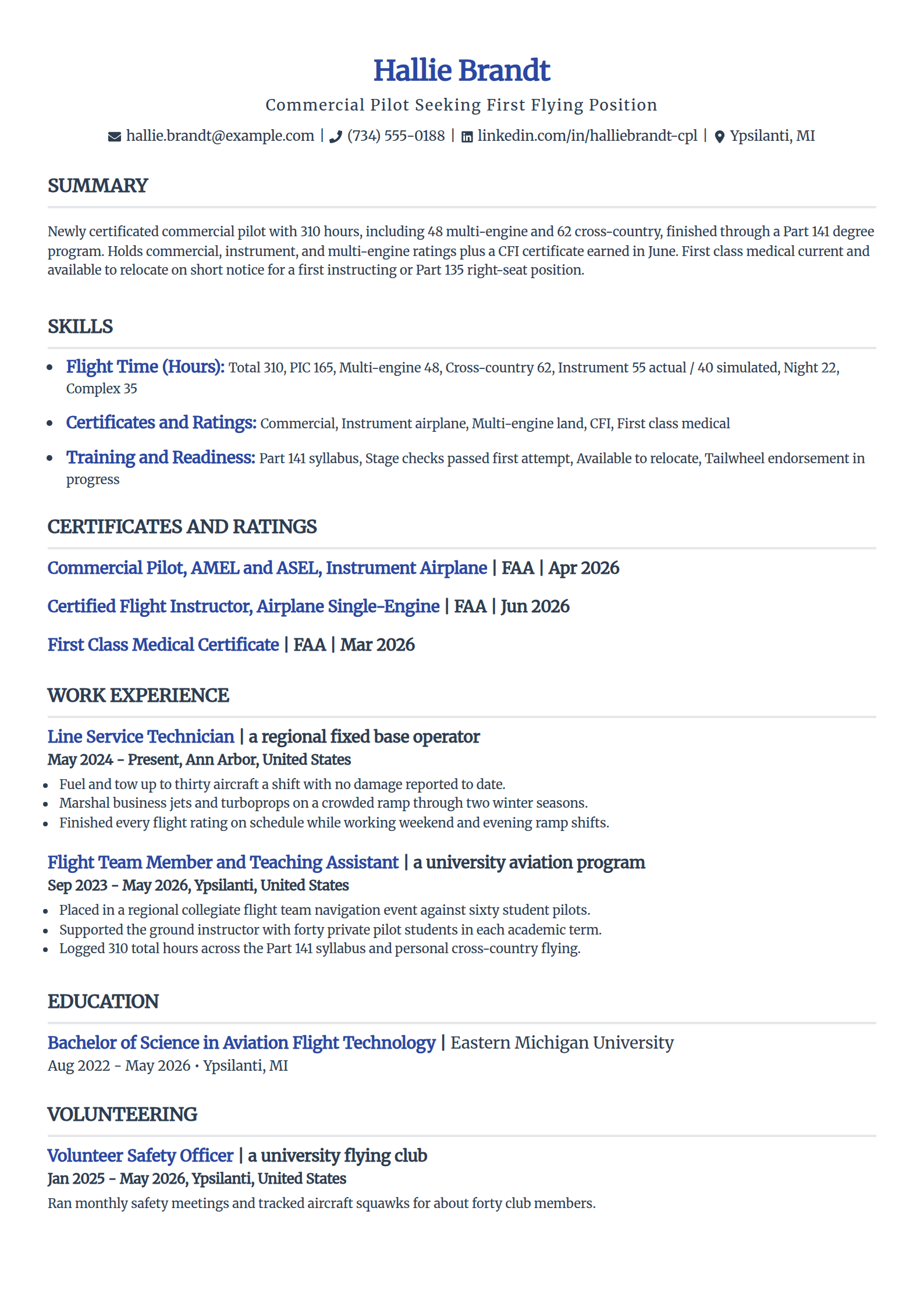
Low-Time Pilot Resume Template
Why this resume example works?
- Shows what a 310-hour logbook looks like on a page without padding it, which is the honest version of this resume.
- Breaks out multi-engine and cross-country time, the two categories a first employer checks at this level.
- Puts the CFI certificate and its date in the certificates block, since it is the qualification that makes a first job possible.
- Uses the line service job as evidence of ramp awareness instead of apologizing for it.
- States availability to relocate, which at this experience level genuinely decides who gets called.
Build your pilot resume
Pick a template above and the editor keeps the layout clean and ATS-safe while you drop in your own certificate, flight time table, and type ratings.
Build my resumeHow to write a pilot resume in 2026
Hiring for this role runs on arithmetic before it runs on judgment. A recruiter checks your hours against the posting's published minimums, confirms your certificate and medical, and only then reads a bullet. Build the page in that order.
Put the flight time table on page one
The hours block belongs directly under the summary, not at the bottom with the skills, and the certificates block sits right after it, above your work history. Every example on this page is built in that order. Break it out into the same categories the posting names so nobody has to do arithmetic to check you: total time, pilot in command, second in command, multi-engine, single-engine, turbine split into turbojet and turboprop, instrument, night, and cross-country. Add the categories your corner of the industry screens on, such as dual given for instructing, tailwheel and application time for ag work, or unaided night and goggle time for air medical.
Total 4,120 | PIC 1,650 | SIC 2,470 | Multi-engine 3,560 | Turbojet 2,380 | Instrument 480 actual / 170 simulated | Night 820
Use exact logbook figures and keep simulator time out of aircraft totals
Employers verify these numbers against your logbook, which makes this the one resume where guessing has a real consequence. Four rules:
- Take every figure from your logbook or logging program on the day you write the resume, and never estimate.
- Avoid suspiciously round totals. A line reading 1,500 even invites the question your logbook then has to answer.
- Keep simulator, flight training device, and LOFT time out of aircraft totals, and show instrument time as actual and simulated separately.
- Update the figures for every application rather than carrying forward last month's numbers.
Write a summary that names the certificate, the time and the seat
Three to four sentences. The first carries your certificate level, total time, and what you fly now. The second carries the strongest operational fact about the flying, such as the route structure, the aircraft, or the conditions. The third carries your type ratings and medical class. The fourth says what you are going after, which is the one place a pilot resume should state a target.
Regional first officer with 2,610 total hours and 1,180 in the Embraer 175, flying a Midwest base on a fifteen-day line. Came up the restricted ATP route on a qualifying bachelor's at 1,000 hours after 980 hours of dual given. Restricted privileges removed at 1,500 hours; now holds an ATP with an EMB-170 type rating and a first class medical.
List certificates, ratings and currency the way a recruiter checks them
This block is a checklist, so write it as one. Each line gets its issuer and its date, because a date is what turns a claim into something verifiable:
- Pilot certificate and level, with category and class, such as airline transport pilot, airplane multi-engine land.
- Type ratings written as the certificate shows them, such as B737, A320, CL-65, EMB-170 or CE-560XL.
- Instructor certificates separately, since CFI, CFII and MEI are searched as different terms.
- Medical certificate class and date, which an operator treats as a condition of the offer, not a detail.
- The extras that gate specific jobs: FCC restricted radiotelephone permit, passport, state applicator license, goggle authorization, Part 133 or Part 137 qualification.
Write employment bullets about the operation, not the aircraft
The aircraft is already in your job title and your hours table, so the bullets should carry what the flying actually involved: the schedule, the route structure, the conditions, the checks you hold, and what you fixed or taught. Lead each one with a verb and attach one number that a chief pilot could picture, such as legs a month, acres a season, loads a week, or students sent to a practical test. Browse the full set of ATS-friendly layouts on the resume templates hub if none of the sixteen above is your style.
Keep it to one page
One page covers almost every pilot resume, and the aviation side of the industry is more insistent about this than any other field. If you are running out of room, cut the oldest entries to two or three bullets and drop pre-aviation jobs that no longer prove anything, rather than shrinking the font or dropping the hours table. Every example on this page is one page, including a captain with 14,200 hours and seventeen years in.
Common pilot resume mistakes
- Rounding or estimating hours. Employers check these figures against your logbook, so a tidy 2,500 that turns out to be 2,418 costs you the credibility of every other number on the page.
- Folding simulator time into aircraft totals. Keep training device and LOFT time out of the aircraft columns, and show instrument time as actual and simulated separately.
- Burying the flight time table at the bottom. It is the first thing screened, so it belongs under the summary, not in a skills block below the work history.
- Leaving out the medical class and date. An operator reads a missing medical as a lapsed one, and the same goes for a flight review, an instrument proficiency check, or a 135.293 check after a gap.
- Writing bullets that could belong to any pilot. "Operated aircraft safely and in accordance with regulations" is the job description. Name the operation instead: the schedule you flew, the conditions, the checks you hold, the pilots you trained.
Frequently asked questions
What should a pilot resume include?
A pilot resume needs a three-to-four-sentence summary naming your certificate, total time and current seat, a flight time table near the top, a certificates and ratings block, employment in reverse-chronological order, education, and any professional training. The flight time table is what makes this different from every other resume: break your hours into total, pilot in command, second in command, multi-engine, single-engine, turbine, instrument split into actual and simulated, night and cross-country, plus the categories your part of the industry screens on. The certificates block carries your certificate level, category and class, type ratings, instructor certificates, and your medical class with its date.
How do you list flight hours on a pilot resume?
As a table or a clearly separated block on page one, broken into the same categories the posting publishes minimums for, so a recruiter can check you without doing arithmetic. Take every figure straight from your logbook or logging program on the day you apply, and use exact numbers rather than estimates or round totals, because employers verify these against your logbook. Keep instrument time split into actual and simulated, and never fold simulator, flight training device or LOFT time into aircraft totals. Add the categories that matter to your corner of the industry, such as dual given, tailwheel, external load, or unaided night.
How long should a pilot resume be?
One page. Aviation is stricter about this than most fields, and every example on this page fits on one, including a captain with 14,200 hours and seventeen years of Part 121 flying. The reason is that the screen is the hours table plus the certificates block, and both fit easily; the employment history is there to explain where the hours came from, not to list everything you have done. If you are short of room, trim the oldest entries to two or three bullets and drop pre-aviation jobs, rather than reducing the font or cutting the flight time table.
How do you write a pilot resume with no airline experience?
Lead with the certificate and the exact hours you do have, then show how you are building the rest. A 310-hour commercial pilot with a fresh CFI has a real resume: the certificates block carries commercial, instrument, multi-engine and CFI with their dates, the hours table breaks out multi-engine and cross-country, and the work history uses line service, dispatch, flight team or teaching assistant roles as evidence of operational awareness. Do not pad the logbook, because the numbers get checked. State availability to relocate, which at low time genuinely decides who gets a call.
How do military pilots write a civilian resume?
Translate the logbook first. Civilian recruiters screen on total time, pilot in command, second in command, multi-engine, turbine, instrument and night, so convert military records into those categories rather than listing sorties or mission types. Name the aircraft in plain terms, such as a C-17A, and drop unit designations and program acronyms a civilian reader will not recognize. Say which route you took to the certificate: a military pilot can qualify for a restricted ATP at 750 hours, against 1,500 for the unrestricted certificate, and completing the ATP-CTP course is what turns that into an airline class date. Keep instructor pilot and evaluation work, which is the military experience airlines value most.
Do you put simulator hours on a pilot resume?
Not inside your aircraft totals, ever. Simulator, flight training device and LOFT time are logged separately from aircraft time, and merging them is the error that ends an application in this industry, because employers verify the totals against your logbook. Instrument time is the one place the distinction shows on the page: write it as actual and simulated, for example 480 actual and 170 simulated, so the reader can see exactly what you flew in the aircraft. If you want simulator time on the resume at all, give it its own labeled line.
More pilot resume resources
Build your pilot resume
Pick a template above and the editor keeps the layout clean and ATS-safe while you drop in your own certificate, flight time table, and type ratings.