What an Assistant Manager Resume Has to Prove: 16 Templates and Examples
- ATS Friendly
- 16 Settings and Levels
- Scope-First Examples
An assistant manager resume example should answer one question a hiring manager has before any other: what happens on your shift when the manager is not there. That means your setting, the headcount you supervise, the shifts you cover, and the numbers you own, in the first three lines. Pick a layout below, then model your own on the example built for your setting, from a retail floor to a restaurant, hotel, warehouse, or gym.


540k+ resumes created
Assistant manager resume templates by setting and route in
Each template below is a real assistant manager resume laid out in that format, one per setting across retail, big-box stores, restaurants, quick service, hotels, grocery, warehouses, gyms, convenience stores, bank branches, multi-department venues, and the customer service desk. The last four cover the routes in: no prior management title, a promotion from within, a part-time shift lead going full time, and an assistant manager aiming at the store manager job. Pick one, then swap in your own headcount, shifts, systems, and numbers.
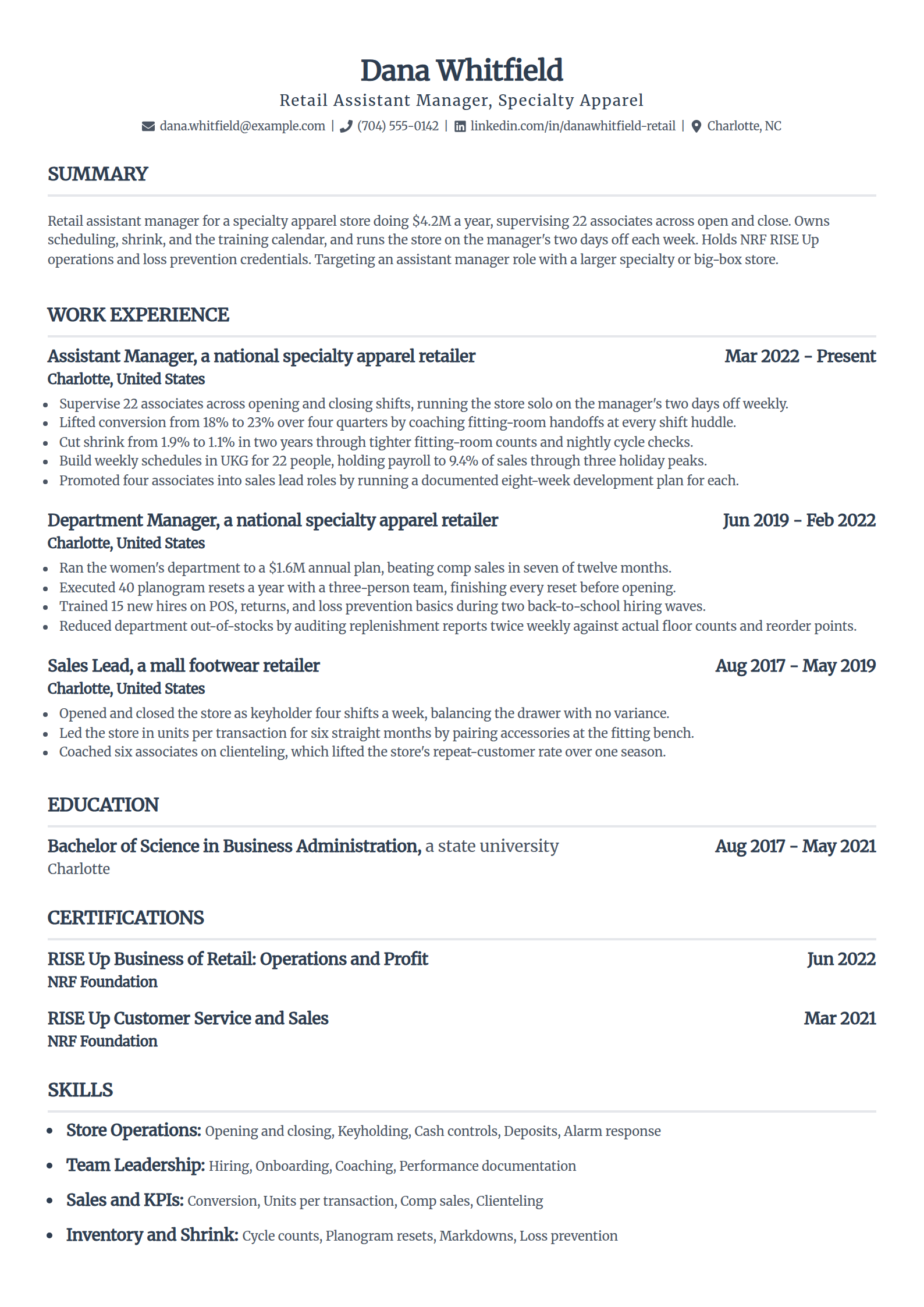
Retail Assistant Manager Resume Template
Why this resume example works?
- Opens with scope a hiring manager can picture: a $4.2M store, 22 associates, and the manager's two days off each week.
- Attaches a number to the work rather than the title, like conversion moving from 18% to 23% over four quarters.
- Names the systems a posting screens for, UKG scheduling and the store's POS, instead of listing soft skills.
- Shows the promotion path in the job titles themselves, sales lead to department manager to assistant manager.
- Keeps a clean single-column layout that an applicant tracking system reads without trouble.
Assistant Store Manager Resume Template
Why this resume example works?
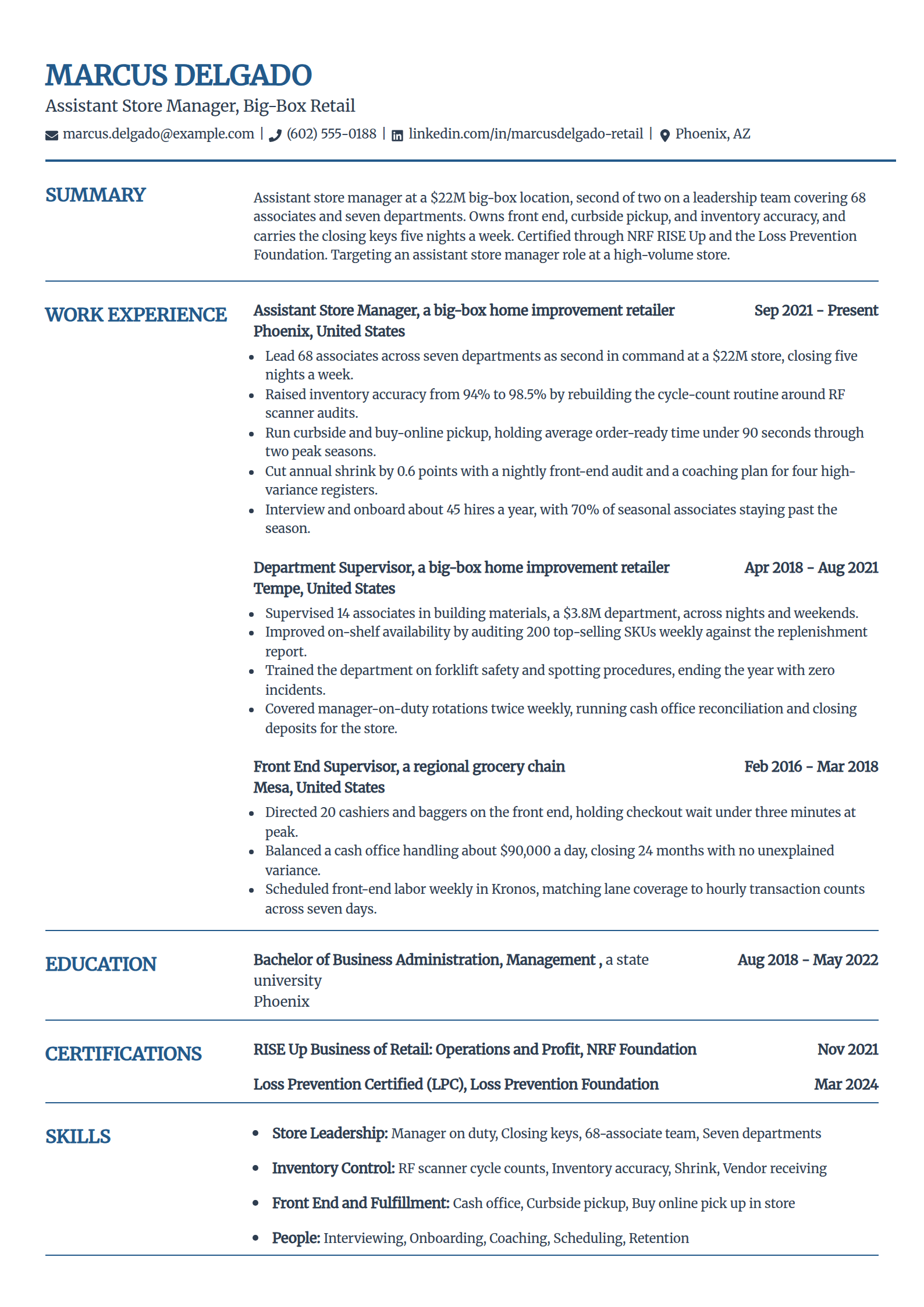
- States the second-in-command position outright: second of two leaders over 68 associates and seven departments.
- Proves operational ownership with inventory accuracy moving from 94% to 98.5% on a rebuilt cycle-count routine.
- Covers the fulfillment work big-box stores now hire for, curbside and buy-online-pickup order times.
- Names a real credential rather than a vague claim, Loss Prevention Certified through the Loss Prevention Foundation.
- Uses a modern two-tone layout that still keeps headings and dates easy for a parser to read.
Restaurant Assistant Manager Resume Template
Why this resume example works?
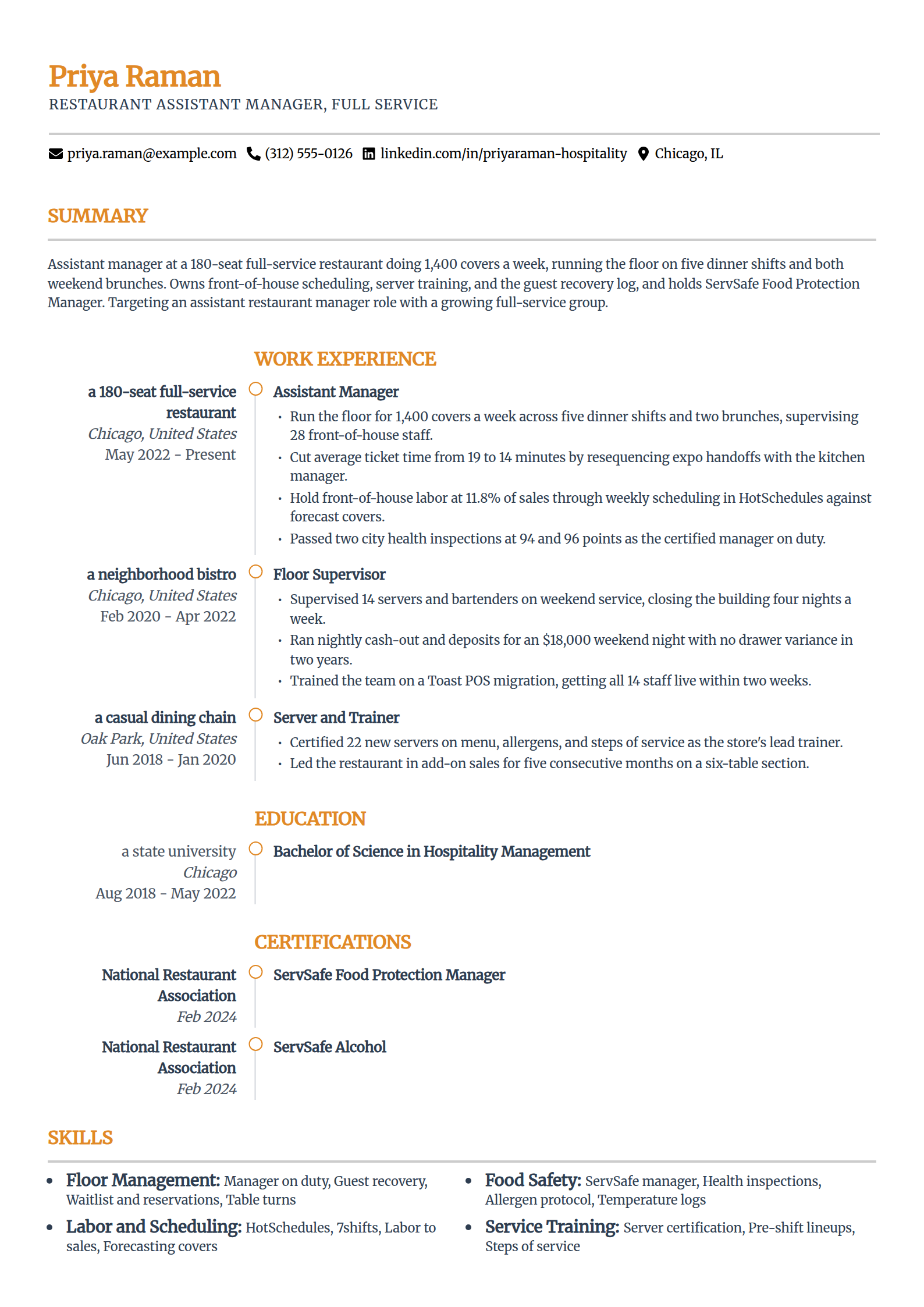
- Leads with covers and shifts, 1,400 covers a week across five dinner services and two brunches.
- Puts the certification that decides the shortlist up top, ServSafe Food Protection Manager.
- Shows both halves of the job, ticket time cut from 19 to 14 minutes and labor held at 11.8% of sales.
- Names the scheduling and POS stack a restaurant posting lists, HotSchedules, Toast, and MICROS Simphony.
- Keeps front-of-house results concrete, including two health inspections passed as the manager on duty.
Fast Food and QSR Assistant Manager Resume Template
Why this resume example works?
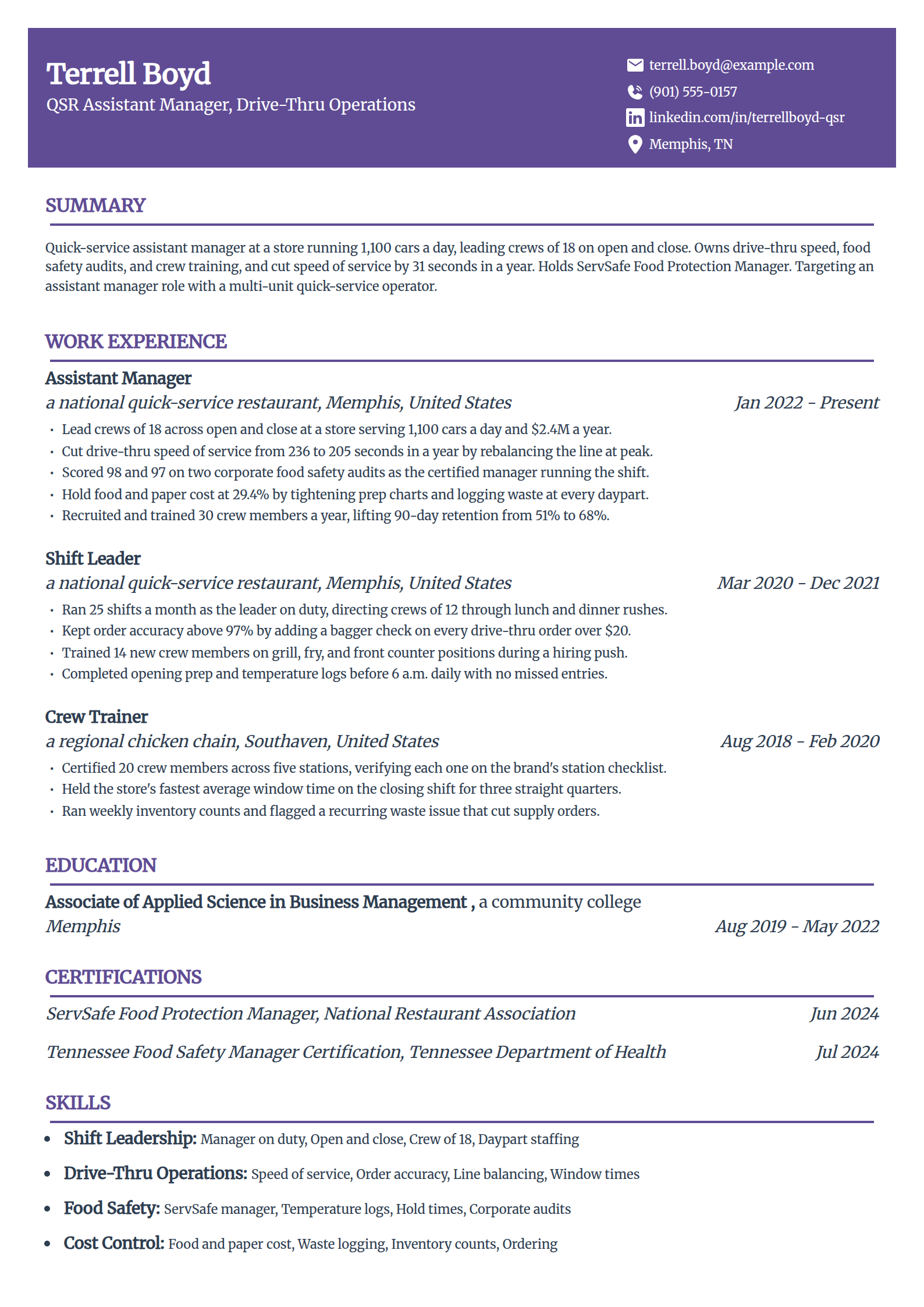
- Measures the job the way a quick-service operator does, 1,100 cars a day and speed of service in seconds.
- Shows a drive-thru improvement that reads as real work, 236 seconds down to 205 over a year.
- Pairs food safety audit scores with the certification behind them instead of claiming both separately.
- Tracks crew retention honestly, 90-day retention up from 51% to 68% after a training change.
- Uses a roomy layout that keeps a crew-to-manager progression readable on one page.
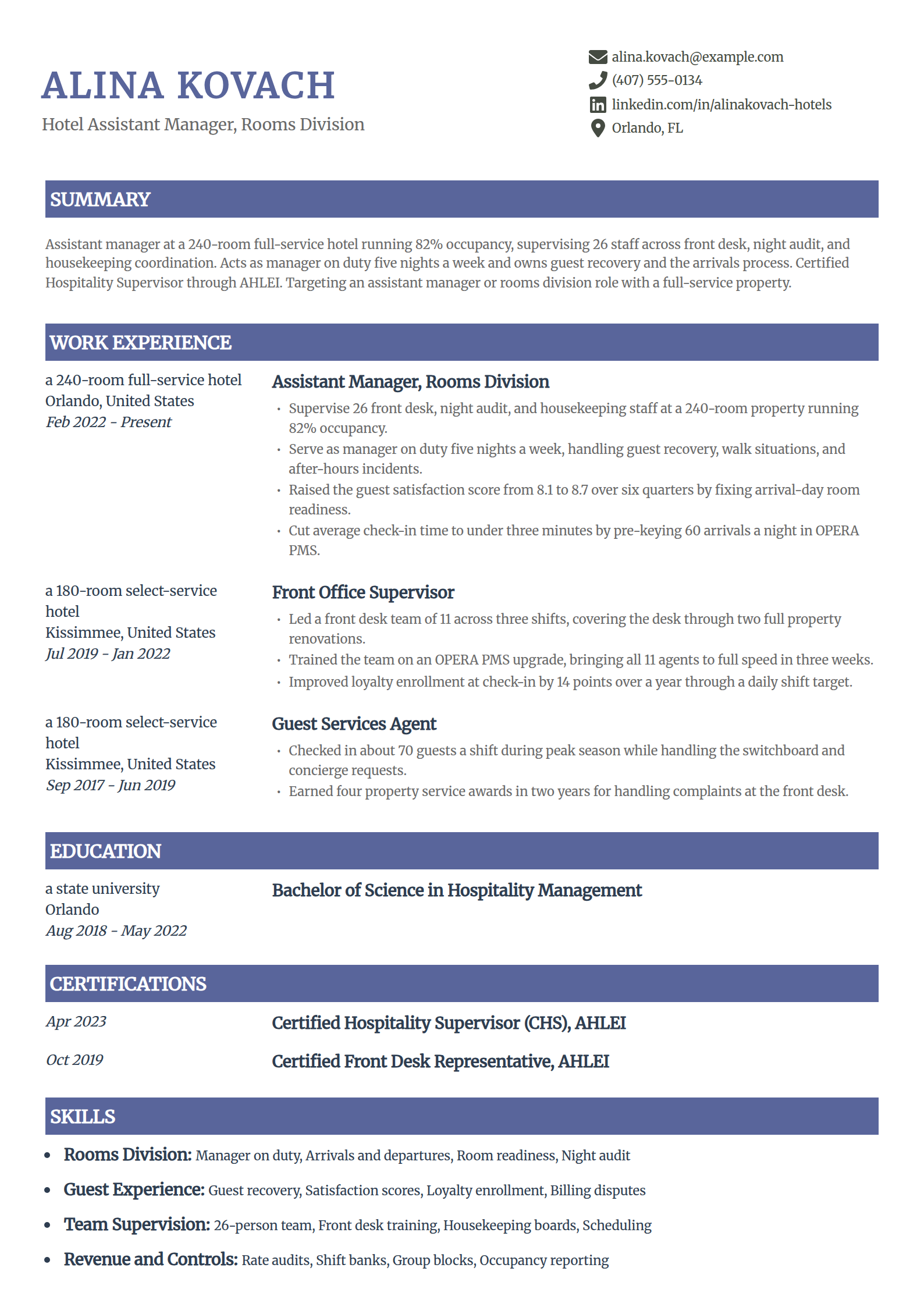
Hotel Assistant Manager Resume Template
Why this resume example works?
- Sizes the property before anything else, 240 rooms at 82% occupancy with 26 staff across three functions.
- Names manager-on-duty nights explicitly, which is the part of the job a hotel is actually hiring for.
- Ties the guest score to a cause, arrival-day room readiness, rather than claiming the score alone.
- Names the system every rooms posting lists, OPERA PMS, and the night audit work that goes with it.
- Carries a Certified Hospitality Supervisor credential from AHLEI, named exactly so a reviewer can verify it.
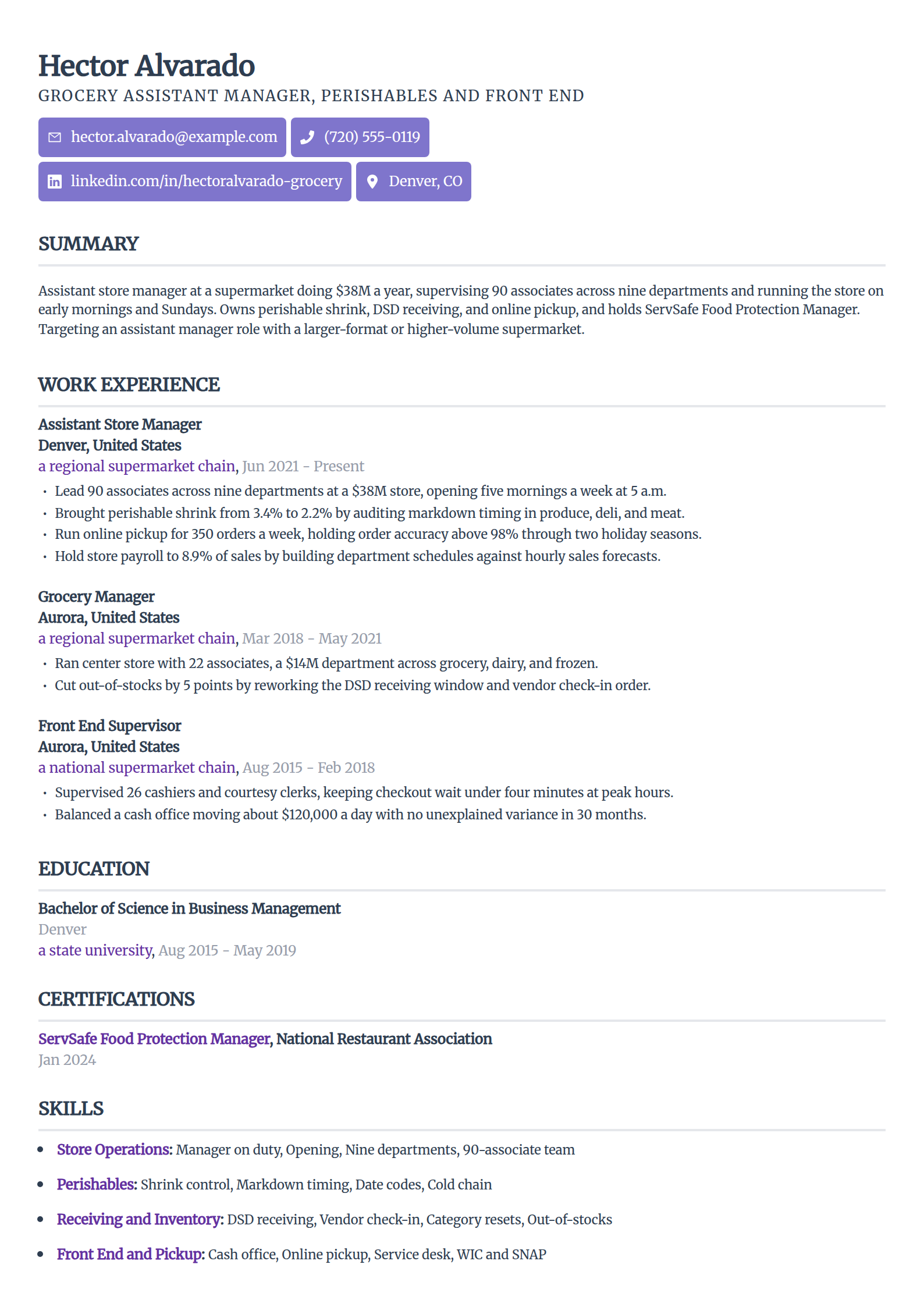
Grocery Assistant Manager Resume Template
Why this resume example works?
- Opens on store scale and shift reality, a $38M store, 90 associates, nine departments, and a 5 a.m. open.
- Leads with the number a supermarket cares most about, perishable shrink down from 3.4% to 2.2%.
- Covers online pickup volume, which is now a standard part of the assistant manager scorecard.
- Keeps the food safety claim tied to the ServSafe credential and the inspections it covers.
- Uses a structured layout that keeps nine departments and a long store record legible.
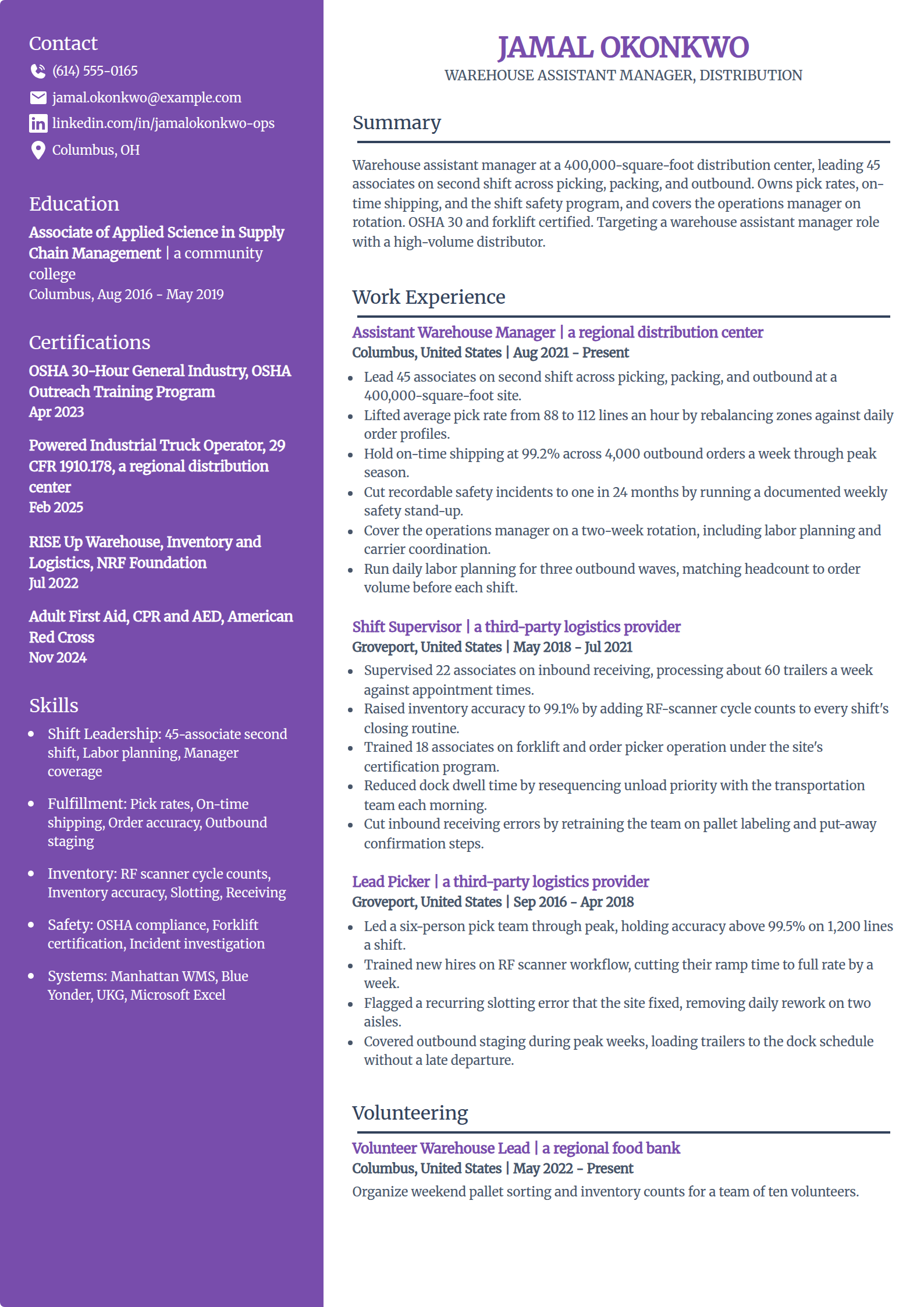
Warehouse Assistant Manager Resume Template
Why this resume example works?
- Frames the shift, not the title: 45 associates on second shift across picking, packing, and outbound.
- Uses distribution numbers a hiring manager trusts, pick rate from 88 to 112 lines an hour.
- Puts safety where it belongs for this role, one recordable incident in 24 months with the routine behind it.
- Names the WMS by vendor, Manhattan and Blue Yonder, since that is what the posting screens for.
- Shows manager coverage as a standing rotation, which is exactly what a step-up candidate needs to prove.
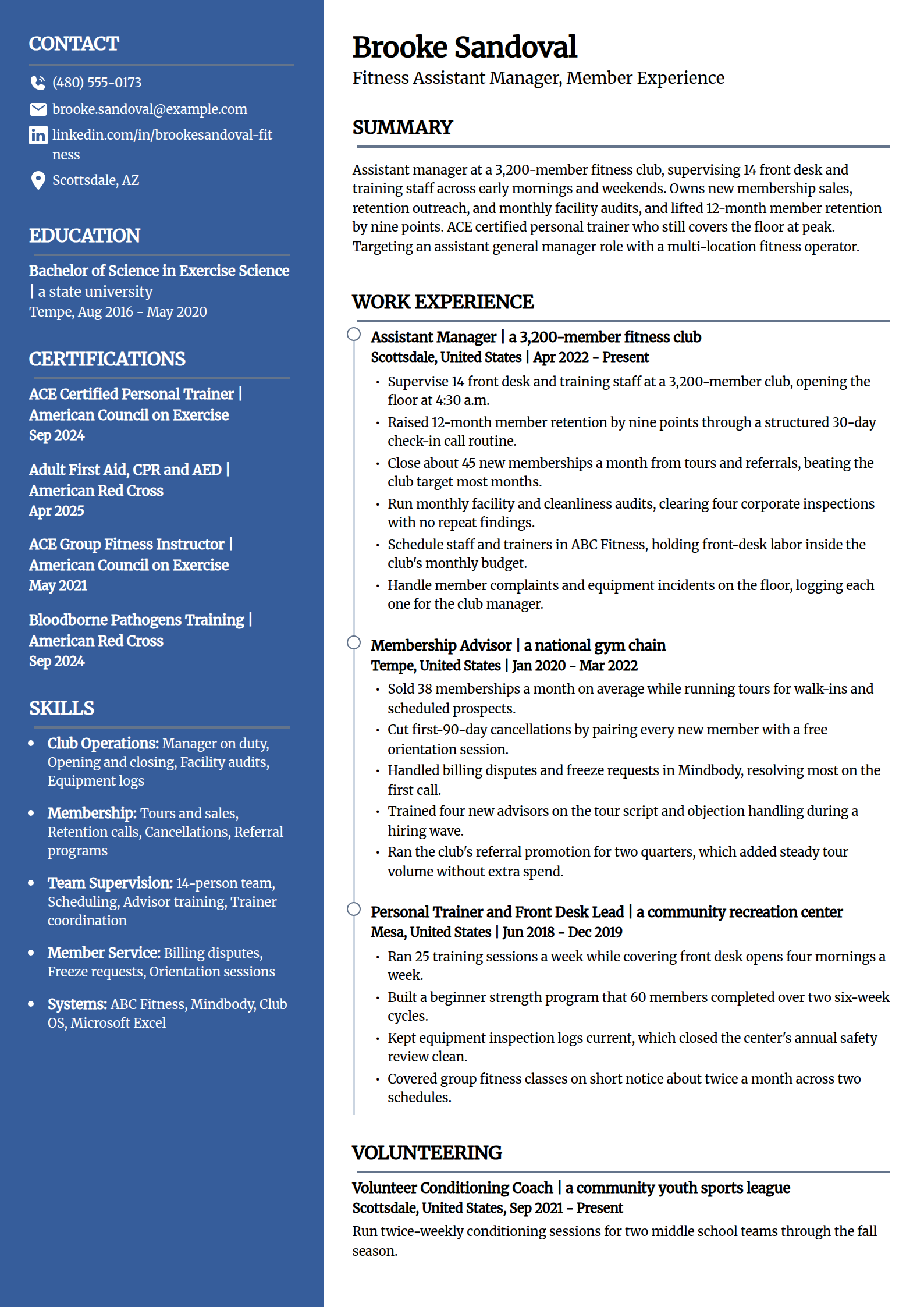
Gym Assistant Manager Resume Template
Why this resume example works?
- Sizes the club first, 3,200 members and 14 staff, then the 4:30 a.m. open that comes with the job.
- Balances the two things a club measures, retention up nine points and about 45 new memberships a month.
- Names the club systems by product, ABC Fitness and Mindbody, rather than saying gym software.
- Keeps the personal training credential in its place, real and current, without turning the resume into a trainer resume.
- Uses a visually rich layout that still separates the member-facing work from the management work.
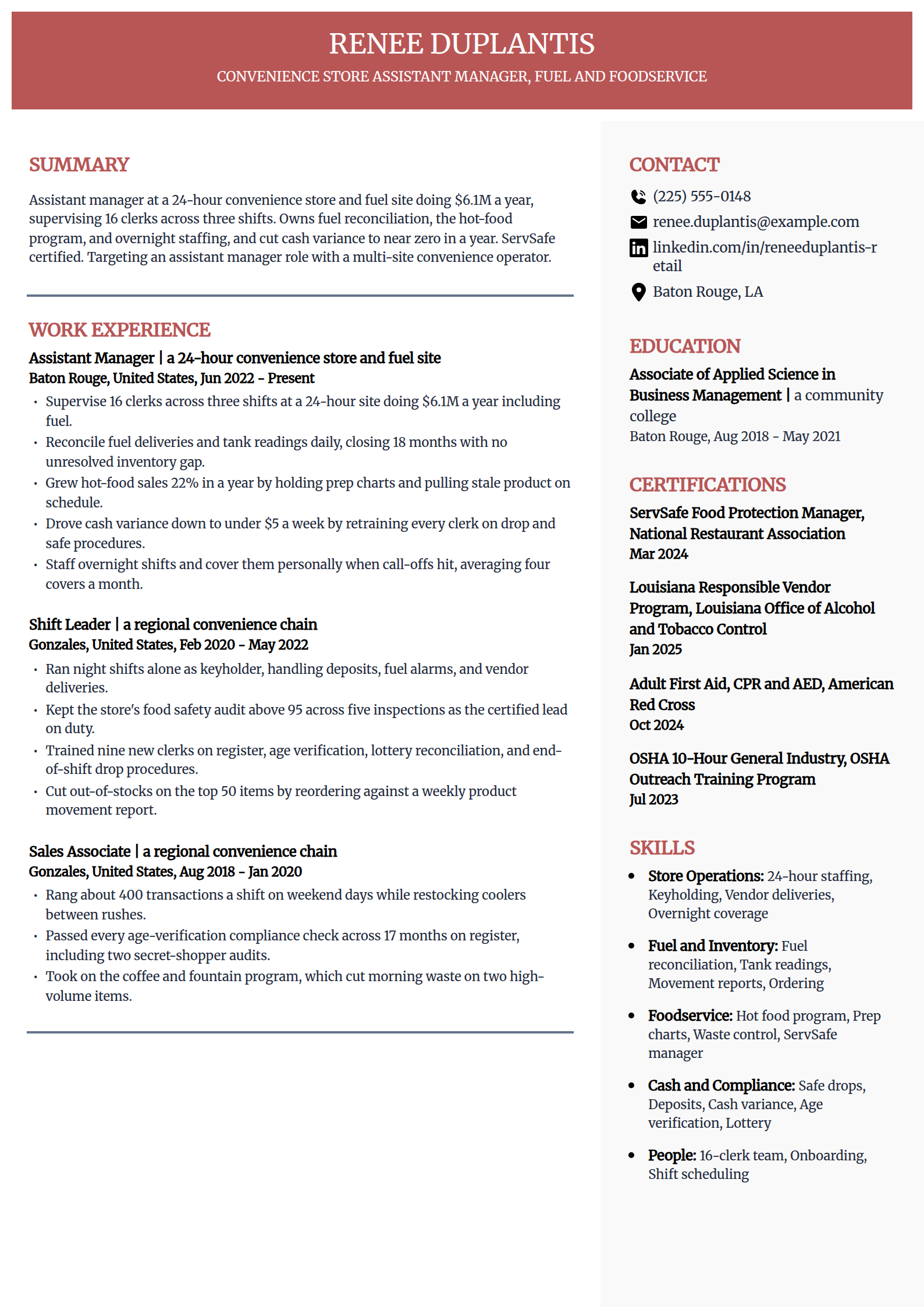
Convenience Store Assistant Manager Resume Template
Why this resume example works?
- Covers what makes this setting different, a 24-hour site, three shifts, and fuel inventory to reconcile daily.
- Uses cash accountability as the proof point, weekly variance under five dollars after retraining every clerk.
- Shows the foodservice side operators care about, hot-food sales up 22% with prep discipline behind it.
- Mentions covering overnight call-offs personally, which is a real part of the job nobody else lists.
- Keeps the compliance items a convenience posting names, age verification and the state vendor program.
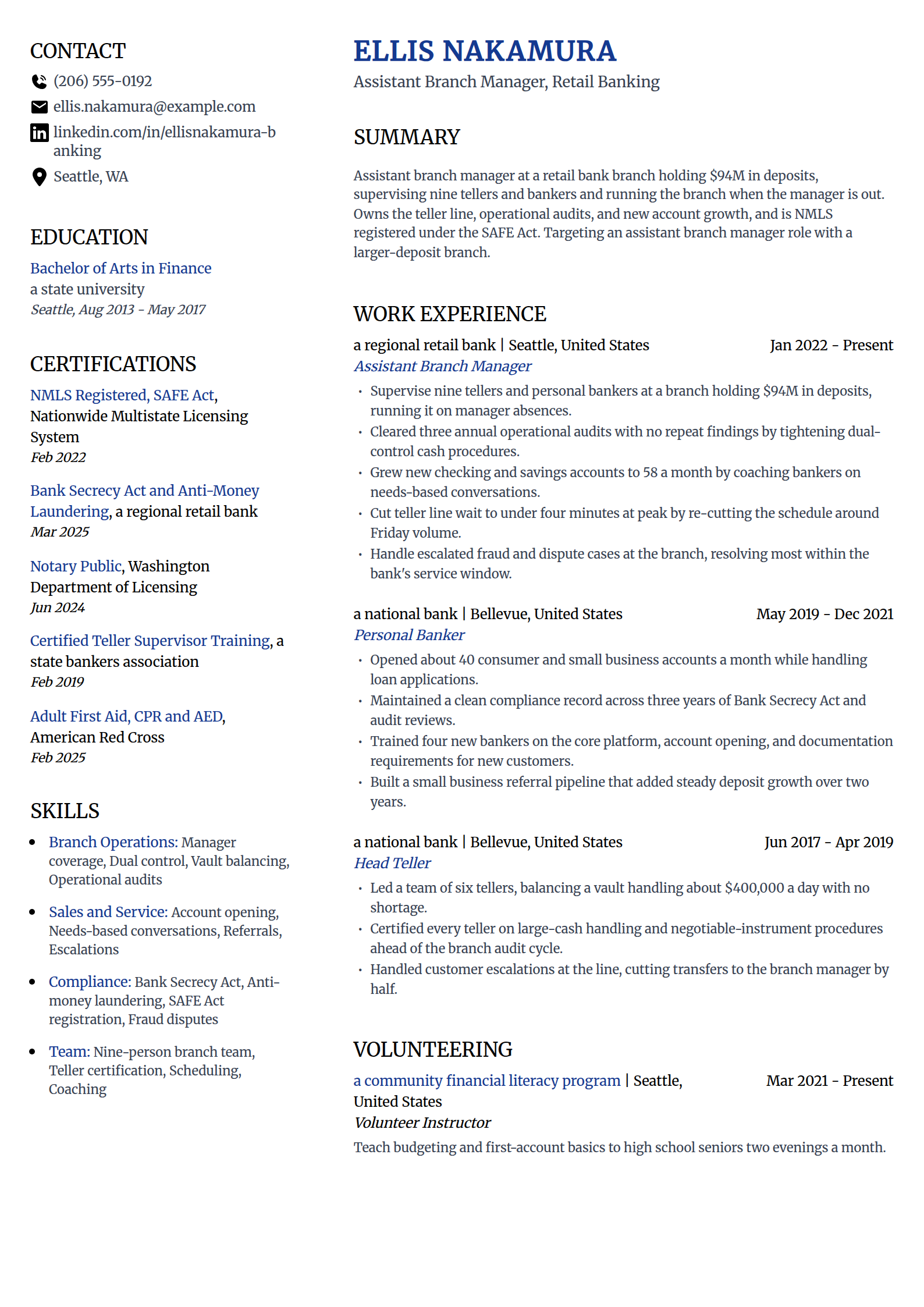
Assistant Branch Manager Resume Template
Why this resume example works?
- Sizes the branch in the only unit that matters, $94M in deposits, with nine staff supervised.
- Puts audit results first, three annual audits cleared with no repeat findings, because banking hires on controls.
- States NMLS registration under the SAFE Act plainly, since it is required to take mortgage applications.
- Shows growth alongside compliance, 58 new accounts a month, so the resume is not only operational.
- Keeps the teller-to-banker-to-assistant-manager path visible without padding the early roles.
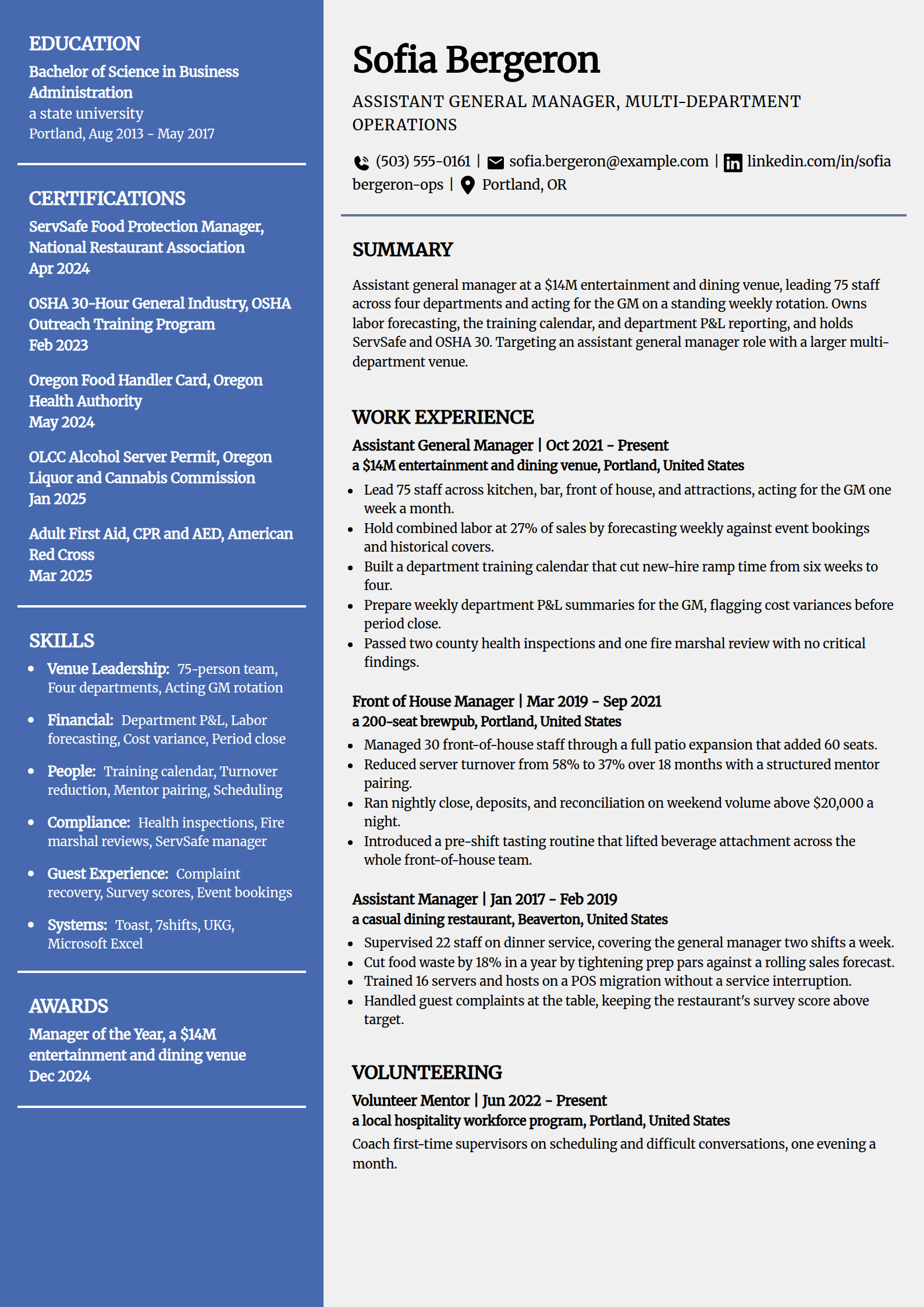
Assistant General Manager Resume Template
Why this resume example works?
- Claims the right level of ownership: 75 staff across four departments, acting for the GM one week a month.
- Names the financial work an AGM actually does, weekly department P&L summaries prepared for the GM.
- Holds a combined labor number at 27% of sales and says what produced it, forecasting against bookings.
- Shows people results with a training calendar that cut new-hire ramp time from six weeks to four.
- Fills the sidebar with a real award and a mentoring role rather than padding the experience section.
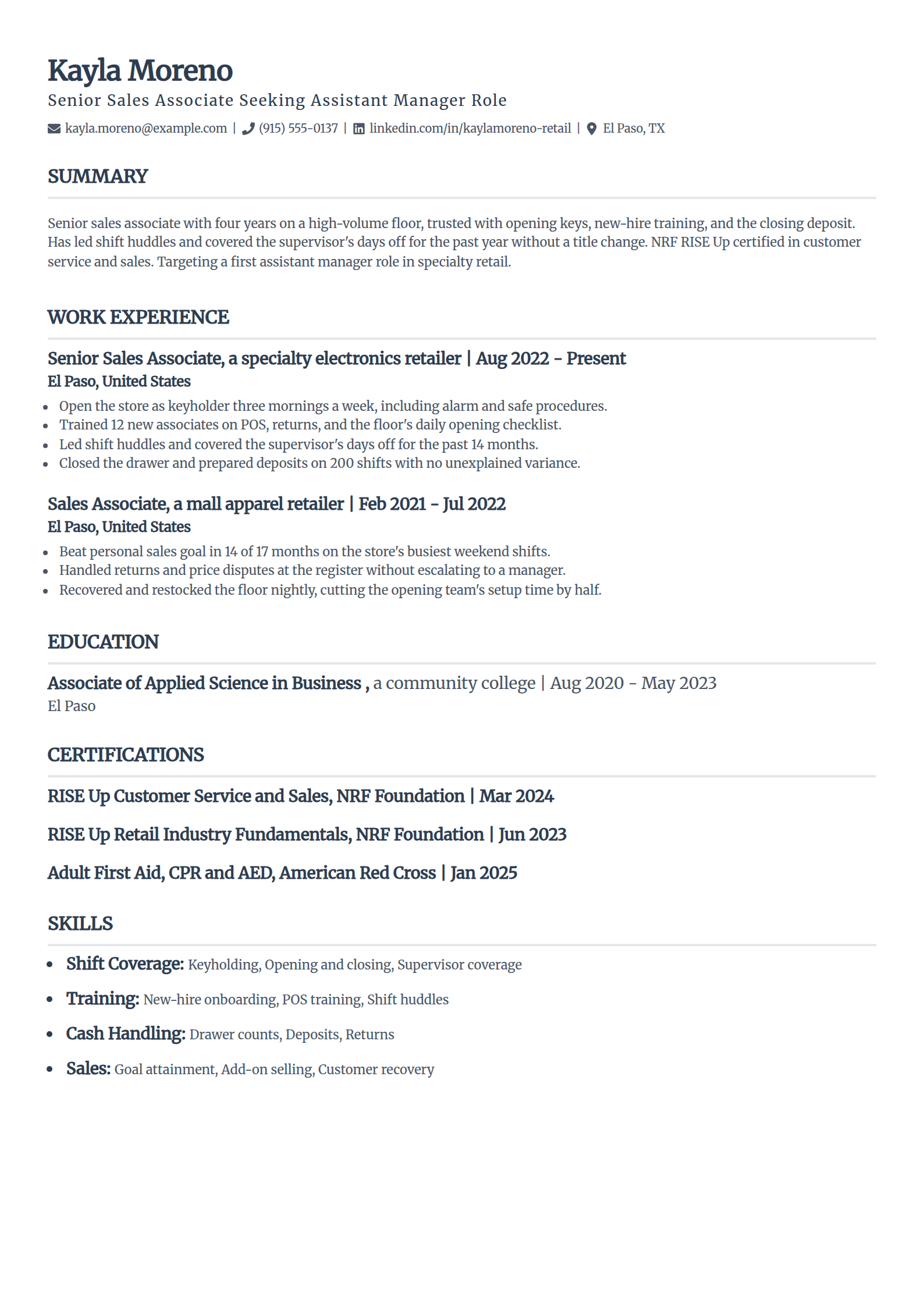
Assistant Manager Resume With No Management Experience
Why this resume example works?
- Names the supervisory work already being done without the title, keyholding, huddles, and covering days off.
- Counts what can be counted at this level, 12 associates trained and 200 shifts closed with no variance.
- Says the target outright in the summary, a first assistant manager role, so the resume has a direction.
- Uses real entry-level credentials, NRF RISE Up, instead of inflating a course into a management qualification.
- Keeps a tight, ATS-safe layout that fits a four-year record without empty space.
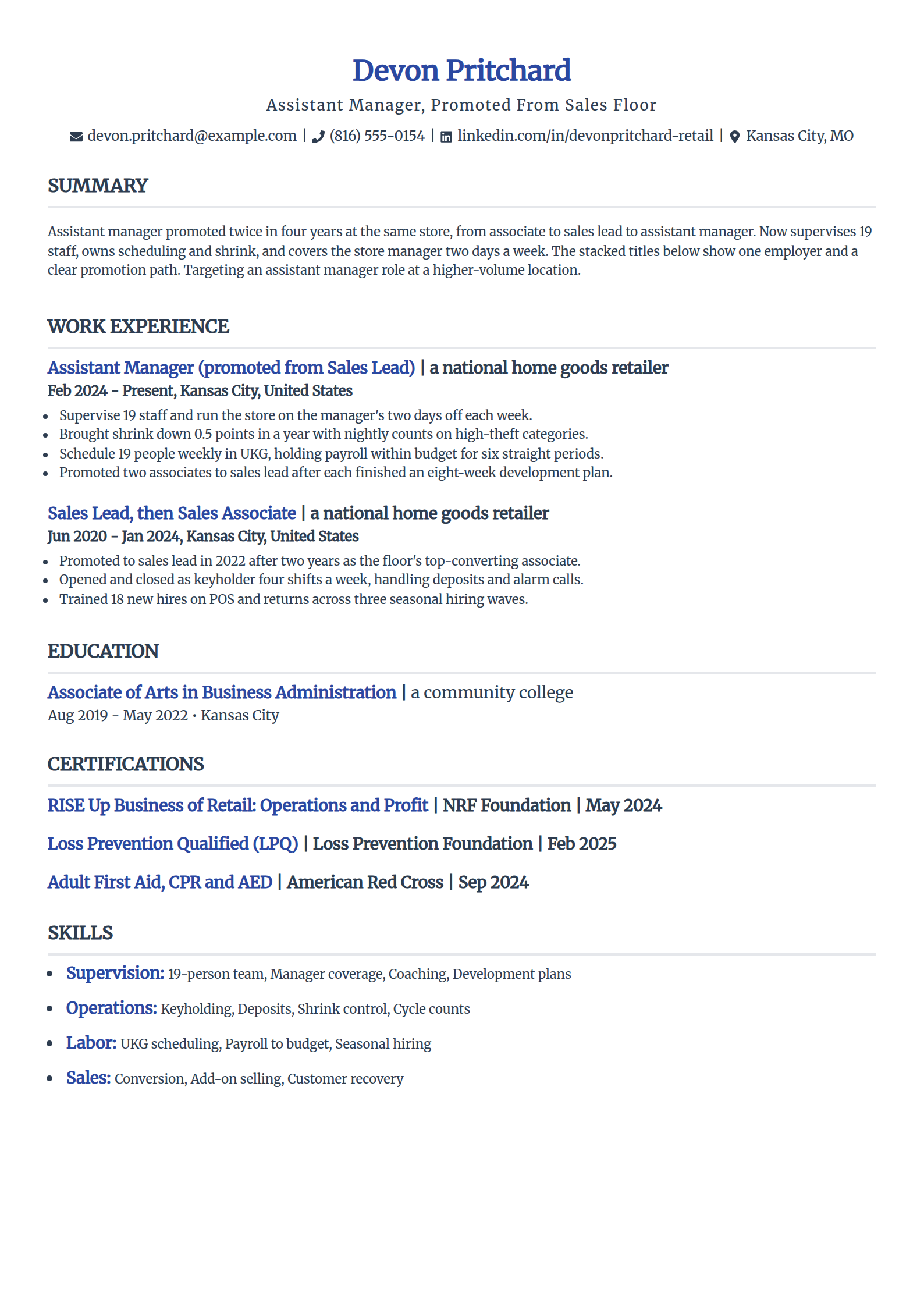
Promoted From Within Assistant Manager Resume Template
Why this resume example works?
- Stacks the titles under one employer, which is what tells a reader this person keeps getting picked.
- Dates each step so the four-year climb from associate to assistant manager is obvious at a glance.
- Keeps the earlier roles short and the current one detailed, so the page weights the right work.
- Shows a manager-level result, shrink down half a point, rather than repeating the old associate duties.
- Uses a plain layout that keeps the promotion path readable in a parser and on a phone.
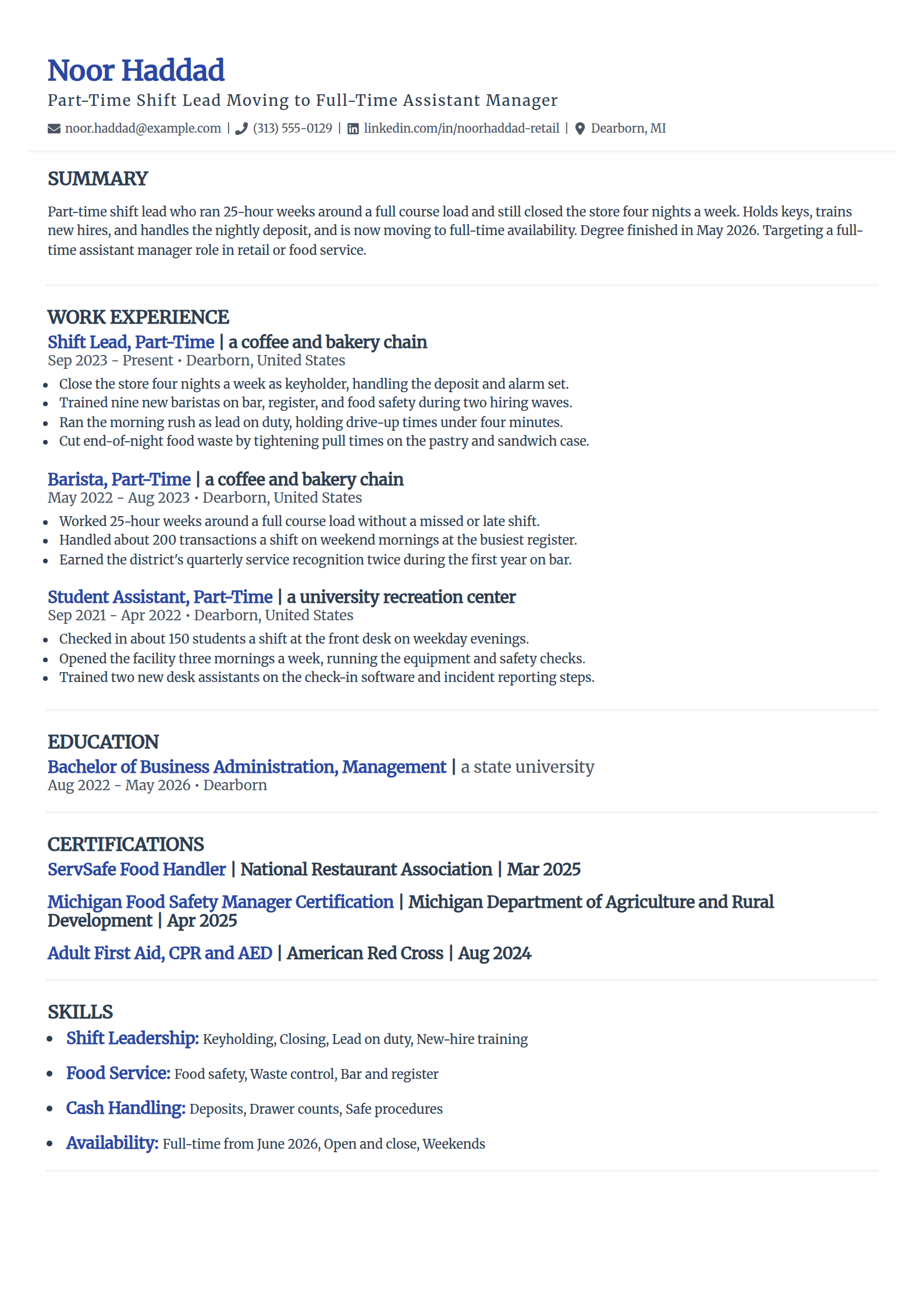
Part-Time to Assistant Manager Resume Template
Why this resume example works?
- Labels the roles part-time honestly and makes the point anyway: keyholder closing four nights a week.
- Answers the availability question directly in the summary, which is the real objection for this candidate.
- Turns a class schedule into evidence, 25-hour weeks around a full course load with no missed shifts.
- Includes a campus job that shows opening duties, so the page is not carried by one employer.
- Uses a refined layout that reads full without inflating a short record.
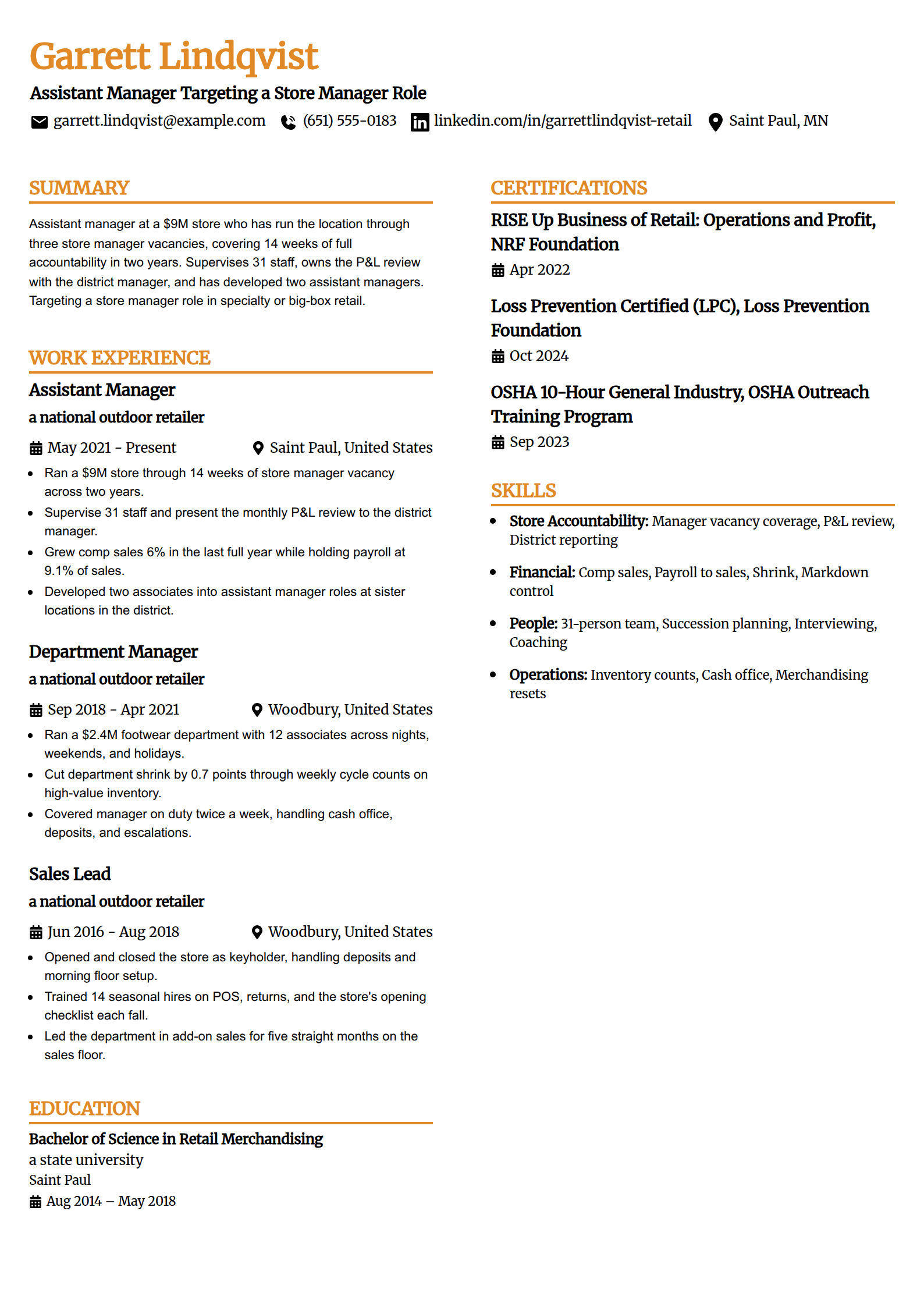
Assistant Manager to Store Manager Resume Template
Why this resume example works?
- Leads with the strongest promotion argument there is, 14 weeks running a $9M store through manager vacancies.
- Shows store-manager work already happening, the monthly P&L review presented to the district manager.
- Pairs growth with cost control, comp sales up 6% while payroll held at 9.1% of sales.
- Counts people developed, two associates moved into assistant manager roles, which is what a store manager is judged on.
- Keeps a tight, ATS-safe layout so the promotion case is readable in under a minute.
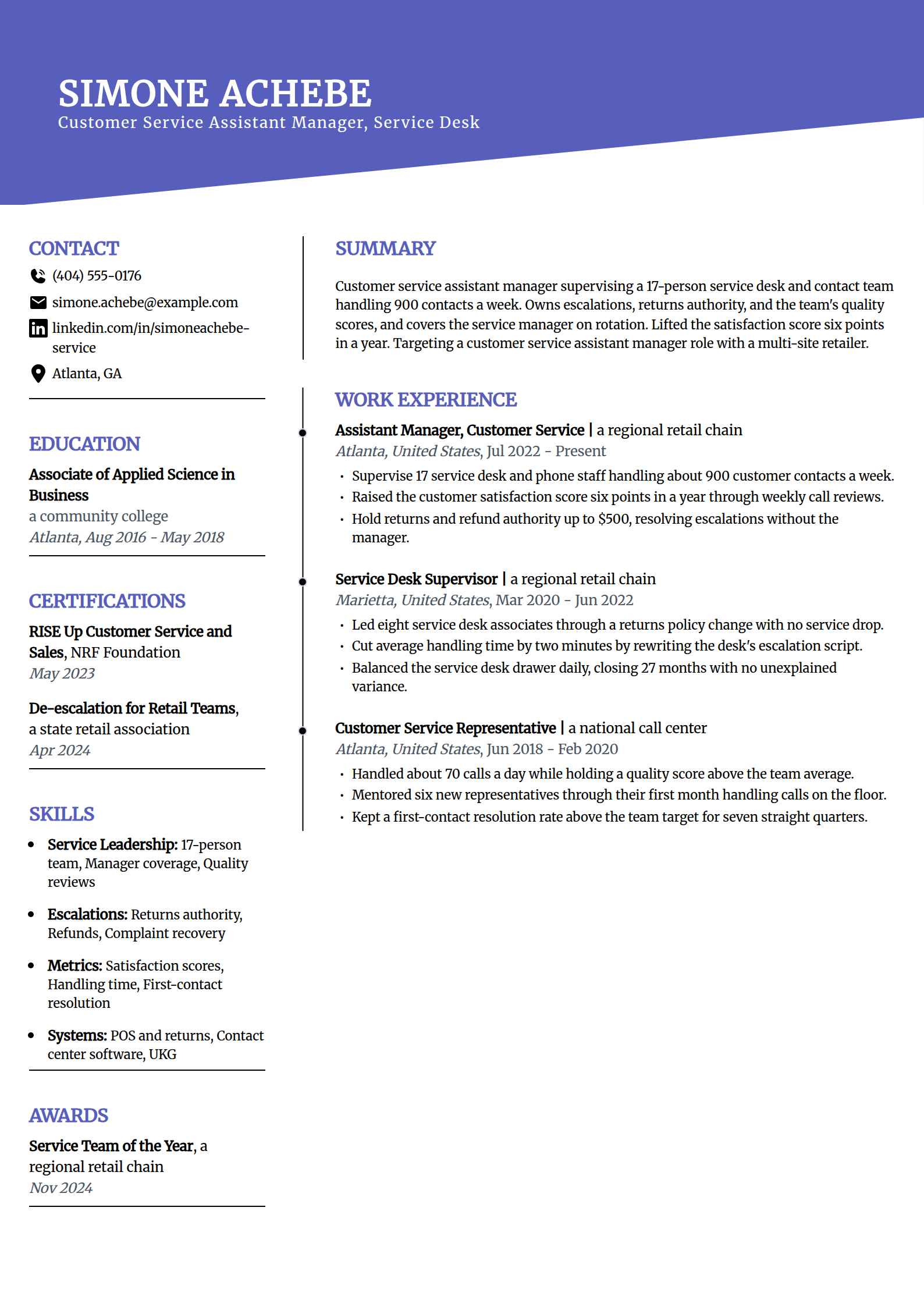
Customer Service Assistant Manager Resume Template
Why this resume example works?
- Sizes the desk in contacts, 17 staff handling about 900 customer contacts a week.
- Names the authority held, returns and refunds up to $500, which is what separates this from a senior rep.
- Ties the satisfaction score to the routine that moved it, weekly call reviews with the team.
- Shows a policy change managed without a service drop, which is the hardest part of this job.
- Lists an award without a long description so the two-column layout stays clean and balanced.
Build your assistant manager resume
Pick a template above and the editor keeps your layout clean and ATS-safe while you swap in your own headcount, shifts, systems, and the numbers you own.
Build my resumeHow to write an assistant manager resume in 2026
Describe yourself by scope, not by title. An assistant manager posting is filled by whoever can show they already run the place when the manager is off, so lead with your setting, your headcount, your shifts, and the numbers you own, then prove each one with results. Almost everything else on the page is negotiable; those four are not.
Open with setting, headcount, and shifts
Three or four sentences at the top, and every one of them concrete. Name the setting the way the industry measures it, then the people and the shifts you cover.
- Size the setting in its own units: a $4.2M store, 180 seats, 240 rooms, 1,100 cars a day, 3,200 members.
- Say how many people you supervise and which shifts you cover, including opens, closes, and overnights.
- Name the one number you own best, like payroll to sales or shrink, and leave the rest for your bullets.
- Drop openers like "results-driven assistant manager with proven leadership", which say nothing about your scope.
Prove what you own without the manager there
This is the section that decides the interview. Write it about the hours you run the place alone.
- Name the authority you hold: keys, opening and closing, cash pulls and deposits, and alarm response.
- List the escalations that reach you, from refund limits to the complaints your team cannot settle.
- Count the coverage: shifts closed, days a week you run the place alone, weeks you covered a vacancy.
- Put a number on each one, because vague authority reads as no authority.
Use the numbers your industry actually tracks
Every setting has its own scorecard, and using the wrong one marks you as an outsider. One credible number per bullet is enough.
- Retail: conversion, units per transaction, shrink, and payroll as a percentage of sales.
- Restaurants and quick service: covers, ticket times, speed of service, food cost, and labor percentage.
- Hotels: occupancy, guest satisfaction, and arrival-day room readiness.
- Warehouses: picks per hour, on-time shipping, and recordable incidents.
- Gyms and clubs: member retention and new memberships a month.
Put the certification that gates the job near the top
Some assistant manager roles will not shortlist you without a specific credential. Write it in full with the body that issued it, near your name or in a credentials block.
- Restaurants, grocery and convenience stores: ServSafe Food Protection Manager, plus a state food safety certificate where one applies.
- Warehouses: OSHA 10-Hour or 30-Hour General Industry, and forklift certification under 29 CFR 1910.178.
- Hotels: the AHLEI supervisor credentials, such as Certified Hospitality Supervisor.
- Bank branches: NMLS registration under the SAFE Act, which is required to take mortgage applications.
- Retail: NRF Foundation RISE Up credentials, and Loss Prevention Qualified or Certified for shrink-heavy stores.
Name systems, not software categories
"Scheduling software" is invisible to a keyword match and a product name is not. List what you have actually used, and tie at least one to a result like holding payroll inside budget through a holiday peak.
- Scheduling and labor: UKG, Kronos, ADP, HotSchedules, 7shifts.
- Point of sale: Toast, MICROS Simphony, and your store's POS by name.
- Property, warehouse and club systems: OPERA PMS, Manhattan, Blue Yonder, ABC Fitness, Mindbody.
- Not sure which names to use? Read three postings for the job you want and use their words.
Keep it to one clean page
One page covers almost every assistant manager, including candidates with ten years of stacked promotions.
- Cut the oldest jobs before you cut results, and hold each bullet to one or two lines.
- Skip skills bars and icon columns, which an applicant tracking system cannot read.
- Pick one of the clean layouts above, then run the file through our ATS resume checker before you apply.
Common assistant manager resume mistakes
- Listing duties from the job description. "Oversaw daily operations" describes the posting, not you; say what changed, like shrink down half a point or a drive-thru 31 seconds faster.
- Hiding the headcount. If a reader cannot tell how many people report to you, they assume three. Put the number in the first two lines.
- Claiming the manager's job. Saying you owned the store P&L when you did not is the fastest way to lose credibility in an interview; say you prepared the reporting, or covered the vacancy for a stated number of weeks.
- Leaving out the credential the posting requires. A restaurant or grocery role without ServSafe, or a bank branch role without NMLS registration, often does not get read at all.
- Writing one generic resume for every setting. A hotel, a warehouse and a gym measure the job differently, so the numbers and systems have to change even when the title does not.
Frequently asked questions
What should an assistant manager put on a resume?
Lead with a three-to-four-sentence summary that names your setting and its size, the number of people you supervise, the shifts you cover, and the one number you own best. Under each job, write results-first bullets that open with a strong verb and carry one credible number, like holding payroll at 9.4% of sales or cutting shrink from 1.9% to 1.1%. Name the credential your setting requires, such as ServSafe Food Protection Manager or OSHA 30, and list the real systems you use rather than software categories. Keep the whole thing to one clean page.
How do you write an assistant manager resume with no management experience?
Lead with the supervisory work you already do without the title. Most senior associates and shift leads hold keys, open or close, train new hires, run huddles, handle escalated customers, and cover the supervisor's days off, and each of those belongs on the page with a number attached. Say how many people you have trained, how many shifts you have closed, and how long you have covered a supervisor. State in your summary that you are targeting a first assistant manager role, and back it with an entry-level credential like an NRF RISE Up certificate rather than inflating a short course into a management qualification.
How do you show a promotion from within on an assistant manager resume?
Stack the titles under one employer rather than repeating the company for each role. List the company once, then each title with its own dates underneath, most recent first, so the climb reads at a glance. Give the current role the detail and keep the earlier ones to two or three lines each, because a reader wants to know what you do now, not what you did as an associate three years ago. Stacked titles at one employer are the clearest signal on this kind of resume that you keep getting picked for more.
What skills and certifications go on an assistant manager resume?
Group skills into operations, people, the numbers you own, and systems, and name the systems outright: UKG, Kronos, ADP, HotSchedules, 7shifts, Toast, MICROS, OPERA PMS, Manhattan or Blue Yonder, ABC Fitness, Mindbody. For certifications, match the setting. Restaurants, grocery and convenience stores want ServSafe Food Protection Manager and often a state food safety certificate. Warehouses want OSHA 10 or 30 and forklift certification under 29 CFR 1910.178. Retail recognizes NRF Foundation RISE Up credentials and Loss Prevention Qualified or Certified from the Loss Prevention Foundation. Hotels recognize AHLEI supervisor credentials, and a bank branch role needs NMLS registration under the SAFE Act.
How long should an assistant manager resume be?
One page for almost everyone in this role, including candidates with ten years and several promotions. A single skimmable page led by your current role is what a hiring manager expects, and it parses cleanly in an applicant tracking system. If you have run multiple sites or carried an assistant general manager scope for years, a second page can work, but only when it carries results rather than older job descriptions. Cut the oldest roles before you cut numbers.
What is the difference between an assistant manager and a store manager resume?
The difference is accountability, and pretending otherwise gets caught in the interview. An assistant manager resume shows delegated scope: a headcount supervised, shifts and keys held, a department or function owned, and the manager covered on days off or during a vacancy. A store manager resume shows full accountability: the unit's profit and loss, hiring and staffing decisions for the whole site, and results the manager owns outright. If you are aiming for the step up, lead with the weeks you ran the store during a vacancy and the reporting you already prepare, which is what the example above does.
More assistant manager resume resources
Build your assistant manager resume
Pick a template above and the editor keeps your layout clean and ATS-safe while you swap in your own headcount, shifts, systems, and the numbers you own.