Grocery Lane to Drive-Thru: 16 Cashier Resume Templates and Examples
- ATS Friendly
- No-Experience Examples
- 16 Real Resumes
A cashier resume example should answer three questions a shift manager is already asking: does your drawer balance, do you keep a line moving, and will you work the shifts you said you would. The 16 examples below are sorted by the register you want, from a first job with no paid work behind you to a head cashier running a twelve-lane front end. Start from the closest one, then swap in your own POS, your own numbers and your own availability.


540k+ resumes created
Cashier resume templates you can edit
Each template below is a real cashier resume laid out in that format, grouped by the register it was written for. The grocery and big-box layouts put the drawer record and the transaction rate where a front-end manager looks first; the no-experience ones give unpaid register work its own dated section instead of hiding it in a skills list. Pick one, then replace the store, the systems and the numbers with your own.
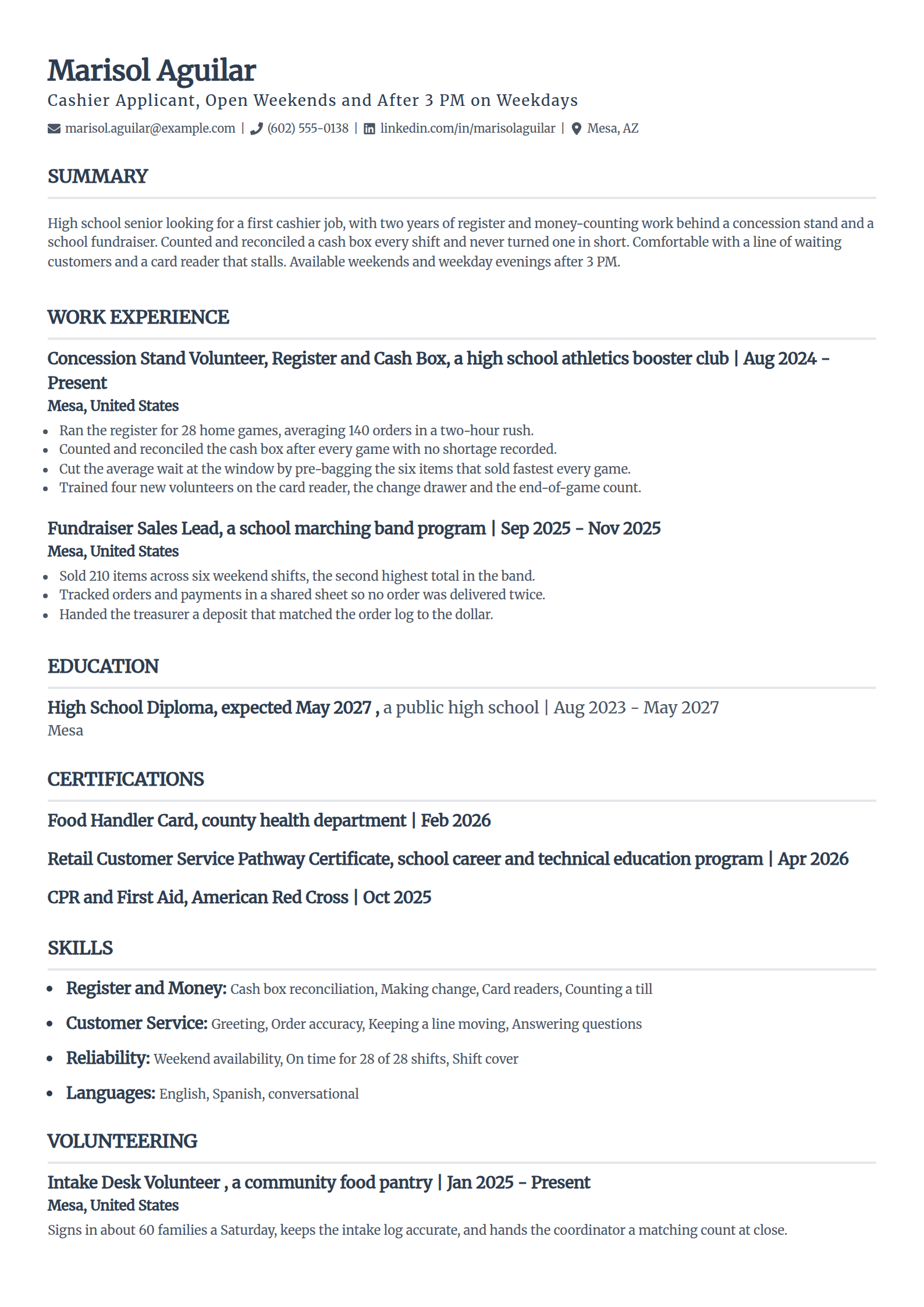
Cashier Resume Template With No Experience
Why this resume example works?
- Formats the concession stand and the fundraiser as dated jobs with bullets, not as a line in a skills list. Unpaid register work is still register work.
- Answers the trust question directly: a cash box counted every shift and never turned in short.
- Puts availability in the headline, because a manager filling a schedule reads that before anything else.
- Carries a number in every bullet, all of them small enough to be believable for a high school senior.
- Keeps the page to one column and standard headings, so a kiosk application parses it cleanly.
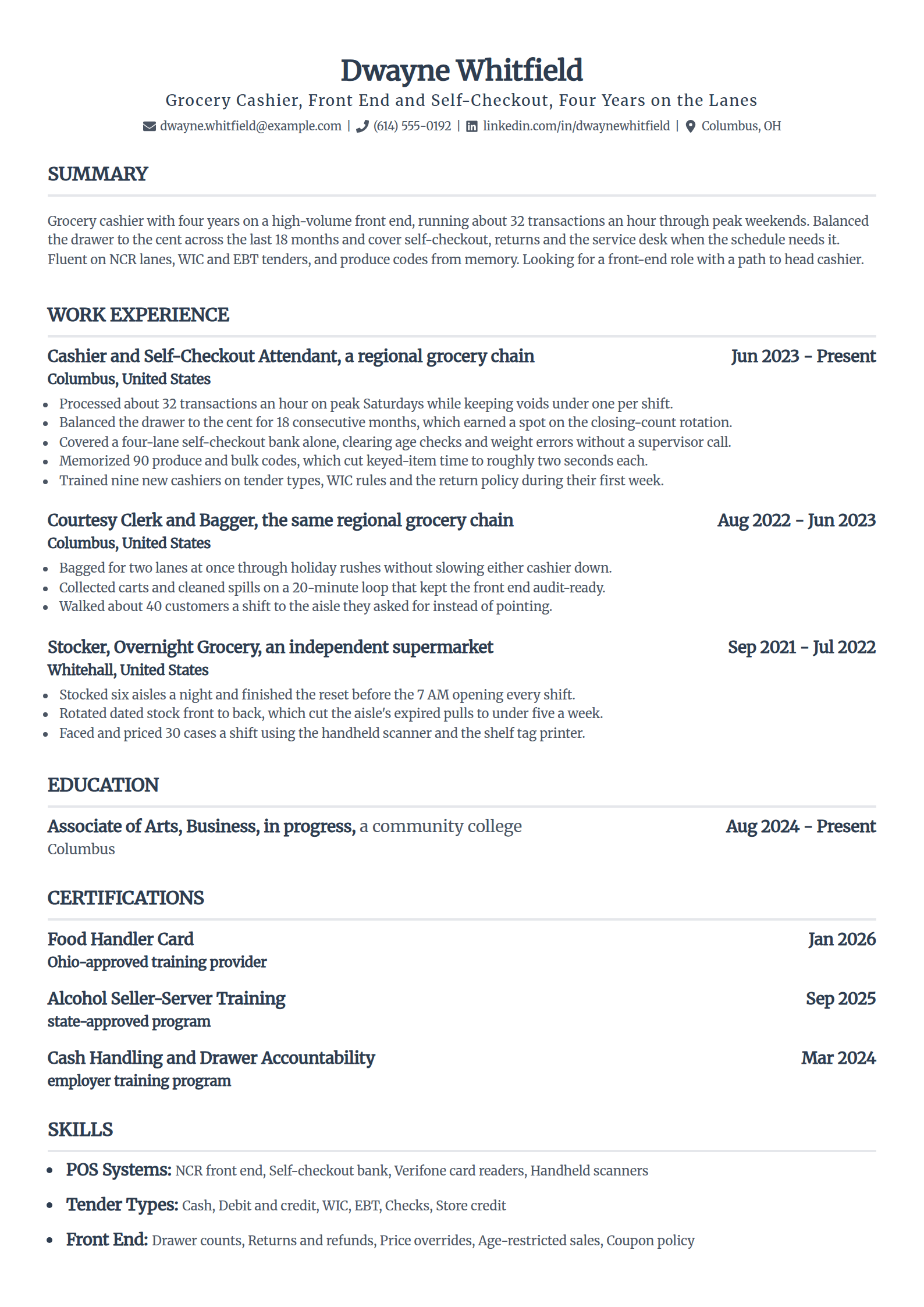
Grocery Store Cashier Resume Template
Why this resume example works?
- Leads with the two numbers a front-end manager tracks: transactions an hour and how long the drawer has balanced.
- Names WIC and EBT outright. A grocery posting screens for those tenders and a generic cash-handling line does not match.
- Shows self-checkout coverage as its own skill, because stores staff that bank from the same schedule.
- Turns memorizing produce codes into a speed claim instead of a duty, which is how the job is actually measured.
- Puts the training of nine new cashiers on the page, which is the argument for a head cashier promotion later.
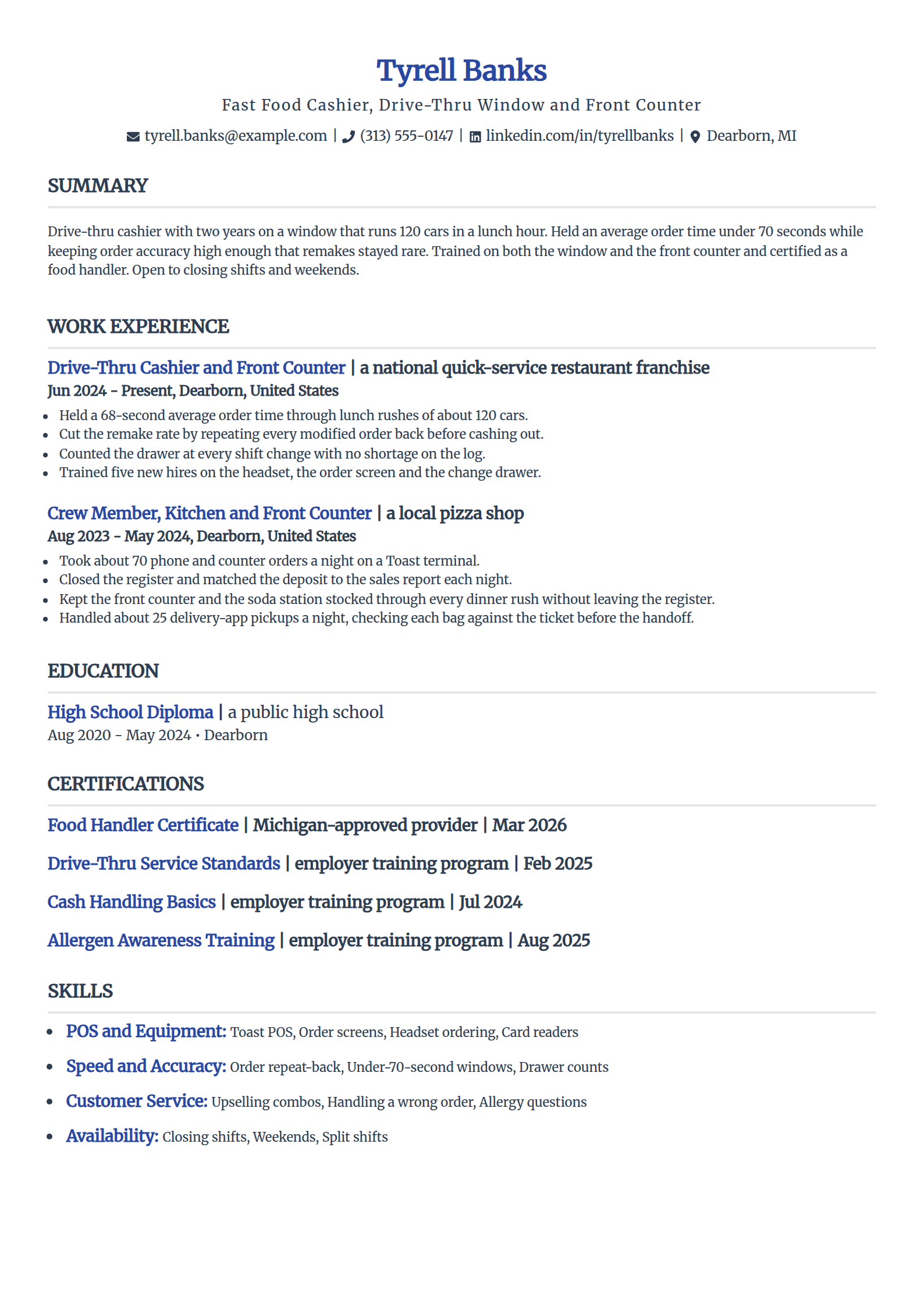
Fast Food Cashier Resume Template (Drive-Thru)
Why this resume example works?
- Uses the metric the window is graded on, average order time, with the car count that gives it context.
- Says how accuracy was achieved, repeating modified orders back, rather than claiming to be detail-oriented.
- Keeps the food handler certificate visible, which a quick-service manager needs before scheduling you.
- Covers both the window and the front counter, so the resume fits whichever position is open.
- Ends with closing shifts and weekends, the availability that gets a fast food application moved up the pile.
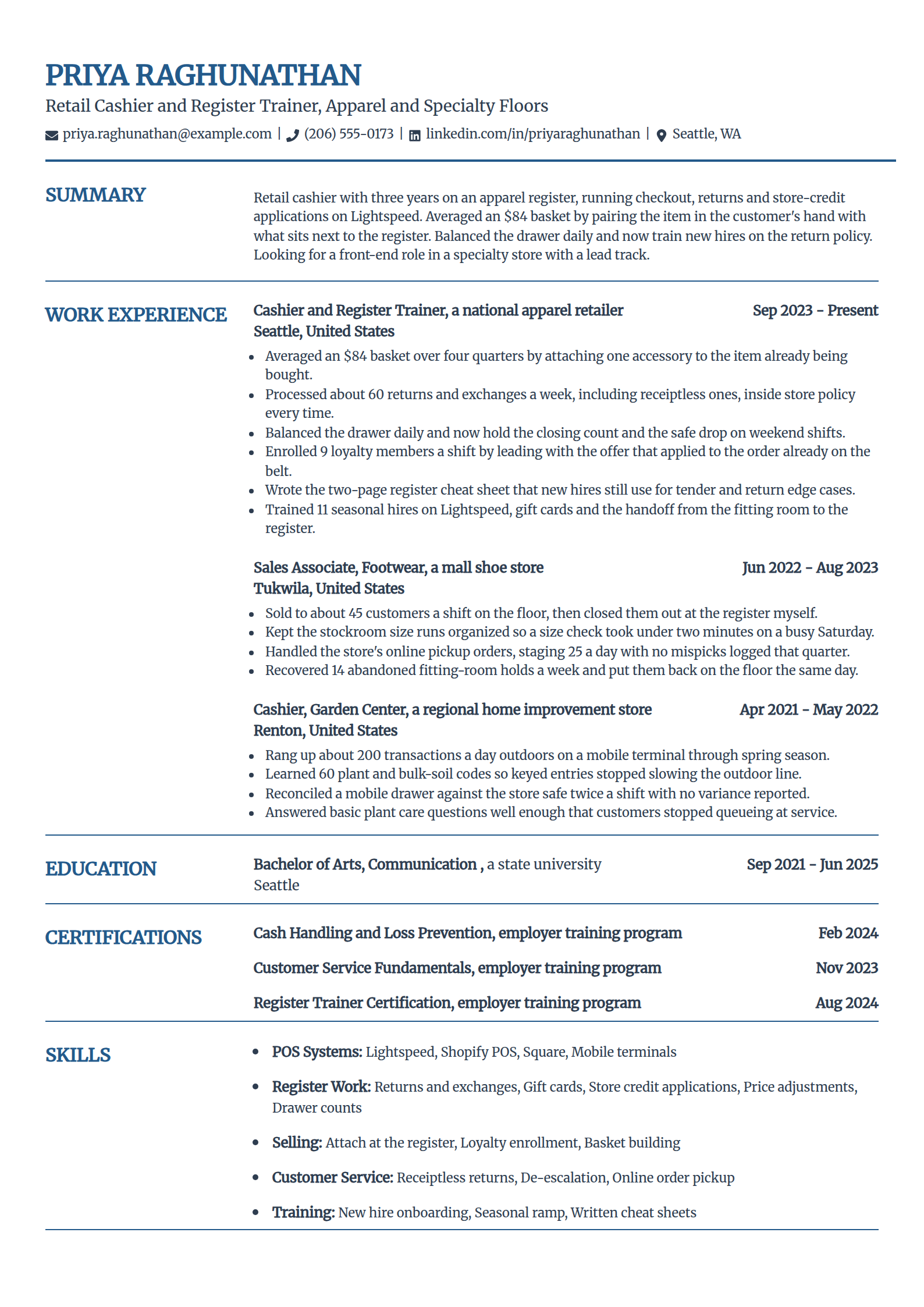
Retail Cashier Resume Template
Why this resume example works?
- Leads with average basket, which is the number a specialty retailer ties to register performance.
- Explains the attach rather than boasting about it: one accessory paired with the item already being bought.
- Puts receiptless returns on the page, the part of the job most cashier resumes leave out and most managers worry about.
- Names Lightspeed, Shopify POS and Square, so the resume matches the system in the posting.
- Mentions the written cheat sheet, which shows someone who fixes the problem for the next person too.
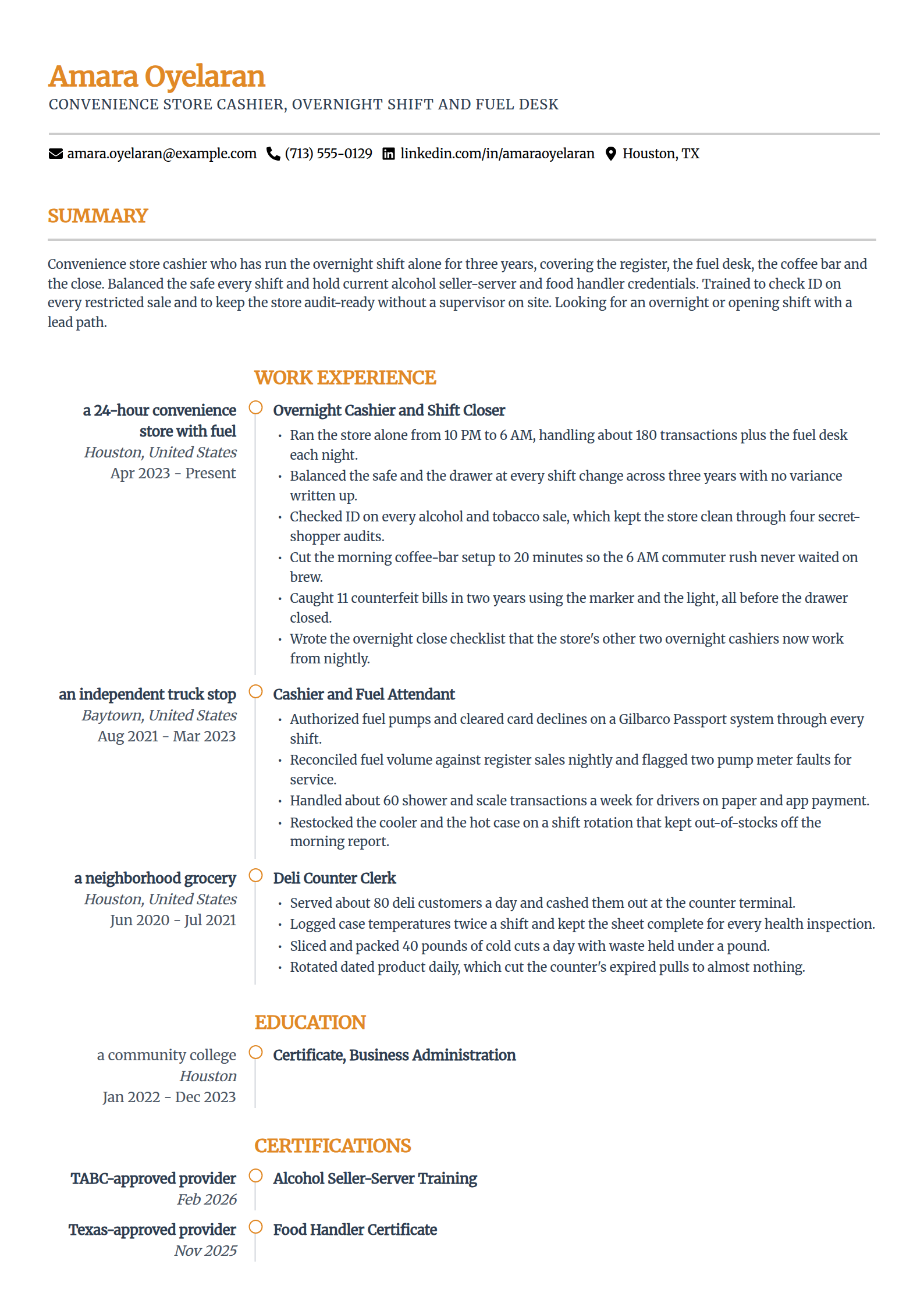
Gas Station and Convenience Store Cashier Resume Template
Why this resume example works?
- Says plainly that the store ran alone overnight, which is the whole hiring question for this shift.
- Pairs the safe record with the audit record, so volume and compliance sit side by side.
- Names the fuel systems, Gilbarco Passport and Verifone Commander, because a fuel site posting screens for them.
- Keeps the seller-server and food handler credentials current and dated, not just listed.
- Counts the counterfeit catches, a specific loss-prevention result rather than a claim to be vigilant.
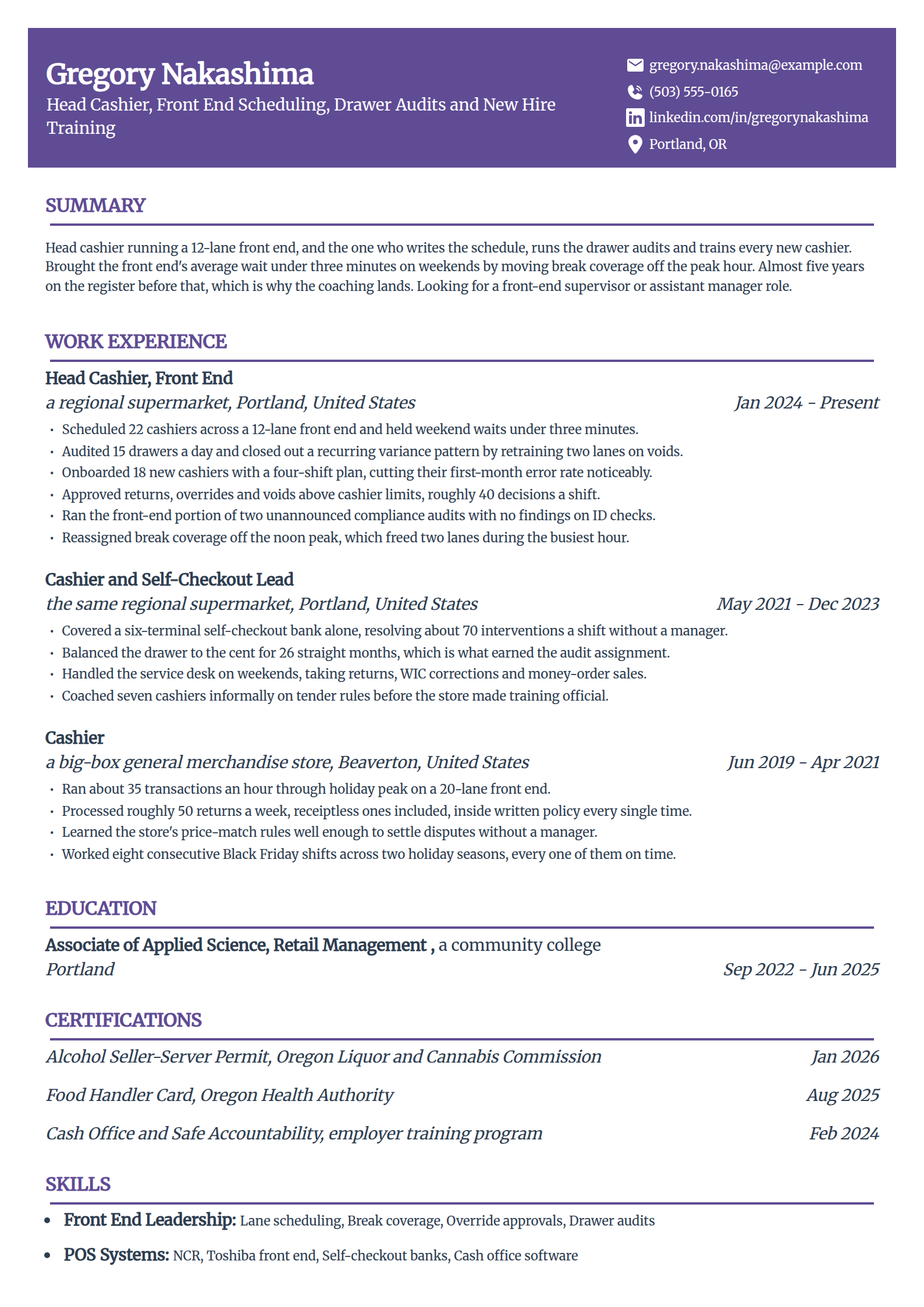
Head Cashier and Front-End Lead Resume Template
Why this resume example works?
- Opens with what is actually being supervised: lane count, cashier count and the wait time that resulted.
- Shows a problem solved, not a duty performed. A variance pattern was traced and two lanes were retrained.
- Quantifies onboarding, because training is the part of a head cashier job a store manager cares about most.
- Keeps the register years underneath, dated, which is why the coaching carries weight.
- Names the override and void authority, the line between a cashier and a lead on most job descriptions.
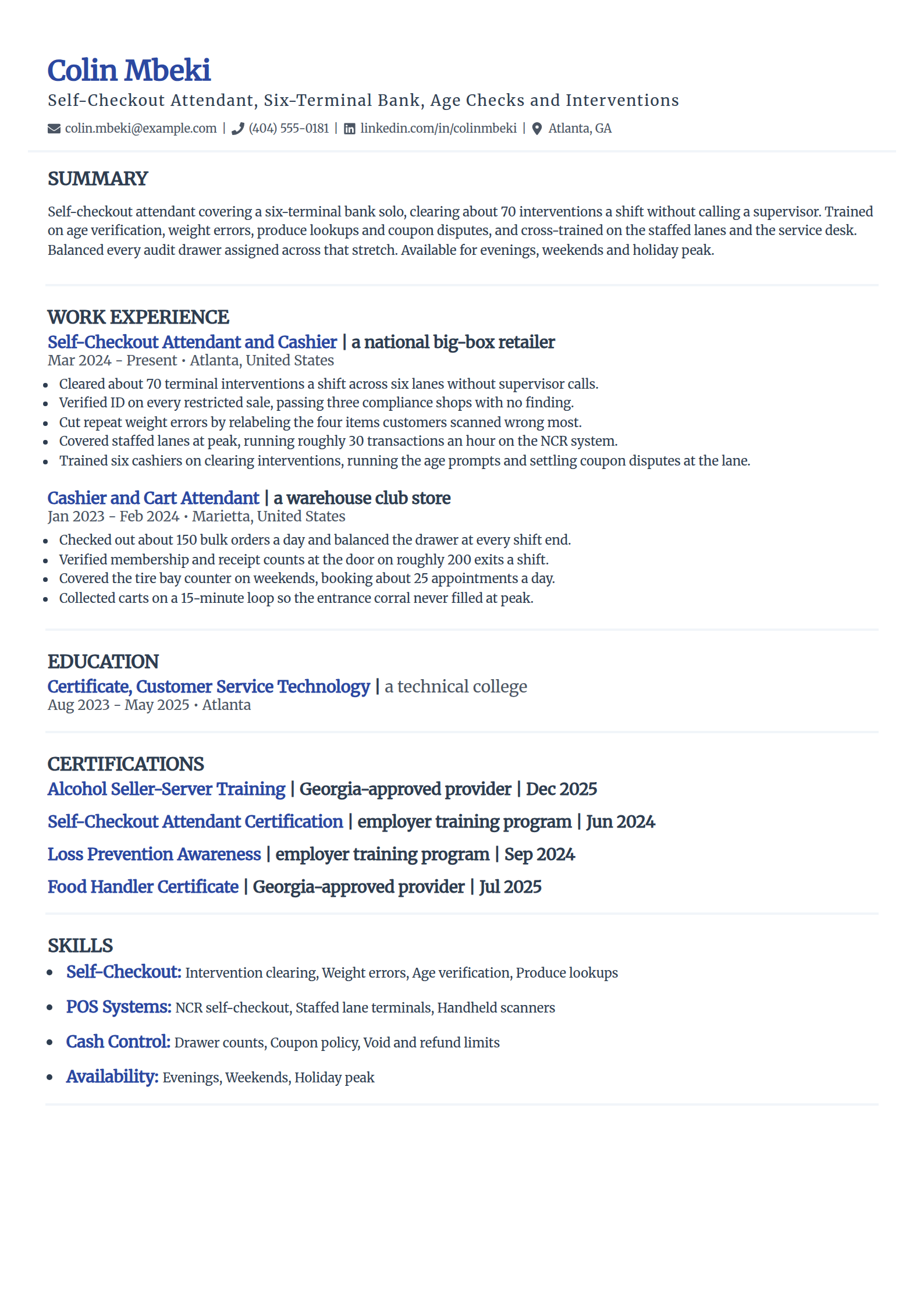
Self-Checkout Attendant Resume Template
Why this resume example works?
- Counts interventions per shift, the one number that describes this job and that nobody else puts on a resume.
- Says the bank was covered solo, which is how stores staff it and what they are checking you can do.
- Shows a fix that stuck: relabeling the items customers scanned wrong most, so the errors stopped repeating.
- Keeps staffed-lane experience on the page so the resume works for either opening.
- Puts the compliance shops on the record, which is the risk a self-checkout bank actually carries.
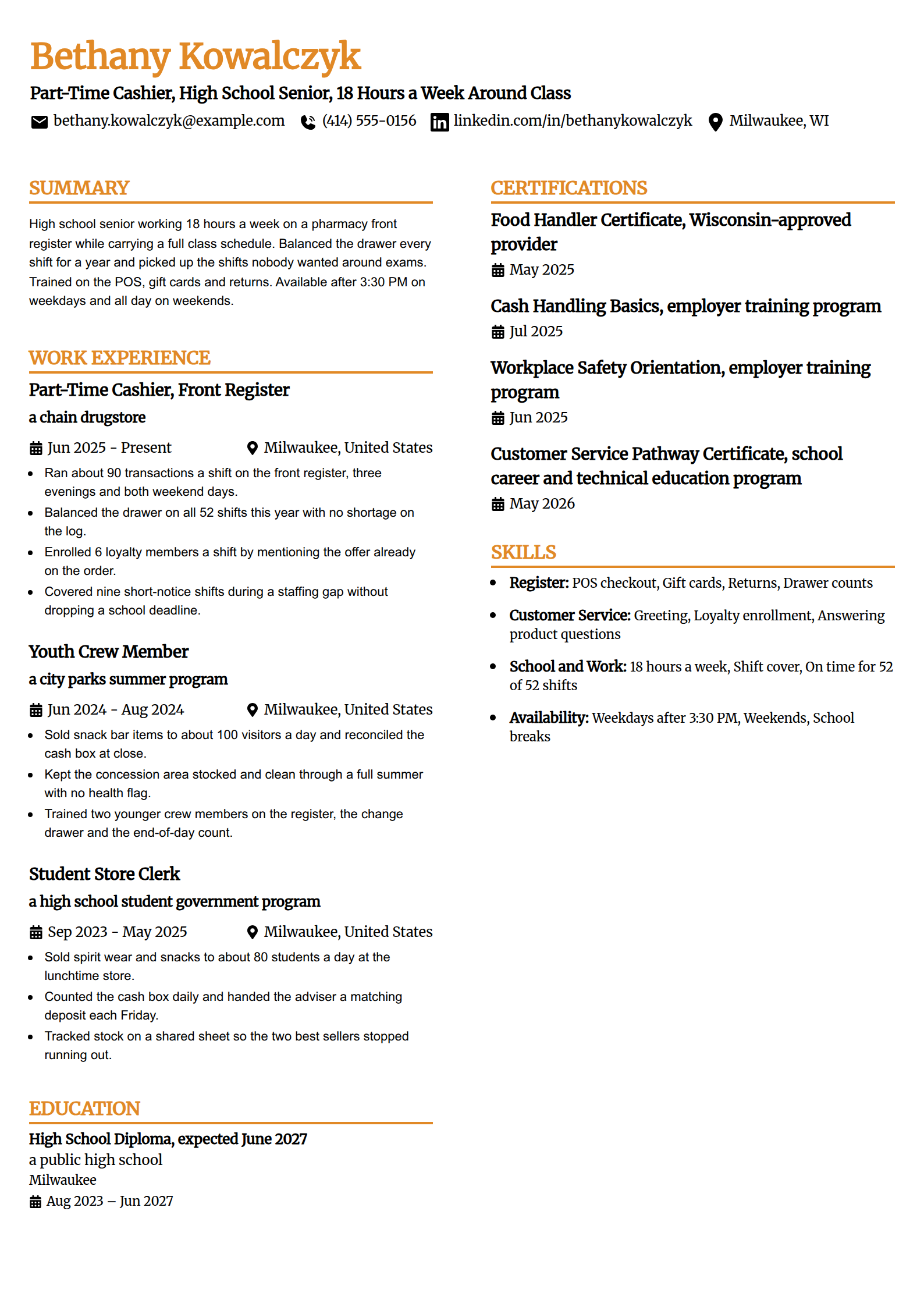
Part-Time Student Cashier Resume Template
Why this resume example works?
- States the hours worked per week in the headline, which answers the only scheduling question a manager has.
- Counts attendance as an achievement, 52 shifts out of 52, because reliability is the thing being bought here.
- Includes the school store and the summer program, both real register work a student can point to.
- Keeps the availability window exact, weekdays after 3:30 and weekends, instead of saying flexible.
- Leaves the grade point average off and spends the space on shifts, which is the right trade for this job.
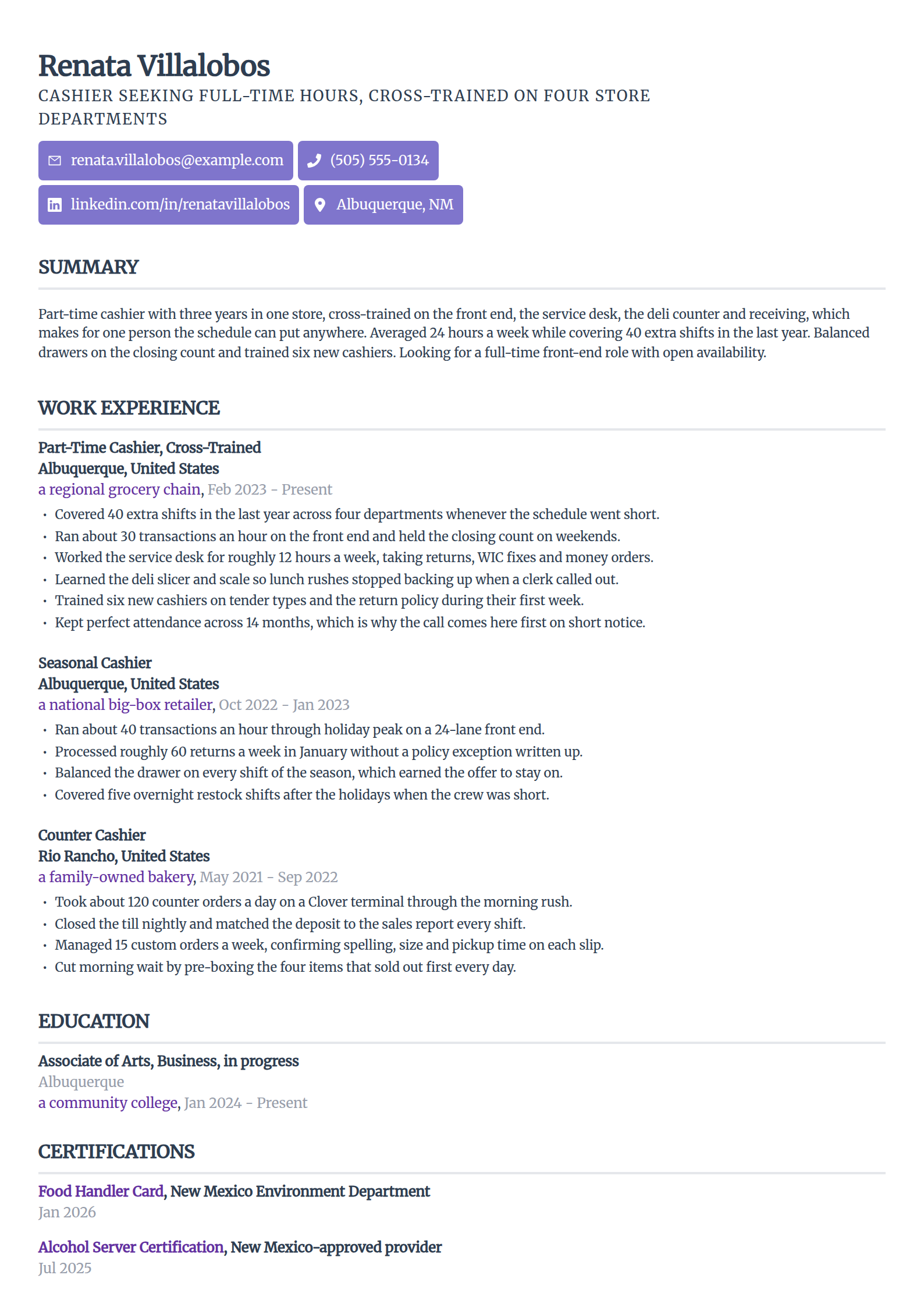
Cashier Resume Template for Moving to Full-Time Hours
Why this resume example works?
- Makes cross-training the argument. Four departments means one person the schedule can put anywhere.
- Counts the 40 extra shifts covered, which is the proof behind an open availability claim.
- Puts perfect attendance over 14 months on the page as a number, not as a personal quality.
- Keeps the service desk hours separate, because that is a different skill set from running a lane.
- Names the languages spoken, which decides staffing in a lot of stores and costs one line to say.
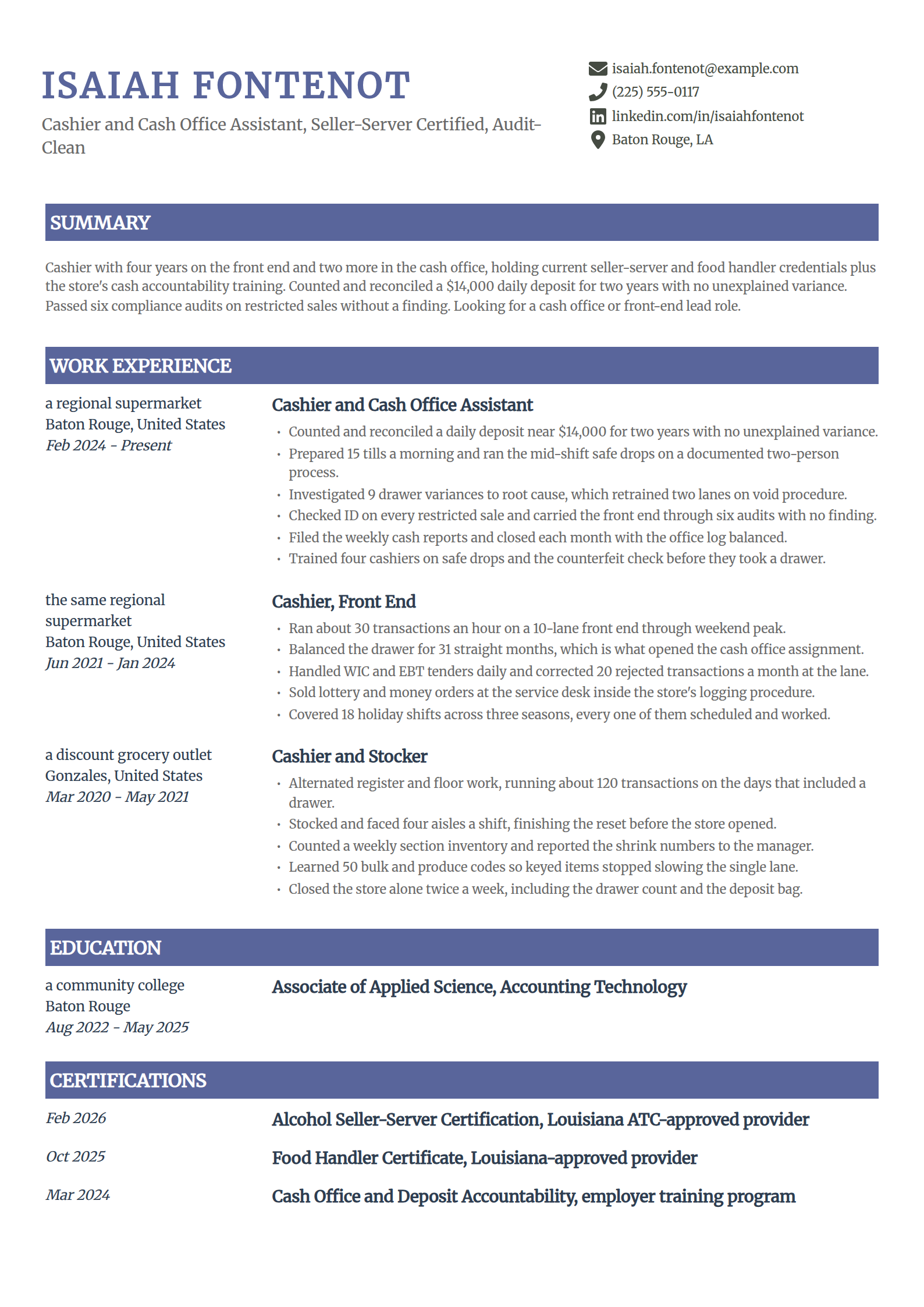
Cashier Resume Template With Cash-Handling Certifications
Why this resume example works?
- Leads with the deposit reconciled and the length of the clean record, which is what a cash office hires on.
- Lists real credentials only: seller-server, food handler and the employer's own cash accountability course.
- Shows the two-person count procedure by name, so a manager knows the controls are already familiar.
- Turns variance investigation into a result, two lanes retrained, rather than a responsibility.
- Keeps the front-end years underneath, because a cash office role is usually filled from the lanes.
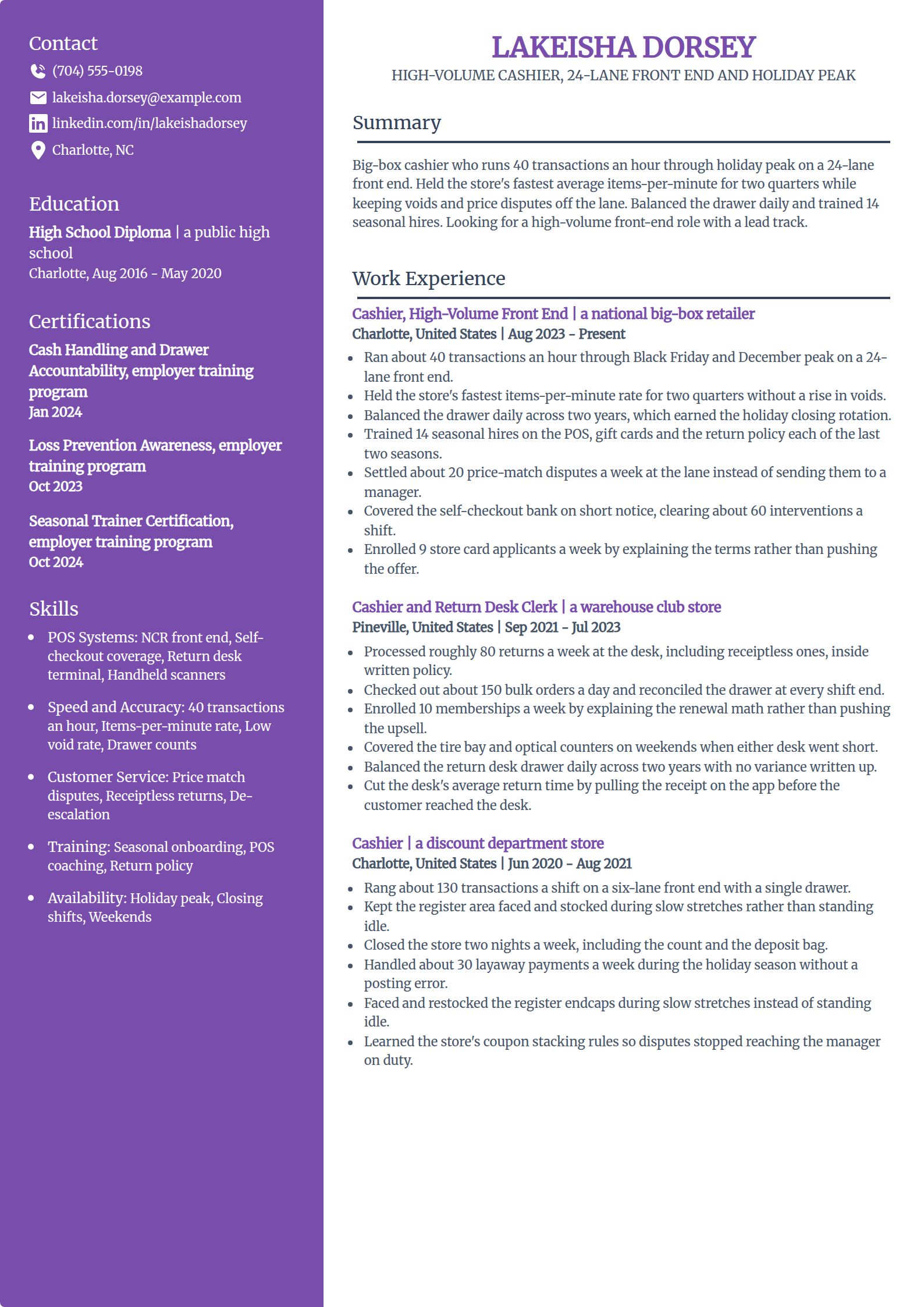
Big Box Cashier Resume Template (High Volume)
Why this resume example works?
- Puts the peak-season rate up front, 40 transactions an hour, with the lane count that makes it meaningful.
- Pairs speed with accuracy in the same breath, so the number reads as competence rather than as risk.
- Counts seasonal hires trained, which is the ask a big-box store has every October.
- Shows price-match disputes settled at the lane, the daily friction a front-end manager wants removed.
- Keeps the return desk work visible, since the two positions get scheduled from the same pool.
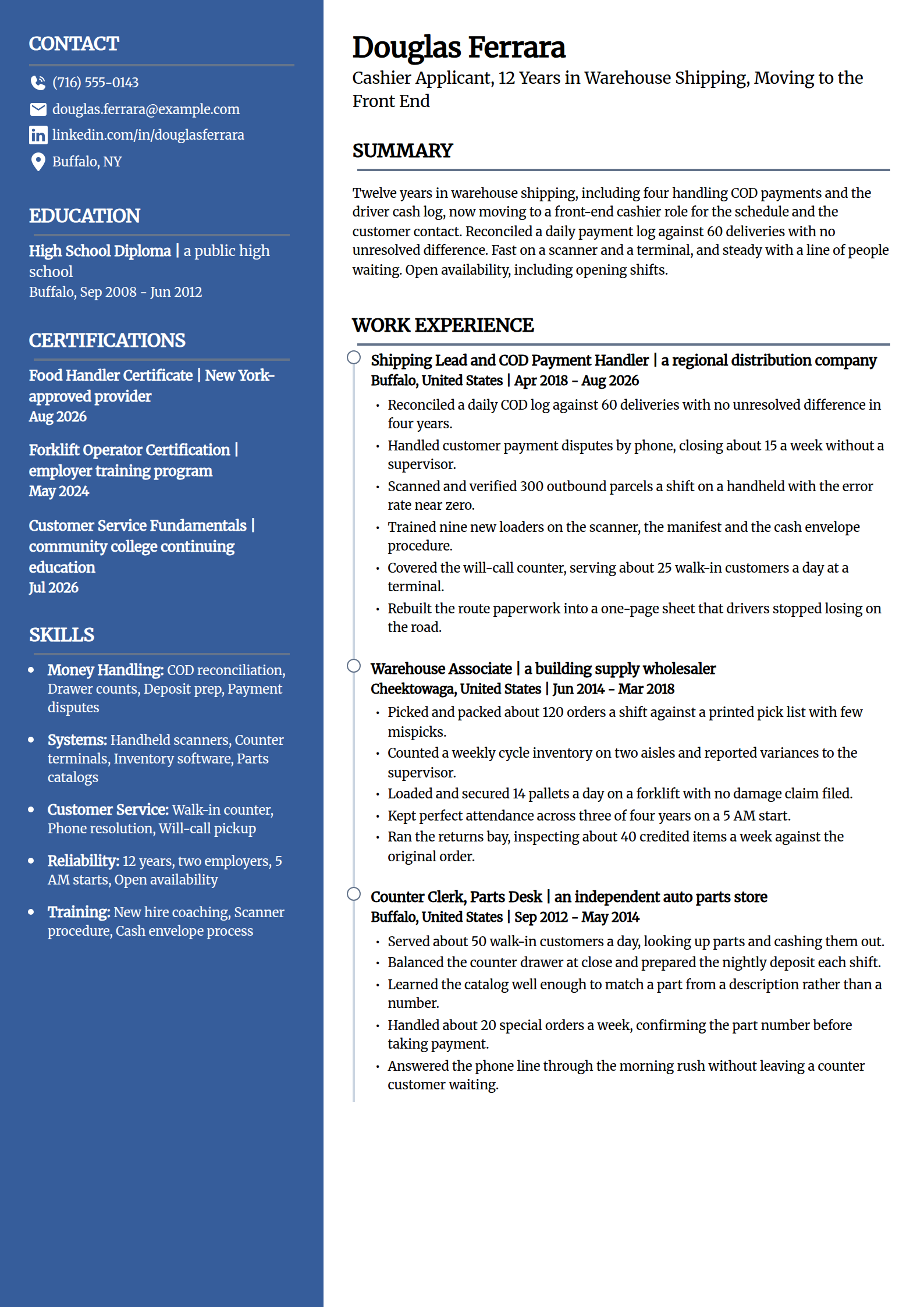
Career Change Cashier Resume Template
Why this resume example works?
- Names the switch in the headline and gives a reason, which stops a manager guessing at the story.
- Finds the money handling inside the old job, a daily payment log reconciled against 60 deliveries.
- Pulls out the customer-facing parts of warehouse work, the will-call counter and the payment disputes.
- Keeps twelve years across two employers on the page, because tenure is an argument by itself.
- Lists the food handler card and the customer service course taken before applying, which shows intent.
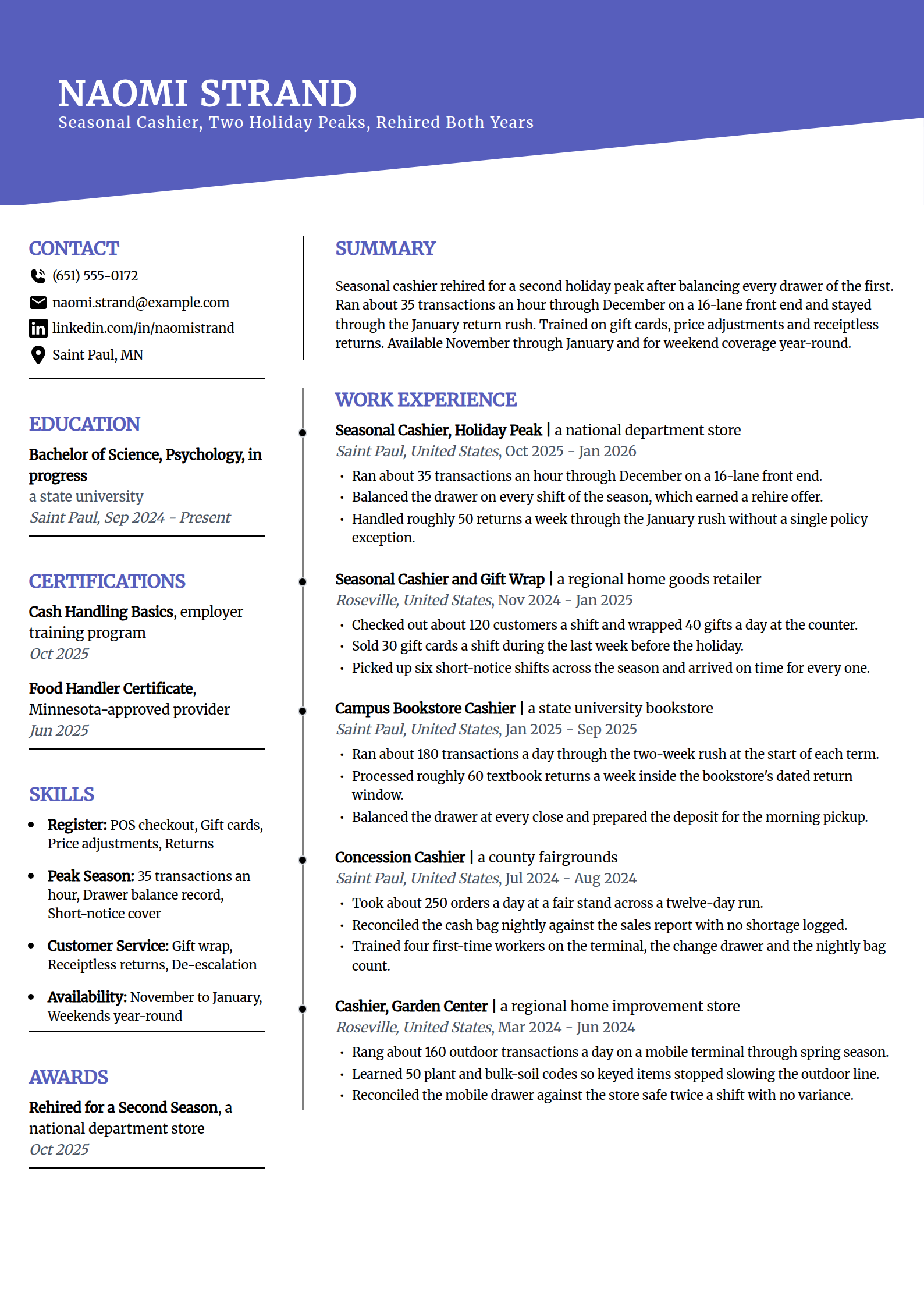
Seasonal Cashier Resume Template
Why this resume example works?
- Leads with the rehire, which is the strongest thing a seasonal worker can put on a page.
- Shows the January return rush was worked too, not just the fun part of the season.
- Groups five short stints into a pattern of repeat seasonal work rather than a list of short jobs.
- States the availability window outright, November through January plus weekends year-round.
- Keeps every bullet countable, so five brief roles still add up to a page worth reading.
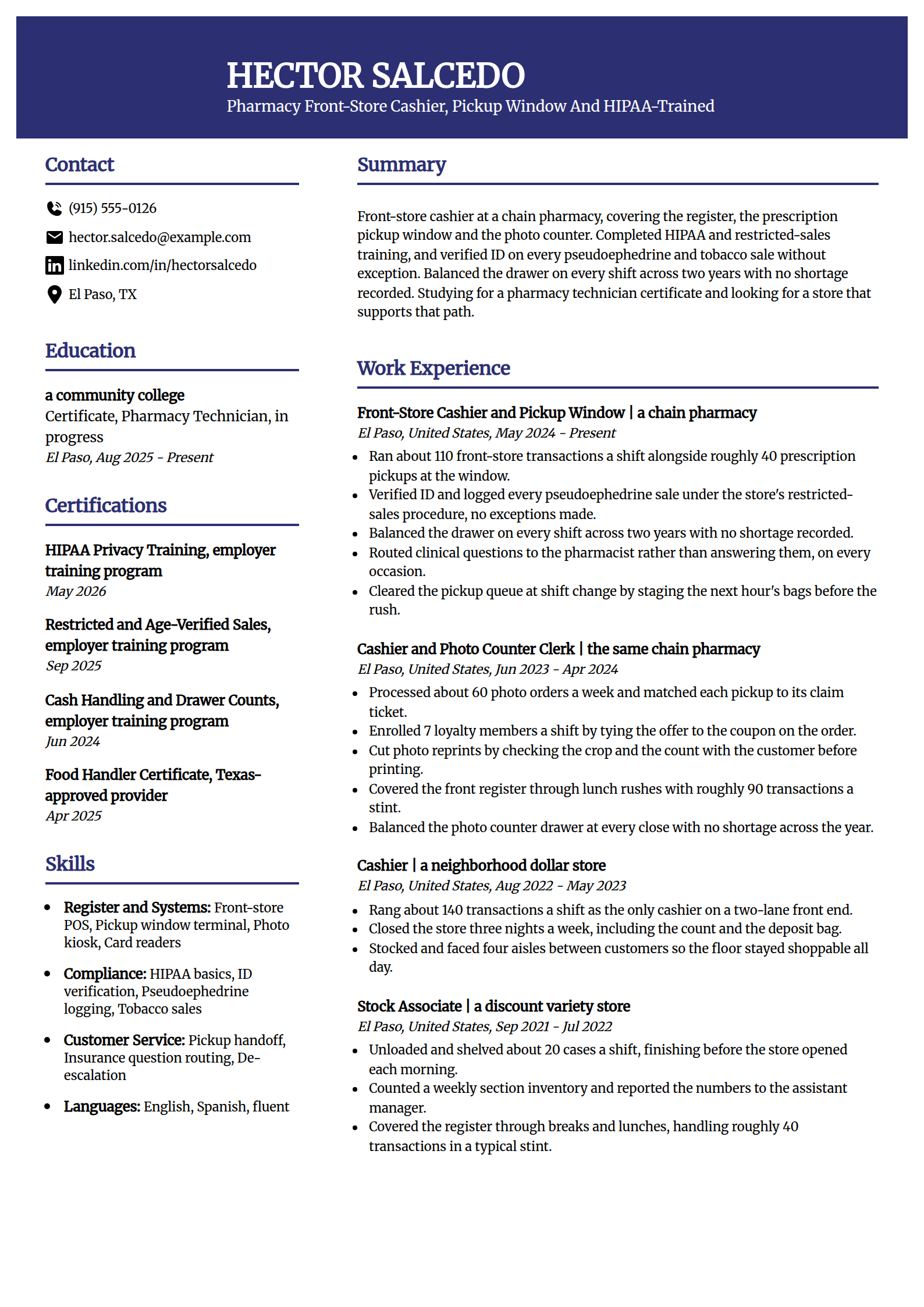
Pharmacy Cashier Resume Template
Why this resume example works?
- Puts HIPAA training and restricted-sales logging in the summary, which is what separates this from any other register.
- Says clinical questions went to the pharmacist every time, the boundary a pharmacy manager is screening for.
- Counts front-store transactions and pickups separately, because they are two different workloads.
- Names the pharmacy technician certificate in progress, which explains why this candidate stays.
- Lists Spanish as a fluent language, which is a scheduling factor at a lot of pharmacy counters.
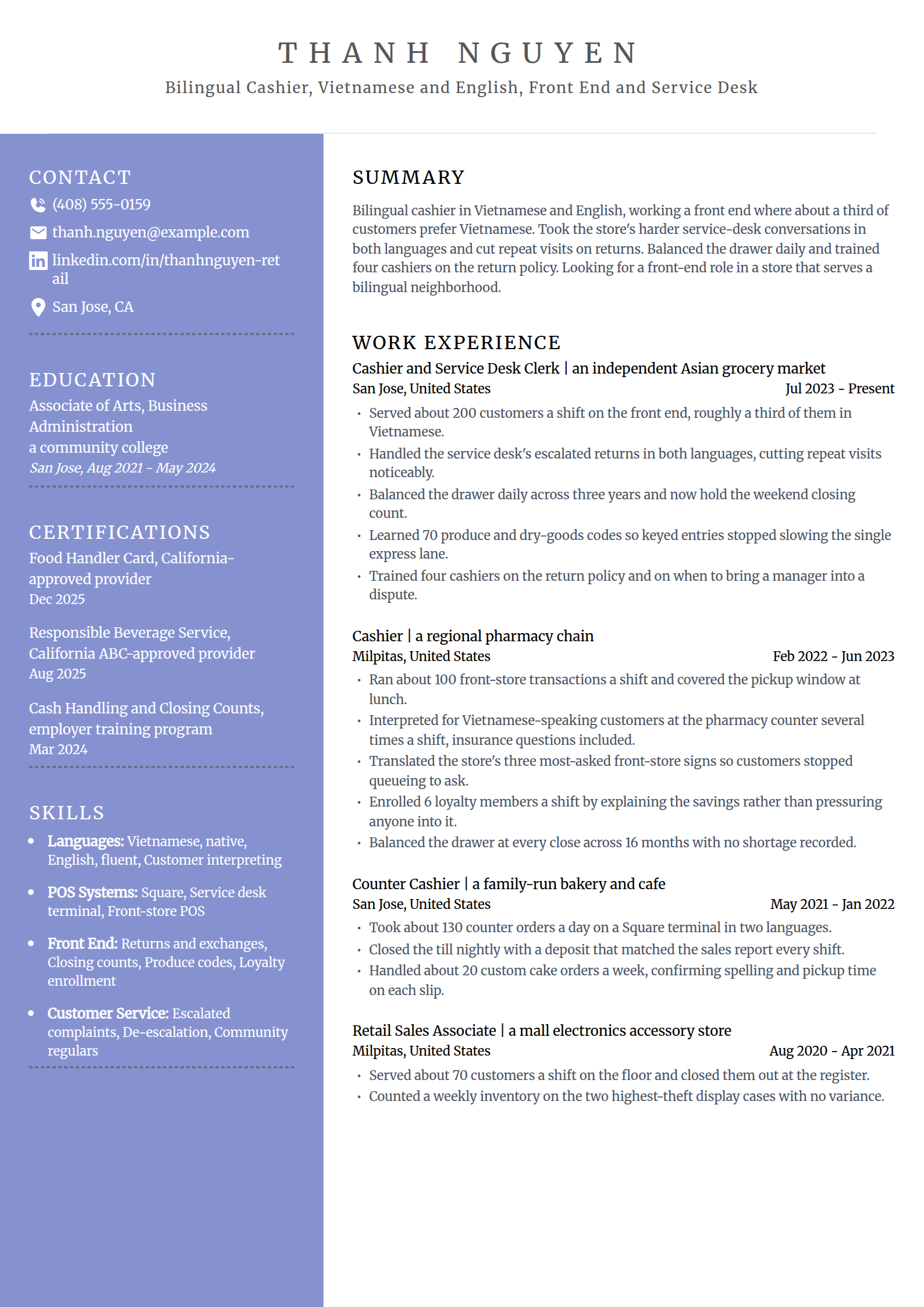
Bilingual Cashier Resume Template
Why this resume example works?
- Treats the second language as work rather than as a trait, with the share of customers it actually serves.
- Shows a result from it: escalated returns handled in both languages and fewer repeat visits.
- Puts interpreting at the pharmacy counter on the page, a specific task and not a general claim.
- Keeps the drawer record next to the language skill, so neither argument has to carry the page alone.
- Names the store type, which tells a hiring manager the neighborhood experience transfers.
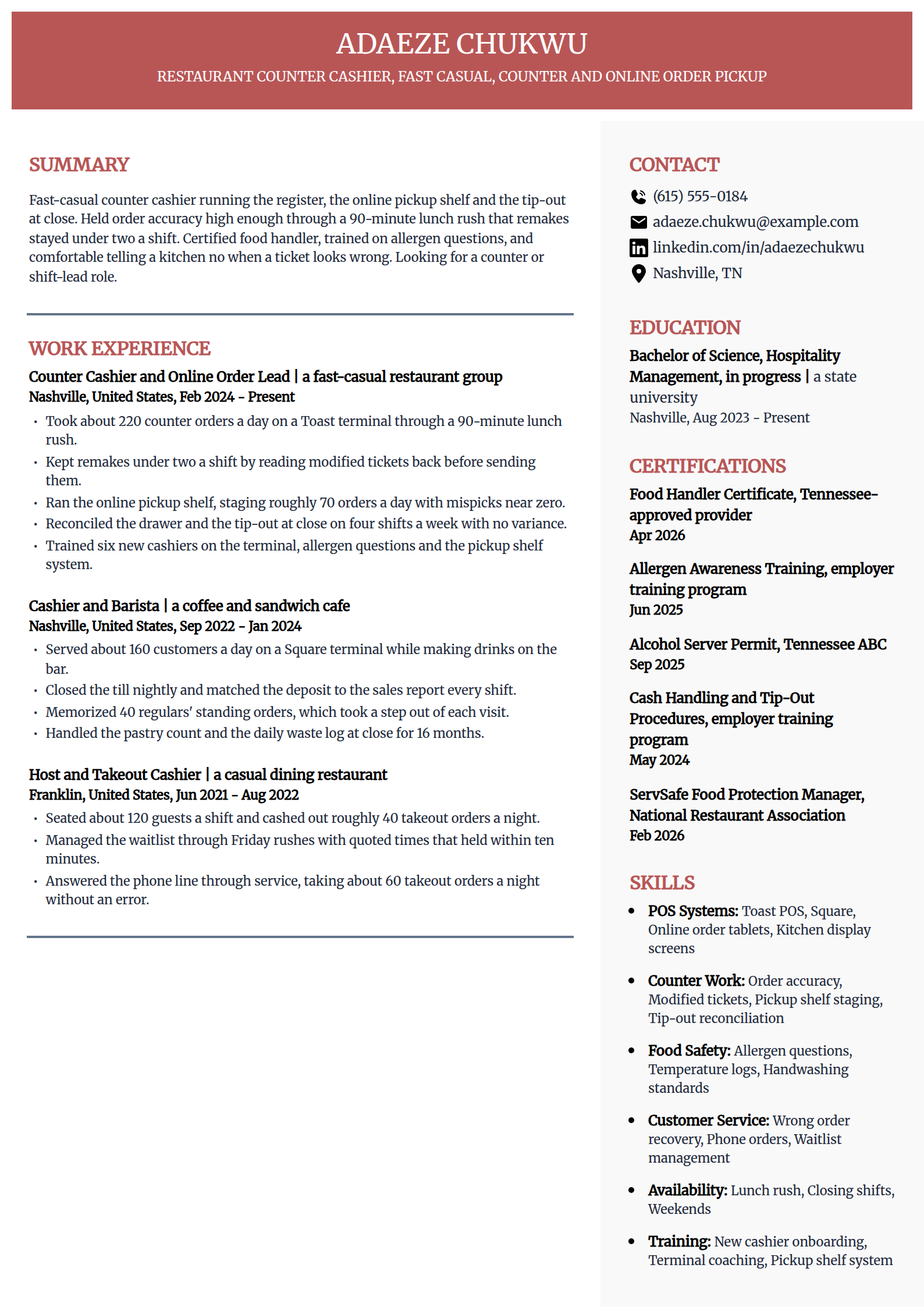
Restaurant Cashier Resume Template (Fast Casual)
Why this resume example works?
- Uses remakes per shift as the accuracy metric, which is how a restaurant counts a counter mistake.
- Adds the online pickup shelf, a part of the job that did not exist five years ago and now sits in every posting.
- Puts the tip-out reconciliation on the page, because that is money handling a manager has to trust you with.
- Names allergen training, which a counter role legally needs to take seriously.
- Keeps the host and takeout job underneath, showing the same accuracy in an earlier setting.
Build your cashier resume on one of these templates
Pick the example closest to the register you want, open it in the builder, and replace the store, the systems and the numbers with your own. Twenty minutes of work and you have a page a shift manager can read in fifteen seconds.
Build my resumeHow to write a cashier resume in 2026
A front-end manager reads a cashier resume for about fifteen seconds, looking for three things: that your drawer balances, that you can keep a line moving, and that you will work the shifts you agreed to. Put those three on the page with numbers behind them. Everything else is supporting detail.
Objective or summary, and how to tell which one you need
You get one or the other, never both. With a year or more of paid work behind you, write a summary: years, setting, and the strongest number you own. With no paid job yet, write a two-to-three sentence objective that names the store type you want and the hours you can work.
- An objective still leads with what you bring, a counted cash box or a fundraiser total, before it says what you are looking for.
- A summary that starts with "seeking" is an objective wearing the wrong label. Rewrite it around what you have already done.
- Copyable summaries and objectives by store type, plus the deeper writing guidance, live on the cashier resume summary page linked below. This page does not repeat them.
Count the register work nobody paid you for
Most people applying for a cashier job have handled money somewhere. The mistake is calling it a transferable skill instead of formatting it as a job with dates, a title and bullets.
- School concession stands, fundraisers and the student store: give the shift count and the total you handled.
- Club, team or band treasurer: say how many payments you tracked and that the deposit matched the log.
- A family business register, a market stall or a weekend resale table: all of it counts, and all of it has numbers.
- Babysitting, lawn care or any self-employed work where you invoiced and collected: that is cash handling too.
- Volunteer intake desks and church or temple collection counting belong here as well, under a volunteering heading if you prefer.
The numbers a front-end manager already knows
"Provided excellent customer service" tells a manager nothing they can use. These are the numbers the job is measured by, so take them from your own shifts and put them on the page.
- Your drawer record, stated as a length of time: balanced to the cent for 18 months beats accurate cash handling.
- Transactions or customers an hour, with the lane count or the rush that gives it context.
- Average basket or ticket, and what moved it, such as attaching one accessory at the register.
- Loyalty or credit sign-ups per shift, which is what a chain measures a cashier on after speed.
- Returns handled per week, including the receiptless ones, because that is where policy judgment shows.
- One number per bullet. Two makes both of them look invented.
Say when you can work, and prove you showed up
This is the half of the decision nobody writes about. A manager is filling a schedule, and between two applicants with the same skills the one with the better availability gets the call.
- Put your real availability in the header or the summary, with times: "weekdays after 3:30 PM and both weekend days".
- Name the shifts most people avoid if you will work them: opens, closes, overnights, holidays.
- Turn attendance into a number. "On time for 52 of 52 shifts" is a fact; "reliable" is a word.
- Count the shifts you covered for other people, because that is what a short-staffed front end is buying.
- If your availability changes in the fall, say so now rather than in the first week of September.
Name the POS you have actually used
A posting screens for the system the store runs. "Cash handling" matches nothing; the system name matches exactly, and it also tells a manager how much training you will need.
- Name them outright: Toast, Square, Clover, Lightspeed, Shopify POS, Aloha, Oracle Micros, NCR, Verifone, Gilbarco Passport.
- Add the tender types the setting uses, such as WIC and EBT for grocery, fuel authorization for a gas station, gift cards and store credit for retail.
- List the surrounding systems too: self-checkout banks, handheld scanners, lottery terminals, money order systems.
- Match the posting's spelling. If it says Micros, write Micros, not Oracle Simphony.
- List only what you have used. The first shift will find out, and most stores will train you anyway.
One page, standard headings, no decoration
Most cashier applications go in through a store kiosk or a chain's online form, and both feed the same parsing software. Formatting choices that look good on screen are what break in that pipeline.
- Use standard section headings: Summary, Work Experience, Education, Certifications, Skills. Clever headings parse as nothing.
- Keep it to one page. Every example on this page fits one, including the ones with four jobs on them.
- Skip the photo, the skill rating bars and the two-color sidebar art. None of it survives a parser.
- Reorder your bullets for each posting. A grocery front end and a drive-thru window are reading for different things.
- Save as a PDF unless the form asks for Word, then run it through the ATS resume checker for a format and keyword pass.
Common cashier resume mistakes
- Leading with cash handled instead of cash accounted for. "Handled $3,000 daily" without an accuracy record reads as risk, not as experience. Put the drawer record in the same bullet.
- Writing "no experience" at the top. You have counted money somewhere, at a concession stand, a fundraiser or a family register. Give it a date, a title and bullets like any other job.
- Hiding your availability. A manager is filling a schedule, so the hours you can work belong in the header, not in an interview three weeks later.
- Explaining why you left a job. A resume is not the place for a drawer shortage, a termination or a dispute. That conversation belongs to the reference call, if it happens at all.
- Listing "cash handling" and stopping there. Name the POS, the tenders and the systems instead, because that is what the posting is matching against.
- Putting an objective and a summary on the same resume. Pick one: objective with no paid work behind you, summary once you have a year of it.
Frequently asked questions
What should a cashier resume include?
Five things. A header with your name, phone, city and your actual availability. Either a summary or an objective, never both, decided by how much paid work you have behind you. Experience bullets that each carry one number, such as how long your drawer has balanced, transactions an hour, average basket or loyalty sign-ups per shift. A skills block naming the POS systems and tender types you have used rather than the words cash handling. And your education, plus any real credential you hold, like a food handler card or alcohol seller-server training. Keep it to one page, because a store kiosk and a chain's online form both feed the same parsing software.
How do you write a cashier resume with no experience?
Count the register work nobody paid you for, and format it as a job rather than as a claim about your personality. A school concession stand, a fundraiser, the student store, a club or team treasurer role, a family business register, a weekend resale table, babysitting or lawn care you invoiced for: each of those gets a title, dates and two to four bullets with numbers in them. Then use an objective instead of a summary, two or three sentences that lead with what you have done and end with the store type and hours you want. Put your availability in the header, because with no work history that is the strongest thing on your page.
What skills should you put on a cashier resume?
Name systems, not qualities. The POS you have used, by name: Toast, Square, Clover, Lightspeed, Shopify POS, Aloha, Oracle Micros, NCR, Verifone or Gilbarco Passport for a fuel site. The tender types your setting handles: cash, debit and credit, checks, gift cards, store credit, and WIC and EBT for grocery. The register tasks that carry judgment: drawer counts, returns and exchanges, price overrides, age-restricted sales, coupon policy. Then the things that are genuinely about people: de-escalating a complaint, keeping a line moving, loyalty enrollment. Match the posting's exact wording where you honestly can, because that is what the software is comparing against.
Should a cashier resume have an objective or a summary?
One or the other, and the rule is simple. No paid job yet, or fewer than about twelve months of it: write an objective of two to three sentences that leads with what you bring and names the store type and hours you want. A year or more of paid work: write a summary of two to three sentences built on years, setting and your strongest number, and delete the objective. A resume never carries both, and a summary that opens with "seeking" is really an objective with the wrong heading on it.
How long should a cashier resume be?
One page, with no exceptions worth making. Every example on this page fits a single page, including the ones carrying four jobs and a certifications block. If you are running over, cut the oldest job to two bullets, drop high school once you have any college on the page, and delete any bullet without a number or a specific task in it. Hiring for this role happens fast and often from a stack, so a second page is more likely to be skipped than read.
Do you need a certification to work as a cashier?
No. There is no cashier license in the United States, and any course selling you one is selling you nothing. What does exist, and what does help, depends on the setting: a food handler card for grocery, fast food and anywhere you touch prepared food; alcohol seller-server training where the store sells beer, wine or spirits; and employer-run cash handling or loss prevention courses, which you usually take after you are hired. Requirements, including any minimum age for selling alcohol or tobacco, vary by state and sometimes by county, so check what your state and your employer require rather than trusting a general answer.
More cashier resume resources
Build your cashier resume on one of these templates
Pick the example closest to the register you want, open it in the builder, and replace the store, the systems and the numbers with your own. Twenty minutes of work and you have a page a shift manager can read in fifteen seconds.