Your Unit Count Is the First Line of a Car Sales Resume
- ATS Friendly
- Dealership Specific
- 16 Sales Tracks
Units, gross, CSI and the CRM you logged every up in: a sales manager screens a car sales resume for those four lines before anything else. A unit count with no store next to it does not survive the first interview question. The sixteen examples below are complete one-page resumes, one for each desk a dealership hires into.


540k+ resumes created
One template for each kind of selling a dealership hires for
Sixteen desks, sixteen scoreboards. A BDC seat is screened on appointments shown, a fleet office on bids won and upfits quoted, a finance box on product penetration, so start from the template written for the job in the posting rather than the one that looks best.
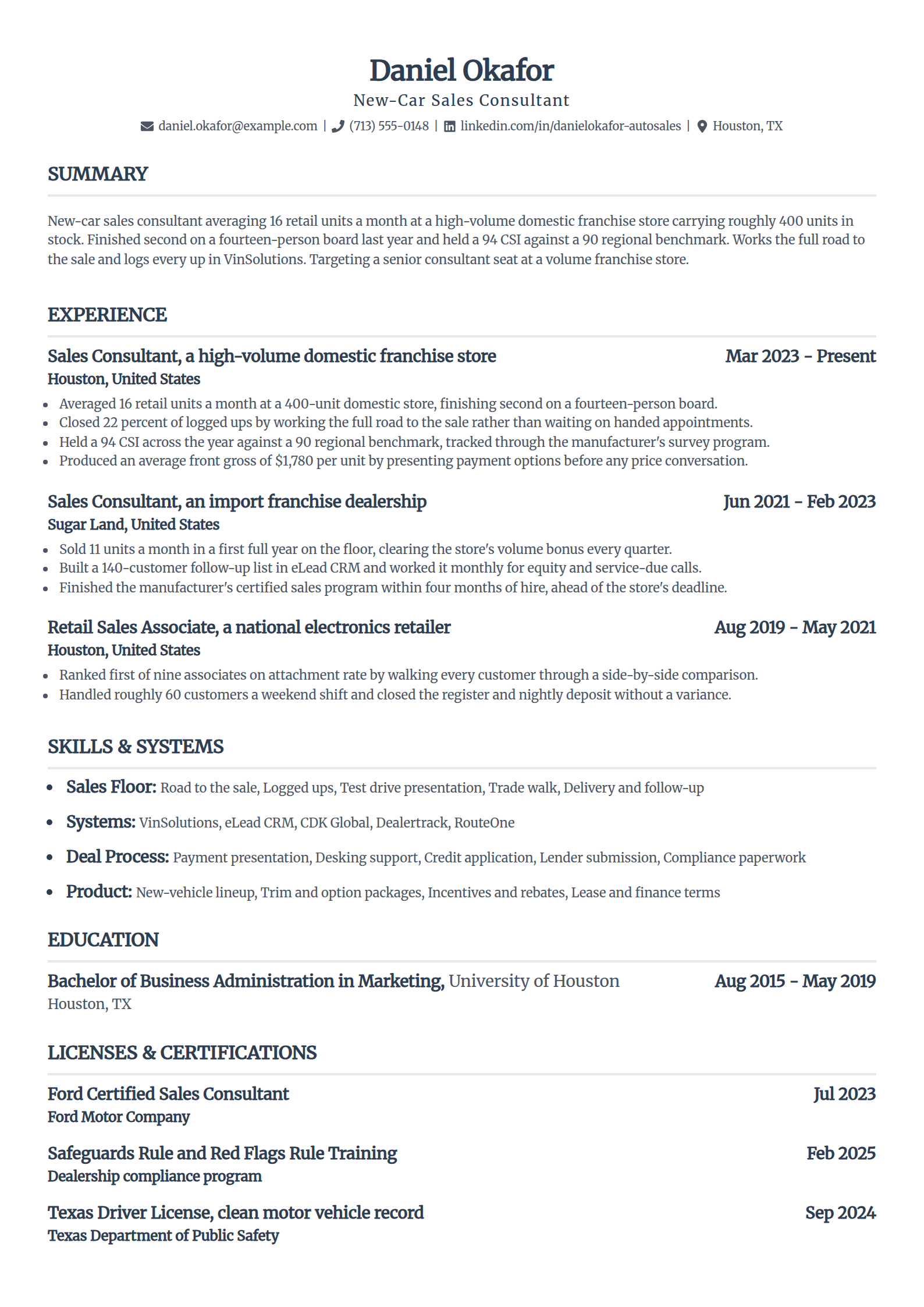
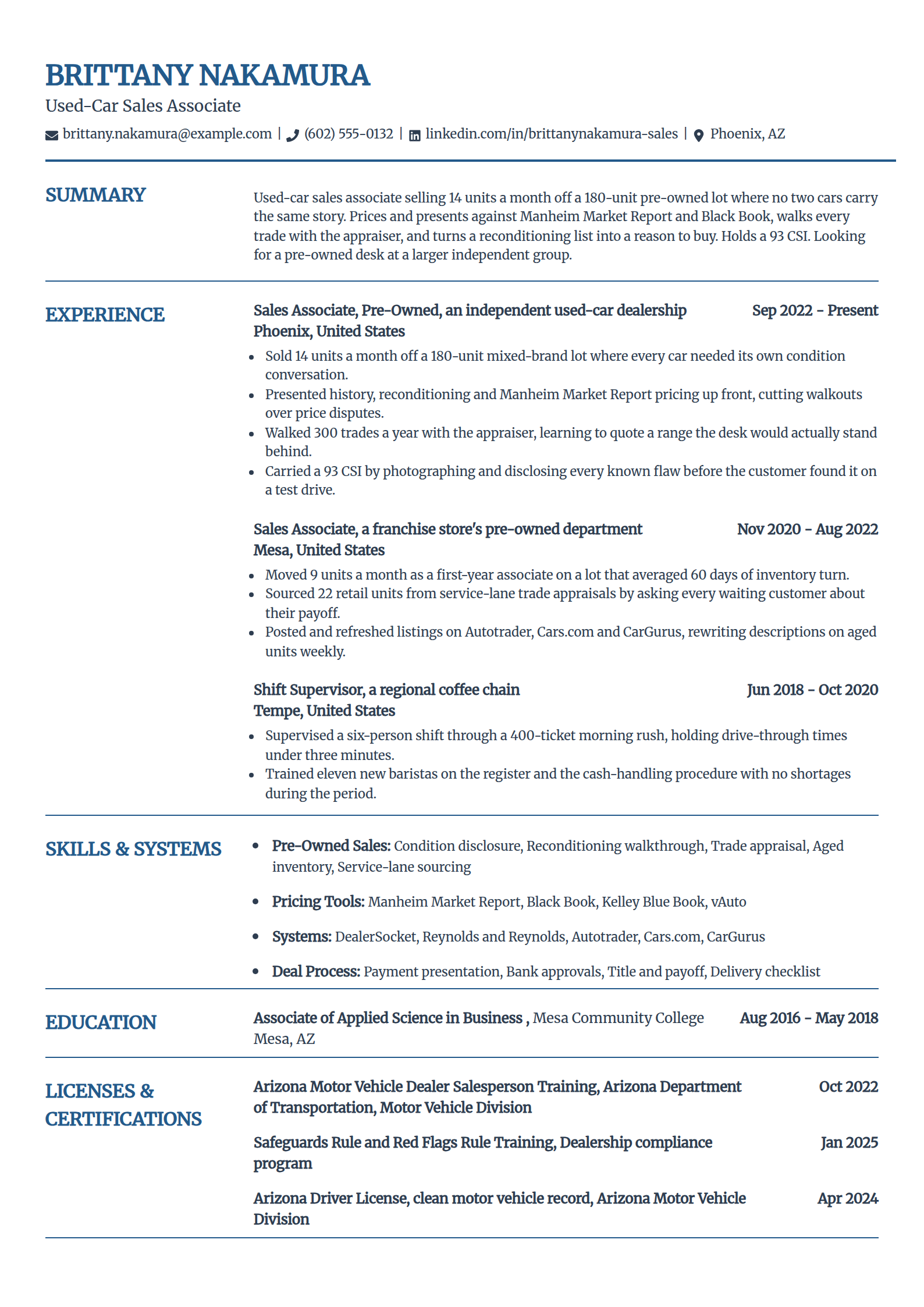
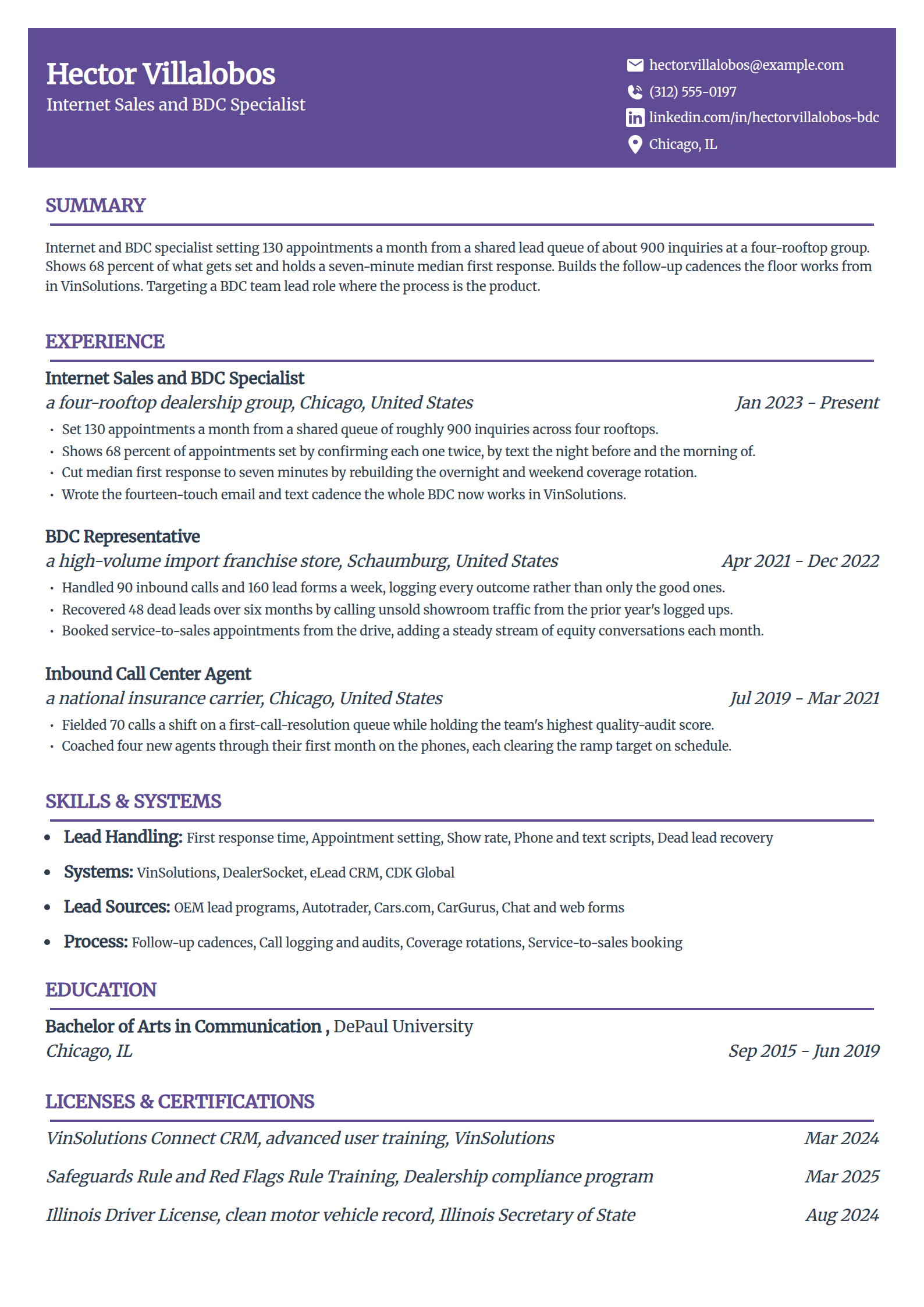
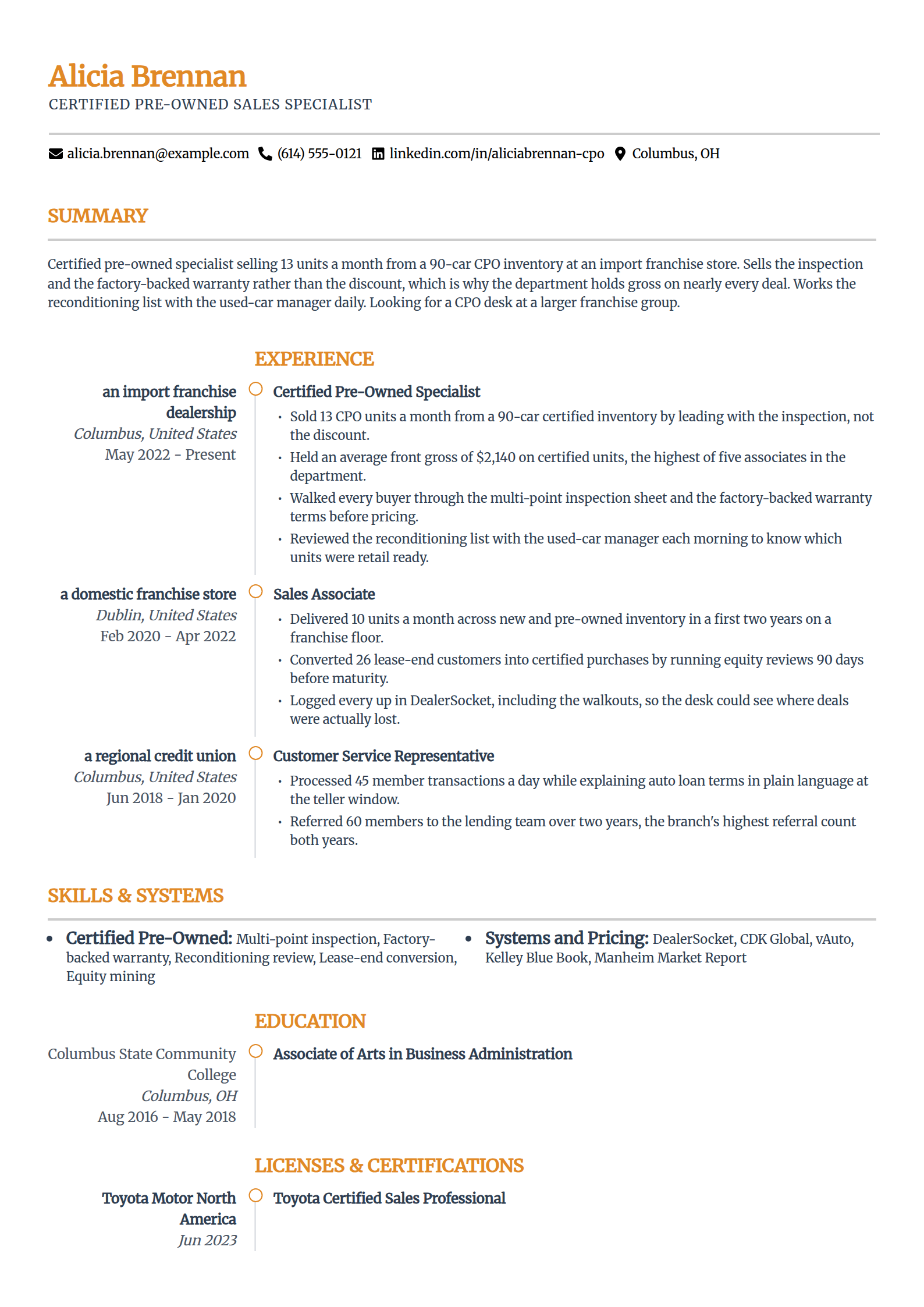
New-Car Sales Consultant Resume Template
Why this resume example works?
- Puts the unit count in the first line of the summary and the store's size right next to it, so the number means something.
- Gives the board position, second of fourteen, which is the comparison a sales manager would make anyway.
- States CSI against the benchmark it was measured on rather than quoting a bare score with nothing behind it.
- Names VinSolutions, eLead, CDK Global, Dealertrack and RouteOne outright, because postings are written as system lists.
- Keeps the retail job underneath with its attachment rate, which is where the comparison selling habit came from.
Used-Car Sales Associate Resume Template
Why this resume example works?
- Leads with the lot size and the mix, because selling 180 one-of-one cars is a different job from selling new inventory.
- Names Manheim Market Report, Black Book, Kelley Blue Book and vAuto, the tools a pre-owned desk actually prices against.
- Counts trades walked with the appraiser, which is how a used-car associate learns to quote a number that holds.
- Makes disclosure the selling point rather than an afterthought, which is what the CSI number on this resume is built on.
- Shows service-lane sourcing, the skill a used-car manager will hire for before anything else on the page.
Internet and BDC Sales Specialist Resume Template
Why this resume example works?
- Uses appointments set and shown instead of units, which is the right scoreboard for a BDC seat and the one postings name.
- States the show rate with the method underneath it: two confirmations, the night before and the morning of.
- Gives a median first response time in minutes, the number an internet director asks about before any other.
- Shows process ownership by naming the cadence this person wrote and the whole department now works.
- Keeps the call-center job visible, because phone volume and call quality scores transfer directly to this desk.
Certified Pre-Owned Specialist Resume Template
Why this resume example works?
- Separates certified inventory from general used stock, which is a real department split most resumes blur.
- Leads with the inspection and the factory-backed warranty rather than price, and the gross figure proves it worked.
- Shows the daily reconditioning review with the used-car manager, the detail that says this person has done the job.
- Counts lease-end conversions with the timing attached, 90 days before maturity, so the method is copyable.
- Carries the credit-union job underneath, where explaining loan terms at a teller window built the finance vocabulary.
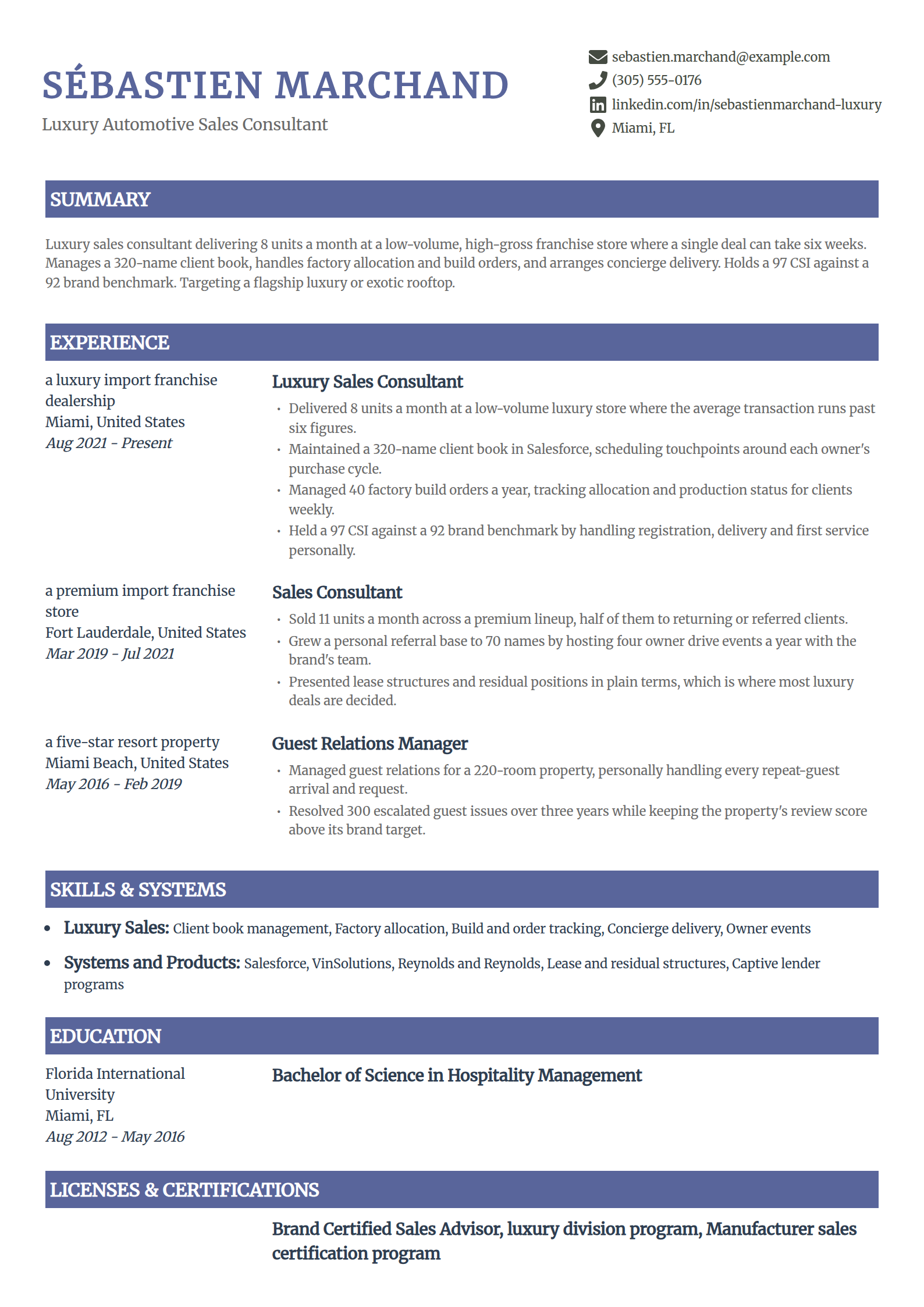
Luxury Automotive Sales Consultant Resume Template
Why this resume example works?
- Owns the lower volume instead of hiding it, and says why eight units a month is the right number at this kind of store.
- Sizes the client book at 320 names, which is the asset a luxury store is actually hiring when it hires a consultant.
- Names factory allocation and build-order tracking, the part of luxury selling that has nothing to do with the showroom.
- Puts CSI against a brand benchmark, because luxury brands score their stores harder than volume brands do.
- Keeps the hospitality background, which is where the standard of service a luxury floor expects was learned.
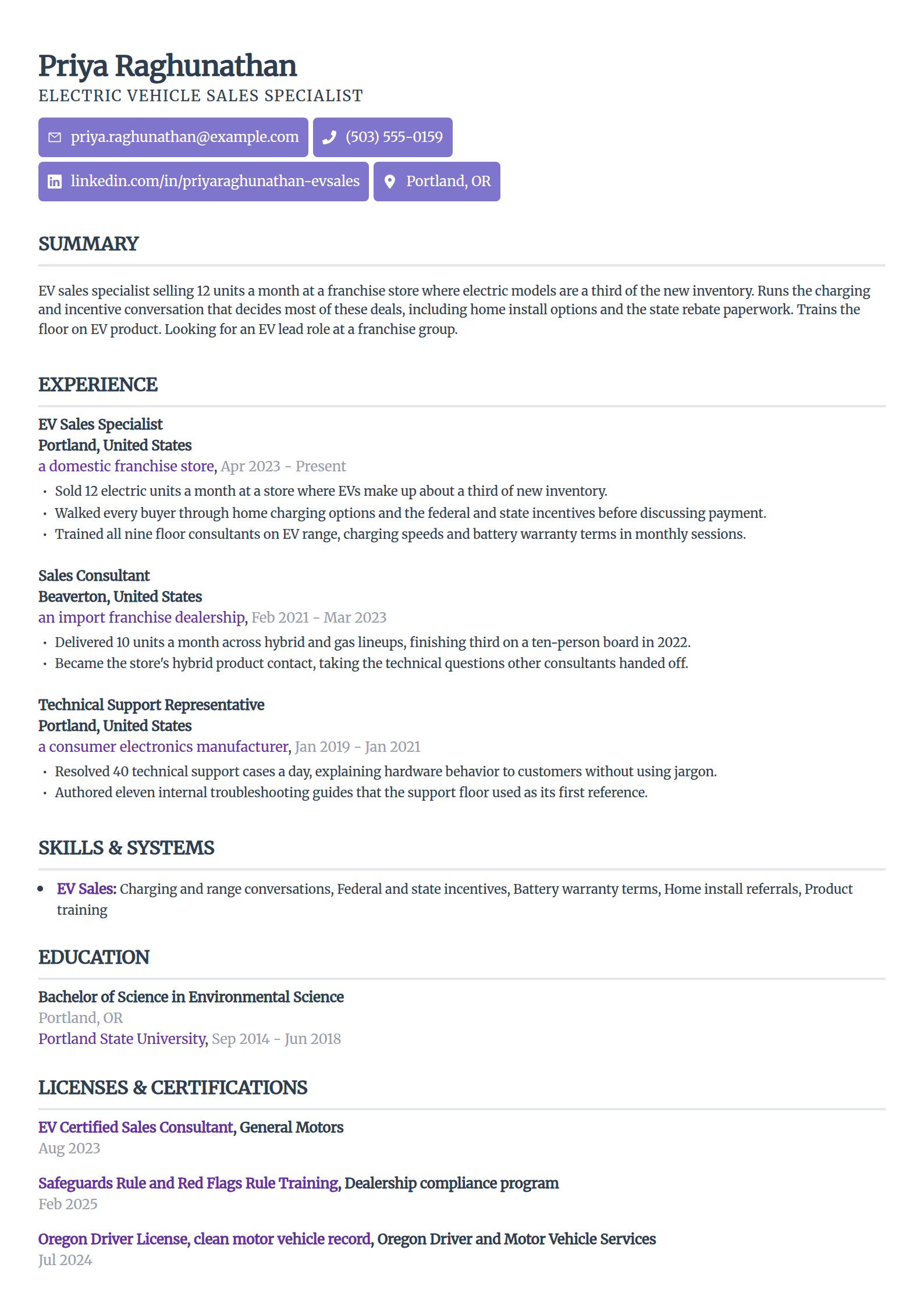
EV Sales Specialist Resume Template
Why this resume example works?
- Frames the job around the conversation that actually closes these deals, which is charging and incentives, not horsepower.
- Puts the share of inventory that is electric next to the unit count, so the volume reads correctly for the store.
- Shows floor training as a deliverable, which is how most EV specialist roles are written in the posting.
- Carries the manufacturer's EV certification, a credential a store cannot assign to an untrained consultant.
- Uses the technical support background to explain the one thing EV buyers ask about most, in plain language.
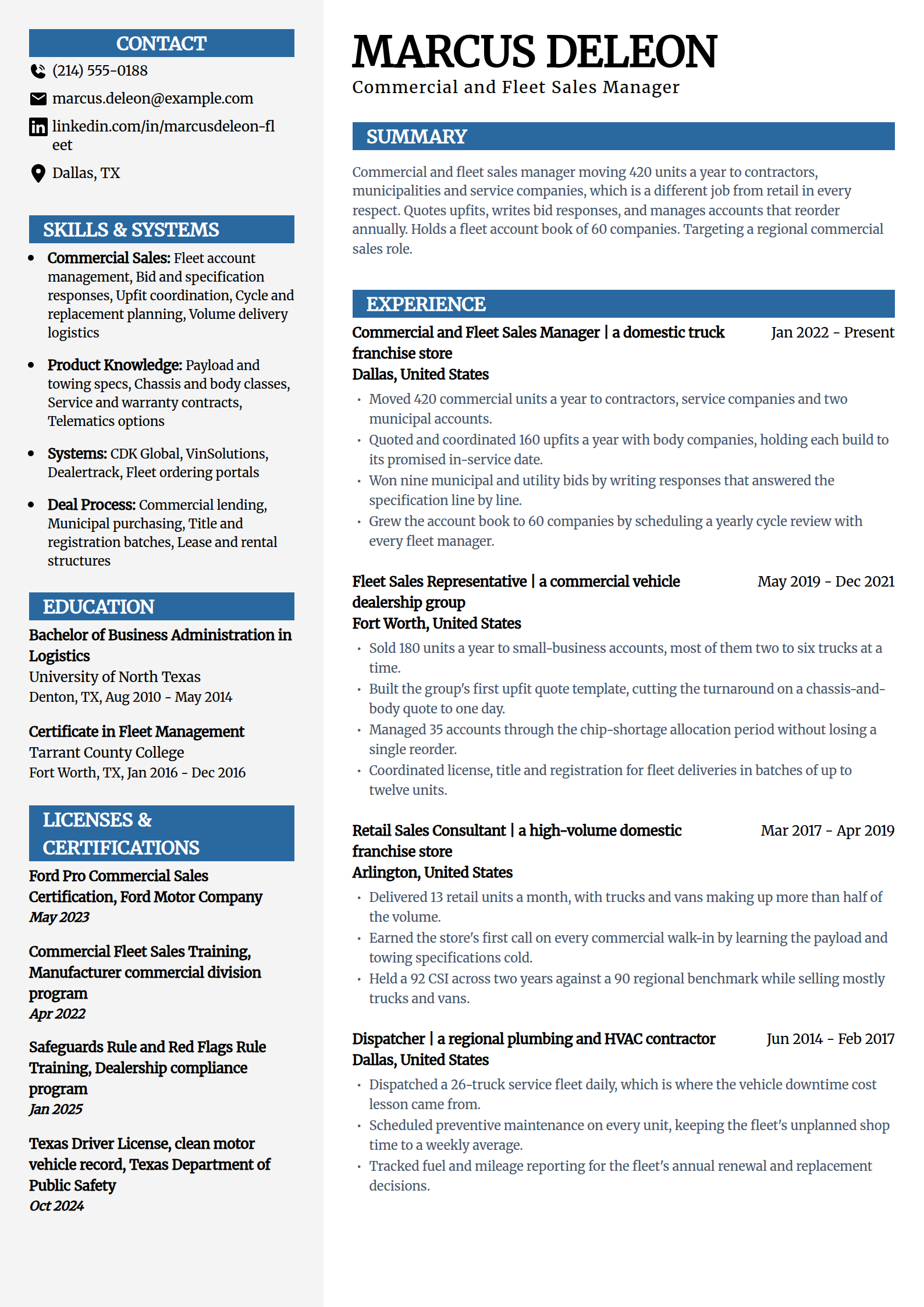
Commercial and Fleet Sales Resume Template
Why this resume example works?
- Counts units a year rather than a month, which is how commercial volume is actually measured and reported.
- Names upfits, bids and specification responses, the three pieces of fleet work that never appear on a retail resume.
- Sizes the account book at 60 companies and shows the yearly cycle review that keeps those accounts reordering.
- Keeps the dispatcher job, because managing a 26-truck fleet is why this person understands vehicle downtime cost.
- Shows municipal and utility bid wins, which is the credential a commercial department hires for outright.
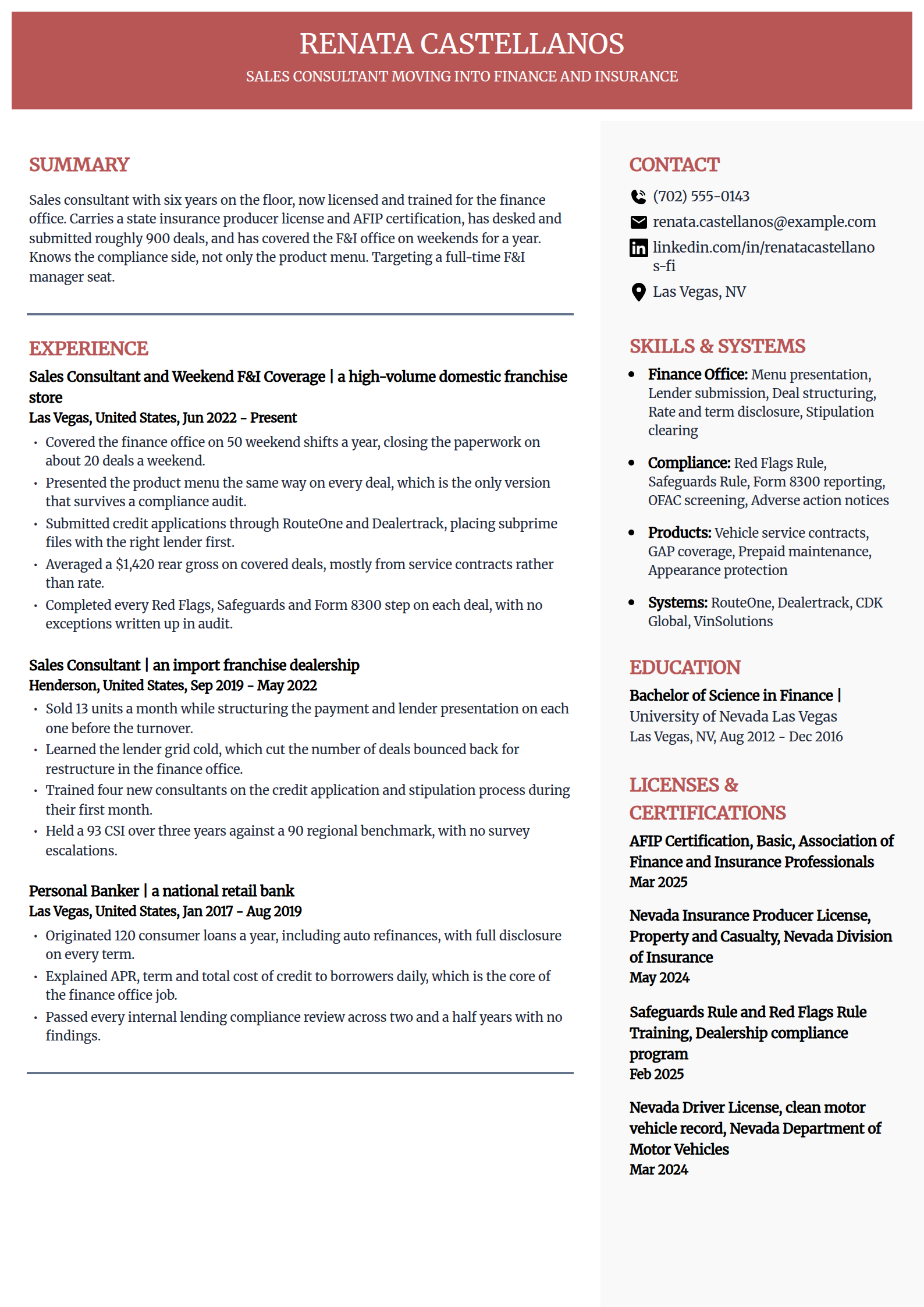
Finance and Insurance (F&I) Manager Resume Template
Why this resume example works?
- Leads with the license and the certification, because a finance office cannot hire someone who does not hold them.
- Counts weekend coverage shifts and deals closed on them, which is how most consultants actually earn the finance seat.
- States the rear gross and says where it came from, service contracts rather than rate, which is what a GM wants to hear.
- Names Red Flags, Safeguards and Form 8300 by name, the compliance steps an F&I audit checks line by line.
- Uses the banking background to show the disclosure habit a finance office is legally required to keep.
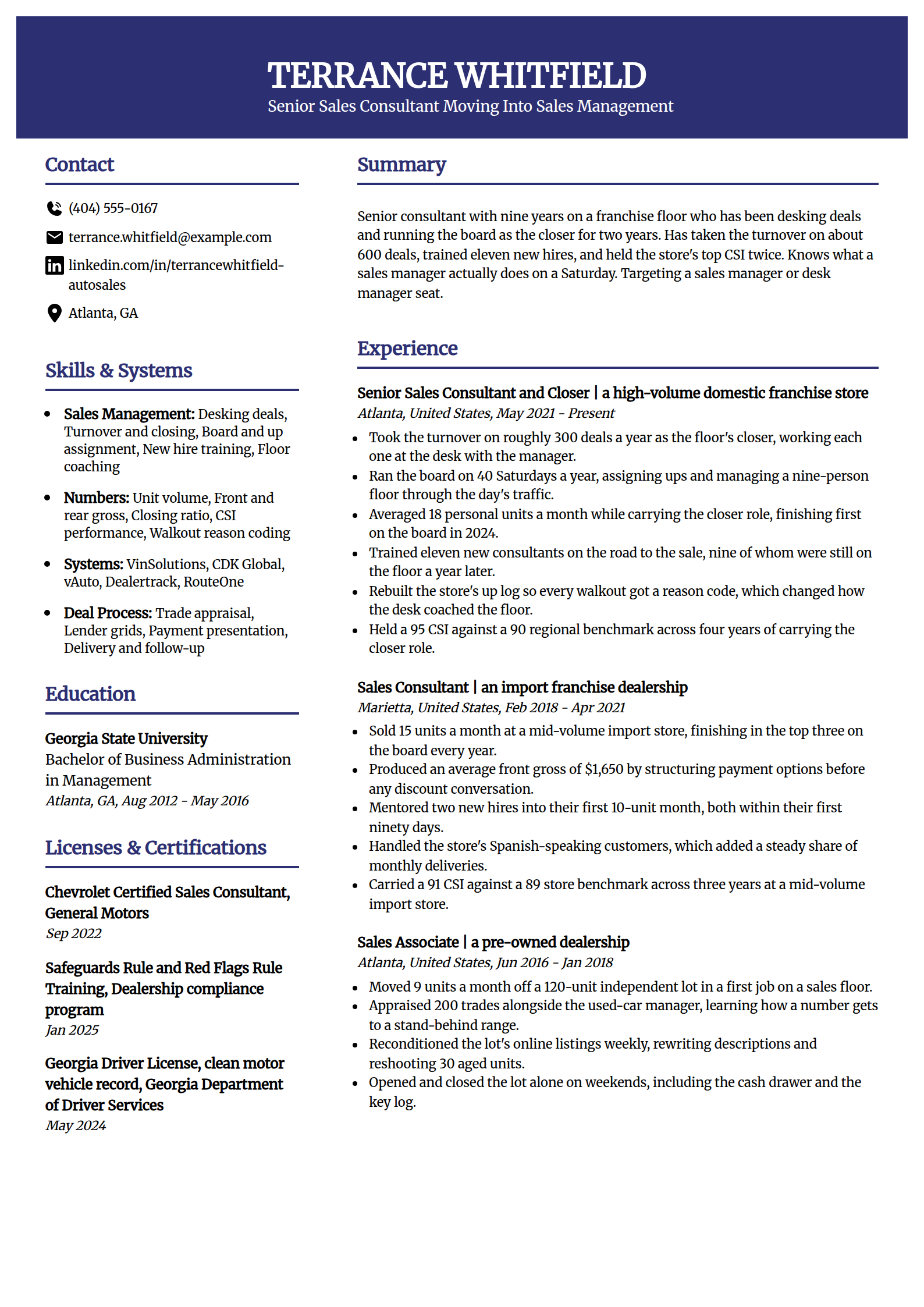
Car Sales Manager Track Resume Template
Why this resume example works?
- Shows the management work already being done, taking turnover and running the board, instead of asking to be given it.
- Keeps the personal unit count visible, because a desk manager who could not sell is not a credible hire.
- Counts people trained and how many stayed a year, which is the number that separates training from onboarding.
- Names a process this person changed, the up log with reason codes, which is exactly what a desk manager does.
- Carries the independent-lot start, where appraising 200 trades taught what a number has to survive.
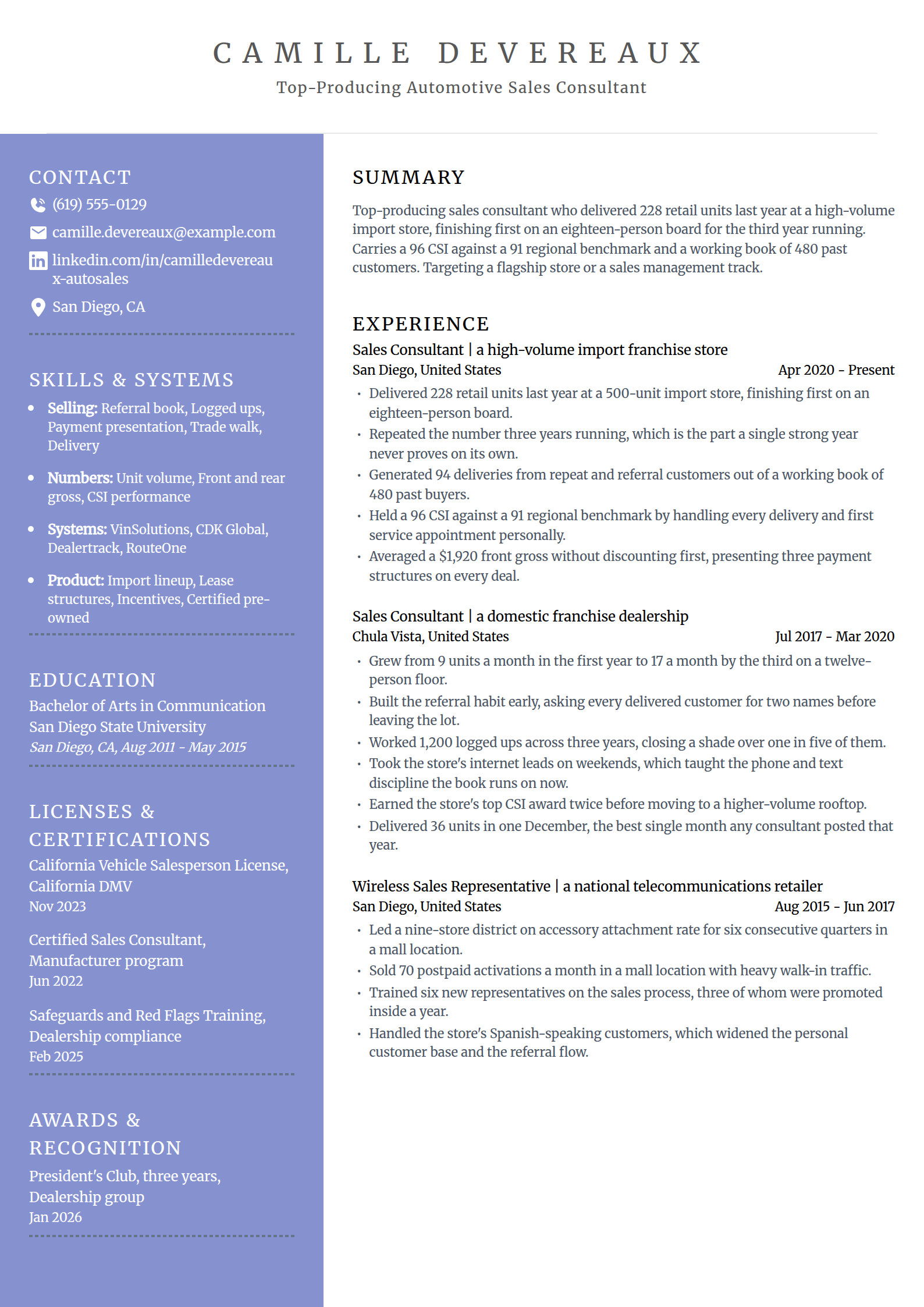
Top-Producing Car Sales Resume Template
Why this resume example works?
- States the annual number, 228 units, and then the fact that matters more: it repeated three years running.
- Gives the store size so the volume reads as a real achievement rather than a number with no scale behind it.
- Breaks out repeat and referral deliveries from the total, which is what a sales manager reads as durable business.
- Shows the first-year number too, nine a month, so the growth curve is visible instead of implied.
- Puts the recognition in an awards section where it belongs, with the year, rather than inside a summary adjective.
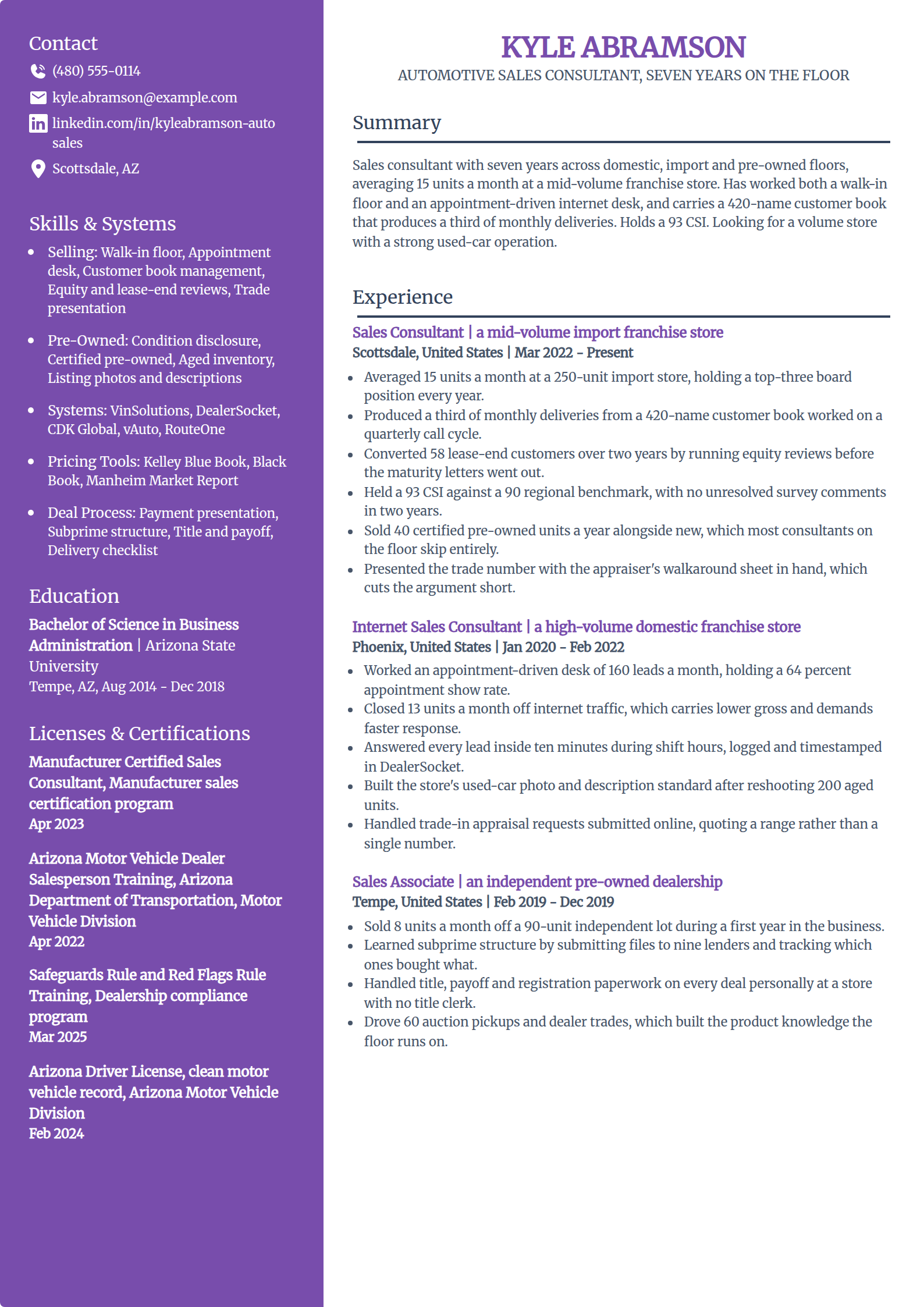
Experienced Car Sales Consultant Resume Template
Why this resume example works?
- Covers both floors this person has worked, walk-in and appointment-driven, because they are different skills.
- Attributes a third of monthly deliveries to a named book size, which turns a vague claim into a measurable one.
- Shows the equity and lease-end habit with its timing, before the maturity letters go out, so a reader can copy it.
- Admits internet traffic carries lower gross, which reads as someone who has actually worked that desk.
- Keeps seven years to one page by dropping detail from the oldest job rather than the context from the recent one.
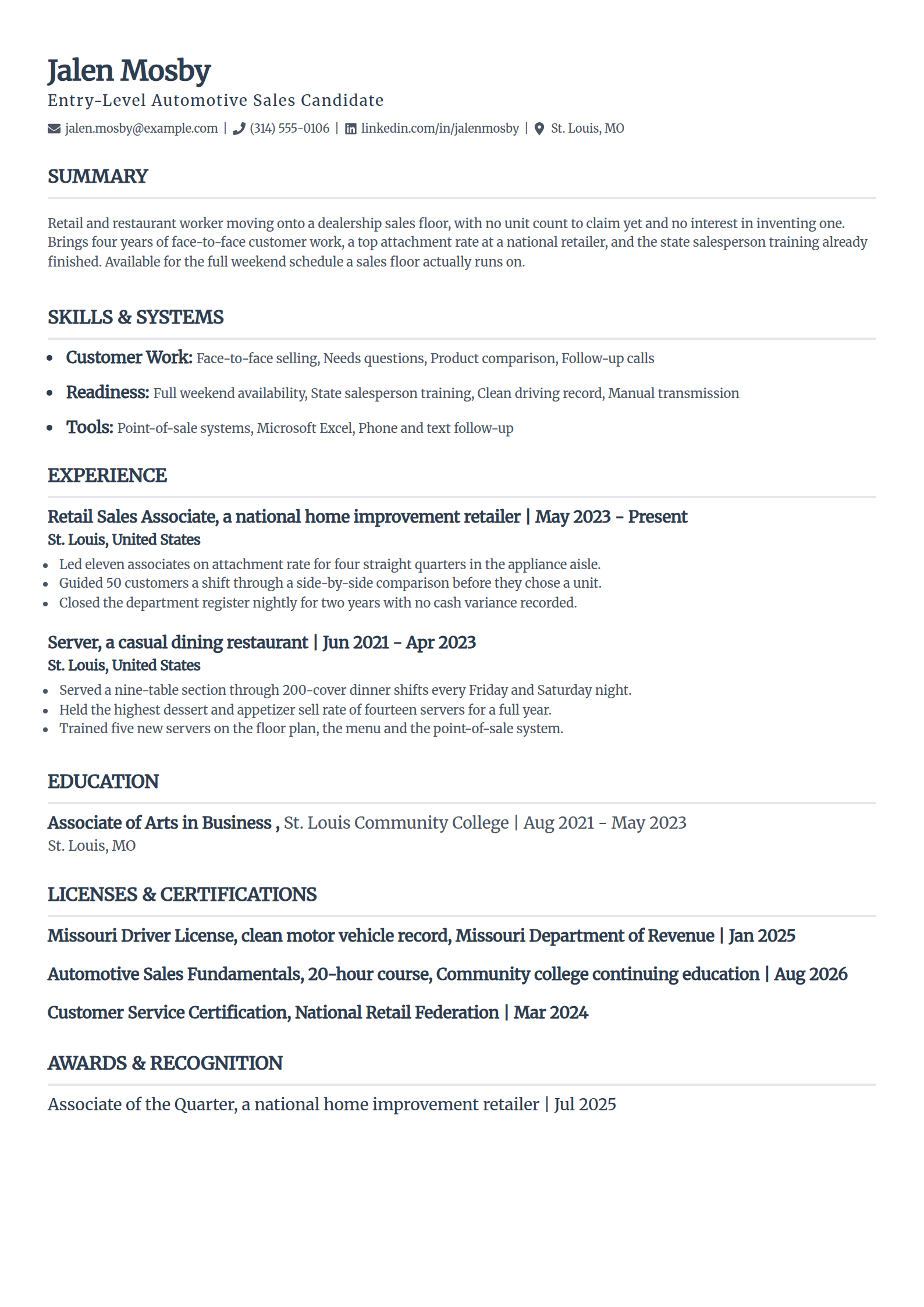
Car Sales Resume Template With No Experience
Why this resume example works?
- Leads with skills rather than experience, correctly, because there is no sales record on a dealership floor yet.
- Says in the summary that there is no unit count and that none will be invented, which is the honest opening here.
- Counts what the previous jobs actually counted: attachment rate, customers per shift, register variance, sell rate.
- Puts weekend availability on the page, because a sales manager screens for it before almost anything else.
- Shows the state salesperson training already finished, which removes a reason not to interview this candidate.
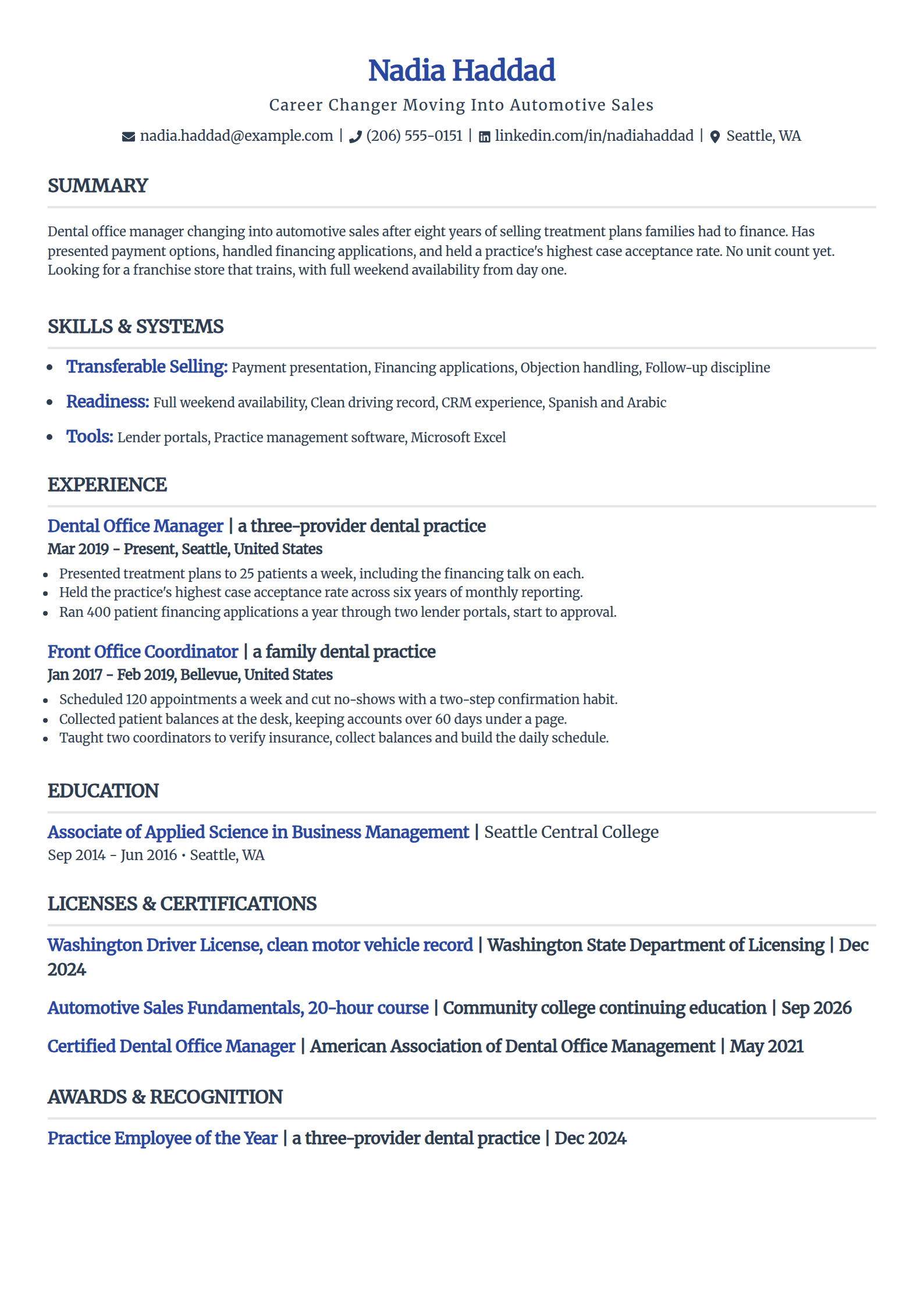
Career Change to Car Sales Resume Template
Why this resume example works?
- Translates the old job into the three things car sales is made of: payment presentation, financing, follow-up.
- Names the previous work plainly rather than disguising it, which no hiring manager has ever been fooled by.
- Counts financing applications processed, the closest real analogue to a credit application on a dealership desk.
- Leads with skills, the second of only two examples on this page that should, and says why in the summary.
- Lists the languages spoken, which on a sales floor is a direct and immediate contribution to volume.
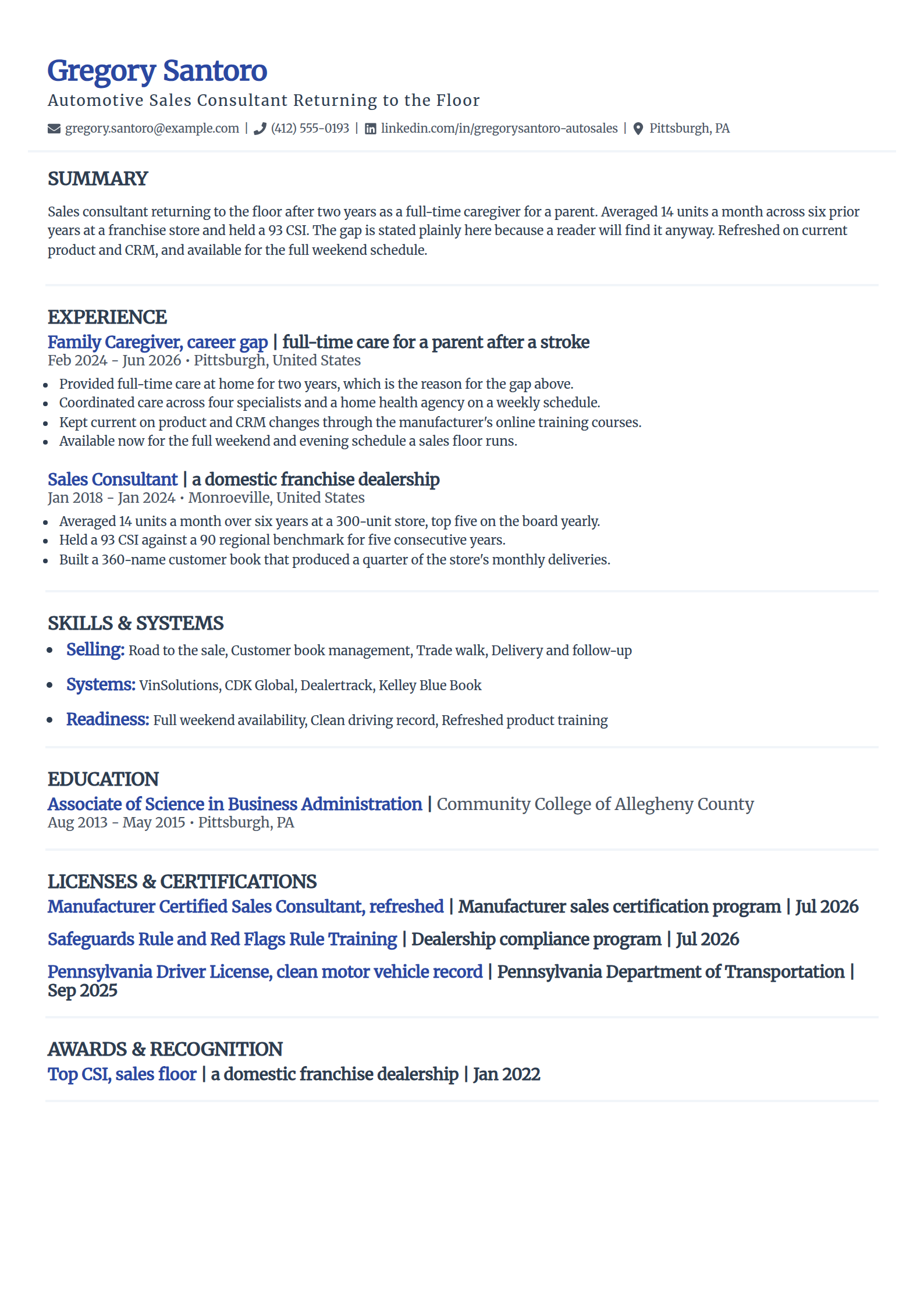
Returning to Car Sales After a Gap Resume Template
Why this resume example works?
- Puts the gap on the page as a dated entry with the reason stated, instead of leaving a hole for a reader to guess at.
- Keeps the prior six years and their numbers directly underneath, so the record is the first thing after the gap.
- Shows the product and CRM refresh, which answers the only real objection to hiring someone back onto a floor.
- States current availability for the full weekend schedule, the practical question behind the objection.
- Carries the customer book size forward, because that book is what makes this candidate worth more than a new hire.
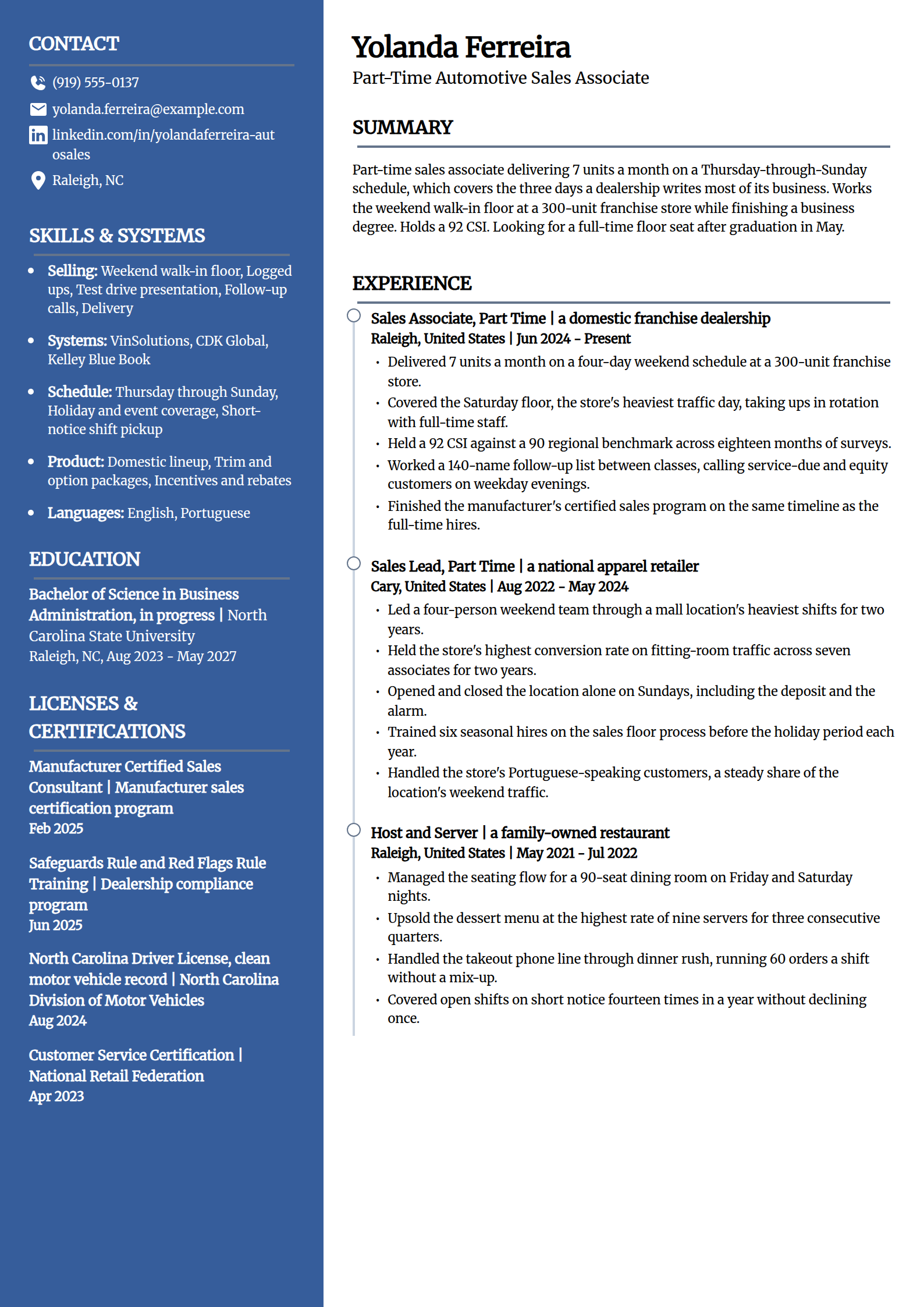
Part-Time Car Sales Associate Resume Template
Why this resume example works?
- States the schedule in the summary, Thursday through Sunday, which covers the days a dealership writes most business.
- Gives the part-time unit count without apologizing for it, and the store size that makes it readable.
- Shows the same manufacturer certification the full-time hires completed, on the same timeline.
- Counts follow-up work done on weekday evenings, which answers the usual doubt about part-time coverage.
- Names the graduation date, so a sales manager can see exactly when this becomes a full-time candidate.
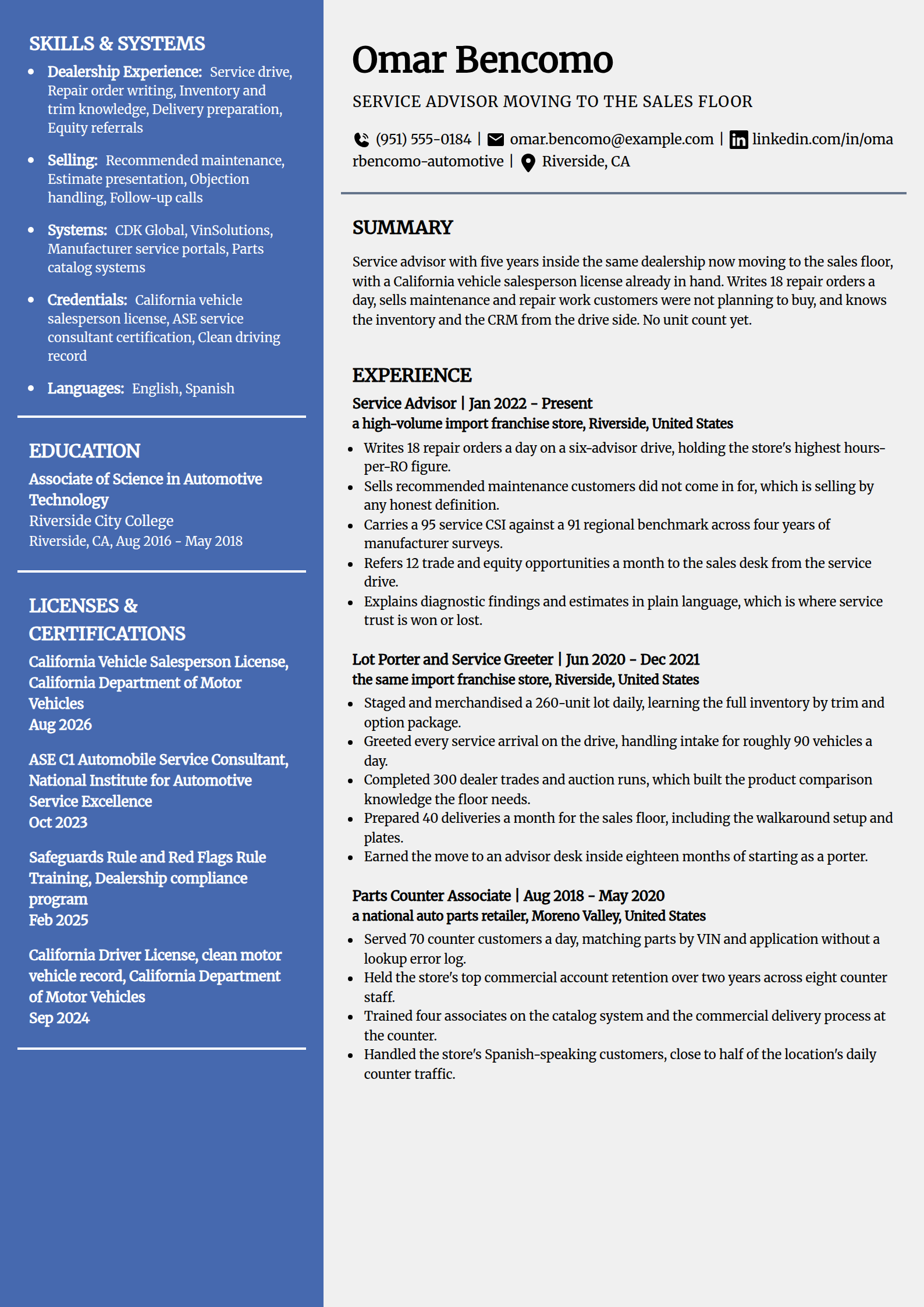
Service Advisor to Car Sales Resume Template
Why this resume example works?
- Keeps experience first, correctly, because dealership experience is this candidate's whole argument even without units.
- Makes the case in one line: selling recommended maintenance customers did not come in for is selling.
- Counts trade and equity referrals already sent to the sales desk, which is sales production under another name.
- Shows the porter start and the move to an advisor desk, which is the promotion path a store already believes in.
- Puts the state salesperson license on the page, so the only administrative blocker to the move is already cleared.
Build your car sales resume
Start from the desk you are applying to, put your own units, gross and CSI in place of the example numbers, and the editor holds the one-page layout a dealer portal can parse.
Build my resumeHow to write a car sales resume
Everything a dealership wants to know about you is already counted somewhere: the sales log, the CRM, the manufacturer's survey, the month-end board. The job of this resume is to move those numbers onto one page in the order a sales manager reads them.
Put the unit count first, and put the store next to it
Open the summary with units a month or units a year, then say what store that was at. Twelve a month at a 400-unit domestic store and twelve a month at a low-volume luxury store are different achievements, and a sales manager reading your page knows it.
Averaged 16 retail units a month at a 400-unit domestic store, finishing second on a fourteen-person board.
What makes a unit count readable to someone who has never seen your store:
- The store's volume tier or inventory size, which is the scale the number sits on.
- The brand type: domestic, import, luxury, independent pre-owned. Each one sells at a different pace.
- Where you finished on the board, and out of how many people, if that comparison helps you.
- New, used or both. A mixed number without that split invites a question you will not be there to answer.
Use the numbers your store already keeps, not percentages against a target
Exceeded quota by 150% is the most common line on published car sales examples and it is the least believable, because a store target moves every month and nobody outside your dealership knows what yours was. Counted numbers survive an interview; derived ones do not.
The numbers a dealership will recognize immediately:
- Units delivered, by month or by year, with the store's size beside them.
- Front and rear gross, or PVR, which is what the deal was worth to the store rather than to you.
- Closing ratio off logged ups, which separates working a floor from being handed appointments.
- CSI, always with the benchmark it was measured against. A bare score tells a reader nothing.
- Appointments set and appointment show rate, if you are applying to an internet or BDC desk.
- Repeat and referral deliveries, which is the number that proves the business is durable.
Lead with experience, unless you have no sales record and no dealership experience
A car sales resume is read for a record, so experience goes above skills on almost every version of this page. Fourteen of the sixteen examples here are built that way.
On this page two examples lead with skills instead. Use that order only when:
- You have never sold on a dealership floor and have never worked inside a store in any department.
- You are changing careers and the transferable competence is the actual argument for interviewing you.
- Coming off the service drive, the parts counter or the lot does NOT qualify: that experience is your argument, so it leads.
- Either way, say in the summary that there is no unit count yet. Inventing one is the fastest way to lose the interview.
Name the systems the way the posting names them
Dealership postings are written as system lists, and the stack differs by department. Listing the wrong one tells a reader you have not worked where you say you have.
Match the systems to the desk you are applying to:
- Floor and CRM: VinSolutions, DealerSocket, eLead CRM, and the DMS, usually CDK Global or Reynolds and Reynolds.
- Finance office: RouteOne and Dealertrack, plus the lender grid and the stipulation process.
- Pre-owned: vAuto, Manheim Market Report, Black Book, Kelley Blue Book, and the listing sites you merchandise on.
- Internet and BDC: the lead sources by name, plus whatever you log response times and outcomes in.
- Say what you did in each one. Logged every up in VinSolutions beats a software line with four names on it.
Put licensing and certification where a screener will find them
Several states license vehicle salespeople directly, and a finance office generally requires a state insurance producer license on top of that. Check what your state requires before you apply, because the requirement genuinely varies.
What belongs in the licenses and certifications block:
- Your state salesperson license, if your state issues one, with the year.
- Manufacturer sales certification, which most franchise stores require inside the first few months anyway.
- A state insurance producer license and AFIP certification if you are going for a finance office seat.
- Compliance training: Safeguards Rule, Red Flags Rule, and Form 8300 reporting.
- A clean driving record. You will be test driving with customers, so a screener checks it either way.
Write a summary that states the record in three to four sentences
Fifty to seventy words, opening with what you sell and how much of it rather than with an adjective. Every summary on this page is built that way, and none of them opens with a word like driven or results-oriented.
New-car sales consultant averaging 16 retail units a month at a high-volume domestic franchise store carrying roughly 400 units in stock. Finished second on a fourteen-person board last year and held a 94 CSI against a 90 regional benchmark. Works the full road to the sale and logs every up in VinSolutions. Targeting a senior consultant seat at a volume franchise store.
What a car sales summary has to carry:
- The department and the unit count, with the store context attached.
- One more counted number: gross, CSI against its benchmark, closing ratio, or book size.
- The systems and credentials a posting would name.
- The seat you want next, stated as a kind of store rather than as a wish.
Keep it to one page in a layout a dealer portal can read
Every example on this page is one page, including a consultant with seven years and one with 228 units in a year. Dealership applications usually go through a portal before a human sees them, so the layout has to survive parsing.
What keeps a car sales resume parseable:
- Standard section headings, with experience headed Experience rather than something invented.
- A single column, or a clean two-column layout with the jobs on the wide side.
- Real text rather than numbers inside images, and one date format down the whole page.
- Running out of room? Cut detail from the oldest job, never the store context from the recent ones.
Common car sales resume mistakes
- A unit count with no store behind it. Sixteen a month means one thing at a 400-unit domestic store and something else entirely at a luxury rooftop that keeps thirty cars in stock. Put the volume tier, the brand type or the board position next to every number you claim.
- Percentages against a target nobody can see. Exceeded quota by 150% is the most common line on published car sales examples and the least credible, because store targets move monthly. Use the numbers the store already keeps: units, gross, logged ups, CSI, appointments, referrals.
- A skills section made of personality. Motivated, driven, people person and results-oriented appear on every resume in the stack and screen for nothing. Replace them with the road to the sale, trade appraisal, desking, equity mining, and the CRM you logged every up in.
- Borrowing a sales record you do not have. Candidates applying for a first dealership job sometimes claim a unit count from a retail job. It falls apart in the first interview question. Count what your job actually counted, and say plainly that the dealership number is still to come.
- One resume for every department. A BDC desk is measured on appointments shown, a fleet seat on bids and upfits, a finance office on product penetration and compliance. Sending a retail floor resume to any of those tells the hiring manager you did not read the posting.
Frequently asked questions
What should a car salesman resume include?
A car sales resume needs a three-to-four-sentence summary that opens with your unit count and the store it was earned at, an experience section listing each dealership with counted numbers underneath, a skills block naming the CRM and DMS you worked in, education, and a licenses and certifications block. The numbers are the part most resumes get wrong: units delivered with the store's volume beside them, front and rear gross, closing ratio off logged ups, CSI against the benchmark it was measured on, and repeat or referral deliveries. Add your state salesperson license if your state issues one, your manufacturer sales certification, and a clean driving record. One page is enough at any level, including seven years and multiple stores.
How do you put car sales numbers on a resume?
Use the numbers your store already keeps and give each one its context. Write units a month or units a year with the store's inventory size or volume tier next to it, because twelve a month at a 400-unit domestic store and twelve at a low-volume luxury store are different achievements. Add front and rear gross, your closing ratio off logged ups, and your CSI with the benchmark it was scored against. Avoid percentages against a target: exceeded quota by 150% is the most common line on published examples and the least believable, since store targets move every month and no one outside your dealership knows what yours was. If you are applying to an internet or BDC desk, appointments set and appointment show rate replace the unit count entirely.
How do you write a car salesman resume with no experience?
Lead with skills instead of experience, which is the one case where that order is right, and say in the summary that you have no unit count yet rather than inventing one. Then count what your previous jobs actually counted: customers handled per shift, attachment or sell rate, register accuracy, repeat customers, anything your employer measured. Retail, restaurant, call center and front-desk work all transfer, because they are face-to-face selling and follow-up under time pressure. Put your weekend and evening availability on the page, since a sales manager screens for schedule before almost anything else, and add any state salesperson training you have already finished. Two examples on this page are built exactly this way.
Do you need a license to sell cars?
It depends on your state. Several states license vehicle salespeople directly, with their own application, a background check, a renewal cycle and in some cases continuing education for used-vehicle salespeople, while other states leave licensing with the dealership rather than the individual. Check your own state's motor vehicle agency before you apply, because the requirement genuinely varies and a dealership will expect you to know. If you are going for a finance office seat, that is separate: F&I work generally requires a state insurance producer license as well, since you are selling insurance-backed products. Put whichever licenses you hold in a licenses and certifications block with the year, where a screener will find them.
What skills should a car salesman put on a resume?
Name the work and the systems, not personality traits. The work is the road to the sale, logged ups, test drive presentation, trade walk and appraisal, payment presentation, desking support, delivery, and the follow-up and equity calls that produce repeat business. The systems are the CRM and DMS by name, usually VinSolutions, DealerSocket or eLead CRM alongside CDK Global or Reynolds and Reynolds, plus RouteOne and Dealertrack for credit submission and vAuto, Manheim Market Report, Black Book or Kelley Blue Book for pre-owned pricing. Match the list to the desk you are applying to, because a fleet seat and a finance office use almost none of the same tools. Leave out motivated, driven and people person; every resume in the stack has them.
How long should a car sales resume be?
One page, at every level. Every example on this page is a single page, including a consultant with seven years across three stores and a top producer with 228 units in a year. Dealership applications usually pass through a portal before a person reads them, so a clean one-page layout with standard headings parses more reliably than a two-page page with a creative structure. If you are running out of room, cut detail from your oldest job rather than the store context from the recent ones, because that context is what makes your numbers readable. A longer history can come up in the interview, where you will have the sales log in front of you anyway.
More car salesman resume resources
Build your car sales resume
Start from the desk you are applying to, put your own units, gross and CSI in place of the example numbers, and the editor holds the one-page layout a dealer portal can parse.