17 College Student Resume Examples, No Experience to Internships
- ATS Friendly
- Internship Ready
- 17 Real Examples
A college student resume example should show your school and expected graduation year up top, then experience built from internships, class projects, research, campus jobs, and volunteering, each with a result and one honest number, on one ATS-safe page. Every example below is a full resume in that shape, written for a specific year and major. Pick the layout that fits, then swap in your own coursework, projects, and numbers.


540k+ resumes created
Editable college student resume templates
Each template below is a real college resume laid out in that format, sorted by the kind of student you are. Choose one, then swap in your own education, projects, internships, and skills. Every layout keeps your name, contact details, and section headings clean so a recruiter or campus career coach reads your background at a glance.
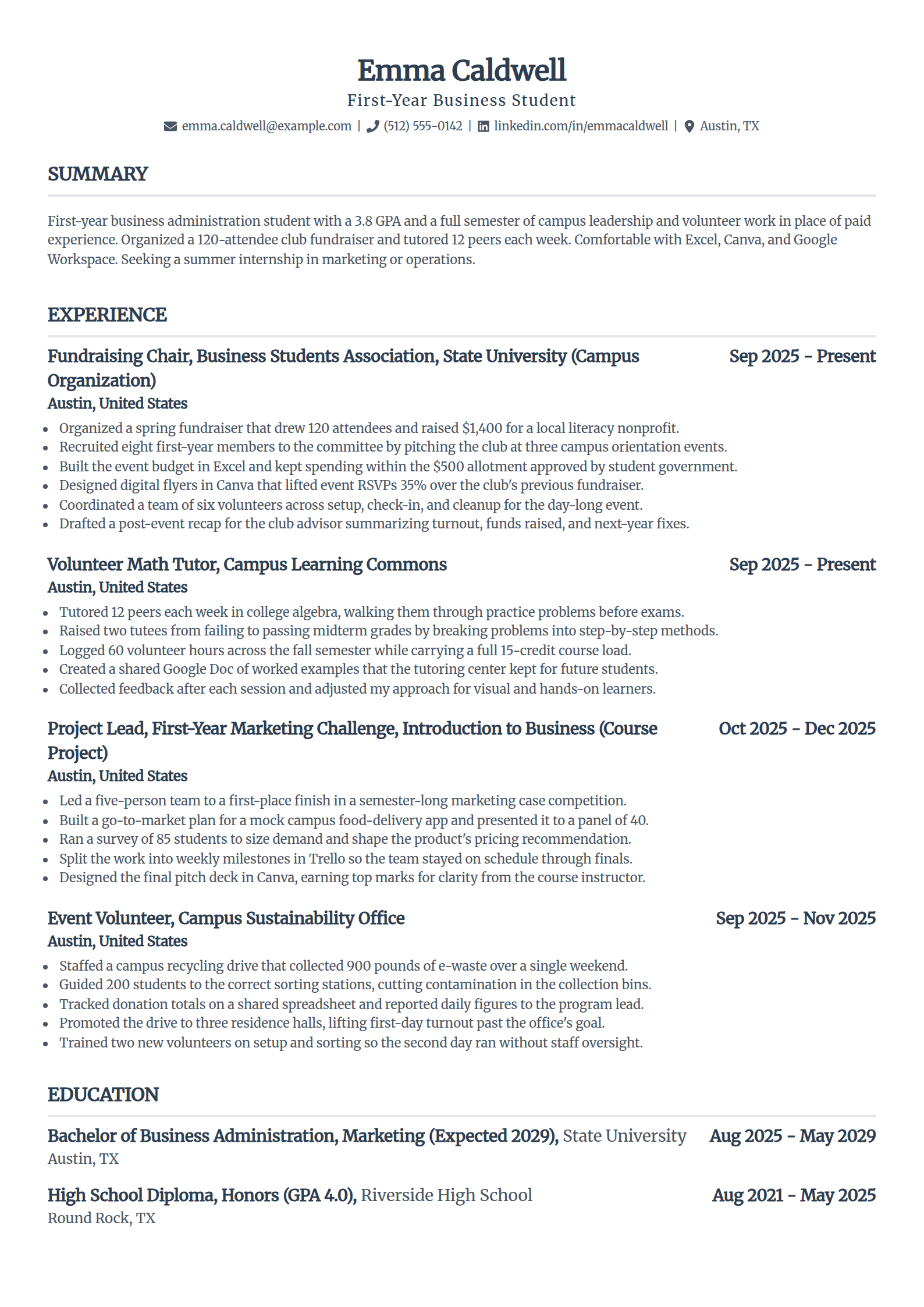
First-Year College Student Resume Template (No Experience)
16 more examples for a completely blank work history →
Why this resume example works?
- Opens with a summary that names her year, major, and 3.8 GPA, then admits up front that campus and volunteer work stands in for a paid job.
- Treats a club role, a tutoring commitment, a class project, and an event as real experience entries, the honest fix for having no job yet.
- Leads every bullet with a strong verb and one modest number, like a $1,400 fundraiser or 60 volunteer hours, never a corporate metric.
- Keeps high school in the education section, which a first-year can legitimately still include beside the university line.
- Uses a clean single-column layout that a parser reads top to bottom without tripping on graphics.
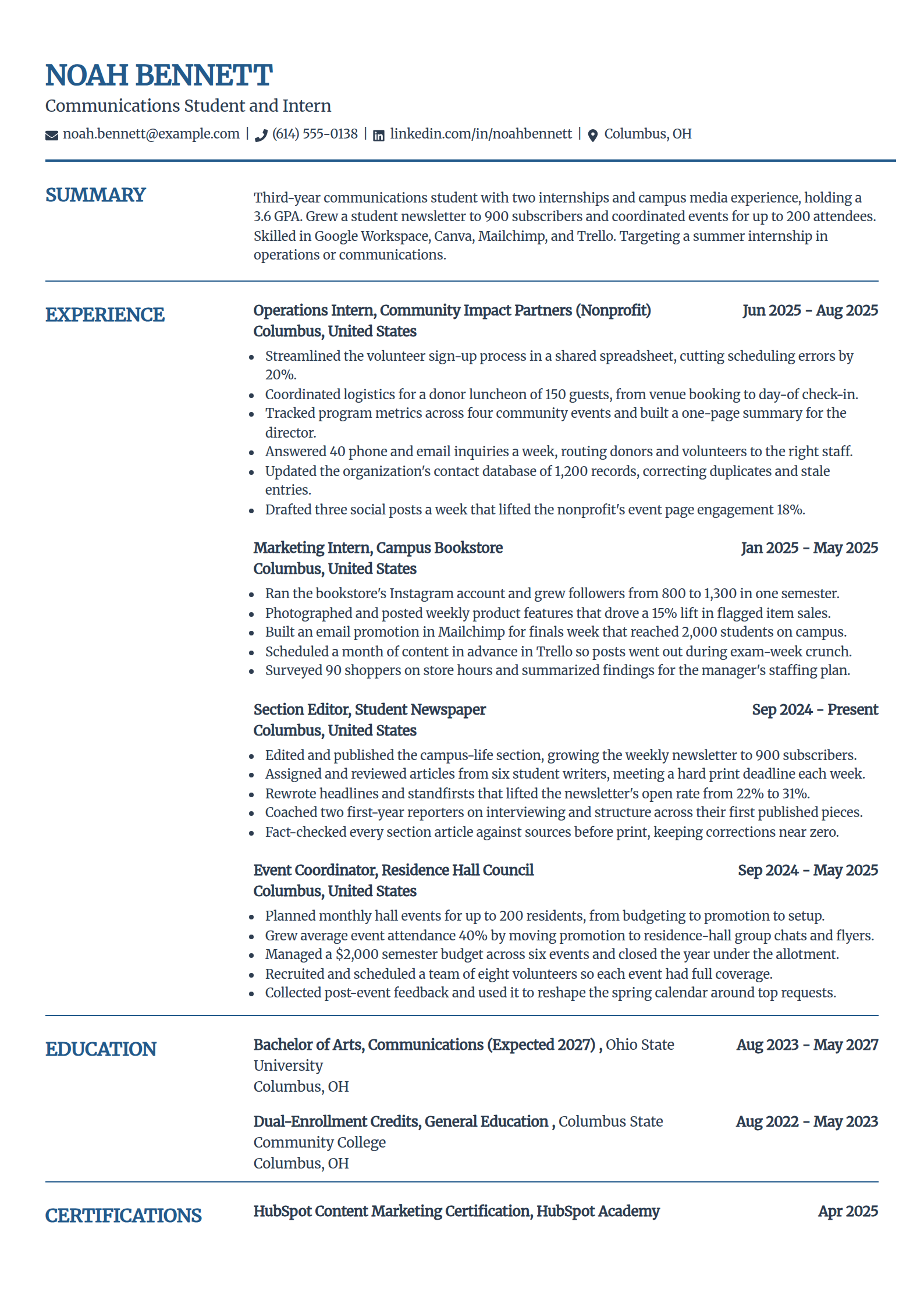
Internship Resume Template
Why this resume example works?
- Frames a junior with two internships plus campus media, the mix most internship applicants actually have.
- Names each internship title fully, Operations Intern and Marketing Intern, so the role reads clearly instead of just Intern.
- Backs each entry with a result, a newsletter grown to 900 subscribers or a 40% attendance lift, not a list of duties.
- Lists real tools an internship posting names, Mailchimp, Trello, and Google Analytics, in a scannable skills block.
- Fills a dense layout with four entries so the page reads complete without padding.
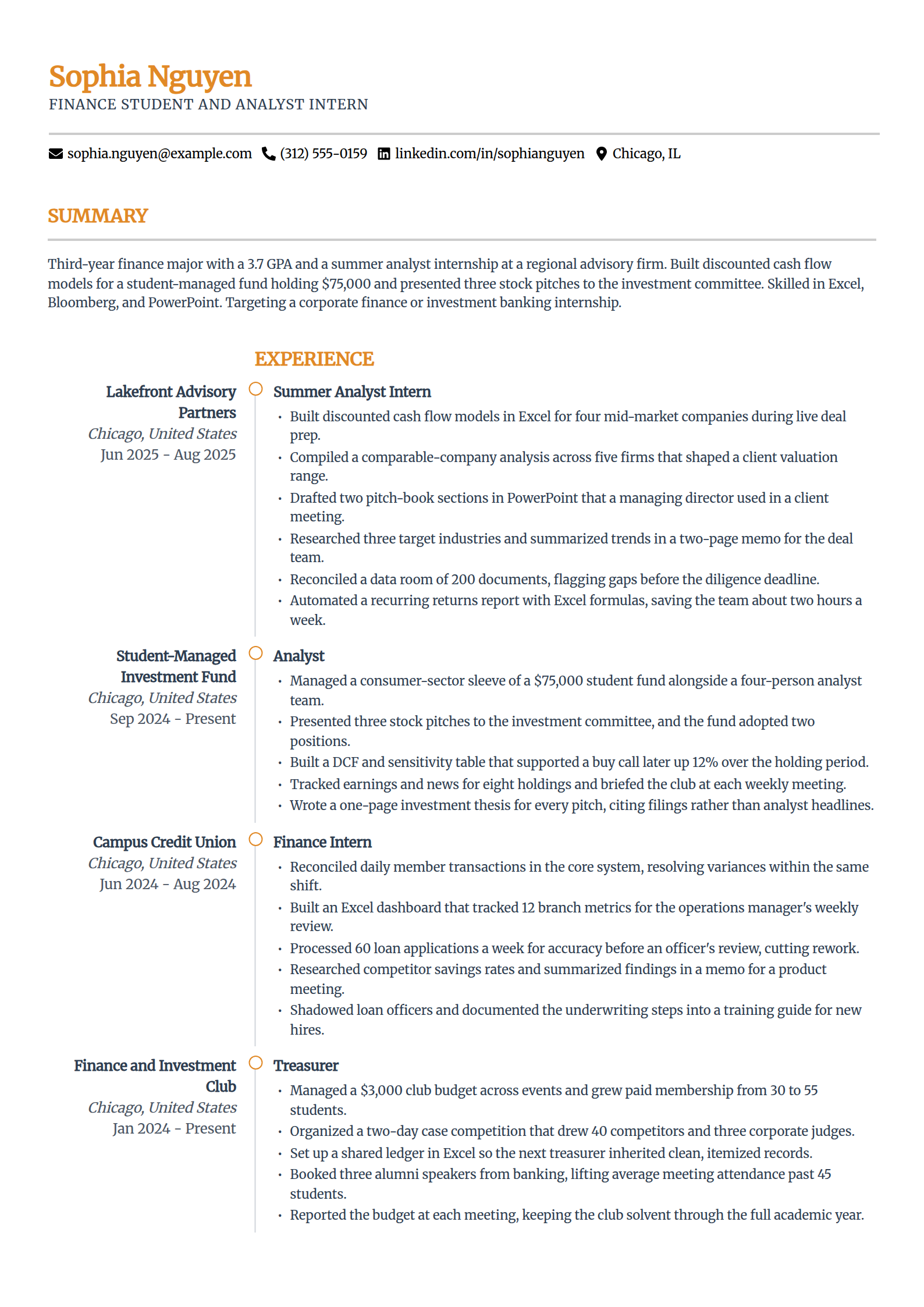
Finance Internship Resume Template
Why this resume example works?
- Leads with a summer analyst internship and a student fund holding $75,000, the record a finance recruiter looks for.
- Shows real deal work, discounted cash flow models and a comparable-company analysis, at a level a student can own.
- Keeps metrics believable, a buy call up 12% over the holding period, rather than an invented multi-percentage claim.
- Carries finance-specific credentials, Bloomberg Market Concepts and the CFA Institute Investment Foundations certificate.
- Uses a structured layout that gives four entries and six skill groups room to read at a glance.
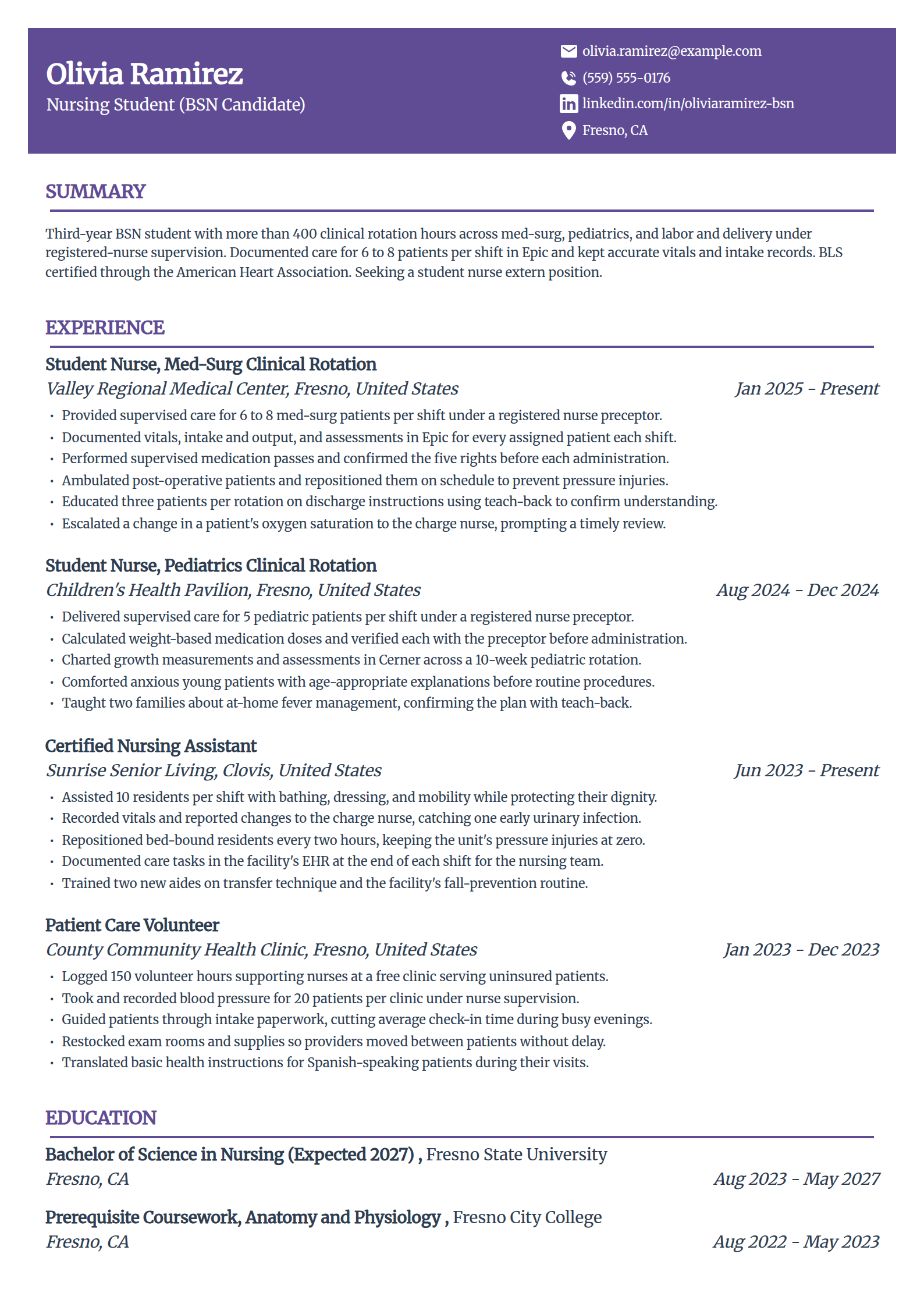
Nursing Student Resume Template (Clinical Experience)
Why this resume example works?
- States clinical work as supervised rotations under a registered nurse, the accurate framing for a pre-licensure student.
- Quantifies the caseload honestly, 6 to 8 patients per shift and 400 rotation hours, numbers a BSN student can defend.
- Names the real systems, Epic and Cerner, plus BLS and CNA credentials, exactly what a nurse-extern posting screens for.
- Spans med-surg, pediatrics, and a CNA role so the page shows breadth without claiming licensed practice.
- Uses teach-back and escalation language that reads like genuine bedside training, not a copied job description.
Undergraduate Research Assistant Resume Template
Why this resume example works?
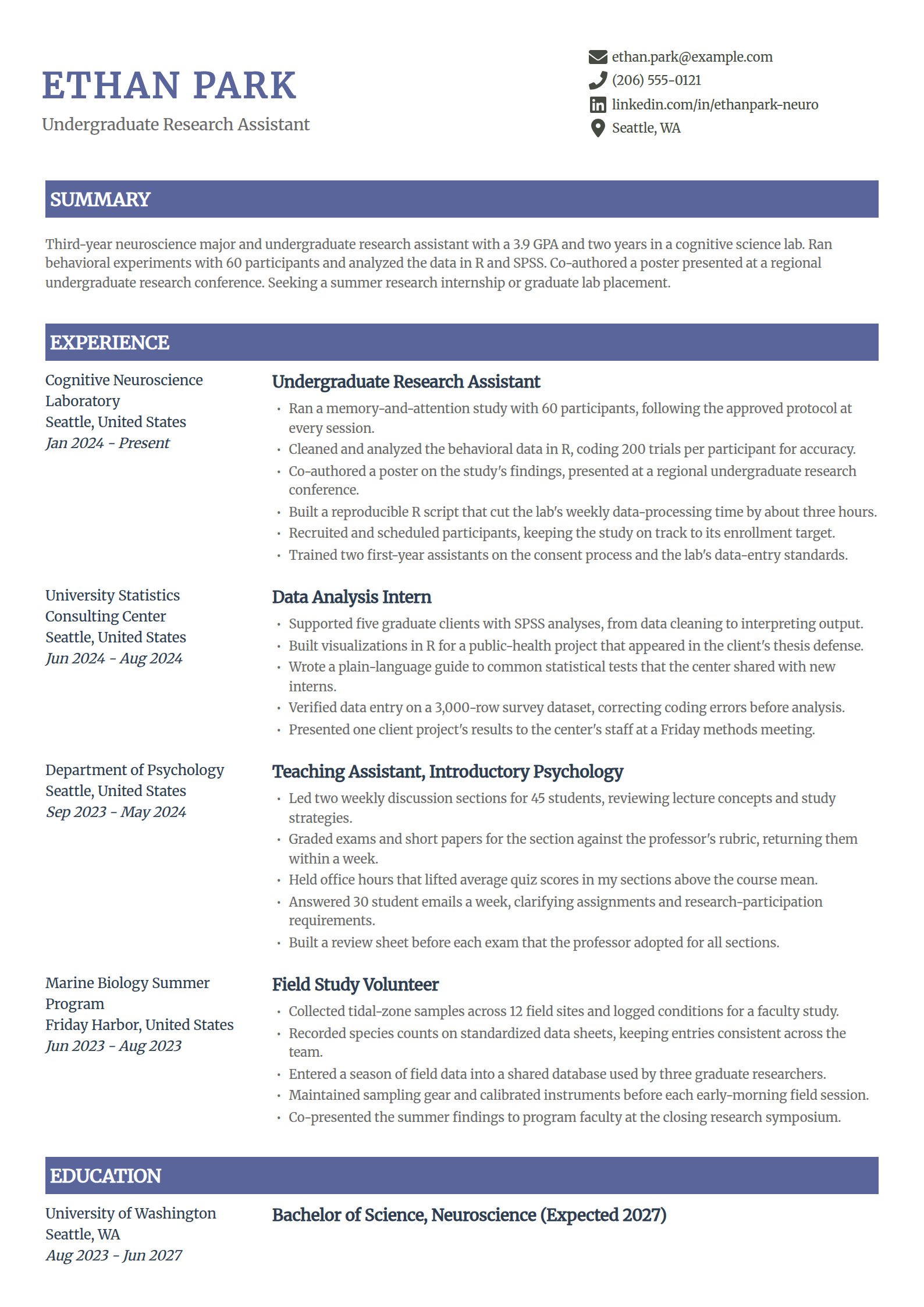
- Leads with two years in a lab and a conference poster, the output that matters most for research and graduate applications.
- Shows real method, a study of 60 participants analyzed in R and SPSS, so the science reads as hands-on.
- Adds a teaching-assistant entry that proves she can explain concepts, a signal labs and programs value.
- Names the credentials a lab expects, CITI human-subjects training and lab safety, near the technical skills.
- Fills a dense layout with four entries that stay squarely in scope for an undergraduate.
Engineering Co-op Resume Template
Why this resume example works?
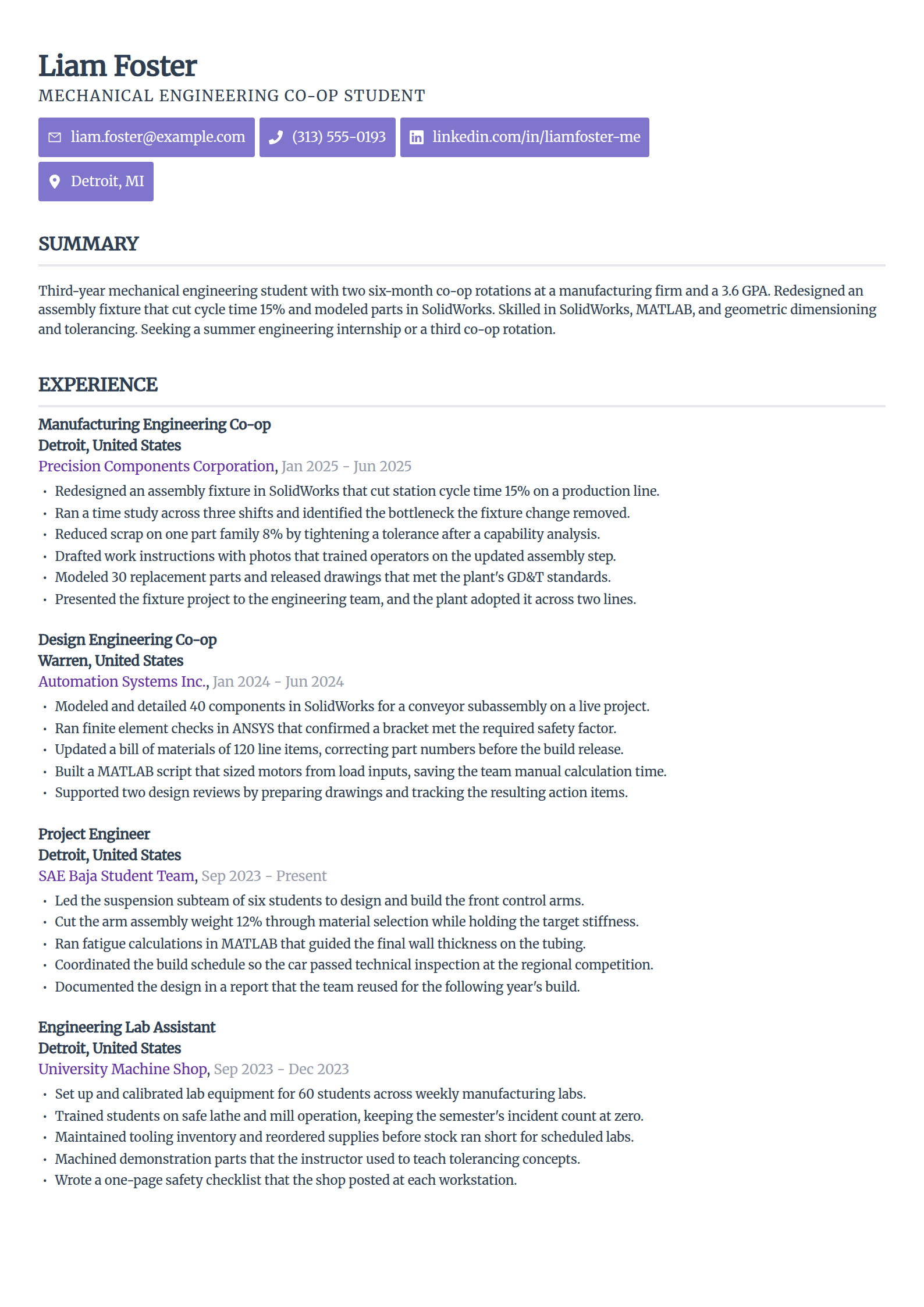
- Leads with two six-month co-op rotations and a fixture redesign that cut cycle time 15%, a concrete engineering win.
- Names the tools a posting screens for, SolidWorks, MATLAB, ANSYS, and GD&T, in both the bullets and the skills.
- Adds an SAE Baja team entry, the kind of project work that shows applied design beyond the classroom.
- Keeps every number modest and traceable, an 8% scrap reduction or a 12% weight cut, not a headline figure.
- Uses a dense two-toned layout that gives four technical entries room without crowding.
Marketing Internship Resume Template
Why this resume example works?
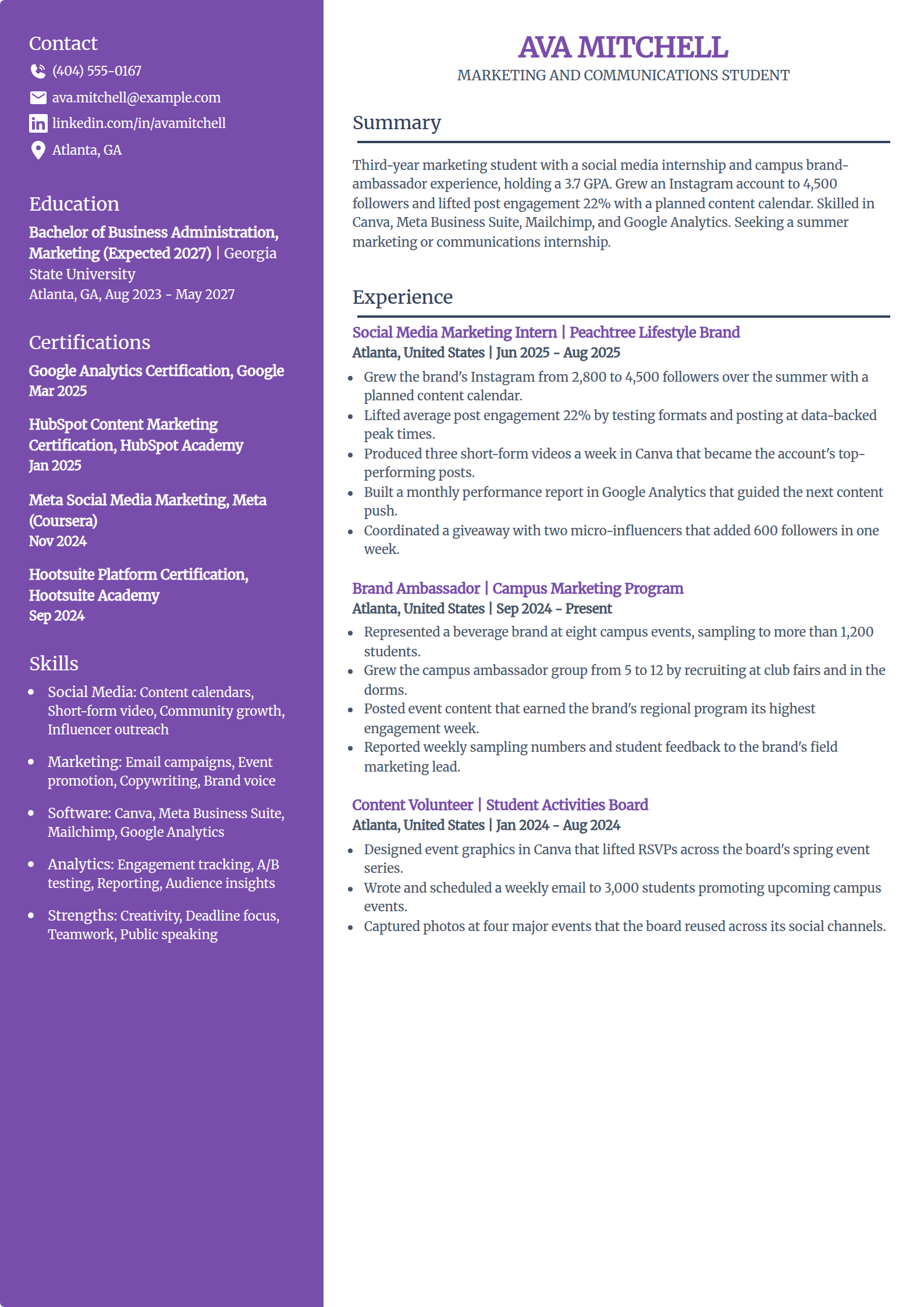
- Leads with a social media internship and a following grown to 4,500, the outcome a marketing team wants to see.
- Ties content work to a number, a 22% engagement lift, that stays believable for a summer internship.
- Includes a brand-ambassador role, a common campus job that reads as real marketing experience here.
- Lists the platforms a posting names, Canva, Meta Business Suite, and Google Analytics, in a clean skills block.
- Uses a medium layout sized to three entries so the page fills without stretching thin.
Computer Science Student Resume Template (Projects)
Why this resume example works?
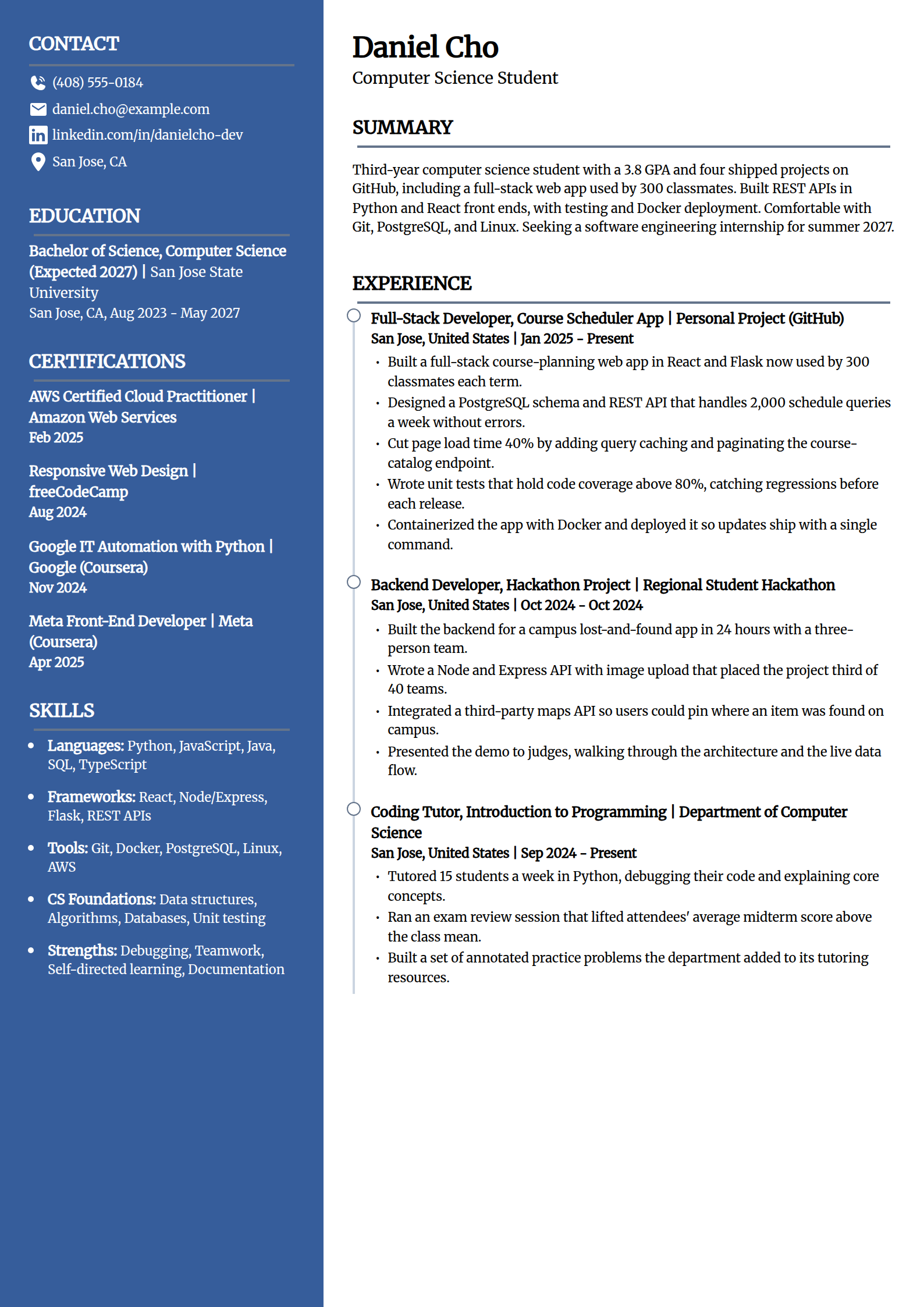
- Leads with shipped GitHub projects, the right move for a CS student with no software job yet.
- Describes a full-stack app used by 300 classmates with real stack detail, React, Flask, and PostgreSQL.
- Shows engineering judgment, unit tests above 80% coverage and a 40% load-time cut, not just a tech list.
- Names languages and tools a screener searches for, Python, Docker, Git, and AWS, in a dedicated skills block.
- Uses a medium layout that treats projects as first-class entries beside a tutoring role.
Work-Study Resume Template
Why this resume example works?
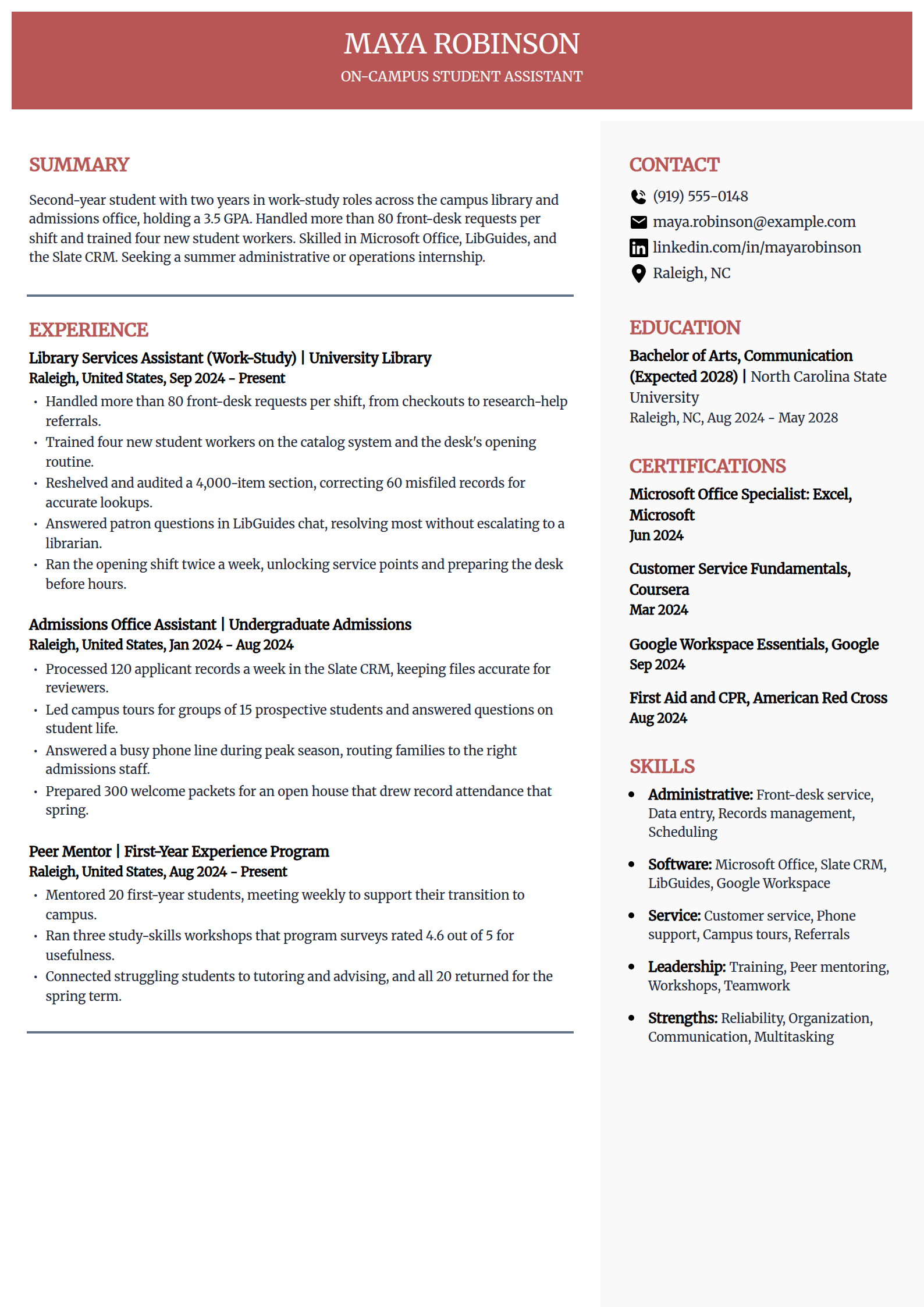
- Leads with two years of work-study across the library and admissions office, steady on-campus experience.
- Quantifies the work, 80 front-desk requests per shift and four student workers trained, at a true scale.
- Adds a peer-mentor role that shows initiative beyond the assigned job.
- Names campus systems like the Slate CRM and LibGuides, transferable tools an employer recognizes.
- Uses a medium layout that gives three roles enough room to read as a real work history.
Resident Advisor (RA) Resume Template
Why this resume example works?
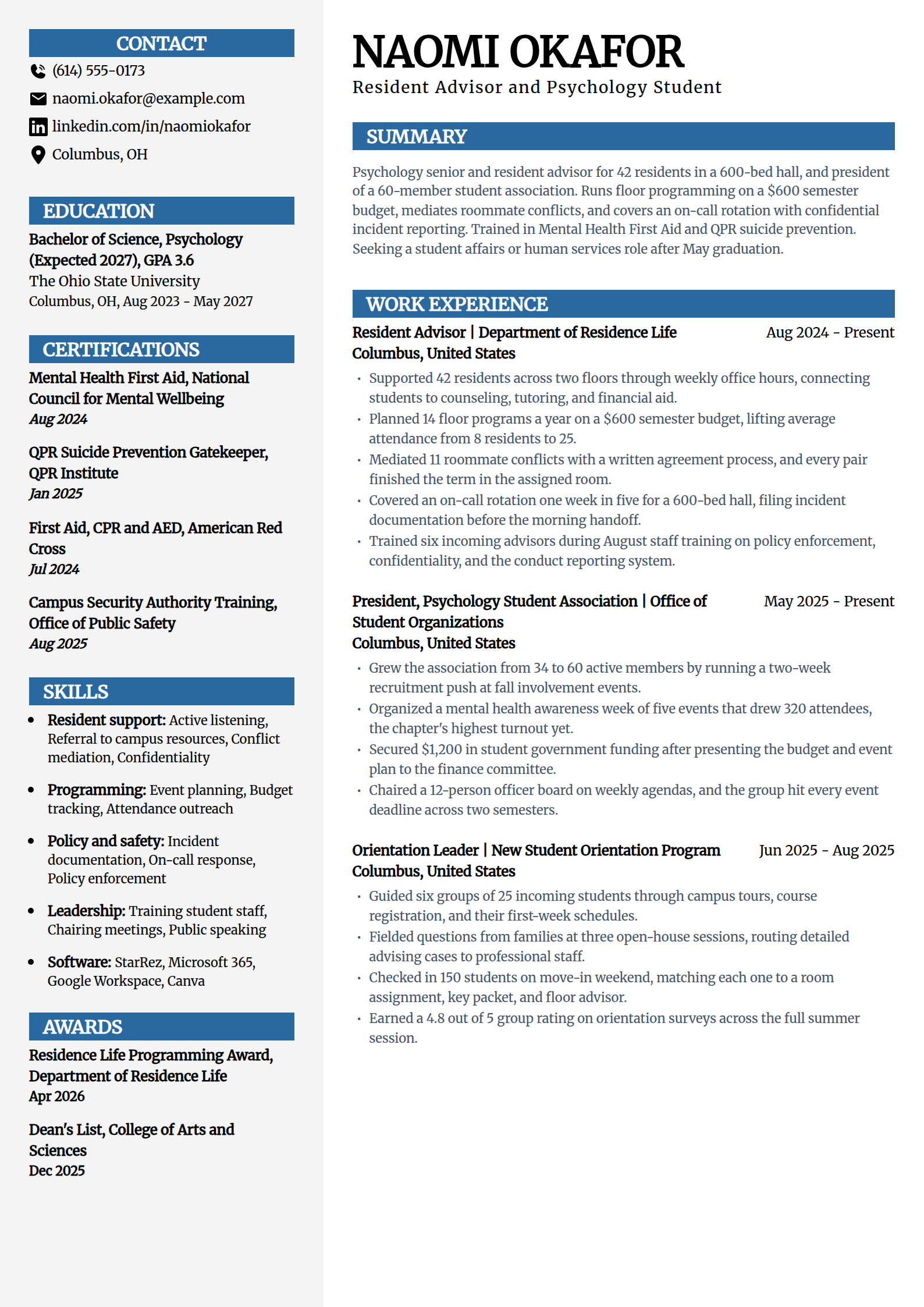
- Covers all three parts of the RA job a residence life office screens for: resident support, programming, and on-call response.
- Sizes the role honestly, 42 residents on two floors and an on-call week in five for a 600-bed hall.
- Proves conflict skills with 11 roommate mediations and a written agreement process, instead of claiming to be a people person.
- Folds an elected club presidency into the same page, so campus leadership and the RA job support one story.
- Carries the training these roles ask about, Mental Health First Aid, QPR suicide prevention, and CPR.
International Student Resume Template
Why this resume example works?
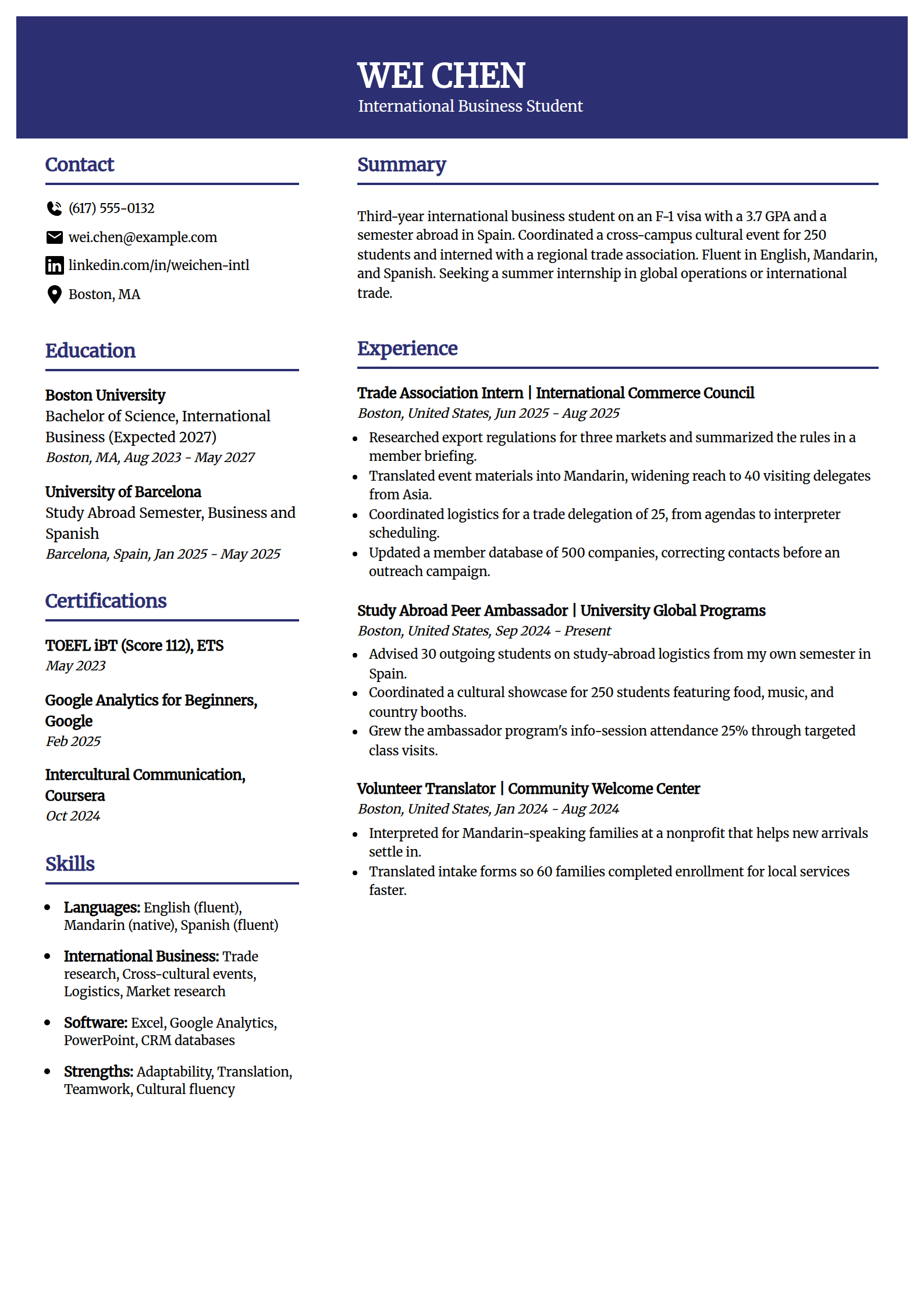
- Frames the F-1 status and a semester abroad plainly, turning an international background into a clear strength.
- Leads with a trade-association internship and a 250-student cultural event, concrete cross-cultural work.
- Highlights fluency in three languages up front, the differentiator for a global-operations internship.
- Keeps a roomy layout with three entries so limited US experience still fills a confident page.
- Lists a TOEFL score and intercultural coursework, credentials an international applicant is asked about.
Nurse Practitioner Student Resume Template
Why this resume example works?
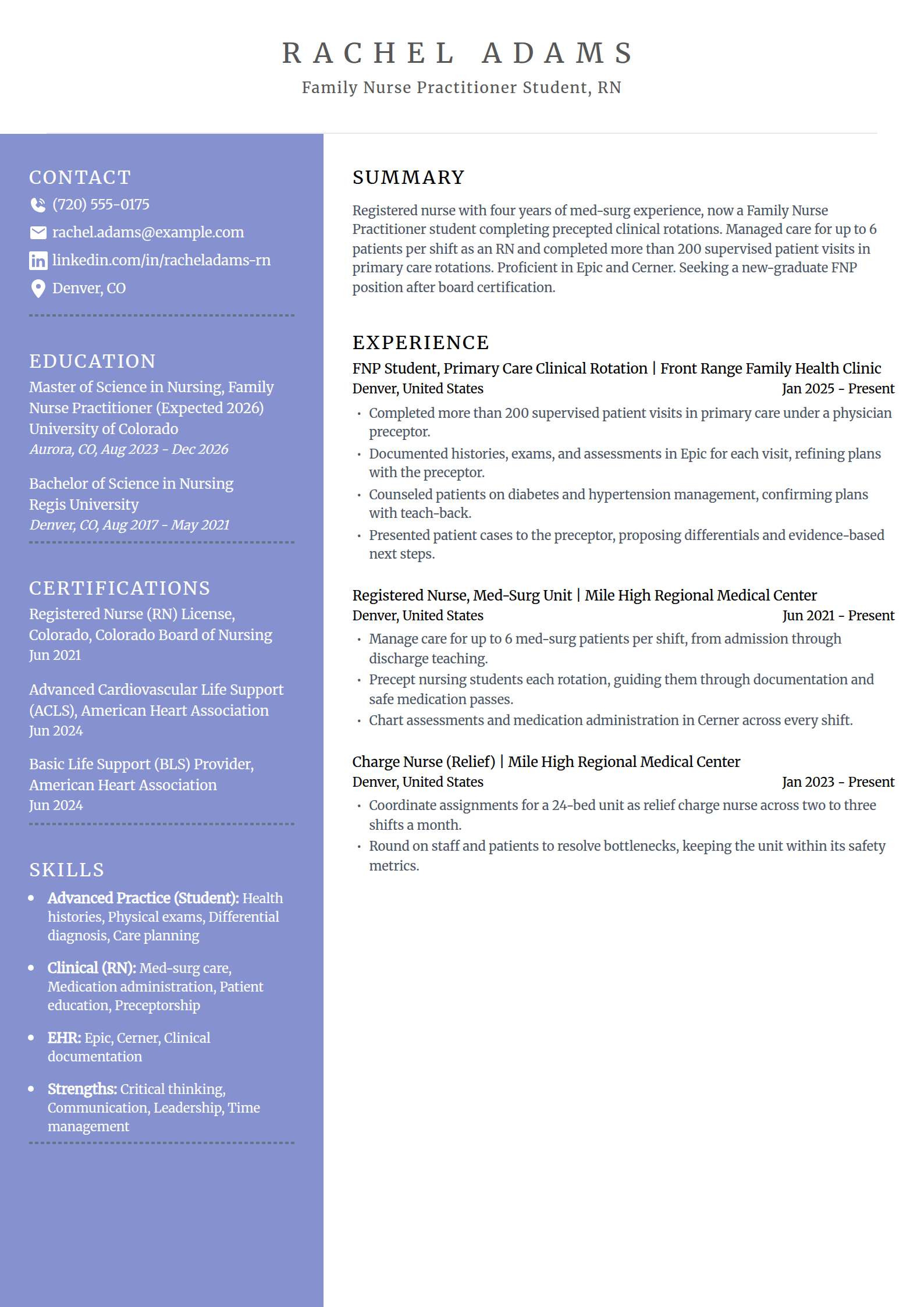
- Shows the real path, a licensed RN with four years of experience now in precepted FNP clinical rotations.
- Separates supervised NP visits from independent RN practice, so the scope of each role reads accurately.
- Quantifies both sides, 200 supervised primary-care visits and up to 6 RN patients per shift.
- Lists the RN license, ACLS, and BLS rather than claiming an NP certification the student does not hold yet.
- Uses a roomy layout that keeps a graduate-level story clear without overcrowding the page.
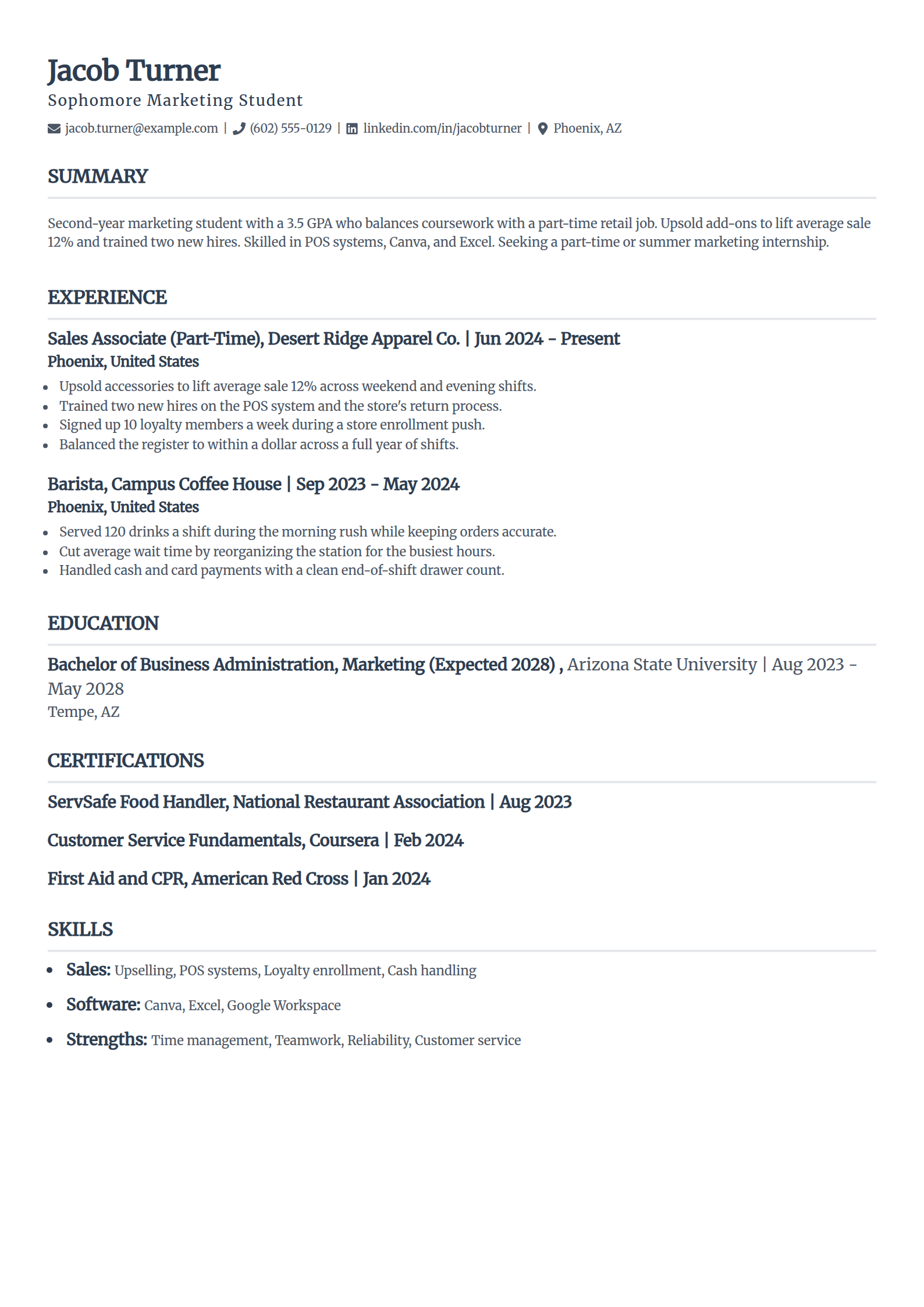
Sophomore Resume Template (Part-Time Job)
Why this resume example works?
- Written for a sophomore balancing a part-time retail job with coursework, the common early-college resume.
- Keeps bullets short and results-first, a 12% average-sale lift and two new hires trained.
- Shows a second job as a barista, so a limited history still reads as steady and reliable.
- Fits a tight, uncluttered layout that fills one page without padding thin experience.
- Lists a few honest, transferable skills, POS systems, Canva, and Excel, rather than a long keyword dump.
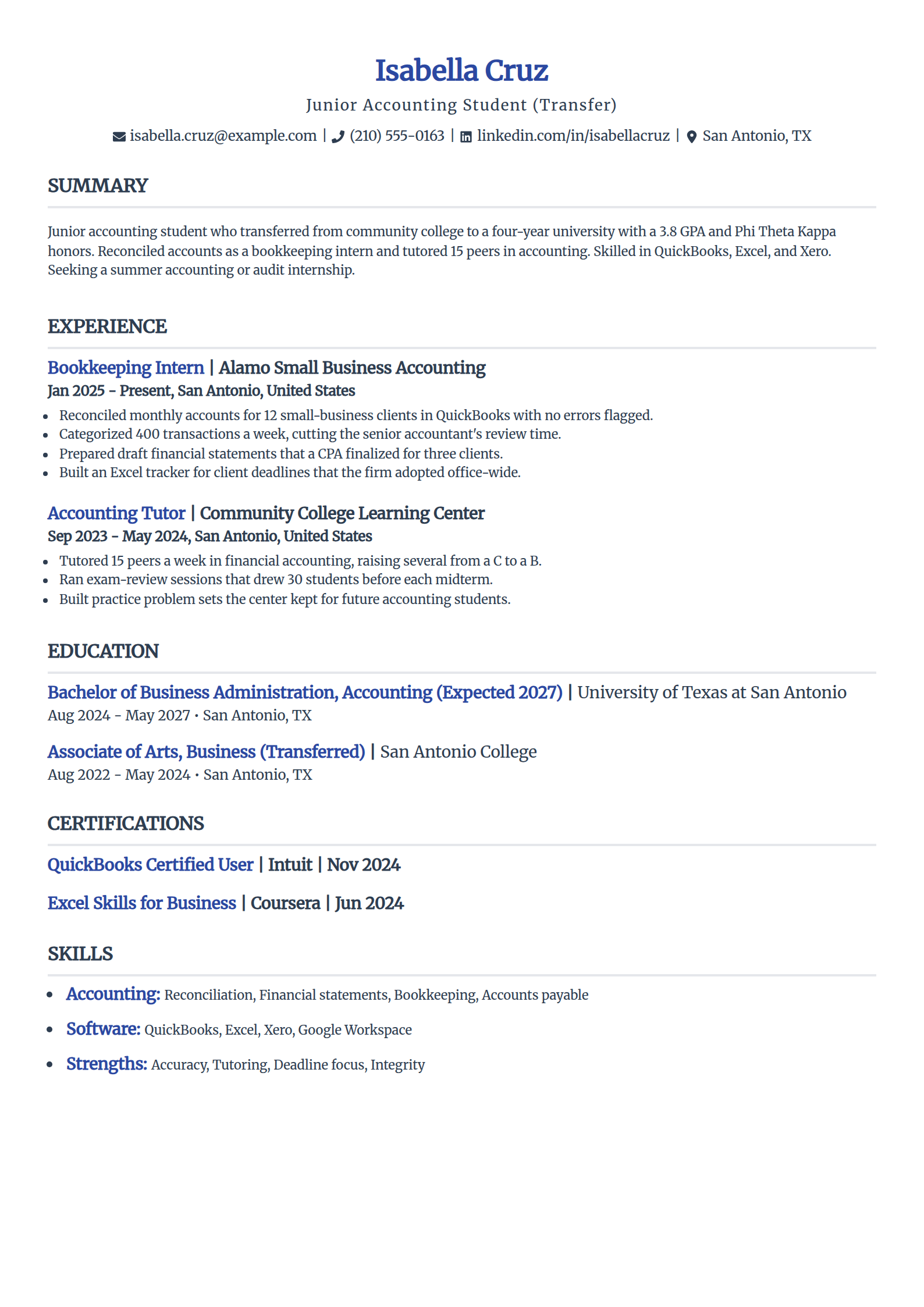
Transfer Student Resume Template
Why this resume example works?
- Shows both schools clearly, the current university and the community college she transferred from with honors.
- Leads with a bookkeeping internship and peer tutoring, campus and work experience that carries across the move.
- Keeps numbers modest and true, 12 clients reconciled and 15 peers tutored, at a believable student scale.
- Names the tools an accounting posting screens for, QuickBooks, Excel, and Xero, in a tight skills block.
- Uses a clean layout that fits real, focused experience on one page without stretching.
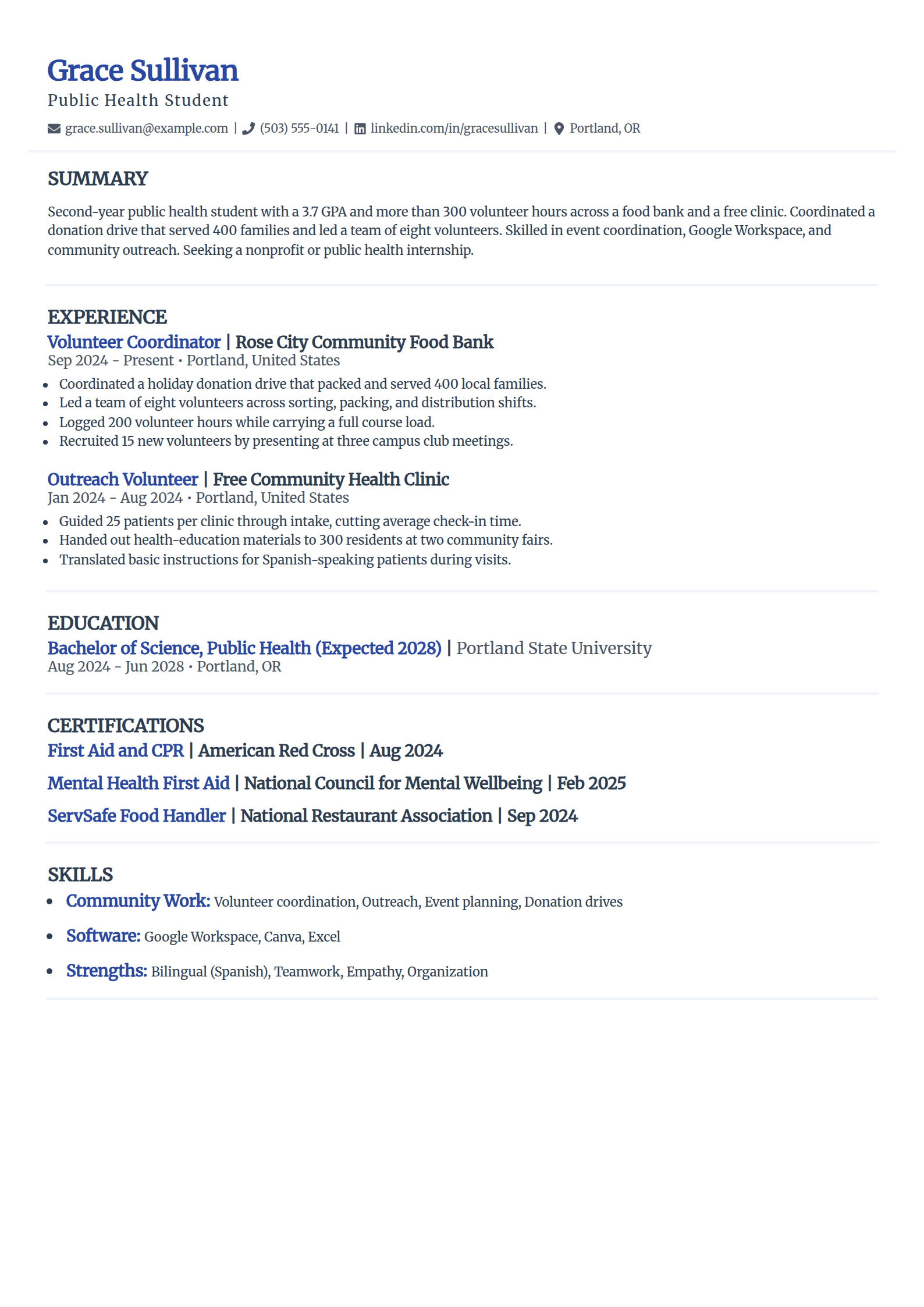
Community Service Resume Template
Why this resume example works?
- Leads with 300-plus volunteer hours across a food bank and a free clinic, the depth a nonprofit role rewards.
- Frames volunteering as roles with results, a drive that served 400 families and a team of eight led.
- Ties the service to the major, public health, so the involvement reads as directed, not scattered.
- Carries fitting credentials, Mental Health First Aid and CPR, that match the community-health focus.
- Uses a refined, tight layout so a service-first resume still looks complete on one page.
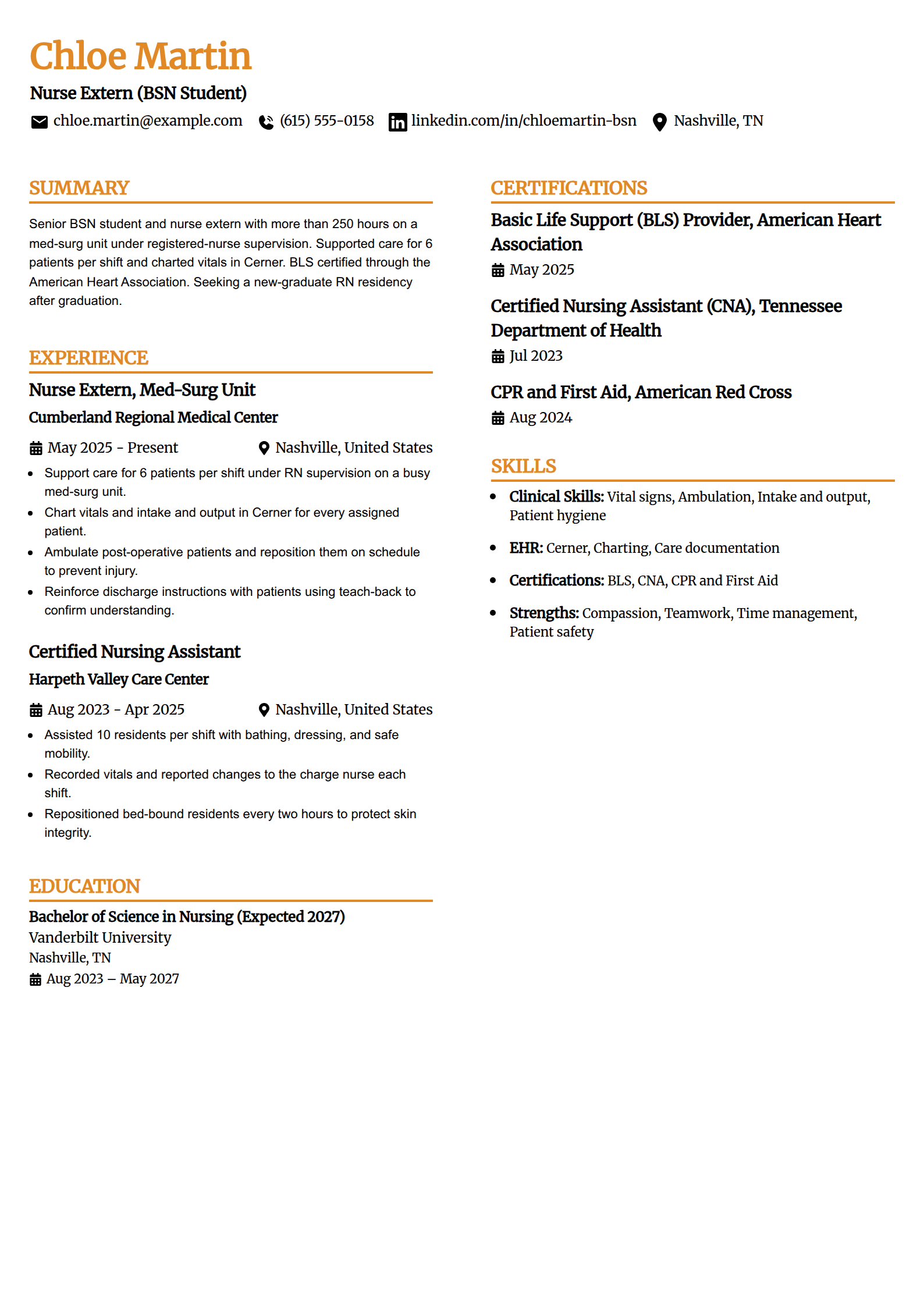
Nurse Extern Resume Template
Why this resume example works?
- Leads with a nurse-extern role and 250 supervised hours, the exact experience a residency posting screens for.
- Keeps clinical claims in scope, charting vitals in Cerner and reinforcing discharge teaching under an RN.
- Pairs the extern role with a CNA history, a realistic ladder for a senior BSN student.
- Lists BLS, CNA, and CPR plainly instead of claiming a license the student has not earned yet.
- Uses a tight two-column layout that fits a focused clinical resume on one clean page.
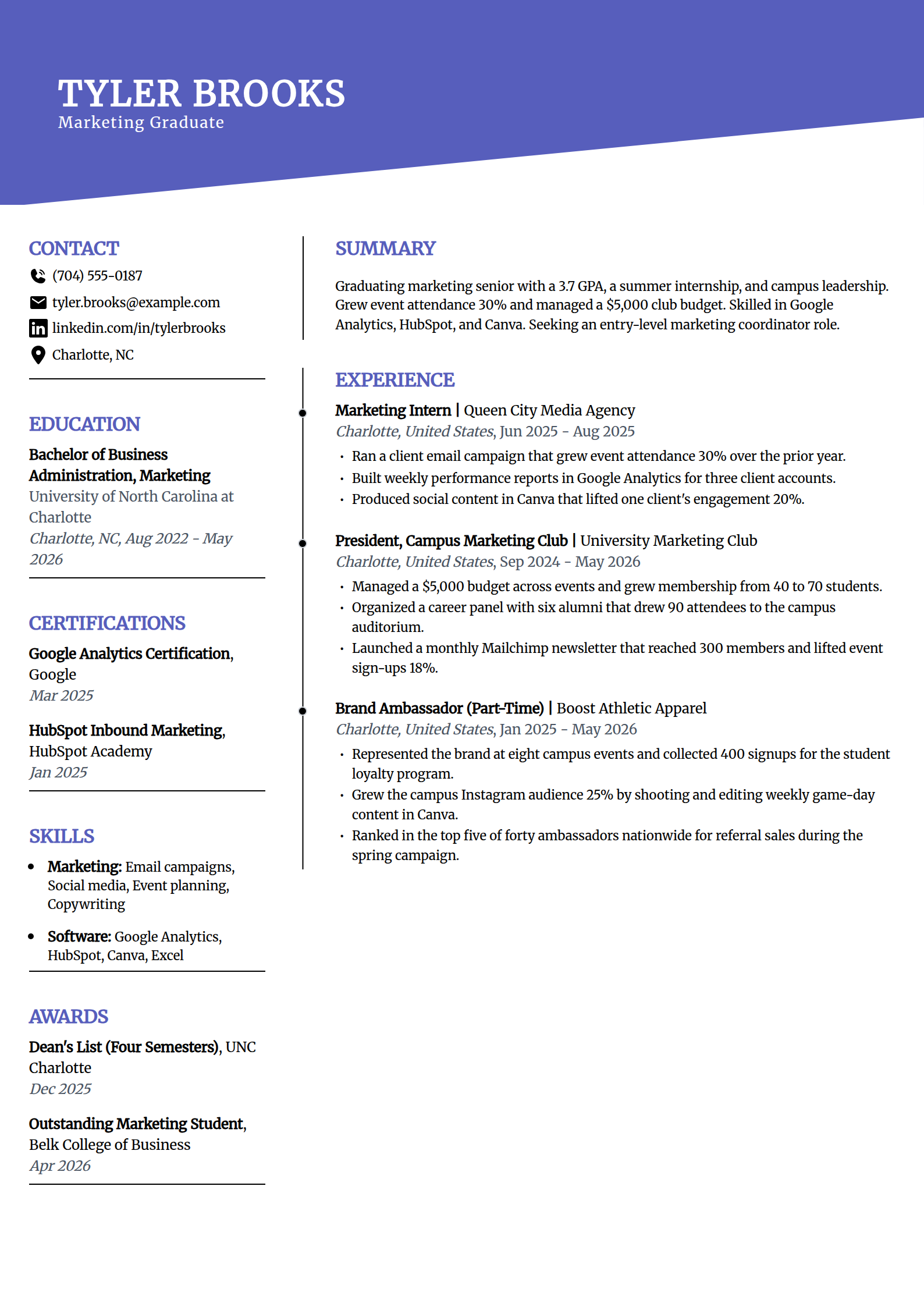
Graduating Senior Resume Template (First Job)
Why this resume example works?
- Written for a senior applying to a first full-time role, with an internship, a club presidency, and a brand-ambassador job.
- Shows scope an employer can quote, a $5,000 budget managed and event attendance grown 30%.
- Uses an awards column for Dean's List and a marketing honor, so the sidebar carries credentials the bullets do not repeat.
- Gives each of the three roles three result-first bullets, so the experience column reads full instead of thin.
- Lists job-ready tools, Google Analytics, HubSpot, and Canva, that a coordinator posting names.
Build your college student resume
Pick a template above and the editor keeps your layout clean and ATS-friendly while you swap in your own education, projects, internships, and skills.
Build my resumeHow to write a college student resume in 2026
Most college students apply before they have a real job, and that is normal. Your resume's job is to show what you have actually done, in coursework, projects, campus roles, research, and volunteering, in a format a recruiter and an applicant tracking system can both read. These moves make yours honest, specific, and easy to skim.
Open with a short summary that fits your year
Write three to four sentences that name your year and major, state your GPA if it helps you, and point to your two or three strongest experiences. If you have no paid job yet, say plainly that projects and campus work stand in, then let the entries prove it.
First-year business student with a 3.8 GPA and a semester of campus leadership and volunteer work in place of paid experience. Organized a 120-attendee club fundraiser and tutored 12 peers each week. Comfortable with Excel, Canva, and Google Workspace. Seeking a summer internship in marketing or operations.
Turn coursework, projects, and campus roles into experience
When you have little or no job history, the experience section is built from everything else you have done. Give each item a title, a date range, and accomplishment bullets, exactly as you would a job.
- Internships and co-ops: write the full title, Marketing Intern, not just Intern, with the organization and dates.
- Class and capstone projects: name the result, a first-place case competition or an app used by 300 students.
- Research: state the method and output, a study of 60 participants and a conference poster.
- Campus jobs, clubs, and volunteering: a work-study desk, a club treasurer role, or a 400-family food drive all count as real entries.
Put education and GPA near the top
For a student, education leads because it is your strongest credential. Keep it near the top and let it carry weight your job history cannot yet.
- List your university, degree and major, and expected graduation year; a first-year can still include high school.
- Include your GPA when it is roughly 3.5 or higher, and label it honestly; leave it off if it works against you.
- Add relevant coursework or a study-abroad semester when it matches the role you are targeting.
- Transfer students list both schools so the path reads clearly, current university first.
List skills and keywords from the posting
Recruiters and parsers both scan for the exact tools a job names. Mirror the posting's wording instead of guessing.
- Name real systems, not vague traits: Excel, SolidWorks, Python, Epic, or Google Analytics, whatever the role uses.
- Nursing students list the EHRs they trained on, Epic or Cerner, plus BLS and CPR, and keep claims to supervised practice.
- CS students name languages and tools a screener searches for, and link a GitHub with shipped projects.
- Group skills into a few labeled categories so a reader finds the match fast.
Keep it to one ATS-friendly page
A student resume is one page, and the format matters as much as the words. A clean layout parses cleanly and reads fast.
- Hold it to a single page and use a single-column or simple two-column layout with standard headings.
- Avoid tables, text boxes, and images inside the resume body, which confuse a parser.
- Save as a PDF so your formatting holds, unless the posting asks for a Word file.
- Run it through the ATS resume checker for a quick format and readability pass before you submit.
Common college student resume mistakes
- Leaving the experience section empty because you have no job. Fill it with projects, campus roles, research, and volunteering instead.
- Writing duties, not results. "Member of marketing club" is a role; "managed a $5,000 budget and grew membership 40 to 70" is proof.
- Inventing corporate metrics. A student does not lift revenue 40%; use hours logged, members led, or a believable percentage.
- Nursing students overstating scope. Say supervised rotations, patient counts, and BLS, never licensed practice or a passed NCLEX you have not sat.
- Burying education or hiding a strong GPA. Lead with your degree and include a GPA of about 3.5 or higher.
Frequently asked questions
How do I write a college resume with no work experience?
Build the experience section from everything you have done besides a paid job. Coursework and capstone projects, undergraduate research, club and student-government roles, campus or work-study jobs, and volunteering all count, and each gets a title, dates, and accomplishment bullets. Lead with your education and GPA, then let those entries carry the page. Say plainly in your summary that projects and campus work stand in for a job; a recruiter reading a first-year resume expects exactly that.
What should a college student put on a resume?
Contact details, a short summary, your education with major and expected graduation year, an experience section, and a skills block. For experience, use internships, class or capstone projects, research, campus jobs, club leadership, and volunteering, each with a result and one modest number. In skills, name the real tools a posting lists, such as Excel, Python, Epic, or Google Analytics. Include your GPA when it is roughly 3.5 or higher, and keep the whole resume to one page.
Do I include my GPA on a college resume?
Include your GPA when it is about 3.5 or higher, listed near the top with your degree and expected graduation year. A strong GPA is one of the clearest signals a student can show, so leaving it off stands out more than a solid number would. If your GPA is not your strongest point, leave it off and let your projects, internships, and campus roles carry the resume instead. Never round up or inflate it, since offers can be rescinded over a number a transcript disproves.
What is the best resume format for a college student or intern?
Use a reverse-chronological, one-page layout in a single column or a simple two-column format with standard headings like Education, Experience, and Skills. Because students lead with school, education sits near the top, above experience. Avoid tables, text boxes, and images inside the resume body, since those confuse an applicant tracking system, and save the file as a PDF unless the posting asks for Word. The templates on this page are laid out this way, so you can pick one and swap in your own details.
How should a nursing student show clinical experience on a resume?
List clinical work as supervised rotations under a registered nurse, with the facility, unit, and dates, and describe it in accomplishment bullets. Quantify honestly, such as caring for 6 to 8 patients per shift or logging 400 rotation hours, and name the EHR you charted in, usually Epic or Cerner. Add BLS or CPR and, if you hold it, a CNA credential. Keep every claim to supervised, in-scope student practice; do not imply licensed practice or a passed NCLEX before you have sat the exam.
How long should a college student resume be?
One page. A student resume is a focused snapshot, not a full history, so keep it to a single, skimmable page with clear headings. If you are short on content, add depth to your projects, campus roles, and volunteering rather than stretching the layout. If you have more than fits, keep the experience that matches the role you are targeting and cut the rest. A tight one-page resume reads as confident; a padded two-page one reads as filler.
More college student resume resources
Build your college student resume
Pick a template above and the editor keeps your layout clean and ATS-friendly while you swap in your own education, projects, internships, and skills.