16 Academic Resume Examples, From Grad School to Faculty
- ATS Friendly
- Research & Teaching Focused
- 16 Real Examples
An academic resume leads with your degree, research, and teaching, not a long job history. Pick a clean template below, then model your own on a real example built for your field and stage, from grad-school applicant to faculty candidate.


540k+ resumes created
Editable academic resume templates
Each template below is a real academic resume laid out in that format, sorted by the kind of applicant you are. Choose one, then swap in your own degree, research, teaching, grants, and publications. Every layout keeps your name, contact details, and dates clean and easy to skim so a committee or a program coordinator reads your record at a glance.
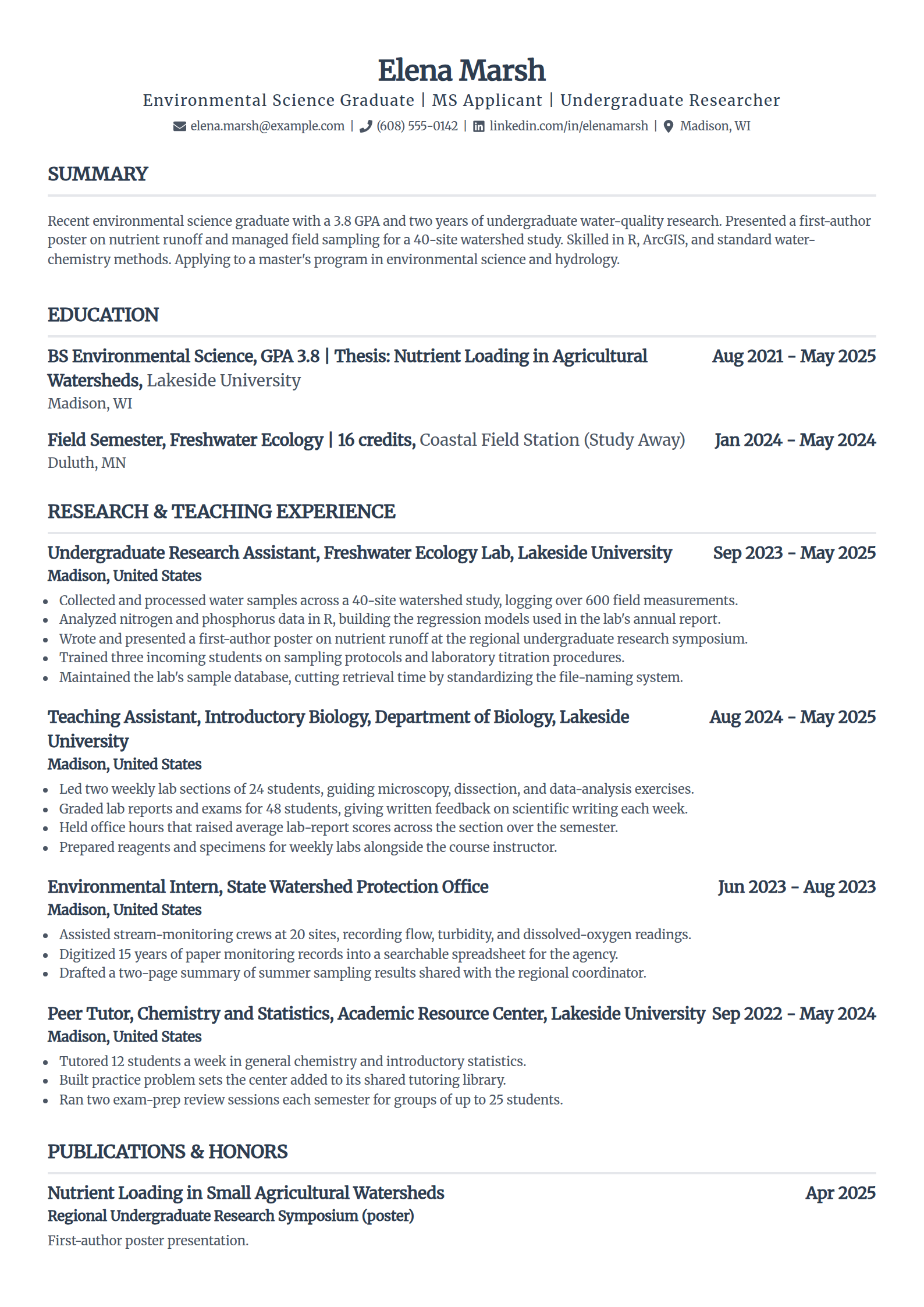
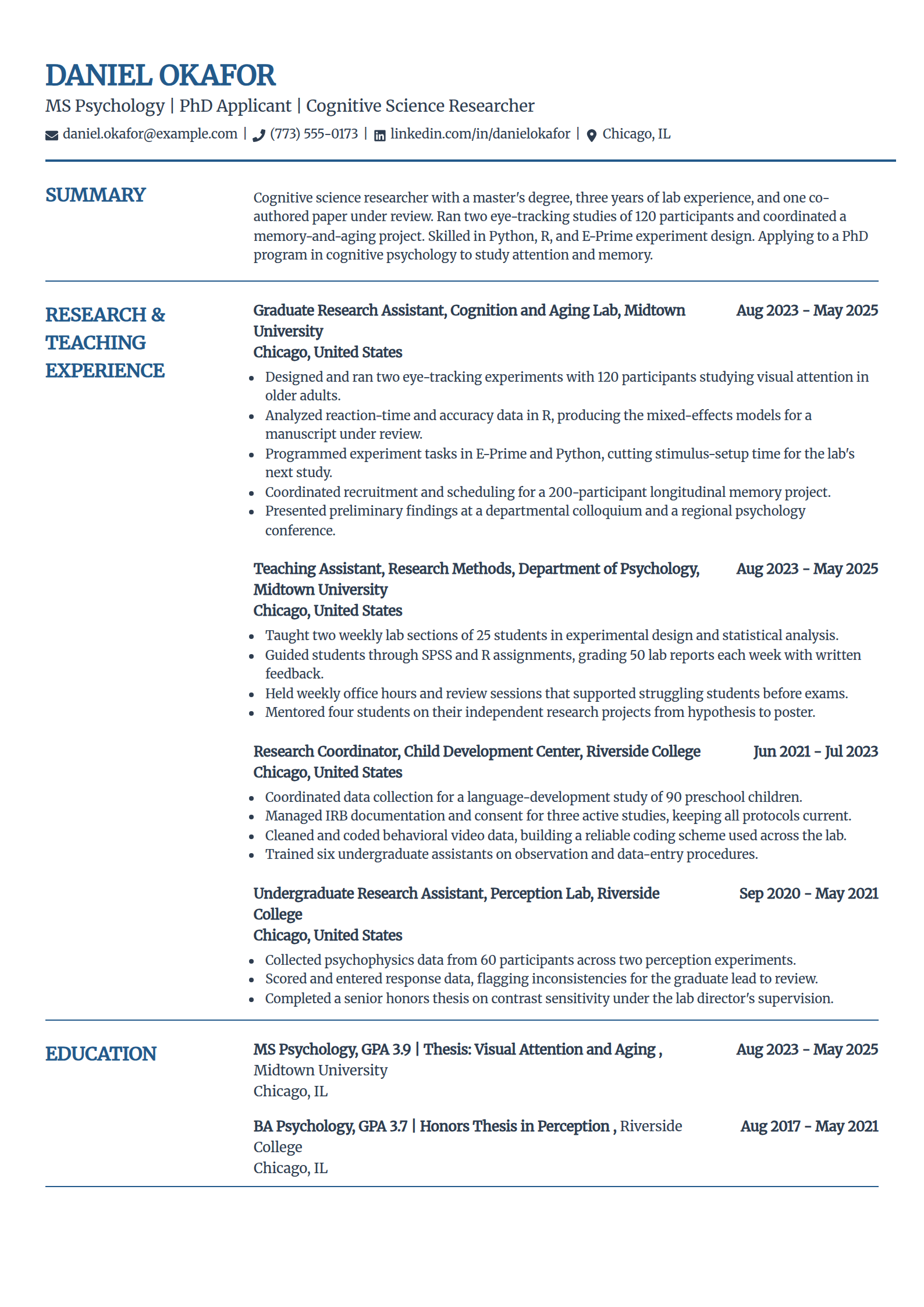
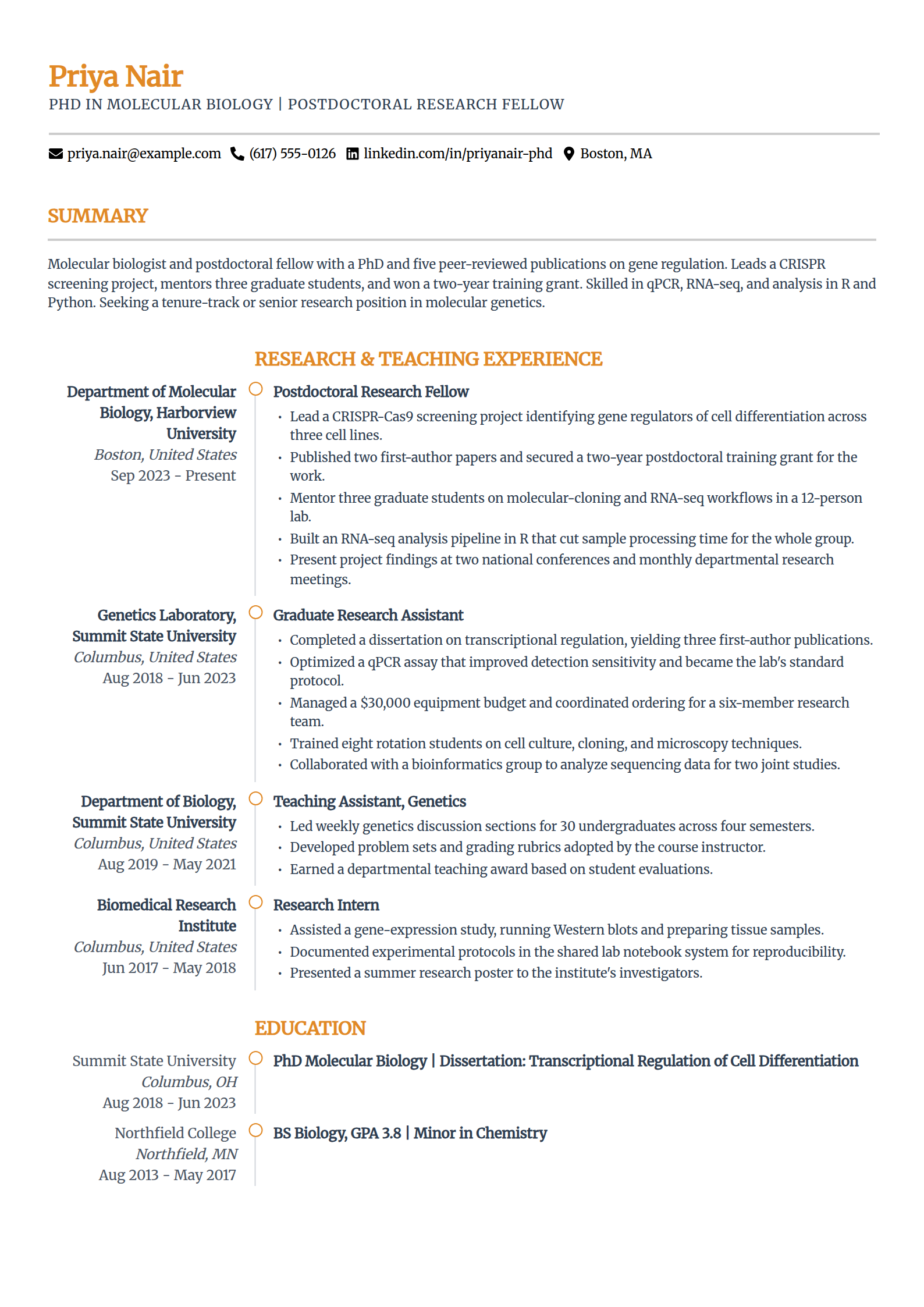
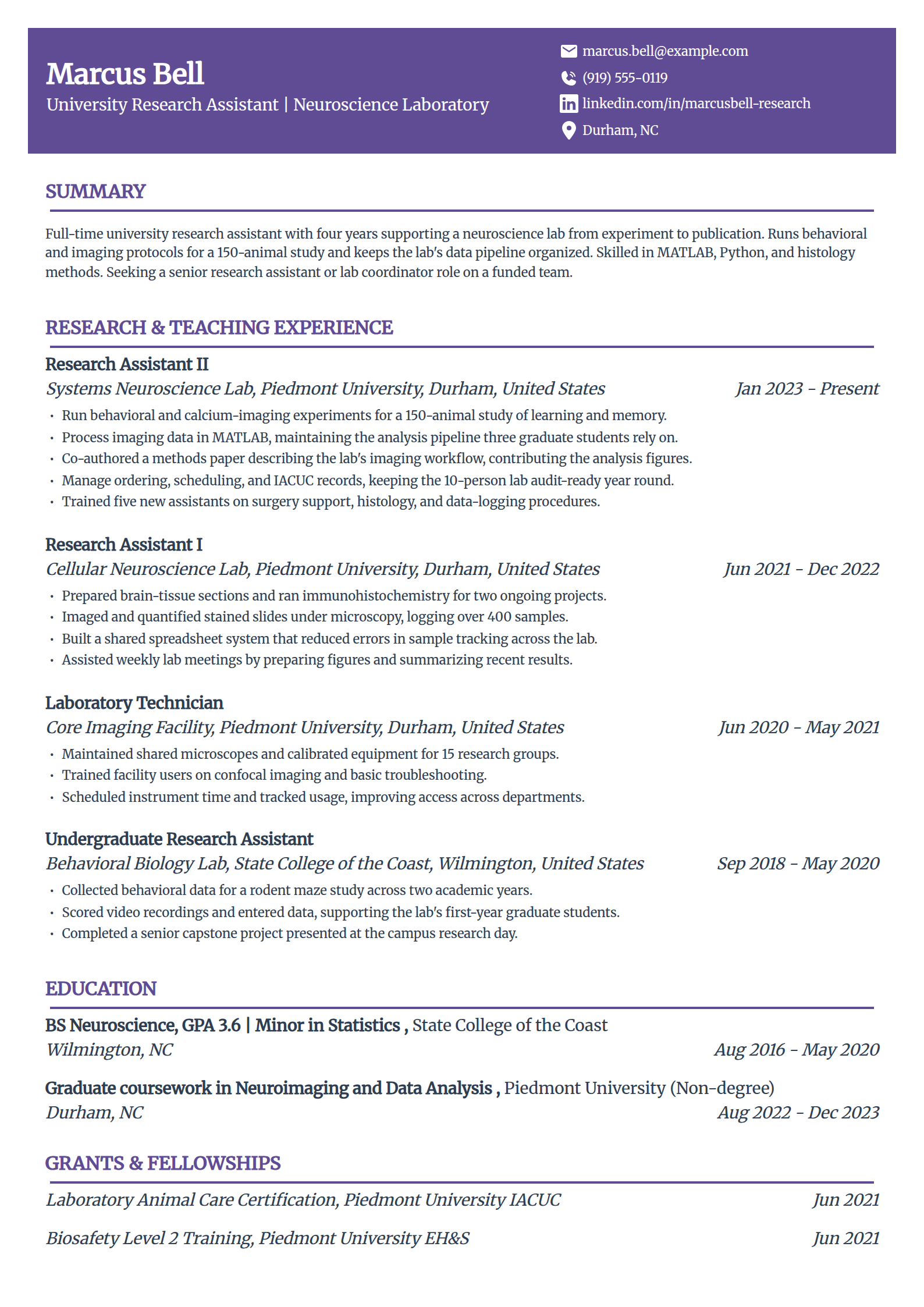
Graduate School (Master's) Applicant Resume Template
Why this resume example works?
- Leads with education, GPA, and a named thesis, the first thing a master's admissions committee looks for.
- Puts undergraduate research above teaching and internships, so the strongest experience is read first.
- Turns lab work into results, over 600 field measurements and a first-author poster, not a list of duties.
- Keeps every number modest and true to an undergraduate, so nothing reads inflated.
- Uses a clean single-column layout that carries research, honors, and a poster on one page.
PhD Program Applicant Resume Template
Why this resume example works?
- Opens with a master's degree and a co-authored paper under review, the record a PhD committee weighs.
- Frames research and teaching as accomplishments, two eye-tracking studies run and 120 participants tested.
- Lists a conference poster and a manuscript under review honestly, with the journal and second-author status named.
- Names the methods and software a lab cares about, from E-Prime and R to IRB and behavioral coding.
- Balances research, teaching, and coordination across four roles without padding any one of them.
Postdoctoral Researcher Resume Template
Why this resume example works?
- Leads with a PhD, five peer-reviewed papers, and a training grant, the core of a postdoc record.
- Shows independence: a CRISPR screening project led, three students mentored, and a pipeline built for the lab.
- Lists selected publications as their own entries with a plausible journal and first-author status, kept to five.
- Names the grants and fellowships with their issuers, from an NIH training grant to a travel award.
- Fills a dense layout with research, teaching, methods, and publications while staying on one page.
Research Assistant Resume Template
Why this resume example works?
- Leads with four years supporting a neuroscience lab, the steady hands-on record a funded team wants.
- Turns lab work into contribution, a 150-animal study run and an analysis pipeline three students rely on.
- Includes a co-authored methods paper, the realistic kind of publication a research assistant earns.
- Names concrete methods and software, from calcium imaging and immunohistochemistry to MATLAB and ImageJ.
- Shows lab operations, IACUC records and ordering, that make a research assistant valuable beyond the bench.
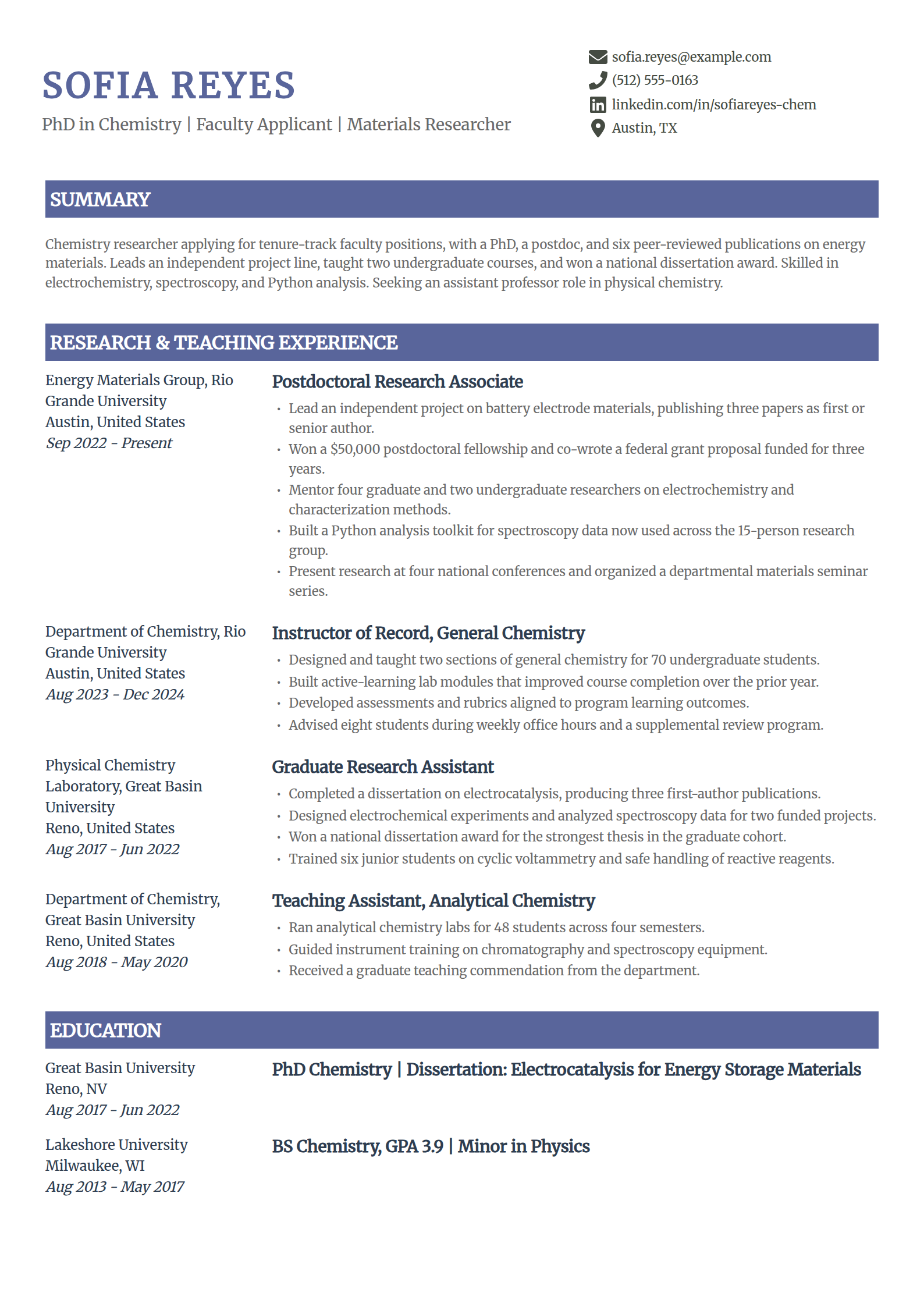
Assistant Professor & Faculty Applicant Resume Template
Why this resume example works?
- Opens with a PhD, a postdoc, and six publications, the scholarship a faculty search reviews first.
- Shows the three faculty pillars, research led, two courses taught, and a grant proposal co-written and funded.
- Lists selected publications with plausible journals and author position, capped at five to stay resume length.
- Names teaching credentials and mentoring, four graduate and two undergraduate researchers supervised.
- Carries grants and a national dissertation award with their issuers, so the recognition is verifiable.
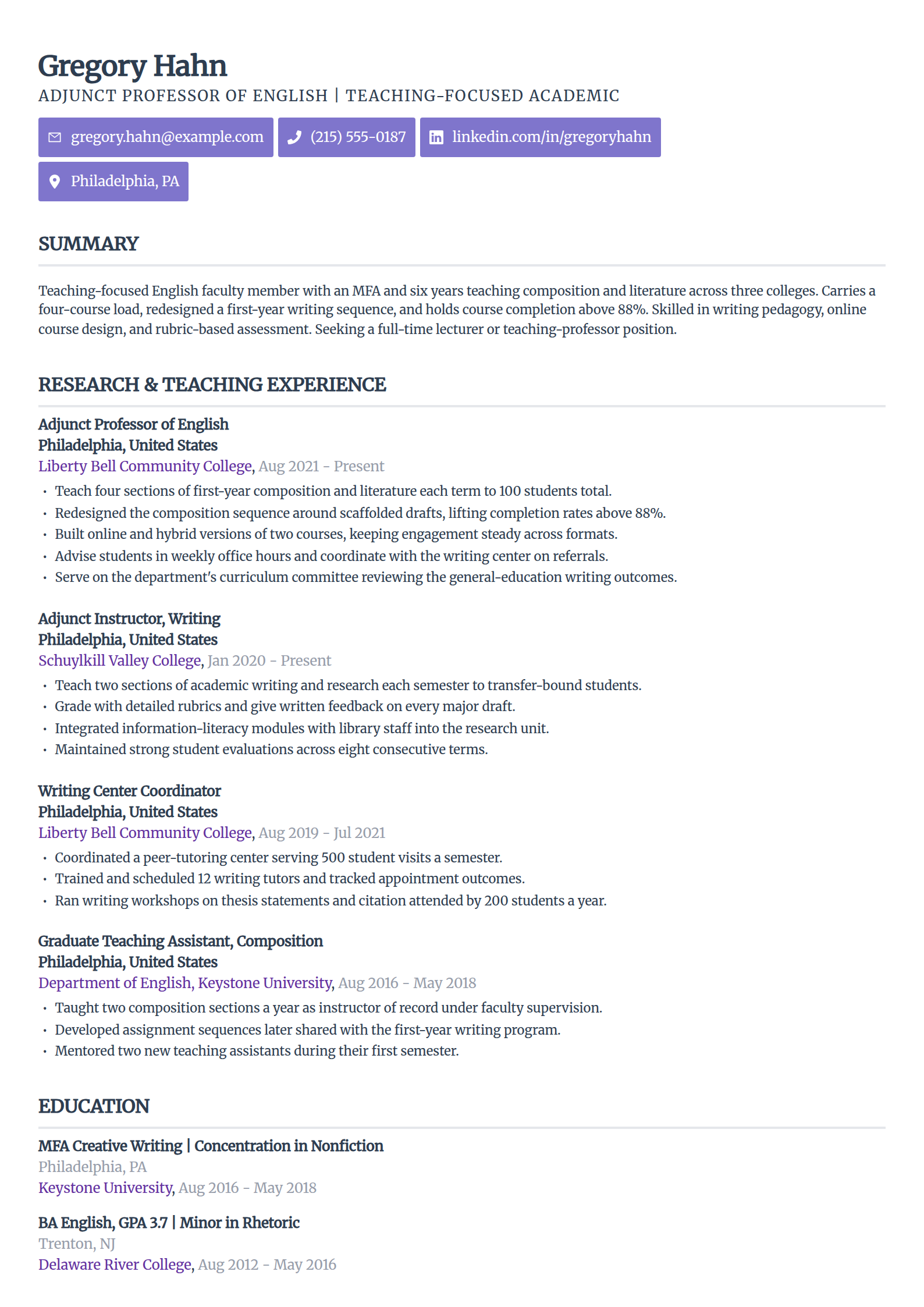
Adjunct & Teaching-Focused Academic Resume Template
Why this resume example works?
- Leads with an MFA and a four-course load, the credentials and reality of adjunct teaching.
- Frames teaching as results, a redesigned writing sequence that lifted completion above 88%.
- Shows range across three colleges plus a writing-center coordinator role, the full teaching picture.
- Names online and hybrid course design and rubric grading, which teaching-focused searches screen for.
- Keeps publications and presentations modest and teaching-adjacent, matching a teaching-focused track.
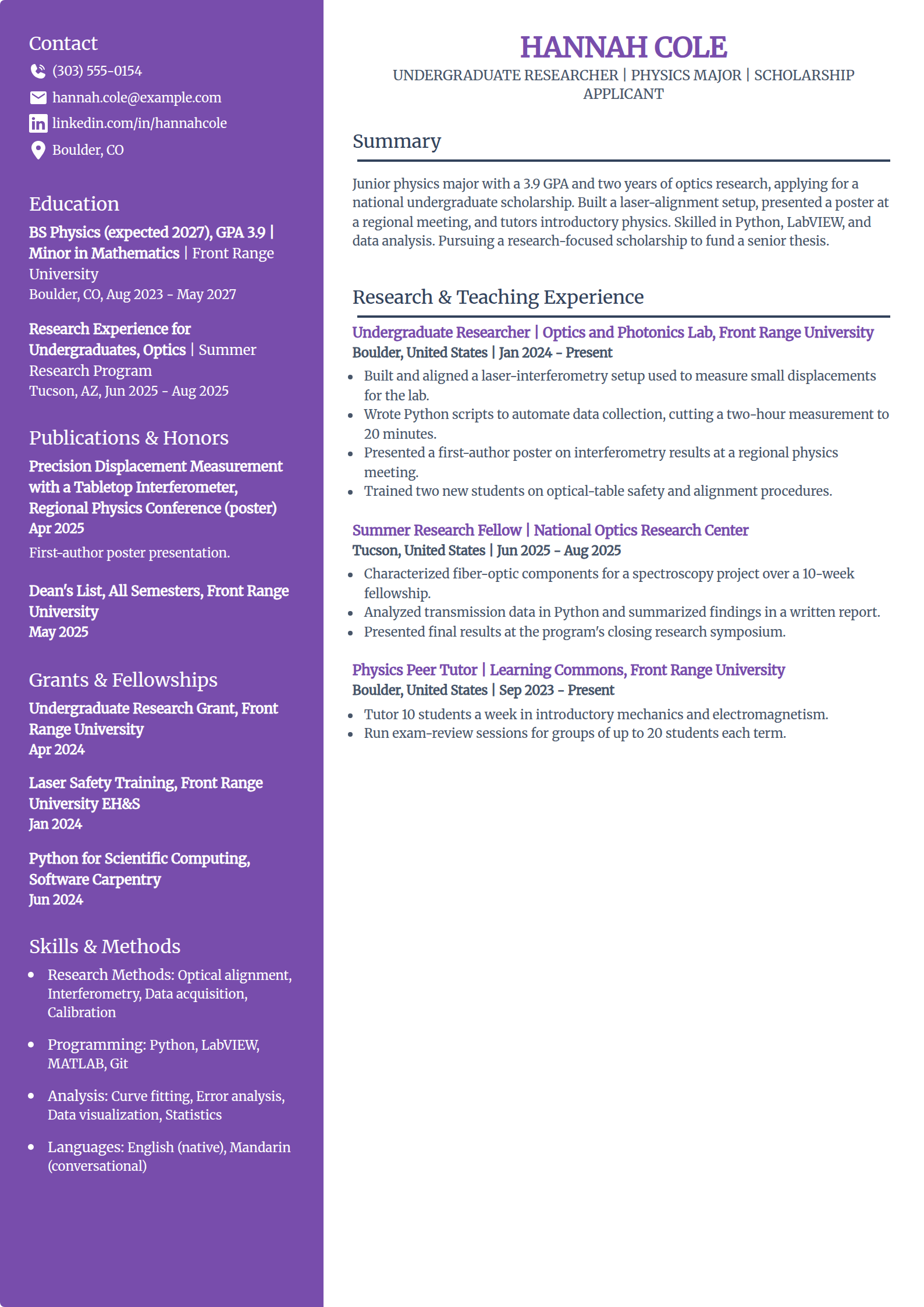
Undergraduate Research & Scholarship Resume Template
Why this resume example works?
- Leads with a physics major, a 3.9 GPA, and a summer research program, the record a scholarship reviews.
- Turns undergraduate research into proof, a laser setup built and a first-author poster presented.
- Keeps the experience to three focused roles, research, a summer fellowship, and tutoring, without stretching.
- Names the tools and methods a reviewer expects, from Python and LabVIEW to optical alignment.
- Carries a poster and department scholarship as honors, the recognition an undergraduate can truly own.
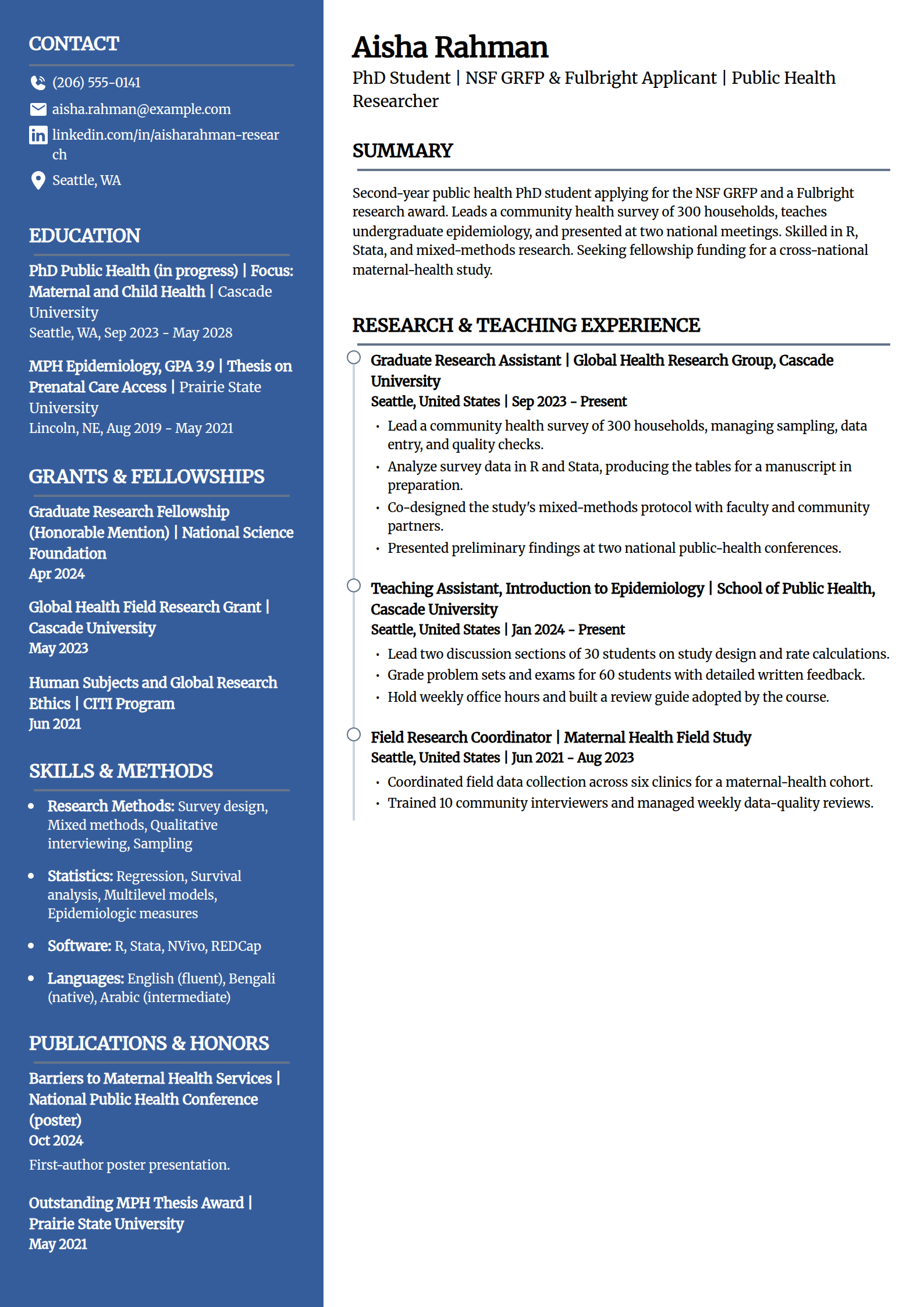
Fellowship & Grant Applicant Resume Template
Why this resume example works?
- Opens with a PhD in progress and a specific goal, an NSF GRFP and a Fulbright research award.
- Shows the research a panel funds, a 300-household survey led from sampling through analysis.
- Lists an NSF honorable mention and a field-research grant with issuers, the record a fellowship rewards.
- Names mixed-methods skills and software, from R and Stata to NVivo, plus three languages.
- Keeps a Medium layout focused on research, teaching, and coordination without padding.
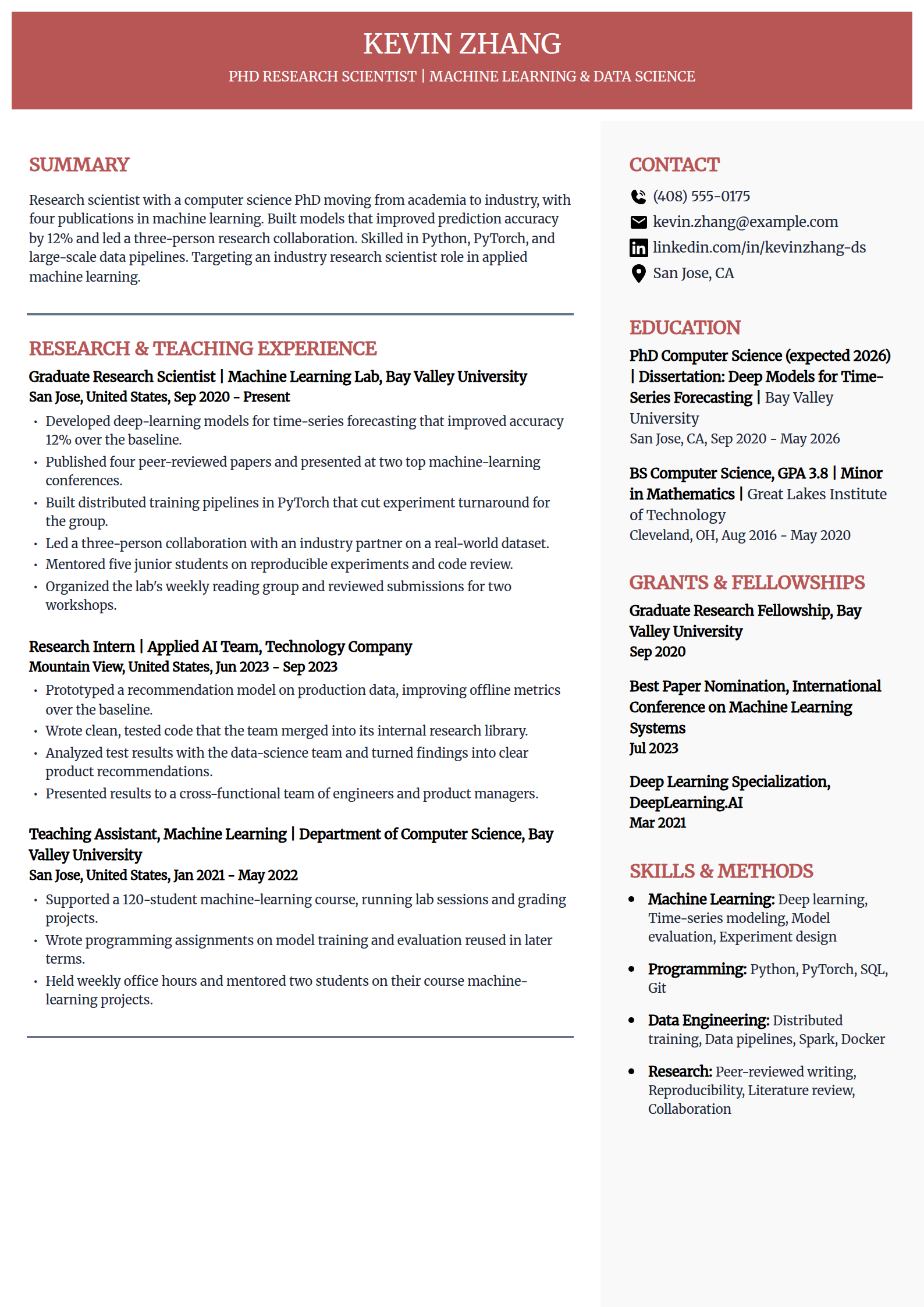
Research Scientist (Academia to Industry) Resume Template
Why this resume example works?
- Reframes a PhD for industry, leading with models that improved accuracy 12% rather than a publication list.
- Folds publications into a single bullet, the right weight for an industry resume, not a full CV section.
- Names industry-ready tools, Python, PyTorch, Spark, and Docker, alongside the research methods.
- Includes an industry internship, showing the candidate has already worked on production data.
- Uses a two-column layout that keeps grants and skills in the sidebar and experience up front.
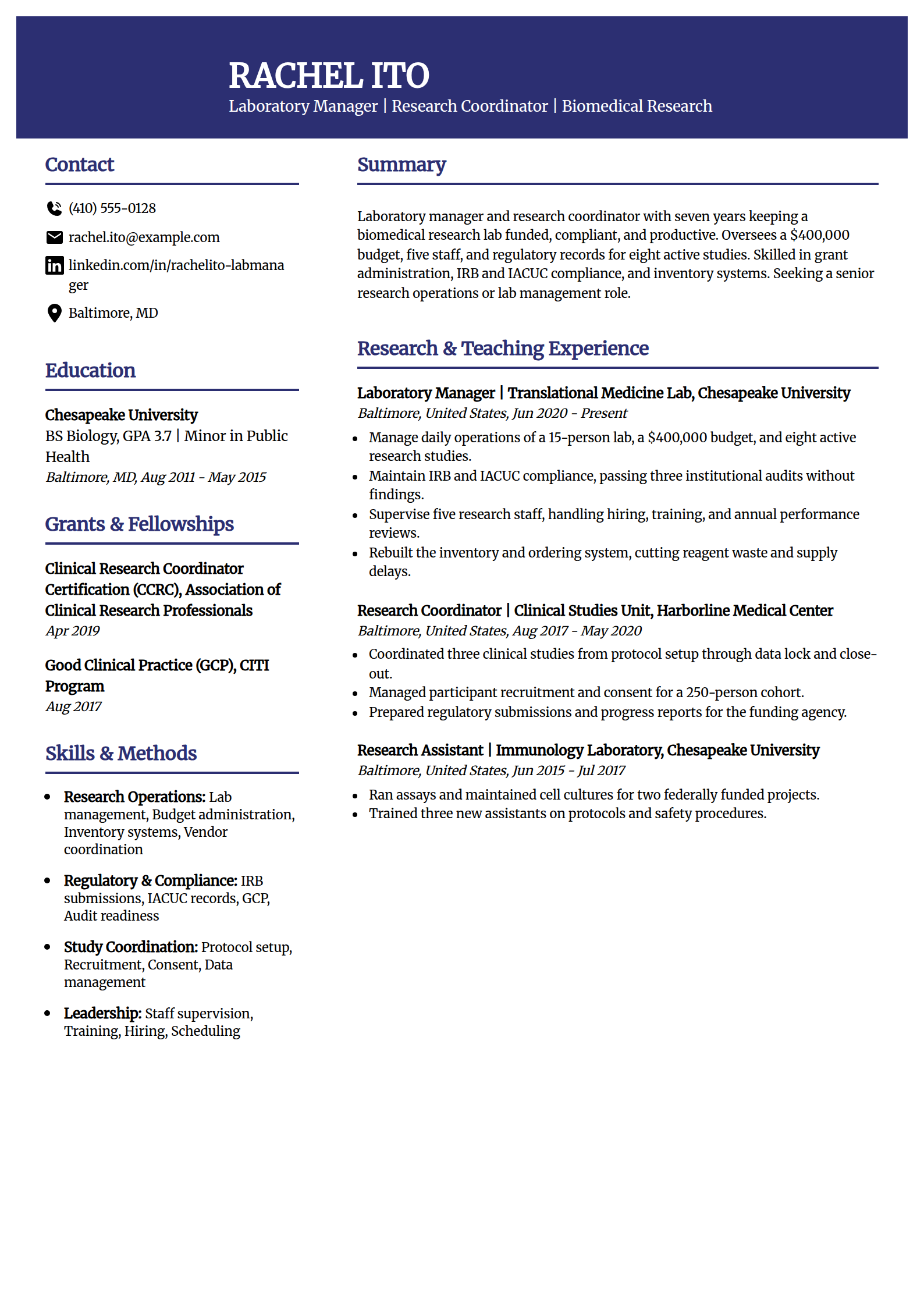
Lab Manager & Research Coordinator Resume Template
Why this resume example works?
- Leads with operations scope, a $400,000 budget, five staff, and eight active studies managed.
- Shows compliance results, three institutional audits passed without findings, that research leaders value.
- Names the regulatory work, IRB and IACUC records and GCP, that defines a research operations role.
- Carries a clinical research coordinator certification with its issuing body, a real credential.
- Keeps a roomy layout clean with three focused roles instead of inflating any single one.
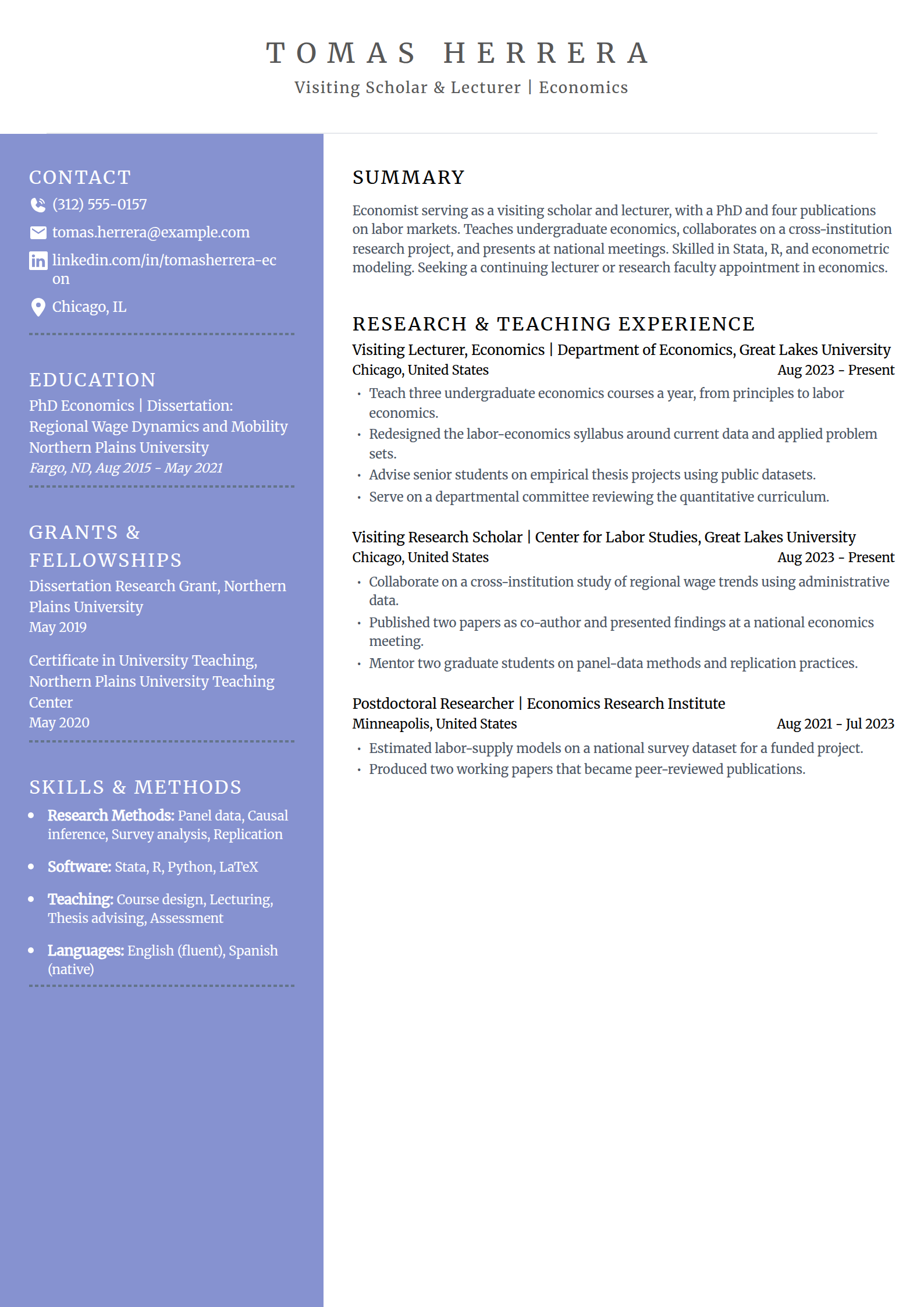
Visiting Scholar & Lecturer Resume Template
Why this resume example works?
- Opens with a PhD and four labor-economics publications, the record a lecturer appointment weighs.
- Pairs teaching and research, three courses a year taught and a cross-institution study joined.
- Names the methods and tools an economics search expects, from panel data and causal inference to Stata.
- Shows publications inside the experience bullets, keeping a roomy layout to one page.
- Carries a teaching certificate and a dissertation grant, credentials that support a continuing role.
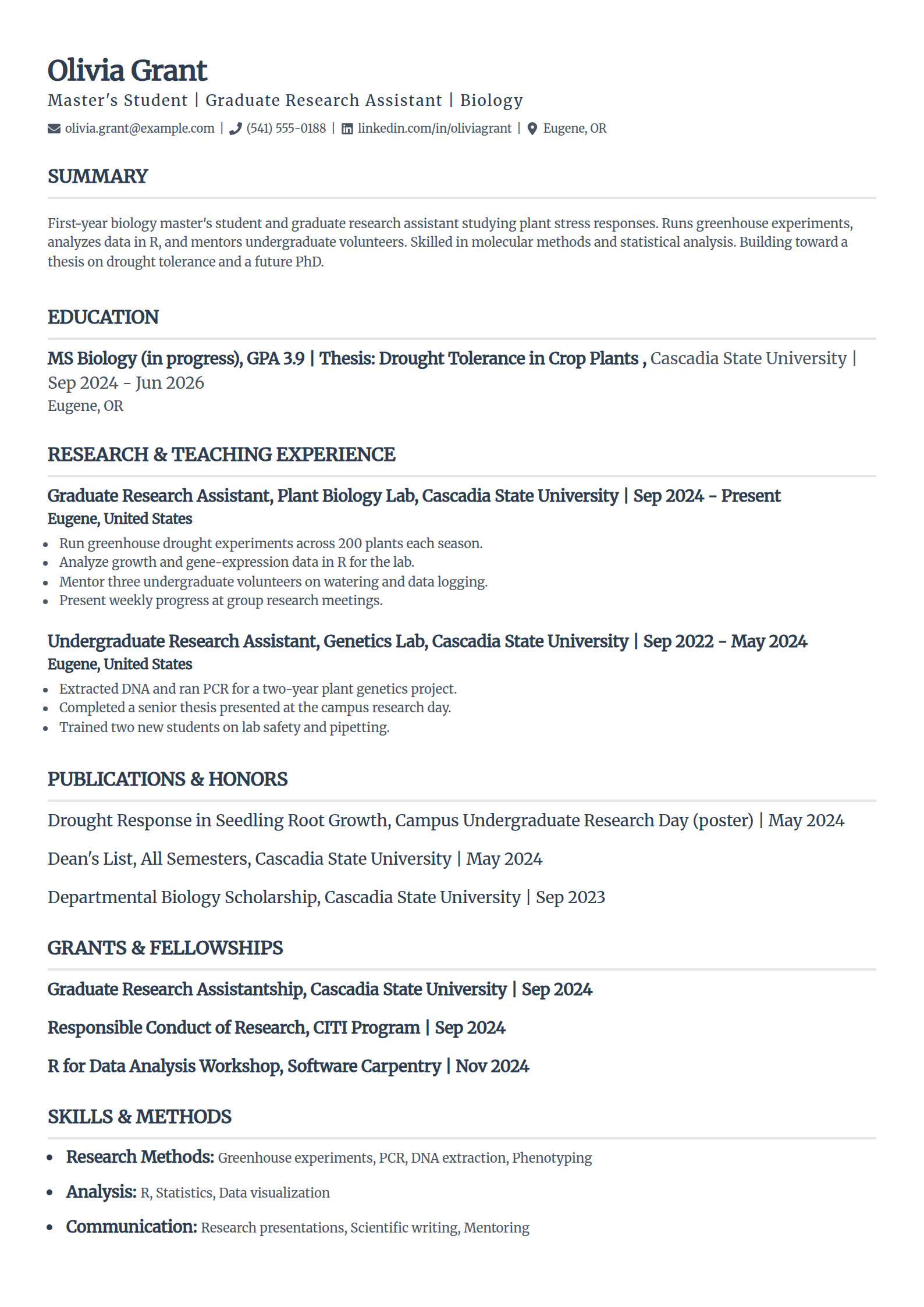
Master's Student Resume Template
Why this resume example works?
- Leads with an in-progress master's and a named thesis, the anchor for a current student.
- Keeps two research roles with tight bullets under 90 characters, so limited experience fills a clean page.
- Turns lab work into scope, 200 plants a season and three volunteers mentored, at the right scale.
- Names core methods and R, the skills a research assistantship actually uses.
- Uses a tight template that reads confident even with a short, honest record.
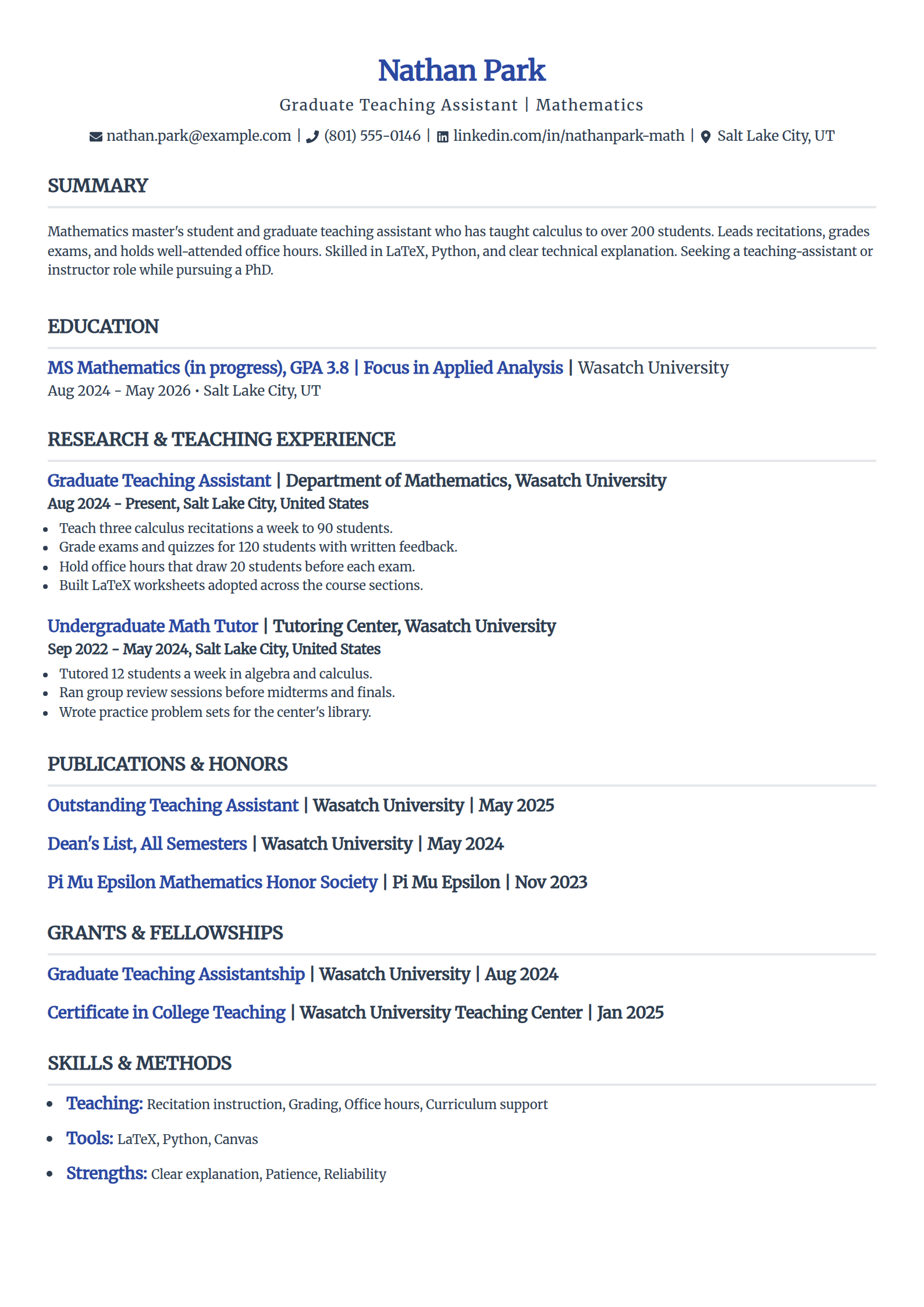
Graduate Teaching Assistant Resume Template
Why this resume example works?
- Leads with an in-progress master's and the teaching scope, calculus taught to over 200 students.
- Frames TA work as contribution, LaTeX worksheets adopted across sections, not just grading.
- Keeps two roles, a teaching assistantship and tutoring, on one tight, skimmable page.
- Names the tools a teaching role uses, LaTeX, Python, and Canvas, without overreaching.
- Carries a teaching award and an honor society, recognition sized to a graduate student.
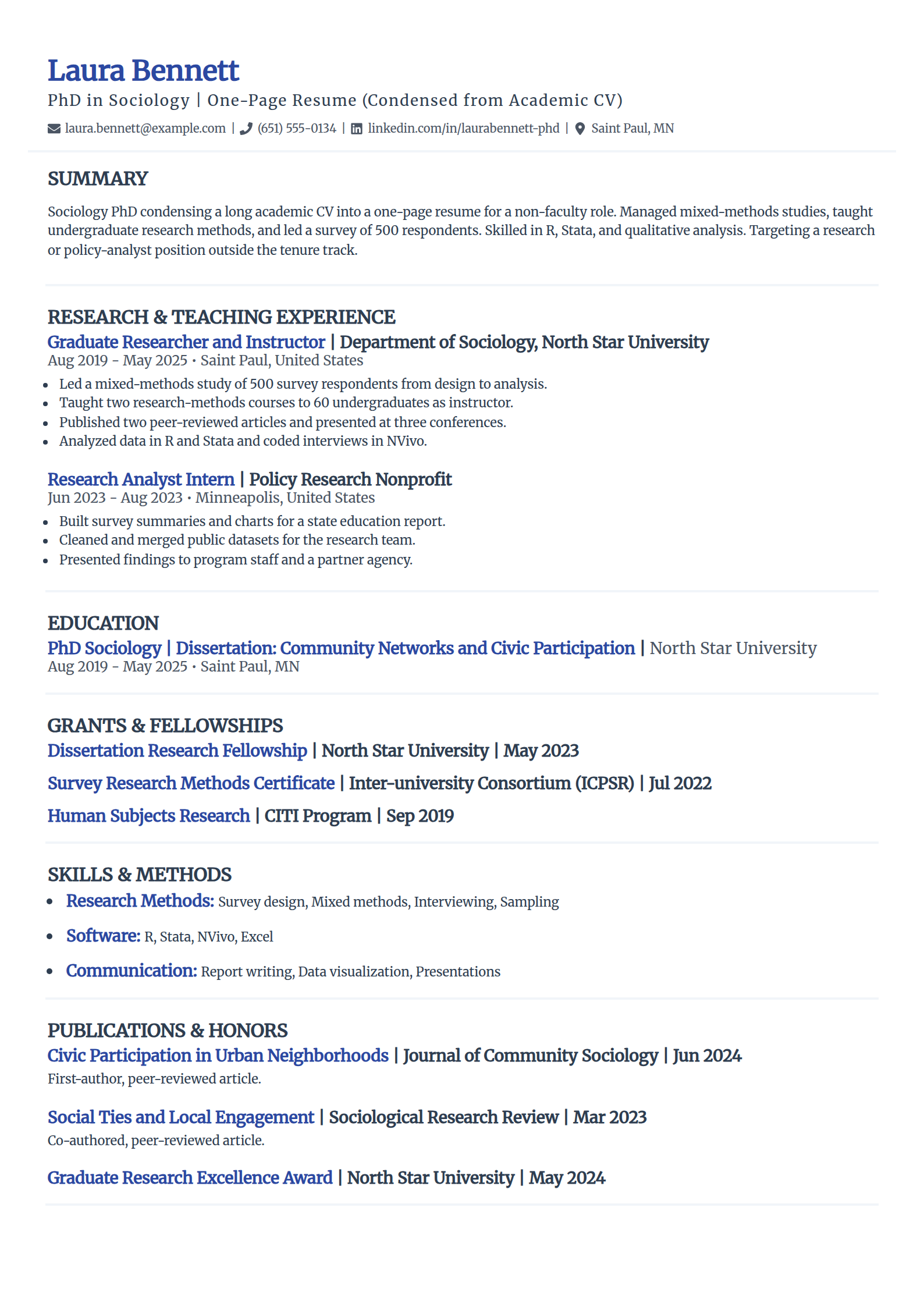
Academic CV vs Resume: One-Page Resume Template
Why this resume example works?
- Shows a sociology PhD condensed into a one-page resume, the tool a non-faculty role asks for.
- Combines research and teaching into one experience entry, the way a resume trims a long CV.
- Keeps two publications on the resume rather than a full CV list, sized to one page.
- Names transferable skills, R, Stata, and NVivo, for a research or policy-analyst target.
- Proves an academic record can fit a tight, readable page without listing everything.
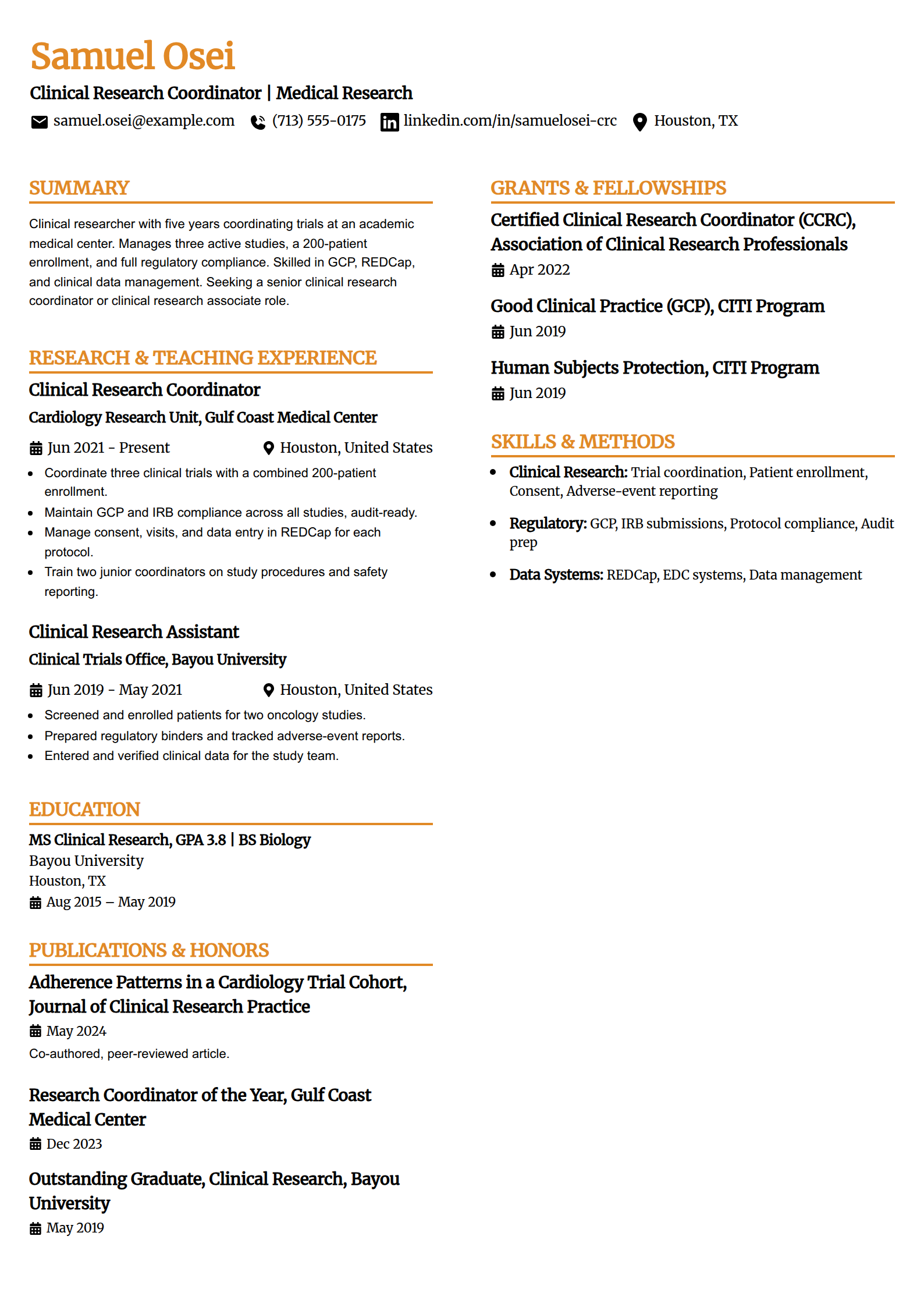
Clinical & Medical Researcher Resume Template
Why this resume example works?
- Leads with trial coordination scope, three studies and a 200-patient enrollment managed.
- Names the regulatory backbone, GCP, IRB, and REDCap, that a clinical research role requires.
- Carries a certified clinical research coordinator credential with its issuing body.
- Shows a co-authored clinical paper, the realistic publication a coordinator earns.
- Keeps a tight two-entry layout that reads complete for a focused clinical career.
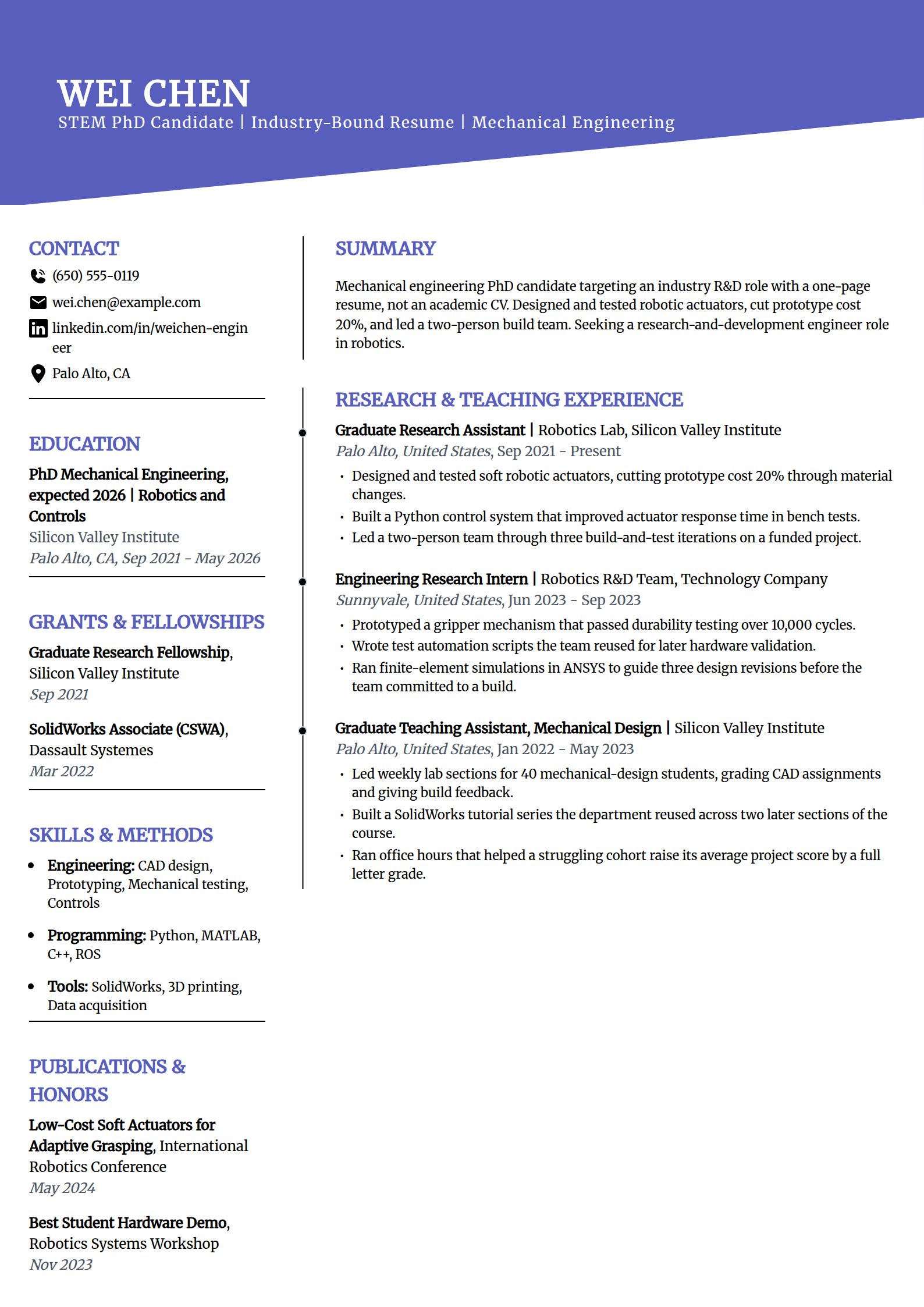
STEM PhD Candidate (Industry Resume) Template
Why this resume example works?
- States the strategy plainly, a one-page resume for industry R&D, not a long academic CV.
- Leads with engineering outcomes, actuators designed and prototype cost cut 20%, over a publication list.
- Keeps three-bullet entries and short award lines, the tight shape this template is built for.
- Names industry-ready tools, SolidWorks, Python, C++, and ROS, that a hardware team screens for.
- Includes an industry internship, showing the candidate has already shipped work outside the lab.
Build your academic resume
Pick a template above and the editor keeps your layout clean and skimmable while you swap in your own degree, research, teaching, grants, and publications.
Build my resumeHow to write an academic resume in 2026
An academic resume leads with your scholarship, not a work history. Education, research, teaching, grants, and publications carry it, and a committee or a hiring manager should find your degree and your strongest research in the top third. These moves make yours easy to skim and easy to trust, and the last section explains, honestly, when you should send a long academic CV instead.
Open with a research-focused summary
Write three to four sentences that name your degree or stage, your field, your strongest research result, and the role or program you are targeting. Lead with what you have done, a study run or a paper published, not what you want from the position.
Molecular biologist and postdoctoral fellow with a PhD and five peer-reviewed publications on gene regulation. Leads a CRISPR screening project, mentors three graduate students, and won a two-year training grant. Skilled in qPCR, RNA-seq, and analysis in R and Python. Seeking a tenure-track or senior research position in molecular genetics.
Lead with education and your thesis or dissertation
Education anchors an academic resume, so it belongs near the top with more detail than an industry resume would carry. Students and recent graduates put it first; established researchers can place it just under a short summary.
- List your degree, institution, and graduation year, and add your GPA when it is strong.
- Name your thesis or dissertation title so a reader sees your research focus at a glance.
- Include honors, a named fellowship, or an honor society where they belong to your record.
- Undergraduates and master's applicants lead with education; postdocs and faculty applicants lead with a summary, then education.
Show research, teaching, and impact
Put research positions, teaching and TA roles, and lab work in your experience section, and open every bullet with a strong verb and a result. Say what changed because of your work, not what the role description said.
- Research: name the project and the outcome, such as a 150-animal study run or a survey of 300 households led.
- Teaching: give the scope, like two lab sections of 24 students taught, plus one result you can prove.
- Methods: name the techniques and instruments you actually used, from qPCR to eye tracking.
- Keep numbers modest and level-appropriate: an undergraduate has a poster, a postdoc has a few papers.
List fellowships, grants, and awards with their issuers
Funding and recognition are their own section on an academic resume, and every entry names the body that granted it. This is where an NSF fellowship or a training grant reads as real.
- Name the grant or fellowship and its issuer, such as an NSF Graduate Research Fellowship or an NIH training grant.
- Add teaching and dissertation awards where you earned them, with the department or society that gave them.
- Keep dollar figures realistic for your level and only include them when they help.
- Do not inflate a nomination into a win; state exactly what you received.
List publications and presentations honestly
Publications belong on an academic resume, but a resume shows a selected, capped list, not the full bibliography a CV would carry. Present each one truthfully.
- List a handful of your strongest publications with the journal or conference and your author position.
- Mark work that is under review or in preparation as such, never as published.
- Include posters and talks under presentations when your publication list is still short.
- With no publications yet, lead with research experience and a conference poster instead; that is normal early on.
List your skills, software, and methods
A skills section lets a reader and a parser find the methods and tools your field runs on. Group them so they are easy to scan.
- Research methods: name techniques by field, such as cell culture, survey design, or econometric modeling.
- Software: list what you use, from R, Python, MATLAB, SPSS, and Stata to LaTeX, NVivo, and REDCap.
- Languages: include reading or speaking ability when it matters to your research or program.
- Match the exact tools a posting or program names where they are true for you.
Keep the format ATS-safe and readable
Whether a person or a parser reads first, a clean layout keeps your record intact. Save the visual flourishes for a personal website, not the resume.
- Use standard section headings and a single readable font, and skip tables, columns of text boxes, and graphic headers.
- Keep your name and contact details in the body of the page, not a header or footer image.
- Save as a PDF unless the application asks for a Word document, and browse clean layouts on our resume templates page.
- Run the finished file through the ATS resume checker for a quick format and readability pass.
Academic CV vs resume: which one to send, honestly
This is the question that decides everything above, and most template galleries skip it because the honest answer is that you often do not want a resume at all. Here is the plain version.
- A resume is one to two pages, tailored, and concise. Most industry jobs, national labs, biotech, and non-faculty campus roles want a resume.
- An academic CV is long, comprehensive, and publications-first. It can run many pages and only grows over time.
- Use a CV for tenure-track faculty positions, most postdocs, and grant and fellowship applications within academia.
- A STEM PhD applying to industry sends a one-page resume, not the CV; the STEM PhD example above shows exactly that.
- When a posting says resume, send a resume. When it says CV, send the long CV. This page builds the resume; it will not pretend one page is right when the job asks for the full record.
Common academic resume mistakes
- Sending a six-page CV when the posting asked for a resume. Match the document to the request; industry wants one to two pages.
- Burying your degree and thesis at the bottom. Education anchors an academic resume, so keep it in the top third.
- Listing duties instead of research results. "Ran experiments" is a task; "ran a 150-animal study and built the analysis pipeline" is proof.
- Inflating your publication record. List a selected, honest set with author position, and mark anything under review as under review.
- Cramming everything into dense, unreadable formatting. Cut to your strongest work and keep the page clean enough to skim.
Frequently asked questions
What is an academic resume?
An academic resume is a one to two page document that leads with your education, research, teaching, grants, and selected publications rather than a long job history. You use it for research positions, non-faculty campus roles, national labs, industry science jobs, and program or scholarship applications that ask for a resume. It is a concise, tailored summary of your scholarship, and it is different from a full academic CV, which is longer and comprehensive.
What is the difference between an academic CV and a resume?
A resume is one to two pages, tailored to the posting, and concise. An academic CV is long, comprehensive, and publications-first, often running many pages, and it only grows as you publish. Use a CV for tenure-track faculty positions, most postdocs, and grant and fellowship applications within academia. Use a resume for industry roles, national labs, biotech, non-faculty campus jobs, and any posting that says resume. When a job asks for one, send that one; do not substitute a one-page resume where the full CV is expected.
How long should an academic resume be?
One to two pages. Students and early-career applicants keep it to one page; researchers with a longer record of publications and grants can use two. If you find yourself needing more than two pages, the role probably wants an academic CV instead, so check the posting. Lead every section with your strongest, most quantified entry so a committee sees the best of your record first, and cut anything that does not earn its place on a short document.
Do you put publications on a resume?
Yes, but a selected and capped list, not your full bibliography. List a handful of your strongest publications with the journal or conference and your author position, and mark anything under review or in preparation as such rather than as published. If your list is still short, include conference posters and talks under a presentations heading. Save the complete, exhaustive publication list for an academic CV, where a comprehensive record is expected.
How do you list research experience on a resume?
Put research in your experience section like a job, with the lab or project, your role, and dates, then write accomplishment bullets. Open each bullet with a strong verb and say what changed, such as a study you ran, a method you built, or a dataset you analyzed, and attach one modest, true number. Name the techniques and software you used, keep the metrics realistic for your level, and lead with the research that fits the position you are targeting.
What goes on an academic resume with no publications yet?
Lead with your research experience, your education and thesis, and any conference posters or talks. Early in a career, having no peer-reviewed publications is normal, so show the work itself: the projects you contributed to, the methods you learned, and the results your lab produced. Add fellowships, grants, and awards with their issuers, list your skills and software, and present a poster as a presentation. Depth in one or two real research roles reads better than a padded list.
More academic resume resources
Build your academic resume
Pick a template above and the editor keeps your layout clean and skimmable while you swap in your own degree, research, teaching, grants, and publications.