Caseload, Setting and Licensure: 16 Special Education Teacher Templates and Examples
- ATS Friendly
- Licensure First
- 16 Caseload Examples
A special education teacher resume example should carry four things: your license and endorsement with its disability-category range, the setting you teach in, the size and shape of your caseload, and evidence you run the whole IEP cycle rather than just attending meetings. Pick the example below that matches the room you want, then swap in your own caseload numbers.


540k+ resumes created
One template per caseload you could be hired to carry
A resource teacher scheduling pull-out minutes, an autism support teacher running discrete trials, and a transition specialist placing students in paid work are three different postings with three different screens. Each template below is a complete one-page resume for one of them, written with the credentials, settings, and programs that posting actually names.
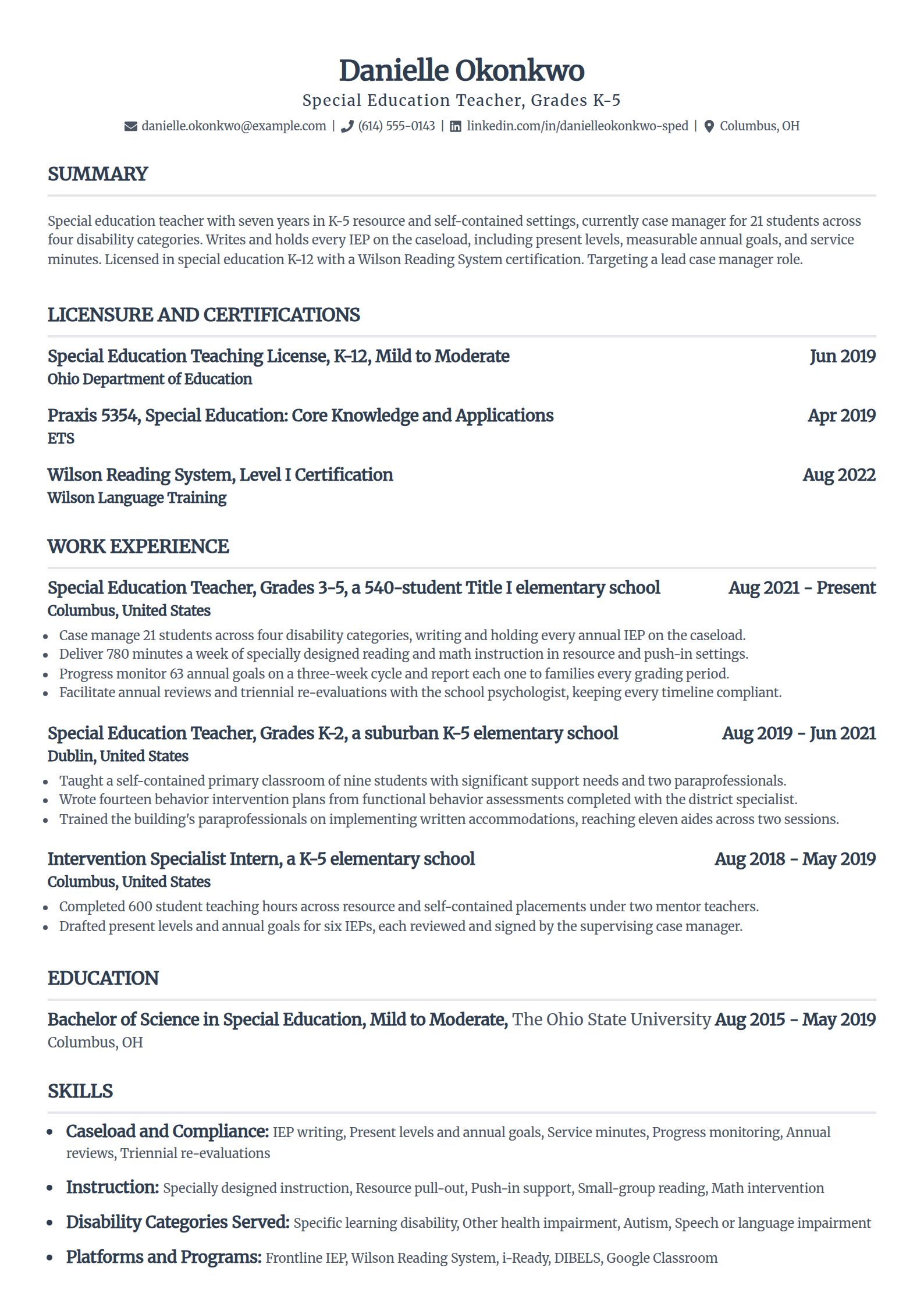
Elementary Special Education Teacher Resume Template
Why this resume example works?
- Puts the license and its mild-to-moderate range directly under the summary, where a district screener checks it first.
- Names the caseload size and the number of disability categories, which tells a principal the shape of the job in one line.
- Counts service minutes delivered per week, a number every special education director recognizes and can verify.
- Shows the whole IEP cycle, from writing and holding annuals through triennial re-evaluations, not just attendance at meetings.
- Carries no percentage claims about student growth, which is what makes the numbers it does give believable.
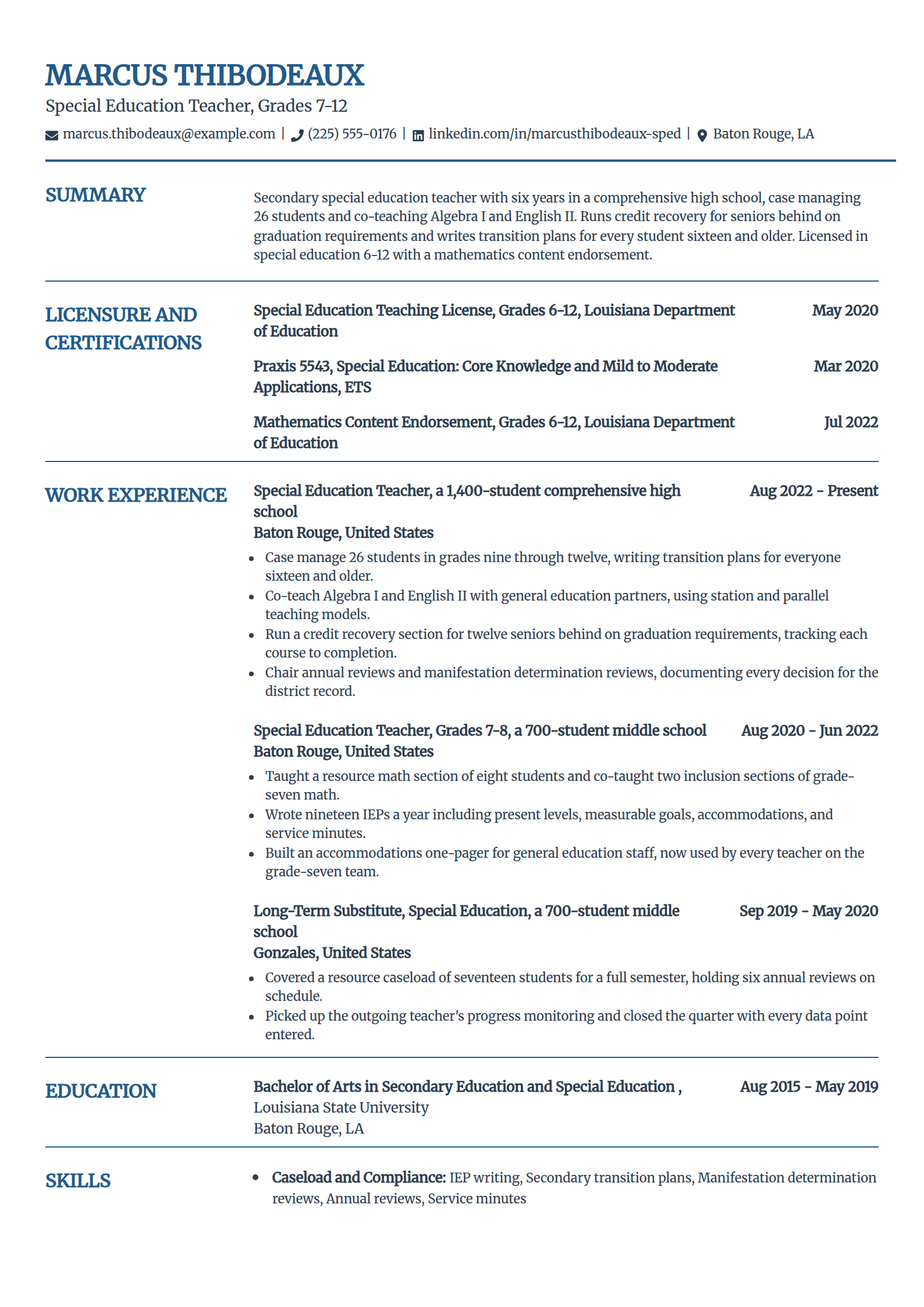
Secondary Special Education Teacher Resume Template
Why this resume example works?
- Leads with the grade band and the co-taught courses, because a secondary posting is written around content coverage.
- Names the co-teaching models used rather than saying collaborated with general education staff.
- Includes transition plans for students sixteen and older, which is a legal requirement a secondary posting screens for.
- Mentions chairing manifestation determination reviews, work that only a secondary case manager does.
- Pairs the special education license with a math content endorsement, the combination that makes a co-teacher hireable.
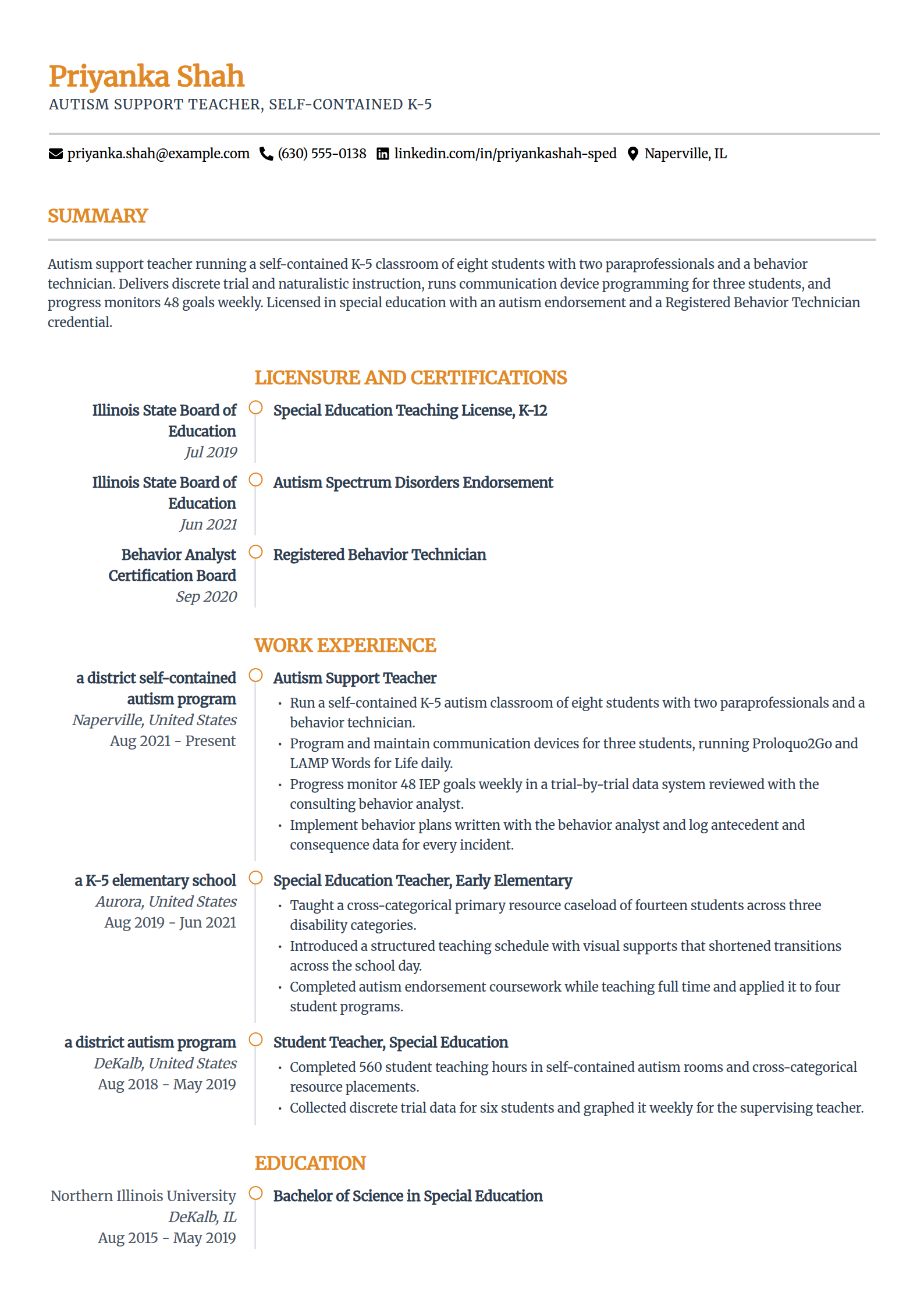
Autism Support Teacher Resume Template
Why this resume example works?
- Describes the room by its staffing, eight students with two paraprofessionals and a behavior technician, so the scale is clear.
- Names the instructional methods outright, discrete trial and naturalistic teaching, instead of saying evidence-based practices.
- Lists the communication apps by name, which is what a program hiring for an AAC-heavy classroom searches on.
- Keeps the behavior work inside scope: plans are written with the consulting analyst and implemented by the teacher.
- Stacks the autism endorsement and the behavior technician credential, the two lines that separate this from a general SPED resume.
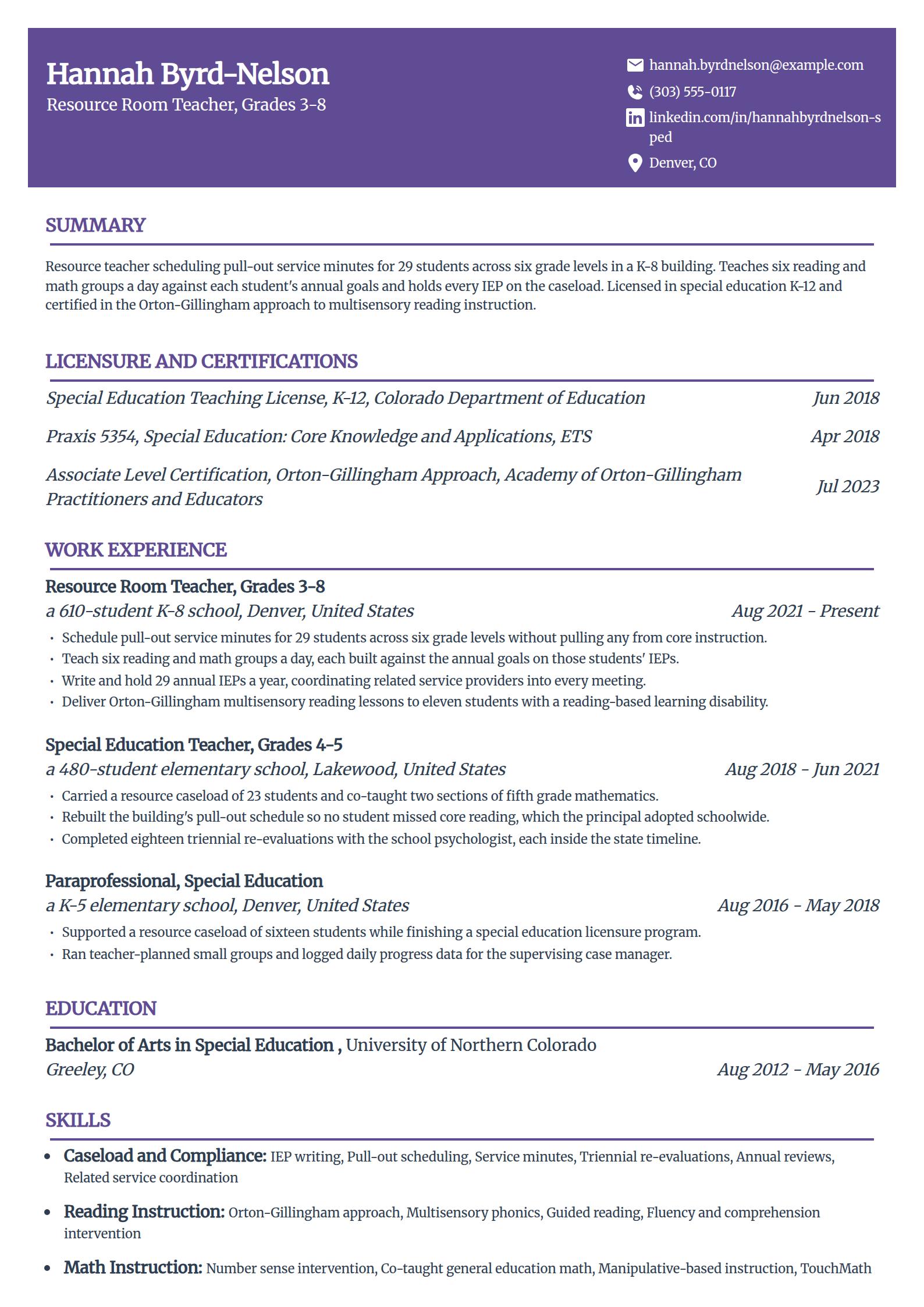
Resource Room Teacher Resume Template
Why this resume example works?
- Treats scheduling as the skill it is, 29 students across six grade levels without pulling anyone from core instruction.
- Counts groups taught per day, which is the honest measure of a resource teacher's load.
- Names the reading methodology, the Orton-Gillingham approach, instead of writing reading intervention.
- Shows a process improvement a principal adopted, which is how a teacher demonstrates influence without a title.
- Includes the paraprofessional years that preceded licensure, because that path is common and reads as commitment.
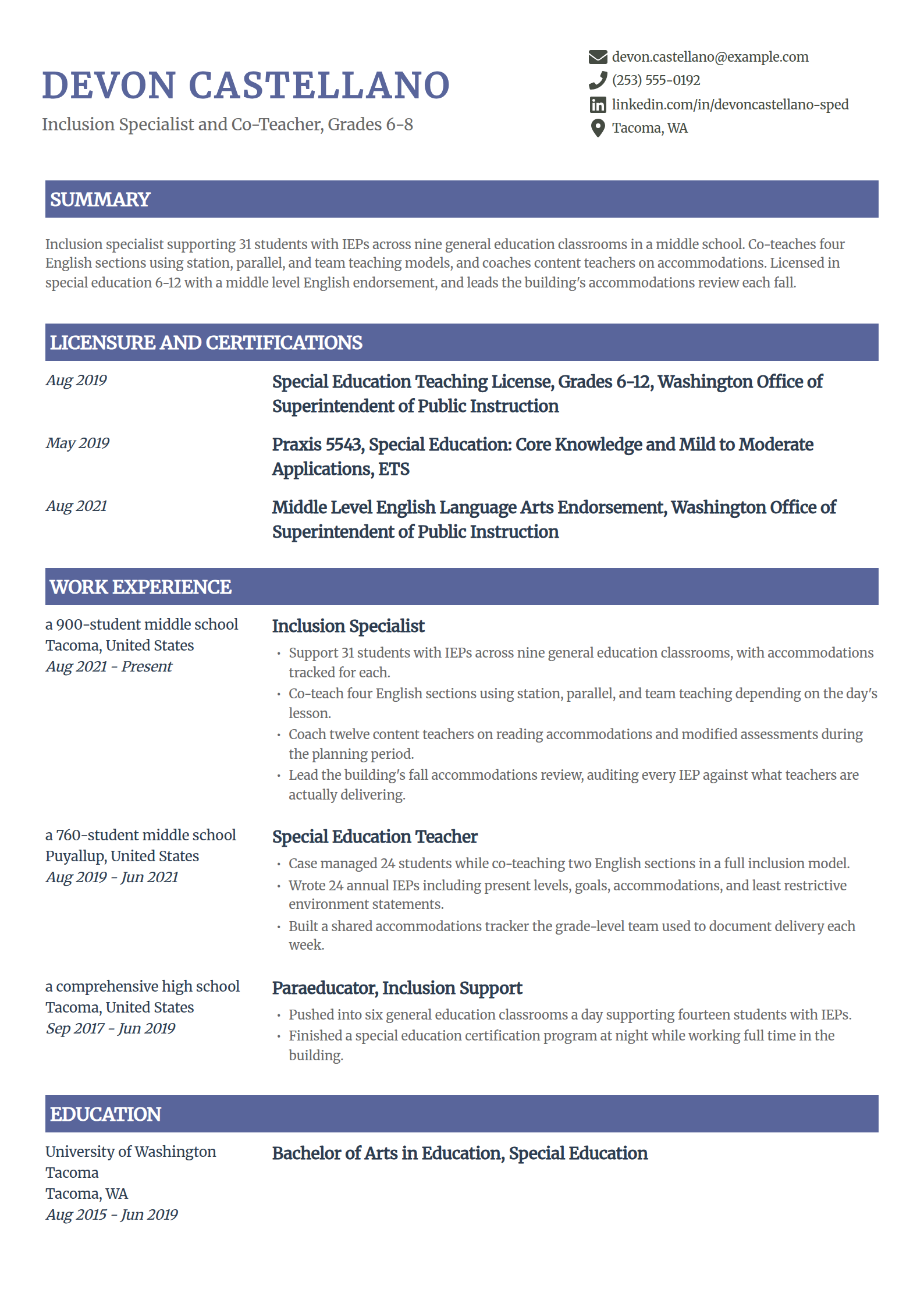
Inclusion Specialist Resume Template
Why this resume example works?
- Measures the job by classrooms covered and students supported, not by a caseload number that would understate it.
- Names all four co-teaching models, which is the vocabulary an inclusion posting is written in.
- Shows coaching of general education colleagues, the part of this role that a caseload count misses entirely.
- Includes an accommodations audit, checking what teachers actually deliver against what the IEPs say.
- Adds a content endorsement, since inclusion specialists are hired to co-teach a subject and not just to support.
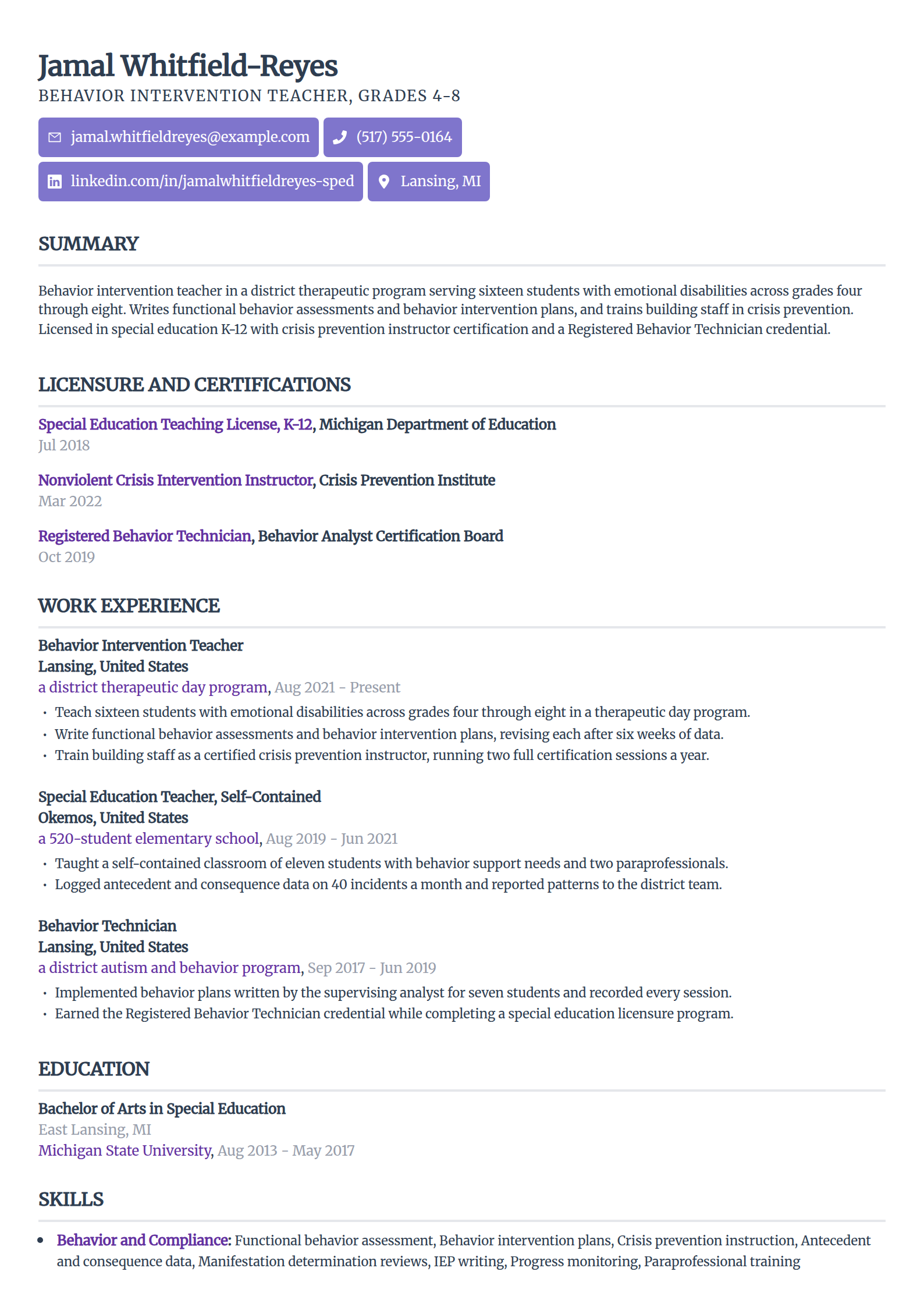
Behavior Intervention Teacher Resume Template
Why this resume example works?
- States the population and the setting in the first line, since a therapeutic program screens on exactly that.
- Shows functional behavior assessments and behavior plans being written and revised against data, not just referenced.
- Carries the crisis prevention instructor credential, which makes this candidate a trainer and not only a participant.
- Counts incidents logged rather than claiming incidents were reduced, a distinction a behavior specialist will notice.
- Keeps the behavior technician years visible, because that is how most behavior teachers learn the data systems.
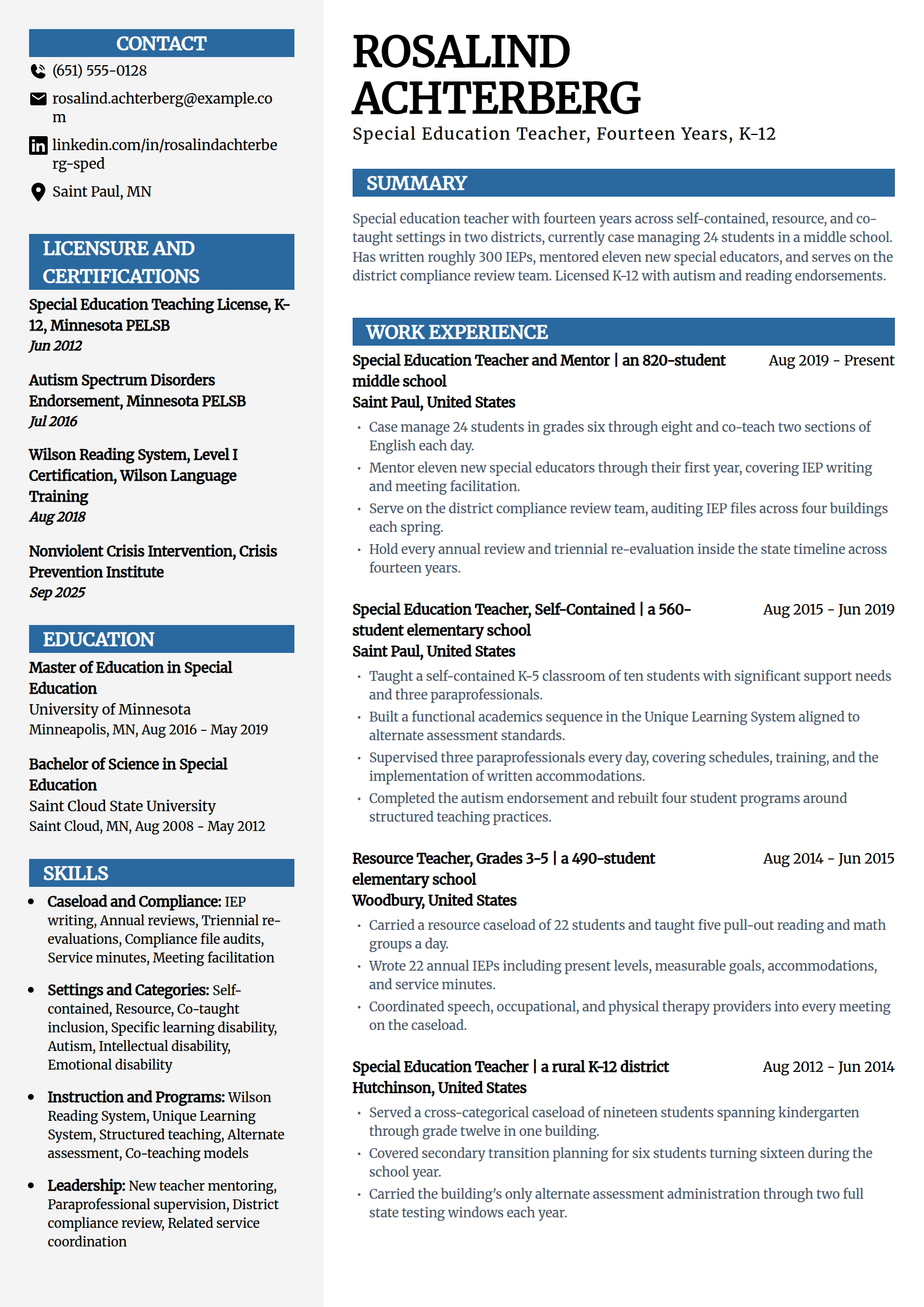
Experienced Special Education Teacher Resume Template
Why this resume example works?
- Fits fourteen years and four roles on one page by trimming the oldest entries instead of shrinking the type.
- Gives a career-scale number, roughly 300 IEPs written, that no early-career candidate can match.
- Shows district-level work, serving on the compliance review team, which is the step before a leadership title.
- States the timeline record plainly, every annual review and re-evaluation held on time across fourteen years.
- Uses a two-column layout that keeps two degrees, four credentials, and the skills block visible beside a long history.
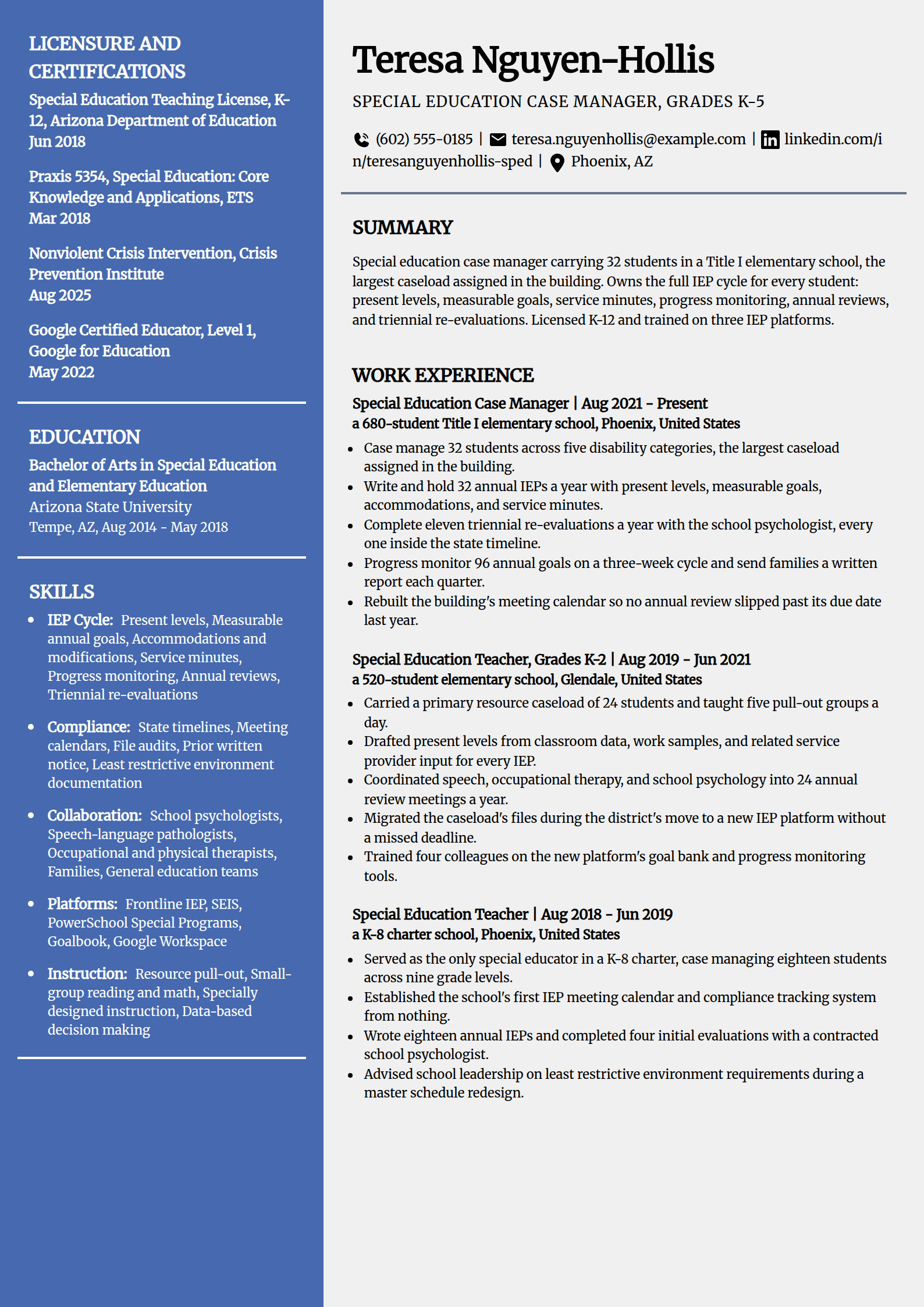
Special Education Case Manager Resume Template
Why this resume example works?
- Owns the caseload number instead of softening it, 32 students and the largest assignment in the building.
- Walks the full IEP cycle in order, which is what a compliance-heavy posting is really asking about.
- Counts re-evaluations completed inside the state timeline, the single most checkable claim on this kind of resume.
- Shows a platform migration carried without a missed deadline, which is an operations win a director will recognize.
- Names three IEP platforms, since a district running one of them wants to skip the training month.
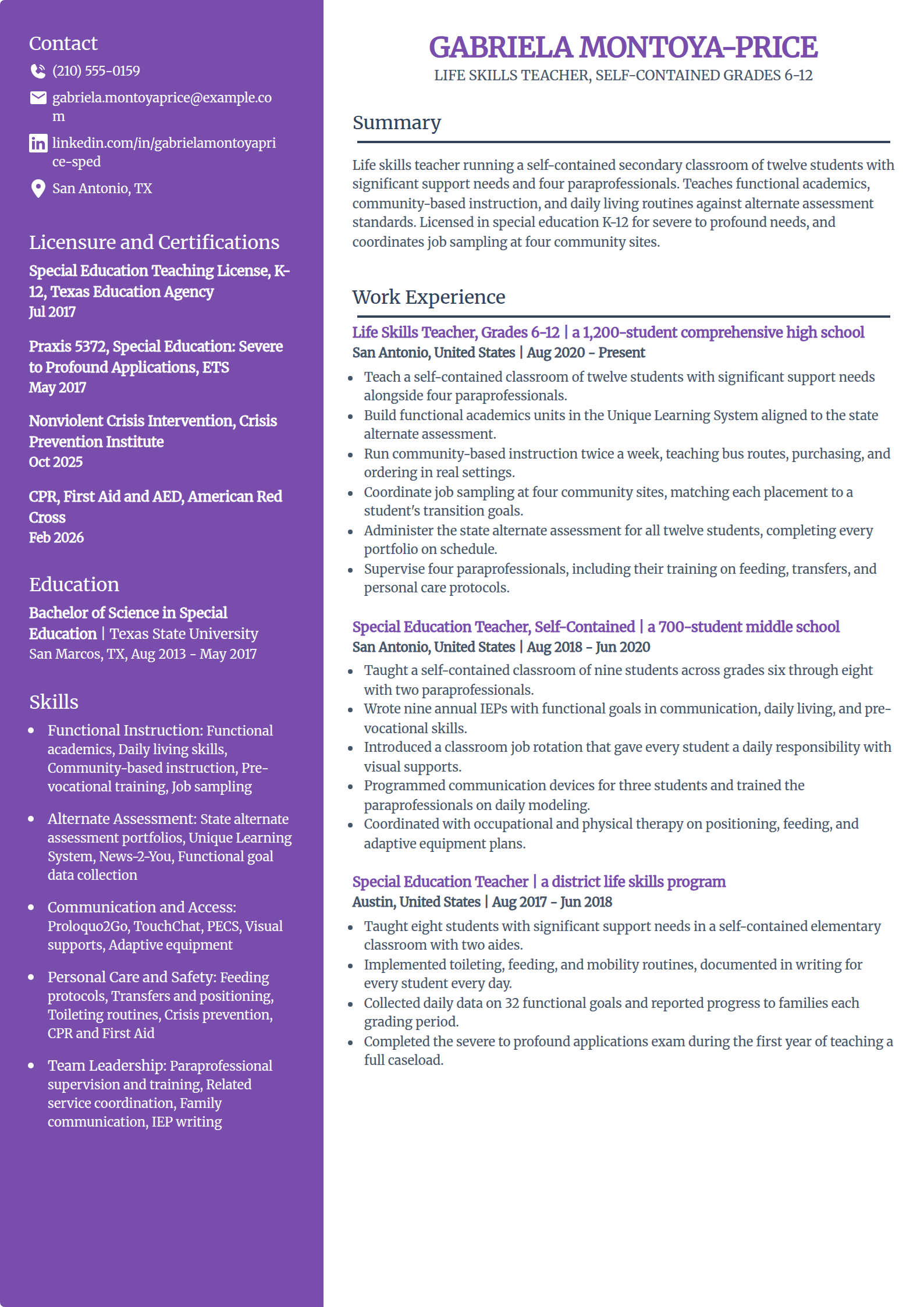
Life Skills Teacher Resume Template
Why this resume example works?
- Describes the classroom by its staffing and its curriculum, so a director knows the support level immediately.
- Names the alternate assessment work, which is a legal obligation and a real workload in this setting.
- Includes community-based instruction and job sampling, the parts of the job that never appear on a generic template.
- Lists personal care openly, because feeding, transfers, and toileting are the work and hiding them costs interviews.
- Carries the severe to profound applications exam, the credential that matches this classroom rather than a general one.
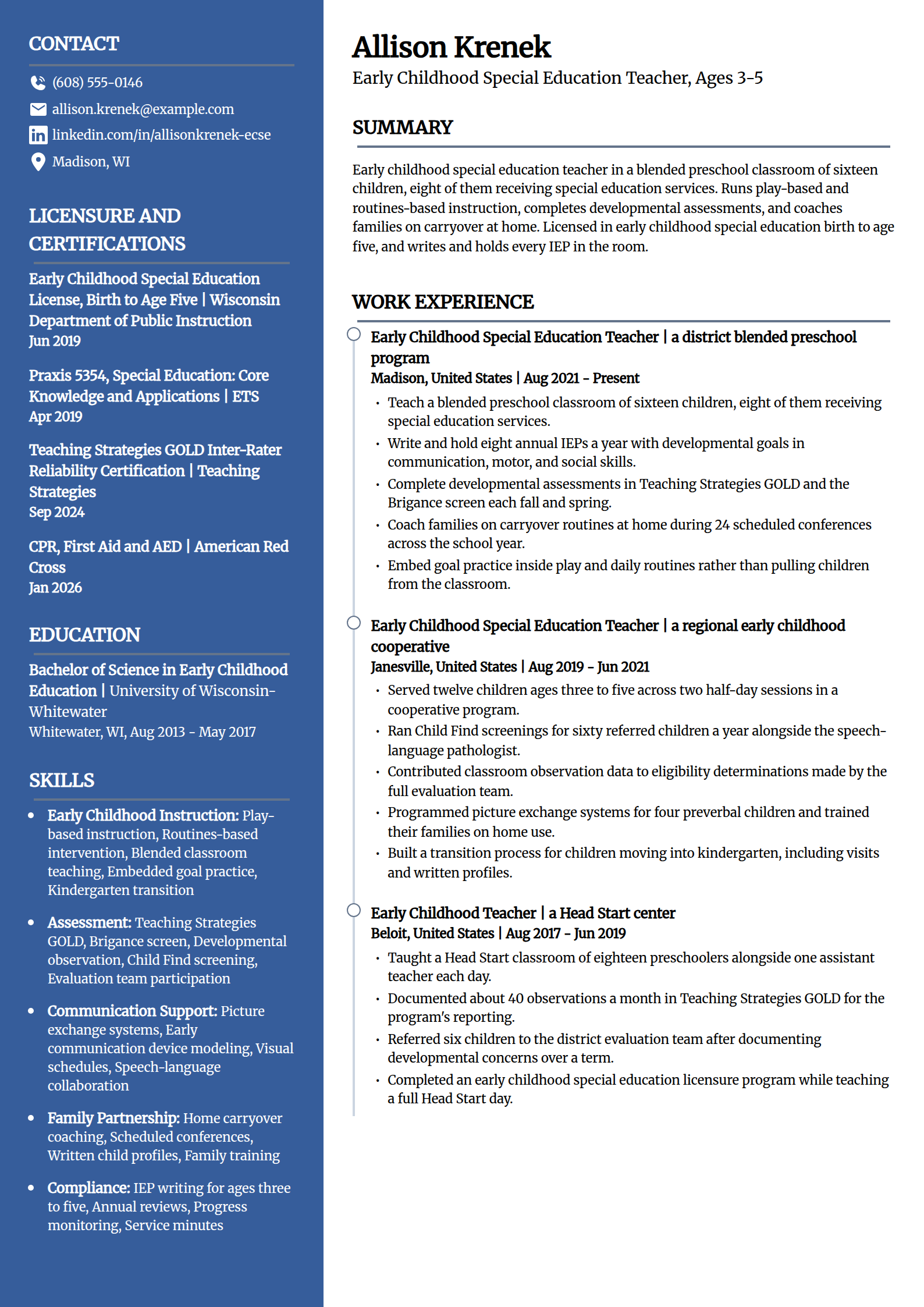
Early Childhood Special Education Resume Template
Why this resume example works?
- Says blended classroom and gives both numbers, sixteen children with eight receiving services, which defines the room.
- Uses the assessment tools an early childhood program runs on, named rather than described.
- Shows family coaching as scheduled, counted work instead of a claim about building relationships.
- Explains the service model honestly: goals practiced inside play and routines rather than through pull-out.
- Includes Child Find screening and evaluation team participation, which is how this role differs from K-12 special education.
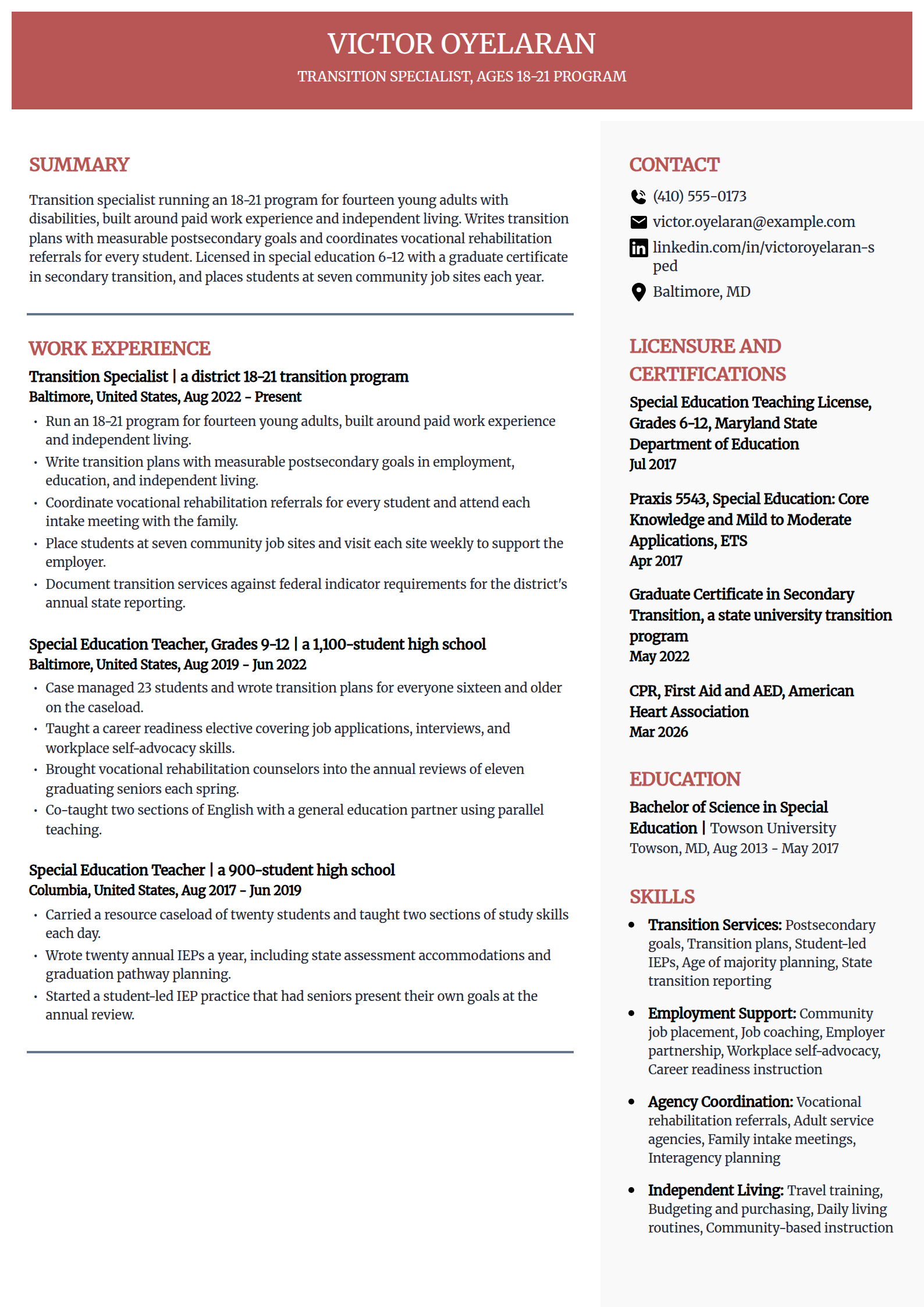
Transition Specialist Resume Template
Why this resume example works?
- Names the program by its age band, 18-21, which is how these postings are titled and searched.
- Writes postsecondary goals in the three required areas, showing command of what a transition plan legally contains.
- Counts employer sites and weekly visits, because job development is the measurable half of this job.
- Includes vocational rehabilitation coordination, the interagency work that separates a transition specialist from a teacher.
- Adds student-led IEPs, a practice that signals this candidate knows what self-determination looks like in a meeting.
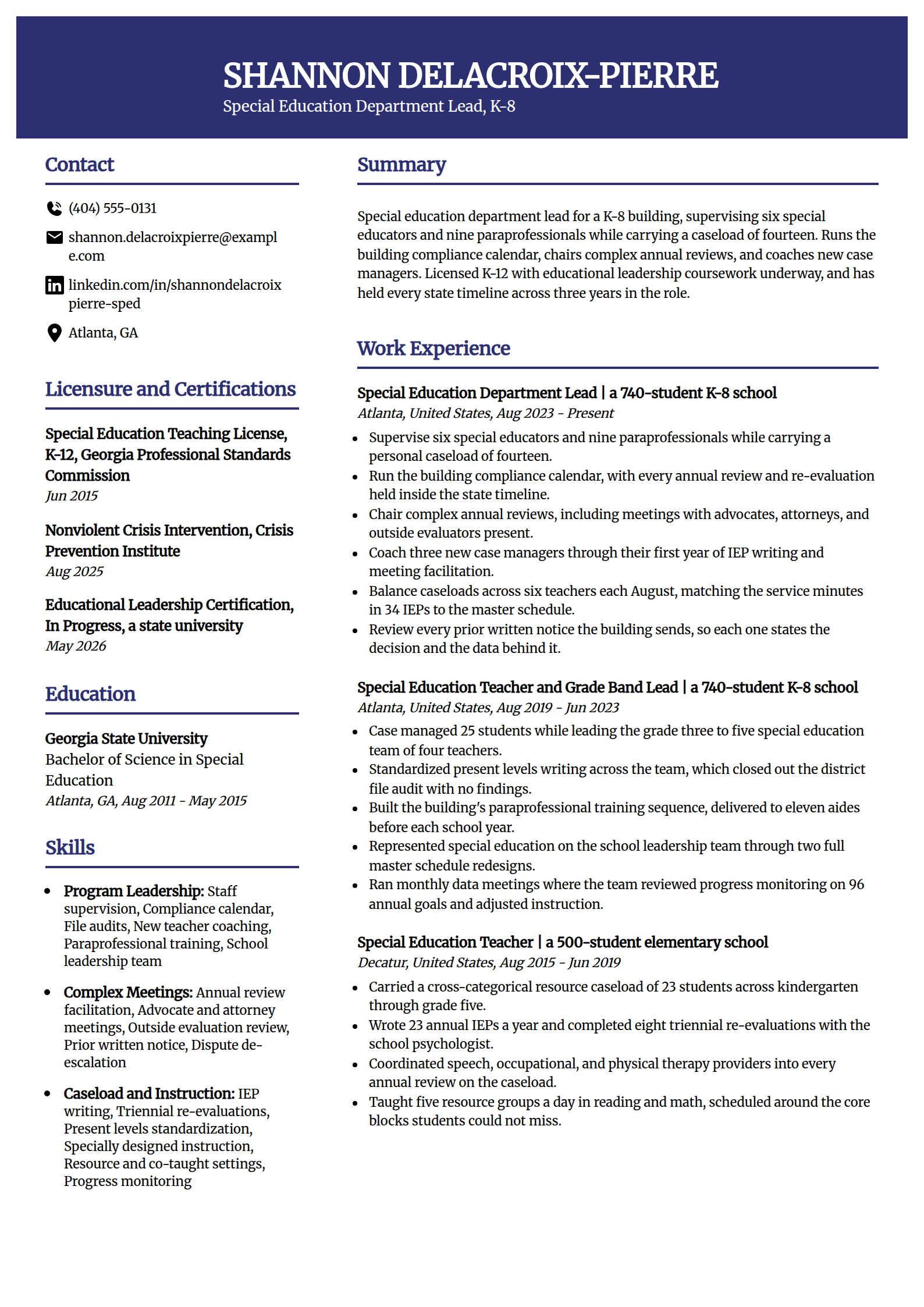
Special Education Department Lead Resume Template
Why this resume example works?
- Shows both halves of the job, supervising fifteen staff while still carrying a caseload of fourteen.
- Makes compliance the headline outcome, with every review and re-evaluation held inside the state timeline.
- Names the hardest meetings specifically, the ones with advocates, attorneys, and outside evaluators in the room.
- Reports a district file audit closing with no findings, which is the cleanest proof of a standardization effort.
- Puts leadership certification in progress on the page, since districts hire the trajectory as well as the record.
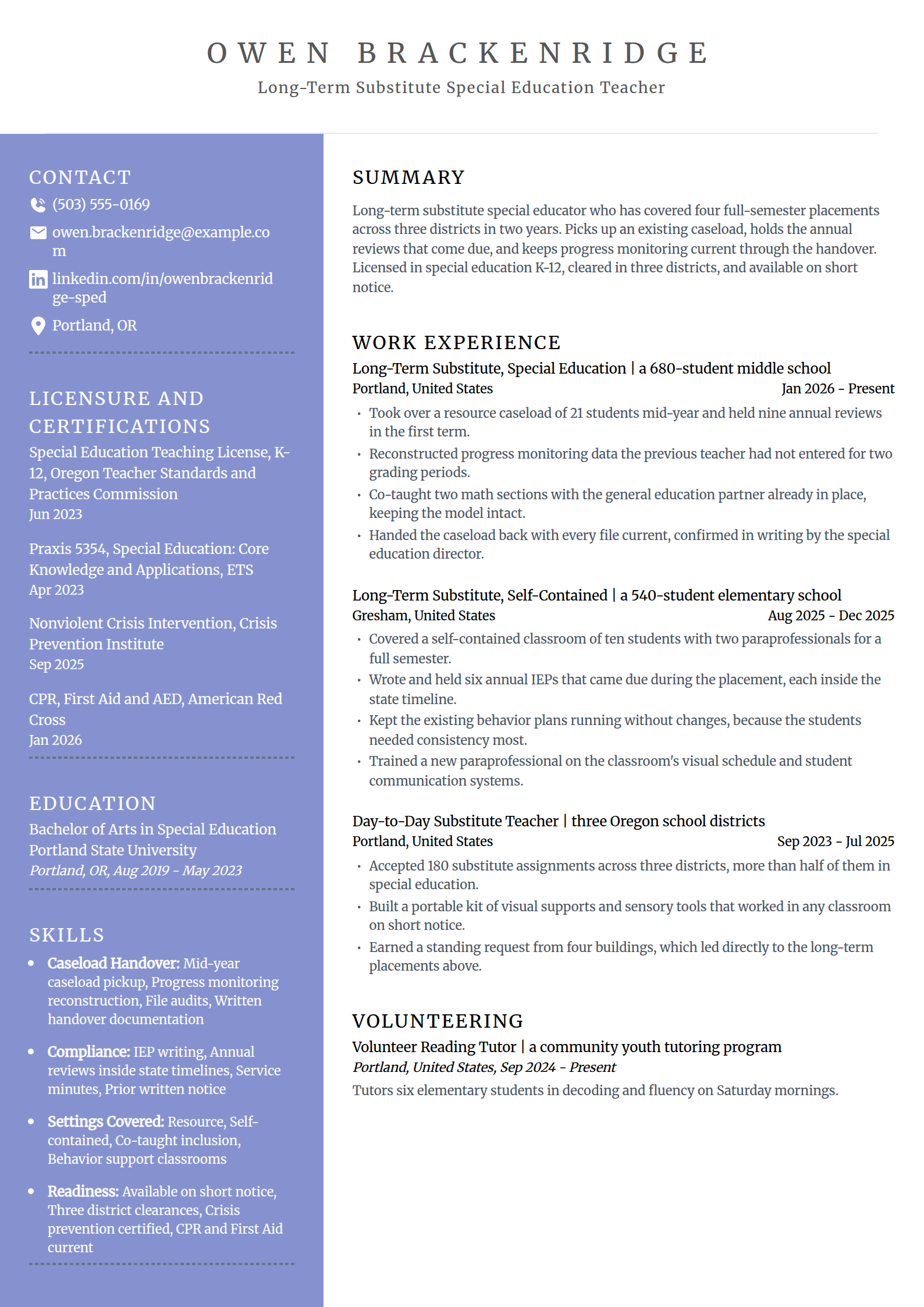
Long-Term Substitute Special Education Resume Template
Why this resume example works?
- Frames short placements as a specialty rather than instability, four full semesters picked up mid-year.
- Leads with the skill that matters here, taking over a live caseload and holding the annuals that come due.
- Mentions rebuilding progress monitoring the previous teacher left incomplete, which is exactly why districts call back.
- Keeps existing behavior plans unchanged for the students' sake, which reads as judgment rather than ambition.
- States three district clearances and short-notice availability, the two logistics facts that decide these hires.
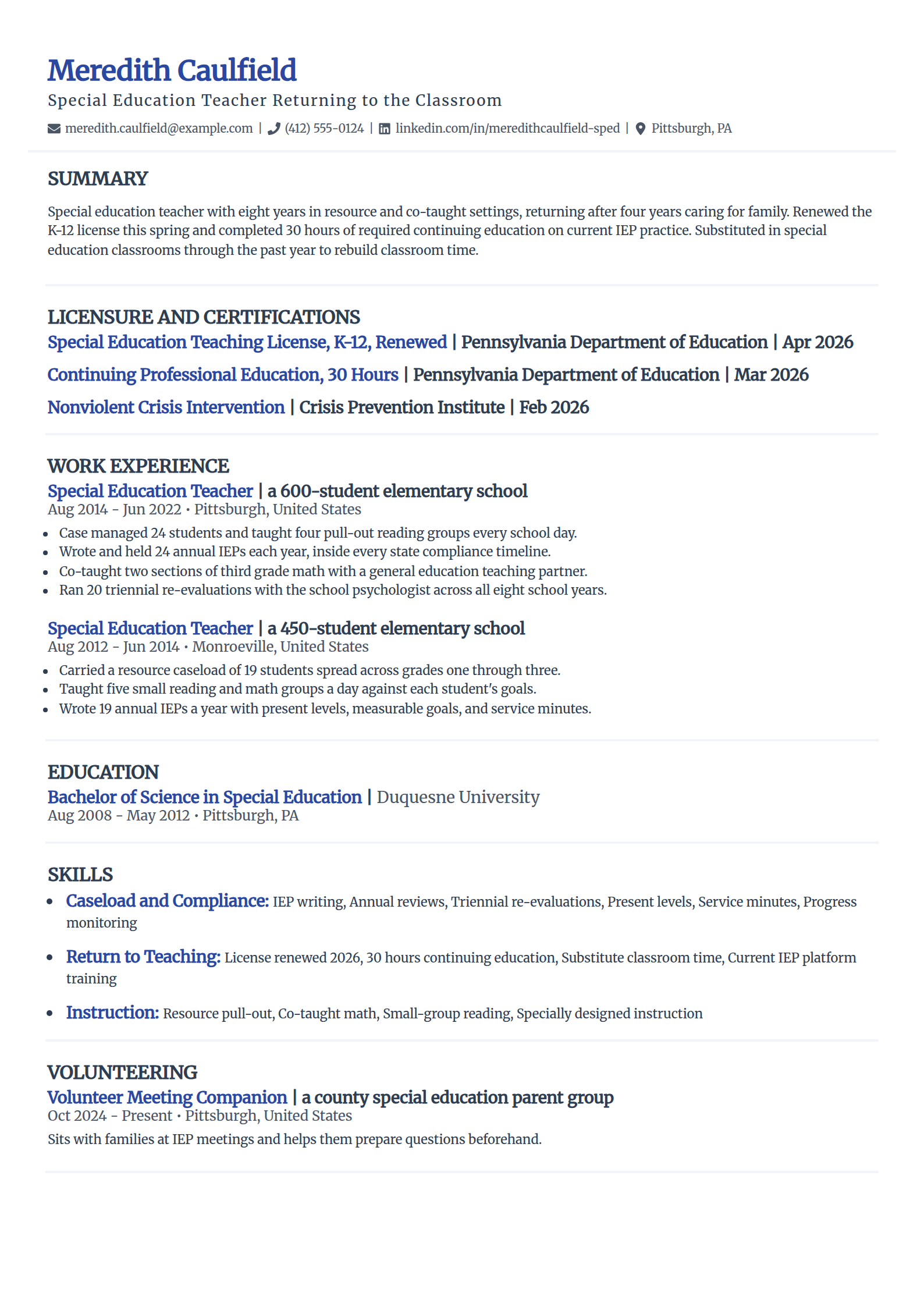
Returning Special Education Teacher Resume Template
Why this resume example works?
- Names the gap and its reason in the summary, which stops a reader guessing at the four-year space in the dates.
- Answers the licensure question first with a renewal date and the continuing education hours completed.
- Uses substitute work to show recent classroom time rather than asking the reader to assume skills carried over.
- Keeps the eight-year record intact, because 24 IEPs a year is still the strongest thing on this page.
- Adds volunteer work sitting with families at IEP meetings, which demonstrates the practice stayed current.
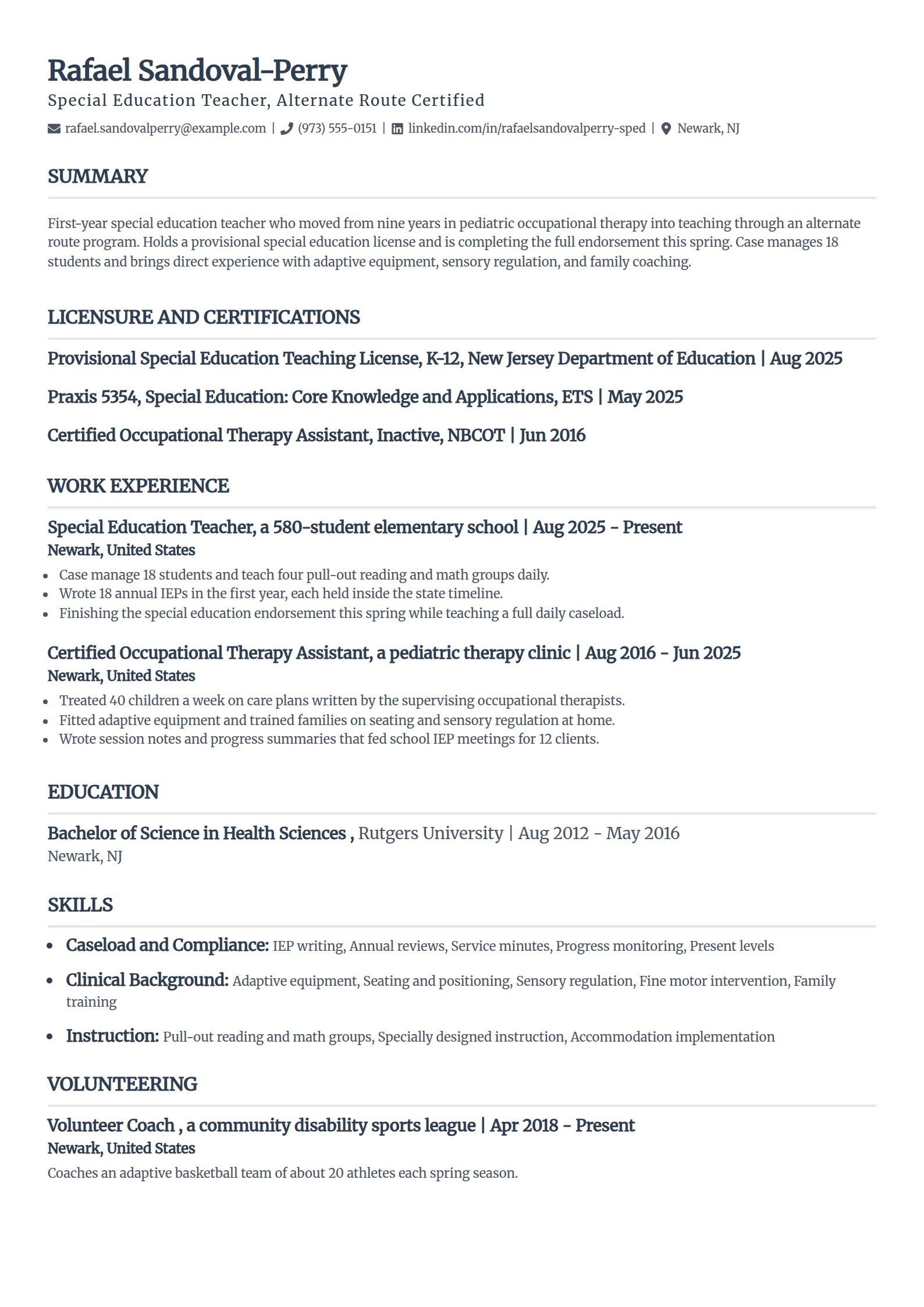
Career-Change Special Education Resume Template
Why this resume example works?
- Puts the provisional license and the endorsement timeline up front, which is the first question an alternate-route hire raises.
- Leads with the teaching year rather than the nine-year clinical career, so the page reads forward.
- Translates the old field into school language: adaptive equipment, sensory regulation, family training.
- Keeps the clinical credential listed as inactive, which is honest and still proves the background was real.
- Shows prior contact with school IEP meetings, which makes the switch read as informed rather than impulsive.
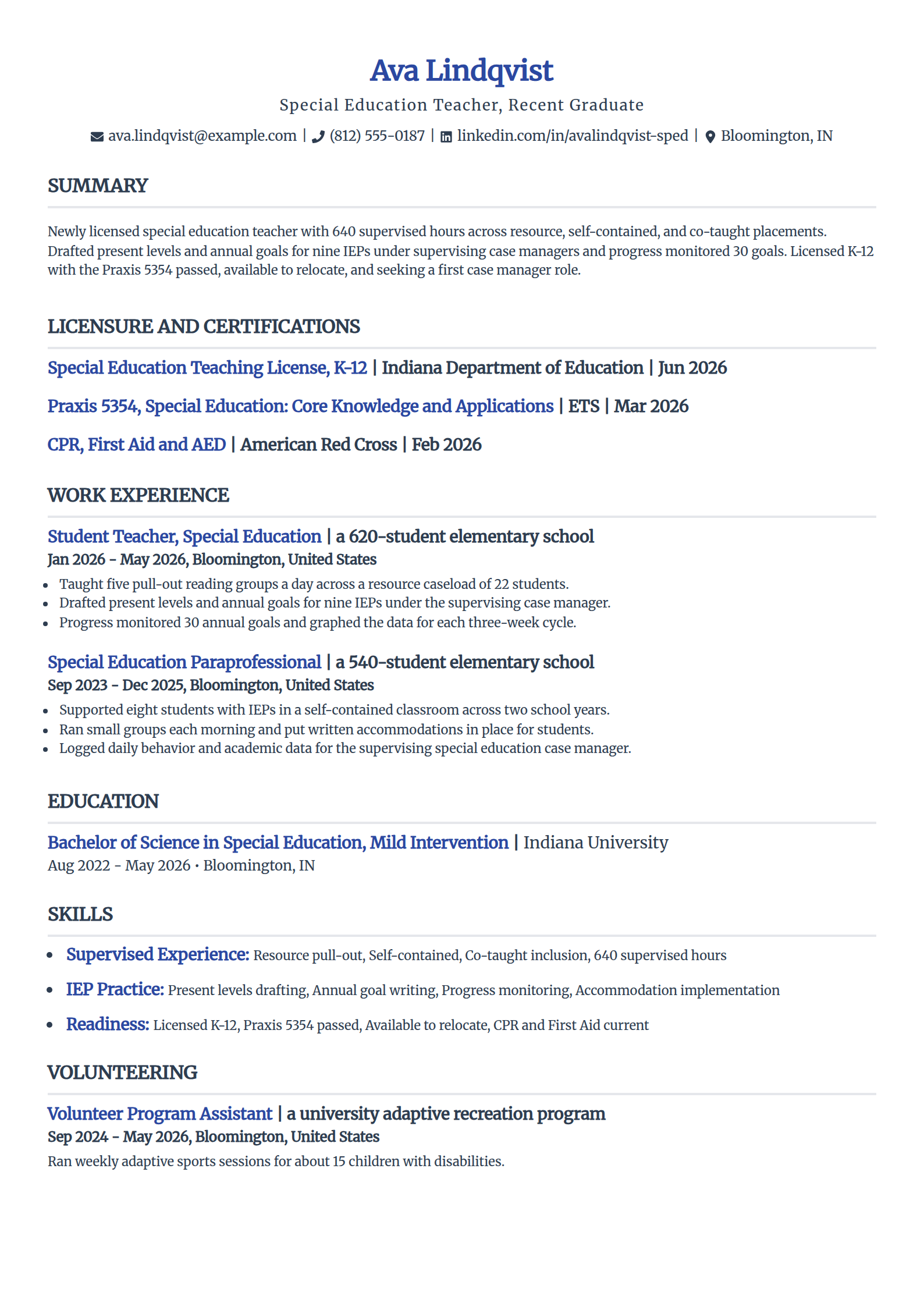
New Graduate Special Education Resume Template
Why this resume example works?
- Counts supervised hours, 640 across three placement types, which is the only volume number a new graduate owns.
- Says the IEP work was drafted under a supervising case manager, which is accurate and still shows the skill.
- Uses the paraprofessional years as real classroom experience rather than filler before the degree.
- Puts the license and the passed exam in the licensure block, the two lines a district clerk needs to see.
- States availability to relocate, which at this stage genuinely decides who gets an interview.
Build your special education teacher resume
Pick a template above and the editor keeps the layout clean and ATS-safe while you swap in your own license, setting, and caseload numbers.
Build my resumeHow to write a special education teacher resume in 2026
Two people read this resume. A district screener checks that your license and endorsement cover the position, then a principal or special education director checks that the caseloads you have run match their opening. Write for both, in that order.
Put licensure and its range directly under the summary
Special education hiring stops at the credential, so the credential goes above your work history, not at the bottom of the page. Every example on this page is built in that order.
Special Education Teaching License, K-12, Mild to Moderate | Ohio Department of Education | June 2019
The block carries five things:
- The license itself, with the grade band it covers.
- The disability-category range, such as mild to moderate or severe to profound.
- The issuing state and the date it was granted.
- Any endorsement that opens a specific door: autism, early childhood, a content area for co-teaching, or a reading methodology.
- An alternate route or provisional license, said plainly, with the date the full endorsement completes.
Count the work instead of inventing a percentage
This is the single biggest difference between a resume that gets an interview and one a director quietly discounts. Published special education resume examples are full of lines like improved goal attainment by 40% or reduced behavioral incidents by 35%.
Nobody can verify those, IEP progress is measured against each student's own goals, and the result belongs to a team. Count these instead:
- Caseload size and how many disability categories it spans, such as 21 students across four categories.
- IEPs written and held in a year, and re-evaluations completed inside the state timeline.
- Service minutes delivered per week, and how they split between pull-out and push-in.
- Goals progress monitored and how often, such as 63 annual goals on a three-week cycle.
- Behavior plans and functional behavior assessments written, meetings chaired, and staff or paraprofessionals trained.
Show the whole IEP cycle, not the phrase IEP experience
Writing IEP experience on a resume tells a director nothing, because every applicant writes it. Show the parts you personally carry instead.
Write and hold 32 annual IEPs a year with present levels, measurable goals, accommodations, and service minutes.
Each of these is a separate line a director can picture:
- Where the present levels data came from.
- Who drafted the measurable annual goals.
- How accommodations were decided with the team.
- How service minutes were scheduled and delivered.
- How progress was monitored and reported to families.
- Who chaired the annual review, including any meeting with an advocate present.
- Any re-evaluation you carried with a school psychologist.
Name the setting, because the setting is the job
Special education is not one job, and a resume that says special education teacher without naming the room makes a principal guess. Use the words the posting uses:
- Resource, self-contained, inclusion or co-taught, life skills, therapeutic or behavior, and early childhood are different assignments.
- Name your grade band, and for secondary roles name the content courses you co-teach.
- Say which disability categories your caseload actually covers, rather than implying you have served them all.
- Name the programs and assessments you have run, such as Wilson Reading System, Unique Learning System, or an alternate assessment.
- Name the IEP platform you have used, whether Frontline, SEIS, PowerSchool Special Programs or another, since districts hire to skip the training month.
Keep it to one page in a layout a district portal can read
One page covers almost every special education teacher, including the fourteen-year example above. If none of the sixteen layouts suits you, the resume templates hub carries the full ATS-friendly set.
District portals parse the file before a person opens it, so keep the layout plain:
- Standard section headings, in the order a screener reads them.
- A single column, or a clean two-column layout.
- Real text rather than text inside images.
- Consistent date formats down the whole page.
- If you are running out of room, trim the earliest roles to two or three bullets rather than the licensure block.
Common special education teacher resume mistakes
- Inventing a percentage. A line like improved IEP goal attainment by 40% reads as made up to anyone who has written an IEP, because progress is measured per student and attributed to a team. Count the caseload, the IEPs, the service minutes and the meetings instead.
- Burying the license. Endorsement, grade band, disability-category range and state are what a district screener checks first, so they belong under the summary rather than at the bottom of the page.
- Writing IEP experience and leaving it there. Show the cycle: present levels, measurable goals, accommodations, service minutes, progress monitoring, annual review, re-evaluation.
- Not naming the setting. Resource, self-contained, inclusion, life skills, behavior and early childhood are separate jobs with separate postings. A resume that just says special education teacher makes a principal guess which one you can do.
- Claiming work that belongs to the team or to another role. Eligibility is determined by a team, behavior plans in most programs are written with a board certified analyst, and related services belong to the providers. Overstating any of these is obvious to the person reading.
Frequently asked questions
What should a special education teacher resume include?
A special education teacher resume needs a three-to-four-sentence summary naming your setting and caseload, a licensure block placed directly under it, a work history written as countable caseload work, education, and a grouped skills block. The licensure block carries your license, grade band, the disability-category range it covers, the issuing state and the date, plus endorsements such as autism, early childhood, severe to profound, a content area, or a reading methodology. The work history should show the full IEP cycle rather than the phrase IEP experience, and name the programs, assessments and IEP platform you have actually used.
How do you put IEP experience on a resume?
Break it into the parts of the cycle you personally carry, and attach a number to each. Say how many students you case manage and across how many disability categories, how many annual IEPs you write and hold in a year, how many re-evaluations you complete with the school psychologist and whether they land inside the state timeline, how many goals you progress monitor and on what cycle, and how many service minutes a week you deliver. Then name where the present levels data comes from and who you coordinate into meetings. A director reads that as someone who has done the work; IEP development as a bare skill bullet tells them nothing.
What skills should a special education teacher put on a resume?
Group them by what the posting screens for rather than listing traits. Caseload and compliance covers IEP writing, present levels, measurable annual goals, accommodations, service minutes, progress monitoring, annual reviews and triennial re-evaluations. Instruction covers specially designed instruction, your setting, co-teaching models, and the reading or math methodology you use. Then name the specific programs, assessments and platforms you have run, such as Wilson Reading System, Orton-Gillingham, Unique Learning System, Teaching Strategies GOLD, i-Ready, DIBELS, Frontline IEP, SEIS or PowerSchool Special Programs. Behavior credentials belong here too, including crisis prevention training.
How do you write a special education teacher resume with no experience?
Lead with the license and the supervised hours, and count both. Student teaching and practicum hours are real volume, so give the total and name the placement types, such as 640 hours across resource, self-contained and co-taught rooms. Say what you did inside those placements in accurate terms: drafted present levels and annual goals under a supervising case manager, progress monitored a set number of goals, taught a given number of groups a day. Paraprofessional, camp, tutoring or behavior technician work all count and should stay on the page. Then put the license, the passed exam and your availability to relocate where a screener will find them.
Should a special education teacher resume list caseload size and disability categories?
Yes to both, and they are two of the most useful numbers on the page. Caseload size tells a principal the scale of work you have carried, and the number of disability categories tells them how varied it was; a caseload of 21 across four categories describes the job better than any adjective. Name the categories your caseload actually covered rather than implying you have served every one of them, since a special education director will ask about the ones you list. If your caseload was unusually large, or you were the only special educator in a building, say so plainly, because that is the context that makes the rest of the resume read correctly.
How long should a special education teacher resume be?
One page, including teachers with ten or more years in the classroom. Districts hire on the licensure block plus a handful of specifics about the caseloads and settings you have carried, and both fit on a page; every example here is one page, including a fourteen-year teacher with two degrees and four credentials. If you are running out of room, cut older unrelated jobs and trim the earliest teaching entries to two or three bullets, rather than shrinking the font or dropping the licensure block. The one thing worth the space at any length is the credential line a screener is checking.
More special education teacher resume resources
Build your special education teacher resume
Pick a template above and the editor keeps the layout clean and ATS-safe while you swap in your own license, setting, and caseload numbers.