Your License Line and Your Caseload Decide a Social Work Resume
- ATS Friendly
- Licensure Accurate
- 16 Full-Page Examples
A social worker resume needs the exact credential your state board issues placed where a screener sees it first, a caseload number carrying its population and setting, the modalities and assessment instruments you actually use, the documentation system you work in, and your field hours if you are new. Below are 16 full one-page resumes, one for each setting this profession hires into.


540k+ resumes created
One profession, sixteen different hiring conversations
A hospital discharge planner, a school social worker, a child welfare case manager and a private practice clinician are all social workers, and each is screened on a different page. Start from the template built for the setting in the posting and the right evidence is already where a reviewer in that setting looks for it.
LCSW Resume Template
Why this resume example works?
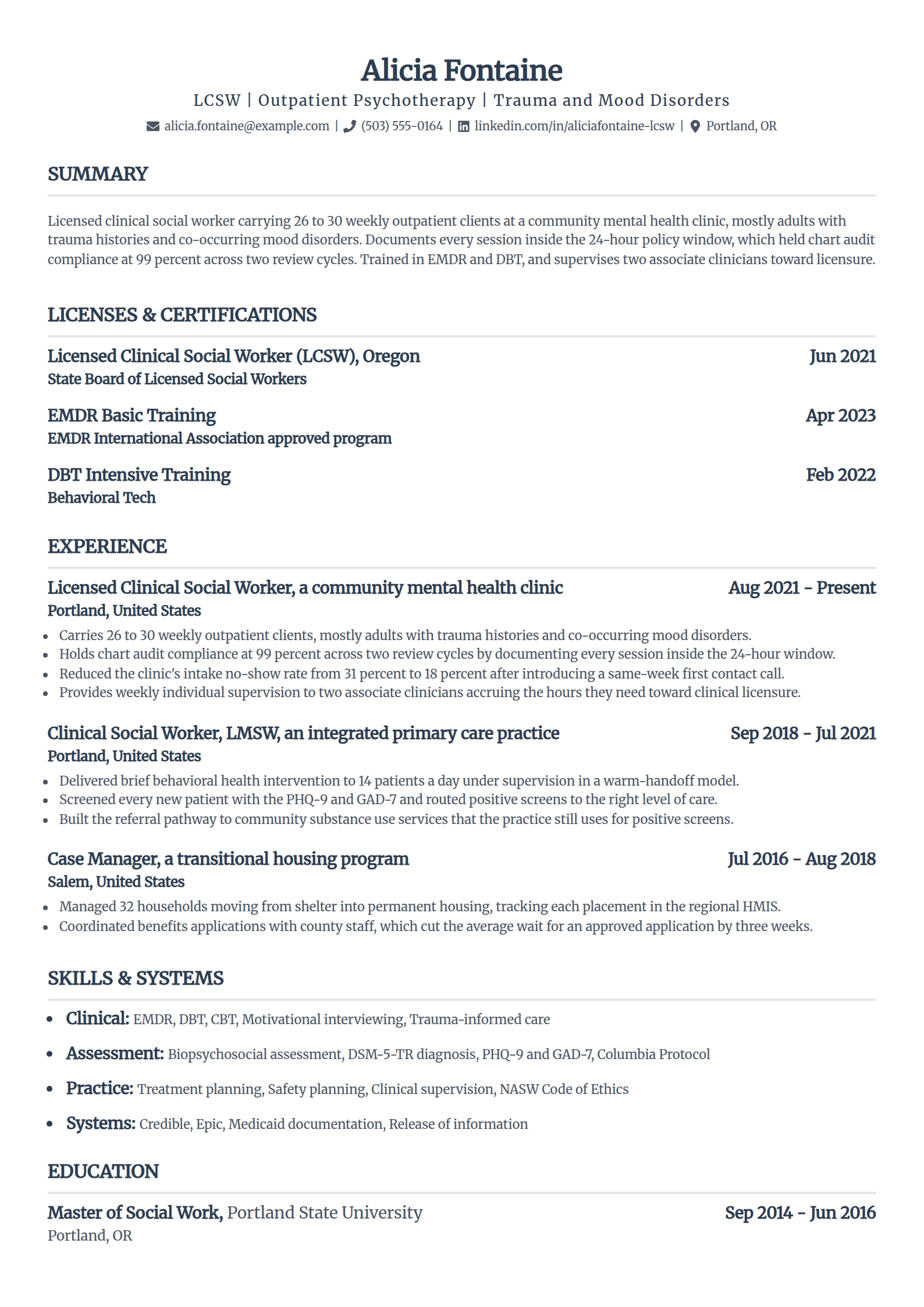
- Puts the licenses block directly under the summary, because for a billable clinical role that is the first screen.
- Gives the caseload as a range with the population attached, so the reader knows what 26 to 30 clients a week means here.
- Uses documentation compliance as the quality number, which a clinical director can verify and a percentage of improved clients cannot.
- Names a no-show rate change and the process that caused it, which is a program result rather than a personal claim.
- Mentions supervising associates toward licensure, the clearest signal of readiness for a senior or lead post.
Medical Social Worker Resume Template
Why this resume example works?
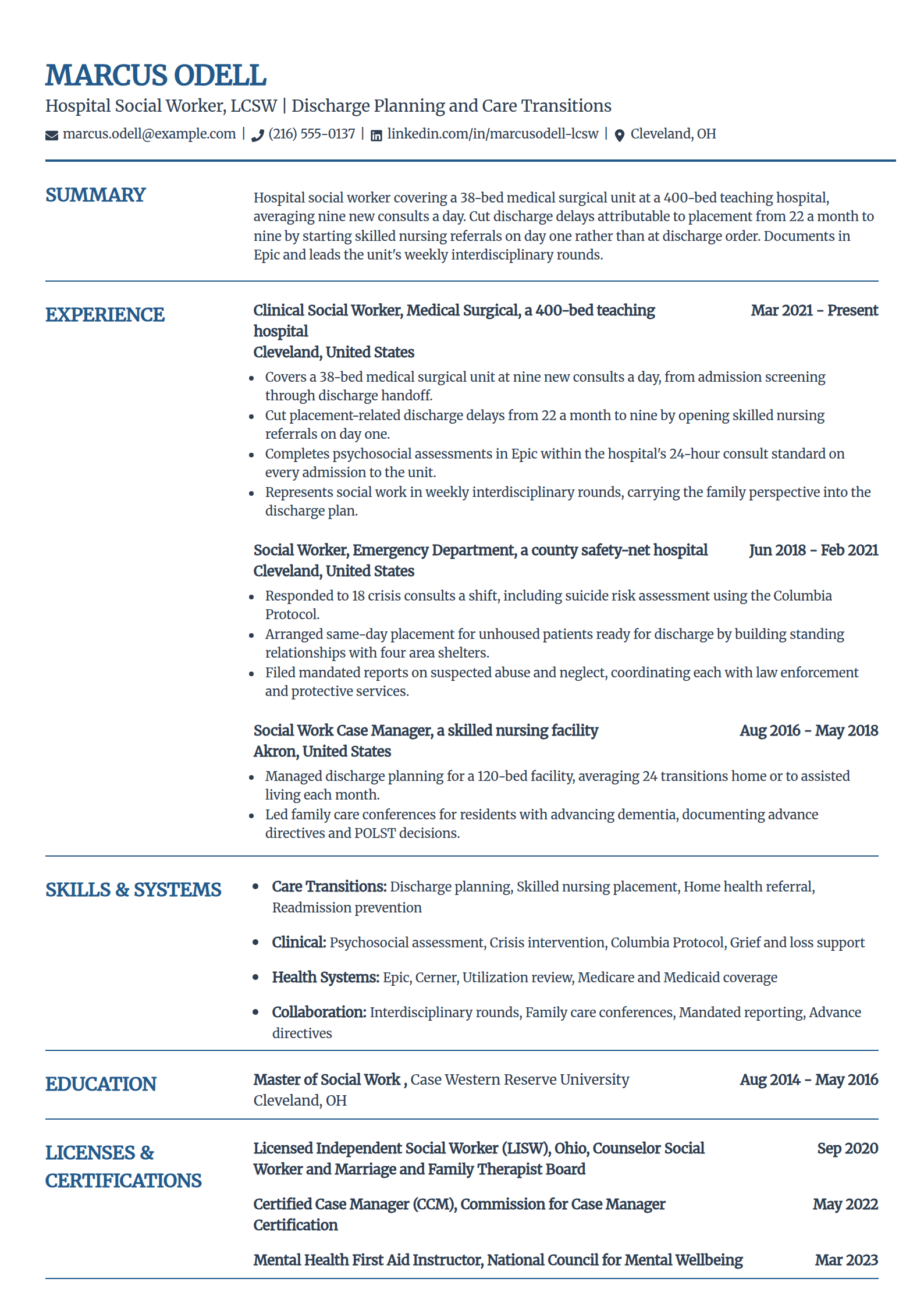
- States unit size and daily consult volume, the two numbers a hospital social work manager uses to compare candidates.
- Measures discharge delays rather than discharges completed, because delay is the problem the department is funded to solve.
- Credits the improvement to starting referrals on day one, which shows the practice change behind the number.
- Names Epic and the 24-hour consult standard, so documentation discipline is specific instead of implied.
- Shows emergency department and skilled nursing history, which is how a reader knows the discharge knowledge is earned.
School Social Worker Resume Template
Why this resume example works?
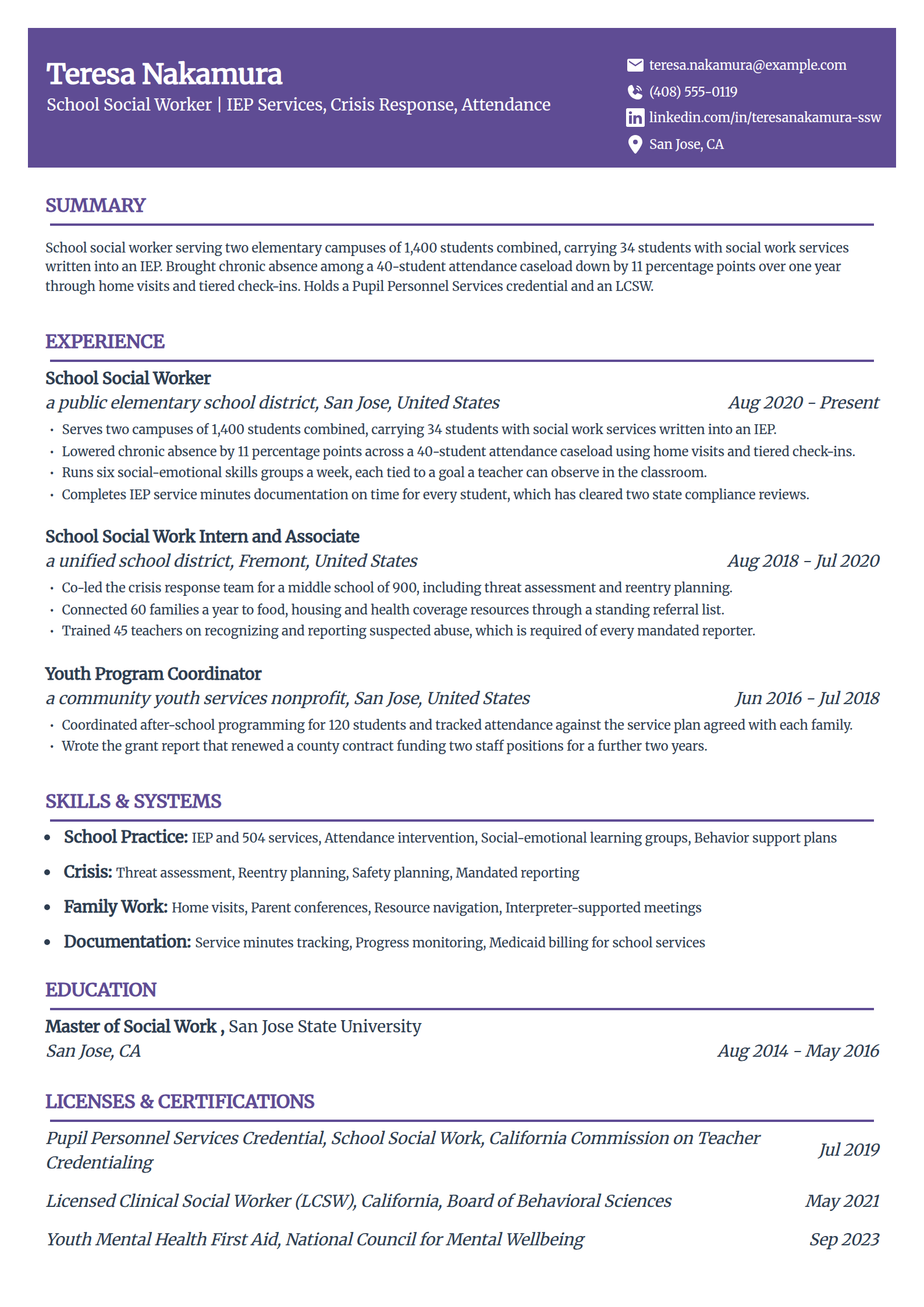
- Separates total enrollment from the IEP caseload, which are the two different numbers a district actually asks about.
- Reports chronic absence in percentage points across a named caseload, the metric every district tracks already.
- Counts groups a week and ties each to a goal a teacher can observe, which keeps the work measurable.
- Mentions service minutes documentation and two cleared compliance reviews, because that is where school social work audits land.
- Lists the Pupil Personnel Services credential alongside the clinical license, since districts screen on the credential first.
Child and Family Social Worker Resume Template
Why this resume example works?
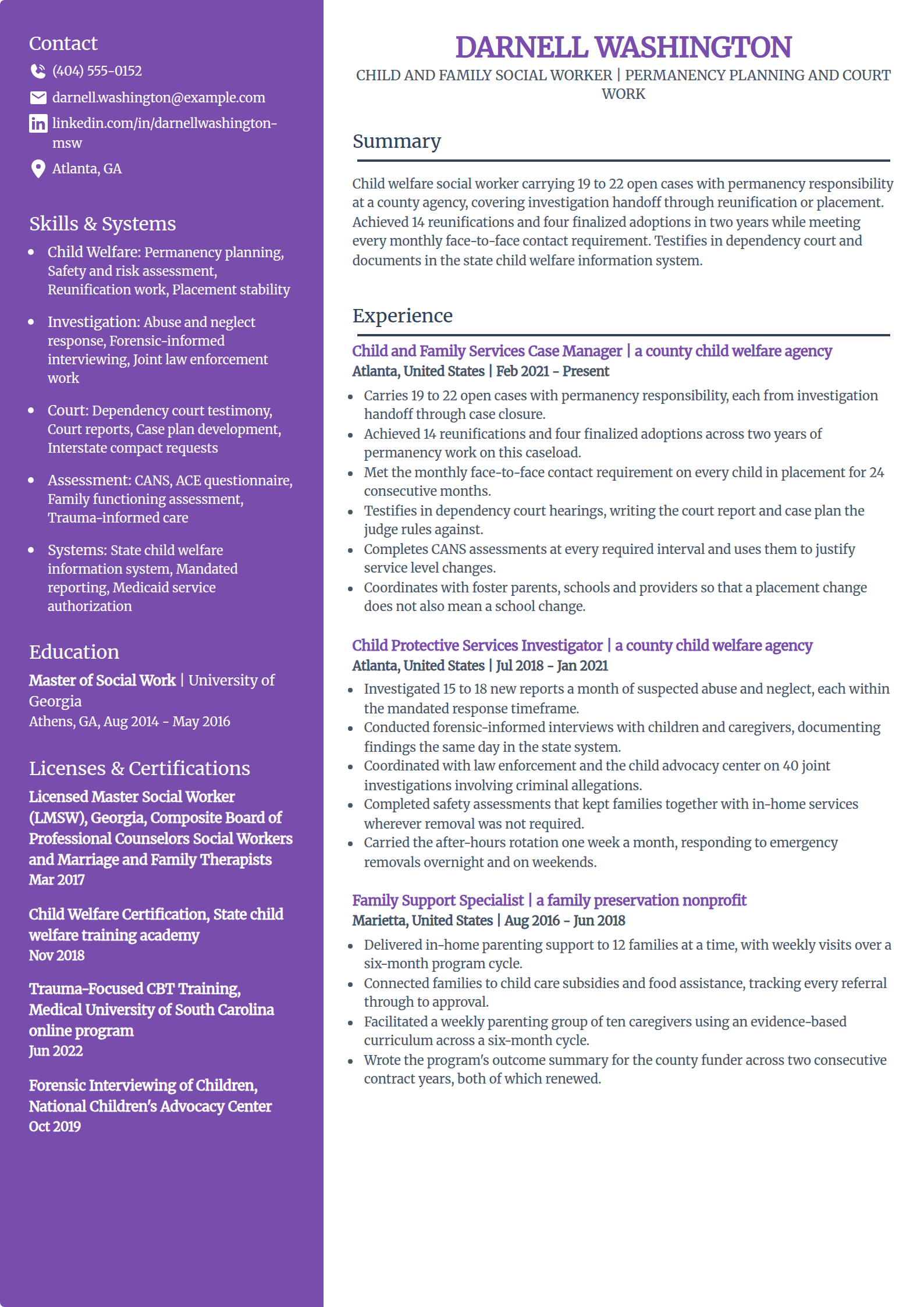
- Says open cases with permanency responsibility, not just caseload, which is a materially different job from investigation.
- Counts reunifications and finalized adoptions as outcomes, the numbers a child welfare supervisor recognizes immediately.
- Claims 24 consecutive months of meeting the face-to-face contact requirement, which is the compliance measure the agency reports.
- Names dependency court testimony and the court report, because comfort in a courtroom is a real hiring criterion here.
- Keeps the investigation years visible with response timeframes attached, so the whole child welfare pathway is on the page.
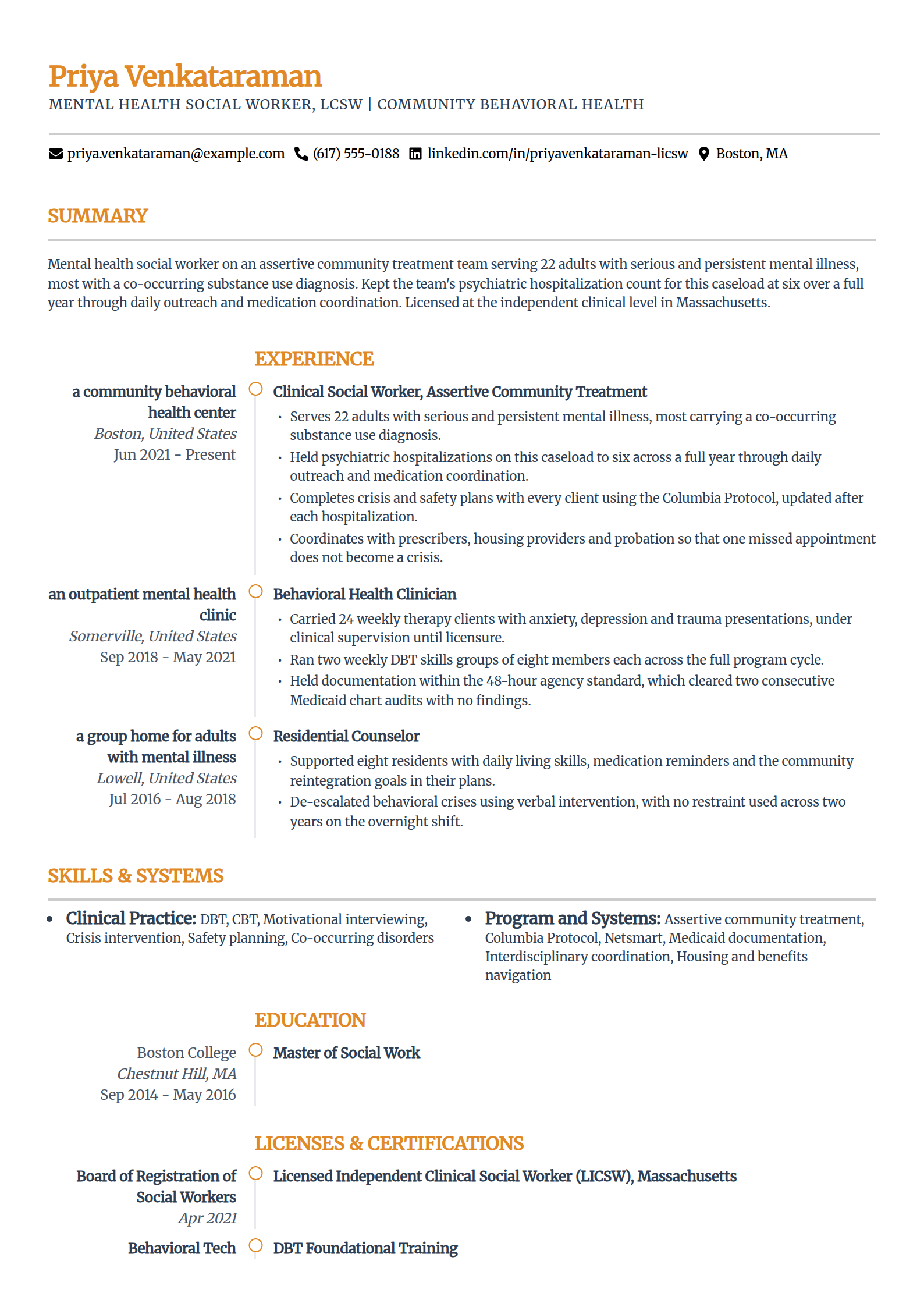
Mental Health Social Worker Resume Template
Why this resume example works?
- Describes the caseload by acuity, not size: 22 adults with serious mental illness is a heavier week than 40 routine clients.
- Uses hospitalizations across a year as the outcome, which is the measure an assertive community treatment team is judged on.
- Names the Columbia Protocol for risk work, so safety planning is tied to an instrument rather than asserted.
- Shows the pre-licensure years under supervision honestly, which makes the current independent license read as earned.
- Mentions no restraint use across two years of overnight residential work, a concrete claim about how crises were handled.
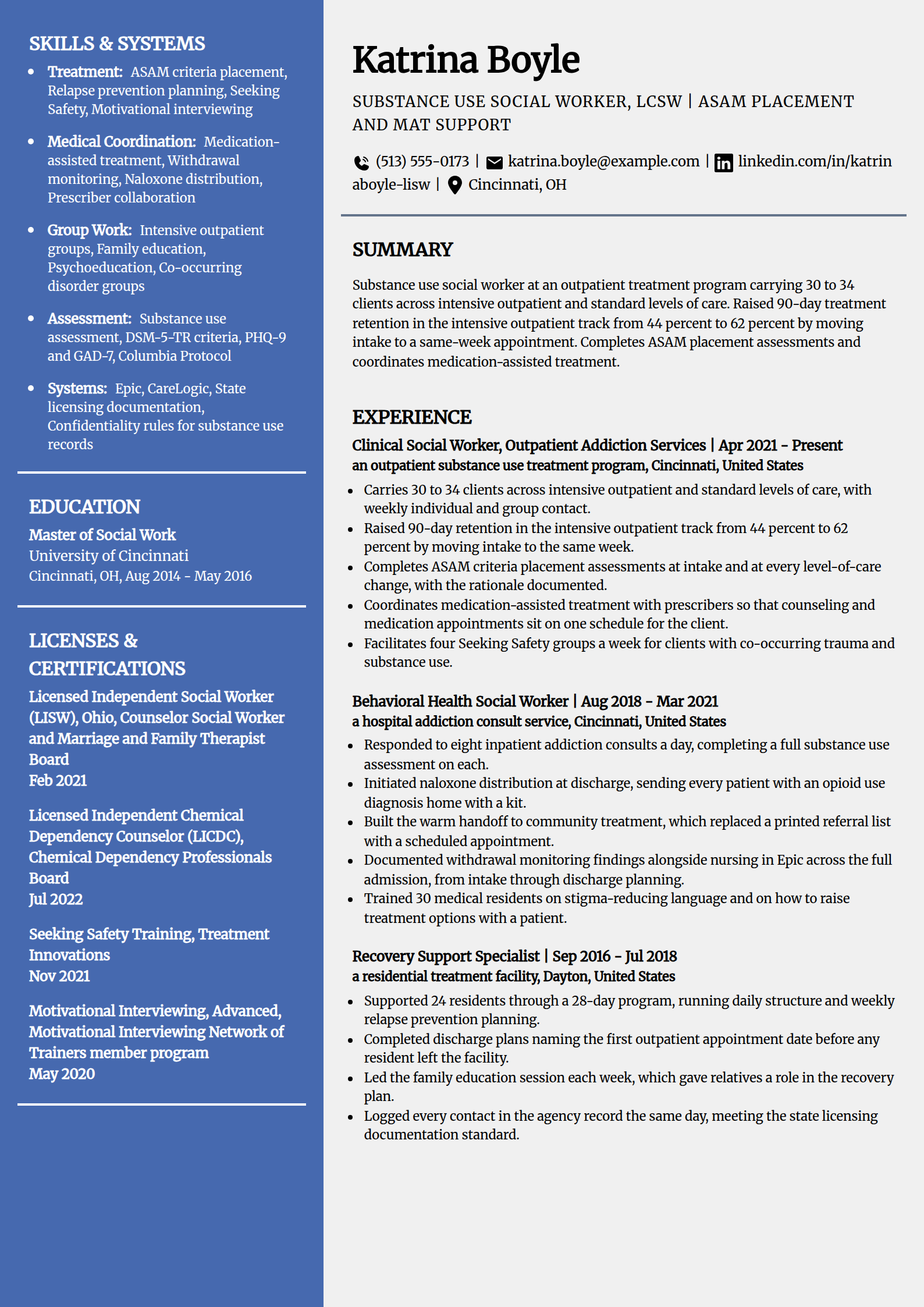
Substance Use Social Worker Resume Template
Why this resume example works?
- Reports 90-day retention, which is the outcome every treatment program is measured on and almost no resume mentions.
- Attributes the retention change to a scheduling fix, so the number has a mechanism a hiring manager can repeat.
- Names ASAM criteria placement assessments, the technical skill that separates this role from general counseling.
- Shows medication-assisted treatment coordination, which signals comfort with the current standard of care.
- Keeps the hospital consult work visible, including naloxone distribution at discharge as a concrete practice change.
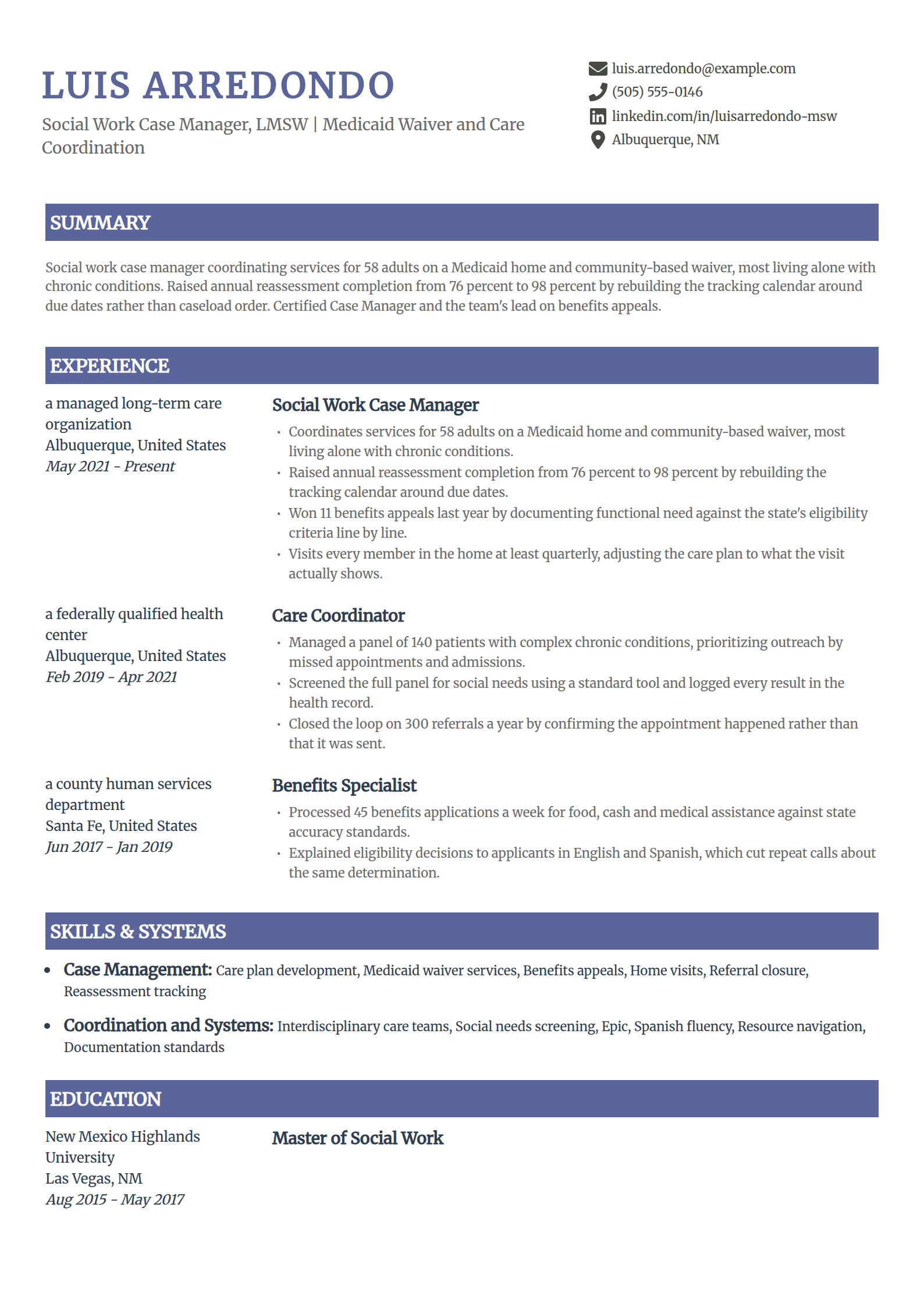
Social Work Case Manager Resume Template
Why this resume example works?
- Names the program type and the population, so 58 members reads as waiver case management rather than therapy.
- Uses reassessment completion as the compliance number, which is what a managed care supervisor audits every month.
- Counts benefits appeals won and says how they were documented, which is specific advocacy rather than a soft claim.
- Mentions confirming referrals happened rather than that they were sent, a distinction every care coordinator understands.
- Puts bilingual capability in the skills block, where a panel scanning for it will actually find it.
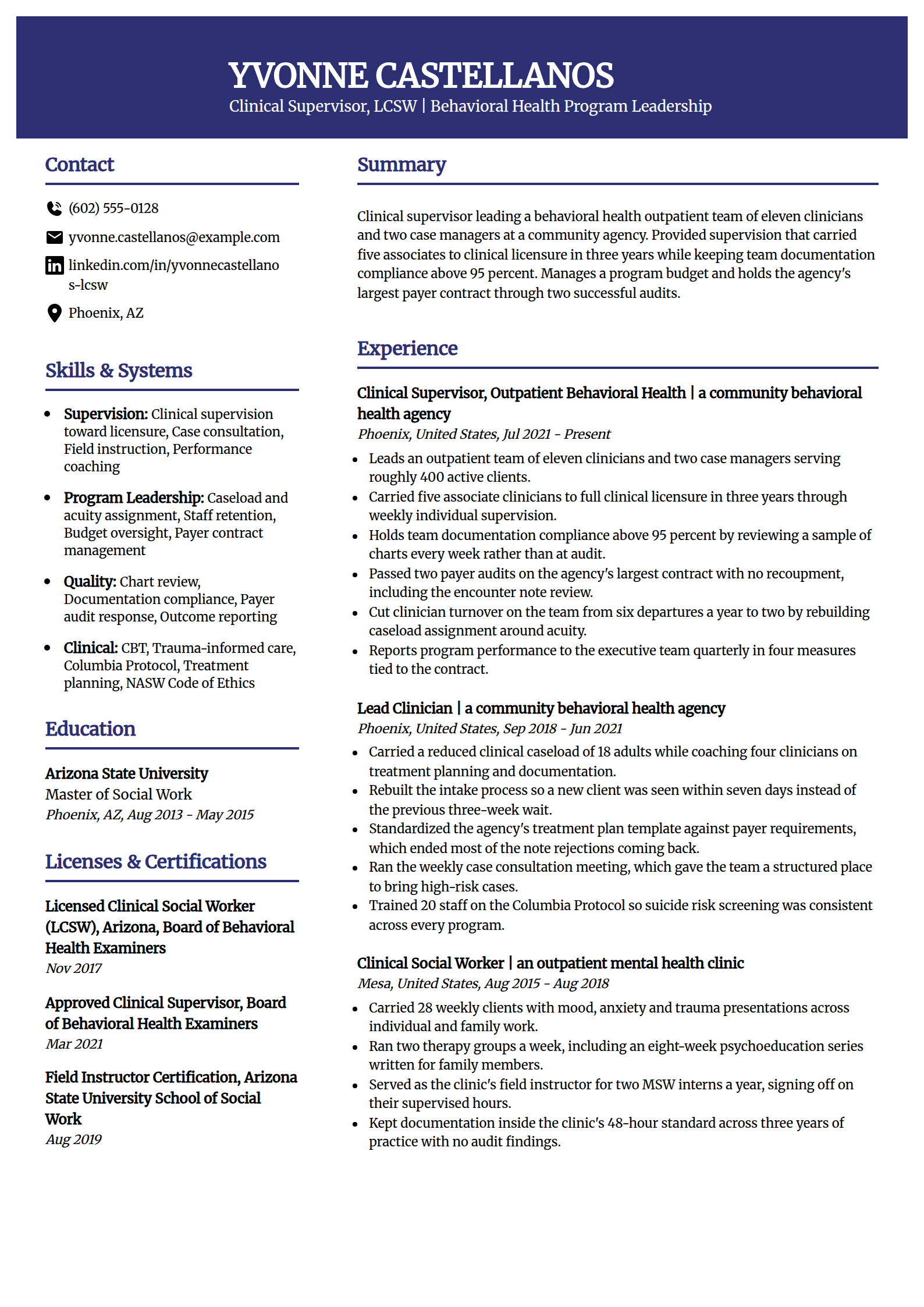
Clinical Supervisor Resume Template
Why this resume example works?
- Opens on team size and client volume, the scope question a hiring panel asks in the first few minutes.
- Counts associates carried to full licensure, which is the single best proof that supervision was real.
- Reports two payer audits passed with no recoupment, a financial outcome a program director has to care about.
- Credits a turnover reduction to caseload assignment by acuity, which is a management decision rather than a mood.
- Keeps the field instructor and lead clinician history, so the path into supervision is visible rather than claimed.
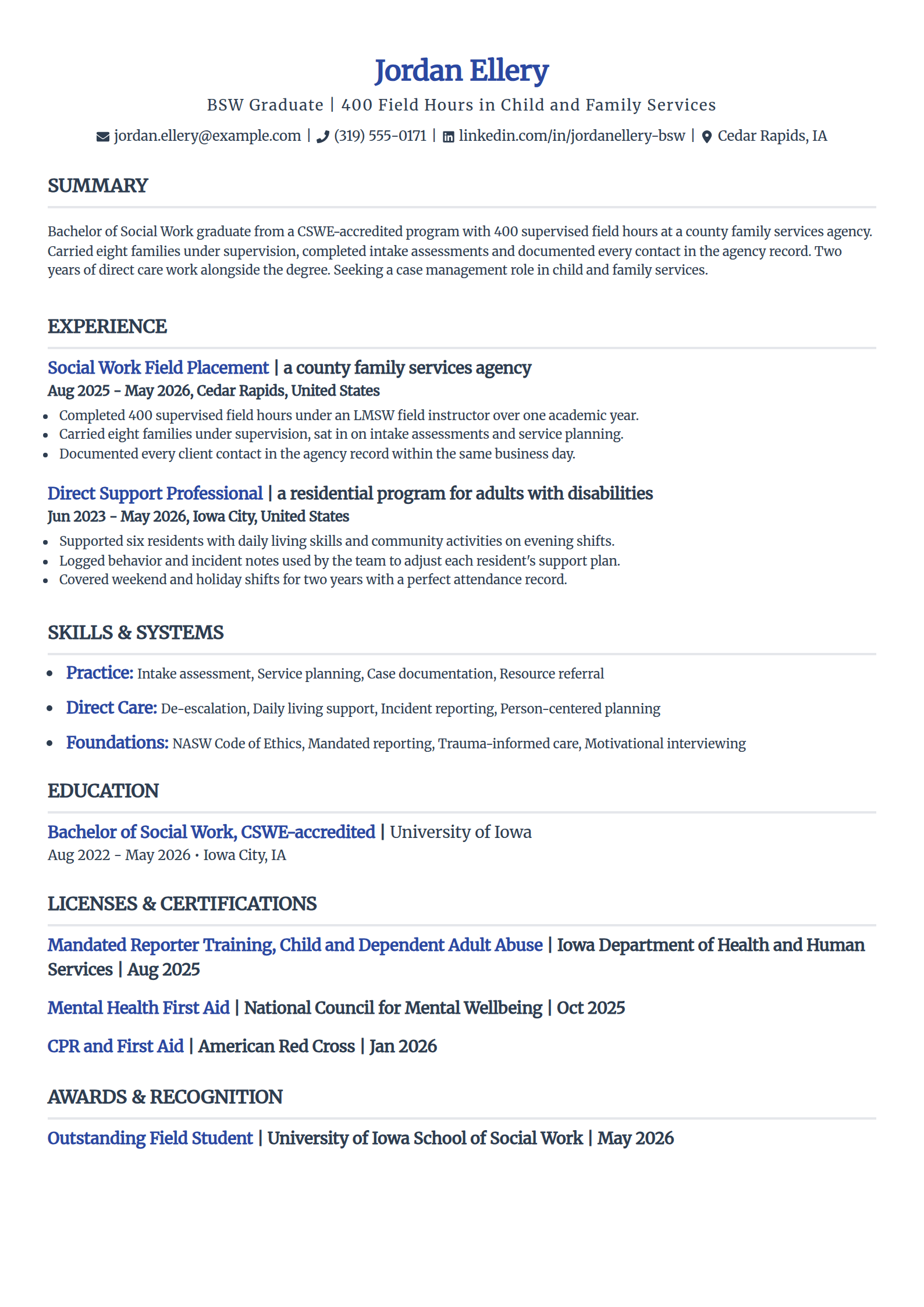
Entry-Level Social Worker Resume Template (BSW)
Why this resume example works?
- Treats the field placement as a job, with hours, dates, supervisor credential and real duties under each.
- Leads with 400 CSWE field hours, which is the number a new graduate owns and most new graduate resumes leave off.
- Says eight families under supervision, which is honest about scope and about the level of responsibility held.
- Keeps the direct support job and counts what it measured, because shift reliability is a real argument at this level.
- Claims no clinical treatment anywhere, which keeps the whole page inside what a BSW can defend in an interview.
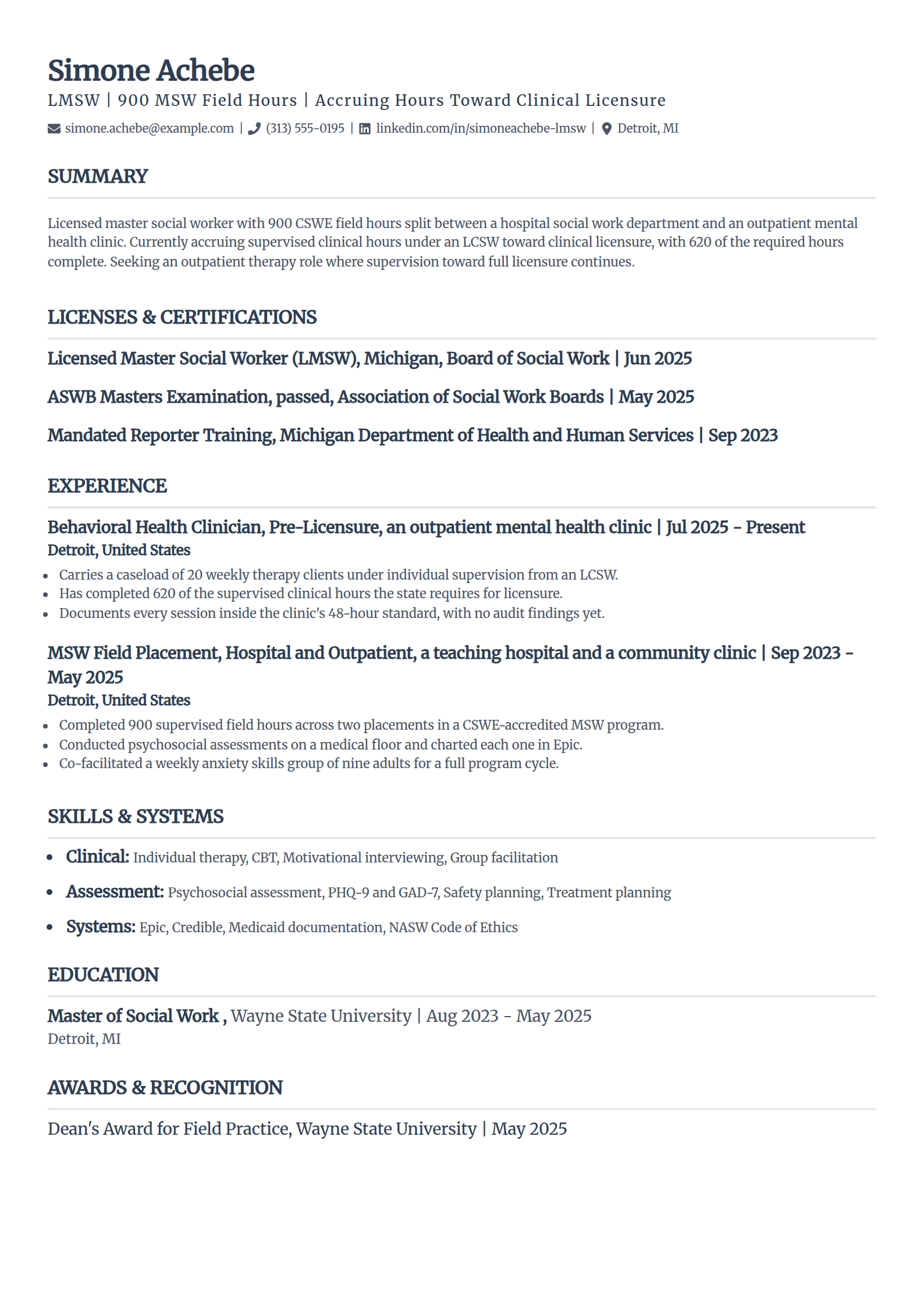
MSW Resume Template for a First Licensed Role
Why this resume example works?
- Puts licensure directly under the summary, because an employer's first question is exactly where this candidate stands.
- States hours completed against the requirement, which is far stronger than saying working toward licensure.
- Names the supervisor's credential, so the hours a reader is being asked to trust have a clear source.
- Lists the 900 CSWE field hours and the two settings they were split across, which answers the experience question directly.
- Says what the next role needs to provide, namely continuing supervision, which is a fair and practical ask.
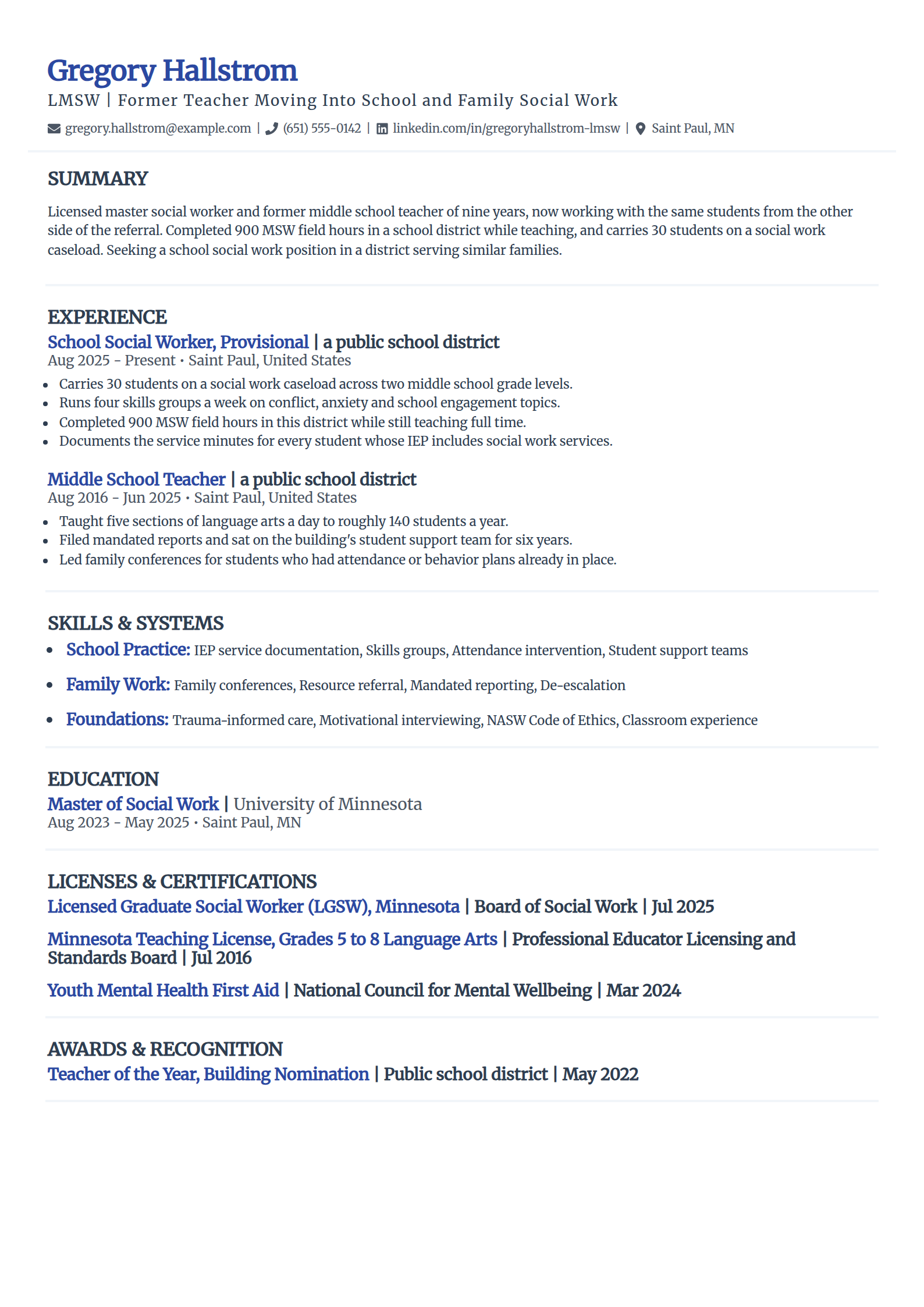
Social Worker Resume Template for a Career Change
Why this resume example works?
- Names the previous profession in the headline rather than hiding it, because nine years in schools is the advantage here.
- Shows the MSW field hours completed inside the same district, which answers the commitment question before it is asked.
- Picks out the parts of teaching that transfer: mandated reporting, student support teams, family conferences.
- Keeps the teaching license on the page, since a district hiring a school social worker reads it as an asset.
- Does not inflate the new caseload, which keeps the whole page credible to anyone who has done the job.
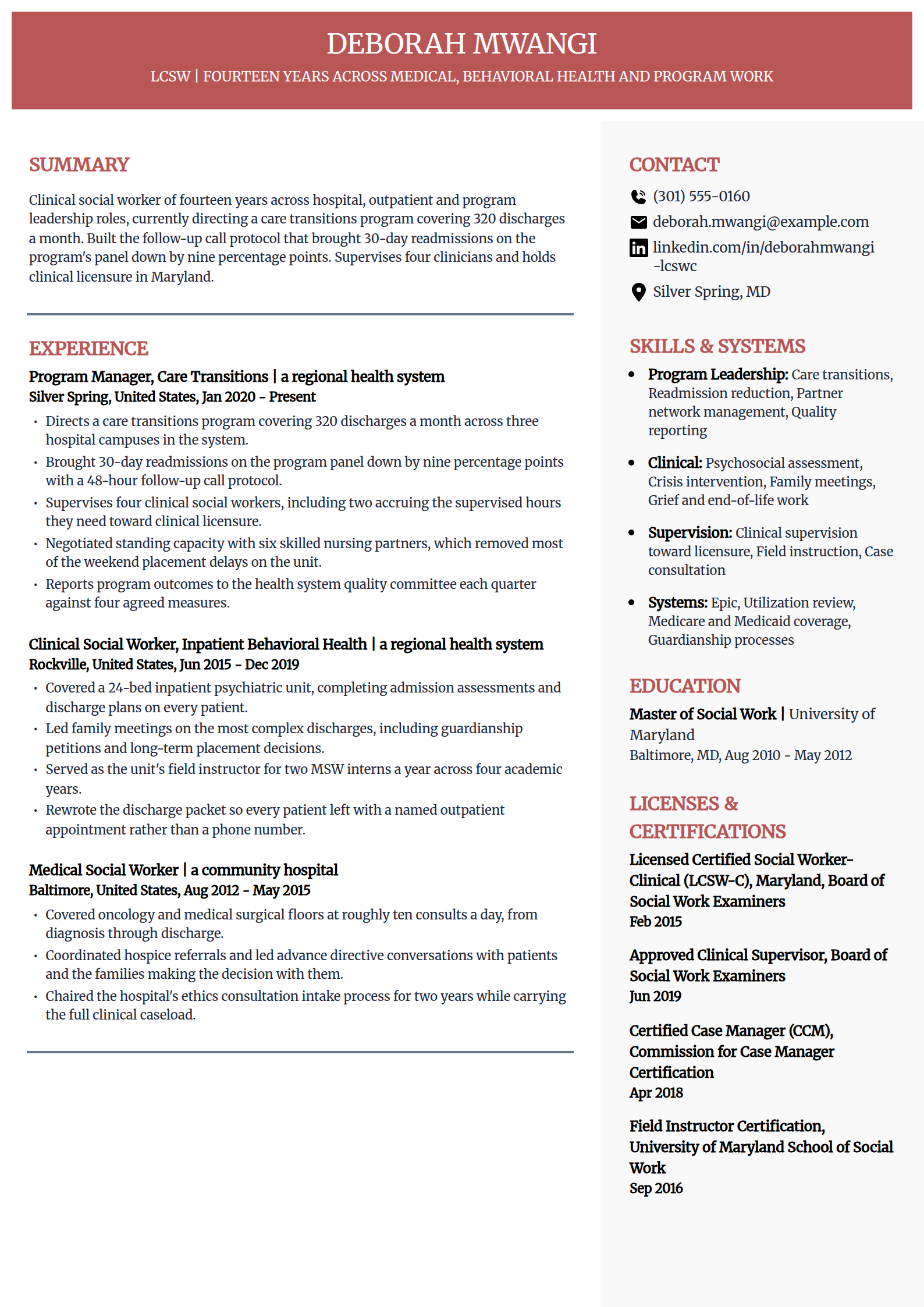
Senior Social Worker Resume Template
Why this resume example works?
- Leads with program scope rather than a caseload, because at fourteen years the question is what you run.
- Reports a readmission change in percentage points against a named protocol, which is a health system outcome.
- Counts supervisees and field students, the clearest evidence of a social worker who develops other social workers.
- Mentions negotiating capacity with skilled nursing partners, which is systems work rather than casework.
- Compresses the earliest hospital years into three lines, keeping the page at one without losing the trajectory.
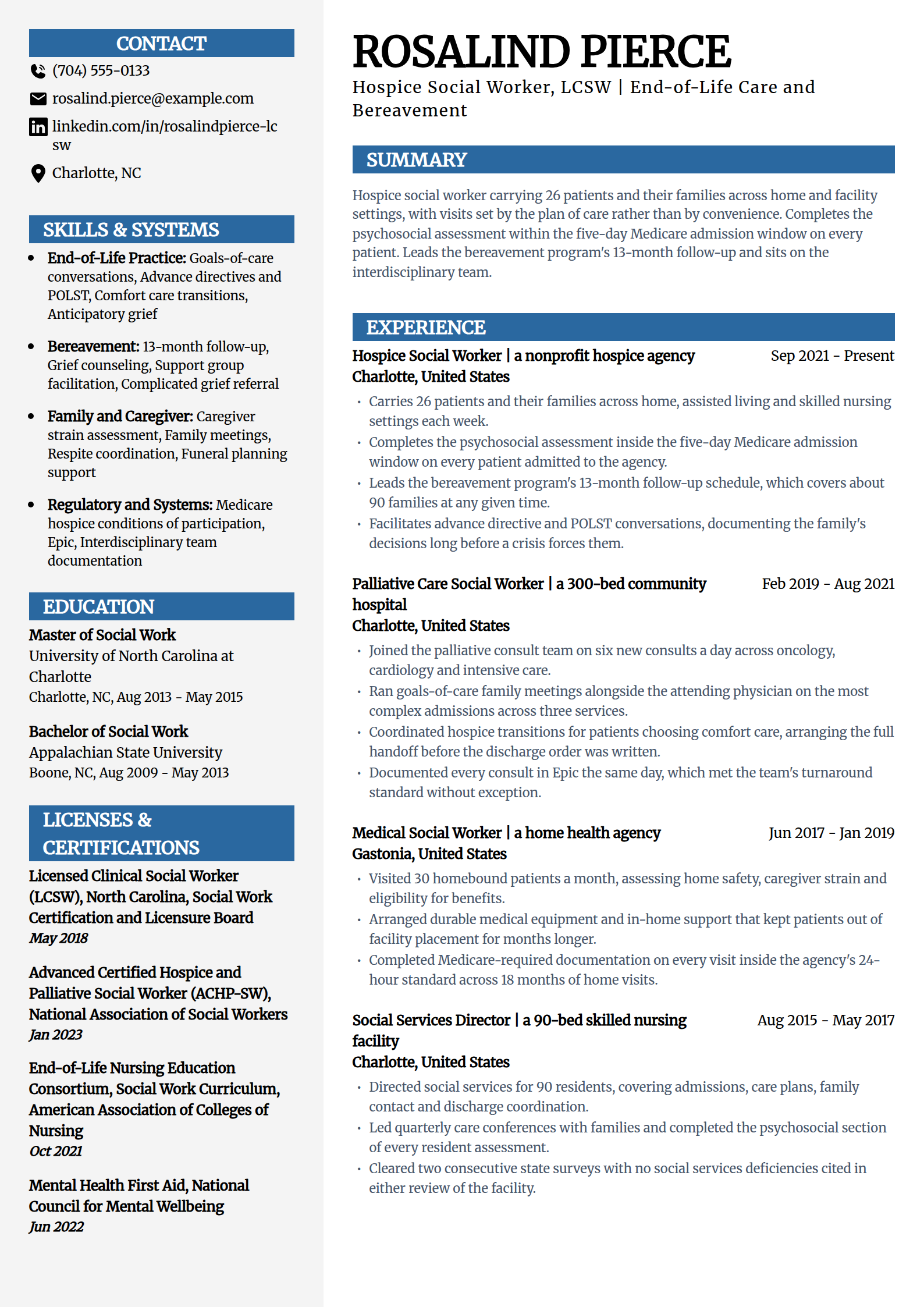
Hospice Social Worker Resume Template
Why this resume example works?
- Names the five-day Medicare admission window, which is the regulatory standard a hospice manager screens against.
- Describes the caseload across home, assisted living and skilled nursing, because the settings change the work entirely.
- Puts the 13-month bereavement follow-up on the page, the part of hospice social work most resumes omit.
- Says advance directive and POLST conversations happen before a crisis, which is the whole argument for the role.
- Builds the page from palliative, home health and skilled nursing history, so end-of-life experience is layered rather than asserted.
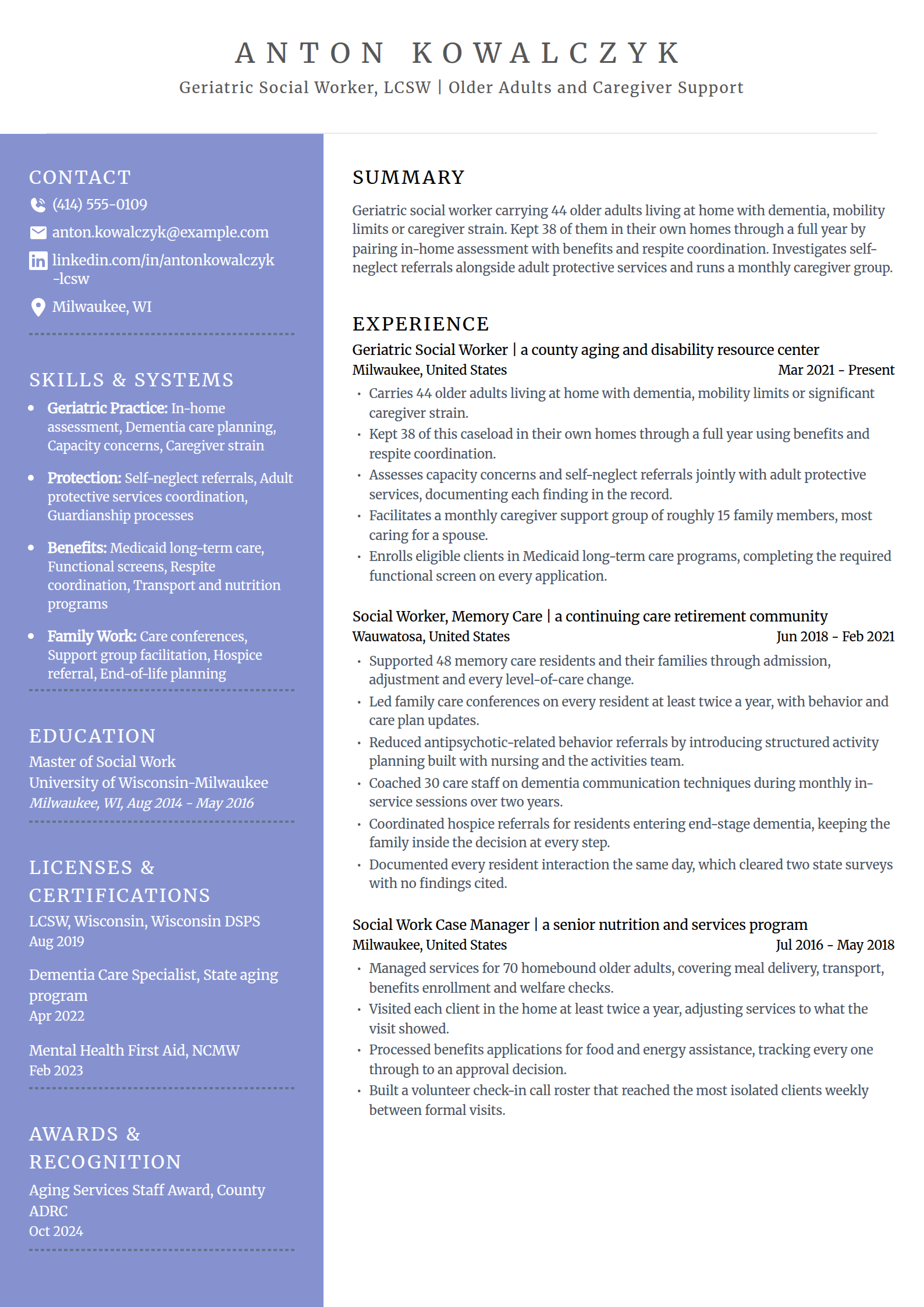
Geriatric Social Worker Resume Template
Why this resume example works?
- Counts how many clients stayed in their own homes across a year, which is exactly what aging services are funded to achieve.
- Pairs the caseload with the reason it is complex: dementia, mobility limits, caregiver strain.
- Names joint work with adult protective services on self-neglect, a sensitive area stated precisely rather than vaguely.
- Includes the Medicaid functional screen, because enrollment work is a large share of this job in practice.
- Keeps the caregiver support group on the page, since family-facing group work is a distinct and marketable skill.
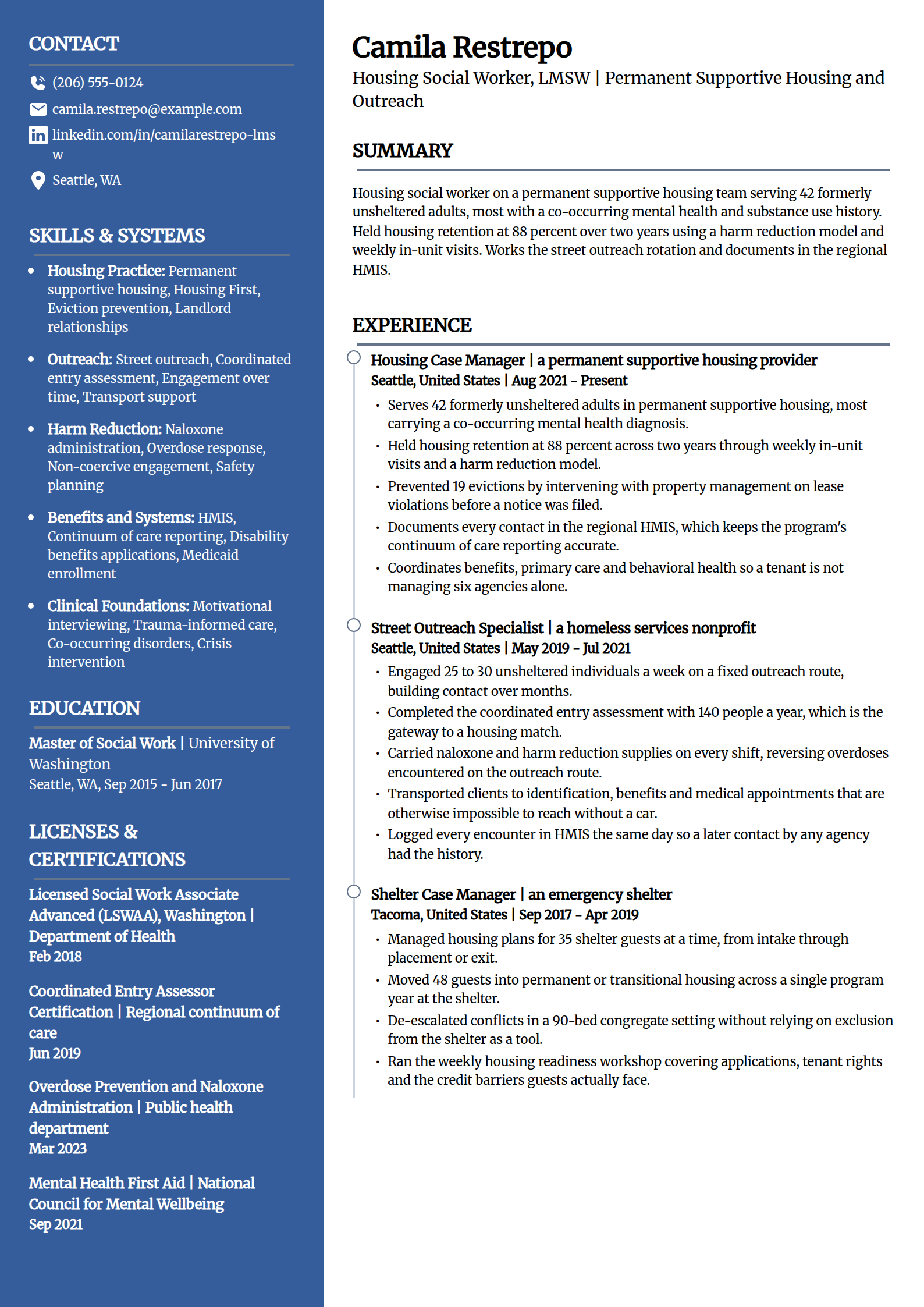
Housing Social Worker Resume Template
Why this resume example works?
- Reports housing retention over two years, which is the one outcome permanent supportive housing programs report upward.
- Counts evictions prevented and names the mechanism, which is intervening with property management before a notice is filed.
- Describes outreach as engagement over months rather than contacts made, which is how the work actually succeeds.
- Names HMIS and coordinated entry, the systems that a continuum of care employer requires and tests for.
- States the harm reduction position plainly, including naloxone on every shift, instead of using softer language.
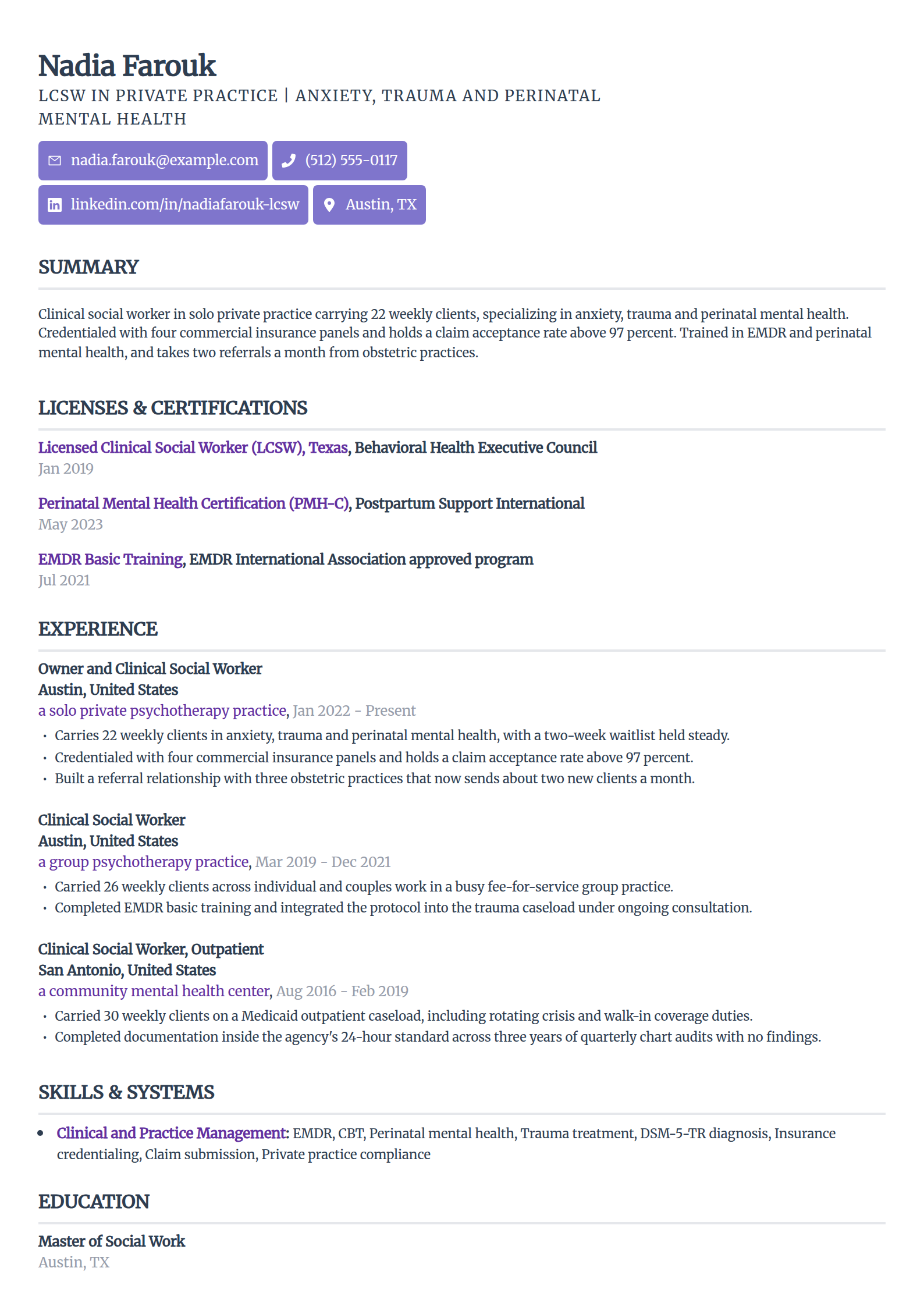
Private Practice Social Worker Resume Template
Why this resume example works?
- Puts licensure first, because in private practice the credential is what makes the work billable at all.
- Treats the practice as a business with a claim acceptance rate, which group practices and agencies both read as competence.
- Names the clinical niche in the headline, since specialization is how referrals and panels actually find a clinician.
- Quantifies the referral relationship by source and volume rather than claiming a strong professional network.
- Keeps the community mental health years, which show this clinician can carry volume and not only a private caseload.
Build your social worker resume
Take the example closest to the setting you are applying into, put your own license title, caseload and documentation numbers in place of its own, and the editor holds the one-page layout an agency portal can read.
Build my resumeHow to write a social worker resume
Two things carry most of the weight: the exact credential you hold and a caseload a reader can picture. Almost everything else on the page is supporting evidence for those two.
Write your license the way your board writes it
Licensed social worker is not a credential. Boards issue specific titles, and a manager filling a position that bills insurance is checking for one exact string plus a state before reading anything else.
What the license line needs:
- The exact title your state issues, such as LCSW, LICSW, LCSW-C, LISW, LMSW, LSW or LGSW, with the state named next to it.
- The year you were licensed, and the license number only if the posting asks for it.
- Whether the title permits independent clinical practice, which matters because clinical and master's level licenses are not interchangeable.
- Any additional credential the setting screens on: a state school social work credential, a case management certification, or an addiction counseling license.
- If you hold licenses in more than one state, list them all. Telehealth roles screen for exactly that.
Put licensure under the summary when it is the screening question
Experience usually leads, and on most social work resumes it should. The licenses block moves directly under the summary only when the credential is what makes the job legally possible.
Move licensure to the top when:
- The role is billable clinical work, where the license is a condition of the position rather than a bonus.
- You are in private practice, where credentialing with insurance panels is part of the job itself.
- You are pre-licensure, where your exact status is the first thing an employer needs to resolve.
- Three examples on this page are built that way. The other thirteen lead with experience, which is the right default.
Give every caseload number its population and setting
Forty-five clients, twelve families and twenty-two open cases describe three different jobs, and the count alone cannot tell a reader which one you did. The context is what turns a number into evidence.
What belongs next to the number:
- Who they are: adults with serious mental illness, children in foster placement, homebound older adults, patients on a medical surgical unit.
- The setting: outpatient clinic, intensive in-home, inpatient unit, school building, permanent supportive housing.
- The acuity or the responsibility, such as permanency planning, crisis coverage or independent clinical treatment.
- The contact frequency where it varies, since weekly therapy clients and quarterly case management visits are not comparable.
- A range is fine and often more honest than a single figure, as long as the context sits next to it.
Use the numbers your agency already reports, not client outcome percentages
Published examples in this field routinely claim client improvement rates and success rates. No case management system produces those, so an interviewer who asks where the figure came from gets an answer that undoes the rest of the page.
Numbers you can actually document:
- Documentation timeliness against the policy window, plus chart audit or utilization review results.
- No-show, engagement and retention rates, which intake and billing teams track already.
- Assessments and screenings administered, with the instrument named: PHQ-9, GAD-7, the Columbia Protocol, the ACE questionnaire, CANS, ASAM criteria.
- Counts rather than rates for outcomes: reunifications achieved, placements made, evictions prevented, discharges coordinated.
- Operational results: discharge delays, readmissions, waitlist length, supervision hours provided, audit findings cleared.
If you are new, your field placement is your experience section
Accredited programs require supervised field hours, 400 for a BSW and 900 for an MSW, and those hours are a real credential. List the placement the way you would list a job, because that is what it was.
What the placement entry needs:
- Organization type, location, dates, and the total supervised hours completed.
- Your field instructor's credential, which tells a reader who was accountable for the work.
- What you actually carried: assessments completed, families or clients seen, groups co-facilitated, documentation written.
- The systems you used, since Epic or a state child welfare system on a new graduate resume is a genuine advantage.
- Nothing you did not do. Claiming independent clinical work from a placement is the fastest way to lose a licensed interviewer.
If you are pre-licensure, say exactly where you are
Working toward my LCSW tells an employer nothing it can plan around. States set their own requirements, typically a few thousand post-master's supervised hours over two to three years, and some count total supervised hours while others count client contact hours.
The precise version:
- Hours completed against the requirement, for example 620 of the hours your state requires.
- Your supervisor's credential and whether supervision is currently in place.
- Which ASWB examination you have passed, naming the category: Bachelors, Masters, Advanced Generalist or Clinical.
- Your expected licensure date, or the exam month if it is booked.
- Verify the current requirement with your own state board before you write the number. It is the detail an interviewer is most likely to know better than you do.
Write a summary of three to four sentences and keep it to one page
Fifty to seventy words, opening with your credential and your setting rather than a word like compassionate. Every example here does that, and every one fits on a single page, including a supervisor leading thirteen staff and a clinician with fourteen years.
Licensed clinical social worker carrying 26 to 30 weekly outpatient clients at a community mental health clinic, mostly adults with trauma histories and co-occurring mood disorders. Documents every session inside the 24-hour policy window, which held chart audit compliance at 99 percent across two review cycles. Trained in EMDR and DBT, and supervises two associate clinicians toward licensure.
What a social work summary has to carry:
- The credential and the setting, in the first clause.
- The caseload with its population attached.
- The one number you would want an interviewer to ask about.
- The modalities, instruments or systems a posting in your setting would name.
Common social worker resume mistakes
- A vague license line. Licensed social worker is not a credential a board issues, and a manager filling a billable role is scanning for one exact title plus a state. Write LCSW, LICSW, LMSW, LSW or whatever your board actually grants, with the state and the year, and say plainly where you are if you are still accruing hours.
- A caseload number with no context. Forty-five clients means one thing in outpatient therapy and something else entirely in intensive in-home work with twelve families. State the population, the setting and the responsibility next to every number, because the count on its own cannot distinguish the easiest version of the job from the hardest.
- Invented client outcome percentages. Published examples are full of improvement rates and success rates that no case management system produces, and one question about the source will undo the whole page. Use documentation compliance, audit results, no-show rates, screenings administered and outcome counts instead. Those are real and a supervisor recognizes them immediately.
- Leaving field hours off a new graduate resume. Accredited programs require 400 supervised hours for a BSW and 900 for an MSW, and those hours plus the placement setting are the strongest thing a first resume has. Burying them under education, or describing the placement as an internship with no detail, throws away the only experience the page can claim.
- A page of adjectives instead of practice. Compassionate, dedicated, empathetic and passionate appear on nearly every application for this job and screen for nothing. Replace each with something checkable: the modality you are trained in, the instrument you administer, the system you document in, the population you have carried.
Frequently asked questions
What should a social worker resume include?
A social worker resume needs a three-to-four-sentence summary that opens with your credential and setting, a licenses and certifications block carrying the exact title your state board issues, an experience section where every caseload number states its population and setting, a skills block naming your modalities, assessment instruments and documentation systems, and education with your degree program named. New graduates add their supervised field hours, 400 for a BSW and 900 for an MSW under accreditation standards, treated as a real experience entry rather than a line under education. The numbers that work are the ones agencies already track: documentation timeliness, chart audit results, no-show and retention rates, screenings administered, and outcome counts such as reunifications or placements. One page is enough at nearly every level.
How do you list your license on a social worker resume?
Write the exact title your state board issues, with the state and the year, and nothing vaguer. Boards grant specific credentials such as LCSW, LICSW, LCSW-C, LISW, LMSW, LSW and LGSW, and these are not interchangeable: the clinical titles permit independent practice including diagnosis and psychotherapy, while master's level titles cover supervised and non-clinical work. Put the license number in only if the posting asks. Hold licenses in more than one state and list them all, since telehealth roles screen for exactly that. Place the block directly under your summary when the credential is what makes the job possible, which is the case for billable clinical roles, private practice and any pre-licensure application. Otherwise experience leads and licensure sits lower.
How do you write a social worker resume with no experience?
You have more experience than you think, because your field placement is experience and it belongs in the experience section written like a job. Give the organization type, the dates, the total supervised hours, your field instructor's credential, and what you actually carried: assessments completed, families or clients seen under supervision, groups co-facilitated, documentation written and in which system. Accredited programs require 400 supervised hours for a BSW and 900 for an MSW, and those figures are a real credential most new graduate resumes leave off. Keep any previous job that measured something, whether that is a direct care role, a residential shift or customer-facing work, and claim nothing clinical that your credential does not cover. Two examples on this page are built exactly this way.
How do you put caseload on a resume?
Always with the context that makes it readable. A caseload of 45 in outpatient therapy, 22 open child welfare cases with permanency responsibility and 12 intensive in-home families are three different jobs, and the number alone cannot distinguish them. Write the count, then who the clients are, then the setting and the responsibility: for example, 26 to 30 weekly outpatient clients, mostly adults with trauma histories and co-occurring mood disorders. A range is fine and often more honest than a single figure. Include contact frequency where it varies, since weekly therapy and quarterly case management visits are not comparable workloads. Only use a number you could defend in an interview, because a supervisor in that setting will know immediately whether it is plausible.
What skills and keywords belong on a social worker resume?
The ones in the posting that are also true of you, grouped so a reviewer can scan them. Clinical roles list modalities by name: CBT, DBT, TF-CBT, EMDR, motivational interviewing, solution-focused brief therapy, trauma-informed care. Assessment belongs in its own group: biopsychosocial assessment, psychosocial assessment, risk and safety planning, and the instruments you administer, such as the PHQ-9, GAD-7, the Columbia Protocol, the ACE questionnaire, CANS or ASAM criteria. Name the documentation system, because Epic, Cerner, a behavioral health record or a state child welfare system is a genuine differentiator. Then add the setting-specific work: discharge planning and utilization review in health care, IEP services and attendance intervention in schools, permanency planning and court testimony in child welfare, HMIS and coordinated entry in housing. Leave compassionate and dedicated off entirely.
How long should a social worker resume be?
One page at nearly every level, which is this site's standard and what every example on this page does, including a clinical supervisor leading thirteen staff and a social worker with fourteen years across hospital and program roles. Published advice often allows two pages for licensed clinicians with supervisory experience or publications, and that is reasonable in academic or research-adjacent applications. For everyday agency, hospital, school and clinic hiring, one well-ordered page parses more reliably through an applicant tracking system and gets read in full. If you are running out of room, compress your oldest roles to two or three lines rather than dropping the population and setting detail from the recent ones, because that context is what makes your caseload numbers mean anything.
More social worker resume resources
Build your social worker resume
Take the example closest to the setting you are applying into, put your own license title, caseload and documentation numbers in place of its own, and the editor holds the one-page layout an agency portal can read.