Pharmacist Resume Templates and Examples, PharmD to CPhT
- ATS Friendly
- Pharmacist & Technician
- 16 Real Examples
Whether you verify prescriptions as a licensed pharmacist or fill and dispense as a technician, this page has a resume built for your exact role. Start from a layout below, then model your own on a real example, from a retail community pharmacist to a certified pharmacy technician. Every credential, from your PharmD and state license to your CPhT, sits where a hiring manager looks first.


540k+ resumes created
Editable pharmacist and pharmacy technician resume templates
Each template below is a real pharmacy resume laid out in that format, sorted by role and setting across retail, hospital, clinical, compounding, and specialty work. Pick one, then swap in your own scripts, immunizations, certifications, and systems. Every layout keeps your name, credentials, and licensure clean so a hiring manager reads your qualifications at a glance and an applicant tracking system parses them without trouble.
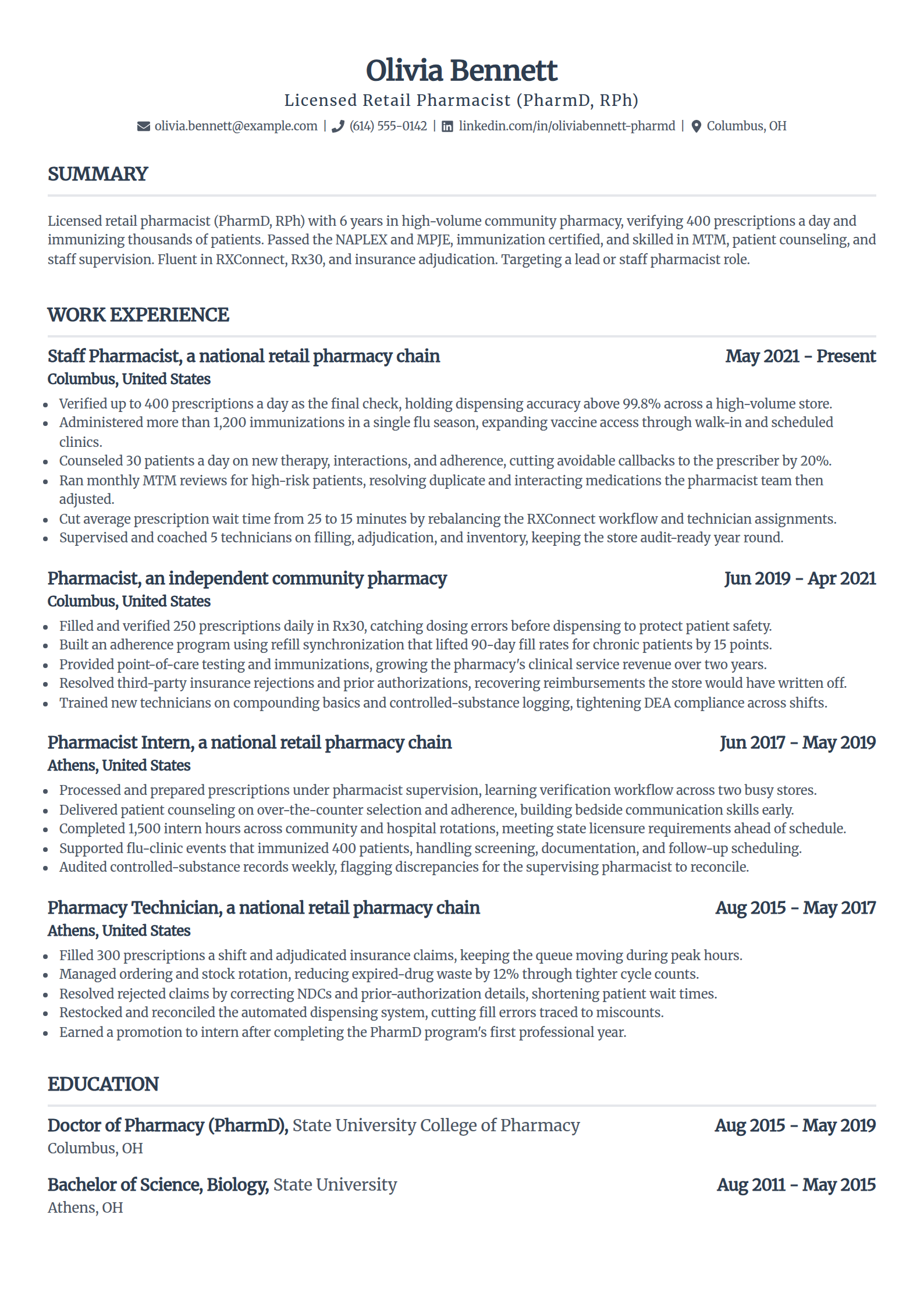
Retail Pharmacist Resume Template
Why this resume example works?
- Opens with a summary that names 6 years, 400 prescriptions verified a day, and passing the NAPLEX and MPJE.
- Shows the pharmacist scope a store expects: final verification, immunizations, MTM, counseling, and supervising technicians.
- Attaches one number to each bullet, like 1,200 immunizations in a flu season or a wait time cut from 25 to 15 minutes.
- Names the systems a posting screens for, RXConnect and Rx30, alongside insurance adjudication.
- Uses a clean, single-column layout an applicant tracking system parses without trouble.
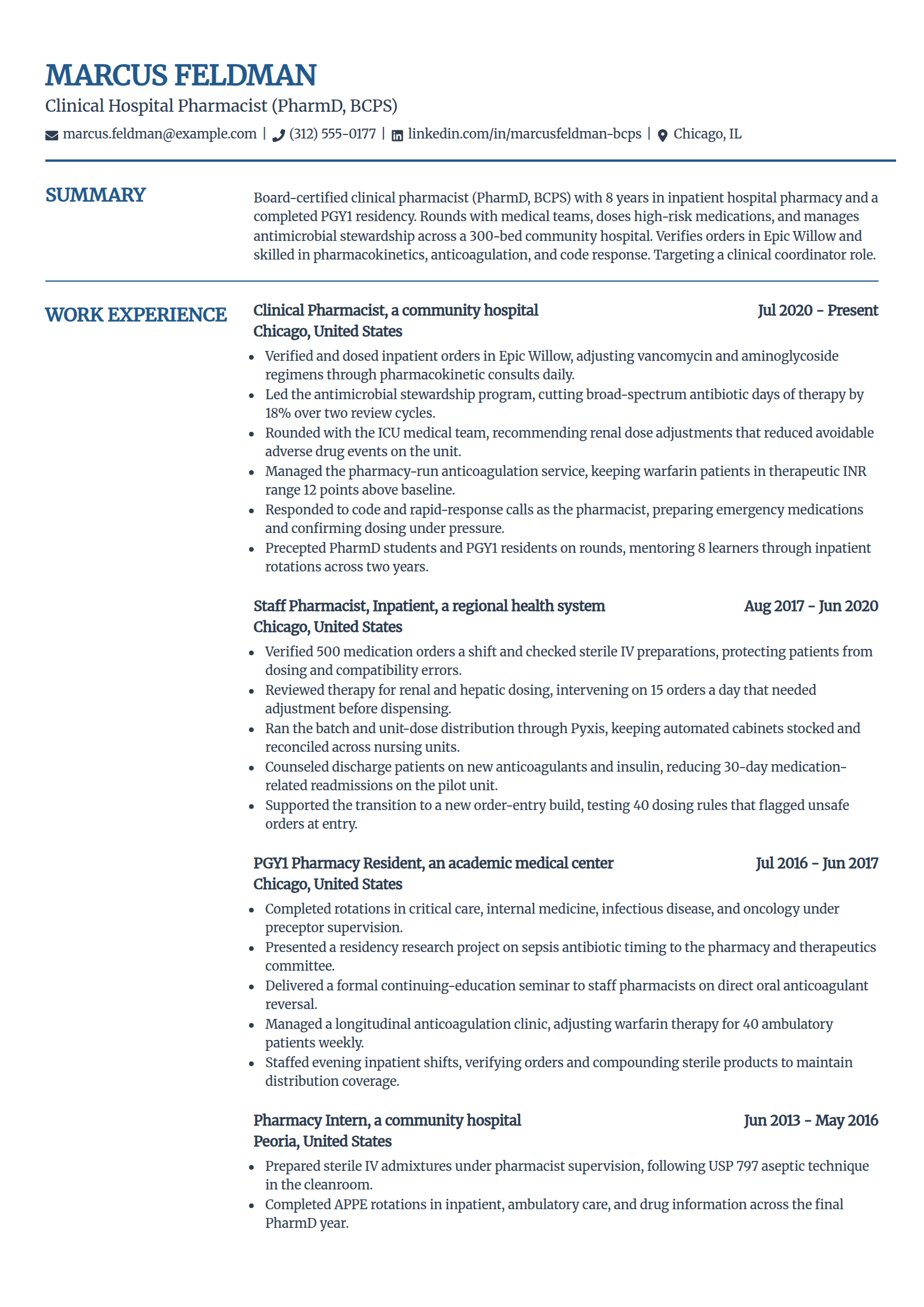
Hospital & Clinical Pharmacist Resume Template
Why this resume example works?
- Leads with board certification (BCPS), a completed PGY1 residency, and 8 years of inpatient practice.
- Shows the clinical work a hospital hires for: pharmacokinetic dosing, antimicrobial stewardship, and code response.
- Names Epic Willow order verification and the exact therapies an interviewer expects, from vancomycin to anticoagulation.
- Keeps each result modest and believable, like an 18% cut in broad-spectrum antibiotic days of therapy.
- Adds precepting and residency teaching, the experience a clinical coordinator role rewards.
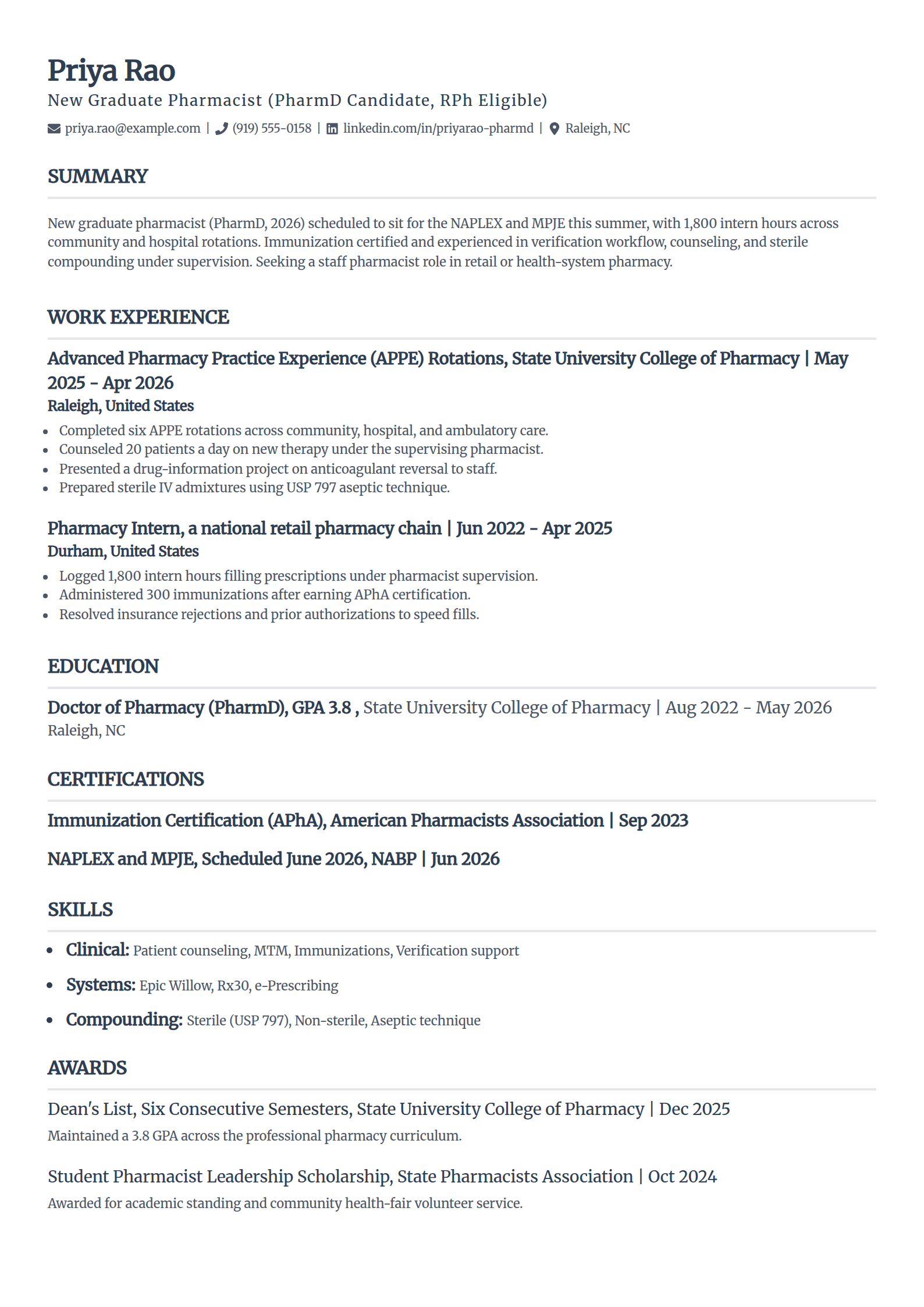
New Grad Pharmacist (PharmD) Resume Template
Why this resume example works?
- Written for a 2026 PharmD, leading with 1,800 intern hours and the NAPLEX and MPJE scheduled for the summer.
- Uses APPE rotations as entries, the right move when paid pharmacist experience does not exist yet.
- States the licensure timeline precisely, scheduled to sit for the exam, never claiming a license not yet held.
- Shows real intern work under supervision, from counseling to 300 immunizations after APhA certification.
- Fills a tight, ATS-safe page with a GPA, honors, and awards instead of padding.
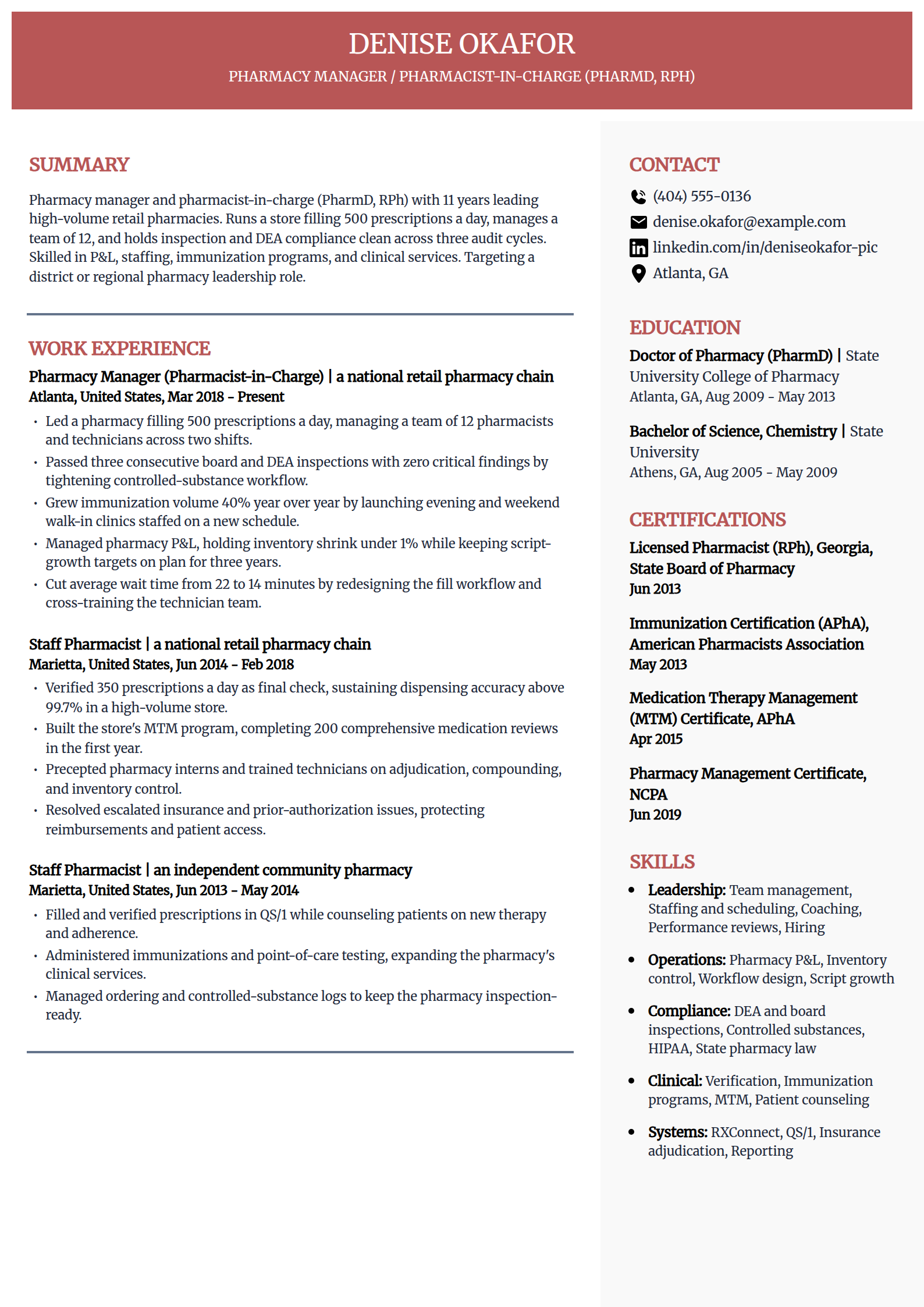
Pharmacy Manager & PIC Resume Template
Why this resume example works?
- Leads with manager scope, a store filling 500 prescriptions a day and a team of 12 across two shifts.
- Shows the leadership a district role rewards: three clean board and DEA inspections and pharmacy P&L ownership.
- Keeps results modest and countable, like immunization volume up 40% and inventory shrink held under 1%.
- Pairs management wins with kept clinical skills, verification, immunization programs, and MTM.
- Uses a refined two-column layout that fits a leadership record cleanly on one page.
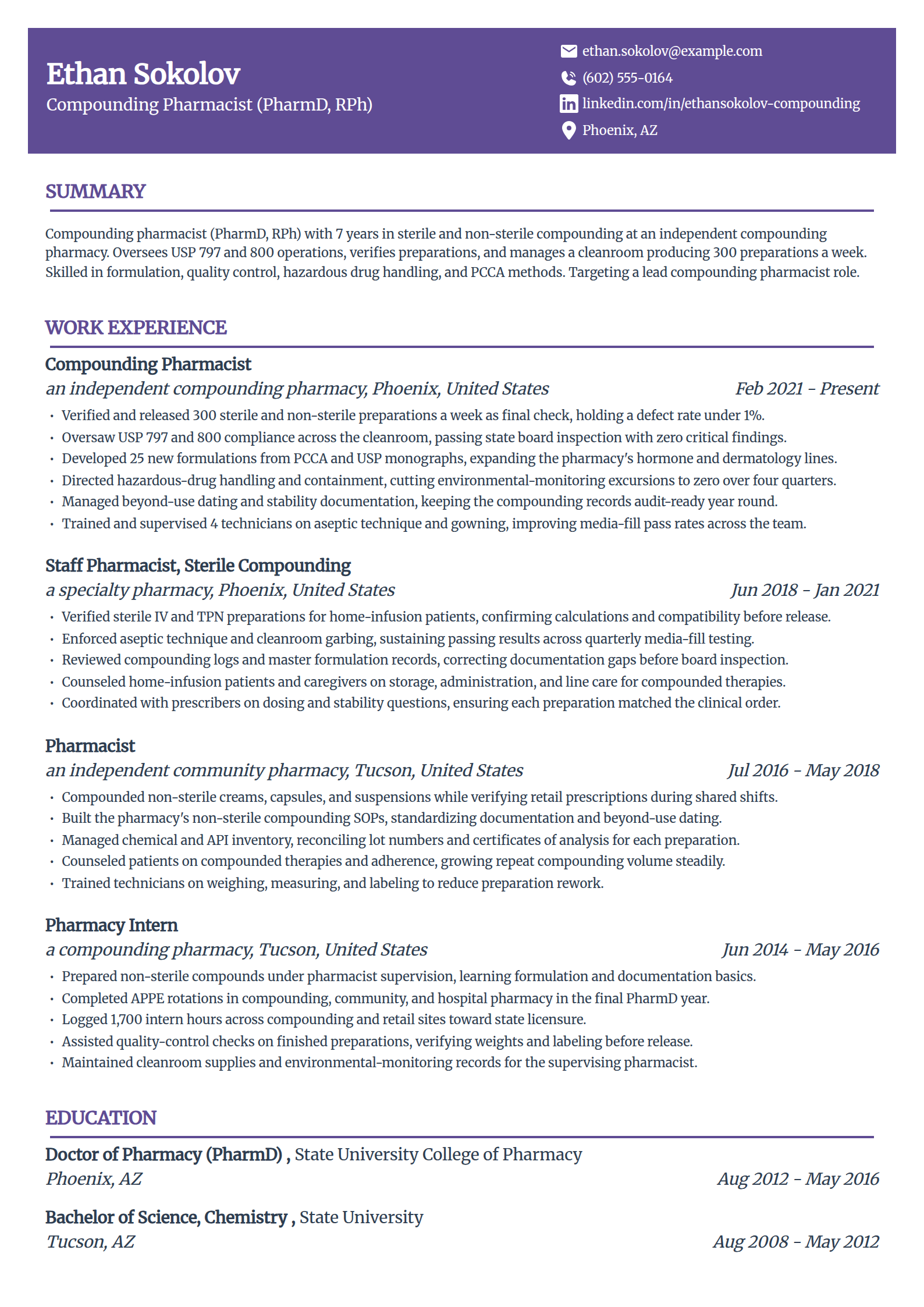
Compounding Pharmacist Resume Template
Why this resume example works?
- Opens with compounding scope, 300 preparations a week released and USP 797 and 800 oversight.
- Names the credentials a compounding pharmacy screens for, sterile and hazardous certificates and PCCA training.
- Shows measurable quality, a defect rate under 1% and zero environmental-monitoring excursions over four quarters.
- Balances verification with formulation development, the range a lead compounding role expects.
- Uses a clean, modern layout that carries a dense sterile-compounding history on one page.
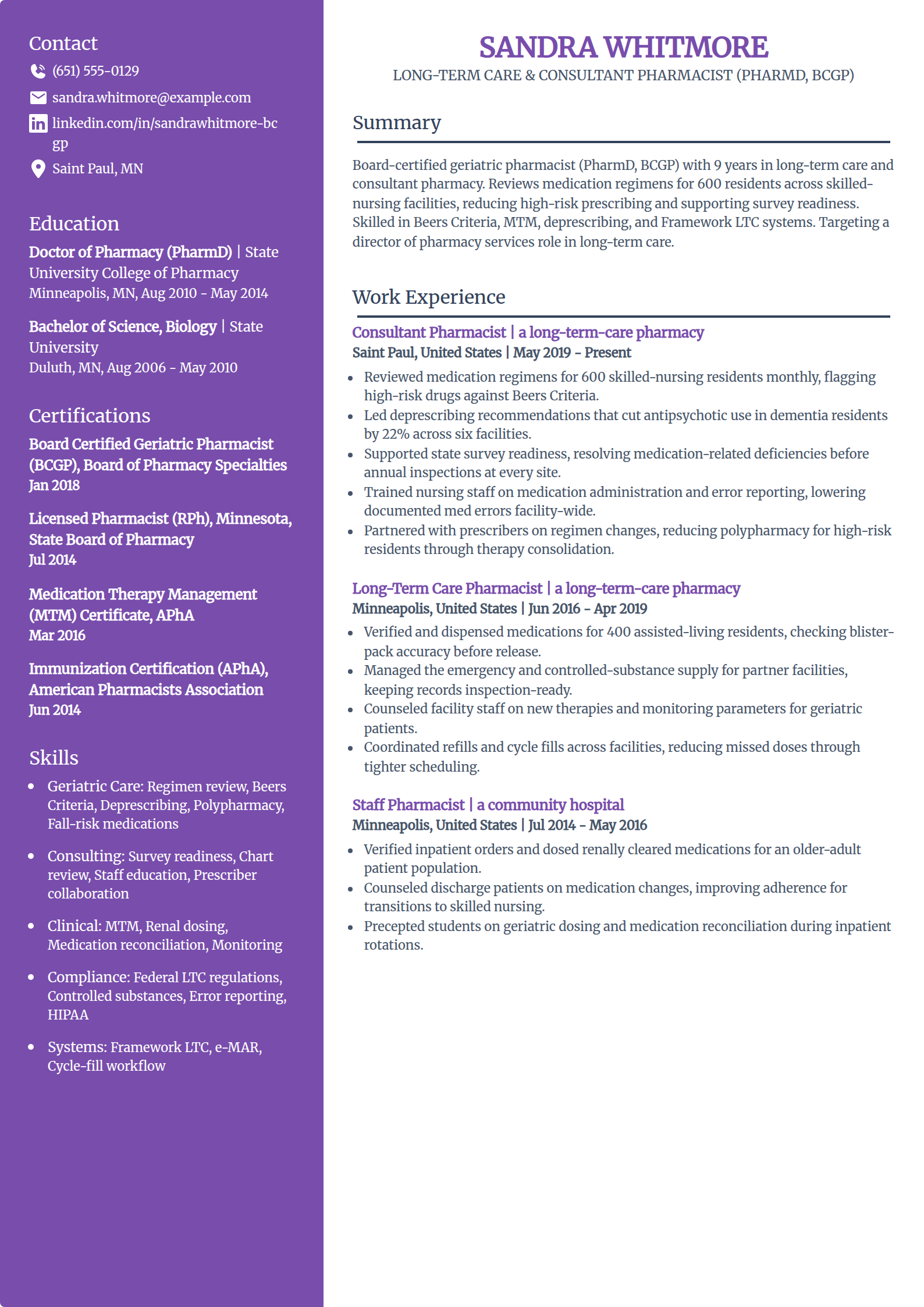
Long-Term Care & Consultant Pharmacist Resume Template
Why this resume example works?
- Frames consultant scope, monthly regimen reviews for 600 skilled-nursing residents against Beers Criteria.
- Shows the geriatric work a director hires for: deprescribing, survey readiness, and prescriber collaboration.
- Leads with BCGP board certification, the credential that signals geriatric expertise.
- Keeps each result believable for the setting, like a 22% cut in antipsychotic use across six facilities.
- Uses a Medium layout that fits a nine-year long-term-care record without empty space.
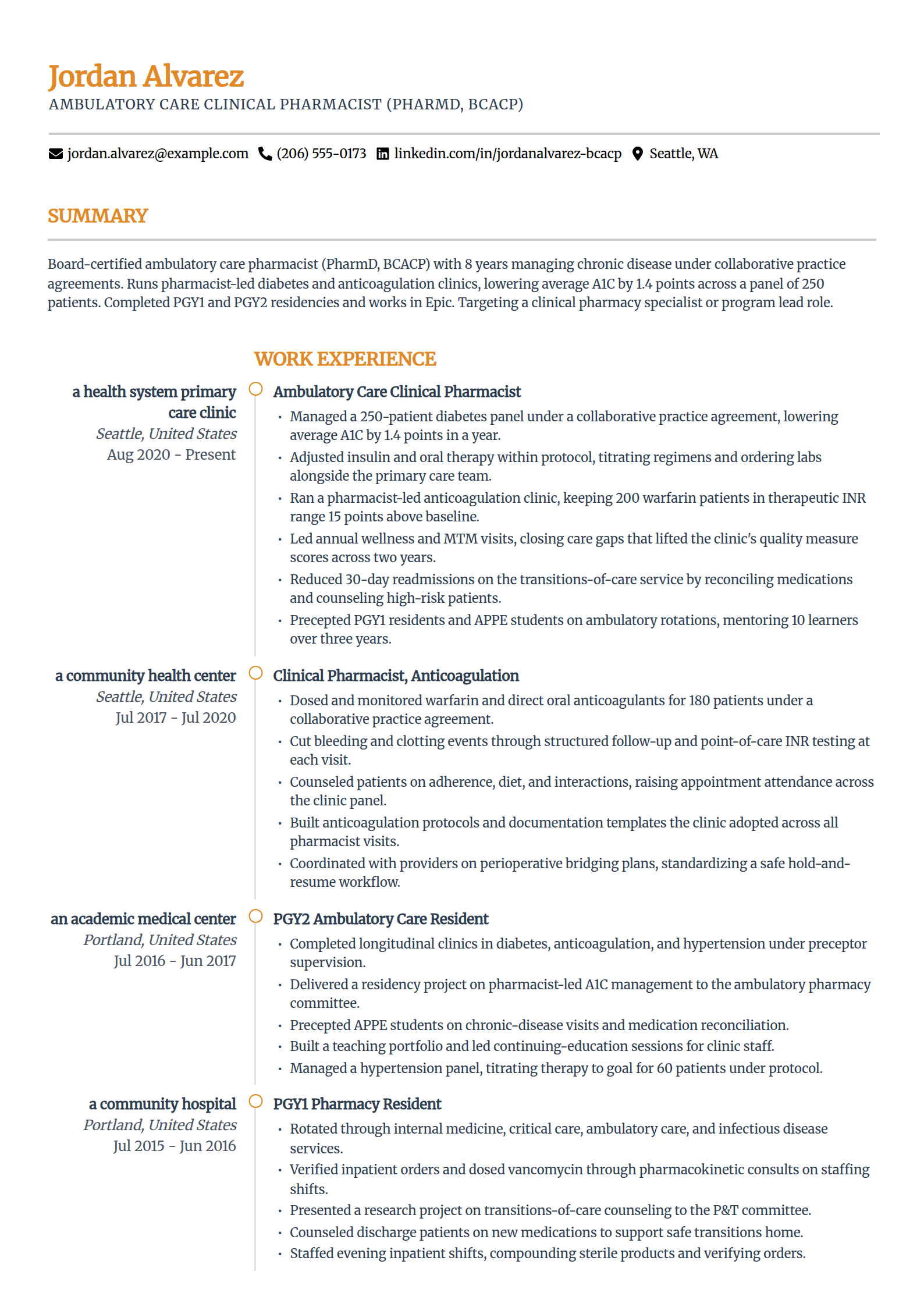
Ambulatory Care Clinical Pharmacist Resume Template
Why this resume example works?
- Leads with BCACP board certification, PGY1 and PGY2 residencies, and collaborative practice experience.
- Shows the chronic-disease work a clinic hires for, a diabetes panel with average A1C lowered 1.4 points.
- Names the pharmacist-led scope only a clinical pharmacist can own, protocol titration and lab ordering.
- Ties clinical results to outcomes a system values, like reduced 30-day readmissions on transitions of care.
- Uses a modern layout that carries a deep residency-trained clinical record on one clean page.
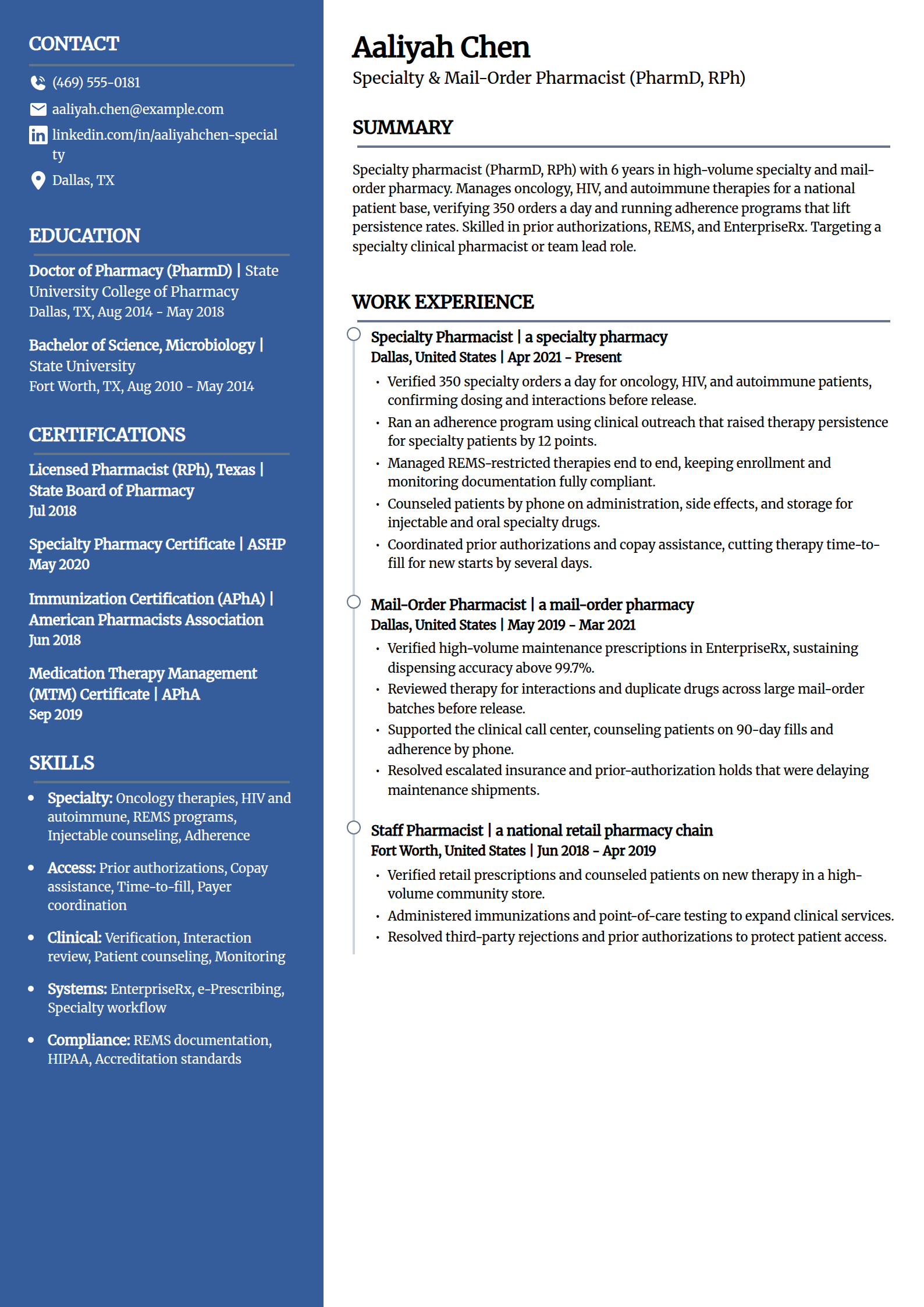
Specialty & Mail-Order Pharmacist Resume Template
Why this resume example works?
- Opens with specialty scope, 350 orders a day verified across oncology, HIV, and autoimmune therapies.
- Names the specialty vocabulary a posting lists, REMS programs, prior authorizations, and copay assistance.
- Shows a measurable adherence result, therapy persistence lifted 12 points through clinical outreach.
- Names EnterpriseRx and the injectable-counseling work a specialty pharmacy screens for.
- Uses a distinctive layout that still reads cleanly for a hiring pharmacist.
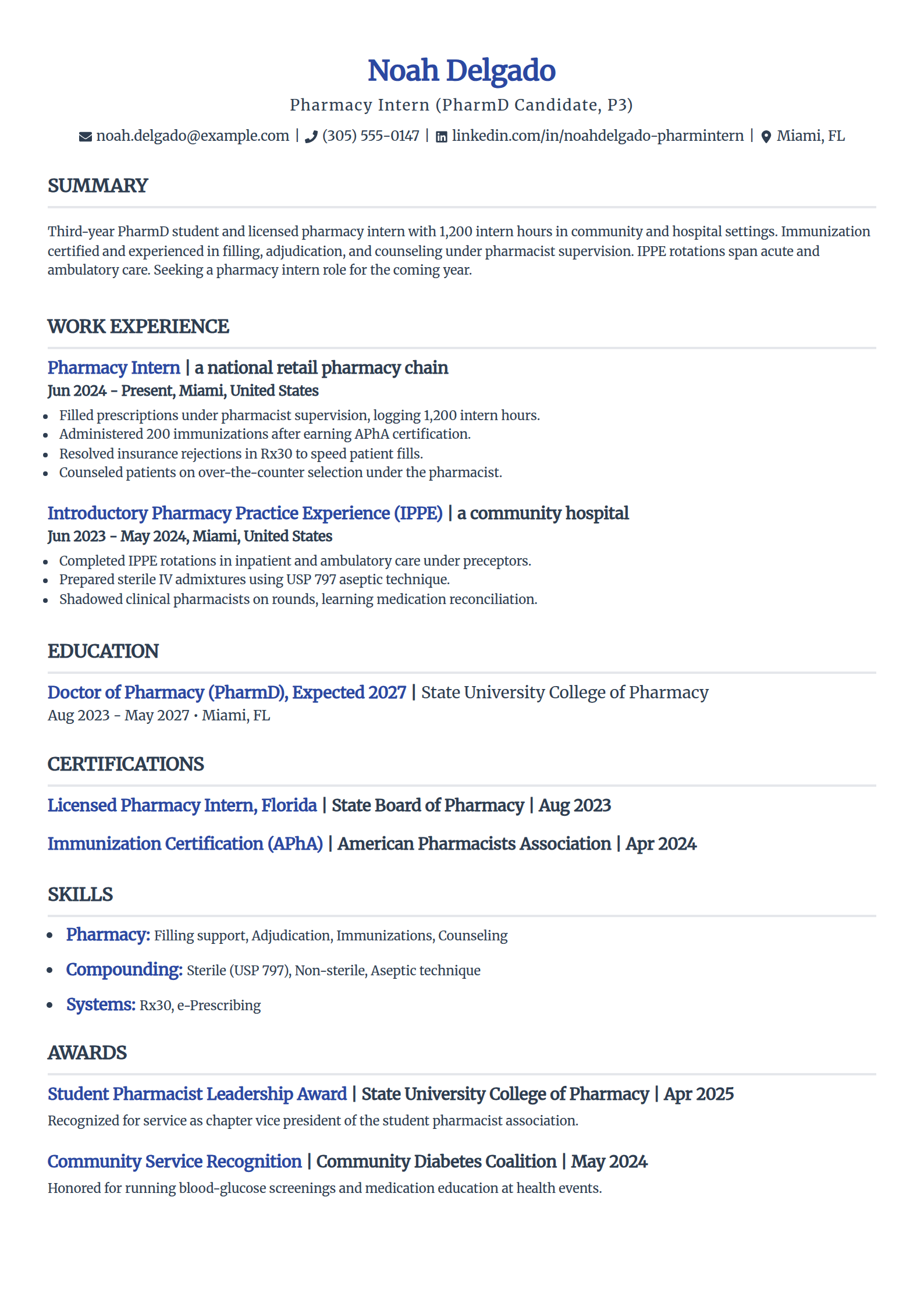
Pharmacy Intern & Student Resume Template
Why this resume example works?
- Written for a P3 student, leading with 1,200 intern hours and a licensed intern credential.
- Uses IPPE rotations as entries, the right structure for a resume still short on paid roles.
- Keeps every intern bullet under supervision, honest about what a student can and cannot do.
- Shows real early skills, immunizations after APhA certification and sterile compounding basics.
- Fills a plain, ATS-safe page with leadership awards instead of padding thin experience.
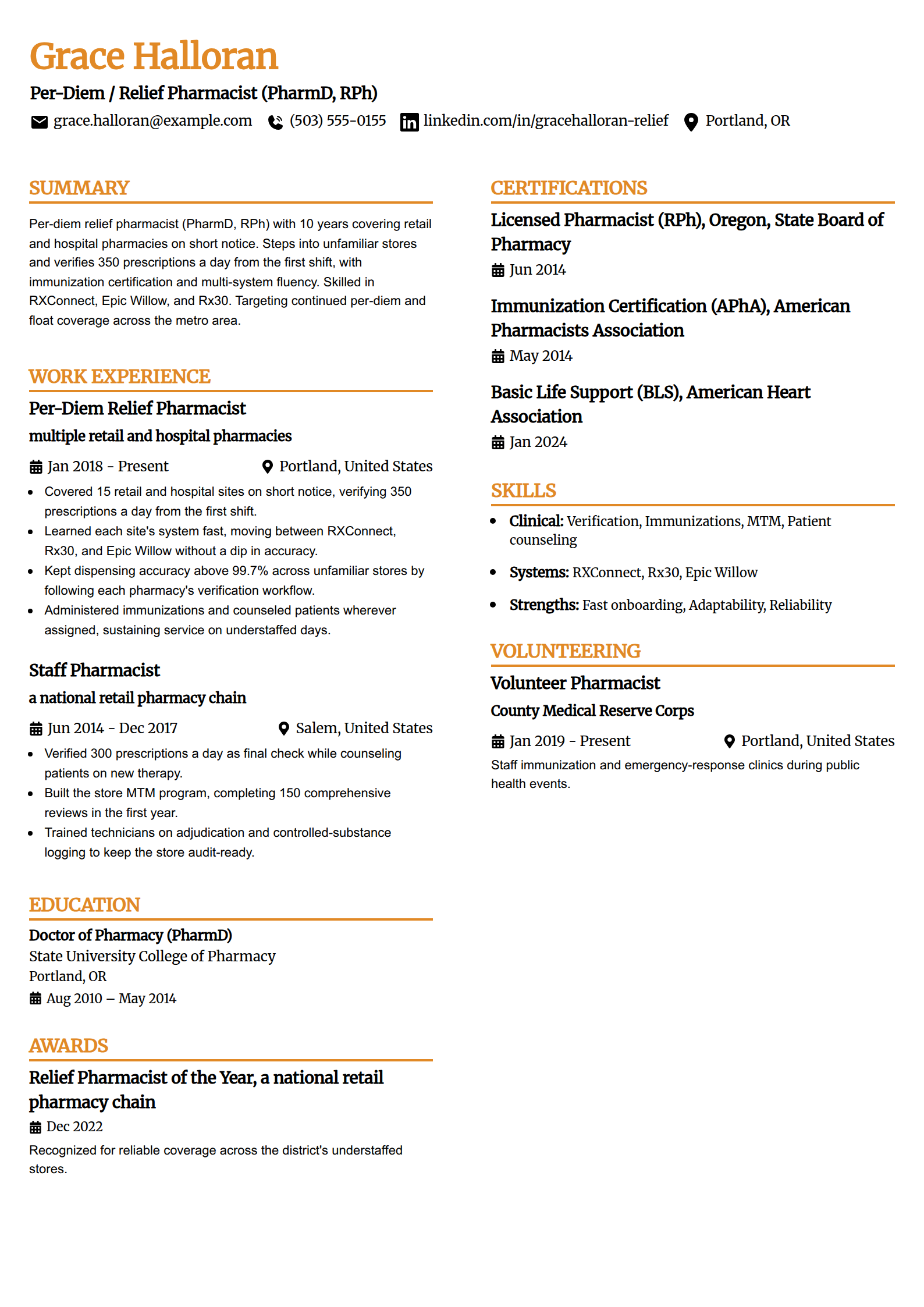
Per-Diem & Relief Pharmacist Resume Template
Why this resume example works?
- Leads with the relief pharmacist's real selling point, covering 15 sites and verifying 350 a day from the first shift.
- Shows multi-system fluency, moving between RXConnect, Rx30, and Epic Willow without a dip in accuracy.
- Keeps two focused roles tight, with the sidebar filled by an award and a volunteer pharmacist role.
- Names the immunization and MTM work that keeps understaffed stores running.
- Uses a refined layout that fits a focused relief record on one clean page.
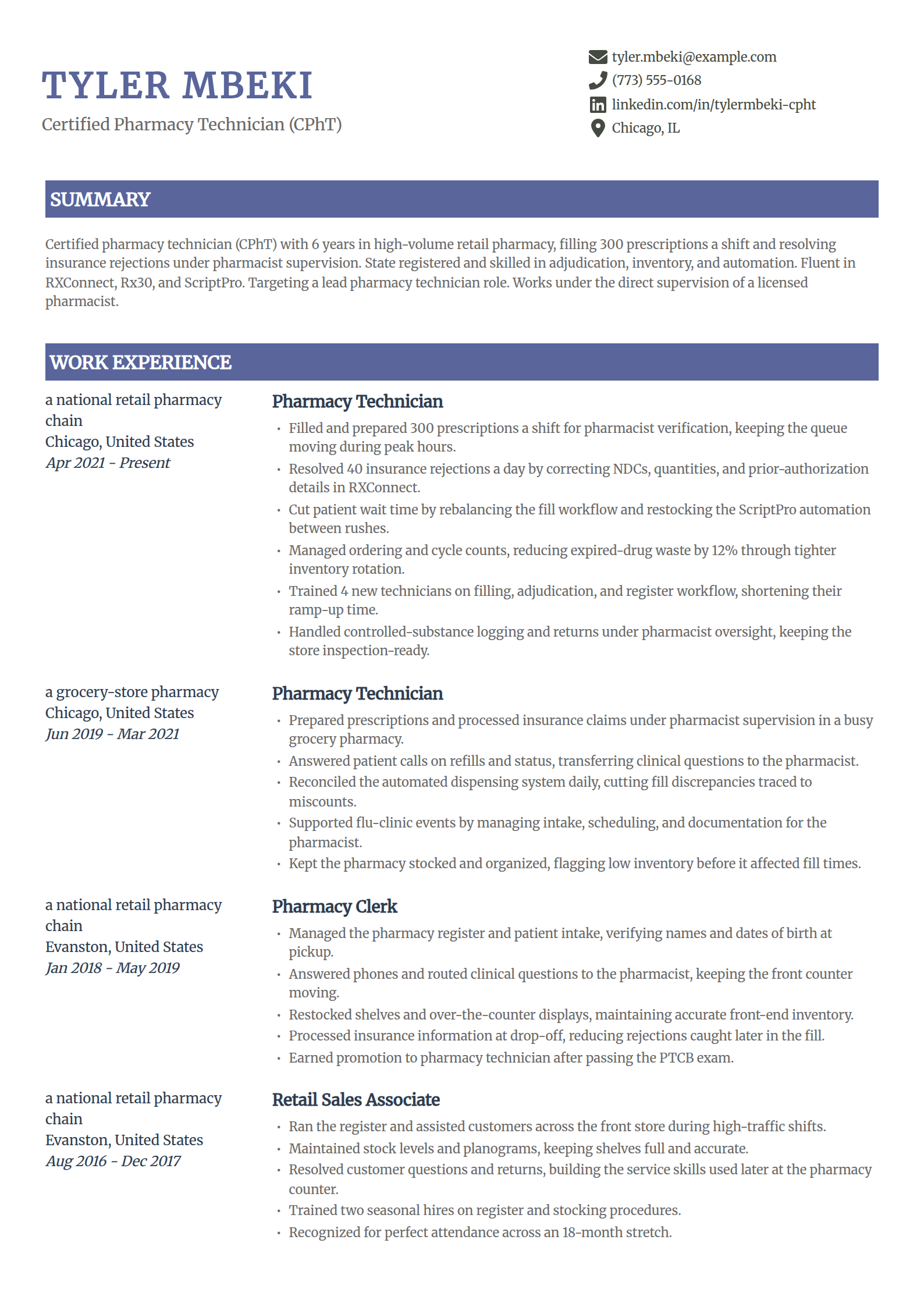
Retail Pharmacy Technician Resume Template
Why this resume example works?
- Opens with CPhT certification and 300 prescriptions filled a shift, the throughput a retail pharmacy screens for.
- Keeps every task in a technician's scope, filling and adjudicating under pharmacist verification.
- Shows the insurance work a tech owns, 40 rejections resolved a day by fixing NDCs and prior authorizations.
- Names the systems and automation a posting lists, RXConnect, Rx30, and ScriptPro.
- Uses a modern two-column layout that carries a full retail-technician history on one page.
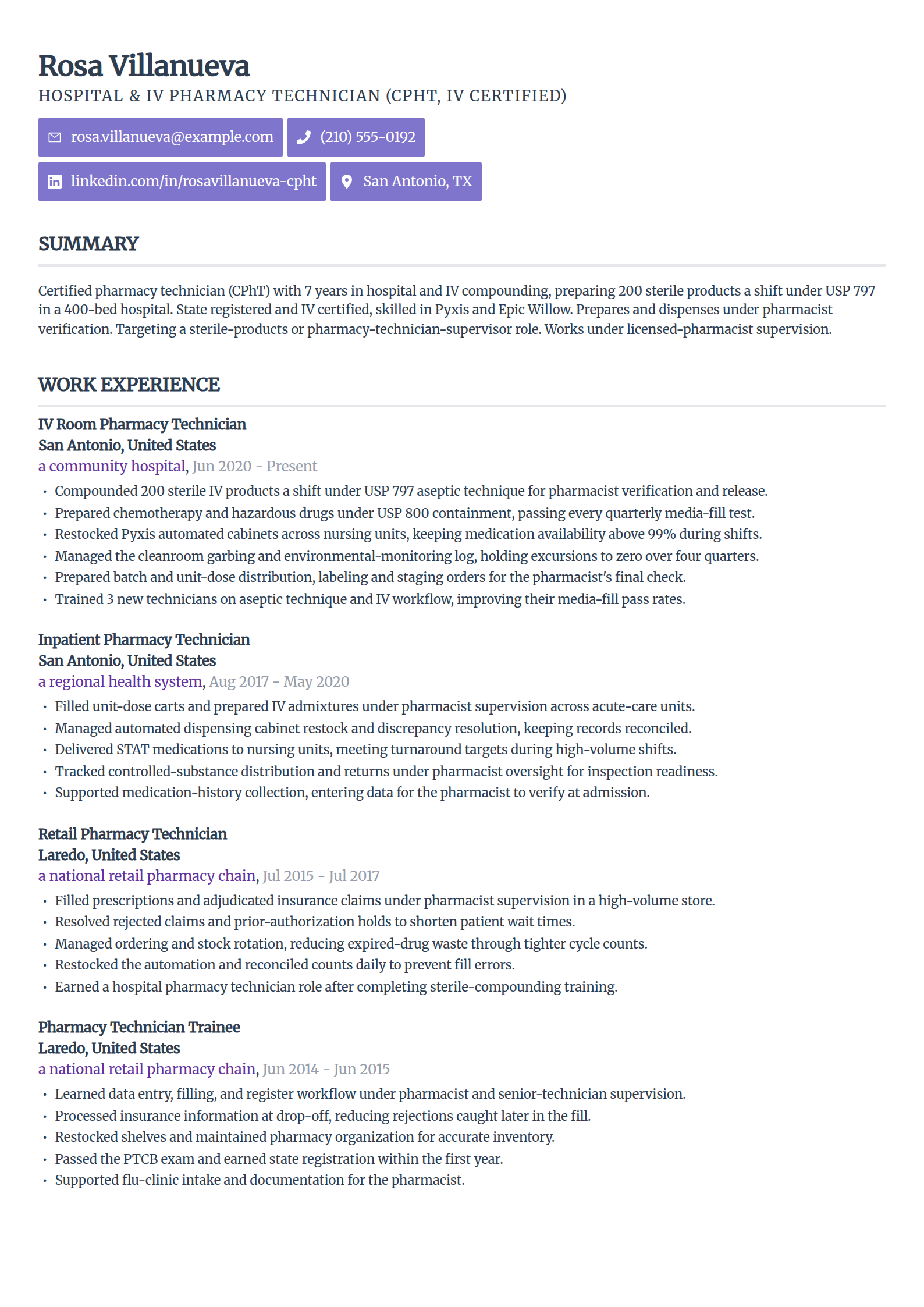
Hospital & IV Pharmacy Technician Resume Template
Why this resume example works?
- Leads with sterile-compounding scope, 200 IV products a shift prepared under USP 797 for pharmacist release.
- Names the credentials a hospital IV room screens for, IV certification, USP 800, and the CSPT.
- Keeps the work in a technician's scope, compounding and restocking Pyxis for the pharmacist's final check.
- Shows measurable quality, passing every quarterly media-fill test and holding excursions to zero.
- Uses a clean, modern layout that carries a dense hospital-technician record on one page.
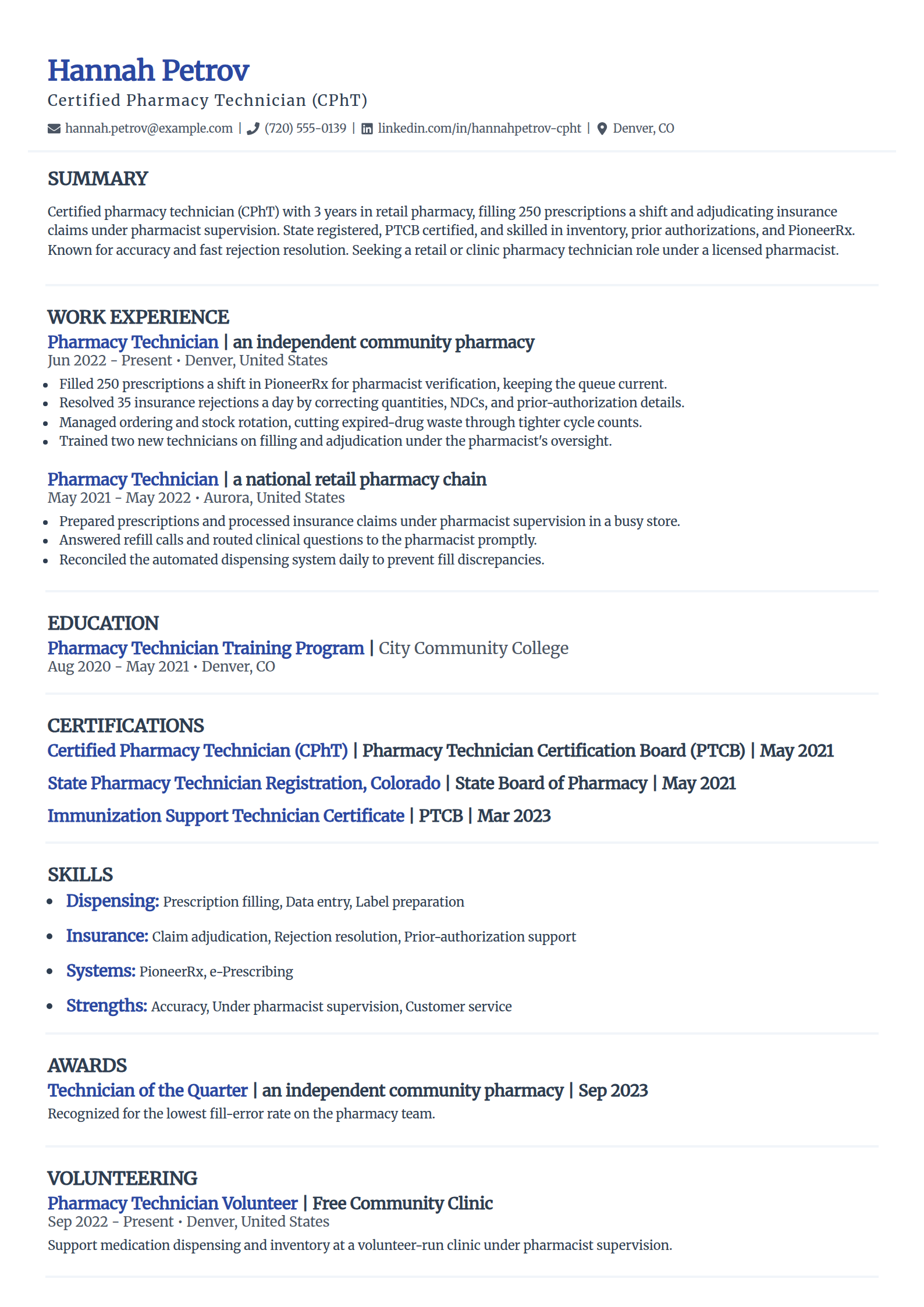
Certified Pharmacy Technician (CPhT) Resume Template
Why this resume example works?
- Leads with the CPhT credential and state registration, the two things a pharmacy checks first.
- Keeps a focused three-year record tight, 250 prescriptions filled a shift under pharmacist verification.
- Shows the rejection-resolution work a tech owns, 35 claims fixed a day in PioneerRx.
- Fills a refined, ATS-safe page with a technician-of-the-quarter award and a clinic volunteer role.
- Uses a clean layout that keeps the focus on certification and accuracy.
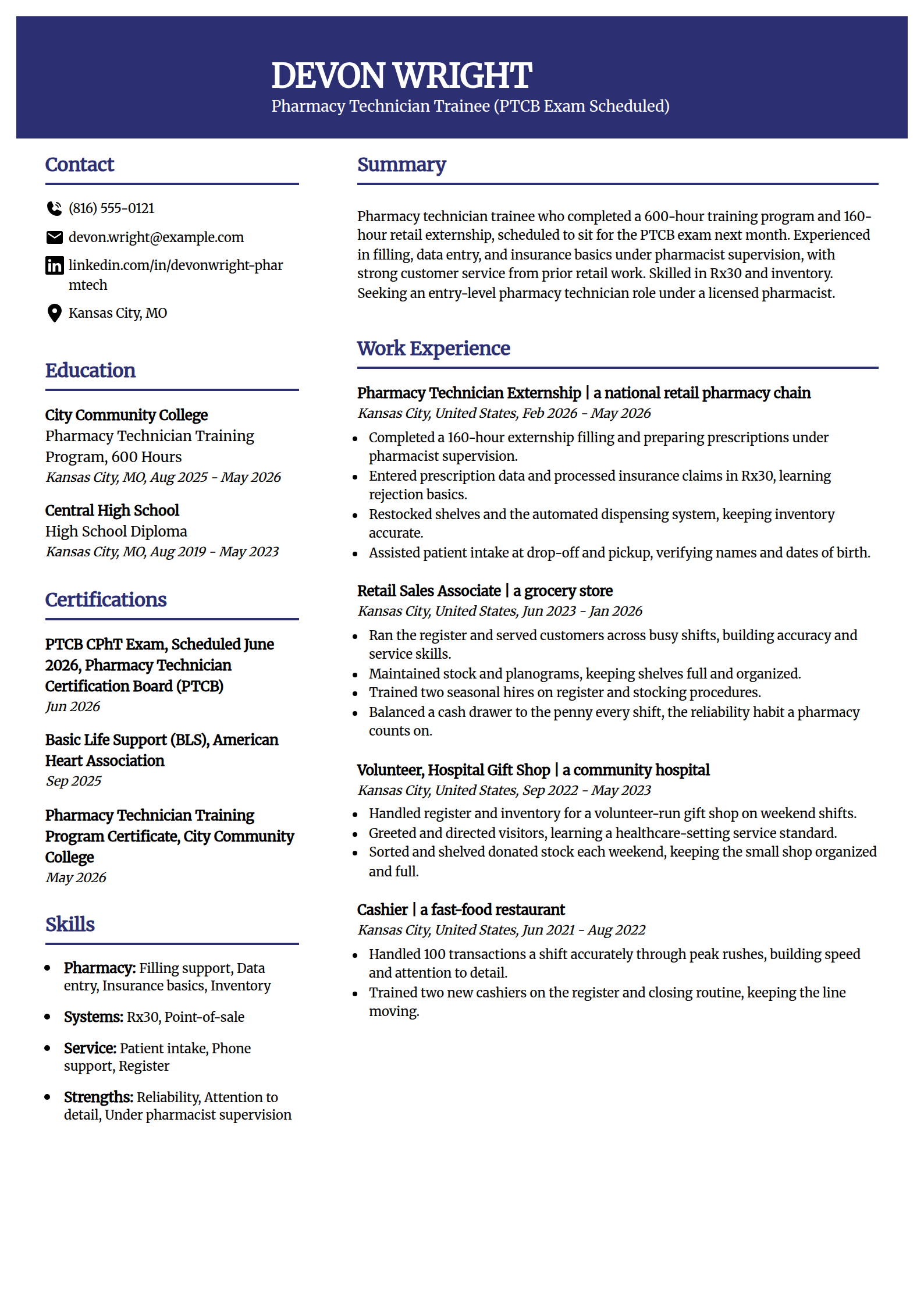
Entry-Level Pharmacy Technician Resume Template
Why this resume example works?
- Written for a trainee with the PTCB exam scheduled, leading with a 600-hour program and a 160-hour externship.
- Uses the externship and prior retail work honestly, no invented pharmacy years.
- States the certification timeline precisely, scheduled to sit for the PTCB exam next month.
- Leans on reliability, accuracy, and customer service, what actually gets a first technician job.
- Uses a roomy layout with the sidebar filled so a beginner's record still looks complete.
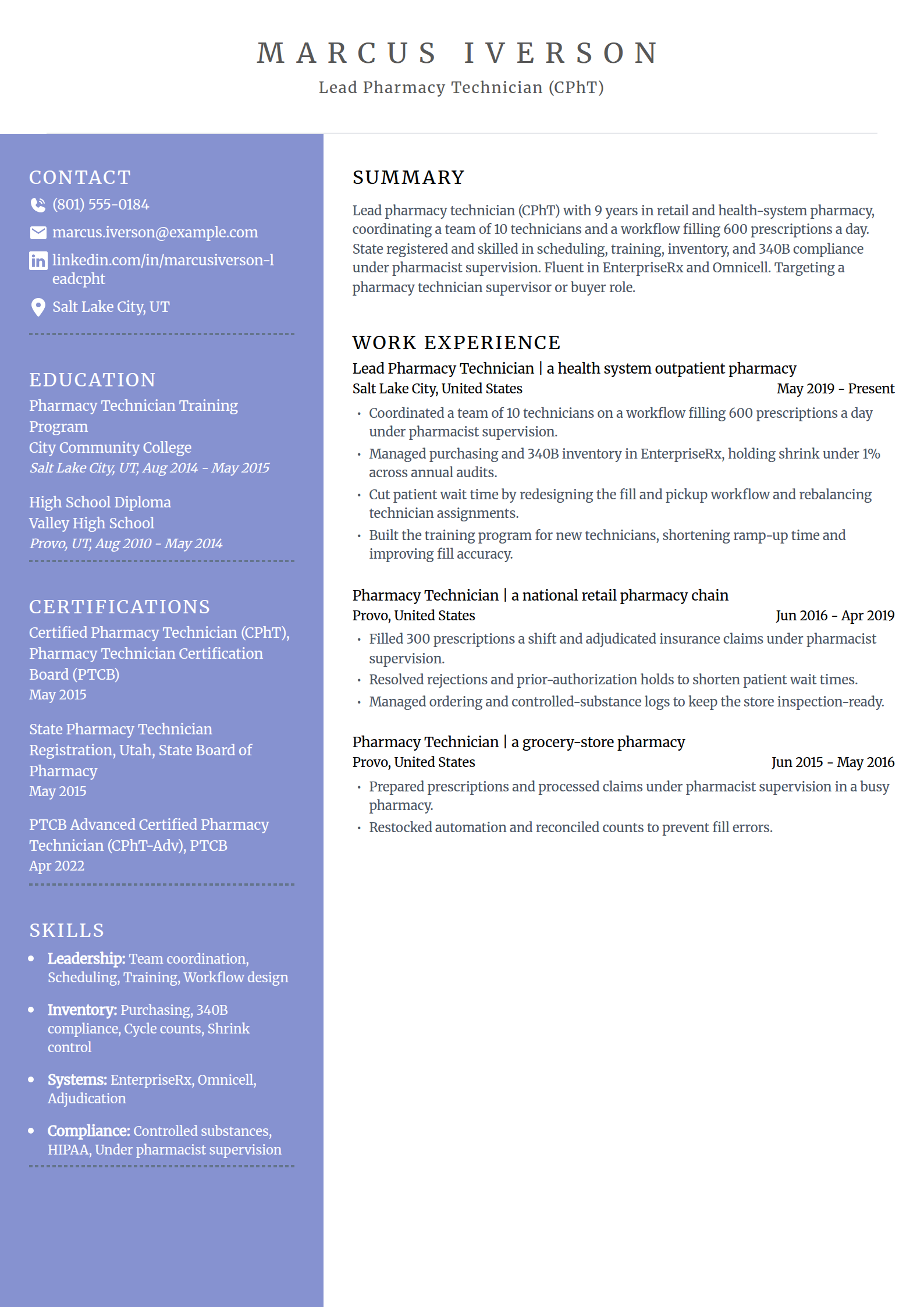
Lead & Senior Pharmacy Technician Resume Template
Why this resume example works?
- Leads with lead-tech scope, coordinating 10 technicians on a workflow filling 600 prescriptions a day.
- Shows the buyer work a supervisor role rewards, 340B inventory managed with shrink under 1%.
- Keeps leadership within a technician's scope, training and scheduling under pharmacist supervision.
- Names EnterpriseRx and Omnicell, the systems a health-system pharmacy screens for.
- Uses a roomy layout with a filled sidebar so a nine-year record still looks full.
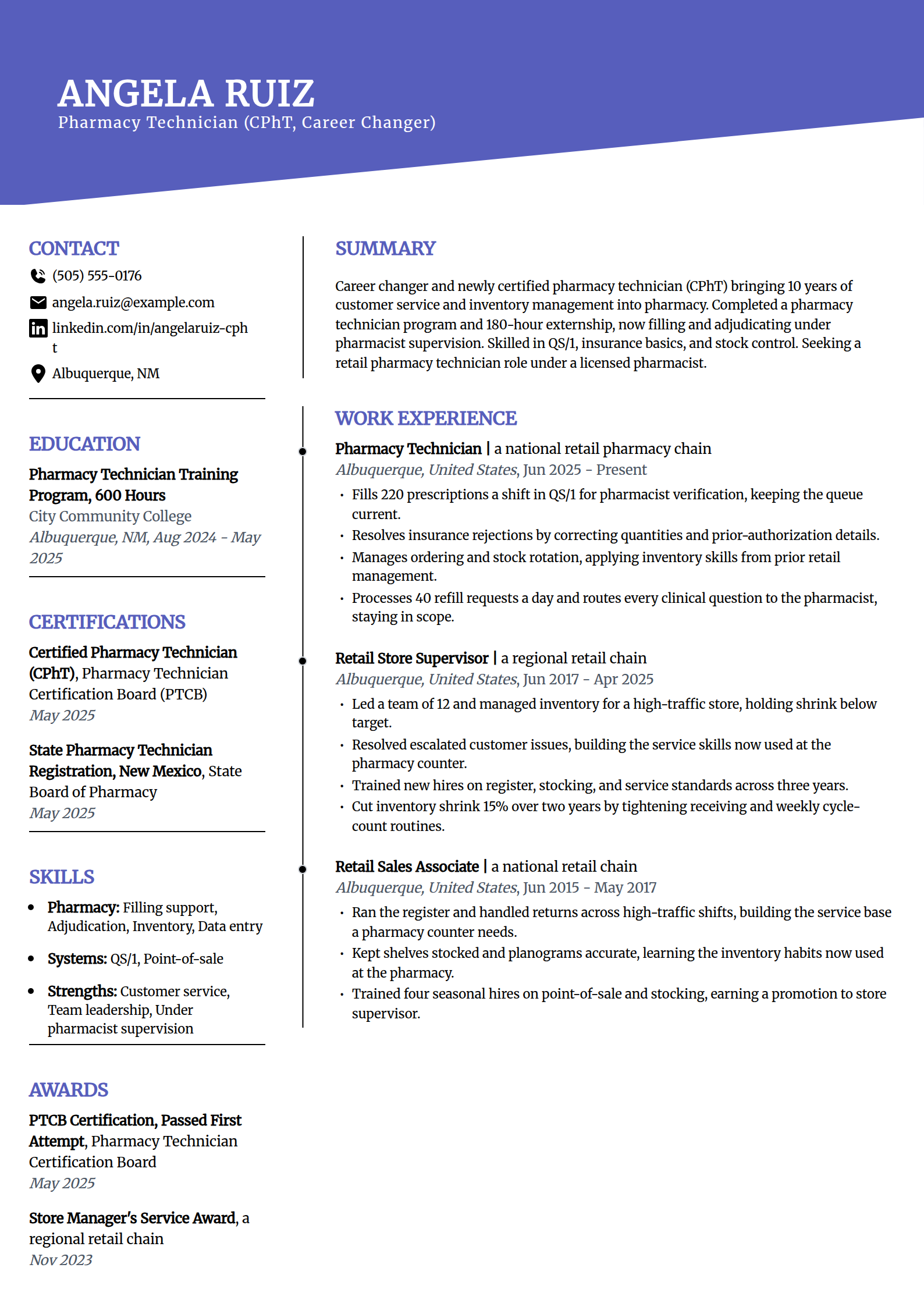
Career-Change Pharmacy Technician Resume Template
Why this resume example works?
- Names the pivot openly, reframing 10 years of retail service and management as pharmacy-ready inventory and people skills.
- Shows recent commitment, a completed pharmacy technician program and a first-attempt PTCB pass.
- Keeps the new role in scope, filling and adjudicating in QS/1 under pharmacist verification.
- Pulls one transferable strength forward, leading a team of 12 and holding shrink below target.
- Lists awards without long descriptions, keeping the layout clean and balanced.
Build your pharmacist or pharmacy technician resume
Pick a template above and the editor keeps your layout clean and ATS-safe while you swap in your own scripts, immunizations, certifications, and systems.
Build my resumeHow to write a pharmacist or pharmacy technician resume in 2026
A pharmacy resume is read fast by someone checking two things: are you credentialed for the role, and does every claim stay inside your scope. Lead with your license or certification, prove each job with one quantified result, and keep the format clean. The rules below apply to both the pharmacist and the technician; the difference is what you are allowed to claim.
Open with a short, credential-first summary
Write three to four sentences that name your years and setting, your license or certification, your strongest number, and the role you are targeting. Pharmacists lead with the PharmD and state license; technicians lead with the CPhT. Keep it to about 60 words so it never spills past the top of the page.
Licensed retail pharmacist (PharmD, RPh) with 6 years in high-volume community pharmacy, verifying 400 prescriptions a day. Passed the NAPLEX and MPJE, immunization certified, and skilled in MTM and patient counseling. Fluent in RXConnect and Rx30. Targeting a lead pharmacist role.
Lead experience with impact, and stay in your scope
Attach one credible number to each bullet, open with a strong verb, and never claim a task your role cannot legally do. This is the make-or-break rule for pharmacy resumes.
- Pharmacists own the final verification, clinical decisions, counseling, MTM, and immunizations: say "verified 400 prescriptions a day as the final check".
- Technicians work under pharmacist supervision: say "filled and adjudicated 300 prescriptions a shift for pharmacist verification", never "approved" or "adjusted therapy".
- Use setting-accurate numbers: scripts per day, immunizations given, wait-time cuts, error-rate reductions, adherence gains, or inventory savings.
- Name the method or system, like resolving 40 insurance rejections a day in RXConnect or preparing IV admixtures under USP 797.
Show your education, licensure, and certifications
Pharmacy screens hard on credentials, so make them impossible to miss at the top of the resume.
- Pharmacists: list the PharmD, active state license (RPh), whether the NAPLEX and MPJE are passed, and any board certs (BCPS, BCACP, BCGP) or residency (PGY1, PGY2).
- Technicians: list the PTCB CPhT (or ExCPT), state registration or license, and any sterile-compounding (USP 797) or IV certification.
- New grads and trainees use APPE and IPPE rotations, internship or externship hours, and pharmacy school in place of years of paid work.
- State exam timing precisely: "scheduled to sit for the NAPLEX" or "scheduled to sit for the PTCB exam", never a credential you do not yet hold.
Match skills to the systems and keywords a pharmacy screens for
A pharmacy skills list should read like the job posting. Group it so a hiring manager and a parser both find what they need.
- Systems: name them, EHR (Epic Willow, Cerner), pharmacy systems (Rx30, QS/1, PioneerRx, EnterpriseRx, RXConnect), and automation (Pyxis, Omnicell, ScriptPro).
- Pharmacist skills: verification, MTM, immunizations, patient counseling, pharmacokinetic dosing, antimicrobial stewardship, and anticoagulation.
- Technician skills: prescription filling, insurance adjudication, prior-authorization support, inventory and ordering, and sterile or non-sterile compounding.
- Compliance for both: HIPAA, controlled-substance recordkeeping, USP standards, and state pharmacy law.
Keep the format clean and ATS-safe
Pharmacy is a conservative-format field, and every employer runs an applicant tracking system, so a clean layout with standard headings is the safe choice.
- Use a single-column or simple two-column layout with standard headings a parser recognizes; skip heavy graphics and photos.
- Pharmacists run one to two pages; technicians keep it to one page. Cut older, unrelated roles to make room for pharmacy work.
- Save as a PDF so the formatting holds, then run it through the ATS resume checker for a quick format pass.
- Swap the numbers in the templates above for your own scripts, immunizations, and systems; do not copy them as is.
Common pharmacist and pharmacy technician resume mistakes
- Claiming a task outside your scope. A technician who writes "verified prescriptions" or "adjusted therapy" looks like they do not understand the role. Techs prepare, dispense, and adjudicate under pharmacist supervision.
- Burying your license or certification. A pharmacist's state license and a technician's CPhT are the first things a hiring manager checks, so put them at the top, not in a footer.
- Writing duty lists with no number. Replace "filled prescriptions" with "filled 300 prescriptions a shift and resolved 40 insurance rejections a day".
- Overstating a credential you do not hold yet. Write "scheduled to sit for the NAPLEX" or "PTCB exam scheduled", never a license or certification you have not earned.
- Leaving off the systems. Name Epic Willow, Rx30, PioneerRx, Pyxis, or ScriptPro; a pharmacy posting screens for the exact software you have run.
Frequently asked questions
How do you write a pharmacist resume?
Lead with a three-to-four-sentence summary that names your PharmD, active state license, strongest number, and target role. Under each job, write results-first bullets that open with a strong verb and carry one credible number, like verifying 400 prescriptions a day as the final check or administering 1,200 immunizations in a flu season. Put your license, whether the NAPLEX and MPJE are passed, and any board certifications where a recruiter reads them first. Keep the resume to one or two clean pages.
What is the difference between a pharmacist and a pharmacy technician resume?
The difference is credentials and scope. A pharmacist resume leads with the PharmD and state license (RPh) and claims pharmacist-only work: the final verification, clinical and therapy decisions, counseling, MTM, and immunizations. A pharmacy technician resume leads with the CPhT and state registration and claims technician work done under pharmacist supervision: filling and dispensing, insurance adjudication, inventory, and compounding under supervision. A technician resume that claims final verification or therapy changes reads as a scope error a hiring manager will catch.
How do you write a pharmacy technician resume with no experience?
Lead with your certification or training and the hours you do have. A new technician leads with the CPhT (or the PTCB exam scheduled), a completed training program, and externship hours, then shows real tasks done under pharmacist supervision. Reliability, accuracy, and customer service carry more weight than invented pharmacy years, which a hiring manager will see through. Fill the page honestly with the externship, prior service work, and awards. The entry-level and career-change technician examples above show the shape.
What certifications should go on a pharmacist or pharmacy technician resume?
Pharmacists list the PharmD, active state license (RPh), whether the NAPLEX and MPJE are passed, immunization certification, and any board certifications such as BCPS, BCACP, or BCGP, plus residency (PGY1, PGY2) where completed. Pharmacy technicians list the PTCB CPhT (or the ExCPT), state registration or license, and any sterile-compounding (USP 797) or IV certification. Put the credential that qualifies you for the role at the very top, and state exam timing precisely when a credential is still scheduled.
Should a pharmacist resume be one page or two?
A pharmacist resume runs one to two pages, and a pharmacy technician resume stays on one page. Use the second page only when a pharmacist has enough relevant clinical, residency, or management experience to justify it; a new graduate or a technician should fit one clean page. Whichever length you use, lead with your most recent role, keep standard headings, and cut older, unrelated jobs so the space goes to pharmacy work and credentials.
What skills and keywords do pharmacy resumes need?
Match the posting, then name the systems outright: EHR platforms (Epic Willow, Cerner), pharmacy systems (Rx30, QS/1, PioneerRx, EnterpriseRx, RXConnect), and automation (Pyxis, Omnicell, ScriptPro). Pharmacists add verification, MTM, immunizations, counseling, pharmacokinetic dosing, and stewardship. Technicians add prescription filling, insurance adjudication, prior-authorization support, inventory, and compounding. Both add compliance keywords like HIPAA, controlled-substance recordkeeping, USP standards, and state pharmacy law. List the specific software you have actually used rather than a generic set.
More pharmacist resume resources
Build your pharmacist or pharmacy technician resume
Pick a template above and the editor keeps your layout clean and ATS-safe while you swap in your own scripts, immunizations, certifications, and systems.