Physical Therapist Resume Templates and Examples, Every Setting
- ATS Friendly
- DPT, PTA, OT & LMT
- 16 Real Examples
Outpatient ortho, acute care, neuro, SNF, home health, pediatrics, sports, or travel, this page has a resume built for your exact setting and license. Start from a layout below, then model your own on a real example, from a new-grad DPT to a board-certified specialist or a PTA. Your DPT, license, board certs, and caseload sit where a recruiter looks first.


540k+ resumes created
Physical therapist resume templates for every setting and license
Each template below is a real physical therapy resume laid out in that format, sorted by setting and license across outpatient orthopedics, acute care, neuro rehab, skilled nursing, home health, pediatrics, sports, travel, and the PTA, OT, and massage roles that hire alongside PTs. Pick one, then swap in your own DPT, license, board certifications, and caseload. Every layout keeps your credentials and functional outcomes readable so a recruiter sees your specialty at a glance and an applicant tracking system parses it cleanly.
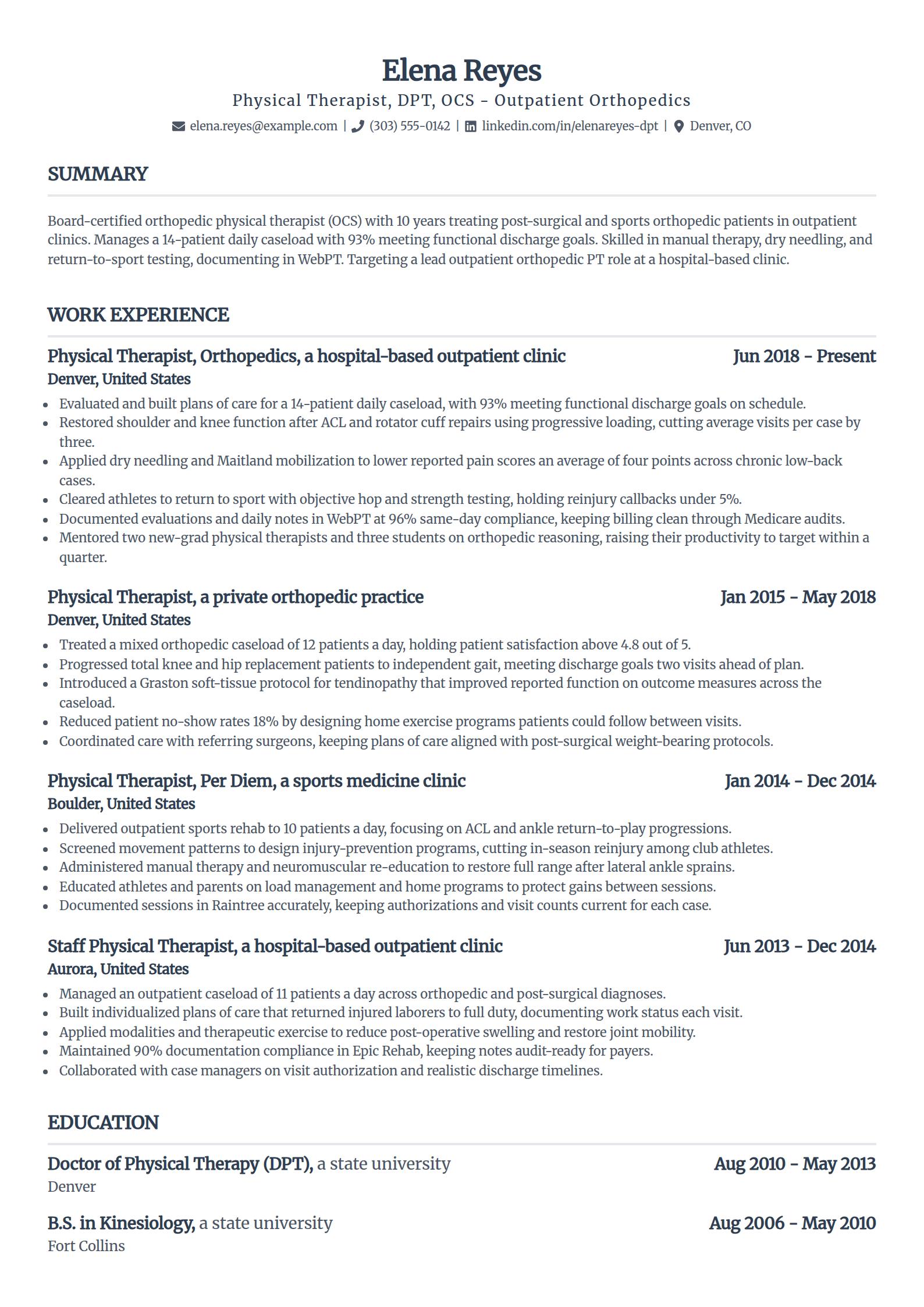
Outpatient Orthopedic PT Resume Template
Why this resume example works?
- Opens with the board certification a recruiter screens for, OCS, plus 10 years and a 14-patient daily caseload.
- Ties results to method, functional discharge goals met by 93% of patients and average visits per case cut by three.
- Names the manual therapy an ortho posting expects: dry needling, Maitland mobilization, and Graston.
- Shows the credentials up top, DPT, state PT license, and OCS, with documentation in WebPT and Epic Rehab.
- Uses a clean, single-column layout an applicant tracking system reads without trouble.
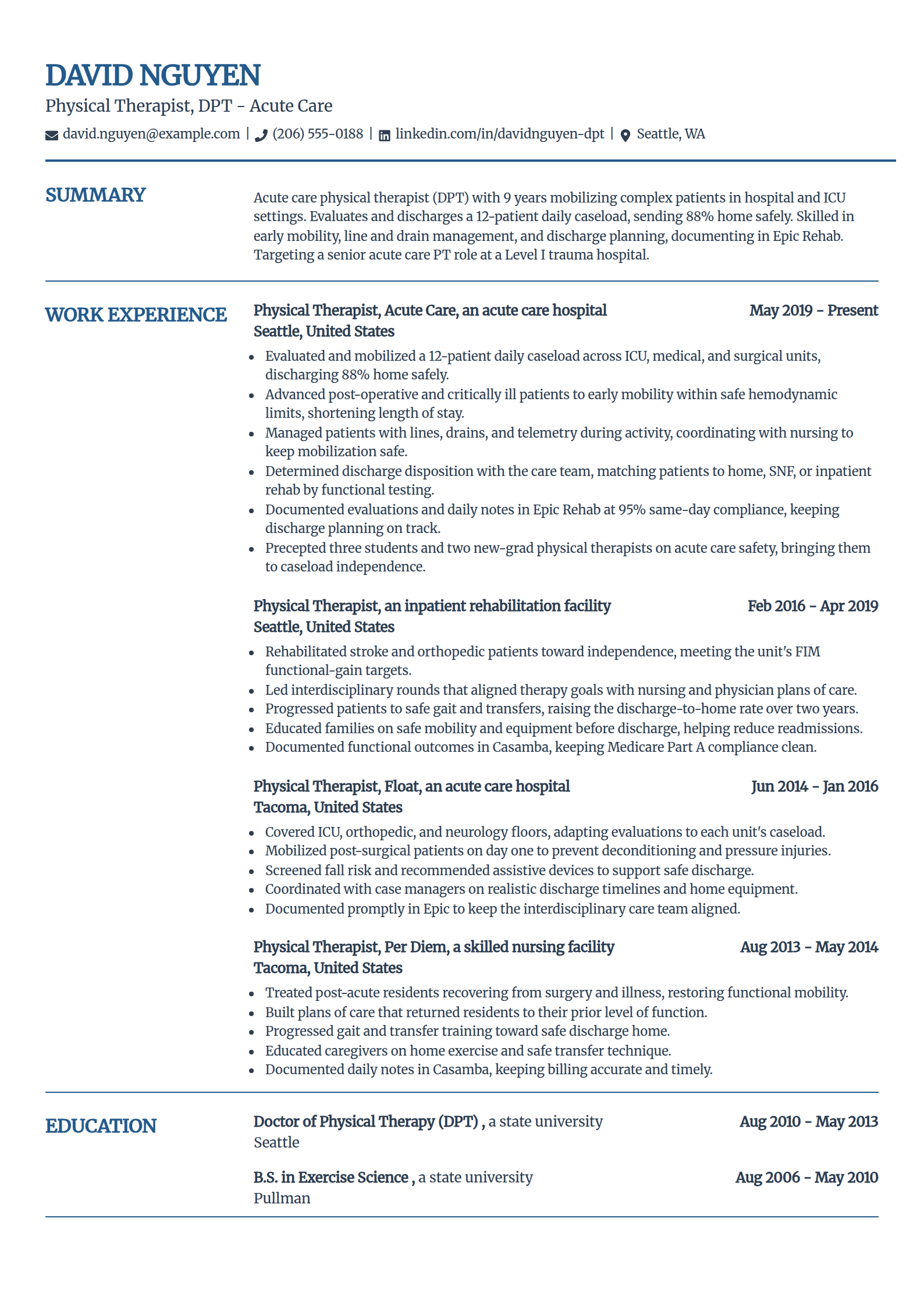
Acute Care PT Resume Template
Why this resume example works?
- Leads with the setting a hospital hires for, 9 years mobilizing ICU and surgical patients with 88% discharged home safely.
- Shows the acute skills that matter, early mobility within hemodynamic limits and line, drain, and telemetry management.
- Ties evaluation to disposition, matching patients to home, SNF, or inpatient rehab by functional testing.
- Names the ACLS credential and Epic Rehab documentation an acute care unit screens for.
- Uses a modern layout that carries a dense hospital history on one clean page.
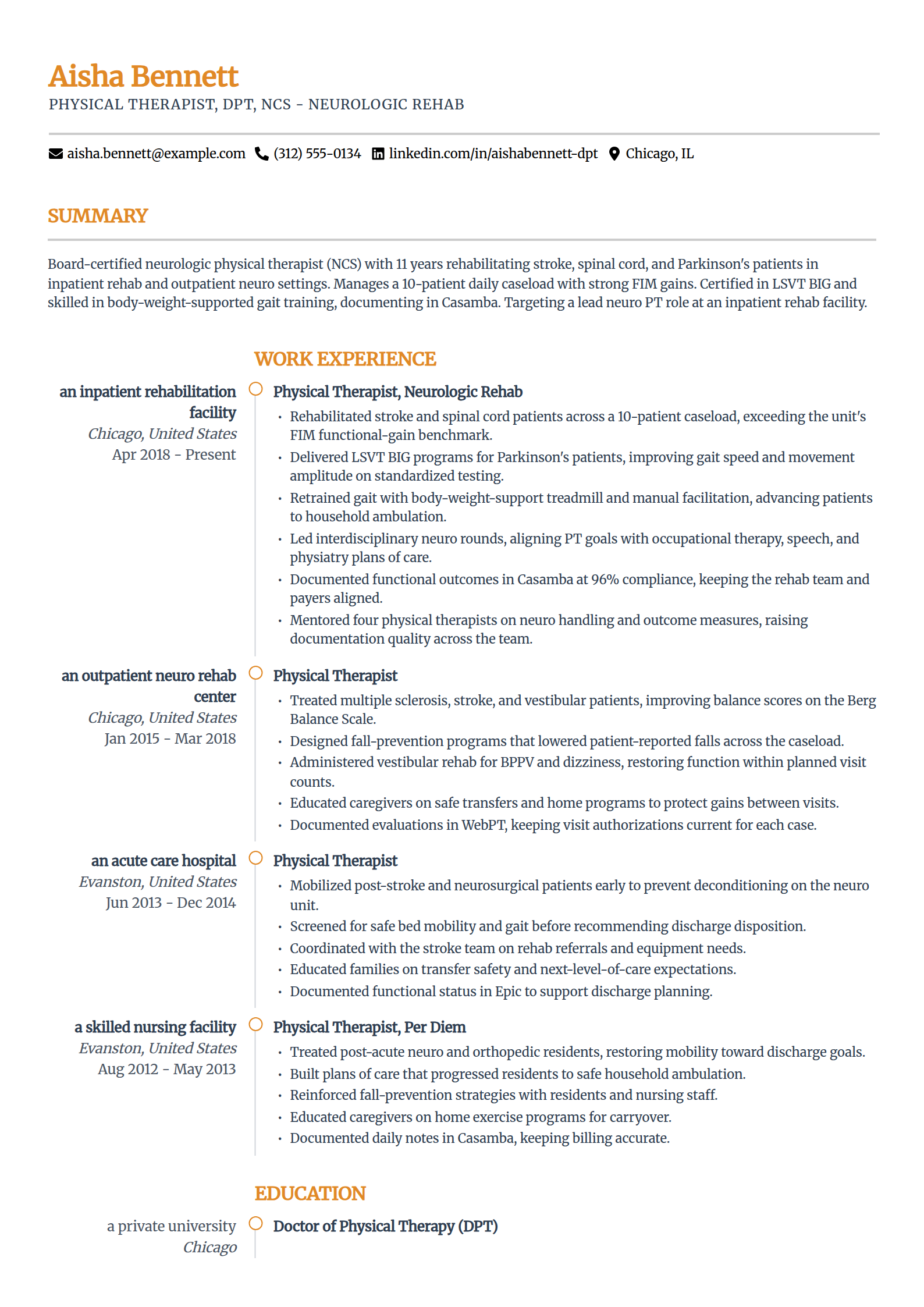
Neuro Rehab PT Resume Template
Why this resume example works?
- Opens with the NCS board certification and 11 years across stroke, spinal cord, and Parkinson's rehab.
- Shows specialty interventions, LSVT BIG for Parkinson's and body-weight-support gait training with measured gains.
- Ties outcomes to real measures, FIM benchmarks exceeded and Berg Balance Scale scores improved.
- Names vestibular rehab and Casamba documentation a neuro rehab facility expects.
- Uses a modern layout that still reads cleanly for a recruiter scanning fast.
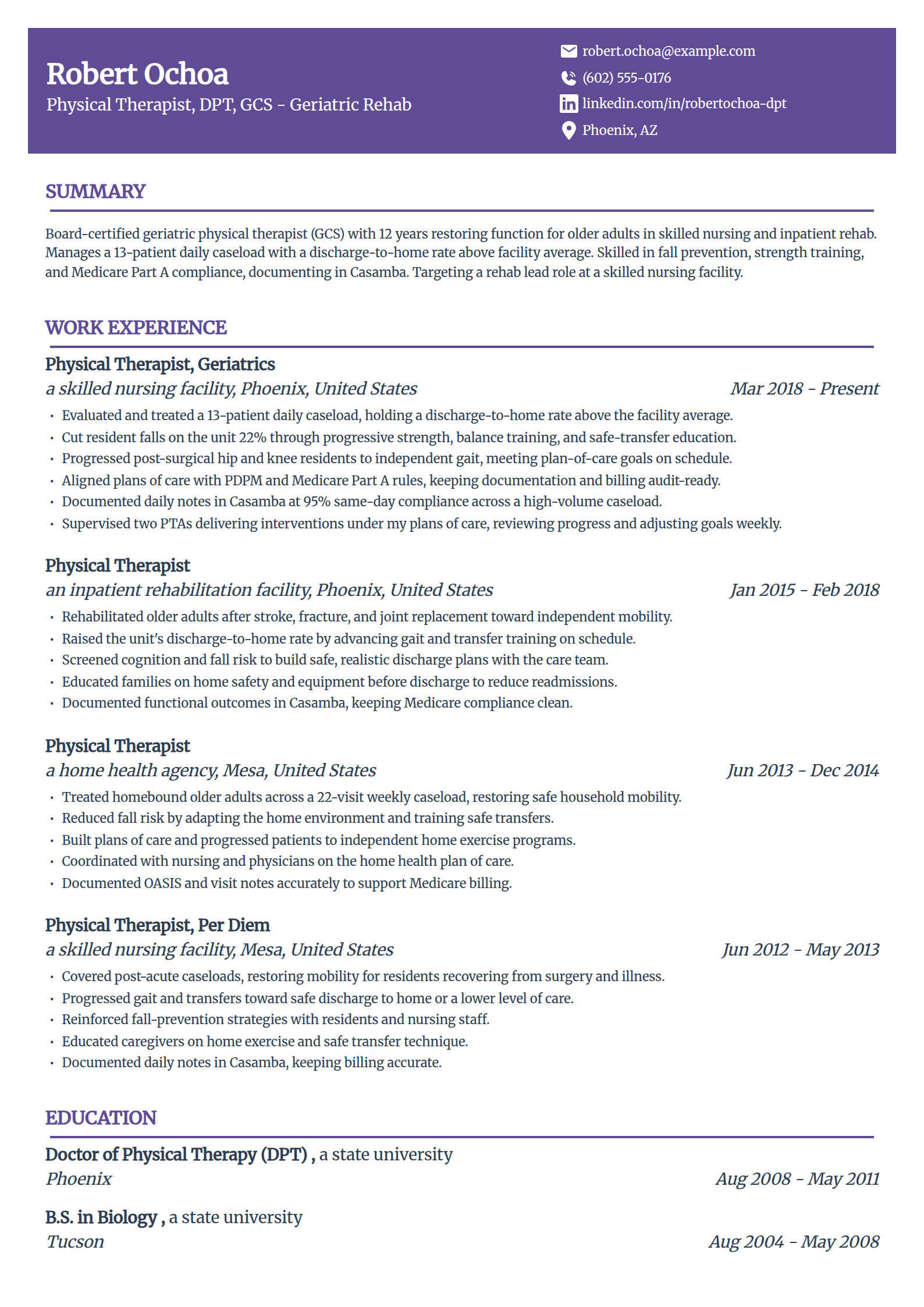
SNF & Geriatric PT Resume Template
Why this resume example works?
- Leads with the GCS board certification and a discharge-to-home rate above the facility average.
- Shows the work an SNF rewards, resident falls cut 22% through strength, balance, and safe-transfer training.
- Names the compliance a facility screens for, Medicare Part A and PDPM, with documentation in Casamba.
- Reflects real supervision, two PTAs delivering interventions under this PT's plans of care.
- Uses a spacious layout that carries a 12-year post-acute record on one page.
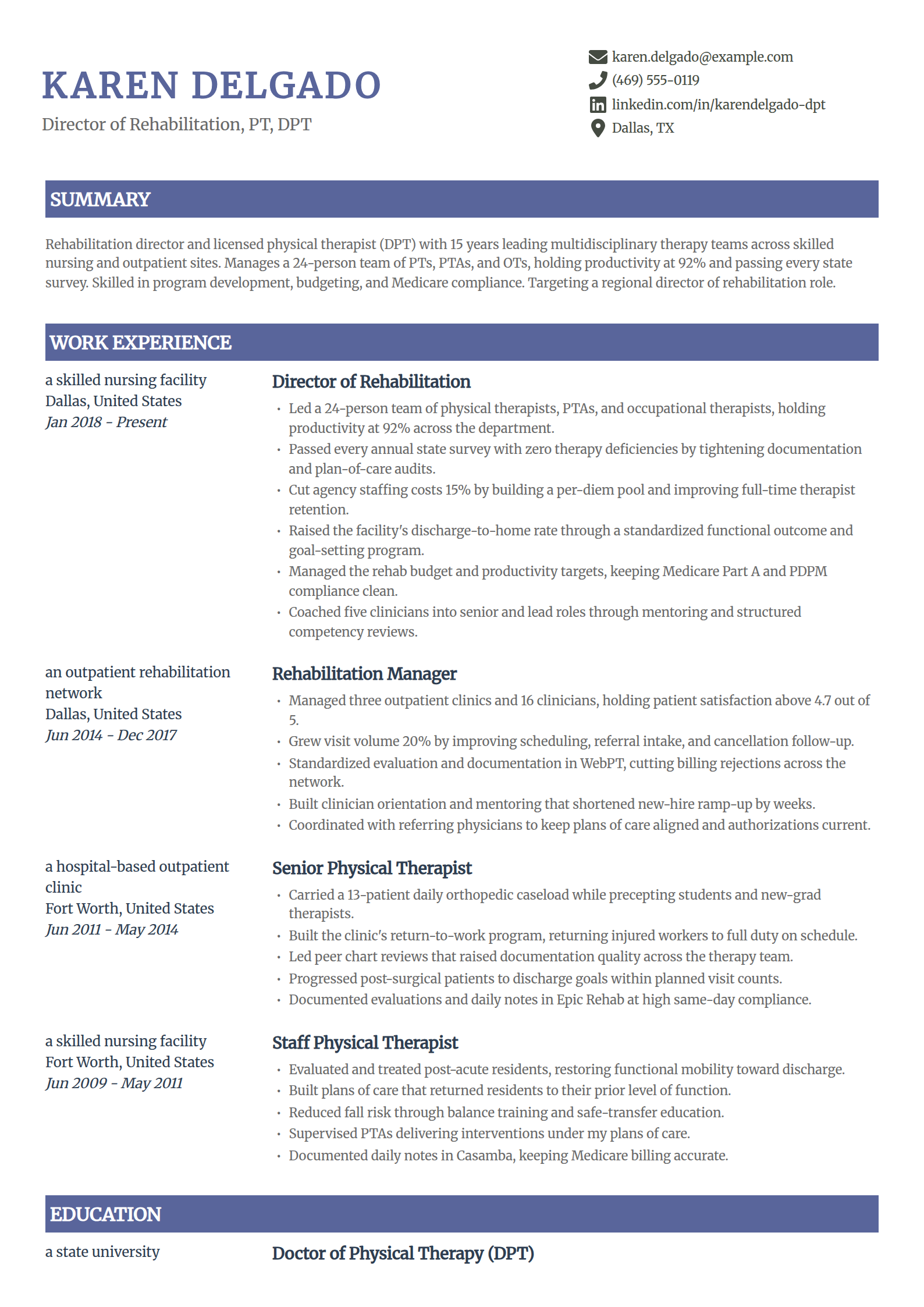
Rehab Director Resume Template
Why this resume example works?
- Leads with leadership scope, a 24-person team of PTs, PTAs, and OTs held at 92% productivity.
- Shows the results a director owns, every state survey passed with zero therapy deficiencies.
- Pairs clinical roots with operations, agency staffing costs cut 15% and discharge-to-home rate raised.
- Keeps every number tied to a program, budget, survey, or retention outcome, not a vague claim.
- Uses a modern layout that carries a 15-year leadership record on one page.
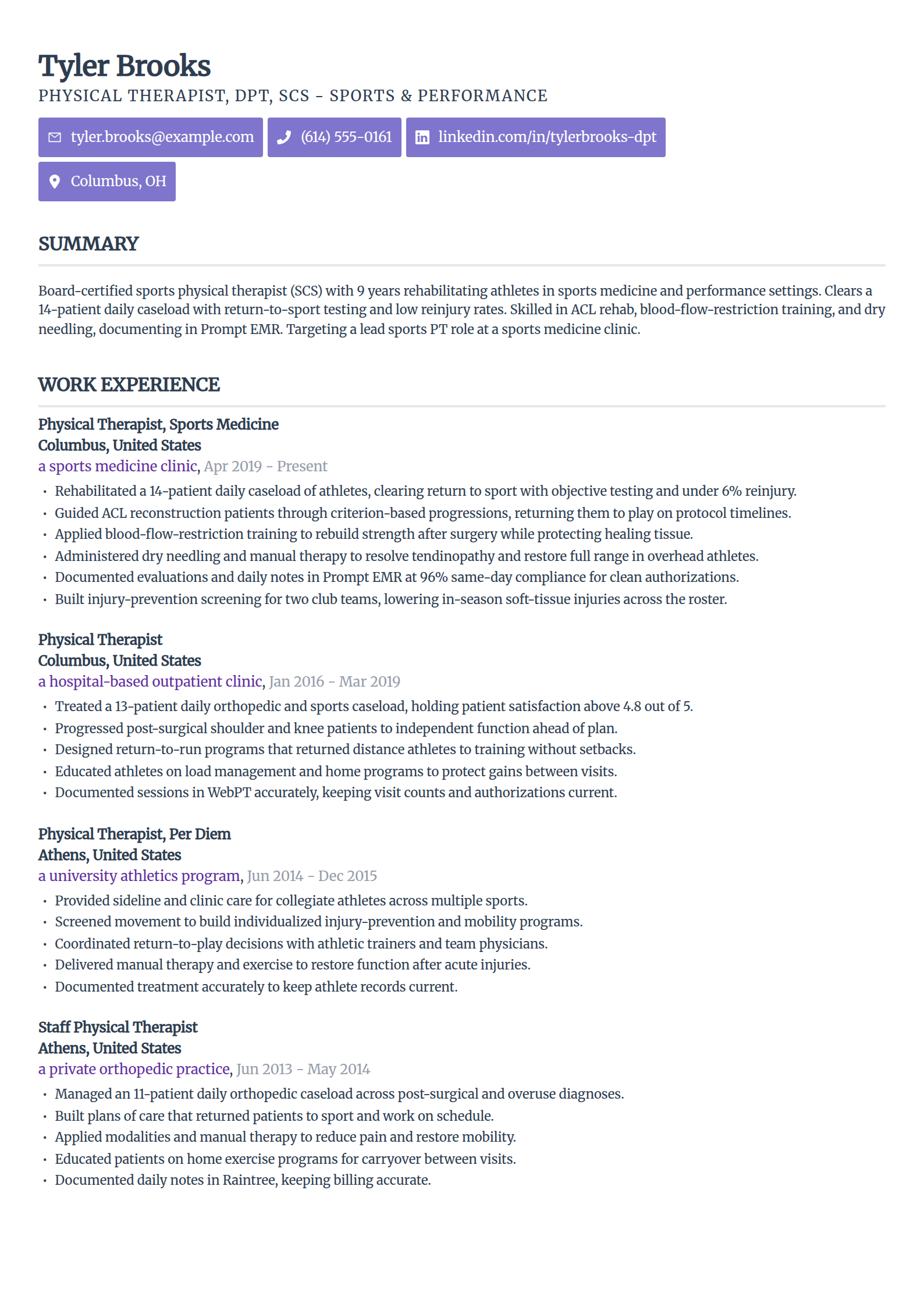
Sports PT Resume Template
Why this resume example works?
- Opens with the SCS board certification and return-to-sport testing with reinjury held under 6%.
- Shows the performance work a sports role hires for, ACL progressions and blood-flow-restriction training.
- Names dry needling and Prompt EMR documentation a sports medicine clinic expects.
- Ties results to a task, in-season soft-tissue injuries lowered through movement screening.
- Uses a clean, modern layout that carries a deep sports history on one page.
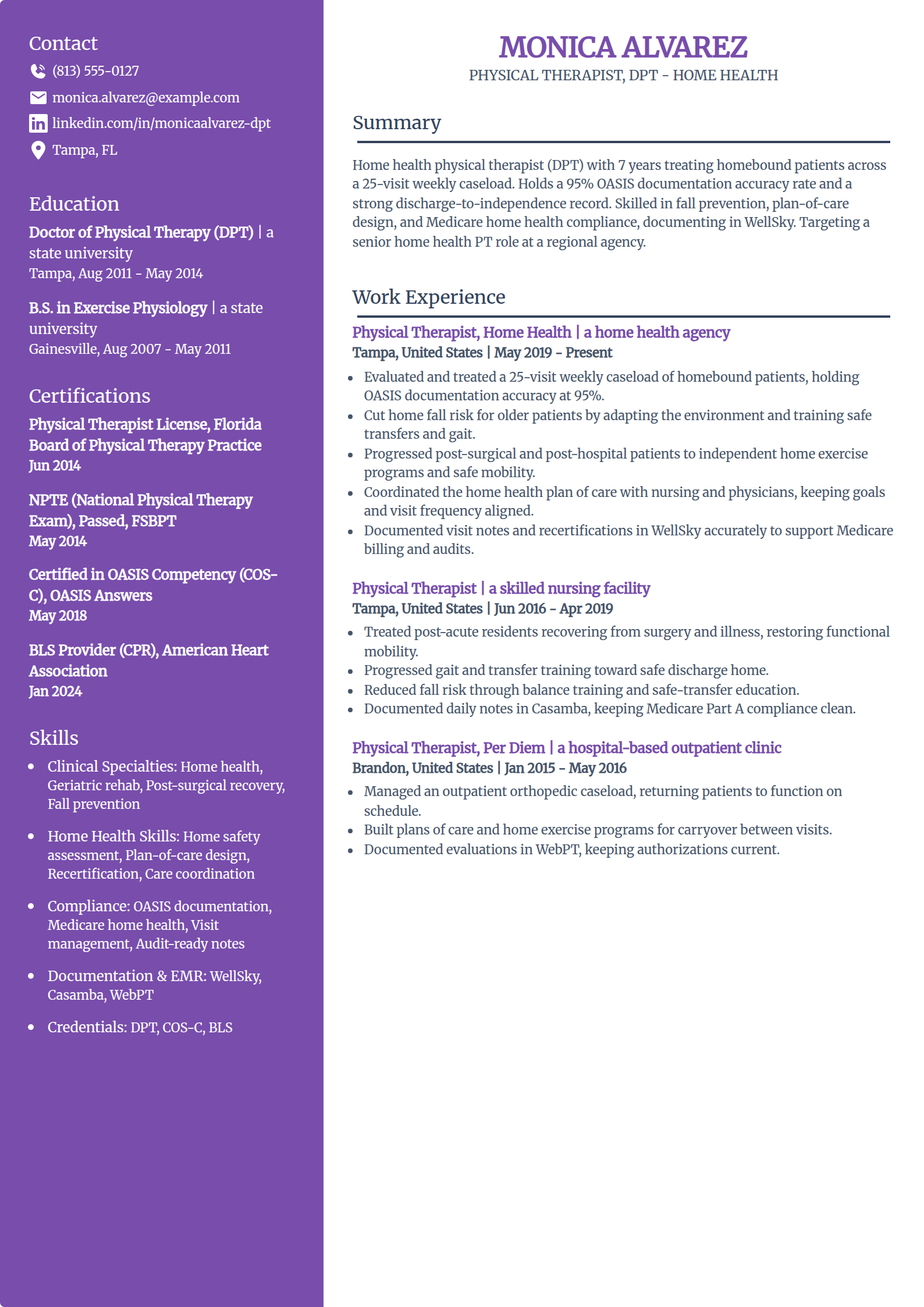
Home Health PT Resume Template
Why this resume example works?
- Leads with the detail home health rewards, a 25-visit weekly caseload with 95% OASIS documentation accuracy.
- Shows the work that matters here, home fall risk cut by adapting the environment and training safe transfers.
- Names the compliance a home health agency screens for, OASIS, Medicare home health, and WellSky.
- Keeps results tied to method, patients progressed to independent home exercise programs.
- Uses a Medium layout that fits a seven-year home health record without empty space.
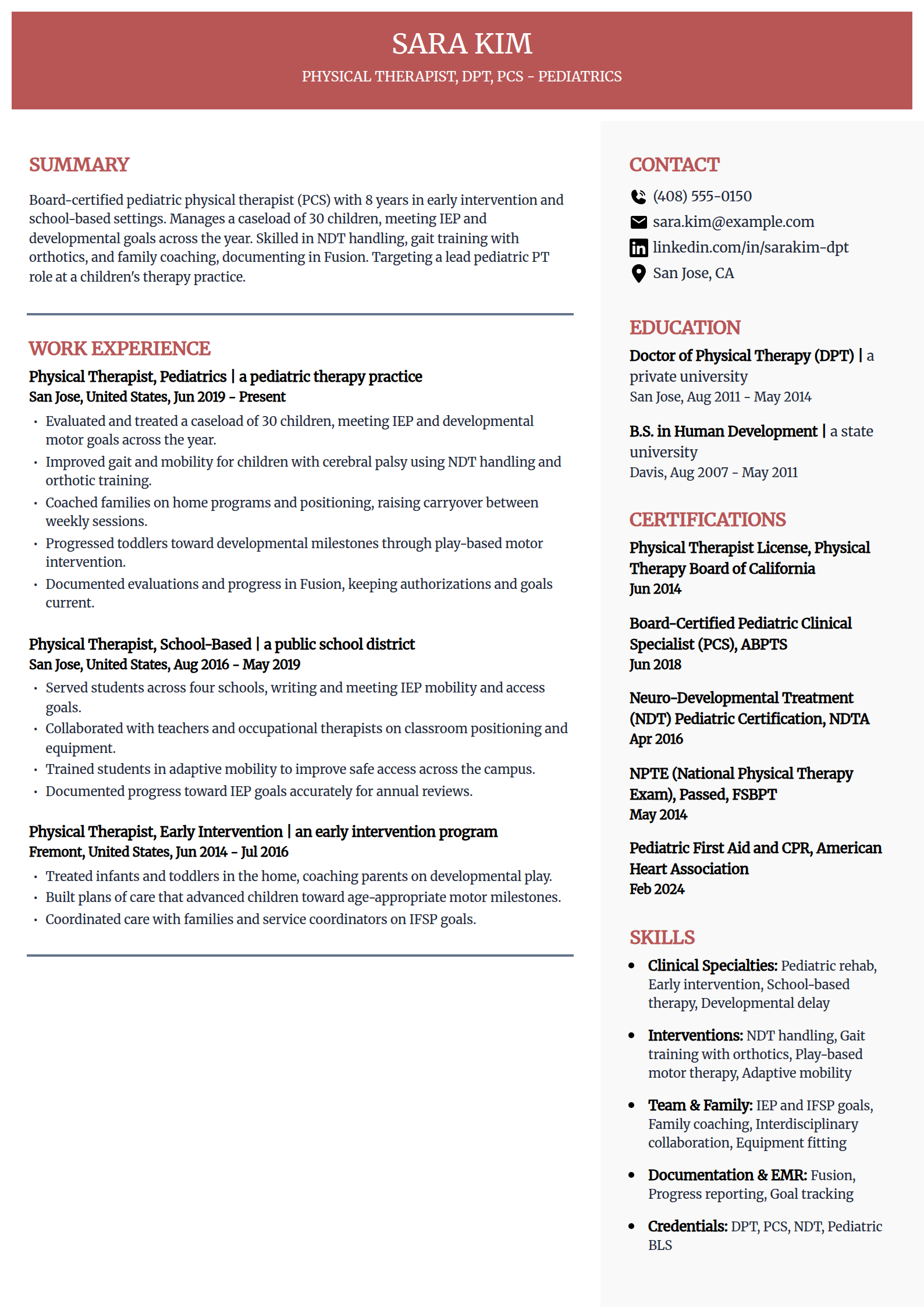
Pediatric PT Resume Template
Why this resume example works?
- Opens with the PCS board certification and a caseload of 30 children meeting IEP and developmental goals.
- Shows pediatric interventions, NDT handling and gait training with orthotics for cerebral palsy.
- Names the school-based and early intervention settings, with IEP and IFSP goals and family coaching.
- Reflects real teamwork, collaboration with teachers, OTs, and service coordinators.
- Uses a refined layout that fits an eight-year pediatric record cleanly on one page.
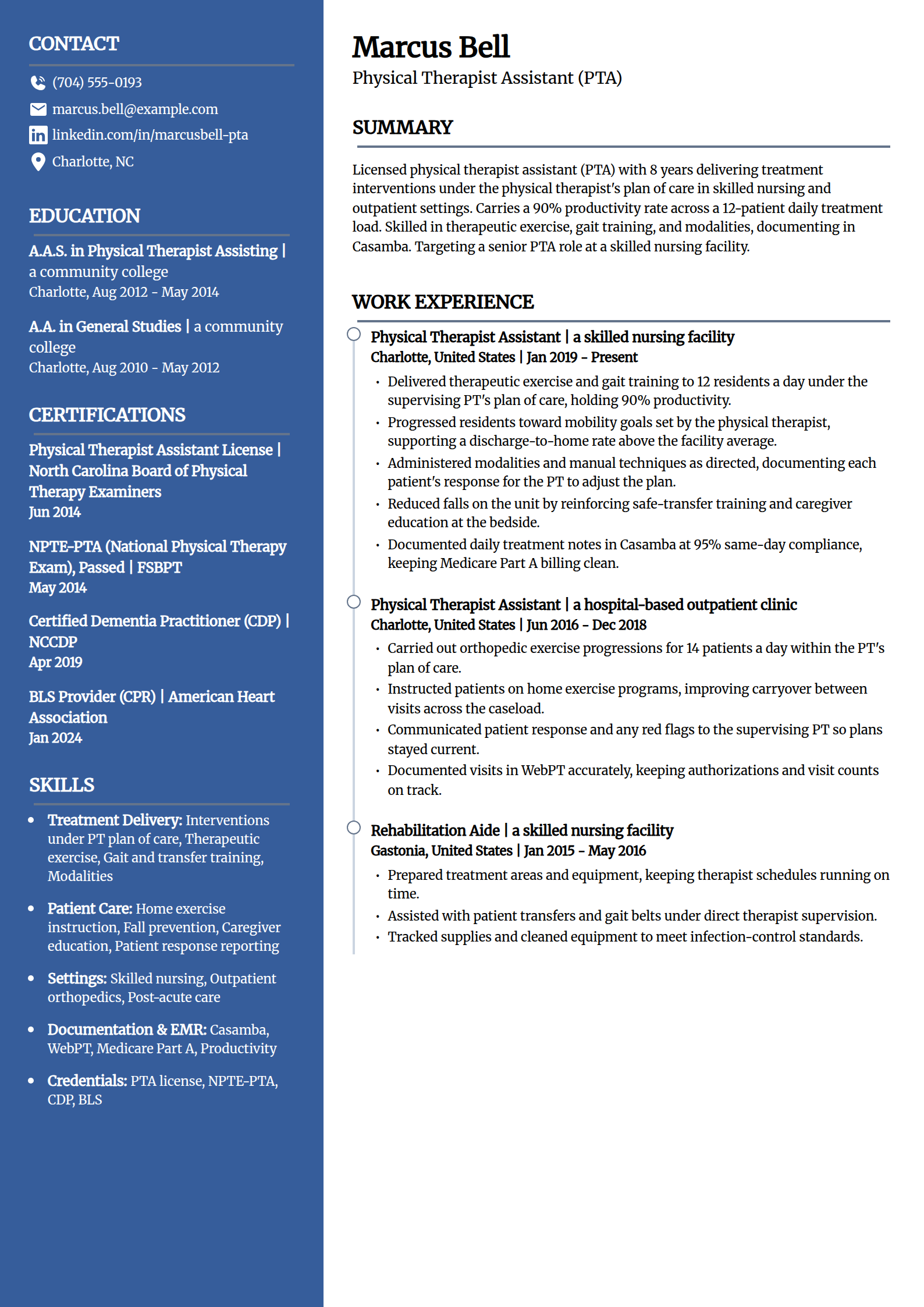
Physical Therapist Assistant (PTA) Resume Template
Why this resume example works?
- Written to PTA scope, delivering interventions under the supervising PT's plan of care, never evaluating or setting it.
- Leads with the PTA license and treatment volume, a 12-patient daily load held at 90% productivity.
- Shows the work a PTA owns, therapeutic exercise, gait training, and modalities documented in Casamba.
- Reflects the supervision line honestly, patient response reported to the PT to adjust the plan.
- Uses a distinctive layout that still reads cleanly for a recruiter.
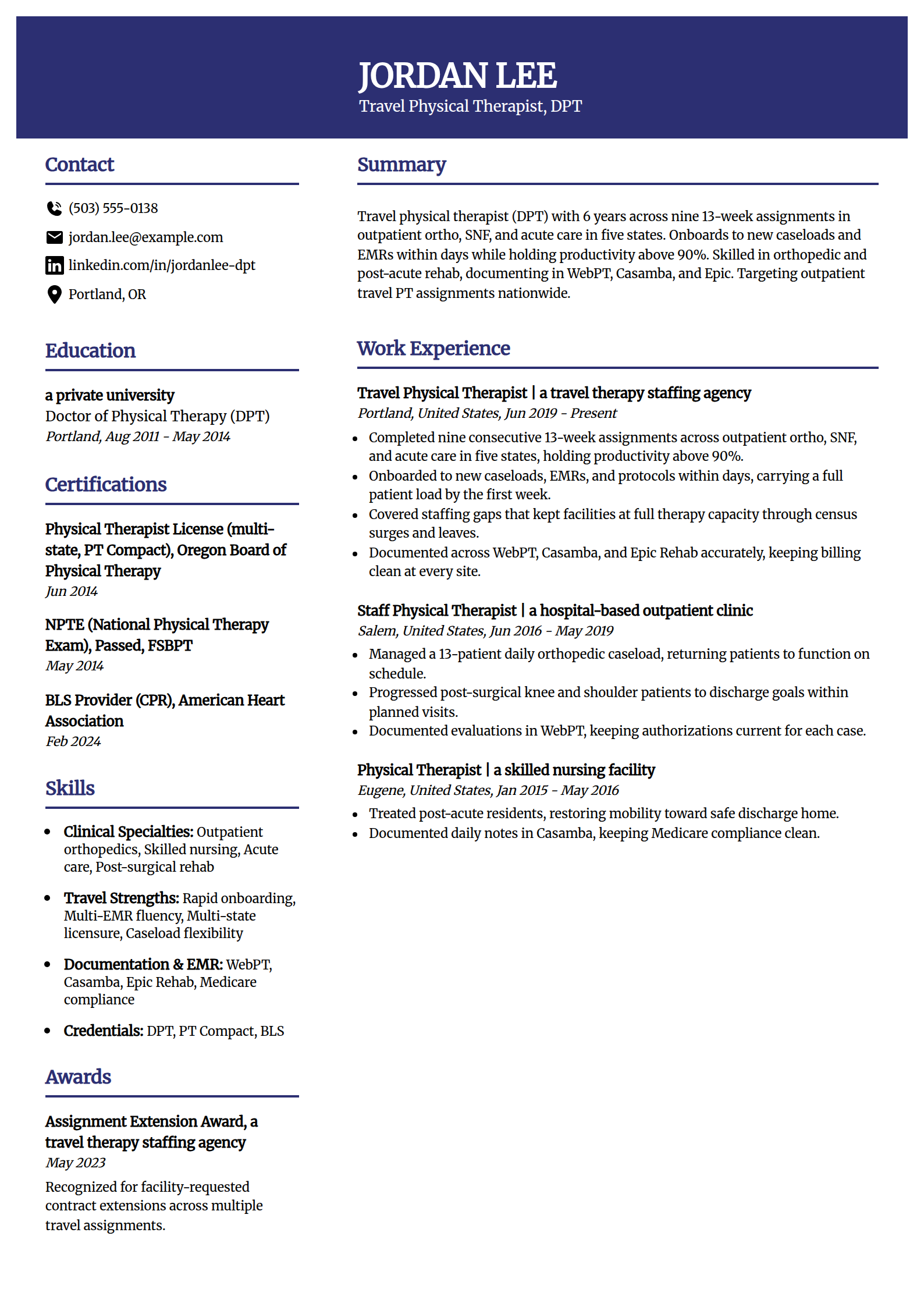
Travel PT Resume Template
Why this resume example works?
- Leads with the strength a travel role rewards, nine 13-week assignments across five states at 90%-plus productivity.
- Shows the adaptability that matters, onboarding to new caseloads and EMRs within days.
- Names multi-EMR fluency, WebPT, Casamba, and Epic, plus multi-state licensure through the PT Compact.
- Keeps results tied to coverage, staffing gaps filled to keep facilities at full therapy capacity.
- Uses a roomy layout with an assignment-extension award so a six-year record looks full.
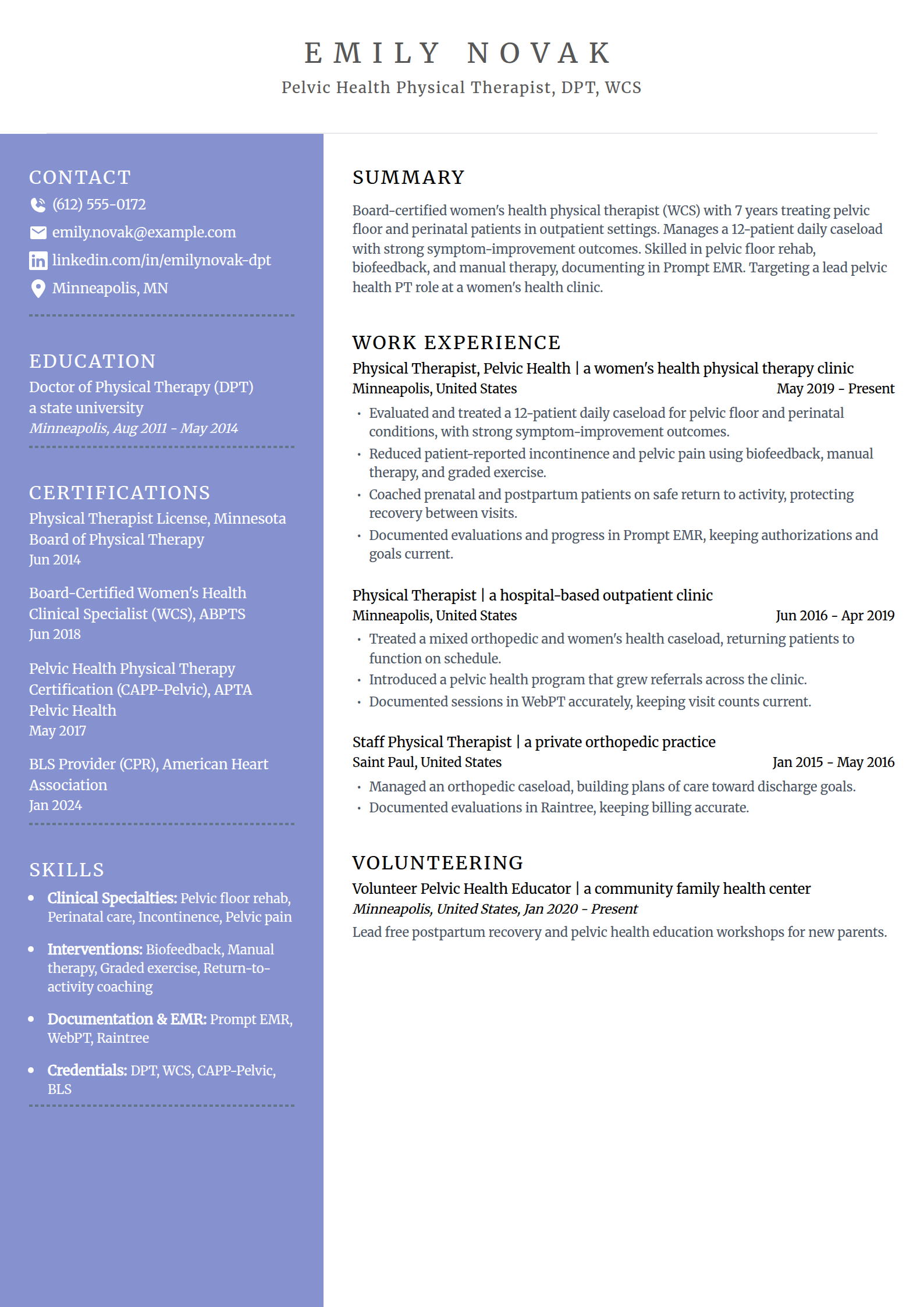
Pelvic Health PT Resume Template
Why this resume example works?
- Opens with the WCS board certification and 7 years treating pelvic floor and perinatal patients.
- Shows the specialty interventions, biofeedback, manual therapy, and graded exercise for pelvic pain.
- Ties results to the role, patient-reported incontinence and pelvic pain reduced across the caseload.
- Names Prompt EMR documentation and the CAPP-Pelvic credential a women's health clinic expects.
- Uses a roomy layout with a community education volunteer role so a seven-year record looks complete.
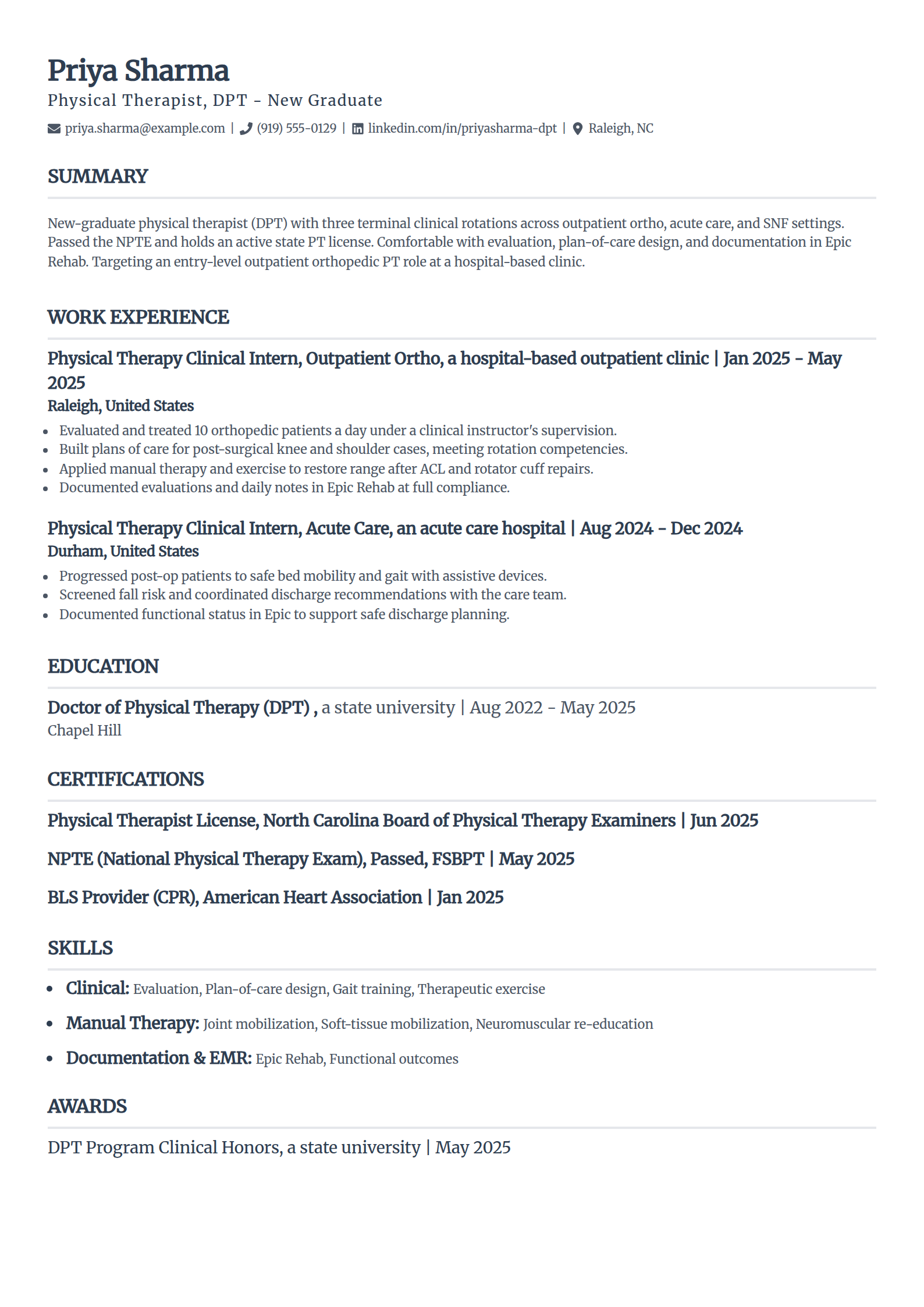
New-Grad DPT Resume Template
Why this resume example works?
- Written for a new graduate, leading with three terminal clinical rotations used as real experience entries.
- Shows the credentials that clear the first screen, DPT, passed NPTE, and an active state PT license.
- Keeps each bullet honest to a student's supervised scope, evaluation and treatment under a clinical instructor.
- Names Epic Rehab documentation and the manual therapy an outpatient posting expects.
- Fills a tight, ATS-safe page with clinical honors and a pro bono volunteer role instead of padding.
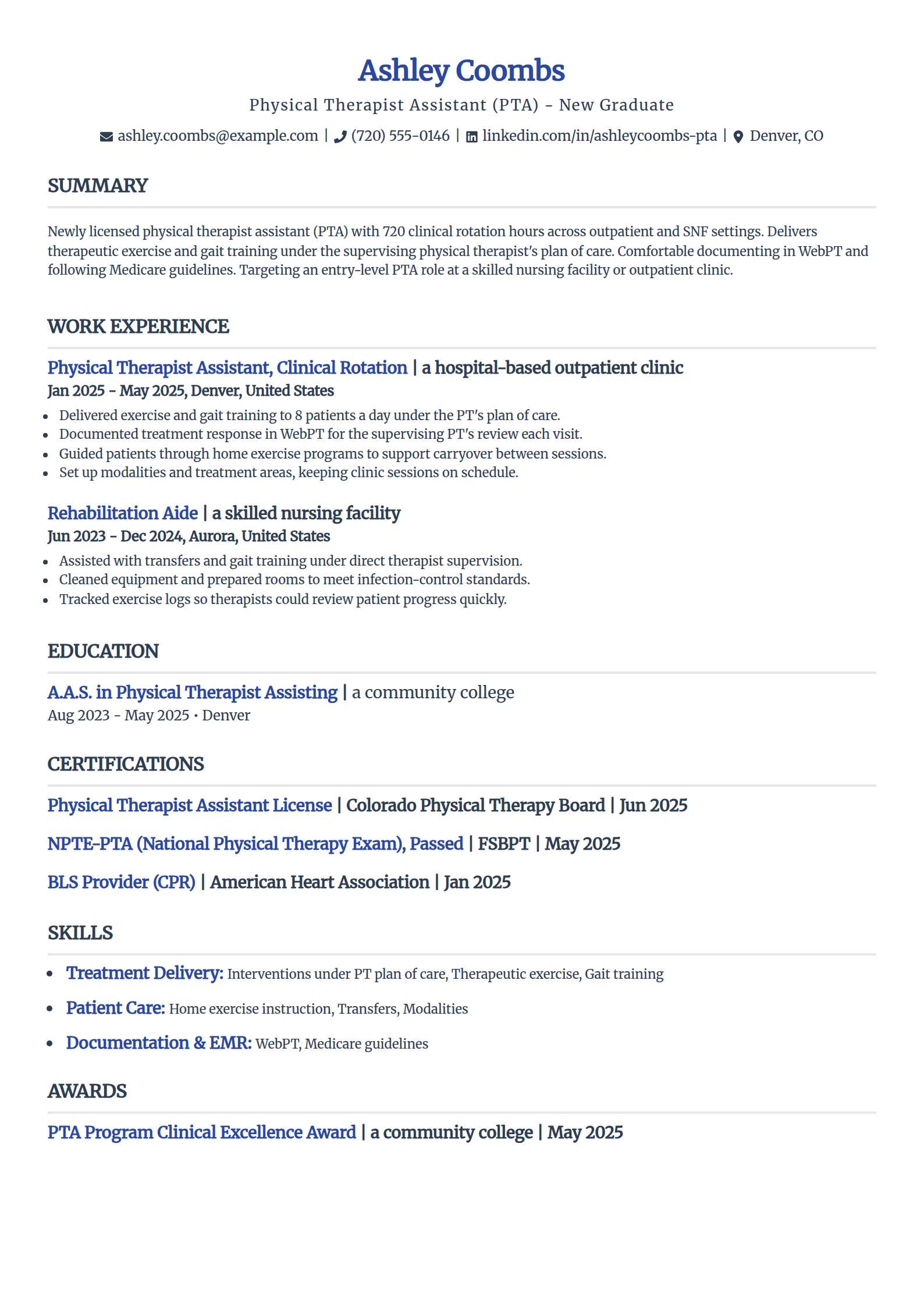
Entry-Level PTA Resume Template
Why this resume example works?
- Written for a new PTA grad, leading with 720 clinical rotation hours across outpatient and SNF settings.
- Keeps scope correct, delivering exercise and gait training under the supervising PT's plan of care.
- Shows the credentials a posting checks, PTA license, passed NPTE-PTA, and WebPT documentation.
- Uses a rehab aide role and rotation as entries, the right move when paid PTA experience does not exist yet.
- Fills a tight, ATS-safe page with a clinical excellence award and an adaptive-sports volunteer role.
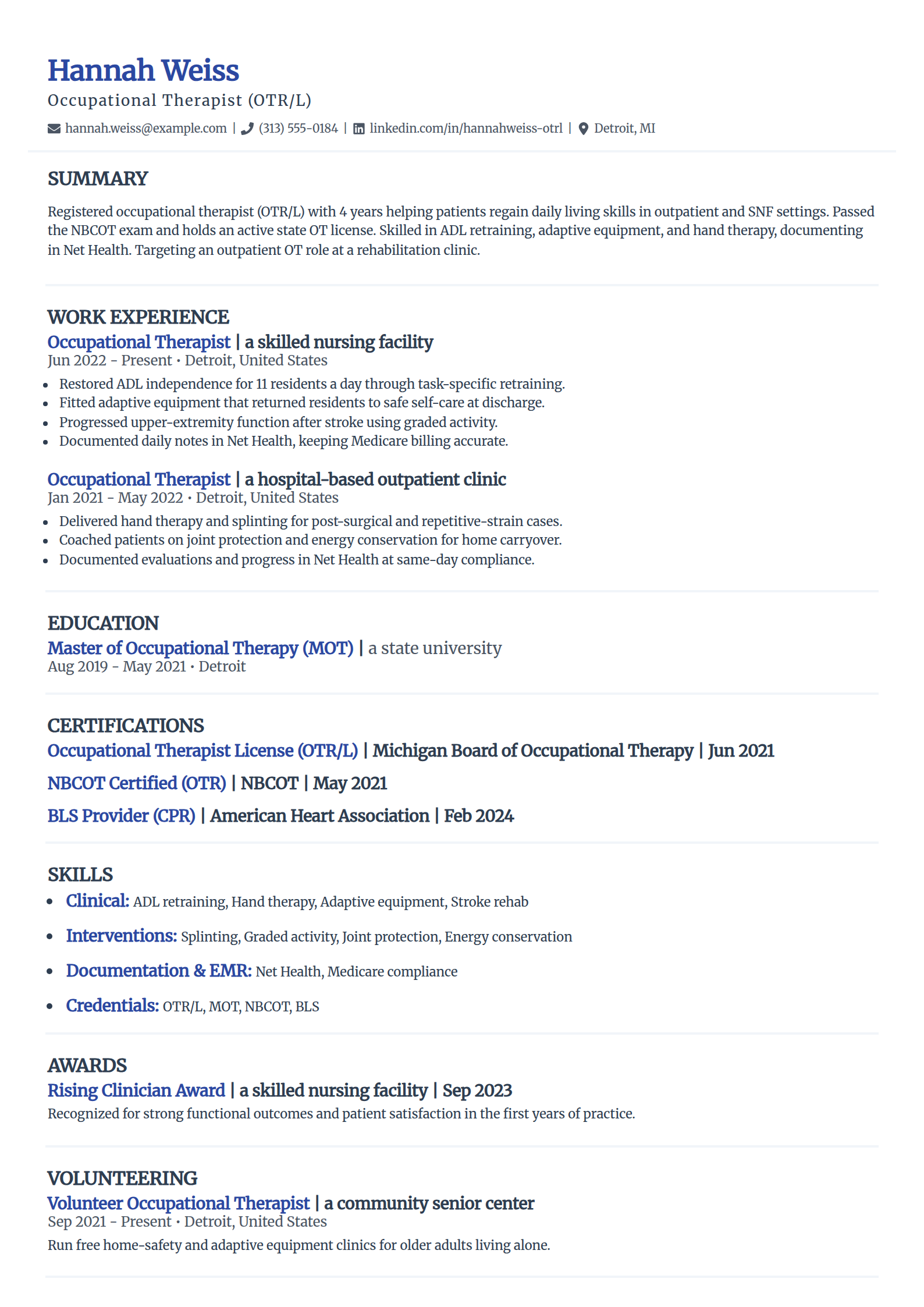
Occupational Therapist (OTR/L) Resume Template
Why this resume example works?
- Written for the OT spillover, leading with the OTR/L license, MOT degree, and NBCOT certification.
- Shows OT-specific work, ADL retraining, adaptive equipment, splinting, and hand therapy.
- Keeps results tied to the role, ADL independence restored for 11 residents a day.
- Names Net Health documentation and Medicare compliance an outpatient OT role expects.
- Fills a refined, ATS-safe page with a rising-clinician award and a senior-center volunteer role.
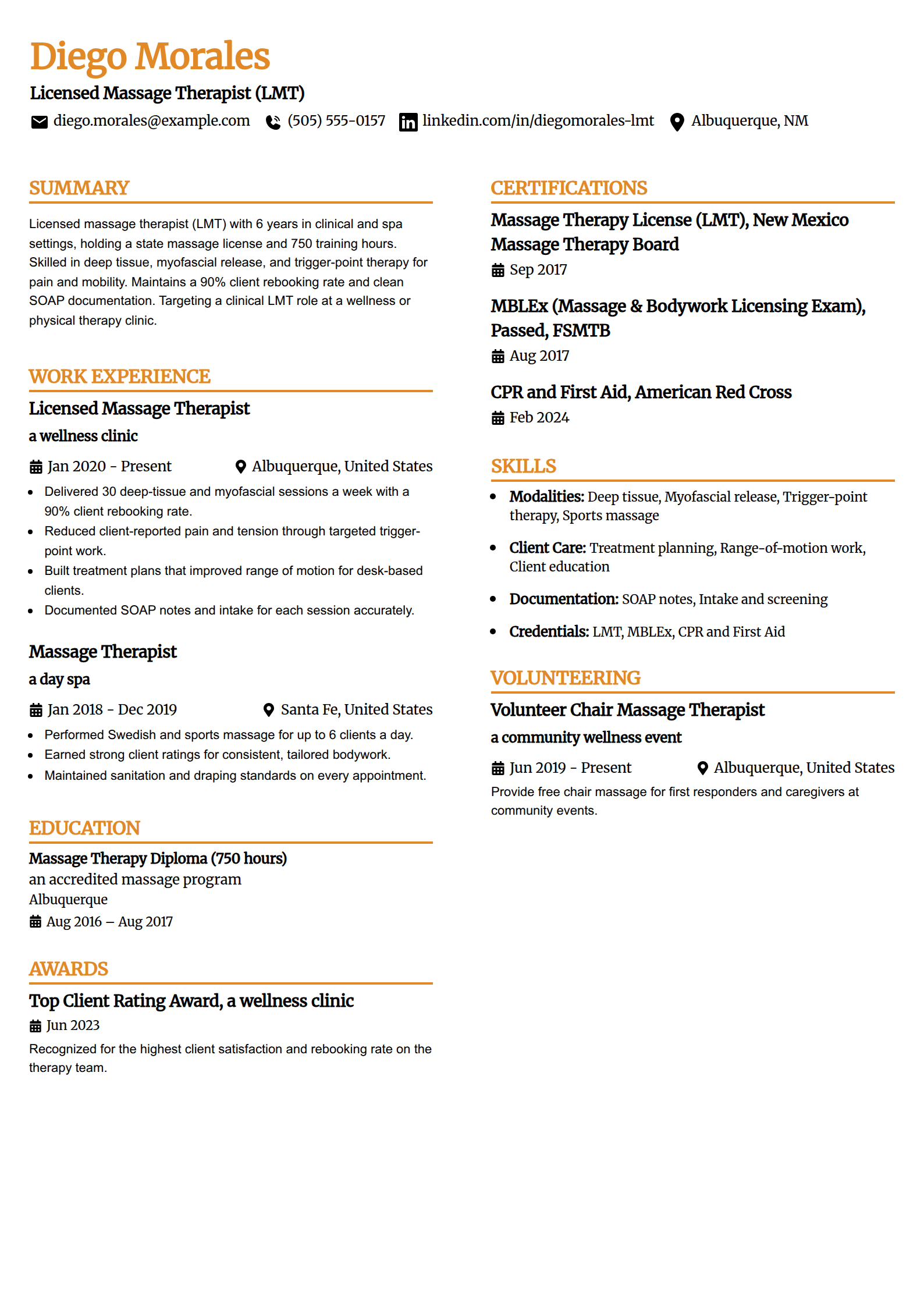
Massage Therapist (LMT) Resume Template
Why this resume example works?
- Written for the massage spillover, leading with the LMT license, 750 training hours, and a passed MBLEx.
- Shows the modalities a clinical role hires for, deep tissue, myofascial release, and trigger-point therapy.
- Keeps results countable, 30 sessions a week with a 90% client rebooking rate.
- Names SOAP documentation and the range-of-motion work a wellness or PT clinic screens for.
- Fills a tight, ATS-safe page with a client-rating award and a community volunteer role.
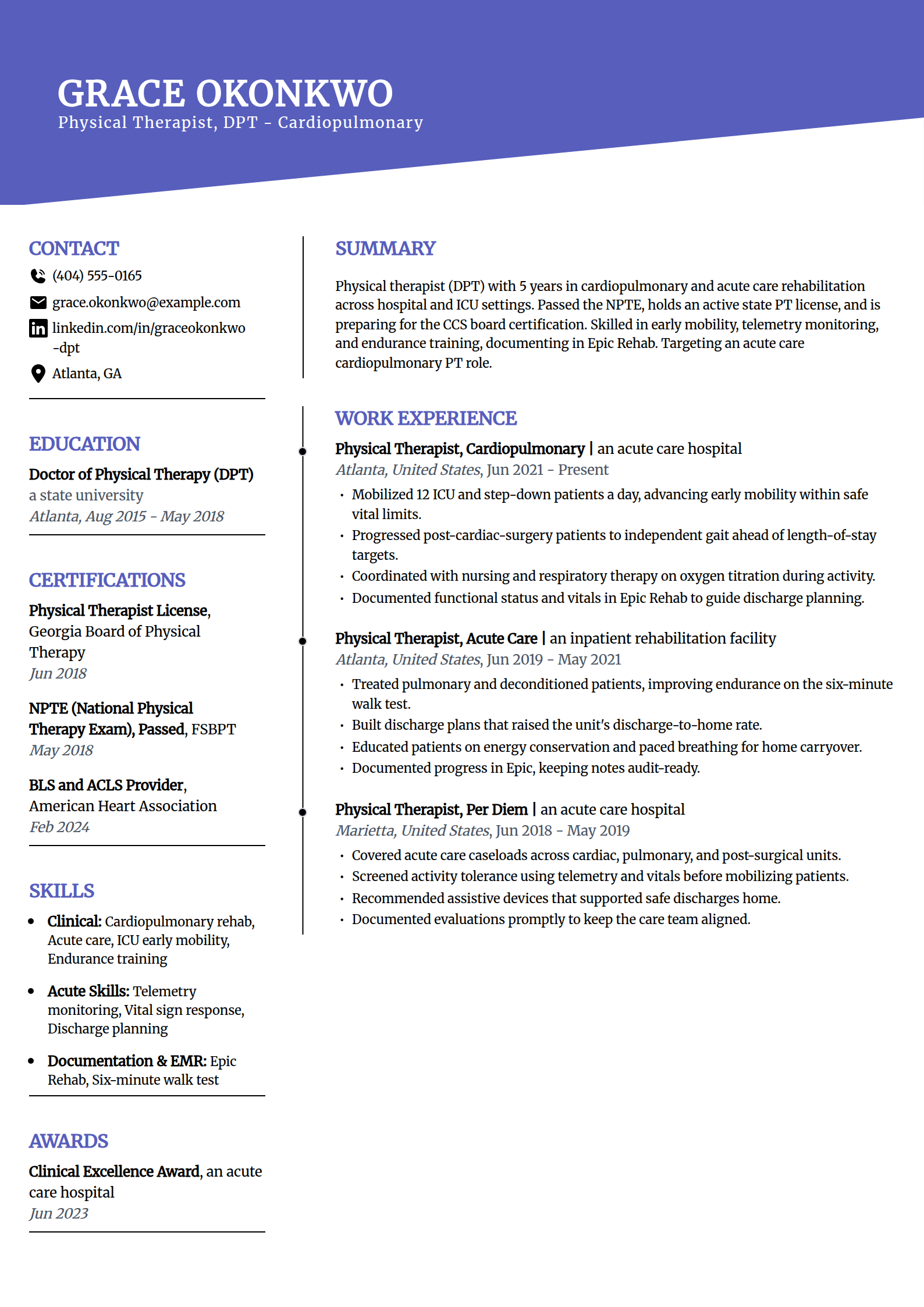
Cardiopulmonary PT Resume Template
Why this resume example works?
- Leads with the acute specialty, cardiopulmonary and ICU rehab with early mobility inside safe vital limits.
- Shows the board path honestly, a passed NPTE and state license with the CCS certification in progress.
- Names the acute skills that matter, telemetry monitoring and oxygen titration coordinated with respiratory therapy.
- Ties results to a measure, endurance improved on the six-minute walk test and discharge-to-home rate raised.
- Lists awards without long descriptions, keeping the layout clean and balanced.
Build your physical therapist resume
Pick a template above and the editor keeps your layout clean and ATS-safe while you swap in your own caseload, certifications, and functional outcomes.
Build my resumeHow to write a physical therapist resume in 2026
A recruiter scans a physical therapy resume for two things: are you licensed and credentialed for the setting, and can you prove functional outcomes. Lead with a short summary that names your DPT, state license, any board certification, and your setting, then make every bullet a result with one number, like caseload size, discharge-to-home rate, or a functional-goal percentage. Keep the format simple so a parser reads it as easily as a person does.
Open with a credential-and-setting summary
Write three to four sentences that name your DPT and license, any board certification, your years and setting, your strongest outcome number, and the role you are targeting. An outpatient PT leads with a caseload and discharge-goal rate; an acute care PT leads with early mobility and safe-discharge rate. Keep it to about 60 words so it never spills past the top of the page. For copyable summaries across the healthcare cluster, see our healthcare resume summary page.
Board-certified orthopedic physical therapist (OCS) with 10 years treating post-surgical and sports orthopedic patients in outpatient clinics. Manages a 14-patient daily caseload with 93% meeting functional discharge goals. Skilled in manual therapy, dry needling, and return-to-sport testing, documenting in WebPT. Targeting a lead outpatient orthopedic PT role at a hospital-based clinic.
Make every experience bullet a result with a number
Name the diagnosis or setting, the intervention, and the outcome, then attach one credible clinical number and the tool or method that produced it. This is what separates a resume that gets a callback from a duty list.
- Use clinical metrics: daily caseload, visits per week, productivity percentage, functional-goal rate, discharge-to-home rate, FIM or Berg gains, or documentation compliance.
- Open with a strong verb like evaluated, rehabilitated, progressed, restored, or reduced, never "Responsible for" or "Helped with".
- Name the method or tool: "cut resident falls 22% through progressive strength, balance training, and safe-transfer education".
- Keep numbers modest and level-accurate: a new grad shows rotation hours, an experienced PT shows caseload and outcomes; one number per bullet is plenty.
Show your degree, license, and board certifications correctly
Your DPT, license, and specialty are the first things a recruiter verifies, so put them where they are easy to find and match them to the setting. This is also where the physical therapist and PTA split shows up.
- Put "PT, DPT" after your name, add any ABPTS specialty right after it (OCS ortho, SCS sports, NCS neuro, GCS geriatric, PCS pediatric, CCS cardiopulmonary, WCS women's health), and list your active state PT license.
- State that you passed the NPTE (National Physical Therapy Exam); a license already implies it, but many postings ask for it directly.
- A physical therapist assistant is a distinct role: lead with the Associate degree, the PTA license, and the passed NPTE-PTA, and show treatment delivered under the supervising PT's plan of care, not evaluation or plan-of-care authorship.
- New grads lead with the DPT and dated clinical rotations as experience; add certifications a setting names, like dry needling, LSVT BIG, or BLS and ACLS for acute care.
Match skills and keywords to the job posting
A skills block should read like the posting, grouped so a recruiter and a parser both find what they need. List the settings, systems, and interventions you have actually used, not a generic dump.
- Group by type: specialties and settings, manual therapy and interventions, evaluation and outcome measures, and documentation.
- Name the EMR you run: WebPT, Epic Rehab, Casamba, Raintree, Prompt, WellSky, Net Health, or Fusion.
- Name the setting outright, outpatient ortho, acute care, inpatient rehab, SNF, home health, pediatrics, or sports, since recruiters filter on it.
- If the posting says "plan of care" or "functional outcomes", use that exact phrasing where it fits, since that is what the applicant tracking system searches for.
Keep the format clean and ATS-safe
A physical therapy resume is read by a parser first and a recruiter second, so a clean layout with standard headings is the safe choice at every level.
- Use a single-column or simple two-column layout with standard headings a parser recognizes; skip heavy graphics and photos.
- Keep it to one page for under about ten years of experience; most physical therapists fit a strong record on a single page.
- Save as a PDF so the formatting holds, then run it through our ATS resume checker for a quick format and keyword pass.
- Swap the numbers in the templates above for your own caseload, outcomes, and certifications; do not copy them as is.
Common physical therapist resume mistakes
- Leaving your license and NPTE status unclear. A recruiter needs to see your DPT, active state license, and any board certification in seconds, so put them by your name and in a certifications block.
- Conflating physical therapist and PTA scope. A PTA works under the physical therapist's plan of care and does not evaluate or diagnose; claiming evaluation or plan-of-care authorship on a PTA resume fails the first clinical read.
- Listing duties instead of outcomes. Replace "treated orthopedic patients" with "managed a 14-patient daily caseload with 93% meeting functional discharge goals".
- Never naming your setting. Outpatient ortho, acute care, SNF, home health, and pediatrics are recruiter filter terms, so name the setting in your summary and each role.
- Dumping every modality in one wall of text. Group manual therapy, interventions, and outcome measures into labeled skill categories a parser and a recruiter can both scan.
Frequently asked questions
How do you write a physical therapist resume?
Lead with a three-to-four-sentence summary that names your DPT, your state license, any board certification, your setting, and the role you are targeting. Under each job, write results-first bullets that open with a strong verb and carry one credible clinical number, like managing a 14-patient daily caseload with 93% meeting functional discharge goals. Name the interventions and the EMR that produced each result, list your DPT, license, and certifications in their own block, and keep the whole thing to one clean, ATS-safe page.
What is the difference between a physical therapist and a PTA resume?
A physical therapist (DPT) evaluates patients, writes the plan of care, and reasons over diagnoses, so a PT resume leads with the DPT, state license, board certifications like OCS or NCS, and evaluation and outcome results. A physical therapist assistant (PTA) is a distinct, lower-licensure role that delivers interventions under the supervising physical therapist's plan of care and does not evaluate, diagnose, or set the plan of care. A PTA resume leads with the Associate degree, the PTA license, the passed NPTE-PTA, and treatment-delivery volume, like a 12-patient daily load at 90% productivity.
How do you write a physical therapist resume with no experience?
Lead with what you do have. A new-graduate DPT leads with the doctorate and dated terminal clinical rotations, treating each rotation as a real experience entry with quantified bullets. Show that you passed the NPTE and hold an active state PT license as your strongest early signals, and keep the scope honest, evaluation and treatment done under a clinical instructor's supervision. List certifications a setting names, like BLS, and add clinical honors or a pro bono volunteer role to fill the page. The new-grad DPT example above shows the shape.
What certifications and licenses go on a physical therapist resume?
Put "PT, DPT" after your name, add any ABPTS board specialty right after it, and list your active state PT license. The recruiter-facing specialties are OCS (orthopaedic), SCS (sports), NCS (neurologic), GCS (geriatric), PCS (pediatric), CCS (cardiovascular and pulmonary), and WCS (women's health). State that you passed the NPTE, and add setting-specific certifications like dry needling, LSVT BIG for Parkinson's, CPR and BLS, or ACLS for acute and cardiopulmonary care. A PTA lists the PTA license and the passed NPTE-PTA instead.
What skills should you put on a physical therapist resume?
Match the posting, then name specific interventions, settings, and systems grouped by type: specialties and settings (outpatient ortho, acute care, SNF, home health, pediatrics), manual therapy and interventions (dry needling, Maitland mobilization, gait training, LSVT BIG), evaluation and outcome measures (plan-of-care design, FIM, Berg Balance Scale), and documentation. Add the EMR you run, like WebPT, Epic Rehab, Casamba, Raintree, or Prompt. List what you have actually done and can speak to in an interview, and mirror the posting's phrasing, since that is what the applicant tracking system searches for.
How long should a physical therapist resume be?
One page for most physical therapists with under about ten years of experience, including new grads, PTAs, and clinicians across outpatient, acute, and post-acute settings. A longer, specialized, or leadership record can run to two pages, but only when the second page carries results, not filler. Lead with your most recent and most relevant setting, keep standard headings, and cut older or unrelated jobs so the space goes to the work that matches the role you want.
More physical therapist resume resources
Build your physical therapist resume
Pick a template above and the editor keeps your layout clean and ATS-safe while you swap in your own caseload, certifications, and functional outcomes.