22 Bartender & Barista Resume Examples, Barback to Bar Manager
- ATS Friendly
- Bartender & Barista
- 22 Real Examples
Craft cocktails, a busy club rail, a hotel bar, an events gig, or a specialty espresso bar, this page has a resume built for your exact spot behind the bar. Start from a layout below, then model your own on a real example. Your certifications, from TIPS and your state alcohol permit to SCA barista training, sit right where a hiring manager looks first.


540k+ resumes created
Editable bartender and barista resume templates
Each template below is a real bar or cafe resume laid out in that format, sorted by role and venue across craft cocktail, nightclub, hotel, fine dining, events, and specialty coffee. Pick one, then swap in your own guest counts, sales, certifications, and drinks. Every layout keeps your name, permits, and impact bullets clean so a hiring manager reads your strongest shifts at a glance and an applicant tracking system parses them without trouble.
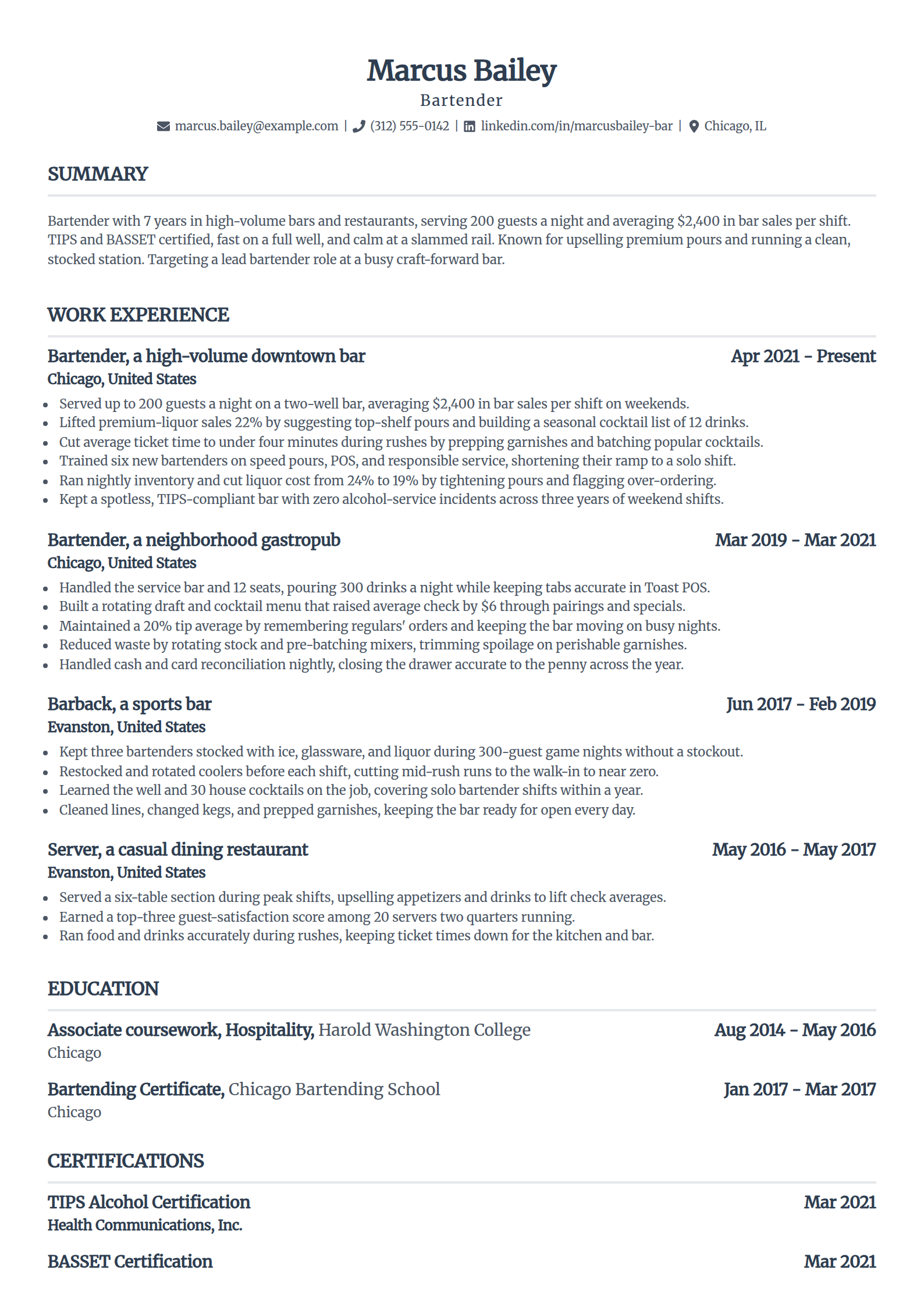
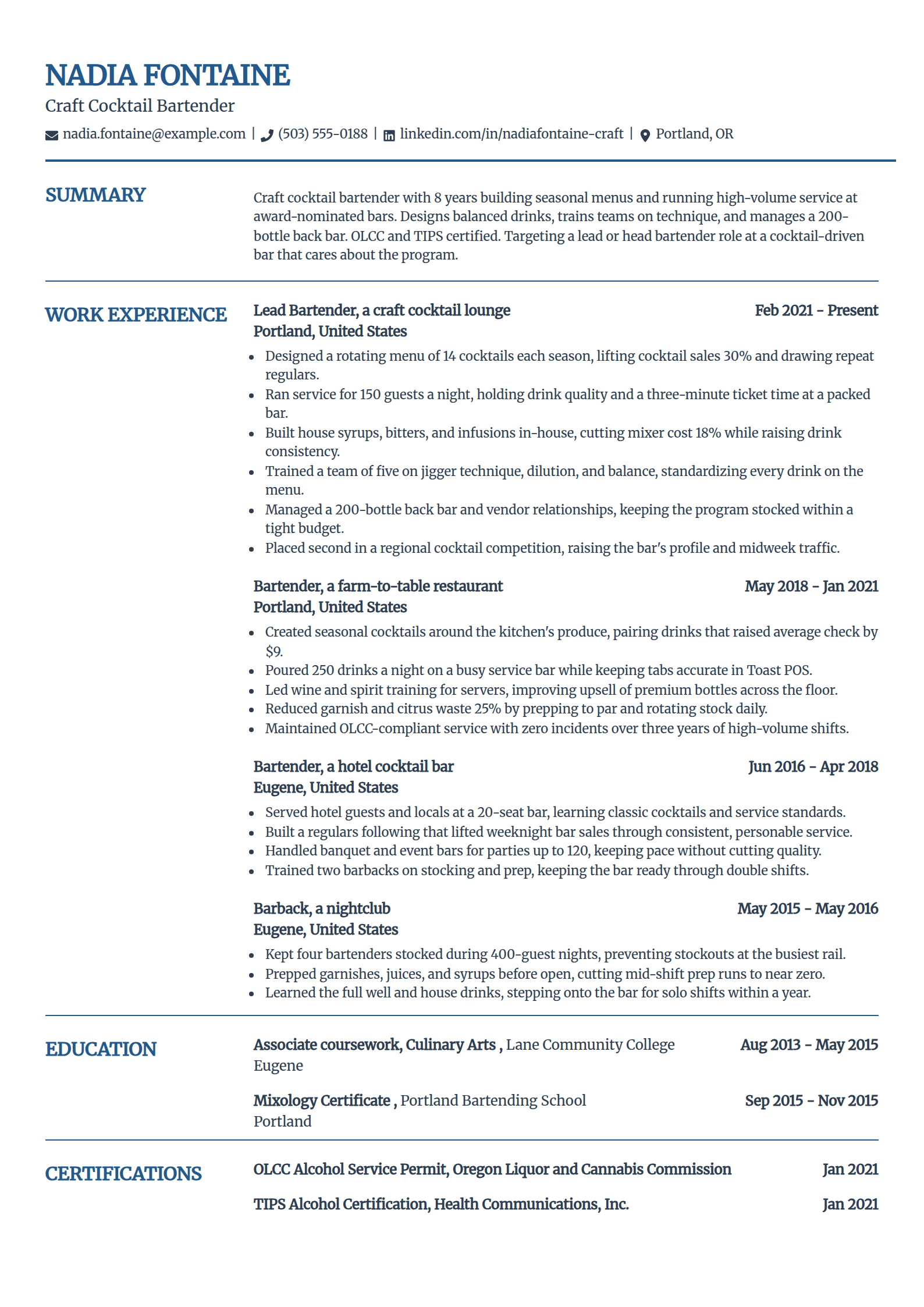
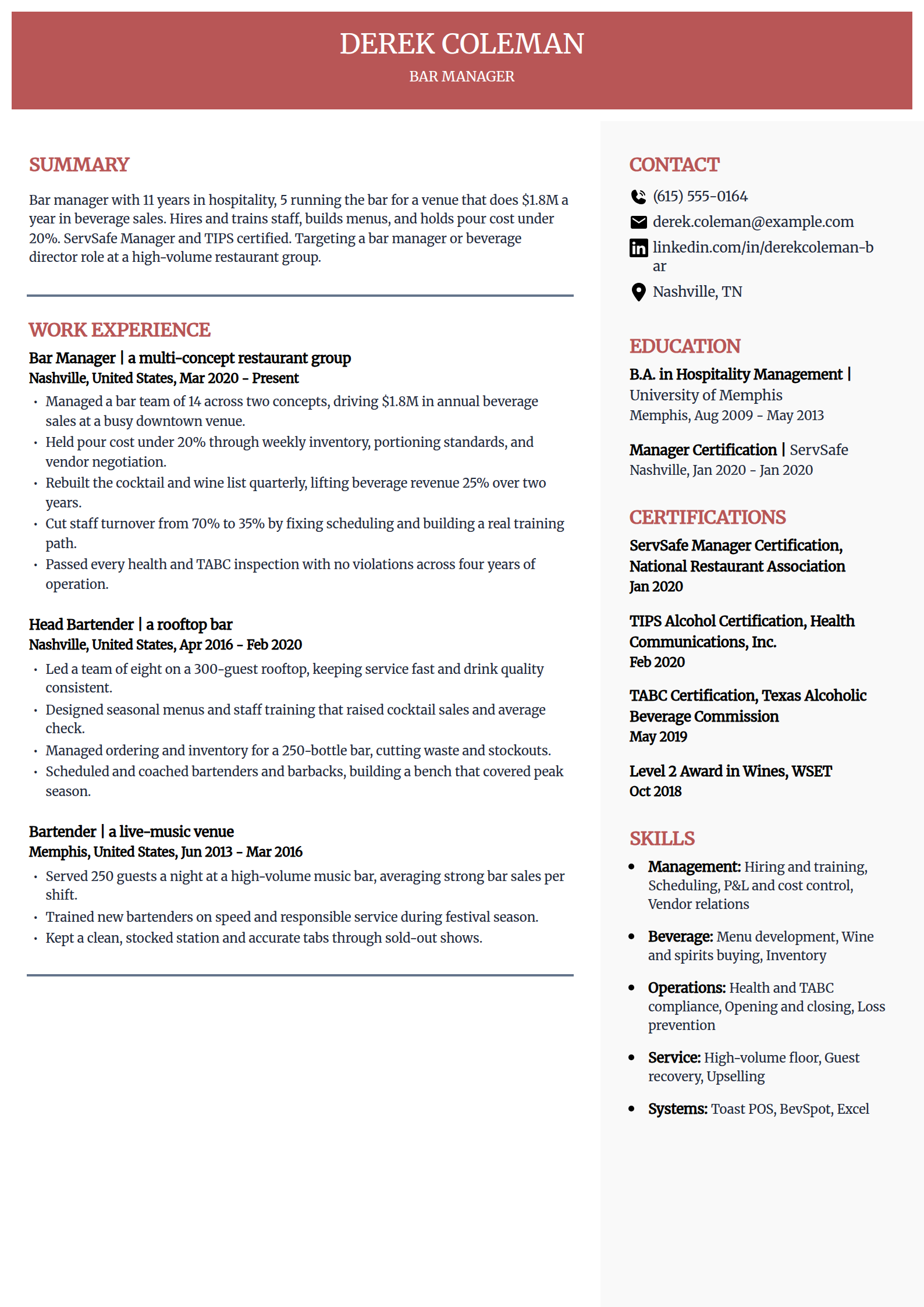
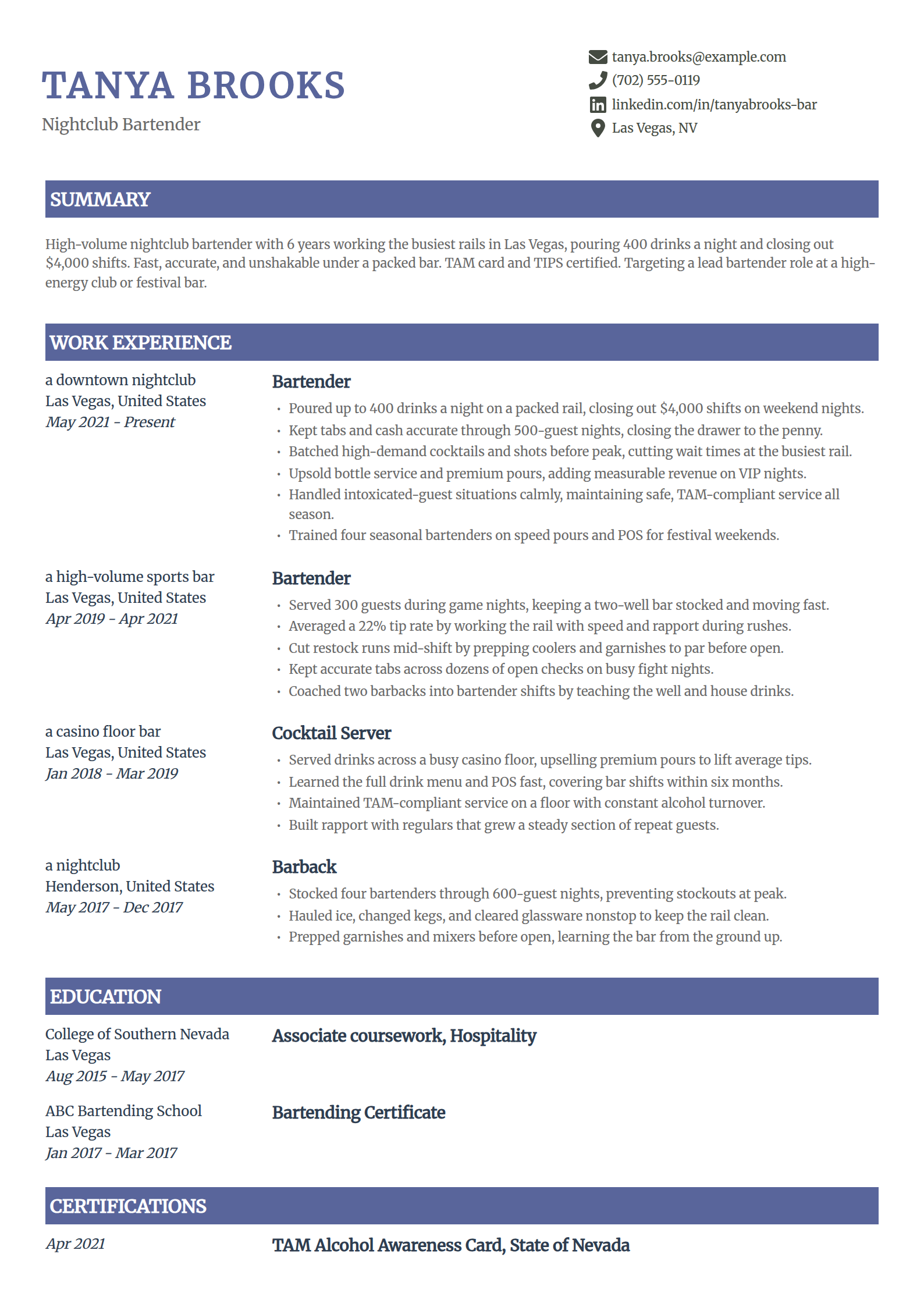
Bartender Resume Template
Why this resume example works?
- Opens with a summary that names 7 years, 200 guests a night, and $2,400 in bar sales per shift.
- Shows the range a bar hires for: craft cocktails, upselling premium pours, training, and inventory control.
- Attaches one number to each bullet, like premium-liquor sales up 22% or liquor cost cut from 24% to 19%.
- Names TIPS and BASSET certification, the credentials an alcohol-serving employer checks first.
- Uses a clean, single-column layout an applicant tracking system parses without trouble.
Craft Cocktail Bartender Resume Template
Why this resume example works?
- Leads with a real program, a rotating 14-cocktail menu that lifted cocktail sales 30% and drew regulars.
- Shows the craft a cocktail bar screens for, house syrups and bitters, balance, and team technique training.
- Names BarSmarts and WSET, the credentials that signal serious product knowledge.
- Keeps each result modest and countable, like an 18% mixer-cost cut or a regional competition placement.
- Uses a modern layout that carries an eight-year cocktail record on one page.
Bar Manager & Head Bartender Resume Template
Why this resume example works?
- Leads with manager scope, a bar team of 14 driving $1.8M in annual beverage sales.
- Shows the ownership a venue rewards, pour cost held under 20% and turnover cut from 70% to 35%.
- Pairs management with hospitality, quarterly menu rebuilds that lifted beverage revenue 25%.
- Names ServSafe Manager and TABC certification and clean inspections, what a group hires on.
- Uses a refined two-column layout that fits a leadership record cleanly on one page.
Nightclub & High-Volume Bartender Resume Template
Why this resume example works?
- Opens with the number a club cares about, 400 drinks a night and $4,000 shift closeouts.
- Shows speed and composure, batching for peak and de-escalating intoxicated-guest situations safely.
- Keeps the drawer honest, tabs and cash accurate through 500-guest nights.
- Names the TAM card and TIPS, the responsible-service credentials a Nevada club requires.
- Uses a modern two-column layout that carries a dense high-volume history on one page.
Sports Bar Bartender Resume Template
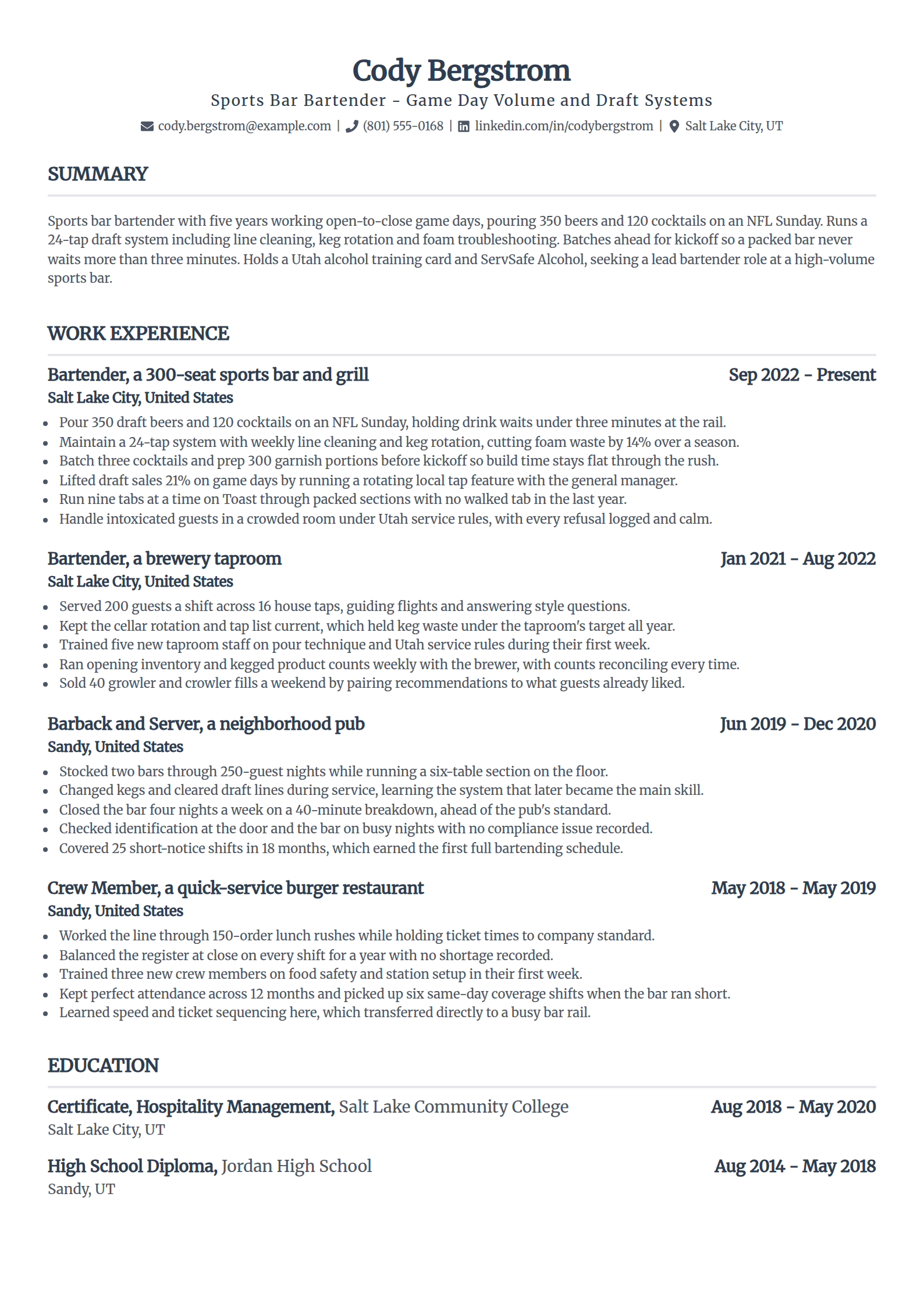
Why this resume example works?
- Sizes the shift the way a sports bar does, 350 draft beers and 120 cocktails on an NFL Sunday.
- Owns the draft system as a skill, weekly line cleaning and keg rotation with foam waste down 14% over a season.
- Shows the prep that makes game day survivable, three batched cocktails and 300 garnish portions before kickoff.
- Names nine simultaneous tabs on Toast with no walked tab in a year, which answers the trust question directly.
- Carries a Certified Beer Server credential, the one that separates a beer bartender from someone who pours beer.
Casino Bartender Resume Template
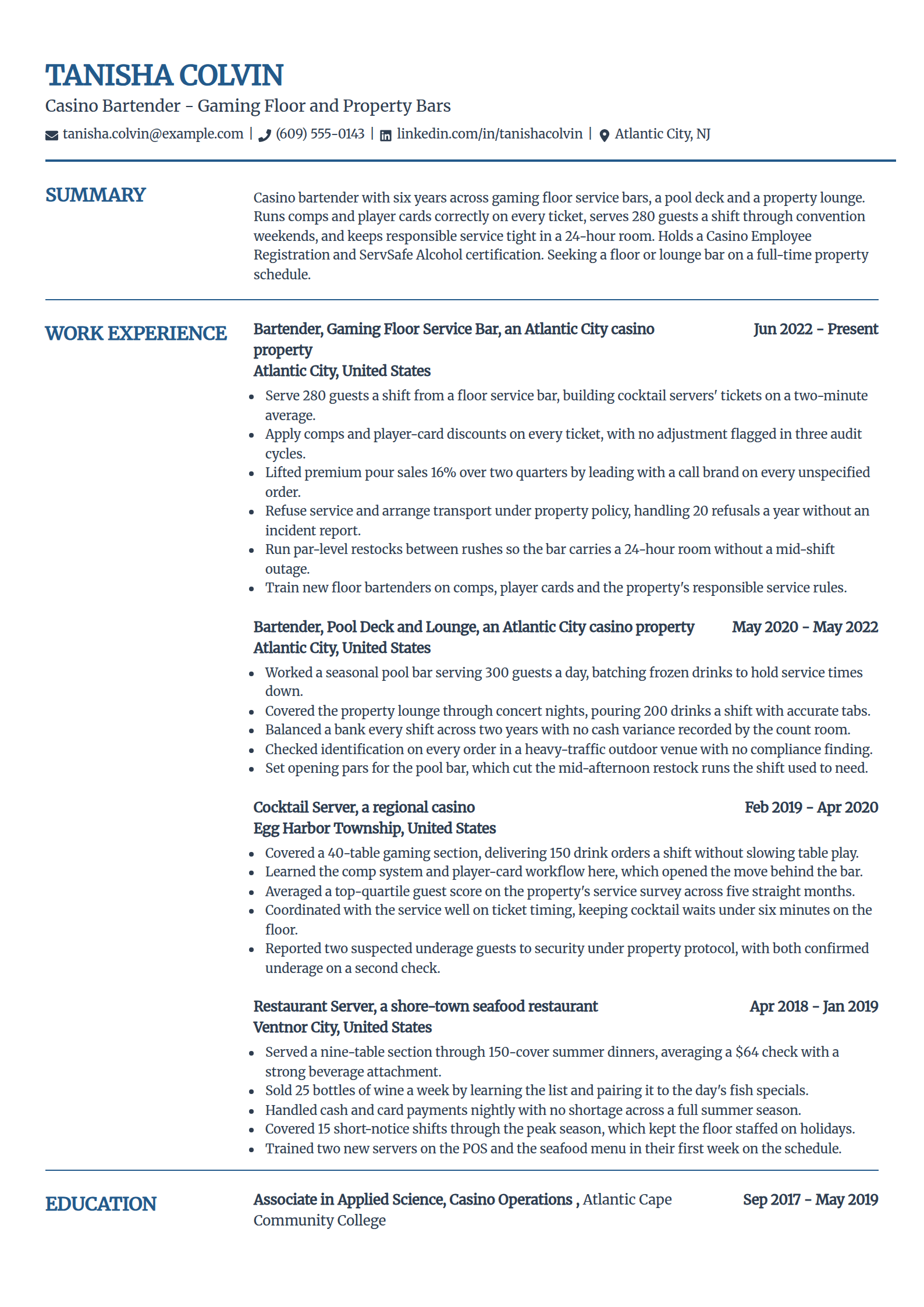
Why this resume example works?
- Leads with the casino-specific work a property screens for, comps and player cards applied correctly on every ticket.
- Uses property numbers, 280 guests a shift from a floor service bar on a two-minute ticket average.
- Names the Casino Employee Registration from the New Jersey Division of Gaming Enforcement, not a generic permit.
- Shows responsible service in the hardest setting there is, 20 refusals a year in a 24-hour room with no incident report.
- Covers the three bars a property actually staffs, gaming floor, pool deck and lounge, on one page.
Flair Bartender Resume Template (Competition Circuit)
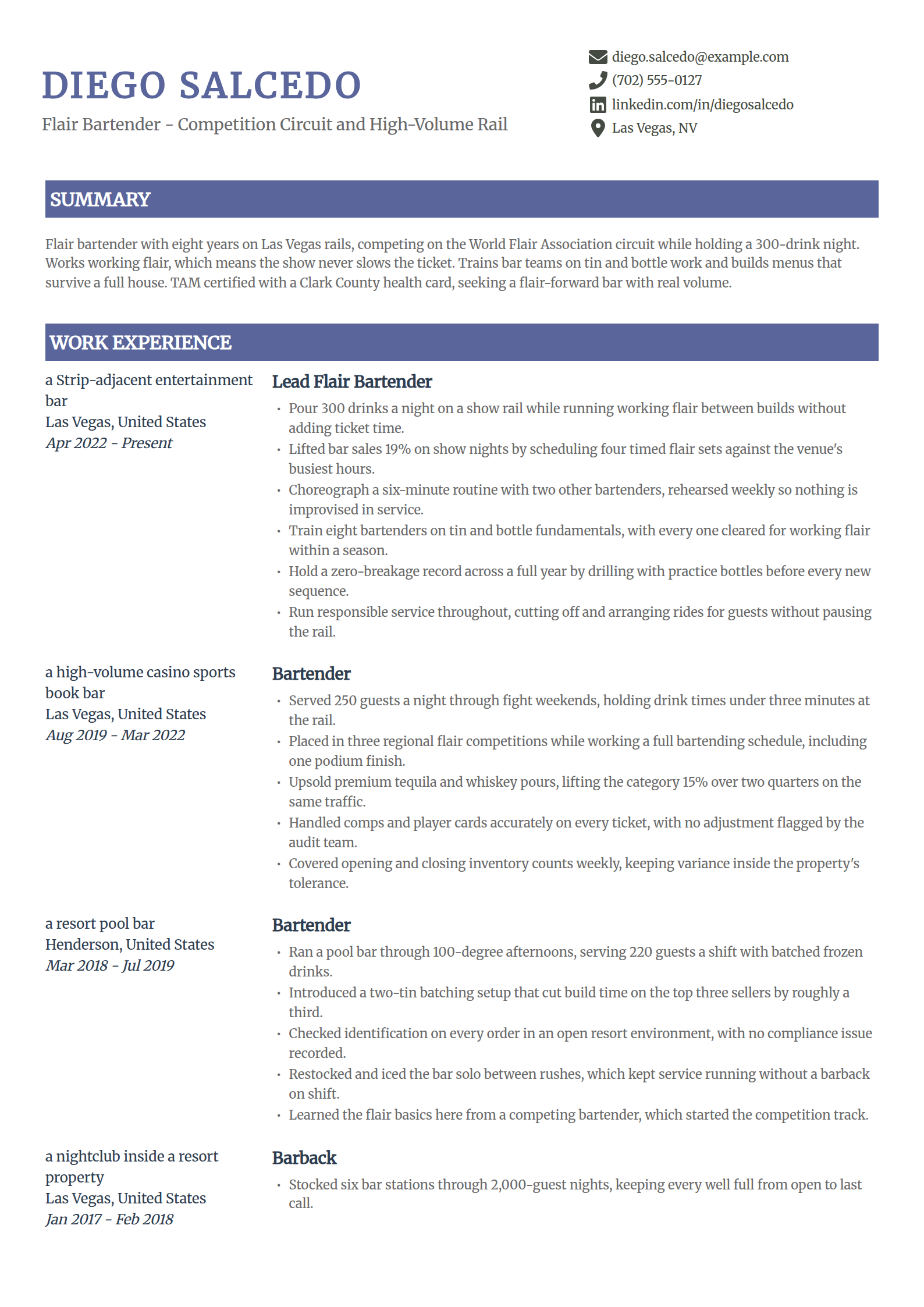
Why this resume example works?
- Answers the manager's real worry first, working flair that never slows the ticket on a 300-drink night.
- Ties the show to revenue, bar sales up 19% on show nights from four flair sets timed to peak hours.
- Treats competition as a credential with a body behind it, the World Flair Association circuit, plus a regional podium finish.
- Keeps a zero-breakage year on the page, which is the cost question every flair hire raises.
- Shows the training side, eight bartenders cleared for working flair in a season, so the hire scales the bar team.
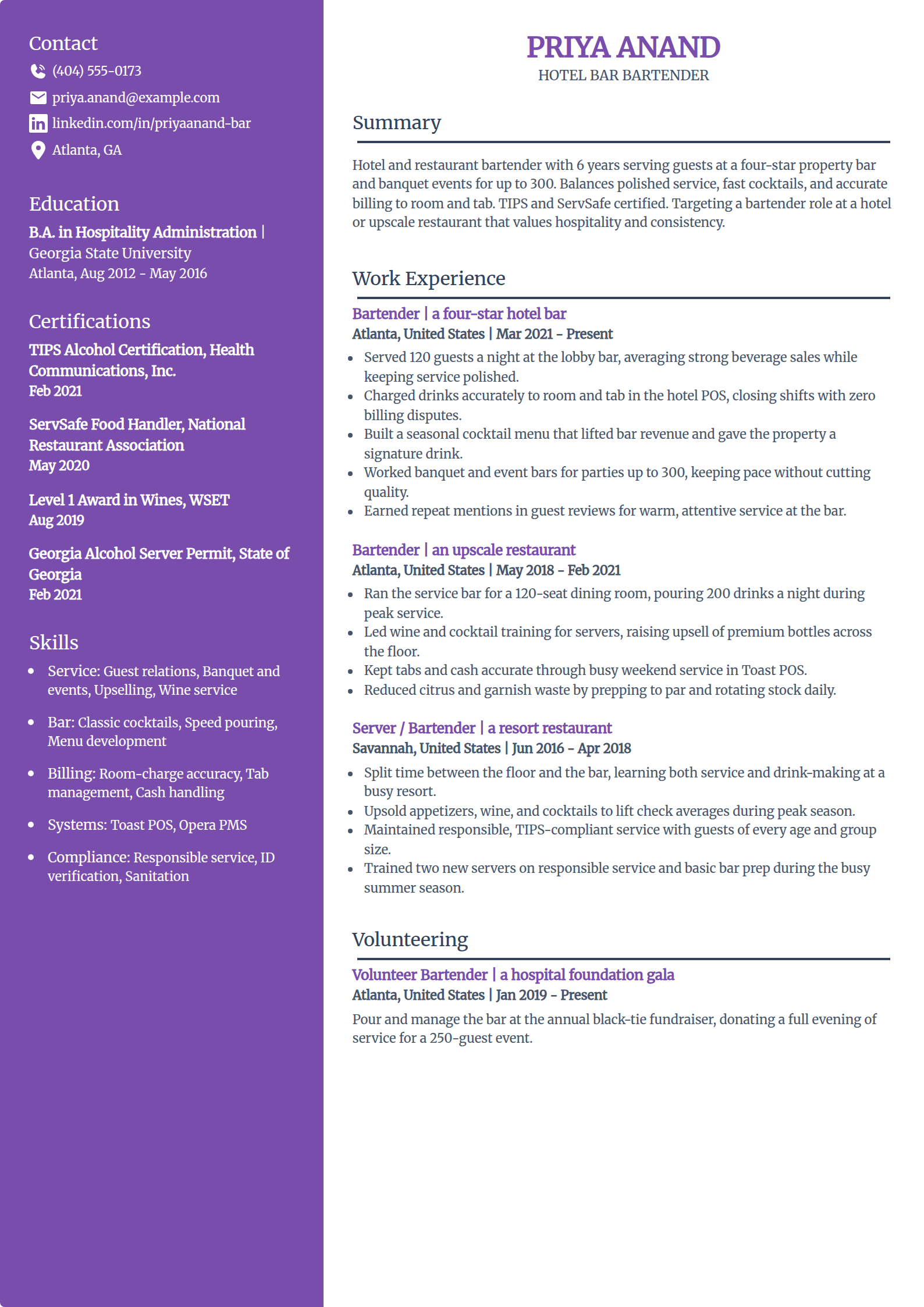
Hotel & Restaurant Bartender Resume Template
Why this resume example works?
- Leads with polished service, a four-star lobby bar and banquet events for up to 300 guests.
- Shows the billing accuracy a hotel screens for, drinks charged to room and tab with zero disputes.
- Pairs cocktails with hospitality, a signature menu and repeat mentions in guest reviews.
- Names TIPS and the state server permit alongside a WSET wine award.
- Uses a Medium layout that fits a six-year hotel-bar record without empty space.
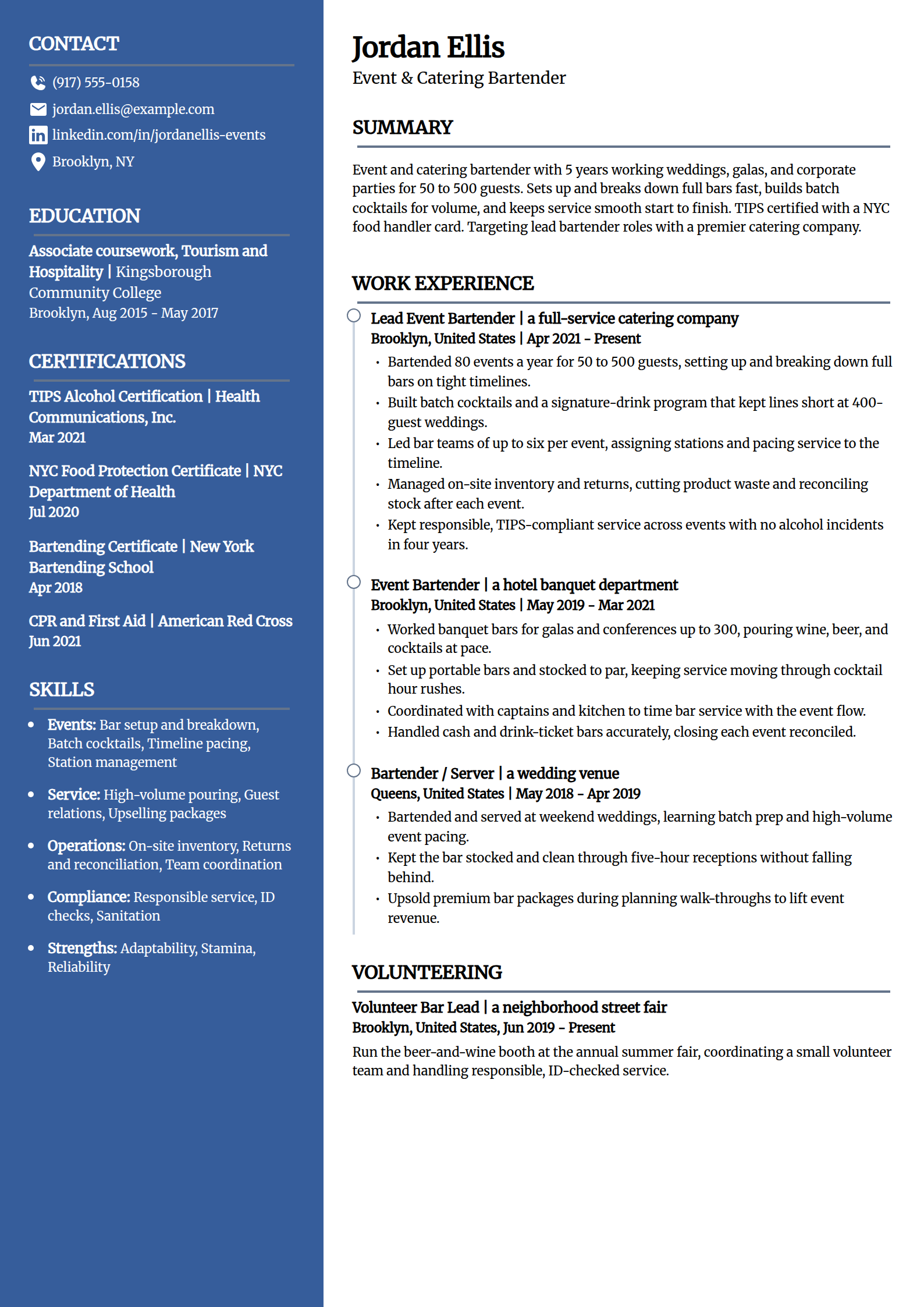
Event & Catering Bartender Resume Template
Why this resume example works?
- Opens with event scope, 80 events a year for 50 to 500 guests with full setup and breakdown.
- Shows the volume skill a caterer hires for, batch cocktails that kept lines short at 400-guest weddings.
- Keeps the work concrete, leading bar teams of six and reconciling on-site inventory after each event.
- Names TIPS and a food-handler card, the credentials a catering company checks.
- Uses a distinctive layout that still reads cleanly for a hiring manager.
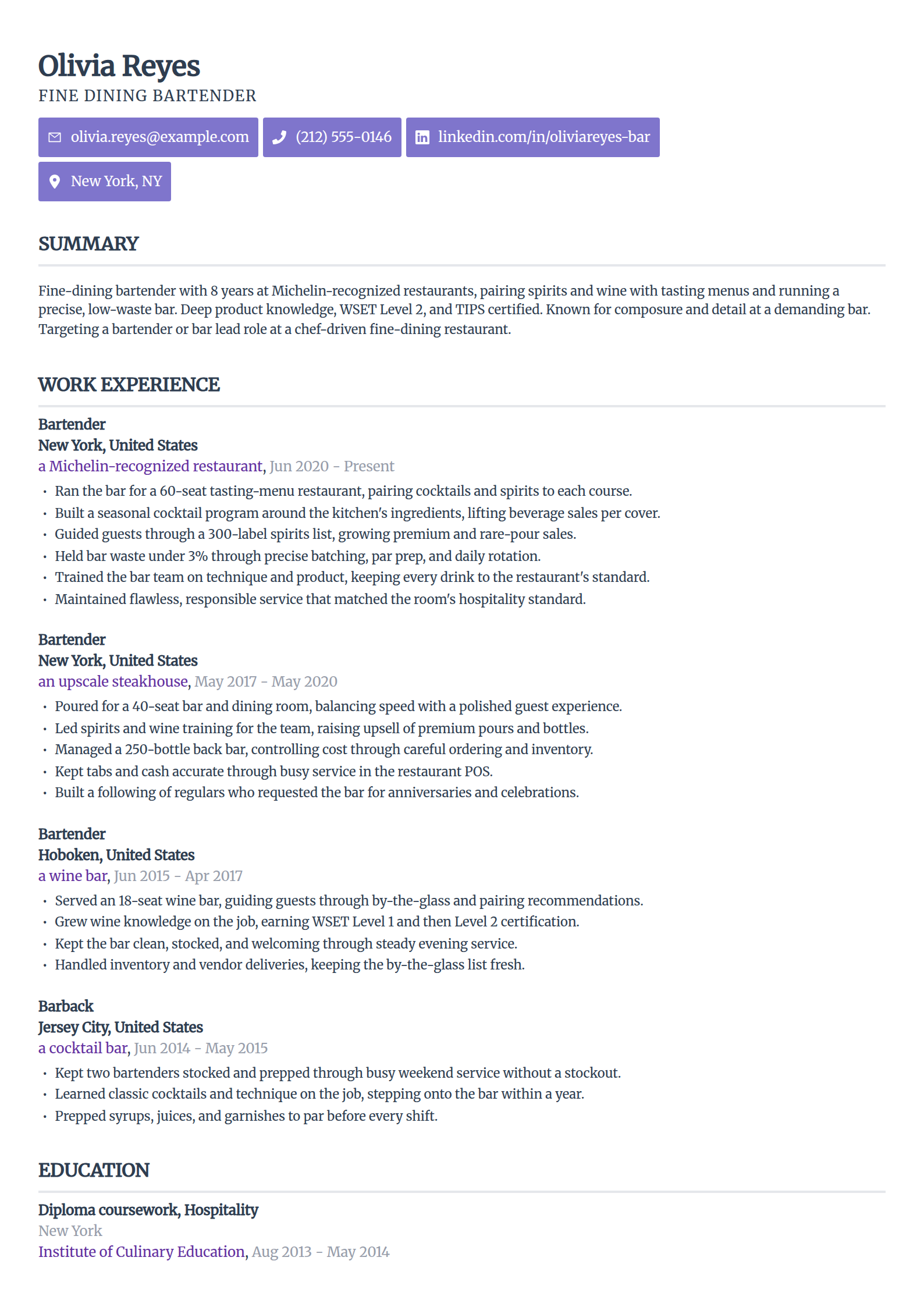
Fine Dining Bartender Resume Template
Why this resume example works?
- Leads with the setting, a Michelin-recognized restaurant bar pairing drinks to a tasting menu.
- Shows the product depth a chef-driven room expects, a 300-label spirits list and rare-pour upselling.
- Keeps quality measurable, bar waste held under 3% through precise batching and rotation.
- Names WSET Level 2 and Certified Specialist of Spirits, the credentials that prove the knowledge.
- Uses a clean, modern layout that carries a deep fine-dining record on one page.
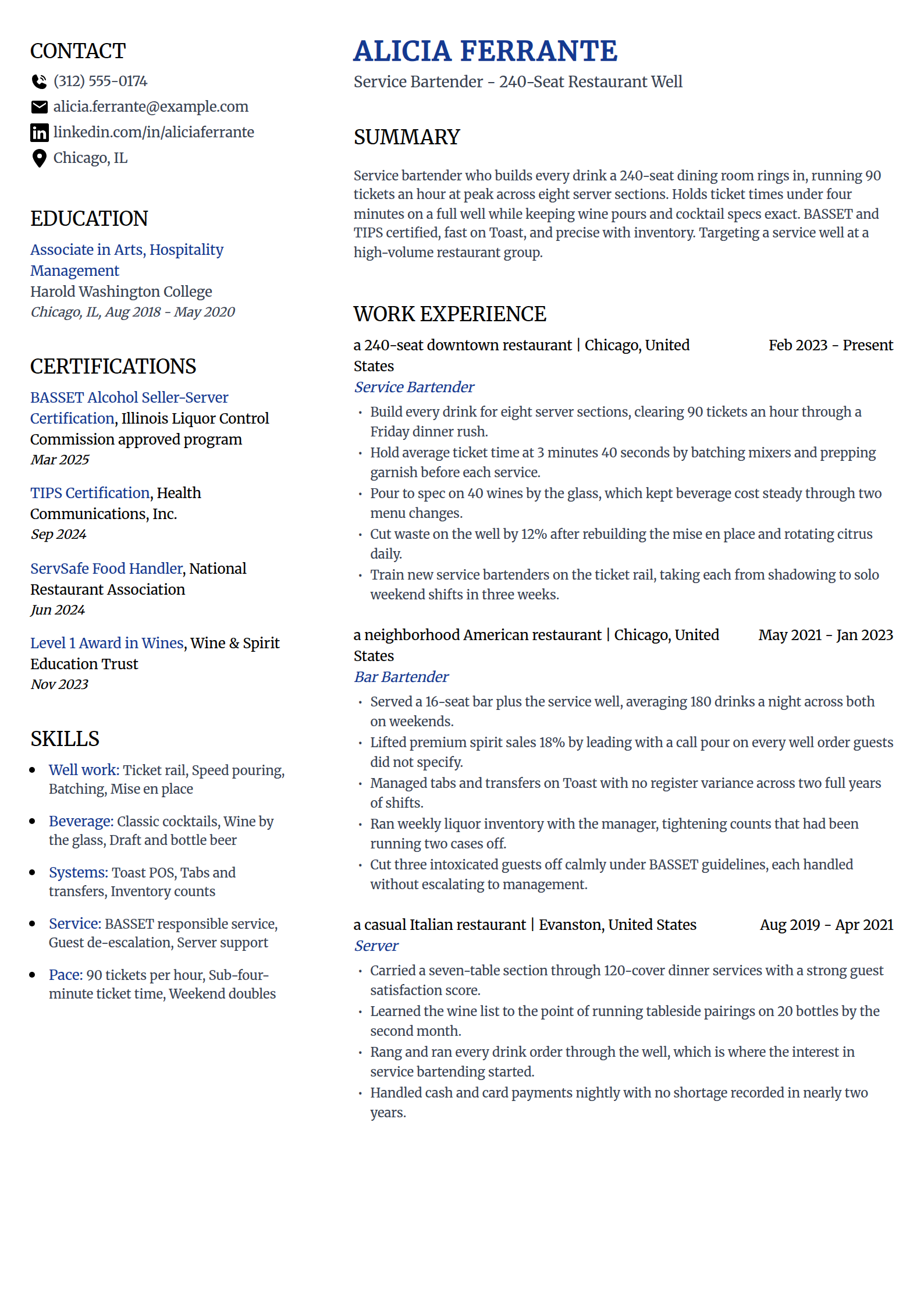
Service Bartender Resume Template (The Well)
Why this resume example works?
- Written for the well rather than the bar rail, where the job is tickets for the floor, not guests in front of you.
- Uses the metrics that prove a service bartender, 90 tickets an hour and a 3 minute 40 second average ticket time.
- Shows wine accuracy alongside speed, pouring to spec on 40 wines by the glass through two menu changes.
- Keeps one efficiency number with its method, 12% less well waste after rebuilding the mise en place.
- Names BASSET and TIPS, the Illinois credentials a restaurant group checks before the interview.
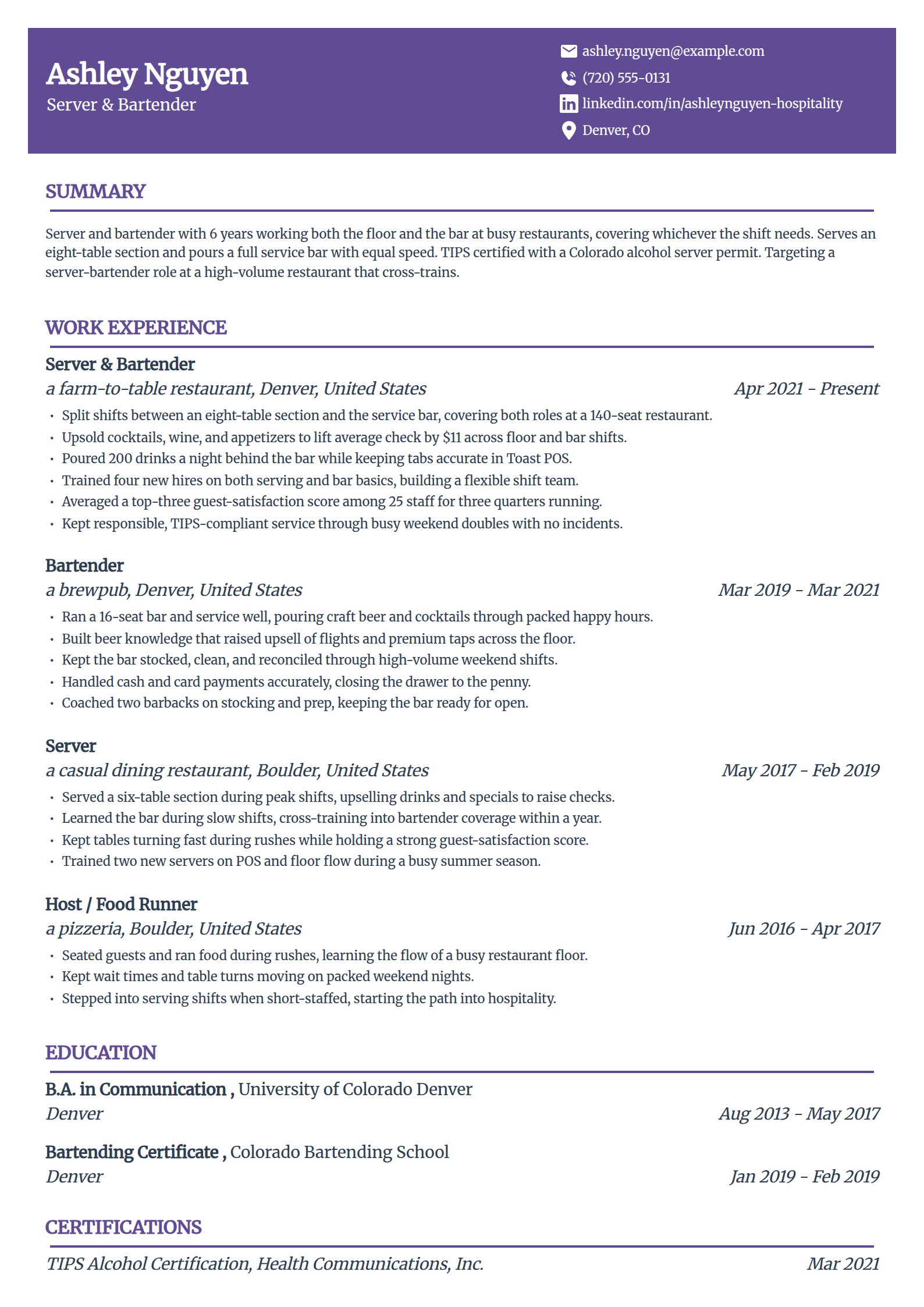
Server & Bartender Resume Template
Why this resume example works?
- Written for the cross-trained hire, covering both an eight-table section and a full service bar.
- Shows the value a restaurant rewards, average check lifted $11 across floor and bar shifts.
- Keeps both skill sets visible, 200 drinks a night behind the bar and a top guest-satisfaction score serving.
- Names TIPS, a Colorado server permit, and a Cicerone beer server credential.
- Uses a spacious layout that carries a six-year floor-and-bar record on one page.
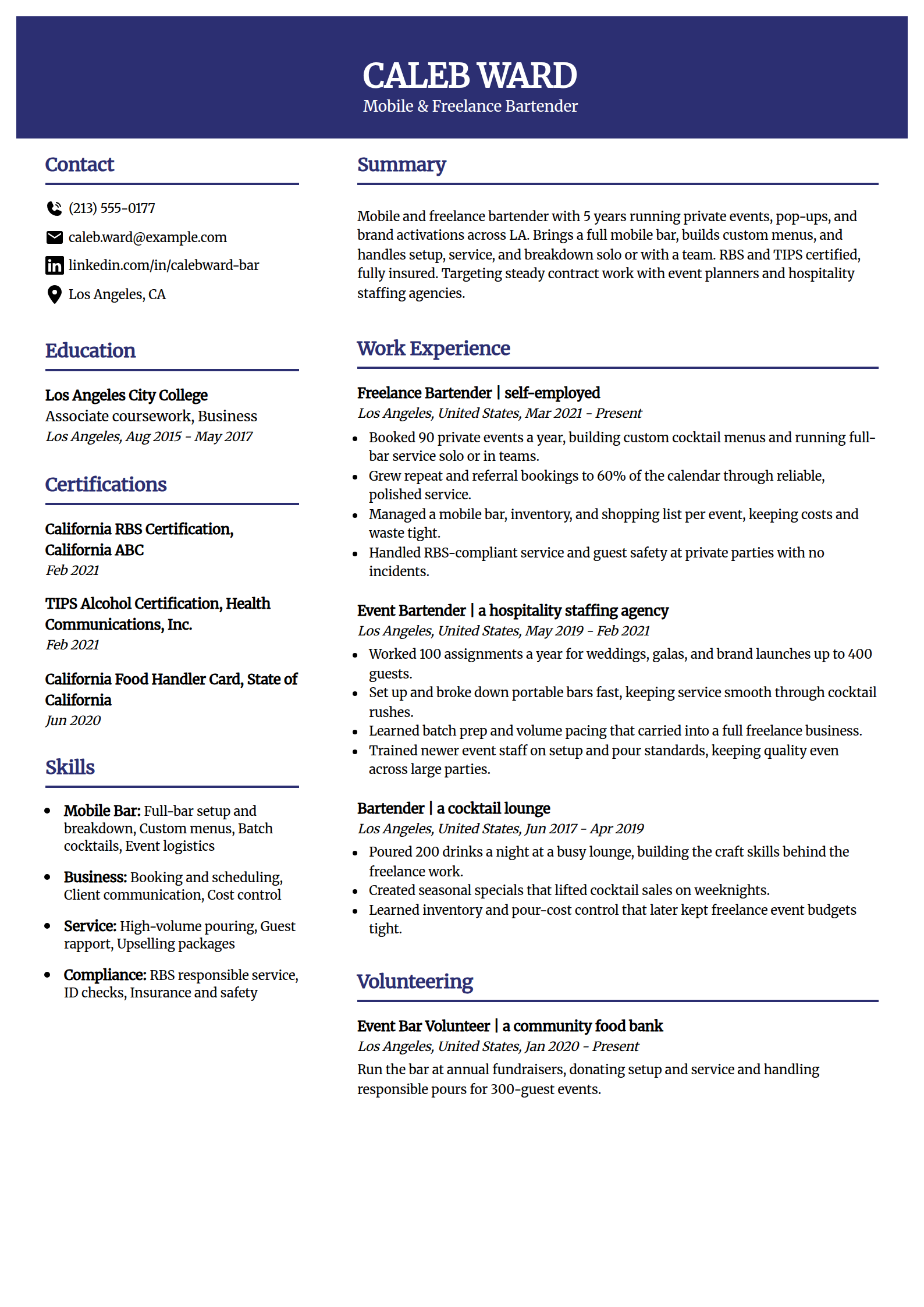
Mobile & Freelance Bartender Resume Template
Why this resume example works?
- Opens with the freelance selling point, 90 private events a year with a full mobile bar.
- Shows the business behind the bar, repeat and referral bookings grown to 60% of the calendar.
- Keeps the work honest, managing inventory and a shopping list per event to hold costs tight.
- Names the RBS permit and insurance, what a planner or agency needs to book you.
- Uses a roomy layout with a filled sidebar so a focused freelance record still looks complete.
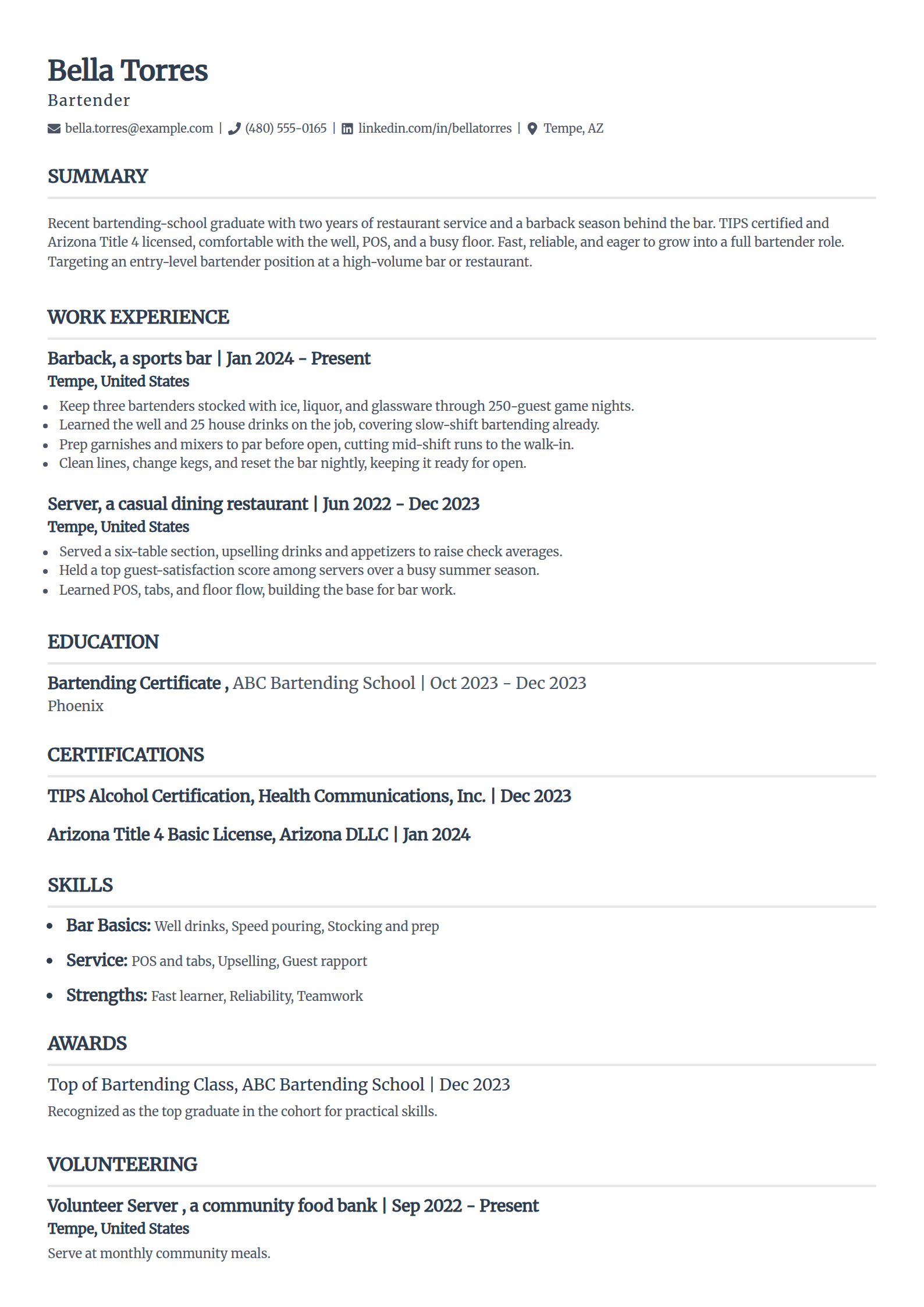
Entry-Level Bartender Resume Template
Why this resume example works?
- Written for a new bartender, leading with a bartending-school certificate, TIPS, and a Title 4 license.
- Uses a barback and serving record as entries, the right move when full bartending years do not exist yet.
- Keeps every bullet honest, already covering slow bartending shifts after learning the well on the job.
- Shows the transferable base an employer wants, POS, tabs, upselling, and a busy floor.
- Fills a tight, ATS-safe page with a top-of-class award and a volunteer role instead of padding.
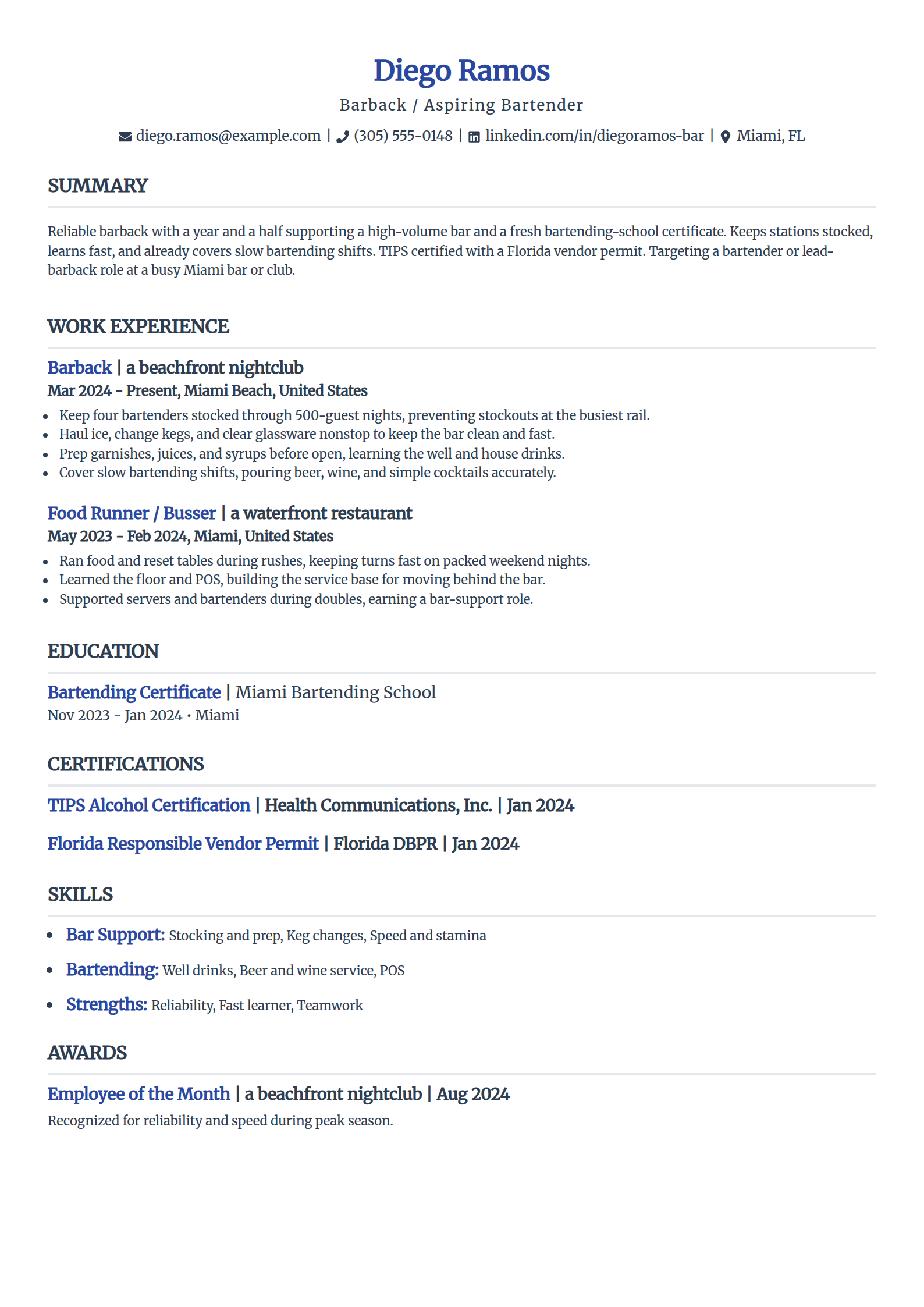
Barback Resume Template
Why this resume example works?
- Written for a barback moving up, leading with keeping four bartenders stocked through 500-guest nights.
- Shows readiness for the bar, already covering slow shifts pouring beer, wine, and simple cocktails.
- Keeps the record honest and specific, stocking, keg changes, and prep, not invented bartending years.
- Names TIPS and a Florida vendor permit, the credentials a Miami bar checks.
- Fills a plain, ATS-safe page with a first serving role and an employee-of-the-month award.
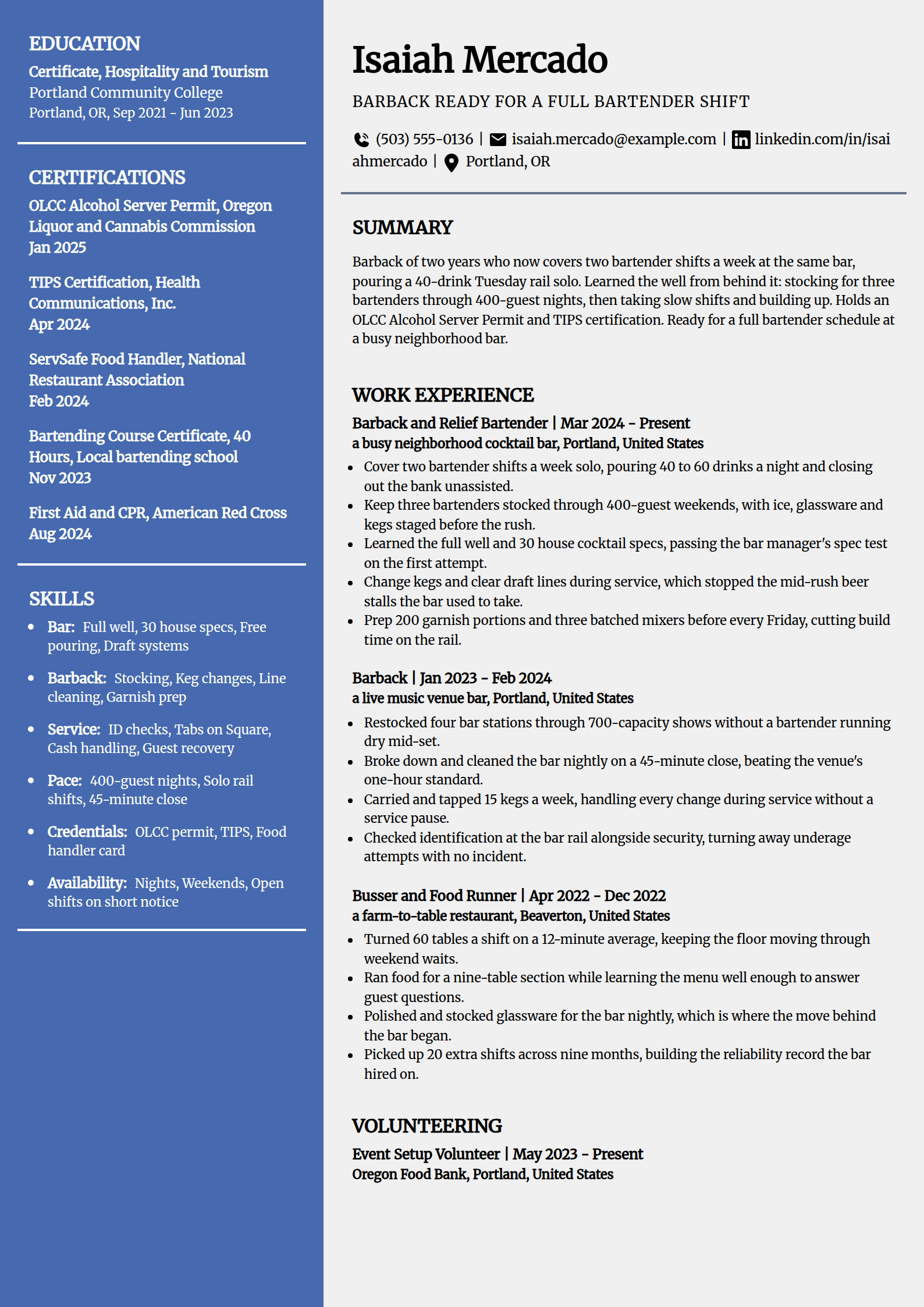
Barback to Bartender Resume Template (Promotion)
Why this resume example works?
- Argues for the promotion with evidence, two covered bartender shifts a week and a 40-drink rail poured solo.
- Proves the well is learned, 30 house specs passed on the bar manager's spec test at the first attempt.
- Keeps the barback record as a strength, three bartenders stocked through 400-guest weekends without a dry well.
- Adds the draft skill a bar promotes on, keg changes and line clearing done during service.
- Holds an OLCC permit and TIPS, so the only thing standing between this applicant and a full schedule is the schedule.
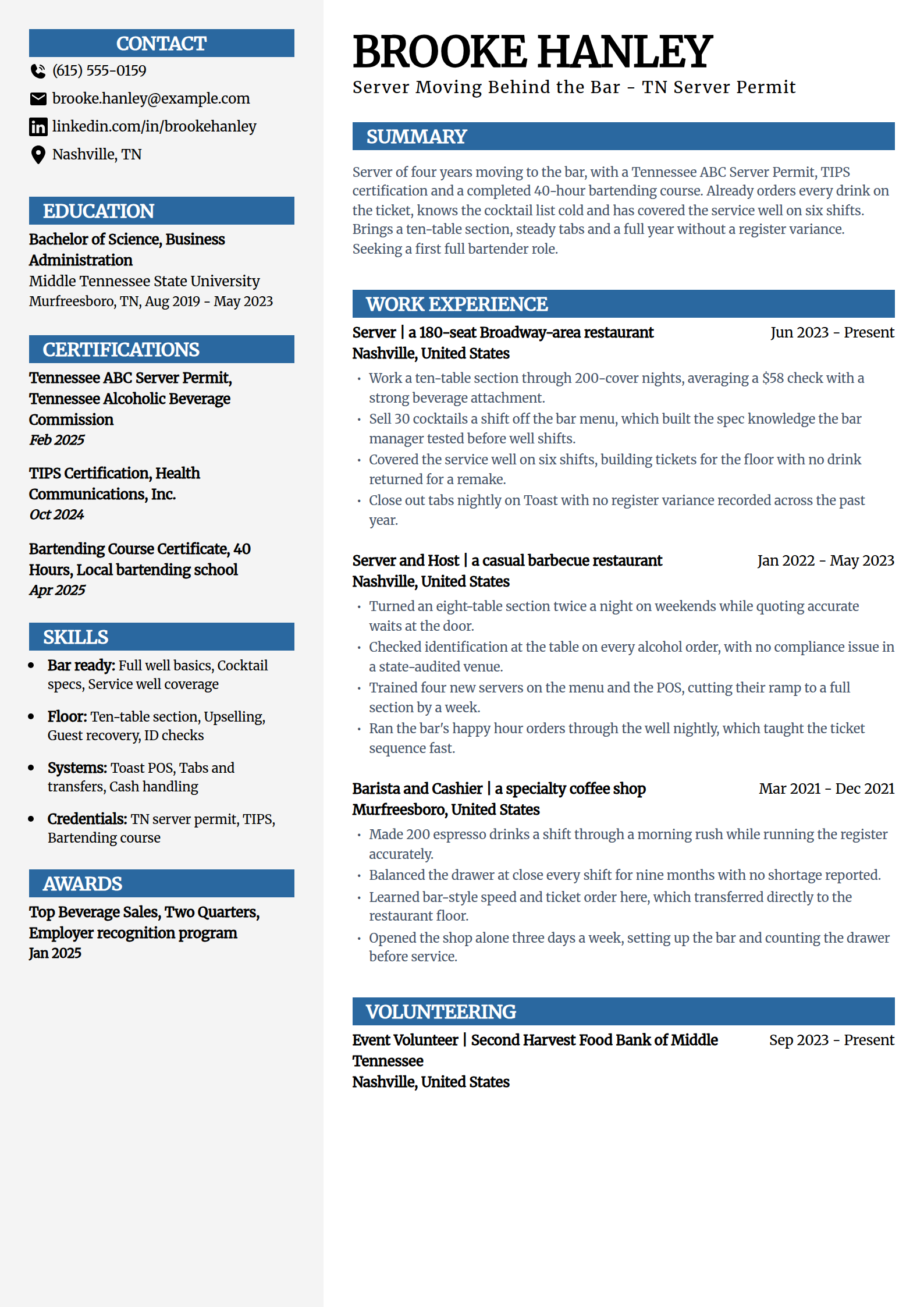
Server to Bartender Resume Template
Why this resume example works?
- Names the move in the headline so a manager reads four server years as preparation, not as the wrong experience.
- Counts the bar exposure honestly, six covered service well shifts with no drink returned for a remake.
- Uses beverage selling as the bridge, 30 cocktails a shift off the bar menu, which is how the spec knowledge was built.
- Answers the register question up front, a full year of tabs on Toast with no variance.
- Pairs a Tennessee ABC Server Permit and TIPS with a completed 40-hour course, never calling the course a license.
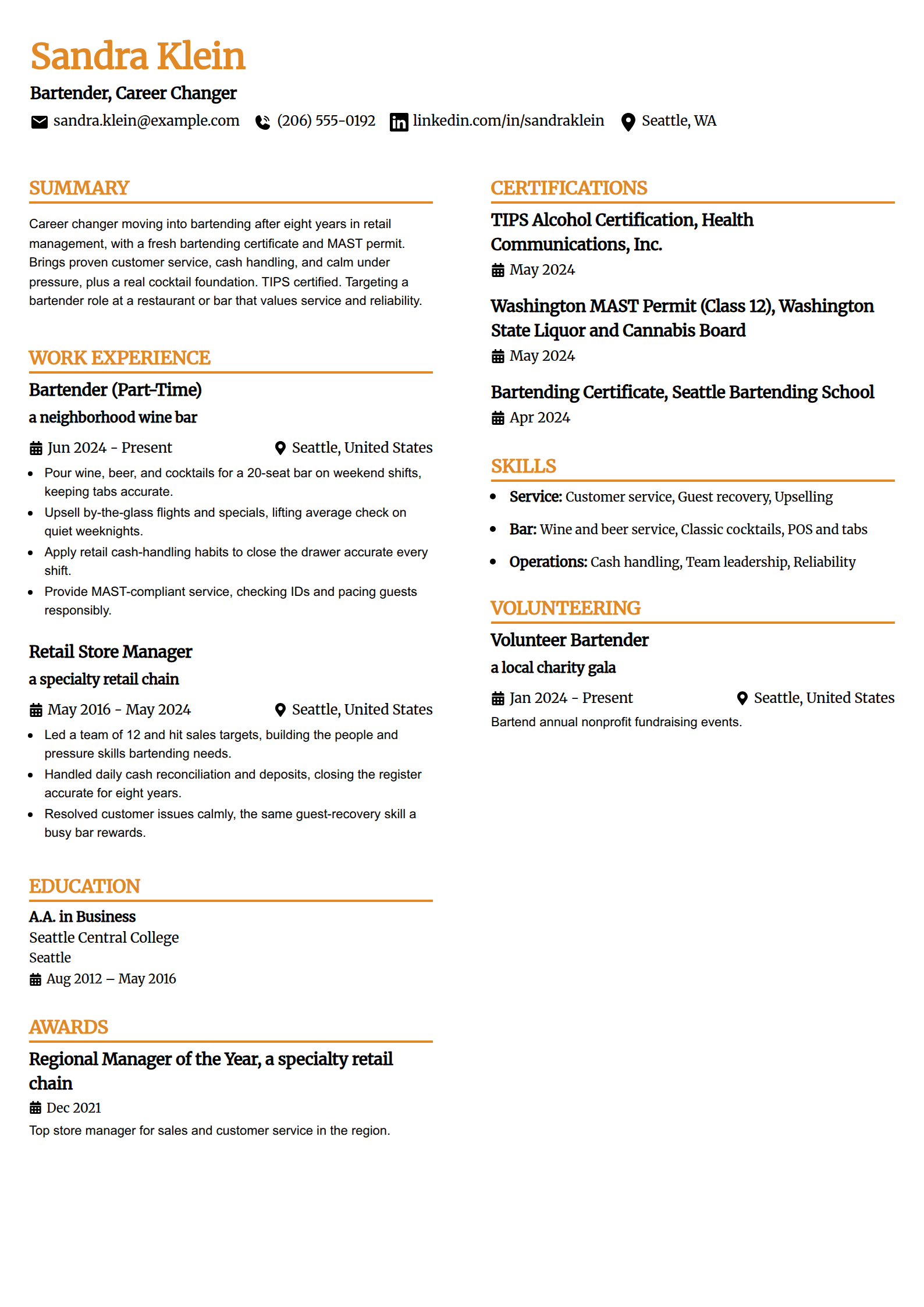
Career-Change Bartender Resume Template
Why this resume example works?
- Names the pivot openly, moving into bartending after eight years in retail management.
- Shows recent proof, part-time bar shifts pouring wine, beer, and cocktails with accurate tabs.
- Reframes prior work as an asset, cash handling and guest recovery a busy bar rewards.
- Names TIPS, a Washington MAST permit, and a bartending certificate, the credentials that make the switch real.
- Uses a tight, ATS-safe layout that keeps the focus on service and reliability.
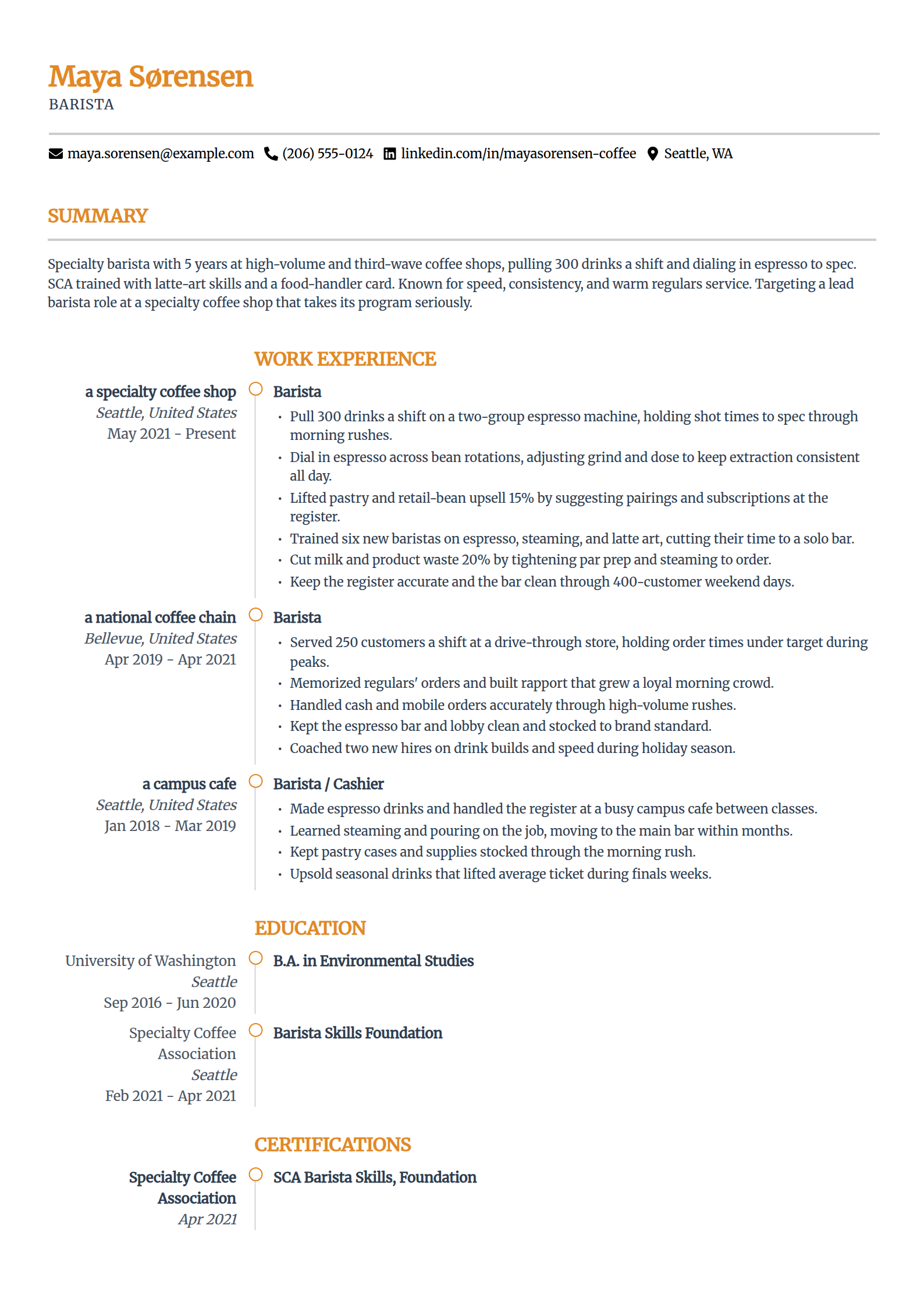
Barista Resume Template
Why this resume example works?
- Opens with barista scale, 300 drinks a shift and espresso dialed to spec through morning rushes.
- Shows the craft a specialty shop screens for, dial-in across bean rotations and latte-art training.
- Keeps the number honest for a cafe, pastry and retail-bean upsell up 15% at the register.
- Names SCA Barista Skills and a food-handler card, the right credentials for coffee, no alcohol permit.
- Uses a modern two-column layout that carries a five-year coffee record on one page.
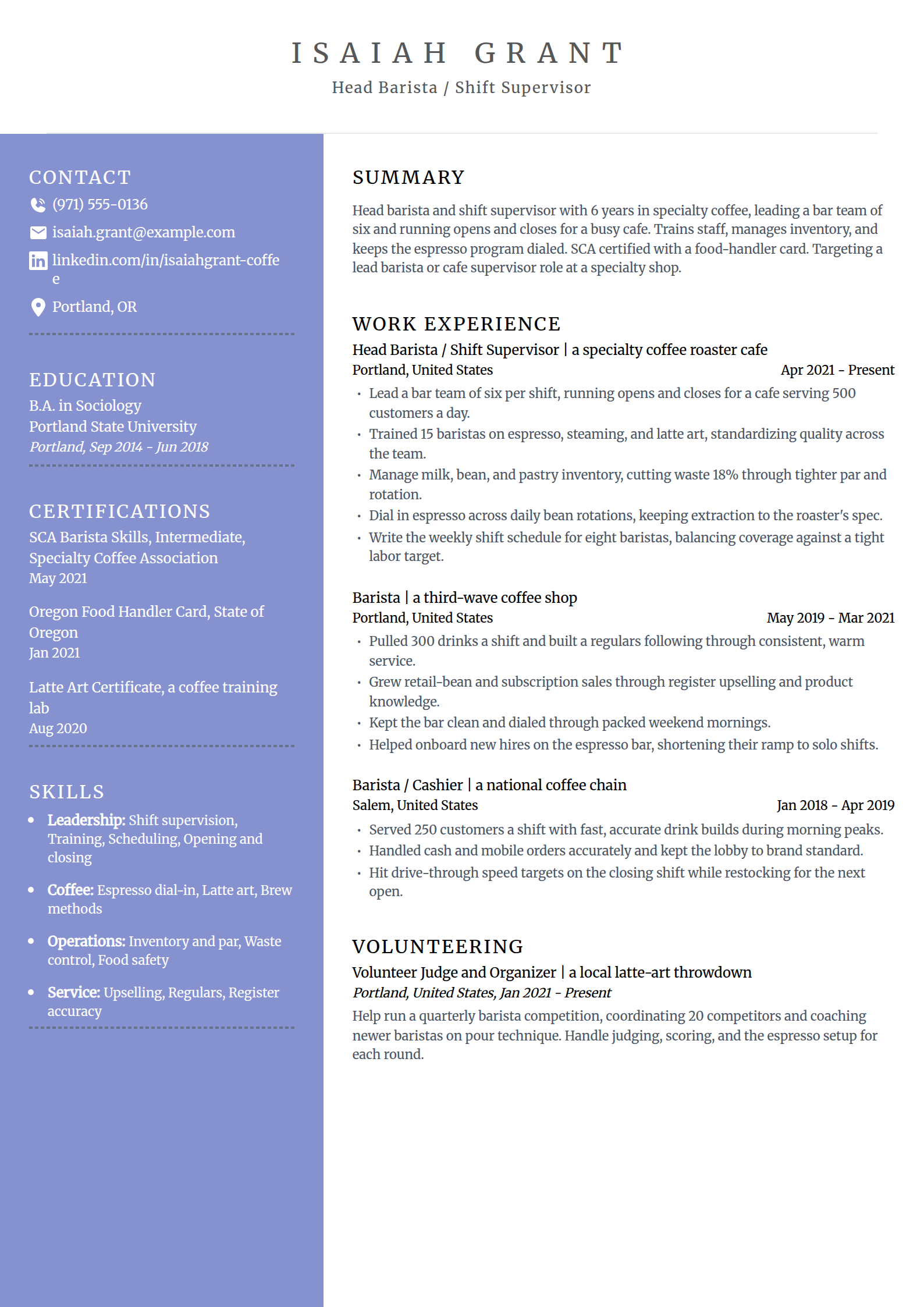
Head Barista & Shift Supervisor Resume Template
Why this resume example works?
- Leads with lead scope, a bar team of six and opens and closes for a cafe serving 500 a day.
- Shows the supervisor work a shop rewards, 15 baristas trained and waste cut 18%.
- Keeps the coffee craft visible, espresso dialed to the roaster's spec across daily rotations.
- Names SCA Intermediate certification and a food-handler card.
- Uses a roomy layout with a filled sidebar so a six-year record still looks full.
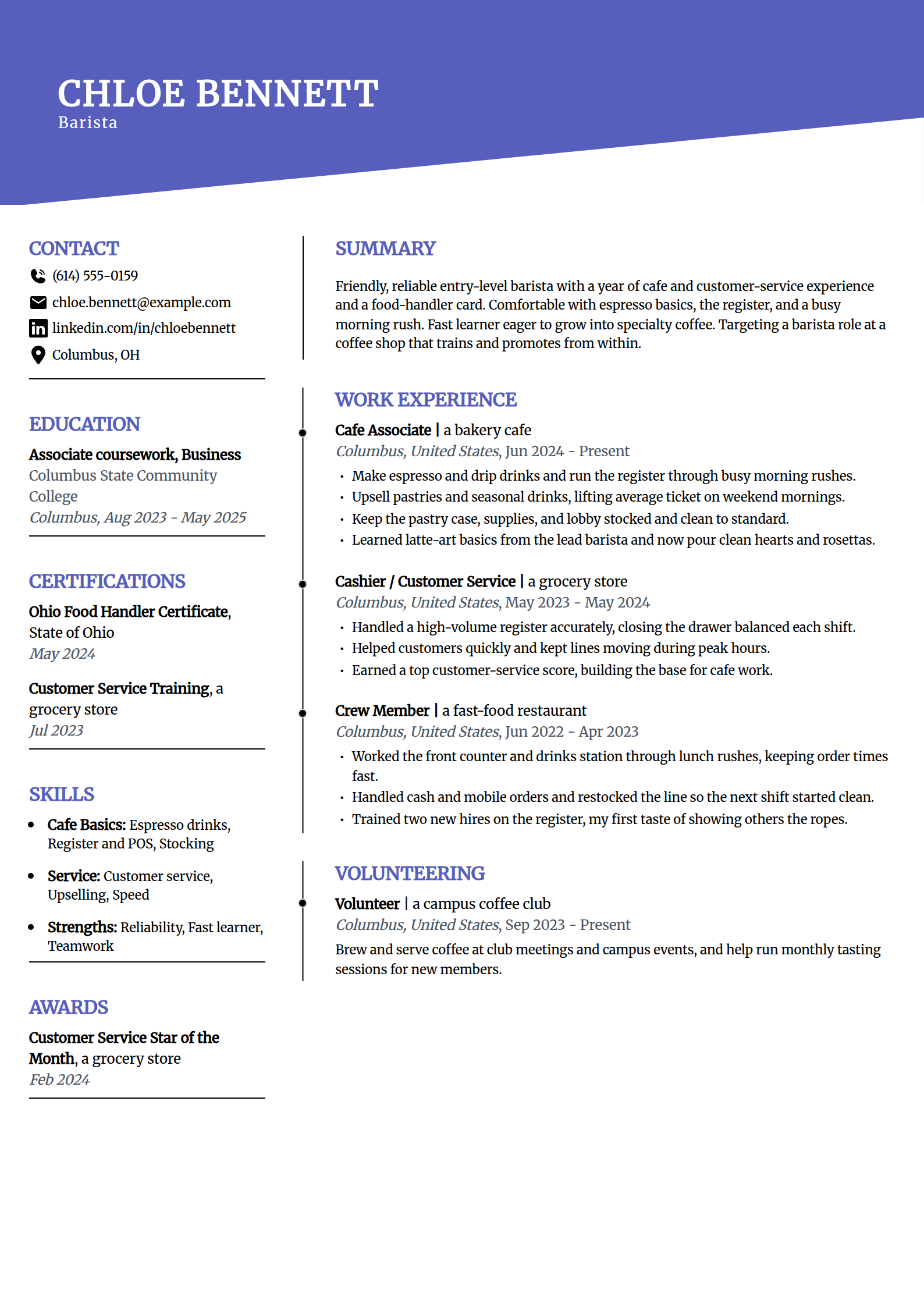
Entry-Level Barista Resume Template
Why this resume example works?
- Written for a first coffee job, leading with a year of cafe and customer-service work.
- Uses register and service experience honestly, no invented specialty-coffee years.
- Keeps each bullet real, making espresso and drip drinks and upselling pastries at the register.
- Names an Ohio food-handler certificate, the one credential an entry cafe role needs.
- Lists awards without long descriptions, keeping the layout clean and balanced.
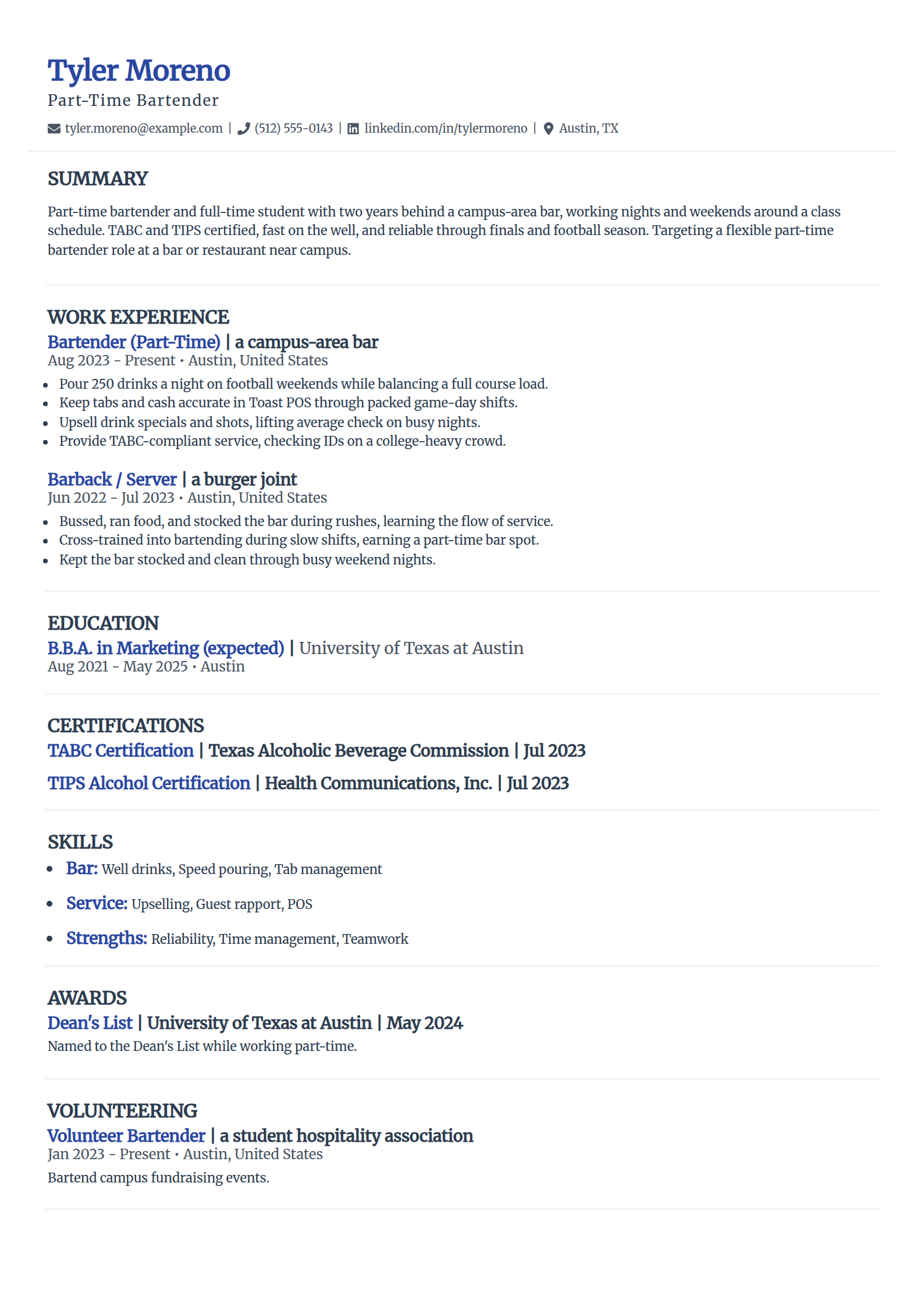
Part-Time & Student Bartender Resume Template
Why this resume example works?
- Written for a student, leading with two years at a campus-area bar around a full course load.
- Shows the reliability a bar needs, 250 drinks a night on football weekends with accurate tabs.
- Keeps the record tight and honest, a barback-to-bartender path and steady part-time shifts.
- Names TABC and TIPS, the Texas credentials an alcohol-serving job requires.
- Fills a refined, ATS-safe page with a Dean's List note and a campus volunteer role.
Build your bartender or barista resume
Pick a template above and the editor keeps your layout clean and ATS-safe while you swap in your own guest counts, sales, certifications, and drinks.
Build my resumeHow to write a bartender or barista resume in 2026
A bar or cafe resume gets scanned in seconds by a manager who is short-staffed and busy. Lead with a short summary that names your setting and your certifications, then prove each job with one quantified result. Keep the format clean and one page. The rules below apply to both bartenders and baristas; the difference is what credentials you lead with.
Open with a short, certification-first summary
Write three to four sentences that name your years and venue, your strongest number (guest volume, bar sales, or drinks per shift), your certifications, and the role you are targeting. Bartenders lead with TIPS and the state alcohol permit; baristas lead with SCA training. Keep it to about 60 words so it never spills past the top of the page.
Bartender with 7 years in high-volume bars, serving 200 guests a night and averaging $2,400 in bar sales per shift. TIPS and BASSET certified, fast on a full well, and strong at upselling premium pours. Targeting a lead bartender role at a busy craft-forward bar.
Make every experience bullet an accomplishment with a number
Open with a strong verb, then attach one credible metric that a bar or cafe manager cares about. A duty list looks the same as every other applicant.
- Use hospitality numbers: guests or covers per shift, drinks per hour, bar sales, tip average, pour cost, upsell, or ticket time.
- Open with a verb like served, poured, built, trained, or cut, never "Responsible for" or "Helped with".
- Name the method: "cut liquor cost from 24% to 19% by tightening pours" or "lifted premium sales 22% with a seasonal menu".
- Keep numbers modest and true to the venue: a nightclub does 400 drinks a night, a fine-dining bar does fewer at a higher check.
Put your certifications and permits where they get seen
Alcohol service is regulated, so a bartender's permit is a screening item, not a footnote. Match what you list to your role.
- Bartenders: list TIPS or ServSafe Alcohol and your state permit under its real name (TABC, RBS, BASSET, MAST, TAM), plus a food-handler card.
- Baristas: list SCA (Specialty Coffee Association) training, any latte-art certificate, and a food-handler card; you do not need an alcohol permit unless the venue serves it.
- A bartending-school certificate is a helpful plus for a new bartender, but it is not a license, so do not label it as one.
- New bartenders and career-changers lead with the certificate and permit they do have, plus barback or service experience.
Match skills to the venue and the posting
A skills block should read like the job you are applying to. A cocktail lounge and a drive-through cafe want different things.
- Bartenders: craft cocktails, free and speed pouring, wine and beer service, POS and tabs, inventory and pour cost, responsible service.
- Baristas: espresso dial-in, milk steaming, latte art, pour-over and batch brew, register accuracy, and food safety.
- Name the systems you have run, like Toast, Square, or Aloha POS, since a posting often screens for the exact one.
- Add the soft skills a busy bar actually rewards: speed under pressure, guest de-escalation, and reliability.
Keep the format clean and one page
Hospitality managers scan fast, and many restaurant groups run an applicant tracking system, so a clean one-page layout is the safe choice.
- Use a single-column or simple two-column layout with standard headings; skip heavy graphics that distract from your highlights.
- Keep it to one page unless you have five-plus years with management experience that genuinely needs a second.
- Save as a PDF so the formatting holds, then run it through the ATS resume checker for a quick format pass.
- Swap the numbers in the templates above for your own guest counts, sales, and certifications; do not copy them as is.
Common bartender and barista resume mistakes
- Writing duty lists with no number. Replace "made drinks and served customers" with "poured 250 drinks a night and averaged a 22% tip rate".
- Burying your certifications. A bartender's TIPS and state permit and a barista's SCA training are screening items, so put them near the top, not in a footer.
- Claiming a venue you have not worked. A resume built for a craft cocktail bar reads wrong if all your experience is a chain sports bar; match the resume to the job.
- Calling a bartending-school certificate a license. It is a helpful course, not a permit, and a manager knows the difference.
- Running two pages for a first bar job. Keep it to one clean page and let your real shifts, certifications, and speed carry it.
Frequently asked questions
How do you write a bartender resume?
Lead with a three-to-four-sentence summary that names your venue, your years, your strongest number, and your certifications. Under each job, write results-first bullets that open with a strong verb and carry one credible metric, like serving 200 guests a night, averaging $2,400 in bar sales, or cutting liquor cost from 24% to 19%. Put your TIPS or ServSafe certification and your state alcohol permit near the top where a manager checks first, match your skills to the venue, and keep the whole thing to one clean page.
How do you write a bartender resume with no experience?
Lead with the certifications and the related experience you do have. A new bartender leads with a bartending-school certificate, TIPS certification, and the state alcohol permit, then shows barback, serving, or customer-service work that proves speed, cash handling, and a busy floor. If you already cover slow bartending shifts, say so honestly. Reliability and real service experience carry more weight than invented bartending years, which a manager will see through. The entry-level, barback, and career-change examples above show the shape.
What skills and certifications does a bartender resume need?
The core certifications are TIPS or ServSafe Alcohol and your state alcohol-server permit under its real name, such as TABC in Texas, RBS in California, BASSET in Illinois, MAST in Washington, or TAM in Nevada, plus a food-handler card. For skills, name what the venue wants: craft cocktails, free and speed pouring, wine and beer service, POS and tab management, inventory and pour-cost control, and responsible service. Add the systems you have run, like Toast or Aloha, since a posting often screens for the exact one.
How is a barista resume different from a bartender resume?
The structure is the same, but the credentials and skills change. A barista resume leads with SCA (Specialty Coffee Association) training, any latte-art certificate, and a food-handler card, and it does not need an alcohol permit unless the cafe serves alcohol. The skills block names espresso dial-in, milk steaming, latte art, brew methods, and register accuracy instead of pours and cocktails. A bartender resume leads with TIPS and the state alcohol permit and names craft cocktails, wine and beer service, and pour-cost control. Match the certifications and skills to the job you want.
Should a bartender resume be one page?
Yes for almost everyone. A bartender or barista resume should fit one clean page, and a hiring manager scanning in seconds will not read past it. Use a second page only if you have five-plus years with real management experience, like a bar manager with hiring, P&L, and multi-venue history, that genuinely needs the room. For every other level, keep it to one page and cut older, unrelated jobs so the space goes to your bar or cafe work and your certifications.
What do you put on a server and bartender resume?
Show both skill sets clearly, since the value of a cross-trained hire is that they cover whatever the shift needs. Lead with a summary that names both roles, then use bullets that prove each one: an eight-table section and a strong guest-satisfaction score for the floor, and drinks per night with accurate tabs for the bar. List your TIPS certification and state alcohol permit, name the POS you have run, and add a beer or wine credential if you have one. The server-and-bartender example above shows how to fit both on one page.
What is the difference between a service bartender and a bar bartender?
A service bartender builds the drinks servers ring in for the dining room and rarely talks to a guest, so the resume is measured in tickets: tickets per hour, average ticket time, the number of server sections covered, and pour accuracy on wine and spec cocktails. A bar bartender works the rail in front of guests, so the numbers are guest counts, bar sales, upsells and tabs. Many restaurants rotate you through both. If you have done both, say so and give each one its own number, the way the service bartender and bar bartender examples above do.
How do you get from barback to bartender on a resume?
Show the shifts you have already covered. A barback resume that argues for a bartender job leads with the bartending you do now, such as two covered shifts a week and 40 drinks poured solo, then keeps the barback record as proof of pace: three bartenders stocked through 400-guest weekends, kegs changed during service, the bar closed in 45 minutes. Add the well knowledge in a checkable form, like passing the bar manager's spec test on 30 house cocktails, and put your alcohol permit and TIPS certification near the top. Do not invent bartending years; a manager will test the well.
More bartender resume resources
Build your bartender or barista resume
Pick a template above and the editor keeps your layout clean and ATS-safe while you swap in your own guest counts, sales, certifications, and drinks.