20 Server Resume Examples, Fine Dining to Fast-Casual
- ATS Friendly
- Server Specific
- 20 Sub-Role Examples
A server resume example that works carries four things: a two to three sentence summary naming your setting and section size, bullets that each pair an action with one number a manager can check, such as covers per shift or attach rate, a certifications block with ServSafe, TIPS and your state alcohol card near the top, and the POS you actually run. The twenty examples below show it across every section of the house.


540k+ resumes created
Editable server resume templates
Every template below is a real server resume laid out in that format, filtered by what matters to you. Pick one, then swap in your own section size, POS, and covers. All of them keep your job titles, dates, and contact details where a restaurant's applicant tracking system expects them.
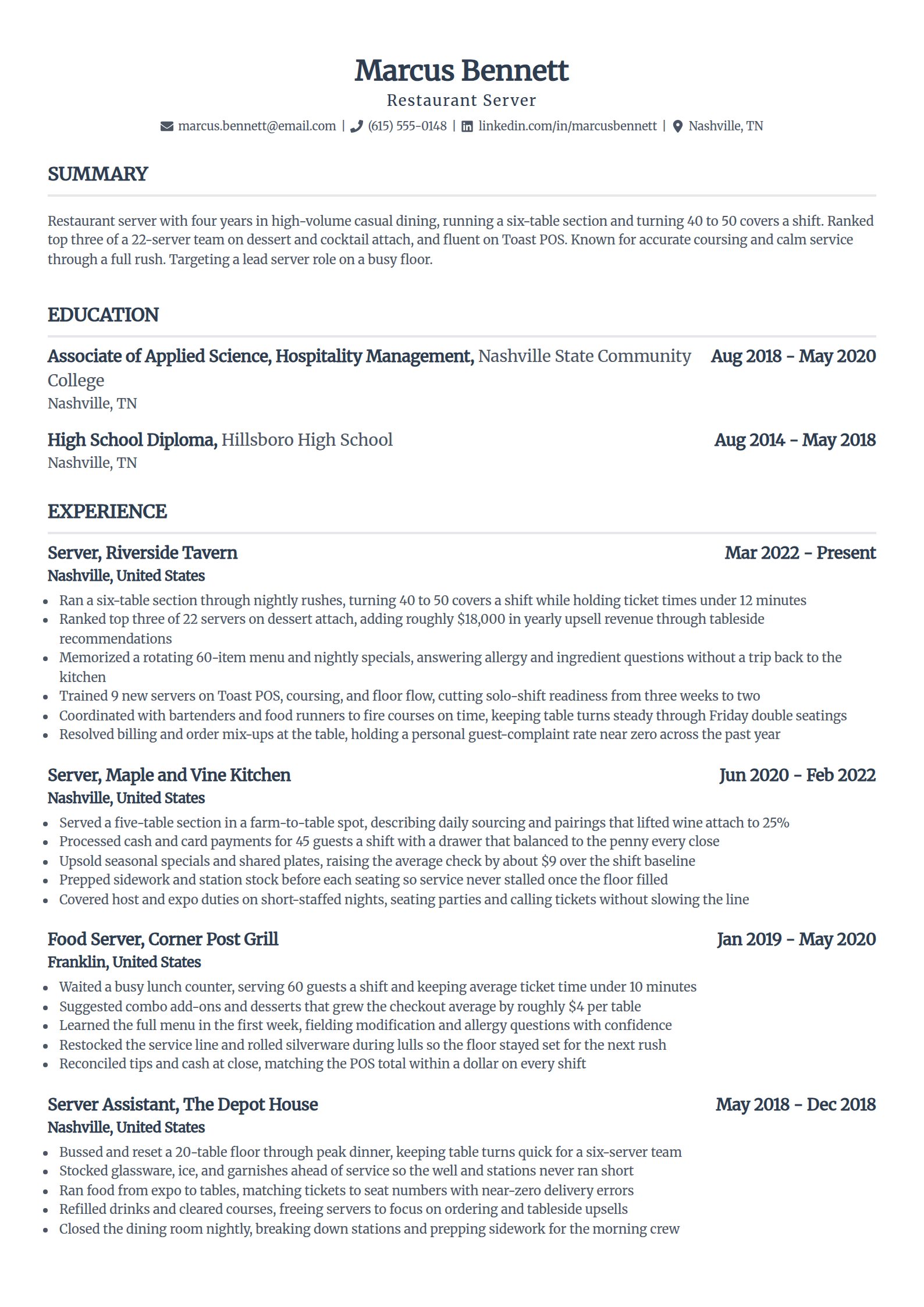
Server Resume Example (General)
Why this resume example works?
- Opens with section size and covers per shift, the two numbers a floor manager scans first.
- Leads bullets with strong verbs like Ran, Ranked, and Trained instead of listing duties.
- Names Toast POS and a dessert-attach ranking, the exact keywords a casual-dining posting uses.
- Keeps one clean single-column layout so an ATS reads job titles and dates without scrambling.
- Carries ServSafe and TIPS near the top, the certifications most server jobs screen for.
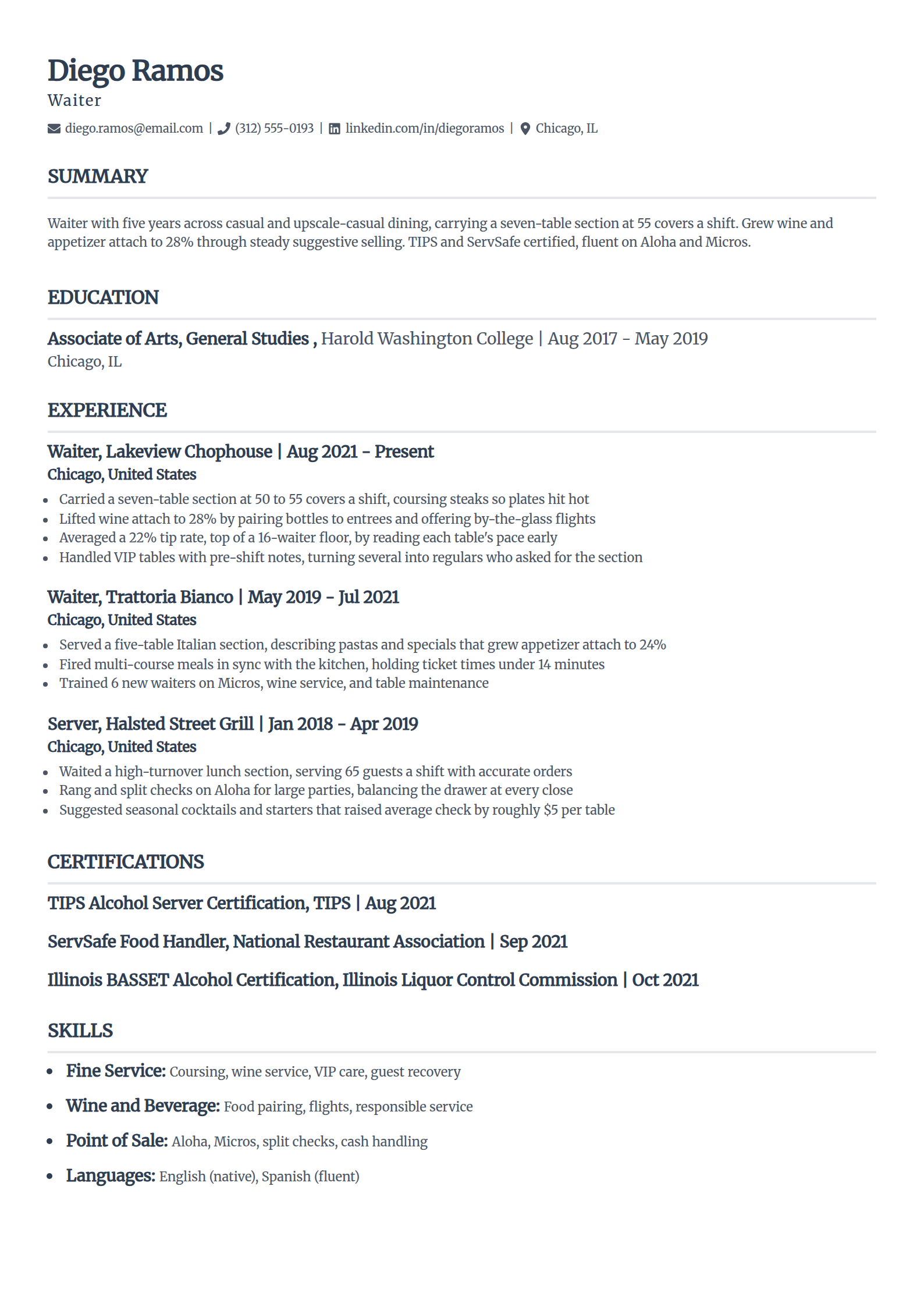
Waiter Resume Example
Why this resume example works?
- Frames a seven-table section and 28% wine attach, showing upscale full-service range.
- Backs the pitch with a top-of-floor tip ranking, a believable proof point for a waiter.
- Names Aloha, Micros, and a sommelier course, matching what chophouse postings ask for.
- Shows a clean climb from busser and runner to waiter, so the experience reads earned.
- Uses the Classic layout: reverse-chronological, standard headings, no graphics to trip a parser.
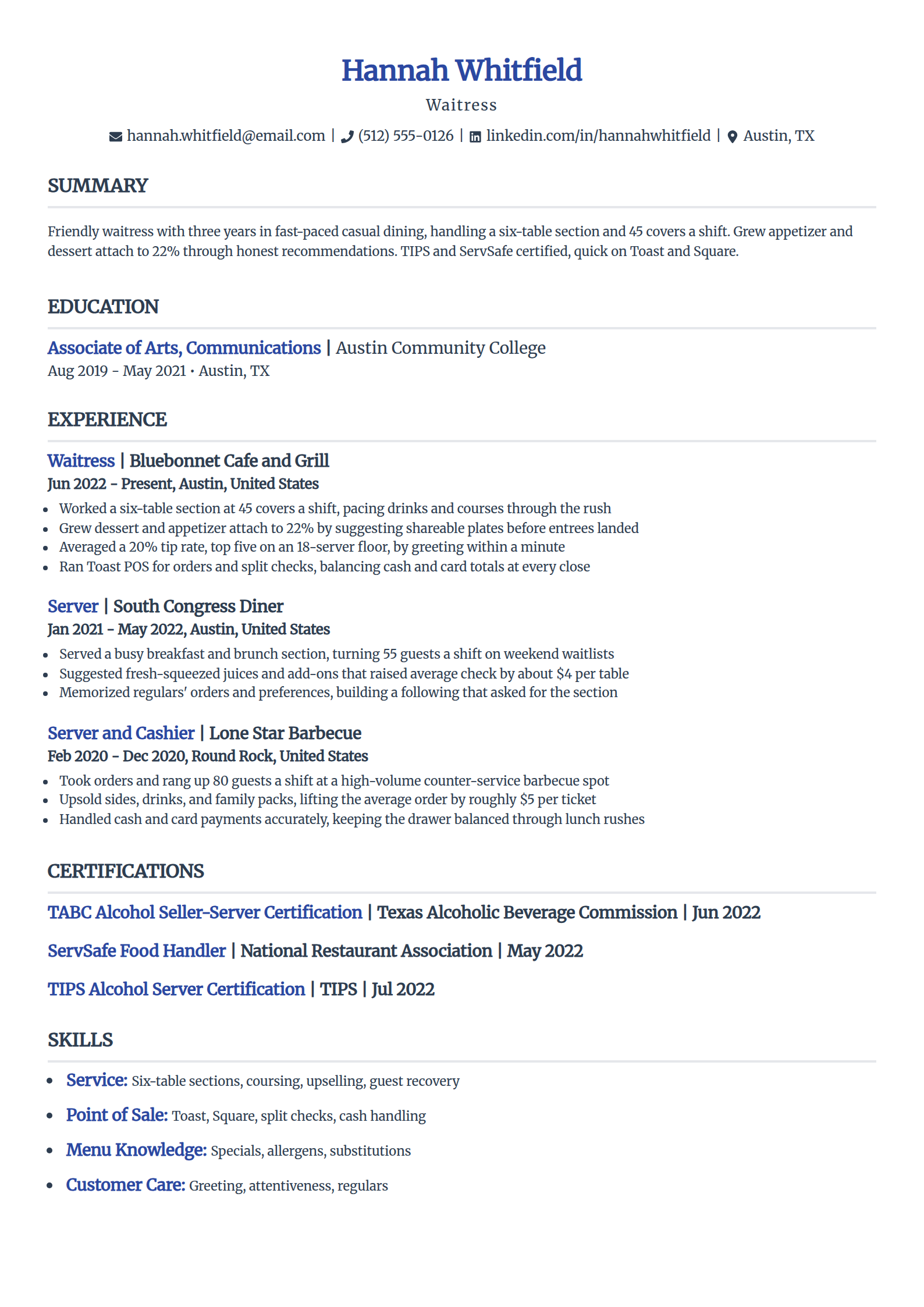
Waitress Resume Example
Why this resume example works?
- Leads with a six-table section and 22% attach rate, concrete without overclaiming.
- Highlights regulars and a top-five tip ranking, the signals neighborhood spots value.
- Names TABC, ServSafe, and Toast, so the certifications and POS keywords are covered.
- Varies the openers across jobs, leading with the setting and the workload, not just the title.
- The Simple template is uncluttered, keeping the focus on service results and dates.
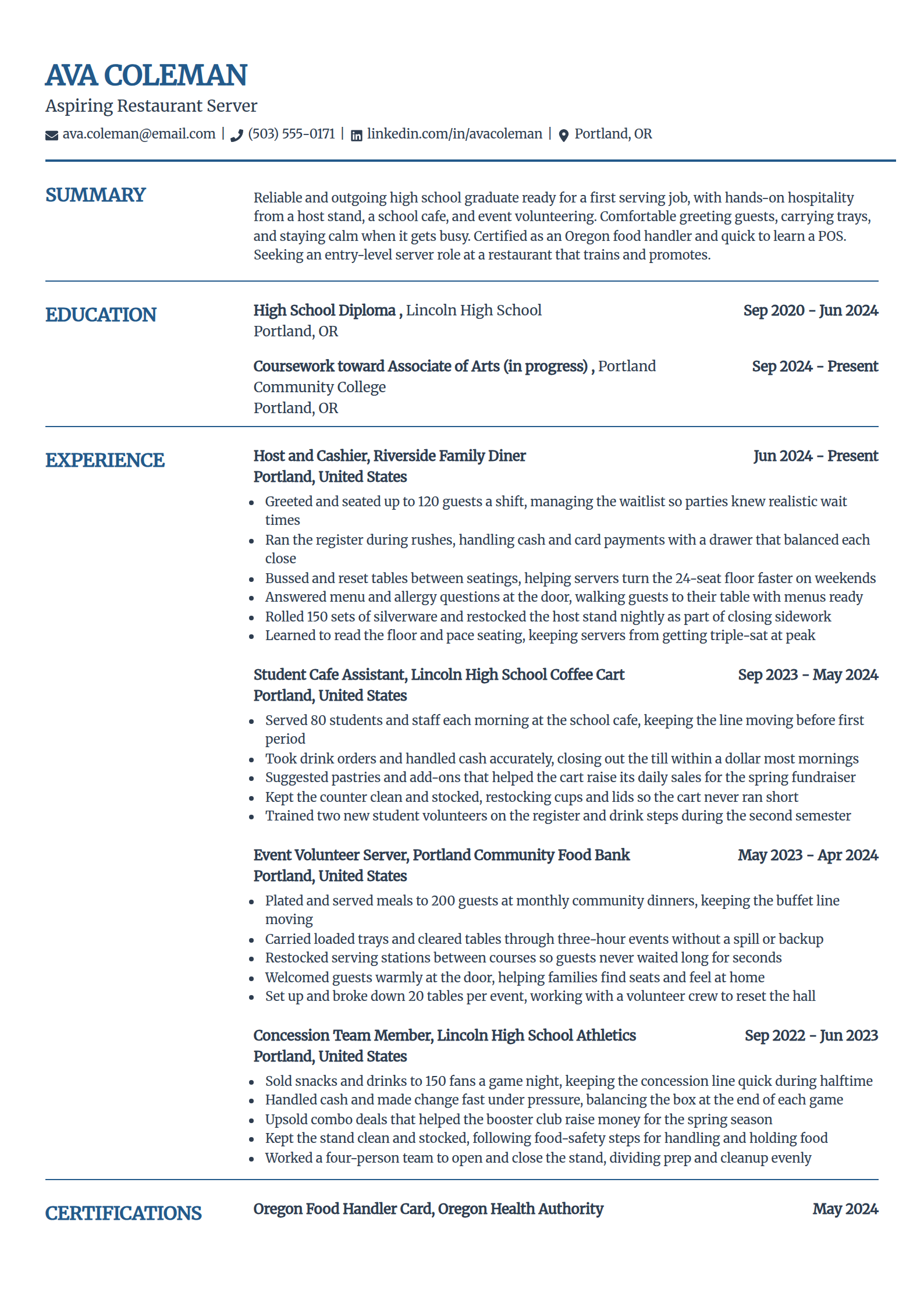
Entry-Level Server Resume Example (No Experience)
Why this resume example works?
- Fills four real entries from host, school cafe, event volunteering, and concessions, not empty space.
- Treats host and volunteer work as experience with dates and bullets, the honest no-experience move.
- Keeps numbers teen-appropriate, like seating 120 guests, with no invented revenue claims.
- Puts a food handler card and CPR up top to show the candidate is ready to start day one.
- The Craft template adds light structure while staying ATS-safe for a first application.
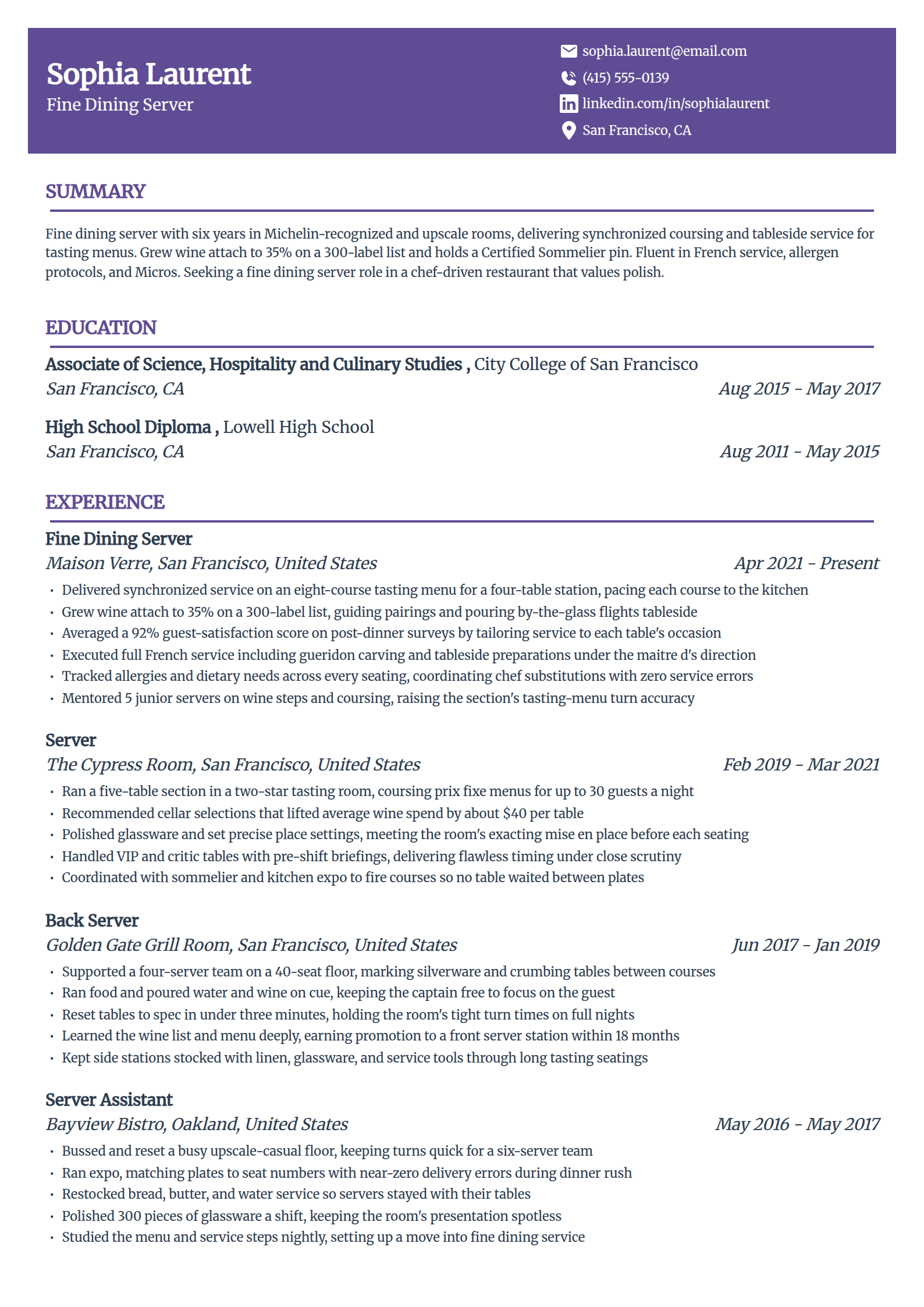
Fine Dining Server Resume Example
Why this resume example works?
- Leads with tasting-menu coursing and a 35% wine attach on a 300-label list, the fine-dining signal.
- Puts a Certified Sommelier pin near the top, the credential upscale rooms screen for first.
- Names French service, gueridon, and allergen protocols, the exact language of chef-driven spots.
- Shows the climb from back server to front server, so the polish reads as trained, not claimed.
- The two-column Panorama layout fills both columns with certs and skills without losing ATS readability.
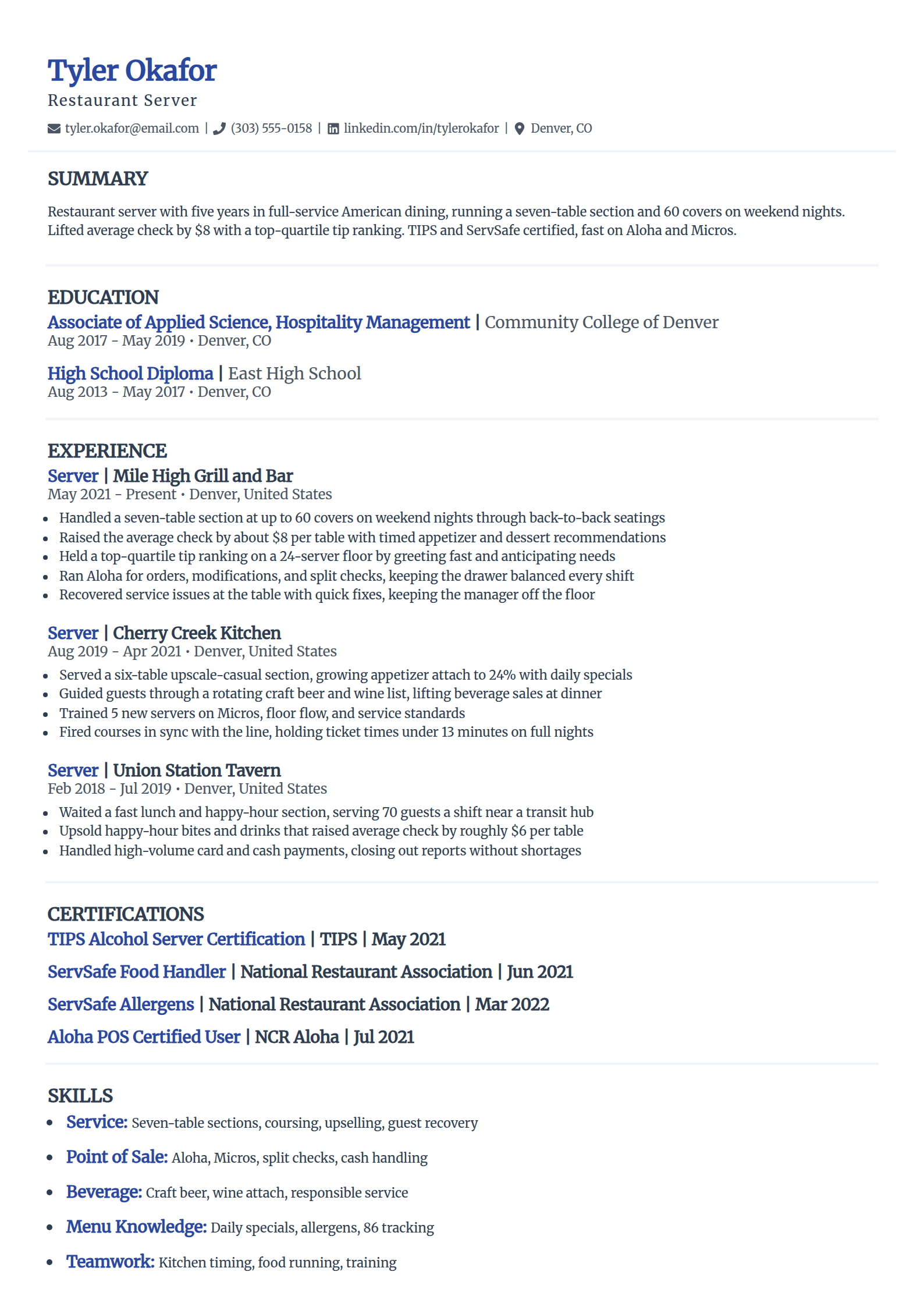
Restaurant Server Resume Example
Why this resume example works?
- Opens with a seven-table section at 60 covers, the workload a high-volume room hires for.
- Ties an $8 average-check lift to specific upselling, a result rather than a duty.
- Names Aloha, Micros, and 86 tracking, showing real front-of-house fluency.
- Keeps a top-quartile tip ranking as proof without stacking multiple percentages in one line.
- The Elegant template stays clean and single-column so dates and titles parse cleanly.
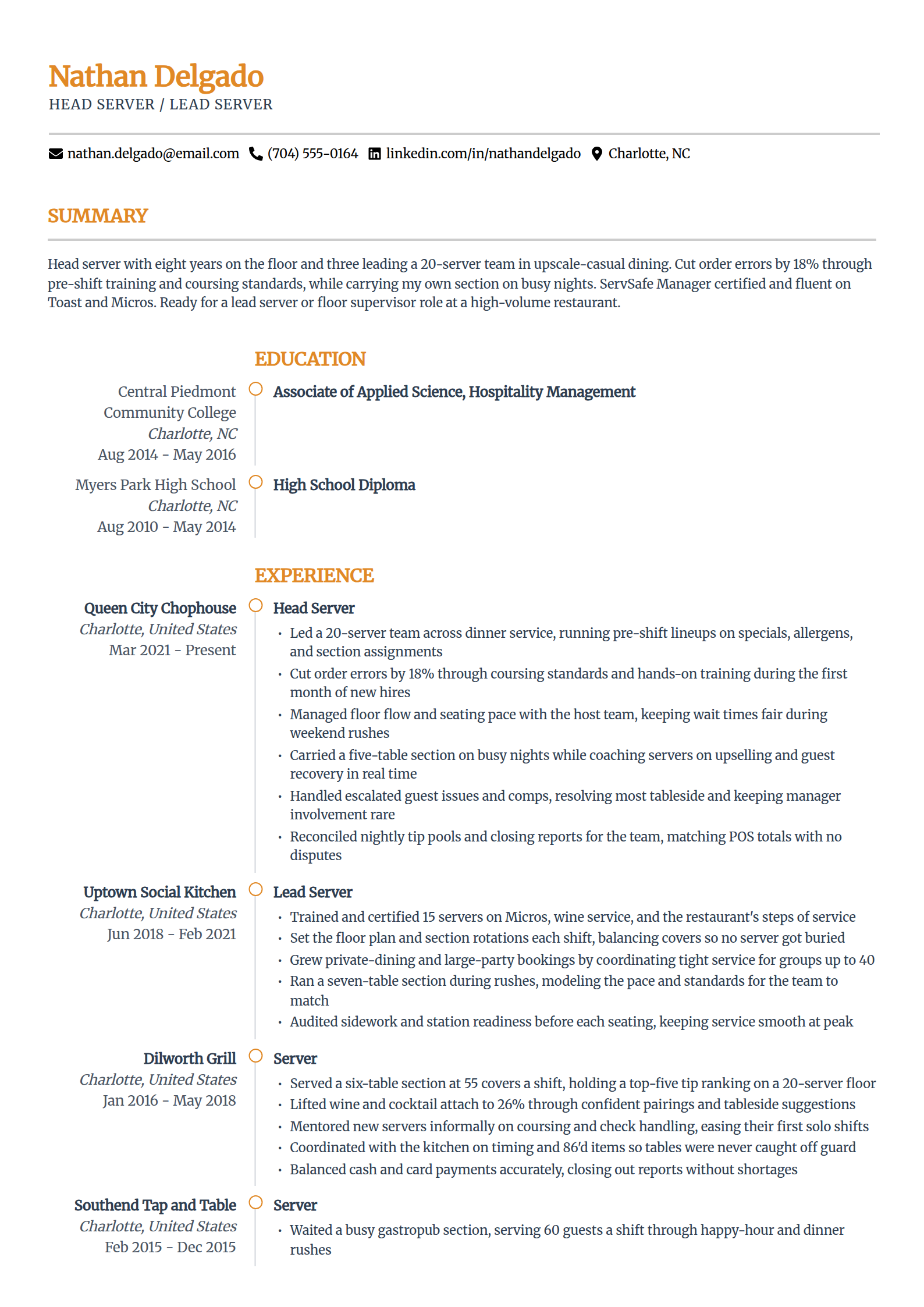
Head Server & Lead Server Resume Example
Why this resume example works?
- Separates eight years on the floor from three leading a team, so both are easy to see.
- Carries an 18% cut in order errors, a leadership metric a floor manager reports on.
- Shows pre-shift lineups, section rotations, and training, the daily work of a lead server.
- Keeps ServSafe Manager up top, the certification that signals a supervisory hire.
- The Zenith template frames the leadership story while keeping the parse ATS-safe.
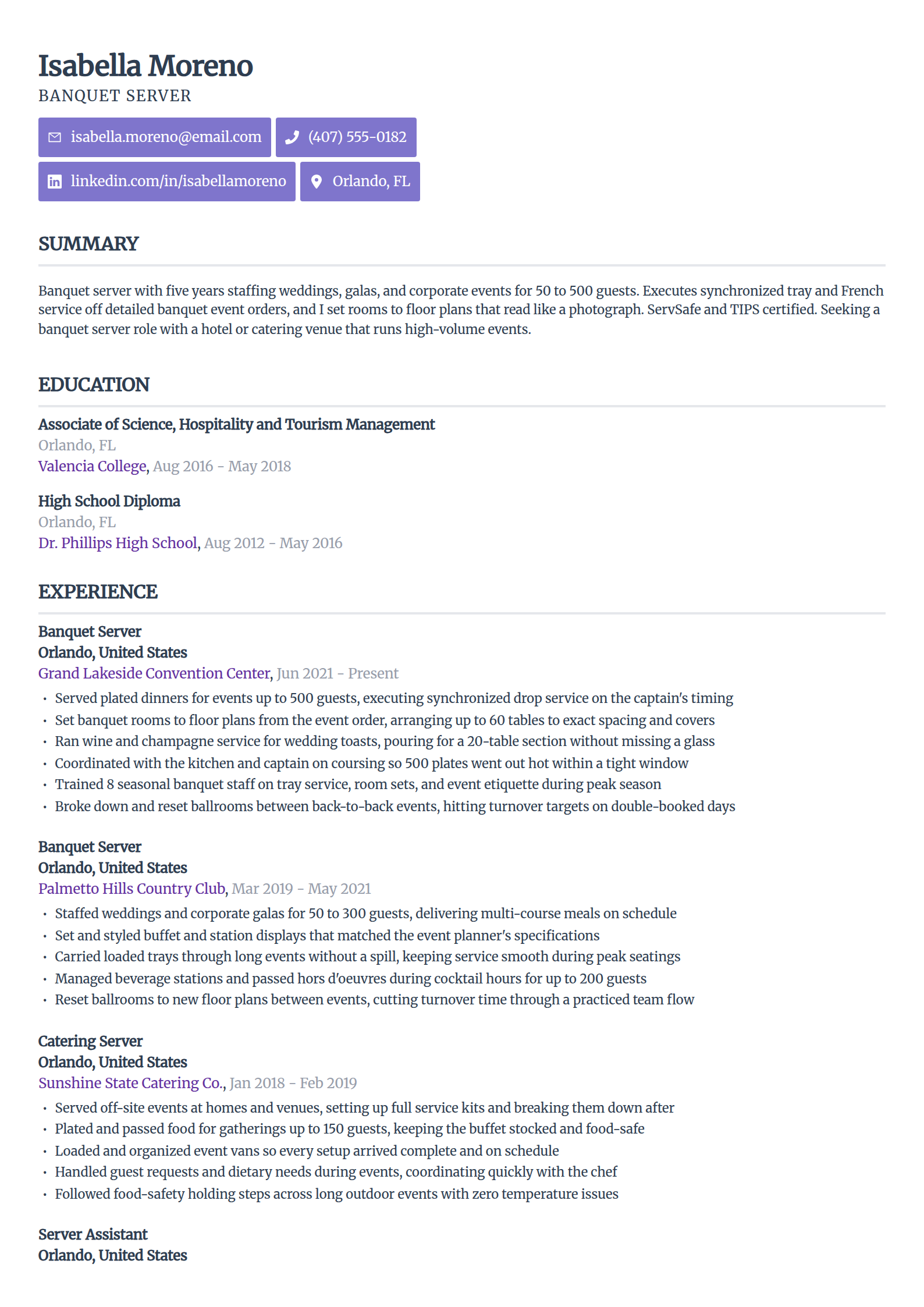
Banquet Server Resume Example
Why this resume example works?
- Leads with events up to 500 guests and synchronized drop service, the banquet proof point.
- Names banquet event orders, floor plans, and room turnovers, the language of event venues.
- Shows wine and champagne service for toasts, a specific skill weddings require.
- Ties setup and teardown to double-booked days, showing stamina and speed under deadlines.
- The Sleek Framework layout fills the sidebar with certs and skills for a full page.
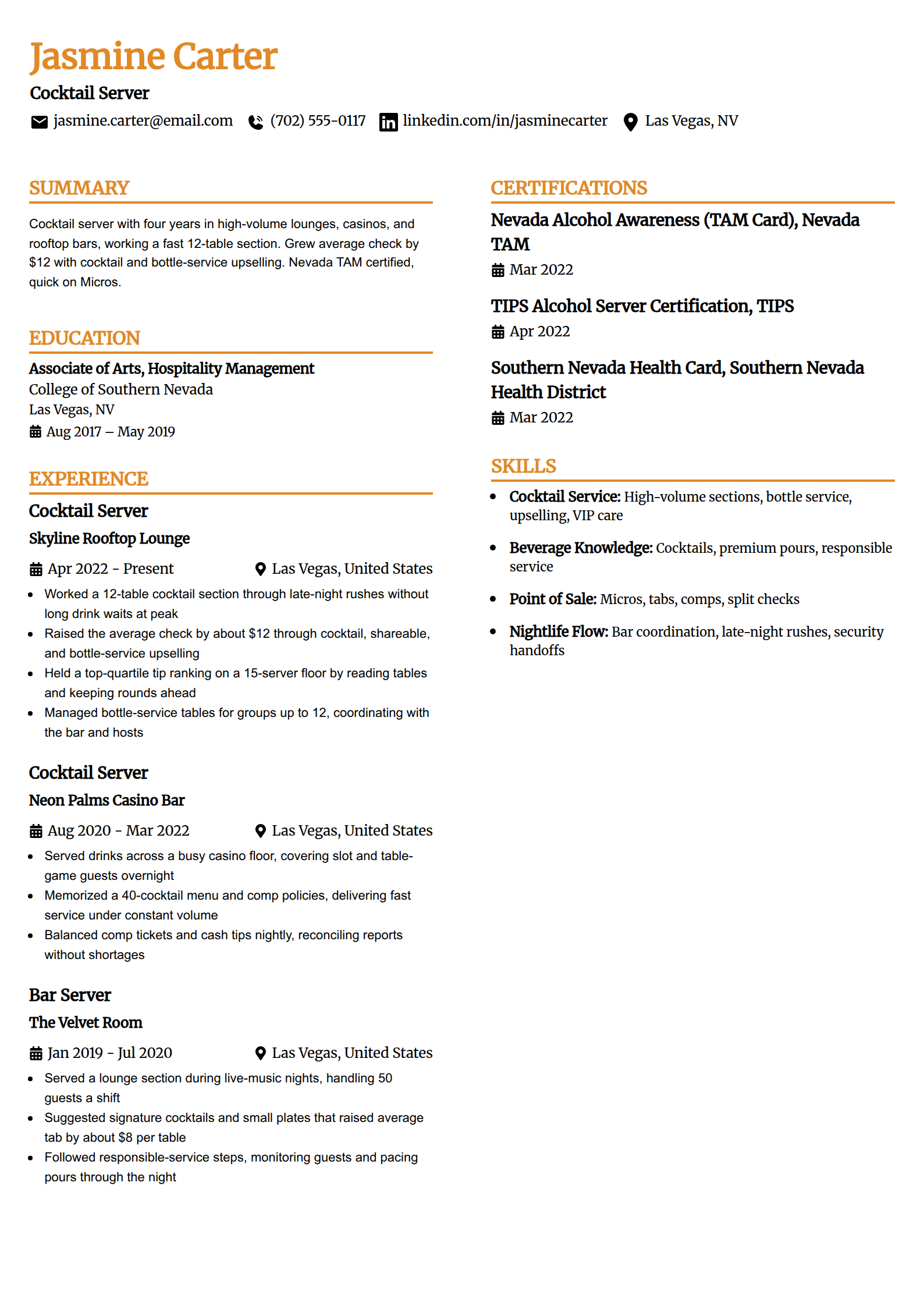
Cocktail Server Resume Example
Why this resume example works?
- Opens with a fast 12-table section and a $12 check lift, the nightlife result that matters.
- Names bottle service, casino floor coverage, and late-night rushes, the exact venue keywords.
- Shows responsible-service handling of cutoffs and security, which lounges and casinos require.
- Carries a Nevada TAM card and TIPS up top, the state-specific alcohol credentials.
- The Professional Edge template keeps a sharp look while staying parser-friendly.
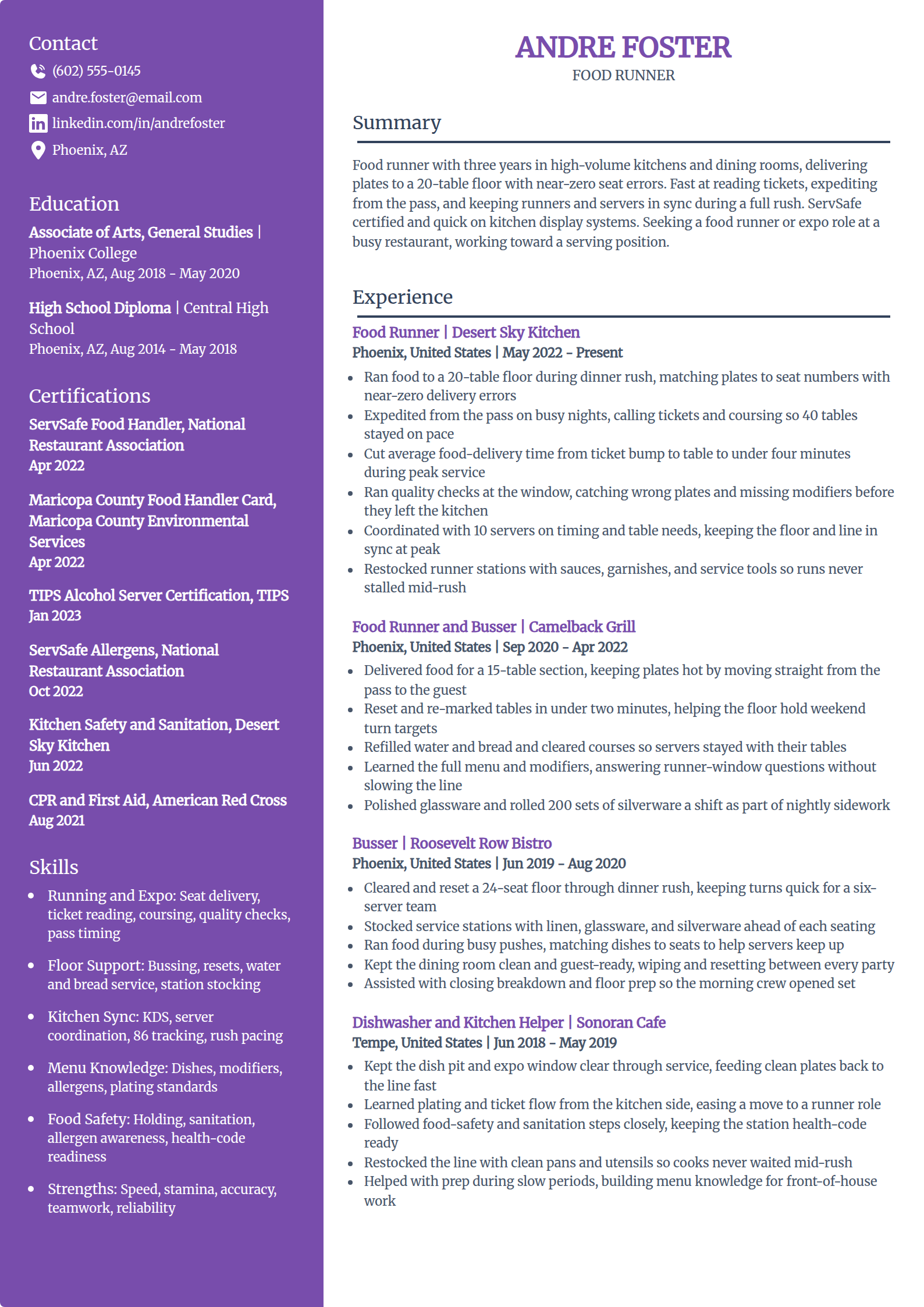
Food Runner Resume Example
Why this resume example works?
- Leads with seat-accurate delivery to a 20-table floor, the core food-runner skill.
- Ties a sub-four-minute delivery time to peak service, a result rather than a task.
- Names expediting, KDS, and quality checks at the pass, showing kitchen-to-floor fluency.
- Shows a path from dish pit and busser toward serving, so the ambition is clear.
- The Pioneer template keeps the layout clean for a fast, entry-friendly parse.
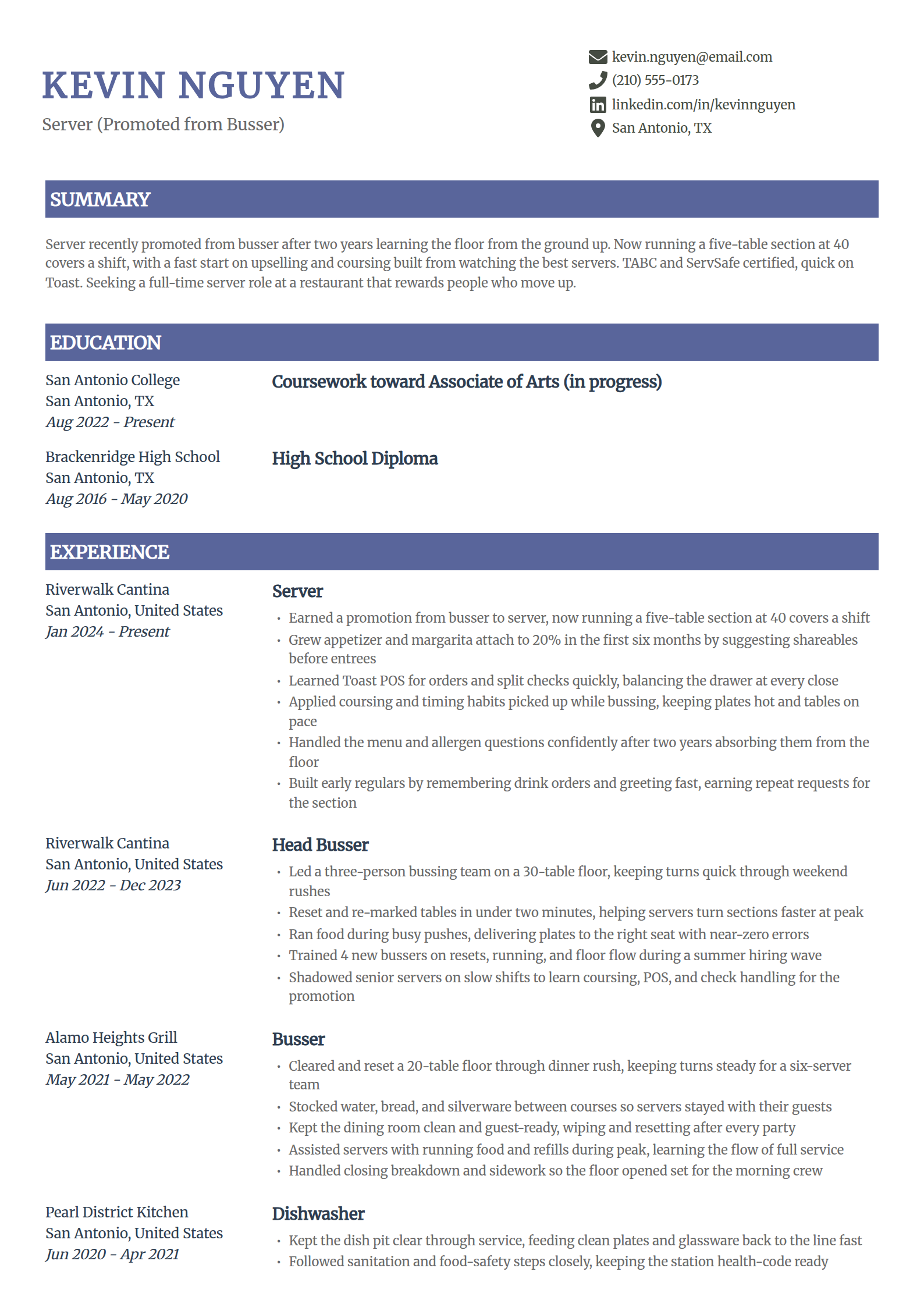
Busser-to-Server Resume Example
Why this resume example works?
- Frames a real promotion from busser to server, the story this candidate should lead with.
- Shows 20% attach built fast from watching senior servers, believable for a new server.
- Keeps the head-busser and busser roles as proof of floor foundation, not filler.
- Names Toast and TABC so the POS and alcohol keywords are covered for the step up.
- The Catalyst template signals momentum while keeping headings ATS-standard.
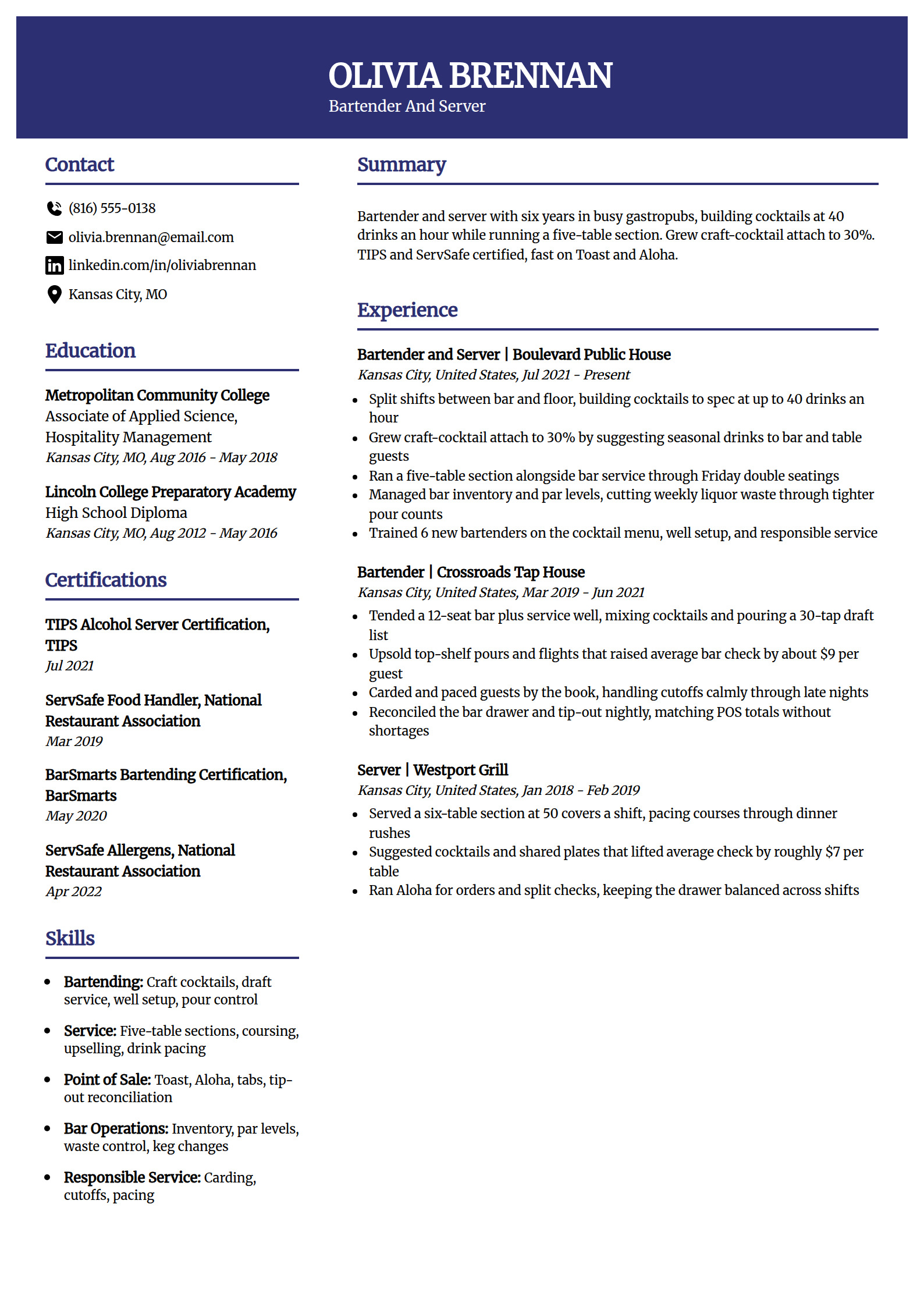
Bartender & Server Resume Example
Why this resume example works?
- Leads with a dual role, building 40 drinks an hour while running a five-table section.
- Ties 30% craft-cocktail attach to suggestive selling at both the bar and the table.
- Names inventory, par levels, and waste control, the bar-operations work managers want.
- Carries TIPS and a bartending certification up top for the dual-role hire.
- The Visionary template supports the versatile profile without breaking the parse.
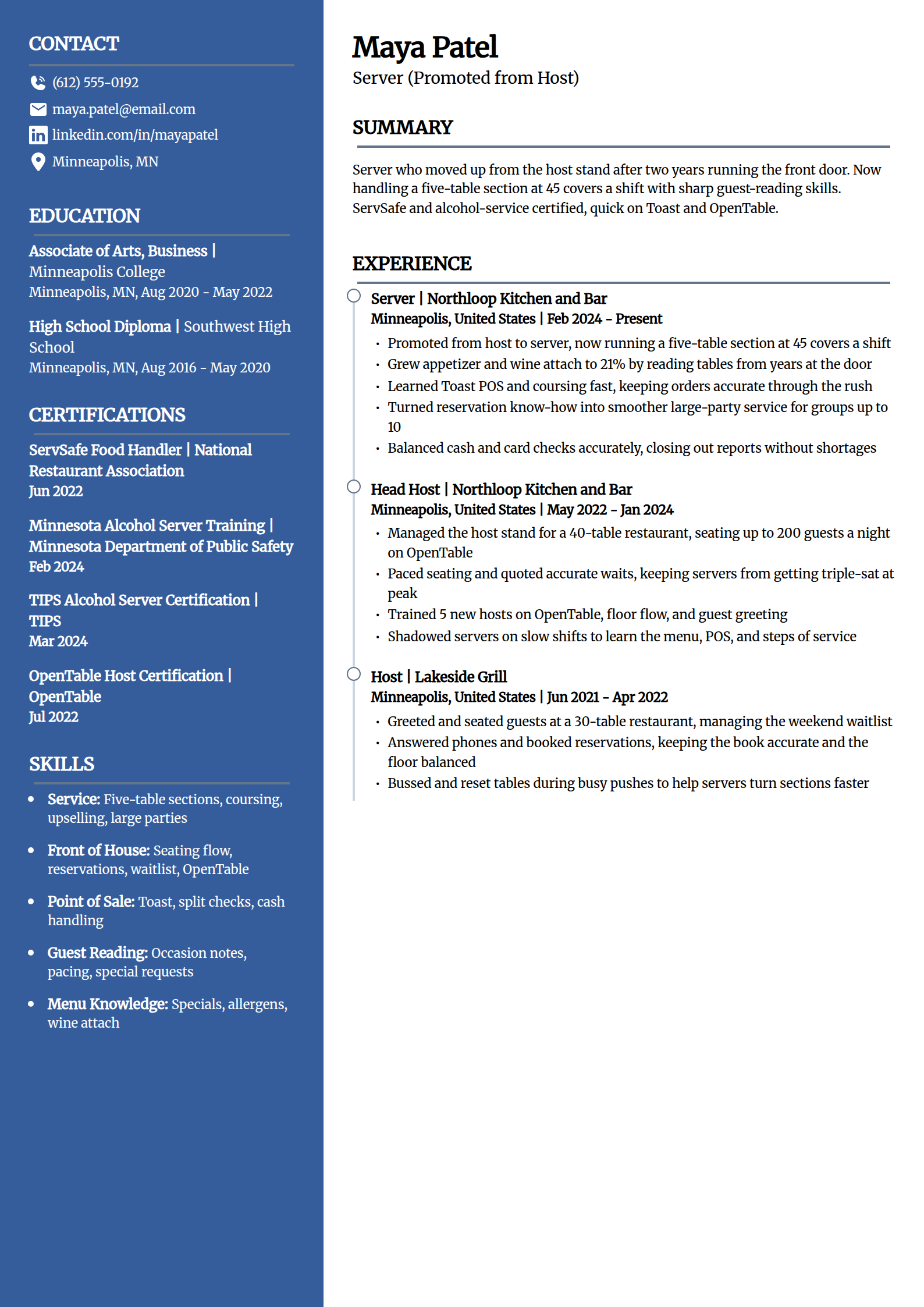
Host-to-Server Resume Example
Why this resume example works?
- Opens with the promotion from host, turning door and seating know-how into floor service.
- Shows reservation and large-party skills carried from the host stand to the section.
- Names OpenTable and Toast, connecting the front-desk tools to the serving role.
- Keeps a retail role as extra proof of customer service and cash handling.
- The Creative template adds personality while keeping section headings standard.
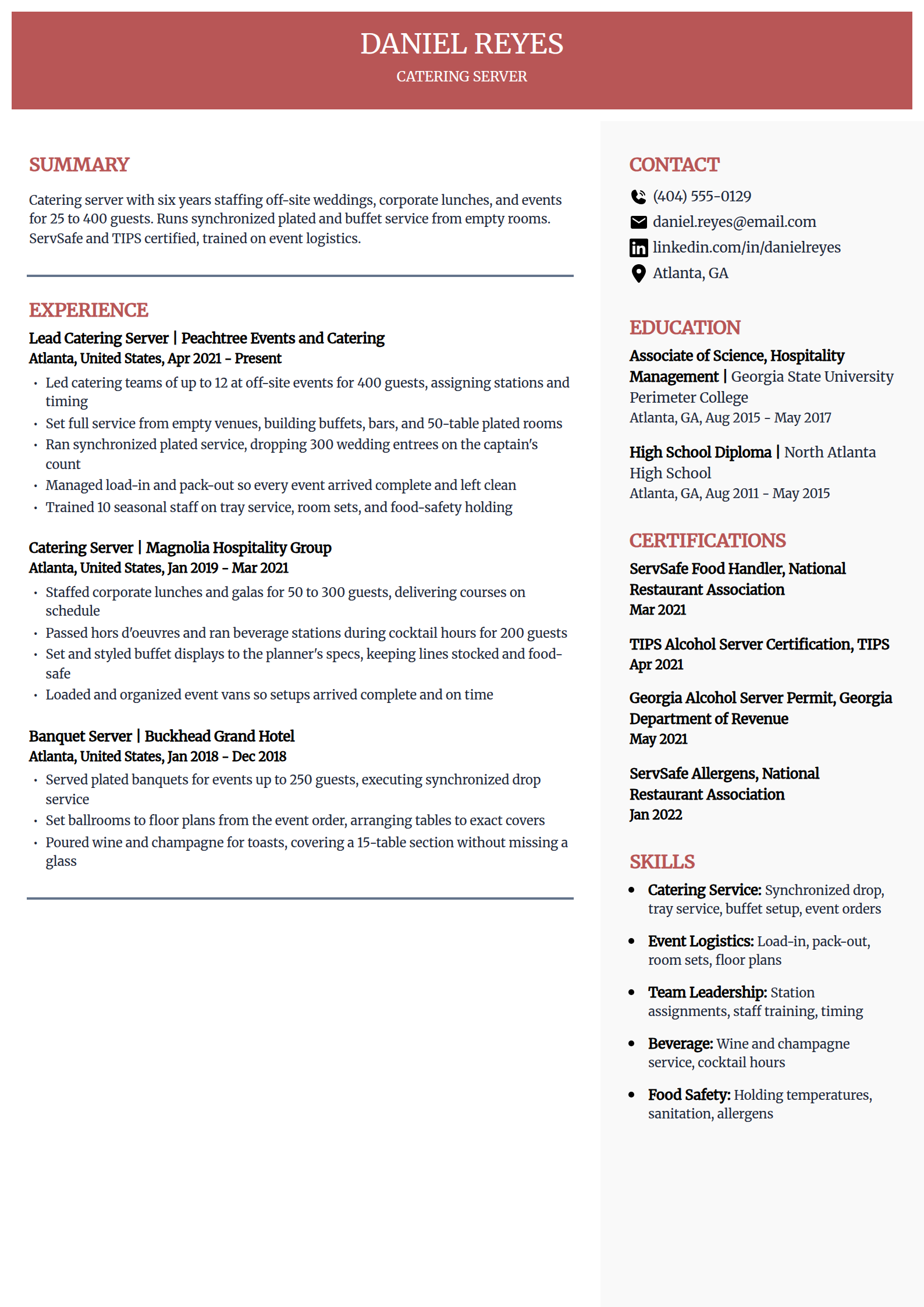
Catering Server Resume Example
Why this resume example works?
- Leads with lead-server duties at off-site events for up to 400 guests, the catering signal.
- Names load-in, pack-out, and synchronized plated service, the logistics caterers hire for.
- Shows team leadership and station assignments, a step above a solo banquet server.
- Keeps ServSafe and event-logistics training up top for a high-touch catering role.
- The Executive template gives a polished, senior look while staying ATS-safe.
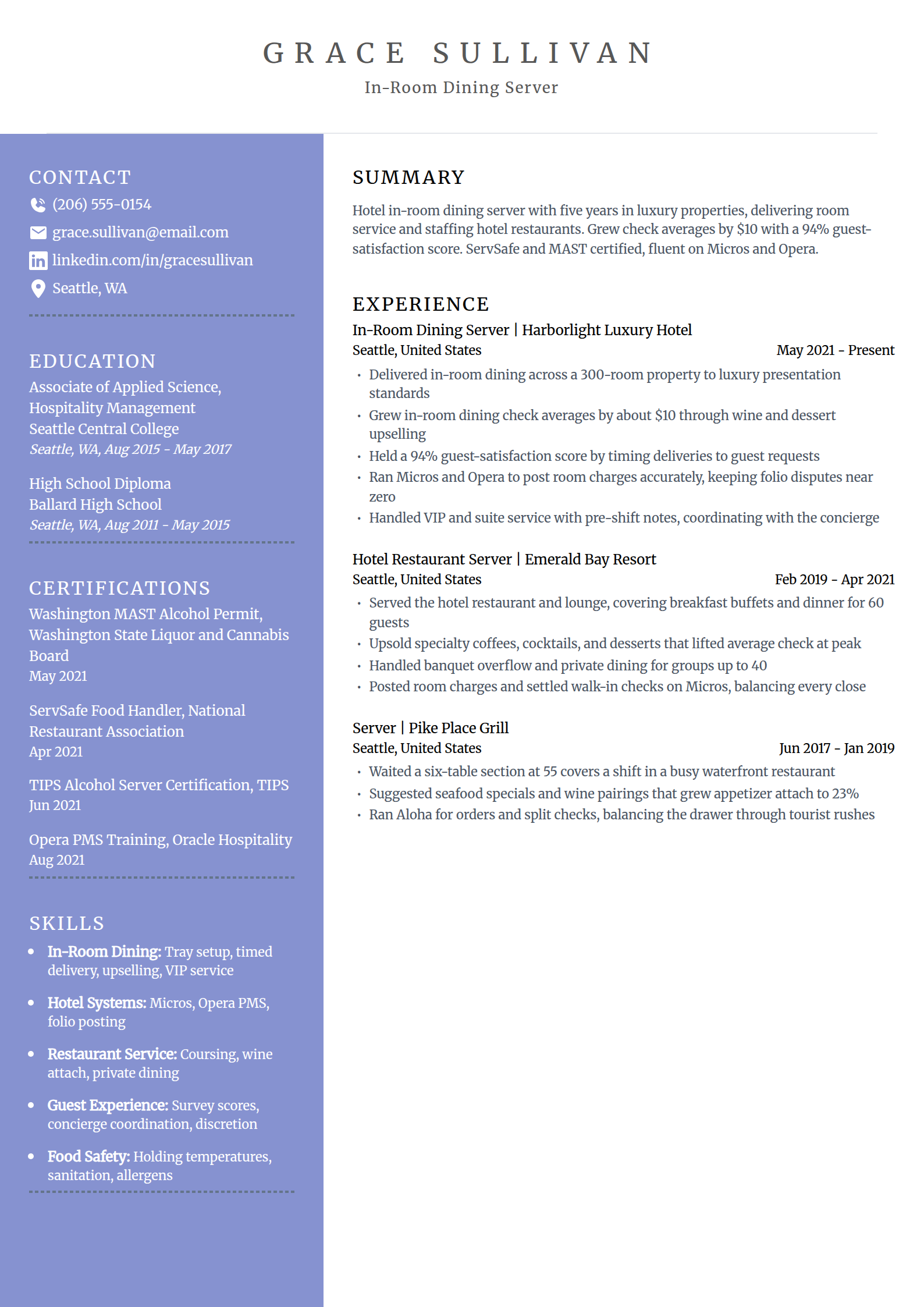
Room Service & Hotel Server Resume Example
Why this resume example works?
- Opens with in-room dining at a 300-room property and a 94% guest-satisfaction score.
- Names Micros and Opera PMS with room-charge posting, the exact hotel systems.
- Shows restaurant, lounge, and banquet coverage, the range luxury properties expect.
- Ties a $10 check lift to on-delivery upselling, a result a hotel outlet tracks.
- The Luminary template presents an upscale look while keeping the parse clean.
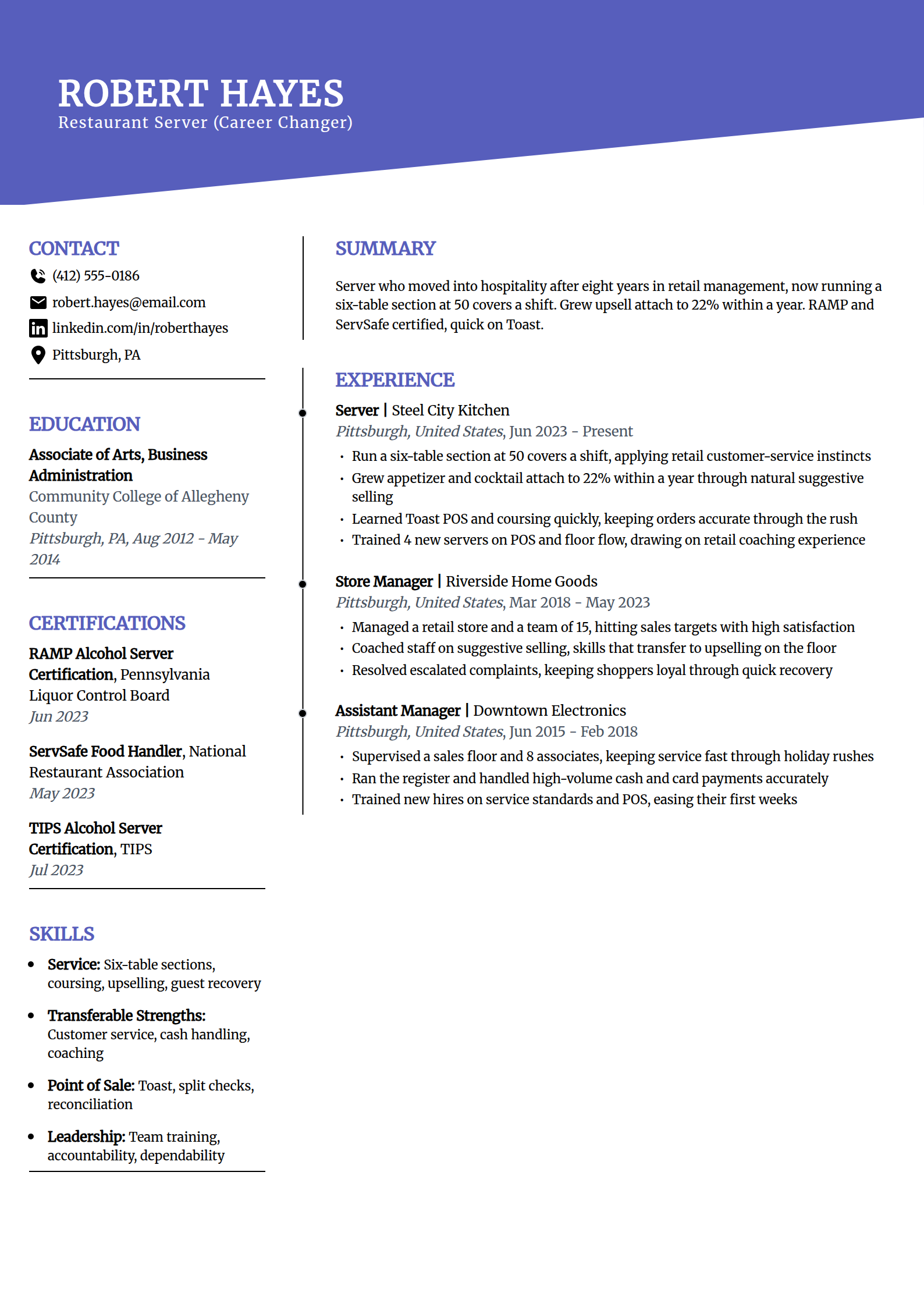
Career-Changer Server Resume Example
Why this resume example works?
- Leads with the current server role first, so the reader sees the transition is already made.
- Translates retail management into serving strengths: customer service, cash handling, coaching.
- Shows 22% attach built within a year, a modest, honest number for a recent switch.
- Keeps RAMP, ServSafe, and Toast up top to close any doubt about restaurant readiness.
- The Orbit template frames a mature, cross-industry story while staying parser-friendly.
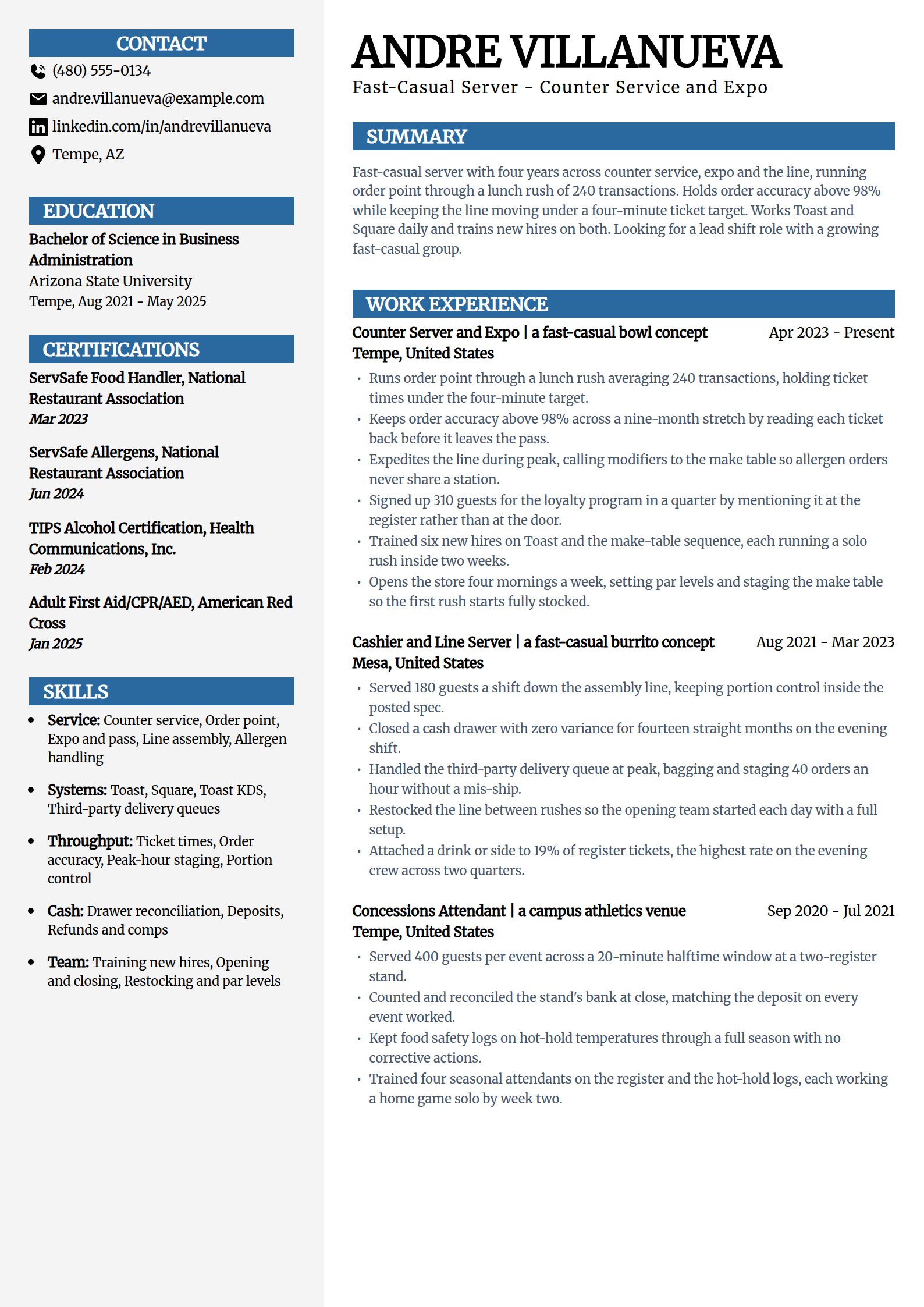
Fast-Casual Server Resume Example (Counter Service)
Why this resume example works?
- Counts transactions, not covers, which is the unit a fast-casual manager actually schedules against.
- Puts ticket time and 98% order accuracy up front, the two numbers that decide a counter hire.
- Names expo and the make table, so the resume reads as someone who has worked the whole line, not just the register.
- Uses a loyalty signup count as the sales number, because there is no check average to quote in counter service.
- Keeps Toast and Square in the skills block with the third-party delivery queue, the tools this job runs on.
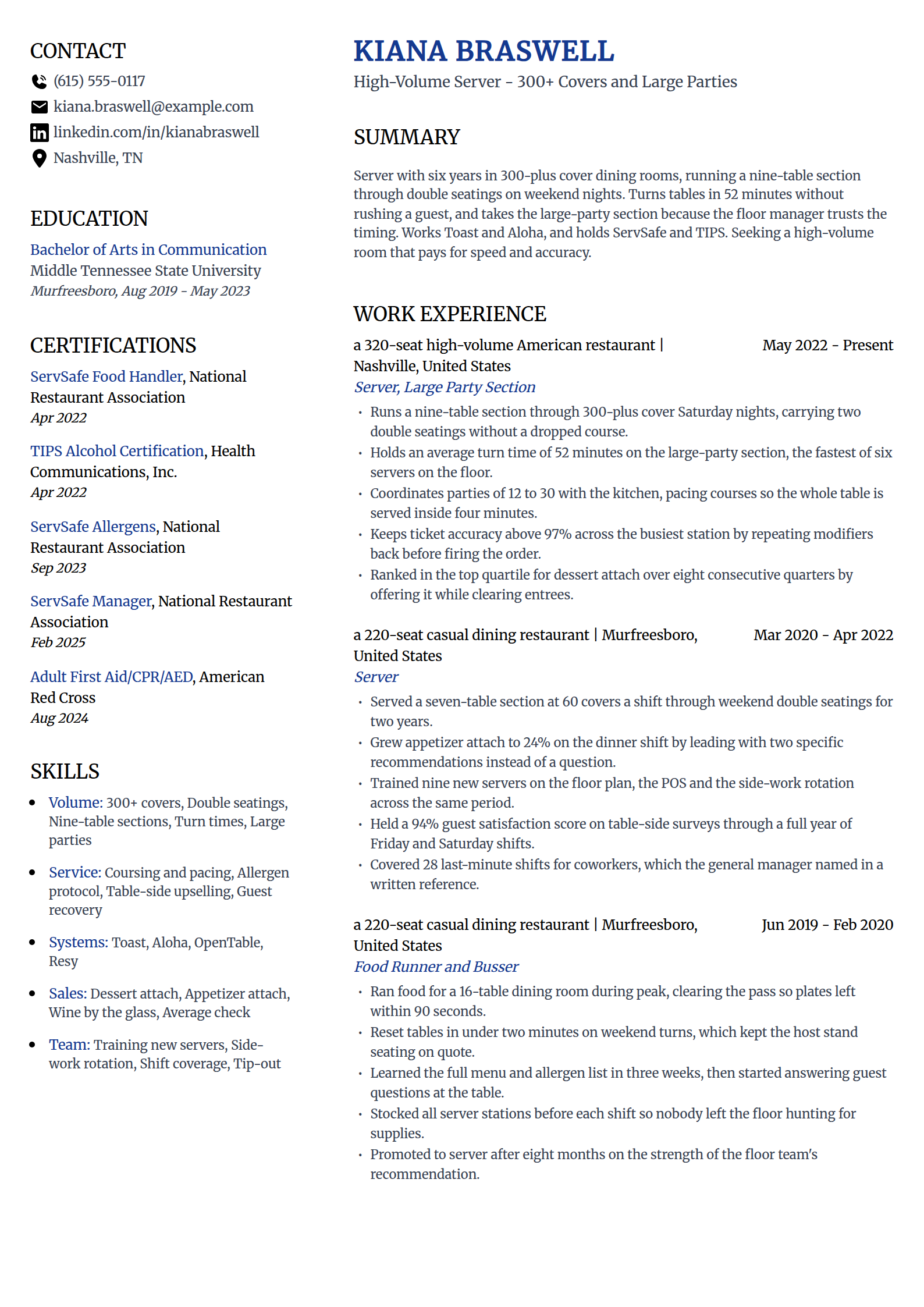
High-Volume Server Resume Example (300+ Covers)
Why this resume example works?
- Opens on 300-plus covers and a nine-table section, which is the entire pitch for a high-volume room.
- Turns speed into a specific number, a 52-minute average turn on the large-party section, not a claim about being fast.
- Shows party coordination with the kitchen, the skill that separates a volume server from a fast one.
- Pairs throughput with accuracy at 97%, because a manager assumes speed costs errors until you prove otherwise.
- Traces the climb from runner to the busiest station, which explains the numbers instead of just asserting them.
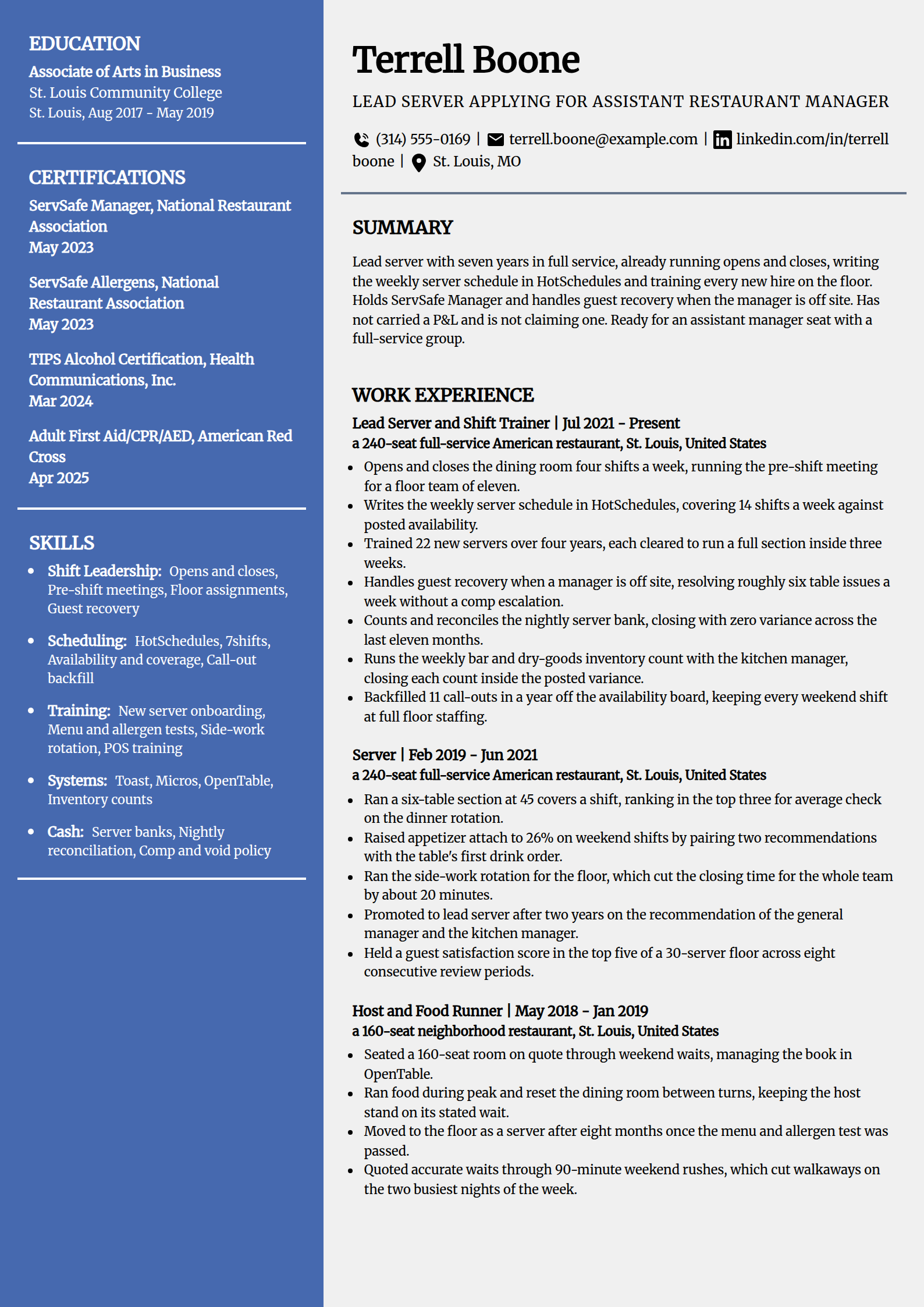
Server to Assistant Manager Resume Example
Why this resume example works?
- Leads with the manager work already being done: opens, closes, pre-shift meetings and the weekly schedule.
- Names the systems a manager is hired on, HotSchedules for scheduling and the nightly server bank for cash.
- Counts the training, 22 servers over four years, which is the clearest evidence of readiness on the page.
- Says plainly that no P&L has been carried, which is the honest line that survives the interview.
- Keeps the server numbers underneath, because an assistant manager who can still run a section is worth more.
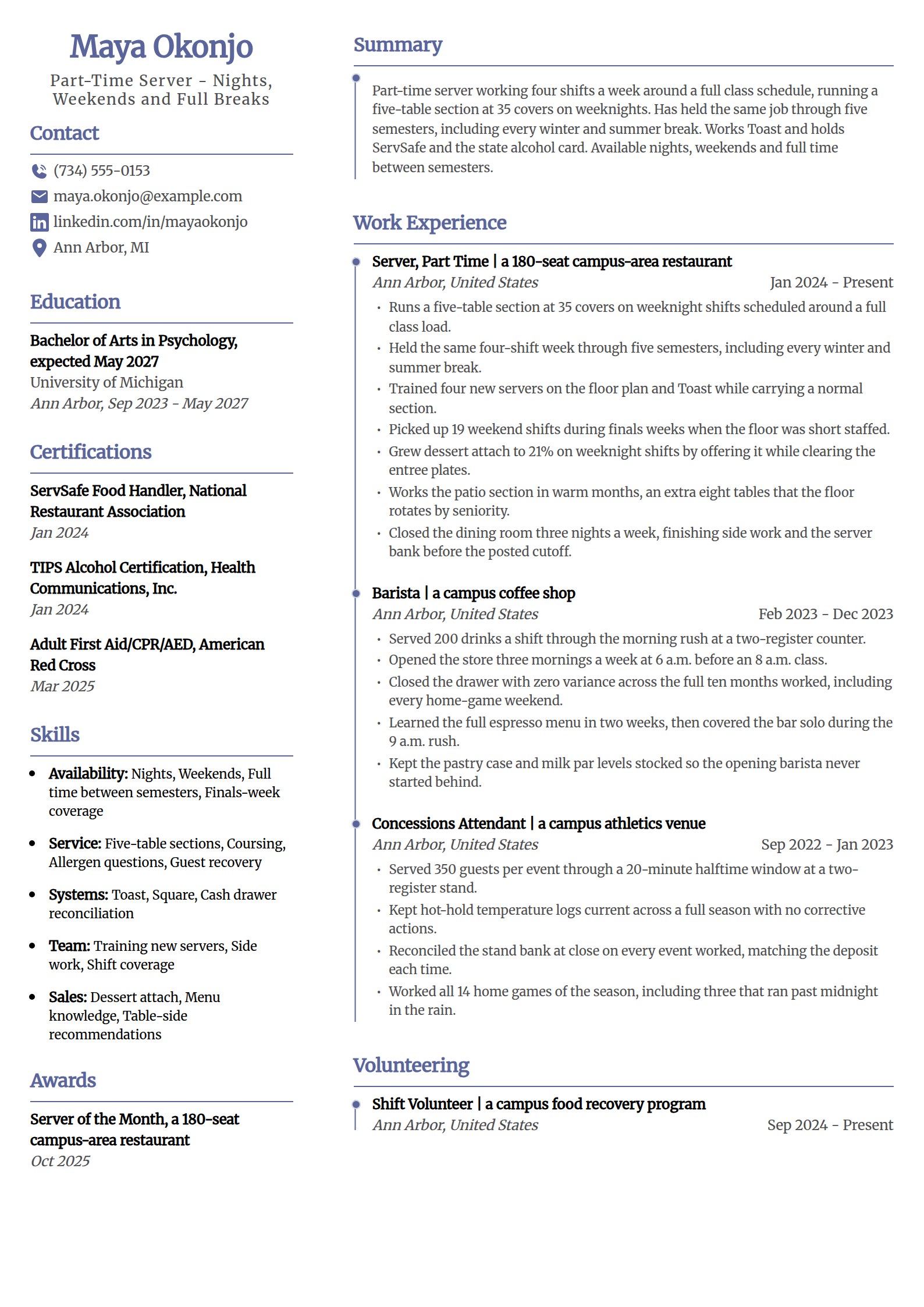
Part-Time Server Resume Example (Student Schedule)
Why this resume example works?
- Puts availability in the headline and the skills block, which is the field a part-time posting screens on first.
- Turns staying power into a number: the same four-shift week held through five semesters and every break.
- Shows shifts picked up during finals weeks, which answers the reliability doubt a student resume raises.
- Keeps the barista and concessions jobs, because a pattern of working through school beats one longer job.
- Carries a real sales number, 21% dessert attach, so the part-time schedule does not read as part-time effort.
Build your server resume
Pick a template above, drop in the numbers from your own section, and the editor keeps the layout parser-safe from first draft to final PDF.
Build my resumeHow to write a server resume in 2026
A server resume gets a six-second skim from a manager, then a keyword match from the applicant system. These moves win both without padding.
Lead with a summary that names your section and your numbers
Write two to three sentences that open with your role and setting, then land on one number a manager cares about: covers per shift, section size, average check, or attach rate. Skip the objective; even a first-time server can lead with a food handler card and real hospitality tasks.
Restaurant server with four years in high-volume casual dining, running a six-table section at 45 covers a shift and holding a top-quartile tip ranking.
Quantify your service bullets
Lead each bullet with a verb, then attach the scale or the result. Numbers turn a duty into proof, and one number per bullet is plenty.
- Volume: ran a seven-table section at 60 covers a shift through weekend double seatings.
- Sales: grew appetizer and wine attach to 25% with tableside recommendations.
- Service: held a 92% guest-satisfaction score across a year of dinner shifts.
Put certifications and POS systems where they get found
Food-service jobs screen for specific credentials and tools, so a manager should see them without scrolling.
- List food safety and alcohol service by name: ServSafe, TIPS, and your state card (TABC, RAMP, BASSET).
- Name the POS you know: Toast, Aloha, or Micros. Mirror the one the posting mentions when it is true.
- Add a wine or sommelier course for fine dining, and CPR or First Aid where it applies.
Match the posting's front-of-house keywords
Mirror the exact section size, service style, and systems the job description names. If the posting says fine dining, coursing, and Toast, your resume should say fine dining, coursing, and Toast where it is true.
Keep the format ATS-safe
Restaurant groups run applicant systems too, and they choke on anything fancy. A clean single-column layout keeps your data intact.
- Skip tables, columns, text boxes, and graphic headers that scramble in a parser.
- Keep your name and phone number in the body, not the header or footer.
- Save as a PDF unless the application asks for a Word document.
Common server resume mistakes
- Listing duties instead of results. "Took orders" is a task; "ran a six-table section at 50 covers a shift" is proof.
- Leaving off certifications. ServSafe, TIPS, and your state alcohol card are often hard requirements, so put them near the top.
- Skipping the numbers. Covers per shift, average check, attach rate, and tip ranking are what a manager scans for.
- Hiding your POS systems. Name Toast, Aloha, or Micros so the resume matches the tools in the posting.
- Using a two-column graphic template that many restaurant applicant systems cannot read cleanly.
Frequently asked questions
How long should a server resume be?
One page for almost every server. Recruiters and floor managers skim fast, so lead each role with your strongest, most quantified bullet: covers per shift, section size, average check, or attach rate. Go to two pages only if you have years across several venues and a leadership track to fill it.
Which resume template is best for a server?
A clean single-column template with standard section headings, like Standard, Classic, or Simple above. Those layouts parse cleanly in restaurant applicant systems and keep your job titles, dates, and certifications in the order a manager expects. Save the visually rich templates for a printed copy you hand over in person.
How do I write a server resume with no experience?
Treat host, busser, cashier, concession, and volunteer roles as real experience, listed with dates and bullets. Add your food handler card, a short summary, and school or club activities that show reliability and teamwork. Do not apologize for the gap; lead with what you have done, not what you lack.
Should a server resume have a summary or an objective?
Use a summary. A resume carries one or the other, never both, and a summary lets you lead with proof: your section size, your covers, and a number. Even a first-time server can write a summary built from a food handler card and hands-on hospitality tasks.
How do I make a server resume ATS friendly?
Use standard section headings, skip tables and columns, and keep your name and phone number in the body of the page. Put your certifications and POS systems in the top third, mirror the posting's exact keywords, and save as a PDF unless the application asks for a Word document.
How do you list POS systems and ServSafe on a server resume?
Name them plainly. Put the POS you know, such as Toast, Aloha, or Micros, in your skills section, and list ServSafe, TIPS, and your state alcohol card (TABC, RAMP, or BASSET) in a certifications block near the top. Match the exact tool the posting names when you have used it.
More server resume resources
Build your server resume
Pick a template above, drop in the numbers from your own section, and the editor keeps the layout parser-safe from first draft to final PDF.