Executive Chef Resume Templates and Examples, Sorted by the Kitchen Not the Ladder
- ATS Friendly
- 16 Real Resumes
- Promotion and Sitting-Chef Examples
An executive chef resume example should answer what a hiring owner asks in the first minute: how many covers you run, what your food cost does under you, and how big the brigade is. The 16 examples below are sorted by the operation rather than by rank, because an independent room, a resort, a private club, a campus and a casino floor all measure the job differently. Start from the kitchen closest to the one you want, then swap in your own numbers.


540k+ resumes created
Executive chef resume templates you can edit
Each template below is a real executive-tier resume laid out in that format, grouped by the operation it was written for. The restaurant and club layouts put covers, food cost and brigade size where an owner or a general manager looks first; the promotion layouts lead with scope already owned rather than with the title being asked for. Pick one, then replace the operation, the systems and the numbers with your own.
Sous Chef to Executive Chef Resume Template
Why this resume example works?
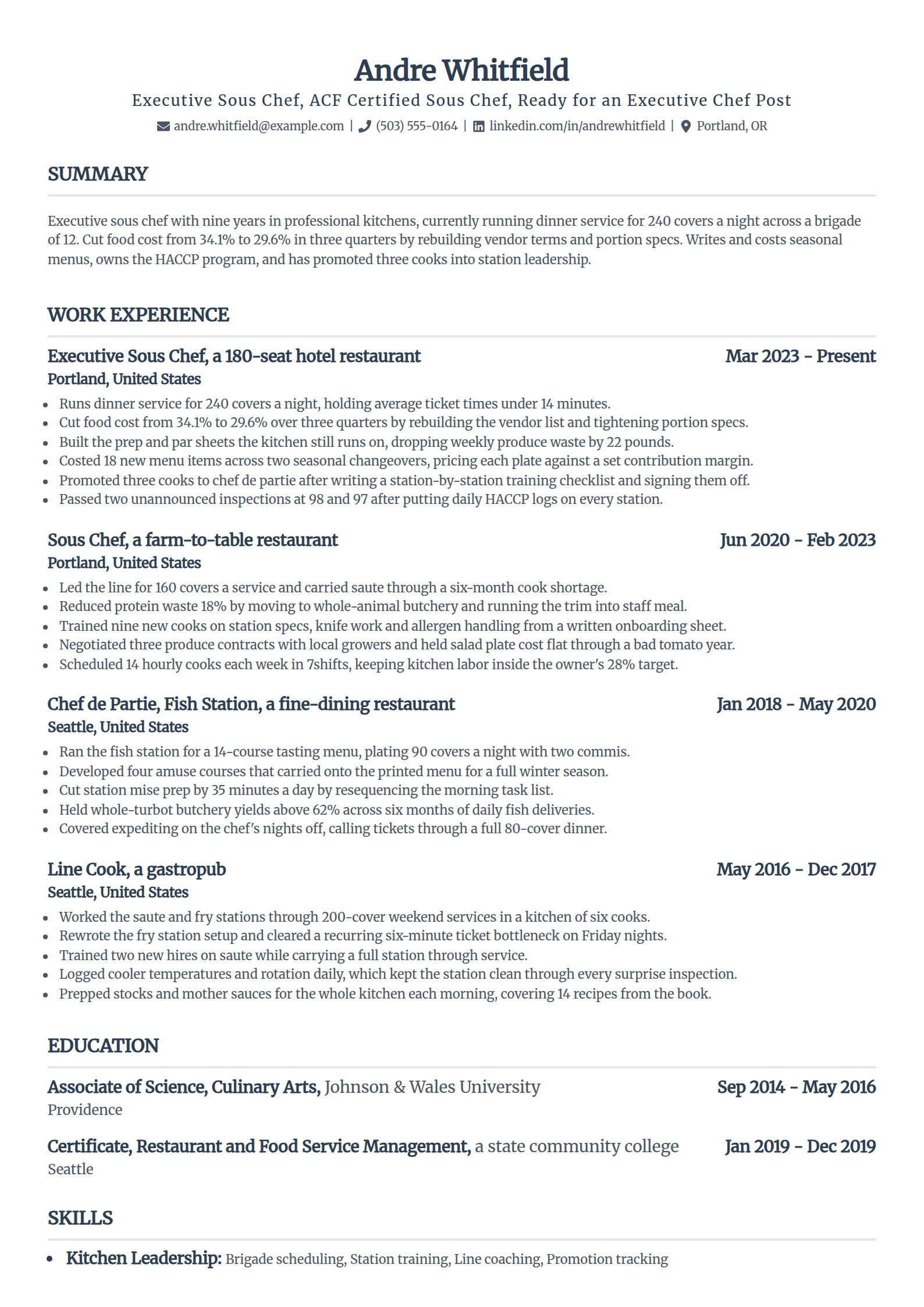
- Leads with scope already held, not with the title being asked for. Running 240 covers a night across 12 cooks is the argument, and it sits in the first line of the summary.
- Carries the one number that decides this hire: food cost moved from 34.1% to 29.6%, with the method attached so it does not read as luck.
- Shows the executive-chef work a sous chef is usually already doing, costing menus and owning the HACCP program, which is what makes the promotion a small step rather than a leap.
- Puts three promoted cooks on the page. Developing people is the part of the job a first-time executive chef is least often asked to prove and most often judged on.
- Keeps a nine-year career to one page by giving the oldest line-cook job the same five tight bullets as the rest, none of them a duty statement.
Independent Restaurant Executive Chef Resume Template
Why this resume example works?
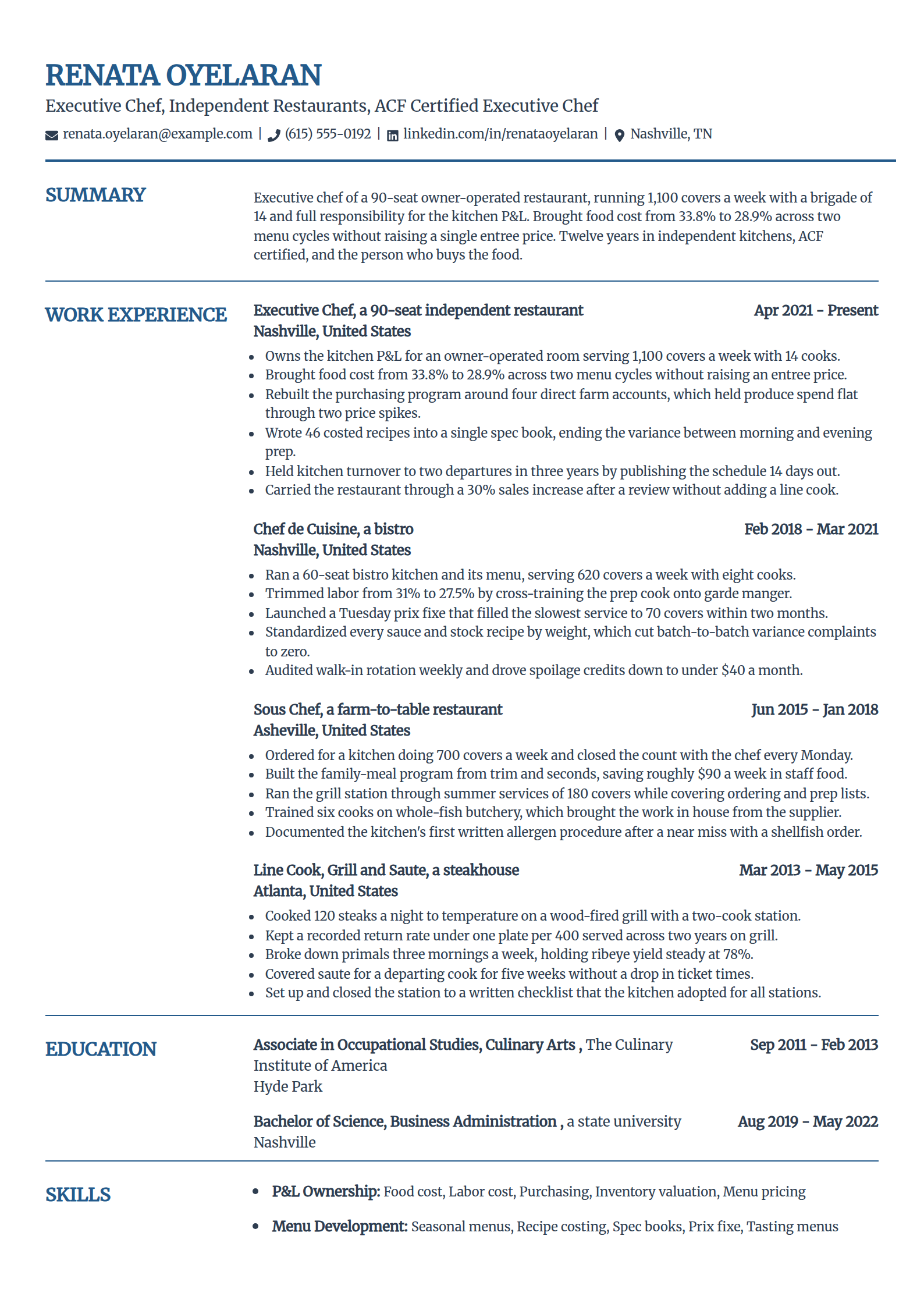
- Says outright that the chef owns the kitchen P&L and buys the food, which is the scope difference between an independent and a hotel or contract kitchen.
- Pairs the food cost move with the constraint that makes it credible: 33.8% down to 28.9% without raising an entree price.
- Names the purchasing program, four direct farm accounts, instead of listing sourcing as a skill. An owner can picture the phone calls.
- Puts kitchen turnover on the page, two departures in three years, with the reason attached. In an independent room that is worth as much as the cost line.
- Ends on capacity: carried a 30% sales jump after a review without adding a cook, which is exactly what a small operator is afraid of.
Hotel and Resort Executive Chef Resume Template
Why this resume example works?
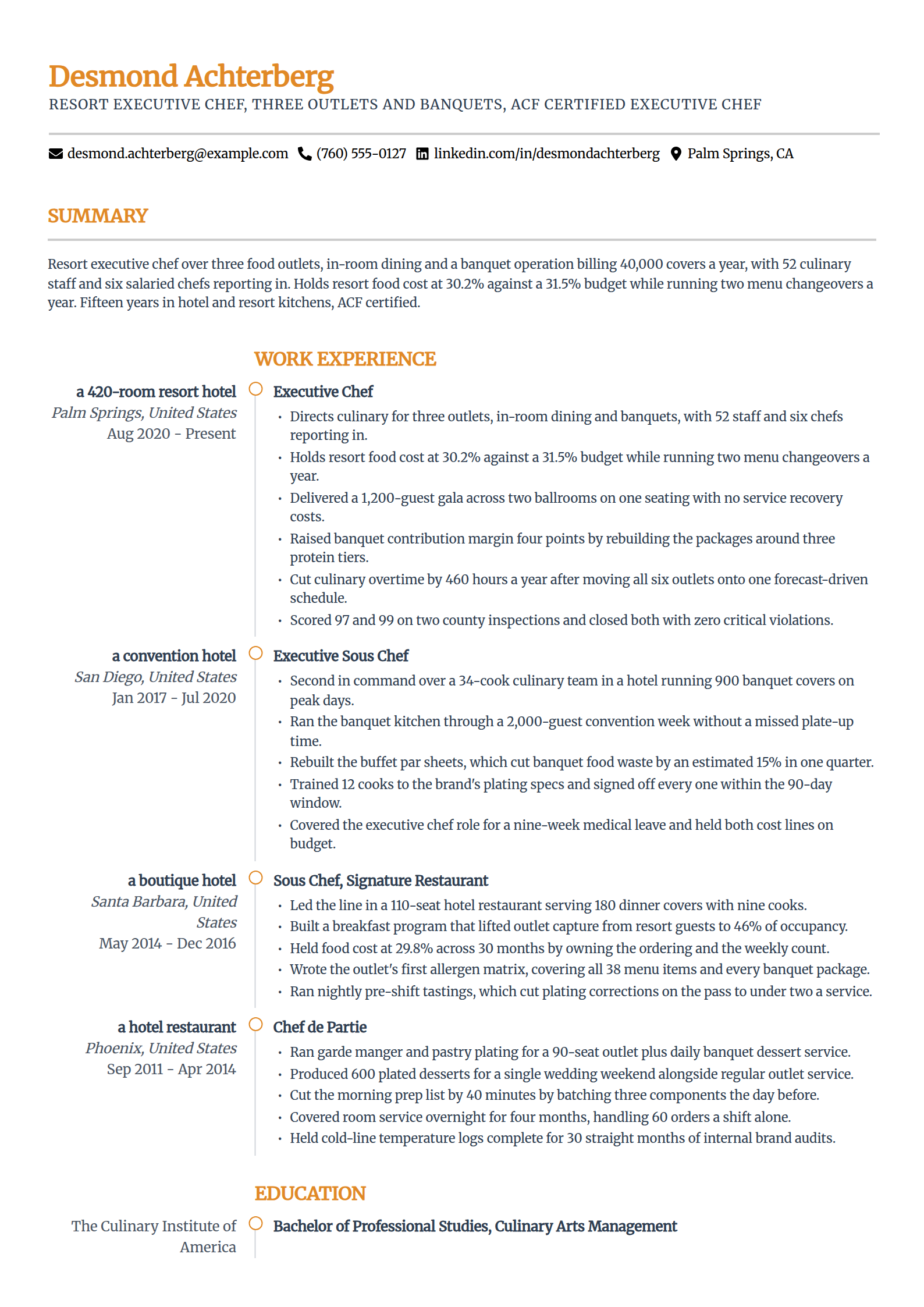
- States the span in the first line: three outlets, in-room dining and banquets, 52 staff and six salaried chefs reporting in. Hotel hiring is a scope question before it is a cooking question.
- Reads food cost against budget rather than in isolation, 30.2% against 31.5%, because that is how a hotel controller reads it.
- Gives banquets their own numbers, a 1,200-guest gala on one seating and four points of contribution margin, instead of folding them into restaurant covers.
- Turns a scheduling change into a labor figure, 460 overtime hours a year, which is the line a director of operations will ask about.
- Carries both inspection scores with the outcome, so the compliance claim is specific rather than a promise to run a clean kitchen.
Country Club Executive Chef Resume Template
Why this resume example works?
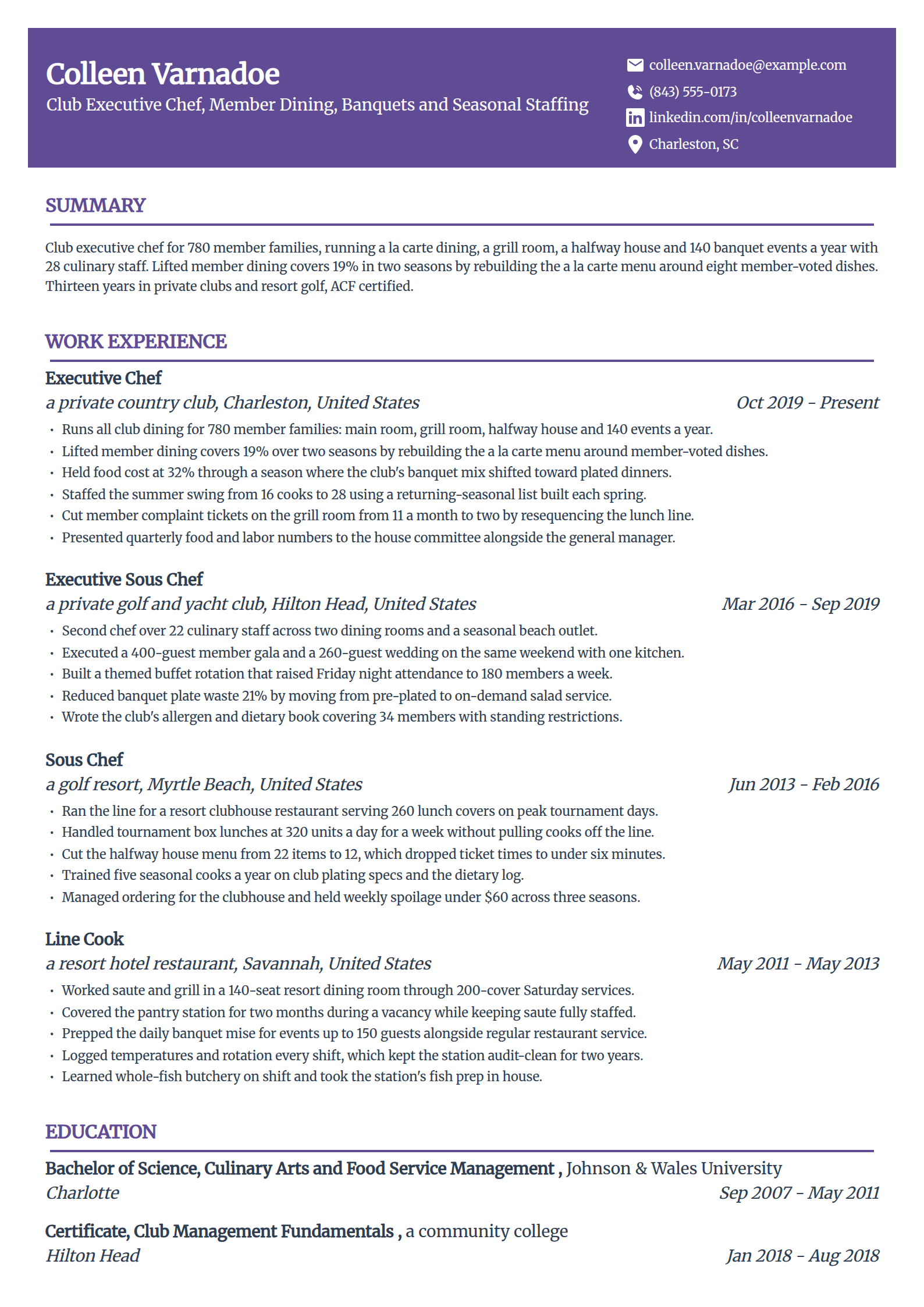
- Counts members, not covers. A club is a fixed audience of 780 families that has to be brought back in, which is a different problem from filling a dining room.
- Leads the achievement line with member dining up 19%, then names the method: a menu rebuilt around dishes members voted for.
- Handles the seasonal swing head on, 16 cooks to 28, and names the returning-seasonal list that fills 70% of the openings. Every club hiring committee asks how you staff the season.
- Includes the house committee reporting. Club chefs answer to a member committee as well as a general manager, and the resume shows that has already been done.
- Covers the whole club, main room and grill room and halfway house and 140 events, rather than a single kitchen, which is what the title actually means here.
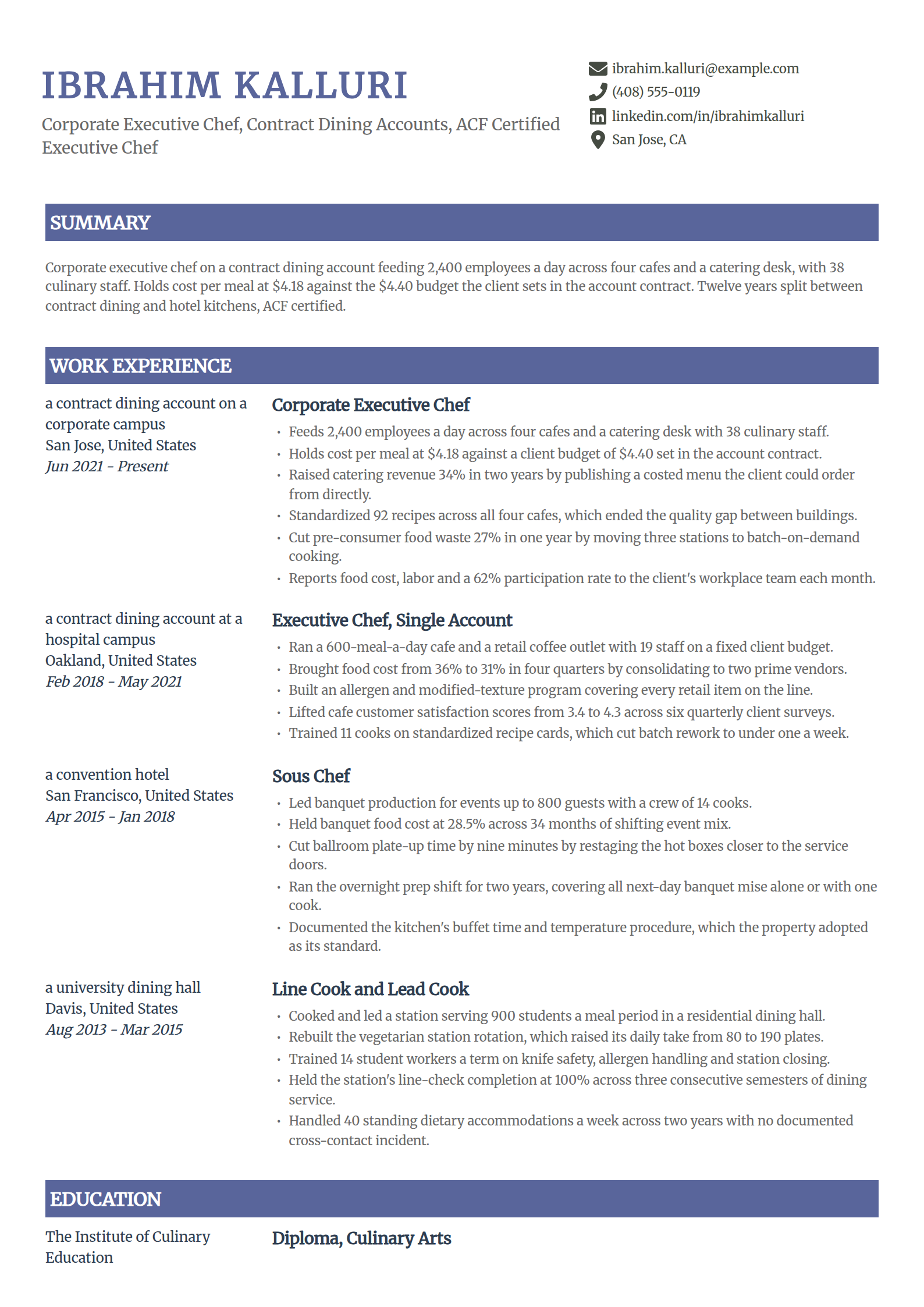
Corporate and Contract Dining Executive Chef Resume Template
Why this resume example works?
- Uses the metric this sector runs on, cost per meal against a client budget, instead of restaurant food cost percentage. Getting that wrong marks an outsider immediately.
- Puts participation on the page. A contract account is judged on whether people choose to eat there, and 62% is the number the client reads first.
- Shows the client relationship, not just the kitchen: a monthly business review with the workplace team is part of the job description at this level.
- Proves consistency across sites with a 92-recipe standardization, which is the thing that goes wrong when one account has four cafes.
- Keeps the dietary and allergen program visible, because a campus account carries standing accommodations that a restaurant never deals with.
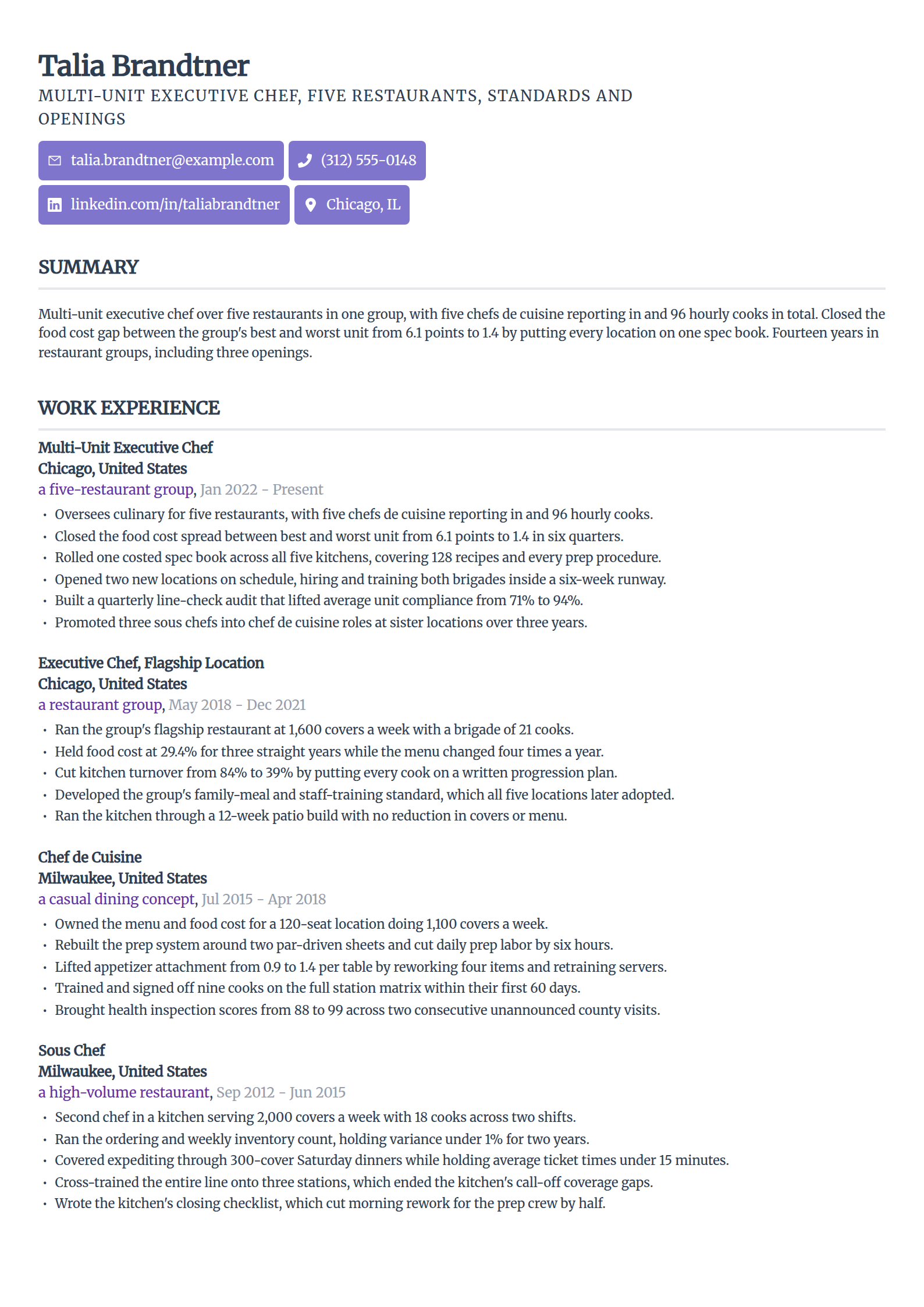
Multi-Unit Executive Chef Resume Template
Why this resume example works?
- Names what a multi-unit chef actually manages: five chefs de cuisine, not 96 cooks directly. The reporting line is the scope claim.
- Picks the one number that only exists at this level, the food cost spread between the best and worst unit, closed from 6.1 points to 1.4.
- Shows the mechanism behind the consistency, one spec book across five kitchens covering 128 recipes, so the result has a method attached.
- Includes two openings delivered on schedule with both brigades hired and trained, which is half of what a growing group is buying.
- Ends the current role on three sous chefs promoted into chef de cuisine seats at sister locations. That is the clearest evidence a group chef can offer.
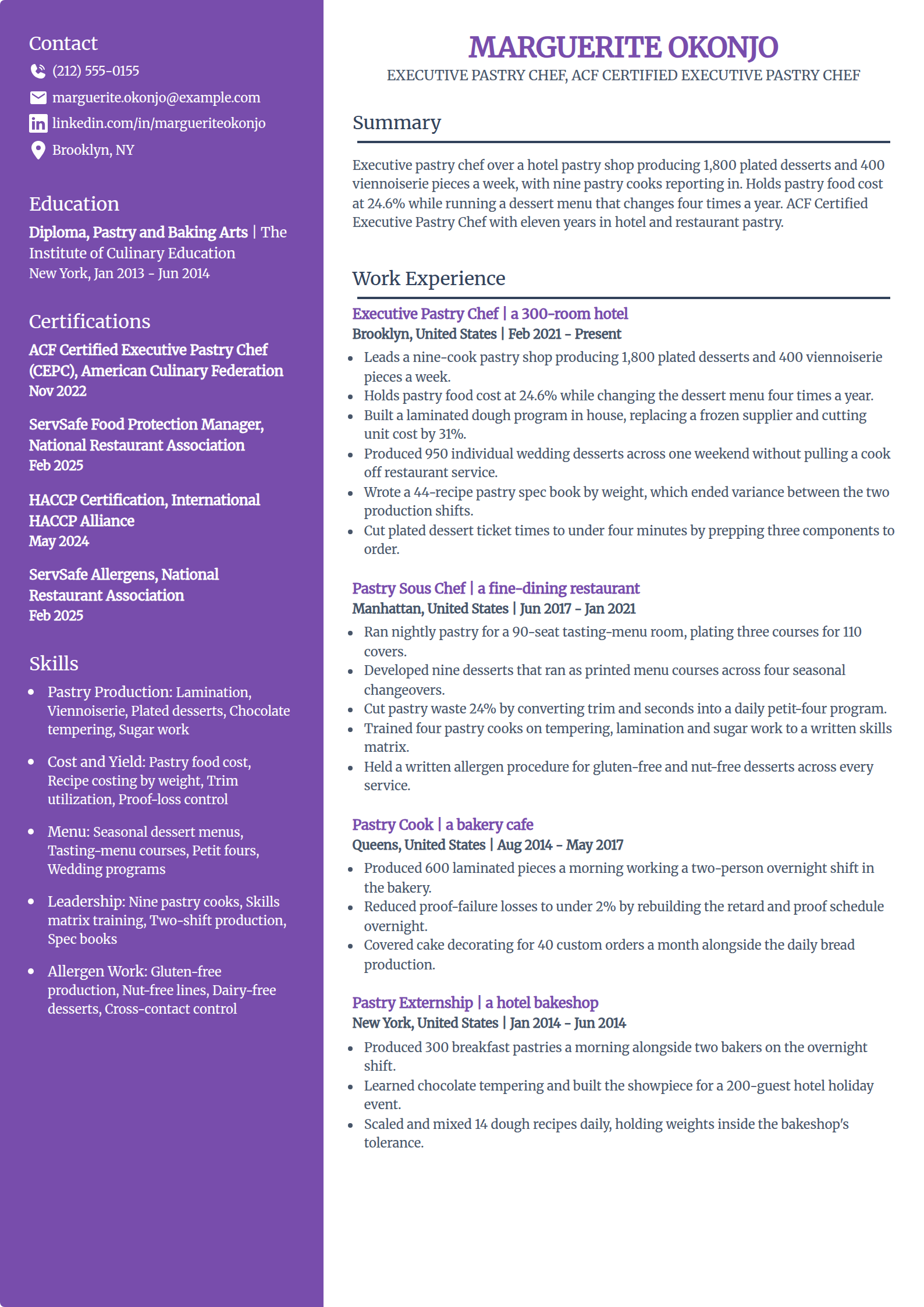
Executive Pastry Chef Resume Template
Why this resume example works?
- Treats pastry as its own executive title with its own credential, the ACF Certified Executive Pastry Chef, rather than as a specialty under a kitchen chef.
- Counts production the way a pastry shop is counted, 1,800 plated desserts and 400 viennoiserie pieces a week, not in covers.
- Puts a make-versus-buy decision on the page: lamination brought in house, unit cost down 31%. That is the argument a food and beverage director responds to.
- Keeps its own cost line at 24.6%, because pastry food cost sits apart from the kitchen's and a hotel budgets it separately.
- Shows the training matrix for tempering, lamination and sugar work, which is how a shop stays consistent across two production shifts.
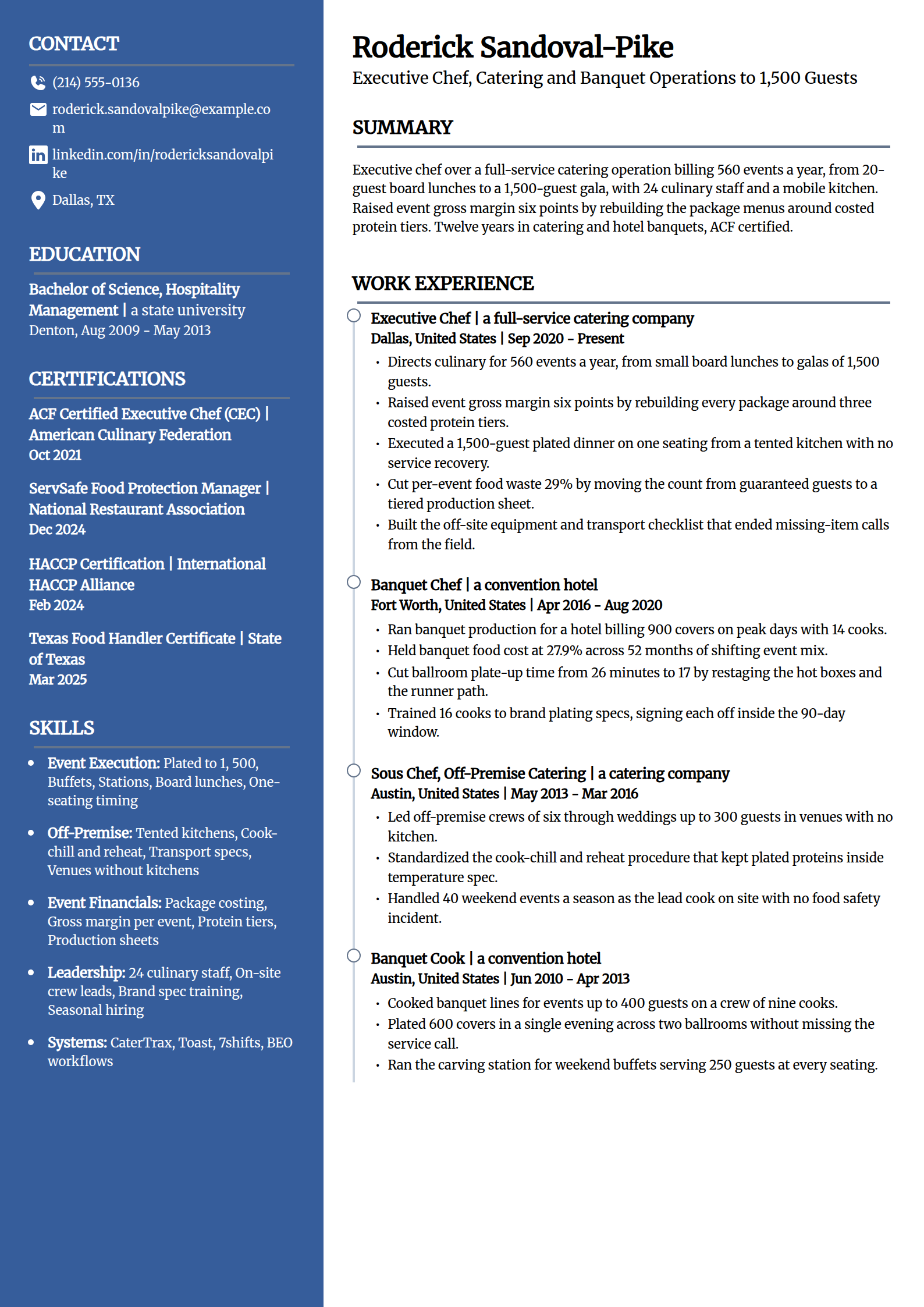
Catering and Banquet Executive Chef Resume Template
Why this resume example works?
- Measures the year in events, 560 of them, with the range stated from small board lunches to a 1,500-guest gala. Catering scope is a range, not an average.
- Leads the financial claim with event gross margin rather than food cost, which is how a catering owner reads the P&L.
- Proves the hardest thing in the job, a 1,500-guest plated dinner on one seating from a tented kitchen, and says it came off with no service recovery.
- Keeps the off-premise skills visible, cook-chill and reheat and transport specs, because catering in a venue with no kitchen is a different craft.
- Cuts plate-up time from 26 minutes to 17 with the change named, which is the number a banquet director lives on.
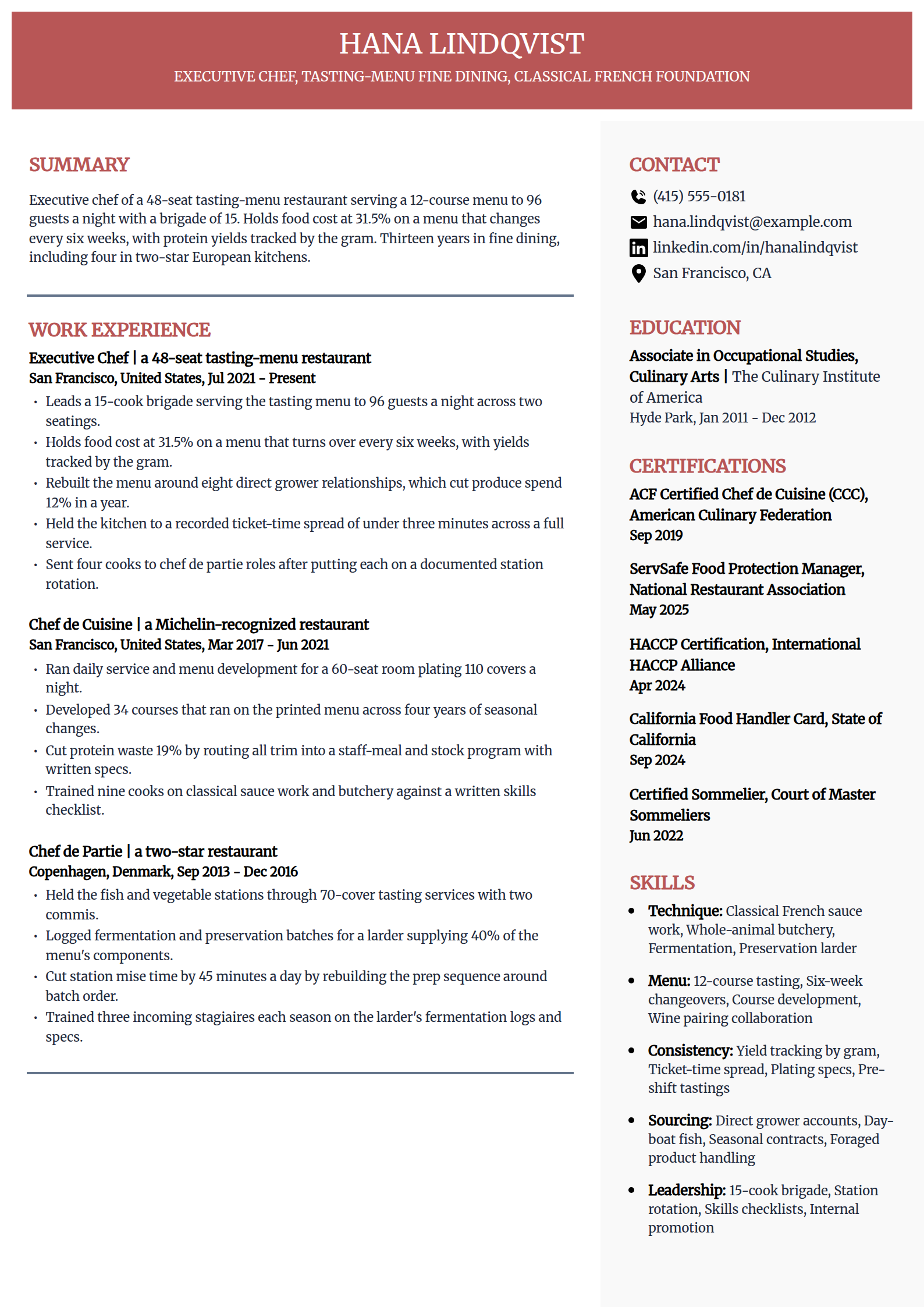
Fine Dining Executive Chef Resume Template
Why this resume example works?
- Sets the format in the first line, a 12-course menu to 96 guests a night across two seatings, so the reader knows the kind of kitchen immediately.
- Shows cost control without pretending this is a volume operation: 31.5% on a menu that turns over every six weeks, with yields tracked by the gram.
- Uses a consistency number a fine-dining chef can own, a ticket-time spread under three minutes across a service, rather than a revenue claim.
- Names the technique foundation and the larder work outright, because at this level a chef de cuisine posting screens for exactly those words.
- Counts four cooks sent to chef de partie roles, which is the retention argument a tasting-menu house cares about most.
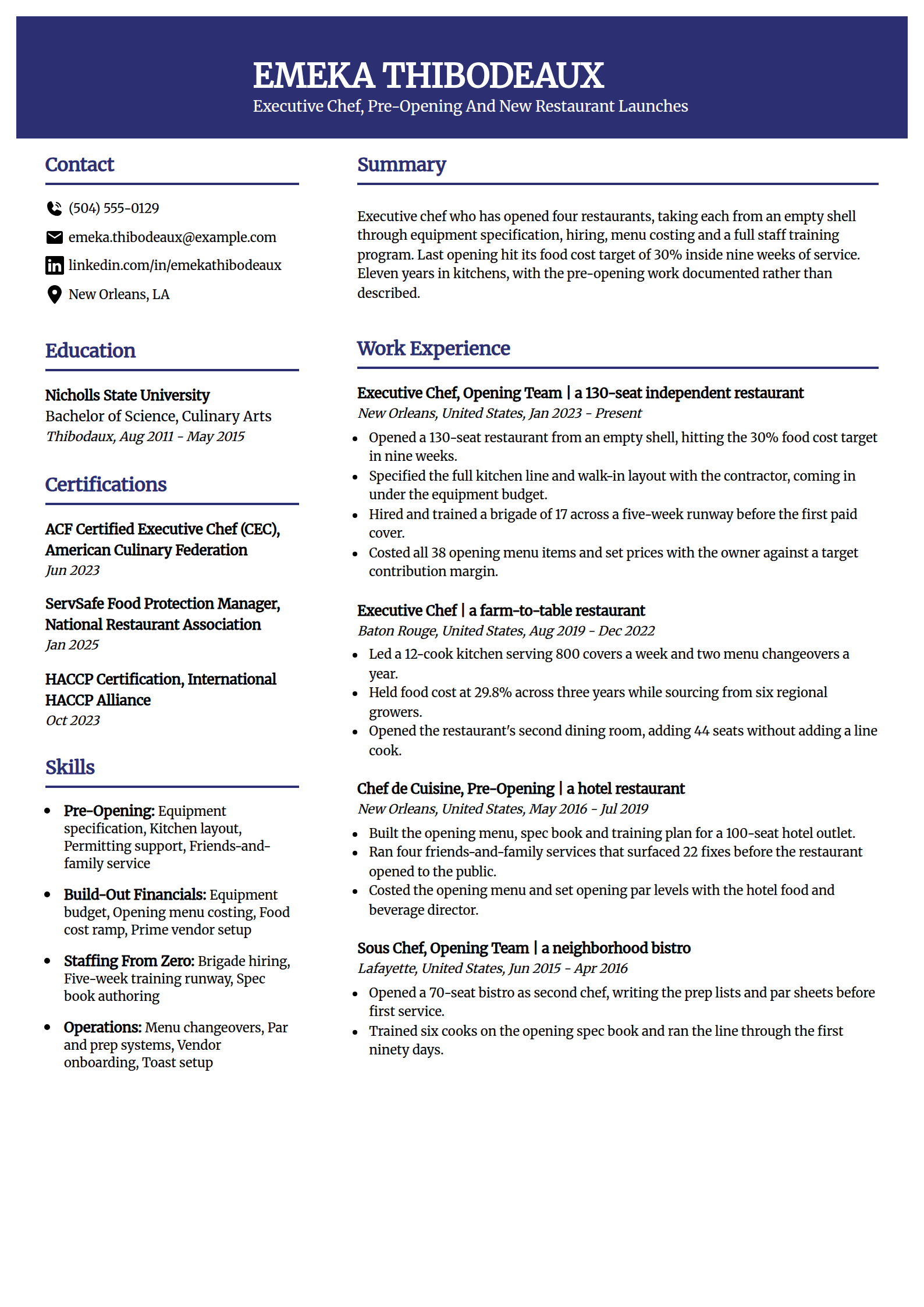
New Restaurant Opening Executive Chef Resume Template
Why this resume example works?
- Counts openings as the headline credential, four of them, because an owner hiring for a build-out is buying that specifically.
- Gives the opening a finish line rather than a story: the food cost target of 30% hit within nine weeks of service.
- Lists the pre-opening work nobody else puts on a resume, equipment specification and walk-in layout agreed with the contractor, inside the equipment budget.
- Shows the staffing runway as a number, a brigade of 17 hired and trained in five weeks before the first paid cover.
- Keeps the friends-and-family services on the page with the 22 fixes they surfaced, which is the detail that proves the openings were run properly.
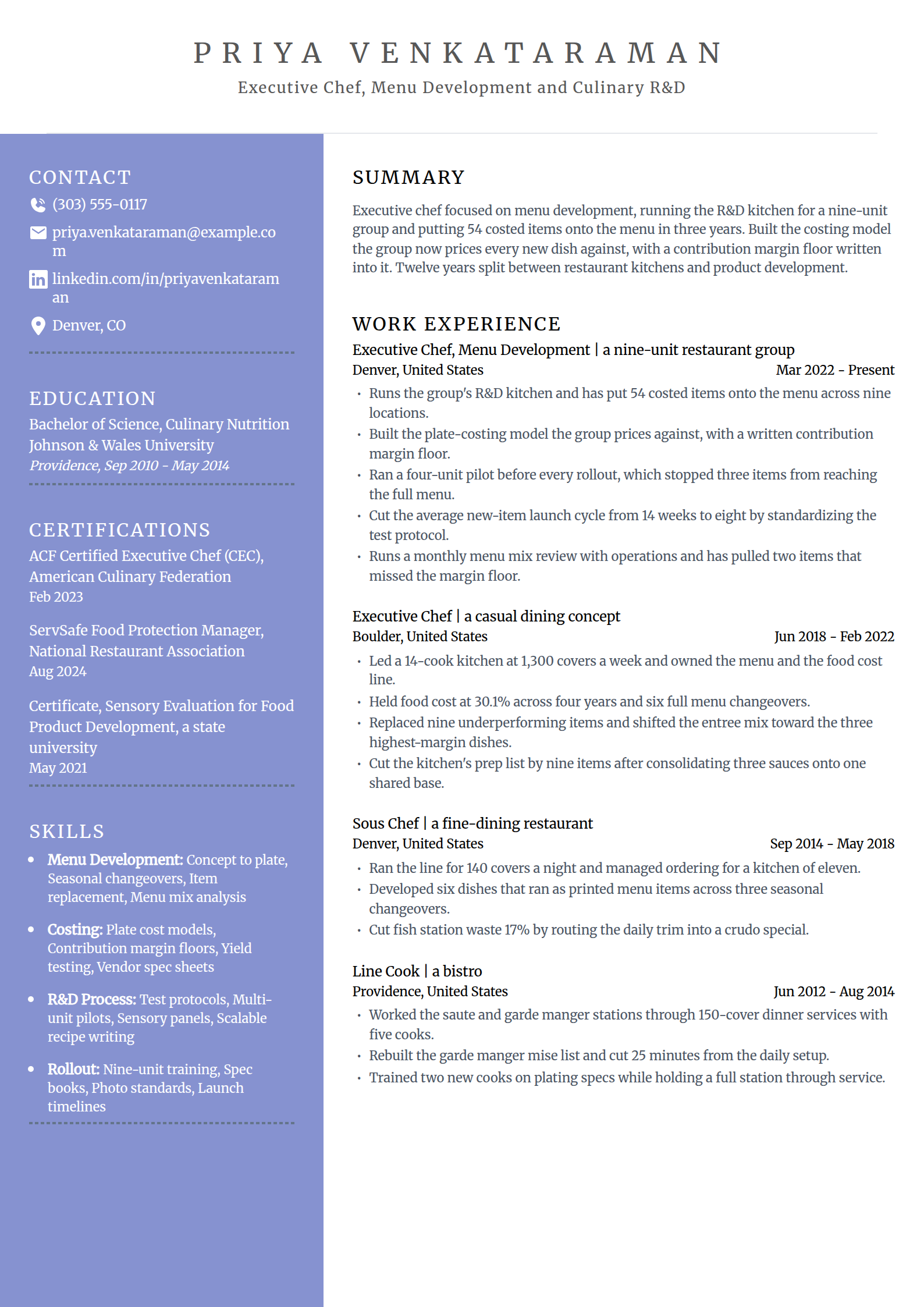
Menu Development Executive Chef Resume Template
Why this resume example works?
- Counts output the way a development role is judged, 54 costed items onto the menu across nine locations, not covers or brigade size.
- Puts the costing model itself on the page, with a written contribution margin floor, which is the deliverable a group is actually hiring for.
- Includes the items that did not ship. Three stopped at the pilot stage, and saying so is what separates a development chef from a recipe writer.
- Turns process improvement into a number, launch cycle cut from 14 weeks to eight, with the standardized test protocol named as the cause.
- Keeps a line kitchen in the history so the R&D work reads as grounded rather than academic.
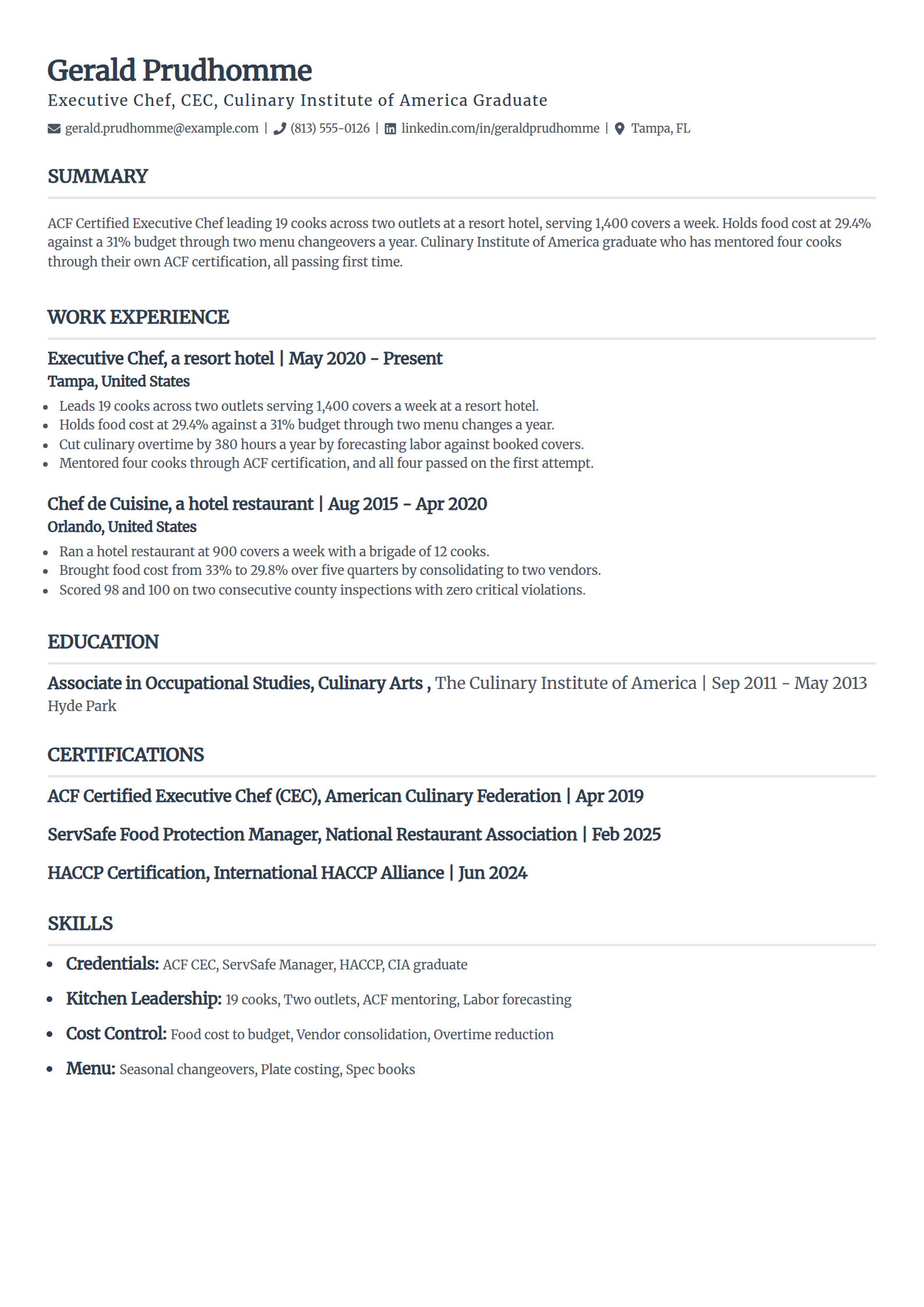
ACF Certified Executive Chef Resume Template
Why this resume example works?
- Puts the ACF letters and the school in the headline, where an ATS and a screener both read them first.
- Gives the credentials a working result rather than leaving them as decoration: four cooks mentored through their own ACF certification, all passing first time.
- Runs on two long tenures instead of four short ones, which is what an executive-tier career usually looks like and what keeps this to one page.
- Reads food cost against a budget figure, 29.4% against 31%, so the number has a reference point.
- Uses a plain single-column layout, which is the safest choice when a hotel group's applicant system is doing the first read.
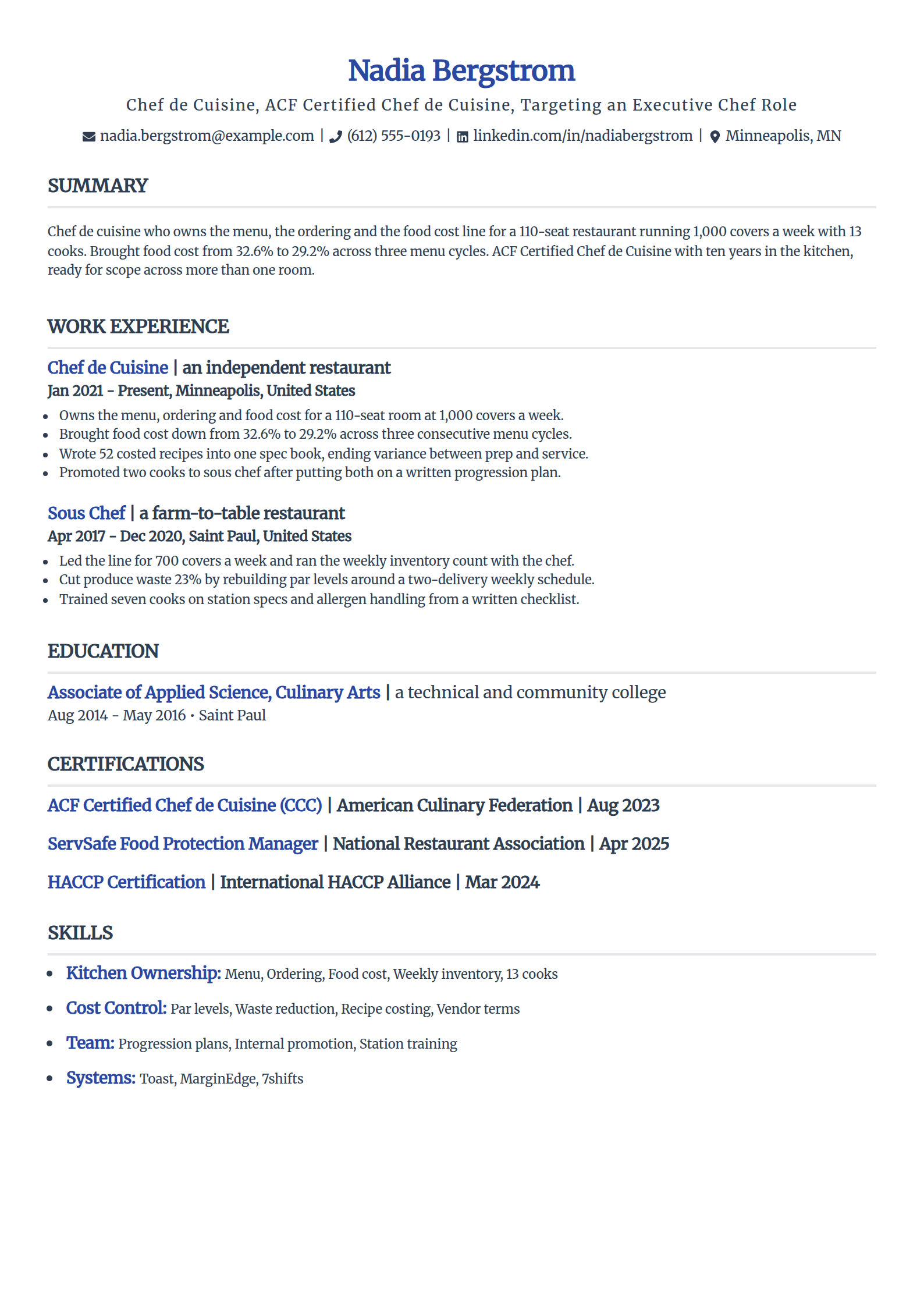
Chef de Cuisine to Executive Chef Resume Template
Why this resume example works?
- Names the three things a chef de cuisine already owns, the menu, the ordering and the food cost, in the first line. That is a scope argument, not a readiness argument.
- Backs it with a cost movement across three menu cycles rather than a single quarter, which reads as a system instead of a lucky season.
- Shows the spec book, 52 costed recipes, because writing the standards is the part of the executive job a chef de cuisine can prove today.
- Counts two cooks promoted to sous chef, which answers the one real doubt about this candidate: whether they can build a bench.
- Stays short and legible. At this stage a busy page hurts, and two well-filled roles say more than five thin ones.
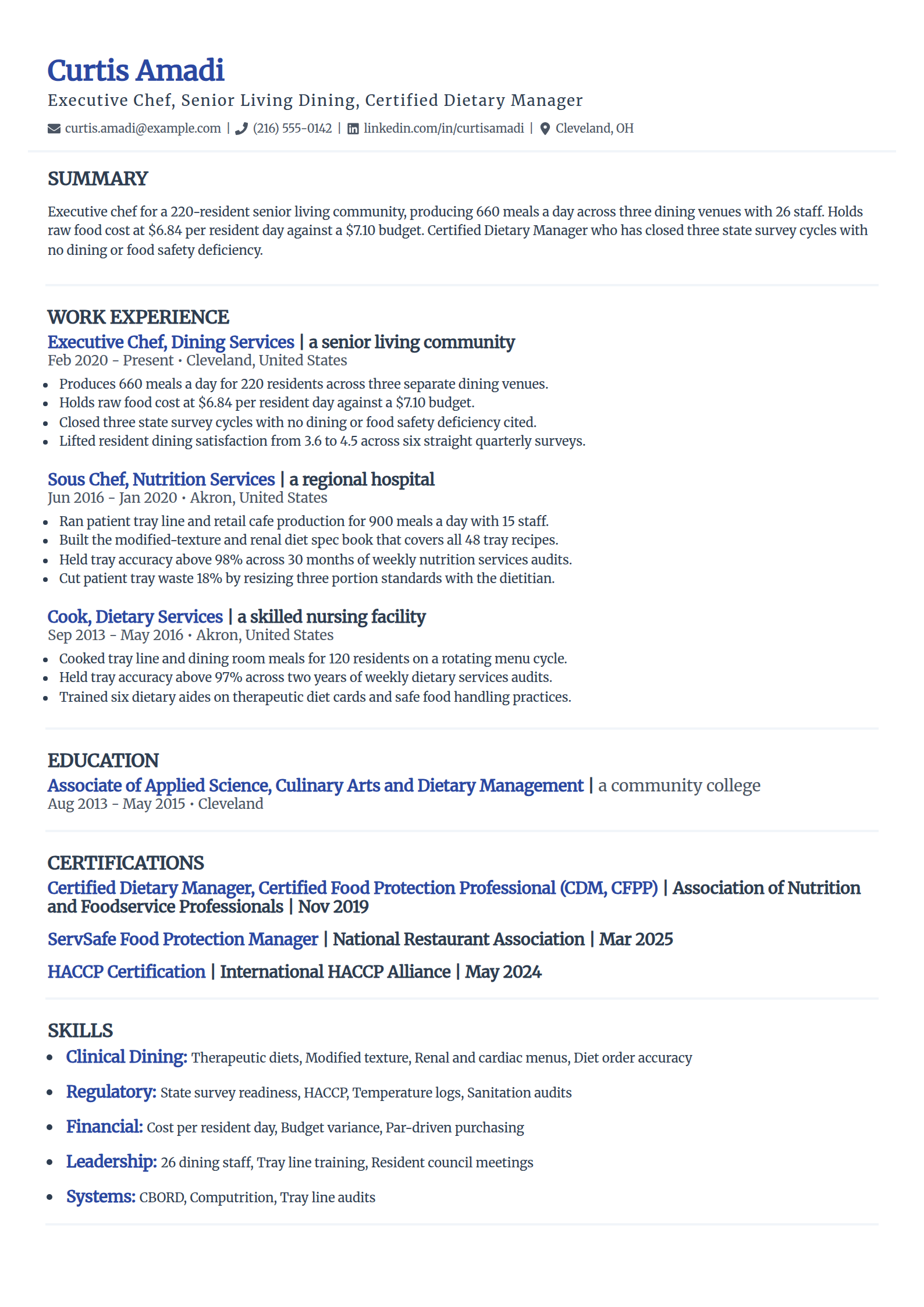
Senior Living Executive Chef Resume Template
Why this resume example works?
- Uses the credential this setting screens for, the Certified Dietary Manager, instead of leading with a restaurant certification that means less here.
- Prices the operation in cost per resident day against budget, which is the only cost figure a senior living administrator uses.
- Puts survey results on the page, three cycles closed with no dining or food safety deficiency. That is the single highest-stakes line in this sector.
- Shows resident satisfaction moving across six quarterly surveys, because residents eat every meal here and the scores follow the food.
- Keeps therapeutic diets and modified texture in the skills block by name, since those are the clinical requirements a restaurant chef would not know.
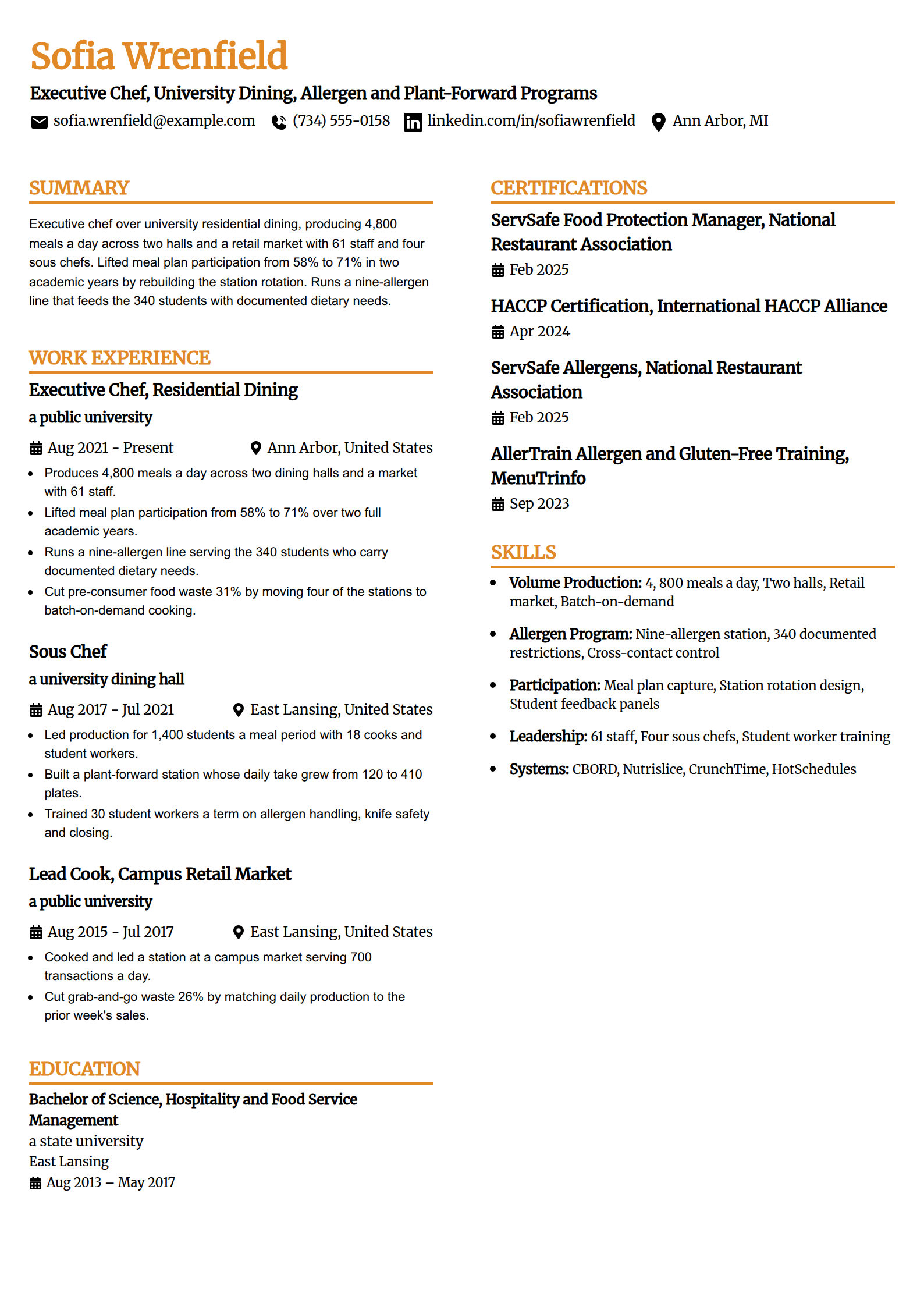
University Dining Executive Chef Resume Template
Why this resume example works?
- Opens on volume that is hard to picture from a restaurant background, 4,800 meals a day across two halls and a market, with 61 staff.
- Uses the number a dining director is measured on, meal plan participation, moved from 58% to 71% across two academic years.
- Gives the allergen program its own line with a count attached, 340 students with documented restrictions, rather than a general claim about dietary needs.
- Shows waste reduction with the operational change that caused it, four stations moved to batch-on-demand cooking.
- Keeps student worker training visible, because a campus kitchen is staffed by people who turn over every term and that is the real management problem.
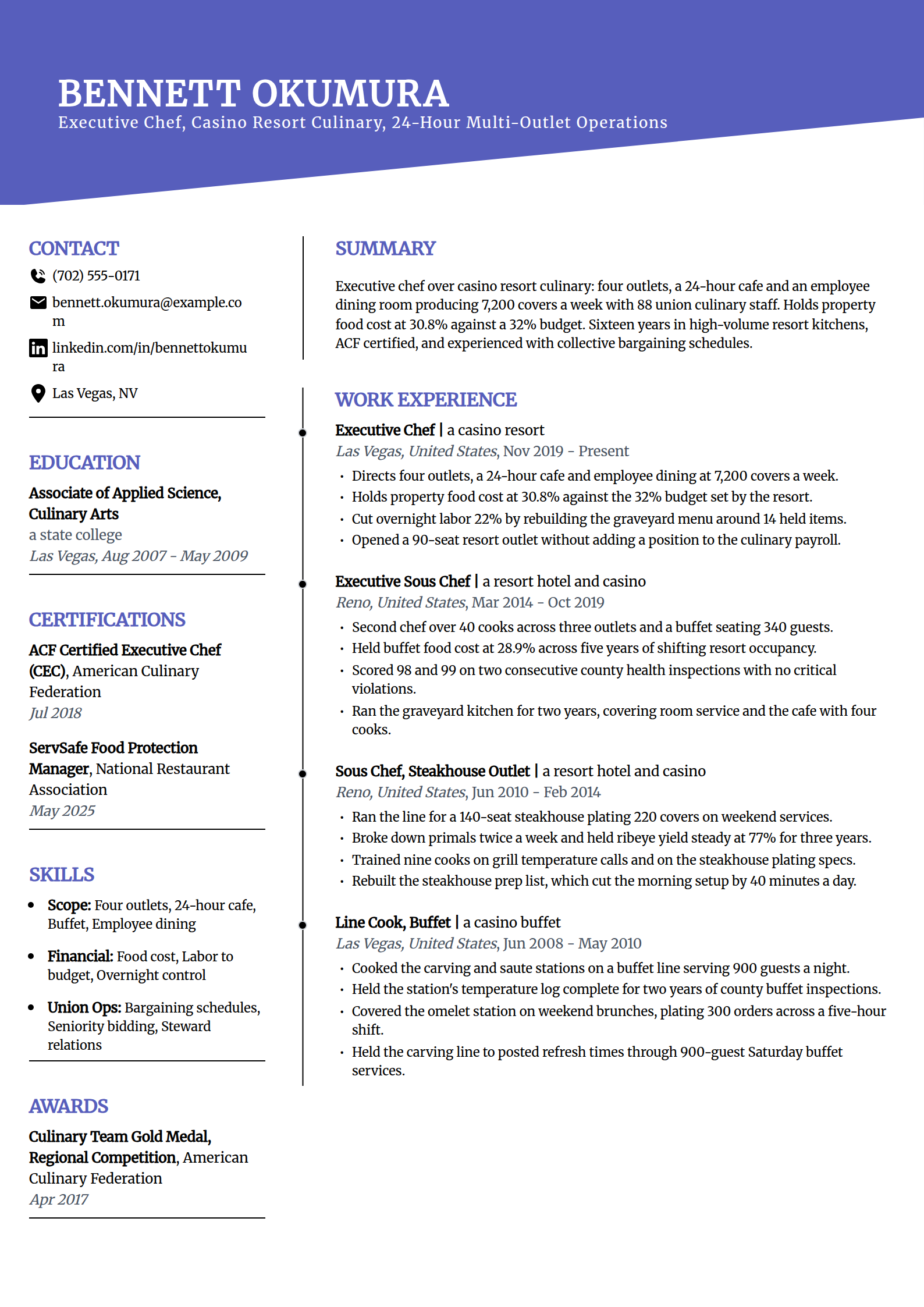
Casino Resort Executive Chef Resume Template
Why this resume example works?
- States the whole property in one line, four outlets plus a 24-hour cafe plus employee dining, which is the scope a casino means by the title.
- Names the union staffing outright. Collective bargaining schedules and seniority bidding are daily work here, and a chef who has never done it struggles.
- Picks a cost win specific to a 24-hour house: overnight labor down 22% by rebuilding the graveyard menu around held items.
- Reads food cost against the property budget, so the figure is a performance claim rather than a bare percentage.
- Keeps the competition medal in a short awards block. At this level it is a credential signal, not a hobby, and it costs three lines.
Build your executive chef resume on one of these templates
Pick the kitchen closest to the one you want, open that example in the builder, and replace the operation, the systems and the numbers with your own. Half an hour of work and you have a page an owner can read before the second coffee.
Build my resumeHow to write an executive chef resume
An executive chef resume is read by someone deciding whether to hand you a cost line and a staff. Two thirds of that decision is scope and numbers; the cooking is assumed by the time you are applying for this title.
Lead with the operation you run, not the title you hold
Executive chef means something different in a 90-seat room, a 420-room resort and a contract account feeding 2,400 people. The first two lines have to say which one you have done.
- Open the summary with the shape of the operation: how many outlets, how many covers or meals, how many people report to you.
- Say what you personally control. Buying the food, setting prices and owning the P&L are three separate claims, and plenty of executive chefs only have one or two.
- Name the setting in the job titles where it helps: Executive Chef, Residential Dining reads more clearly than Executive Chef on its own.
- If you are applying across settings, reorder the bullets so the ones that transfer sit at the top of each role.
- Copyable summaries for chef roles live on the chef resume summary page linked below. This page does not repeat them.
The three numbers, and what to write when you do not have them
Covers per service, food cost percentage and labor percentage are what a hiring owner asks about. Plenty of good chefs ran a kitchen and were never shown the P&L, and the advice everywhere else stops right there.
- If you have the cost numbers, write them as a movement with a method: from 33.8% to 28.9% by rebuilding vendor terms, not a bare percentage.
- If you never saw the P&L, use what you did own: covers per service, average ticket times, brigade size, waste and yield, health inspection scores.
- Retention and promotions are yours whatever the accounting setup. Cooks kept and cooks promoted are numbers no one can take off you.
- Plate cost on a dish you priced yourself is honest even without a full food cost figure. Say what you costed and what it held at.
- One number per bullet. Two in one sentence makes both of them look invented, which is worse than having neither.
- Never estimate a percentage you did not see. A hiring chef will ask how you got it, and the follow-up question is the interview.
One page, and what to cut to get there
The usual advice at this level is two pages, then hedges that one is better. Every example on this page is a full executive career on a single page, including careers with four kitchens on them, so here is the plain version: keep it to one.
- The second page is where food cost numbers go to die. Nobody reads it in the first pass, and the first pass is the one that decides.
- Cut the oldest line-cook role to three bullets, then to a title and dates once you have twelve years behind you.
- Delete any bullet without a number or a specific task. Duty statements are what expand a resume to two pages.
- Keep certifications to the ones a posting screens for. A list of eight food-safety cards is padding.
- The exception is real and narrow: some club and hotel groups ask for a full CV with a menu portfolio. That is a second document you send when asked, not a second page you send unasked.
Applying up from sous chef or chef de cuisine
Half the people searching for this page have not held the title yet. The resume does not have to pretend otherwise, and pretending is what gets it binned.
- Lead with scope you already hold rather than the job you want. Running the line for 240 covers is a fact; ready for the next step is a wish.
- Pull the executive work you already do to the top: menu costing, ordering, scheduling, HACCP, hiring. Most second chefs do more of it than they claim.
- Put promotions you have driven on the page. A first-time executive chef is judged hardest on whether they can build people.
- Use a summary, not an objective. With a year or more of paid kitchen work behind you, an objective reads as a step backwards.
- Do not retitle yourself. Calling a sous chef role Executive Sous Chef when it was not is the one thing a reference call always catches.
Certifications, and which ones get screened
Only a few culinary credentials are matched by a posting's system, and the rest are shelf decoration on an executive resume.
- ACF certifications carry at this tier: Certified Executive Chef, Certified Chef de Cuisine, Certified Executive Pastry Chef, Certified Sous Chef. Spell out the name and the acronym so both forms match.
- ServSafe Food Protection Manager and HACCP are baseline from sous chef up. Keep them current and put the date on them.
- Add the setting's own credential where it exists: a Certified Dietary Manager for senior living, alcohol seller-server training where you own a bar program.
- Name the culinary school if you have one. Schools are matched as keywords in a way that a generic culinary arts line is not.
- List what you hold today. An expired card with an old date is worse on the page than no card at all.
Formatting for the system that reads it first
Hotel groups, contract dining companies, clubs and restaurant groups all route applications through parsing software before a chef sees them. The formatting choices that break there are the ones that look most designed.
- Use standard headings: Summary, Work Experience, Education, Certifications, Skills. A heading like In the Kitchen parses as nothing.
- Name the systems you have used, by name: Toast, MarginEdge, CrunchTime, Compeat, 7shifts, HotSchedules, CaterTrax, Oracle Micros. Kitchen management software is a keyword match; kitchen technology is not.
- Skip the photo, the skill rating bars and the plated-food imagery. Send a menu portfolio separately if you have one.
- Match the posting's own wording where it is honest to. If it says banquet, write banquet rather than events.
- Save as a PDF unless the form asks for Word, then run it through the ATS resume checker for a format and keyword pass before you send it.
Common executive chef resume mistakes
- Listing cuisines instead of scope. A line of French, Italian and New American tells an owner nothing about your ability to run their kitchen. Covers, brigade size and the cost line do.
- Quoting a food cost percentage you never actually saw. If you did not have P&L access, say what you did own instead. The interview question about how you calculated it is the one that ends the conversation.
- Writing duty statements from the job description. Oversaw daily kitchen operations is on every executive chef resume ever filed, which is exactly why it carries no information.
- Letting it run to two pages because the career is long. Every example on this page is a full executive career on one page. The second page is skipped, not read.
- Inflating the title. Calling a chef de cuisine role executive chef, or a sous chef role executive sous chef, is caught on the reference call and costs the offer.
- Burying the setting. Executive chef at a country club and executive chef at a casino are different jobs, and a reader who cannot tell which one you did will assume the smaller one.
Frequently asked questions
What should an executive chef resume include?
Five things. A header with your name, city, phone and the credential letters you hold, such as CEC. A summary of three or four sentences naming the operation you run, the strongest cost or volume number you own, and the kind of kitchen you are targeting. Experience bullets that each carry one number, drawn from covers per service, food cost, labor percentage, brigade size, ticket times, waste, inspection scores or cooks promoted. A certifications block with ACF credentials, ServSafe Food Protection Manager and HACCP, each with its date. And a skills block that names real systems, like Toast, MarginEdge, CrunchTime or CaterTrax, rather than listing cuisines. Keep the whole thing to one page.
How long should an executive chef resume be?
One page. You will read that two pages is standard at this level, usually followed by the admission that one is better, and the plain answer is that the second page is not read on the pass that decides anything. Every example on this page is a full executive career on a single page, including ones carrying four kitchens and a certifications block. To get there, cut the oldest line-cook role to three bullets, delete any bullet without a number or a specific task, and trim the certifications to the ones a posting screens for. The one real exception is a club or hotel group that asks for a full CV and a menu portfolio, which is a separate document you send when it is requested.
How do you write an executive chef resume when you are still a sous chef?
Lead with the scope you already hold rather than the title you want. Open on what you run now, such as dinner service for 240 covers across a brigade of twelve, then pull forward every piece of executive work you already do: costing menus, placing orders, building schedules, owning the HACCP program, hiring and signing off cooks. Put promotions you have driven on the page, because a first-time executive chef is judged hardest on whether they can build people. Use a summary rather than an objective, and do not retitle a sous chef role to something it was not. The gap between second chef and executive chef is mostly cost accountability, so any evidence you have handled it belongs near the top.
Should an executive chef resume have an objective or a summary?
A summary, essentially always. An objective is for someone with no paid history in the field, and nobody reaches an executive chef search without years of kitchen work behind them. Write three or four sentences that name the operation you run, the number you are proudest of and the kind of kitchen you are moving toward. A resume carries one or the other and never both. If your summary opens with the word seeking, it is an objective with the wrong heading on it, so rewrite it around what you have already done.
What certifications belong on an executive chef resume?
The ones a posting's system actually matches. ACF credentials carry at this level: Certified Executive Chef (CEC), Certified Chef de Cuisine (CCC), Certified Executive Pastry Chef (CEPC) and Certified Sous Chef (CSC), issued by the American Culinary Federation. Write both the full name and the acronym so either spelling matches. ServSafe Food Protection Manager and HACCP are baseline from sous chef upward, and both should be current with the date shown. Add the credential your setting asks for, such as a Certified Dietary Manager in senior living or alcohol seller-server training where you run a bar program. Name your culinary school if you attended one. Leave off expired cards and anything a posting would never search for.
What numbers should an executive chef put on a resume?
Covers per service, food cost percentage and labor percentage first, because those are the three a hiring owner asks about in the interview. Write each as a movement with a method attached, such as food cost from 33.8% to 28.9% by rebuilding vendor terms, rather than as a bare figure. Around them, use brigade size, average ticket times, waste and yield, health inspection scores, cooks promoted and turnover. If you never had P&L access, do not estimate a cost percentage: use the operational numbers you genuinely owned, which are just as persuasive and will survive the follow-up question. Keep it to one number per bullet, and aim for a number in at least half of them.
More executive chef resume resources
Build your executive chef resume on one of these templates
Pick the kitchen closest to the one you want, open that example in the builder, and replace the operation, the systems and the numbers with your own. Half an hour of work and you have a page an owner can read before the second coffee.