Restaurant Manager Resume Templates and Examples, GM to Shift Lead
- ATS Friendly
- GM, AGM, Kitchen & Bar
- 16 Real Examples
General manager, assistant manager, kitchen, bar, QSR, fine dining, catering, or banquets, this page has a resume built for your exact role. Start from a layout below, then model your own on a real example that leads with what a hiring group looks for first: P&L ownership, food and labor cost, and covers per shift. The examples run the whole path, from a first move up out of serving to running multiple units, and each one puts your numbers where a recruiter looks first.


540k+ resumes created
Restaurant manager resume templates for every role and segment
Each template below is a real restaurant management resume laid out in that format, sorted by scope and segment across general manager, assistant manager, shift supervisor, kitchen, bar, QSR, fine dining, catering, banquet, franchise, and the server-to-manager path. Pick one, then swap in your own P&L results, food and labor cost numbers, covers per shift, and certifications. Every layout keeps your cost control and team-leadership numbers readable so a hiring group sees your scope at a glance and an applicant tracking system parses it cleanly.
Restaurant General Manager Resume Template
Why this resume example works?
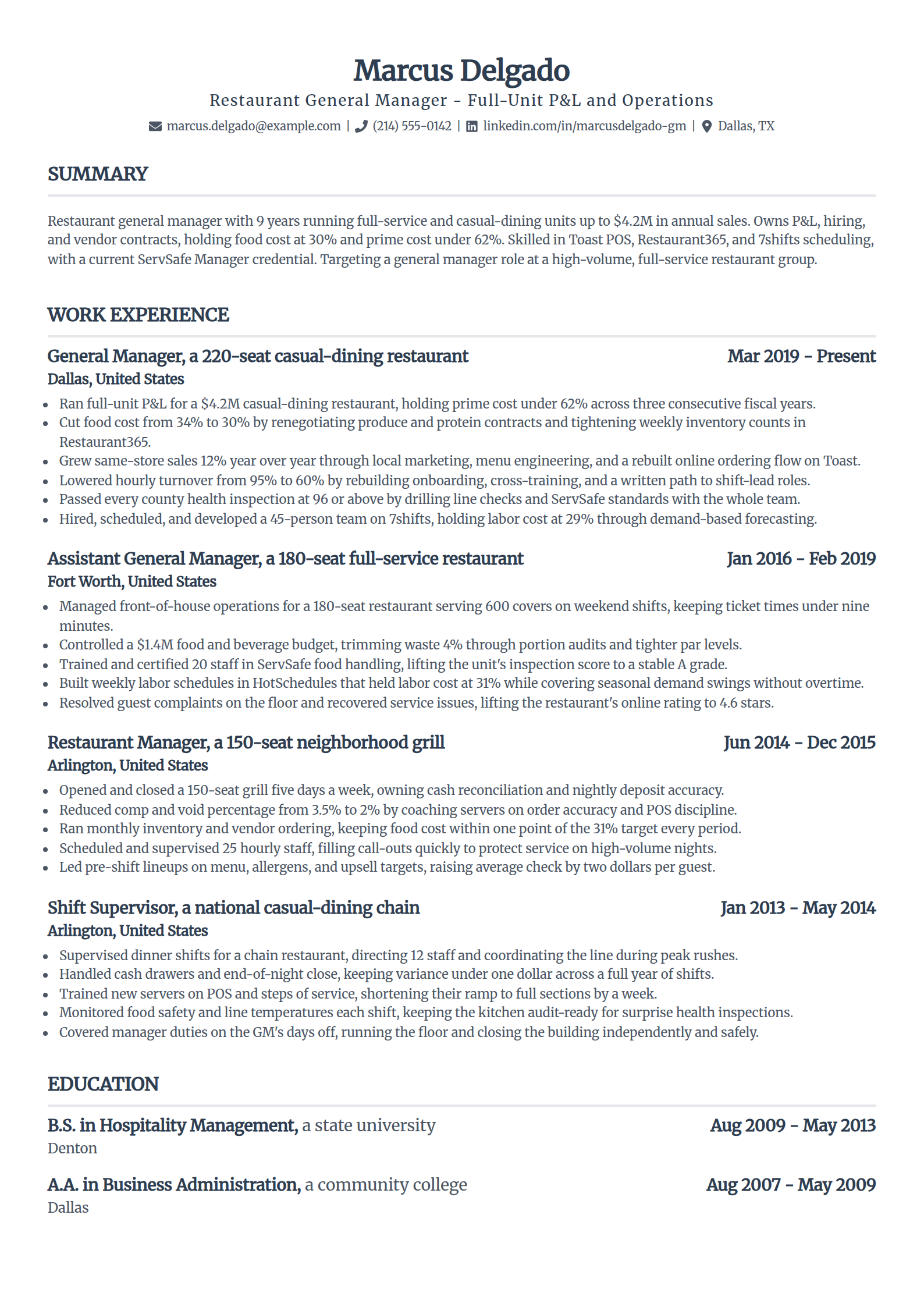
- Opens with full-unit P&L ownership, 9 years running units up to $4.2M in annual sales with food cost held at 30%.
- Ties cost control to a number a hiring group screens for, prime cost kept under 62% across the P&L.
- Names the systems a GM runs: Toast POS, Restaurant365, and 7shifts scheduling, not a vague tools line.
- Shows the credentials up top, ServSafe Manager and the Foodservice Management Professional (FMP).
- Uses a clean, single-column layout an applicant tracking system reads without trouble.
Multi-Unit / District Manager Resume Template
Why this resume example works?
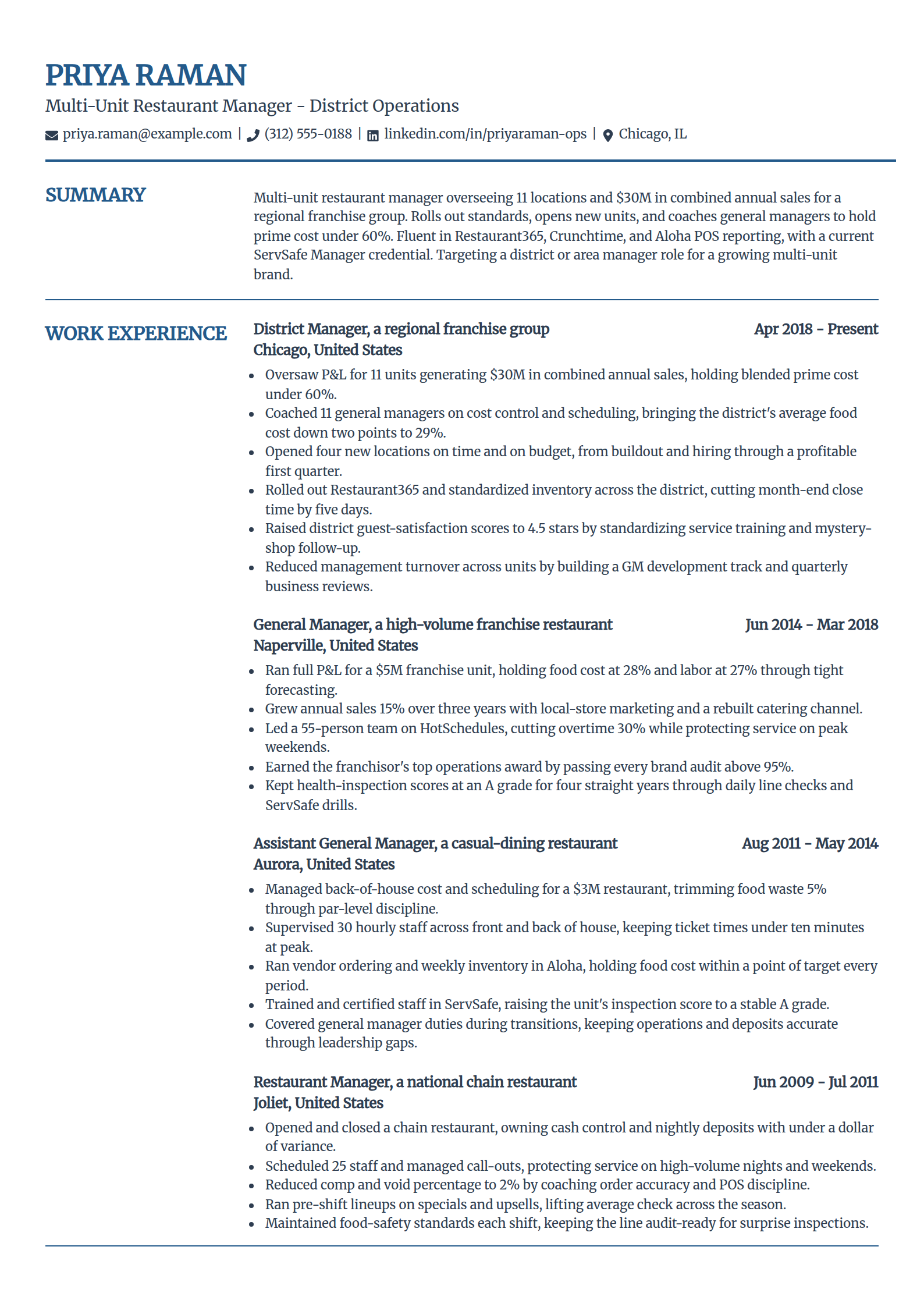
- Leads with the span a district role hires for, 11 locations and $30M in combined annual sales.
- Shows the work above the unit, rolling out standards and opening new stores while coaching GMs.
- Ties leadership to cost, general managers coached to hold prime cost under 60% across the district.
- Names multi-unit systems, Restaurant365, Crunchtime, and Aloha POS reporting across locations.
- Uses a modern layout that carries a dense multi-unit record on one clean page.
Experienced Restaurant Manager Resume Template
Why this resume example works?
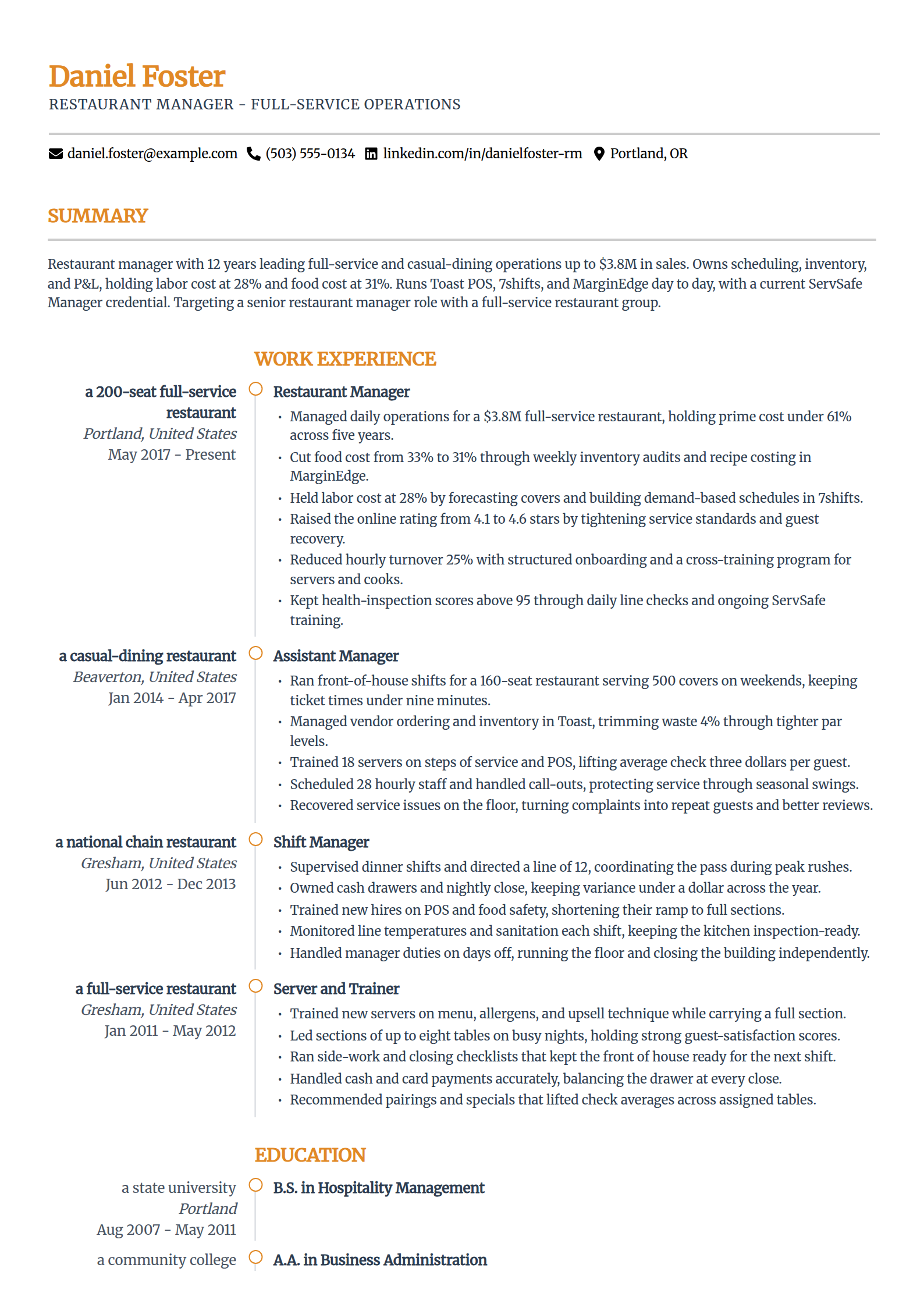
- Opens with 12 years leading full-service operations up to $3.8M in sales, the depth a senior role wants.
- Carries two cost numbers a manager owns, labor held at 28% and food cost at 31%.
- Names the day-to-day stack, Toast POS, 7shifts, and MarginEdge, so the tools read as real.
- Keeps every bullet a result tied to scheduling, inventory, or P&L, not a duty list.
- Uses a modern layout that still reads cleanly for a recruiter scanning fast.
Fine-Dining Restaurant Manager Resume Template
Why this resume example works?
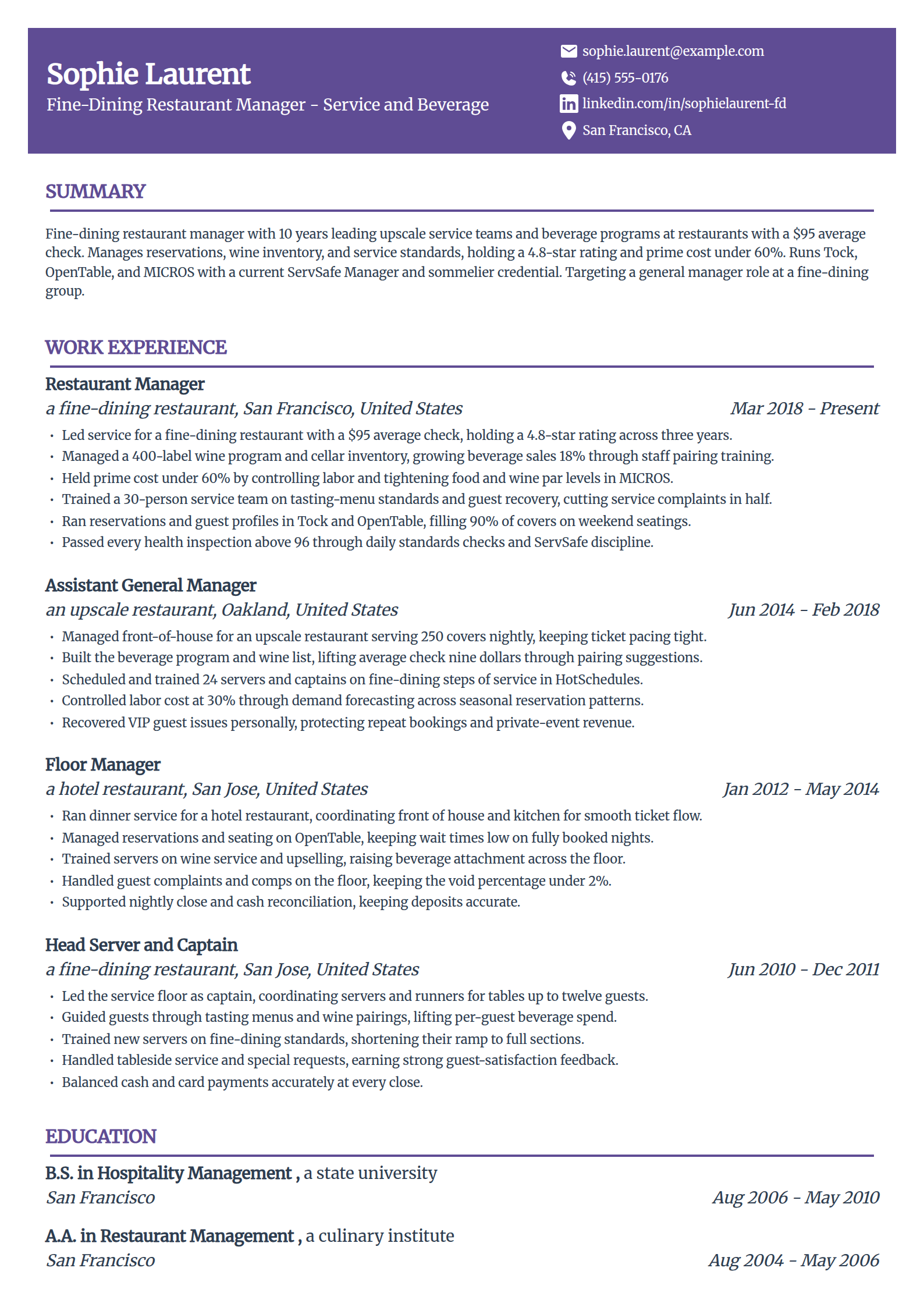
- Leads with the segment an upscale group hires for, a $95 average check and a 4.8-star rating.
- Shows the beverage depth fine dining rewards, wine inventory and a sommelier credential.
- Ties service standards to cost, prime cost held under 60% while running an upscale floor.
- Names the fine-dining stack, Tock, OpenTable, and MICROS, that a reservations-driven room runs.
- Uses a spacious layout that carries a 10-year upscale record on one page.
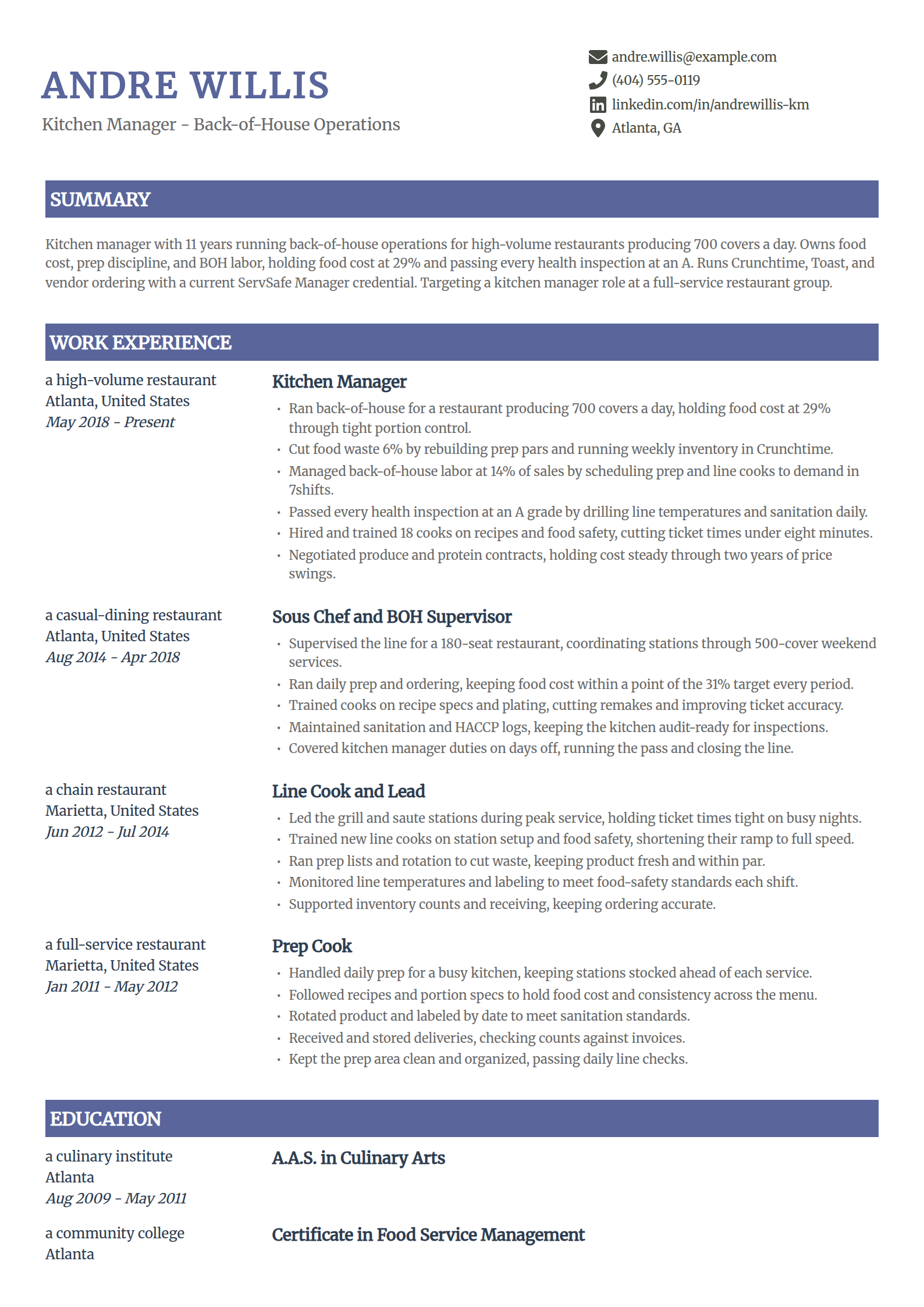
Kitchen Manager (BOH) Resume Template
Why this resume example works?
- Leads with back-of-house scope, running BOH for a high-volume kitchen producing 700 covers a day.
- Carries the two numbers a kitchen manager owns, food cost held at 29% and an A on every inspection.
- Names BOH systems, Crunchtime and Toast, plus vendor ordering, not a generic kitchen line.
- Shows the food-safety credentials a kitchen role verifies, ServSafe Manager and HACCP.
- Uses a modern layout that carries a dense back-of-house history on one clean page.
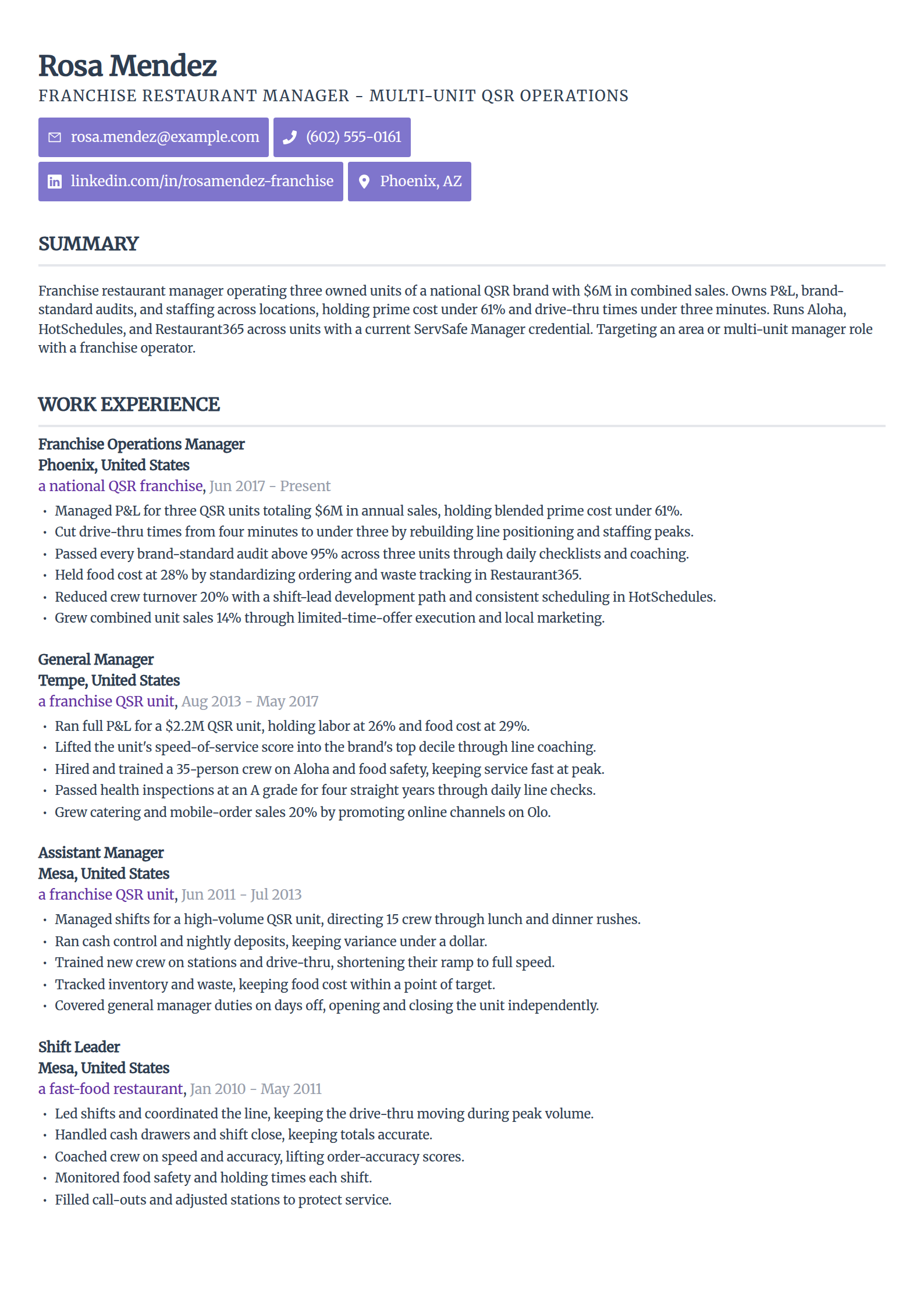
Franchise Manager Resume Template
Why this resume example works?
- Leads with owned-unit scope, three units of a national QSR brand with $6M in combined sales.
- Shows the brand-standard work a franchisor rewards, audits passed and drive-thru times under three minutes.
- Ties operations to cost, prime cost held under 61% across the units.
- Names the franchise stack, Aloha, HotSchedules, and Restaurant365, run across locations.
- Uses a clean, modern layout that carries a multi-unit franchise record on one page.
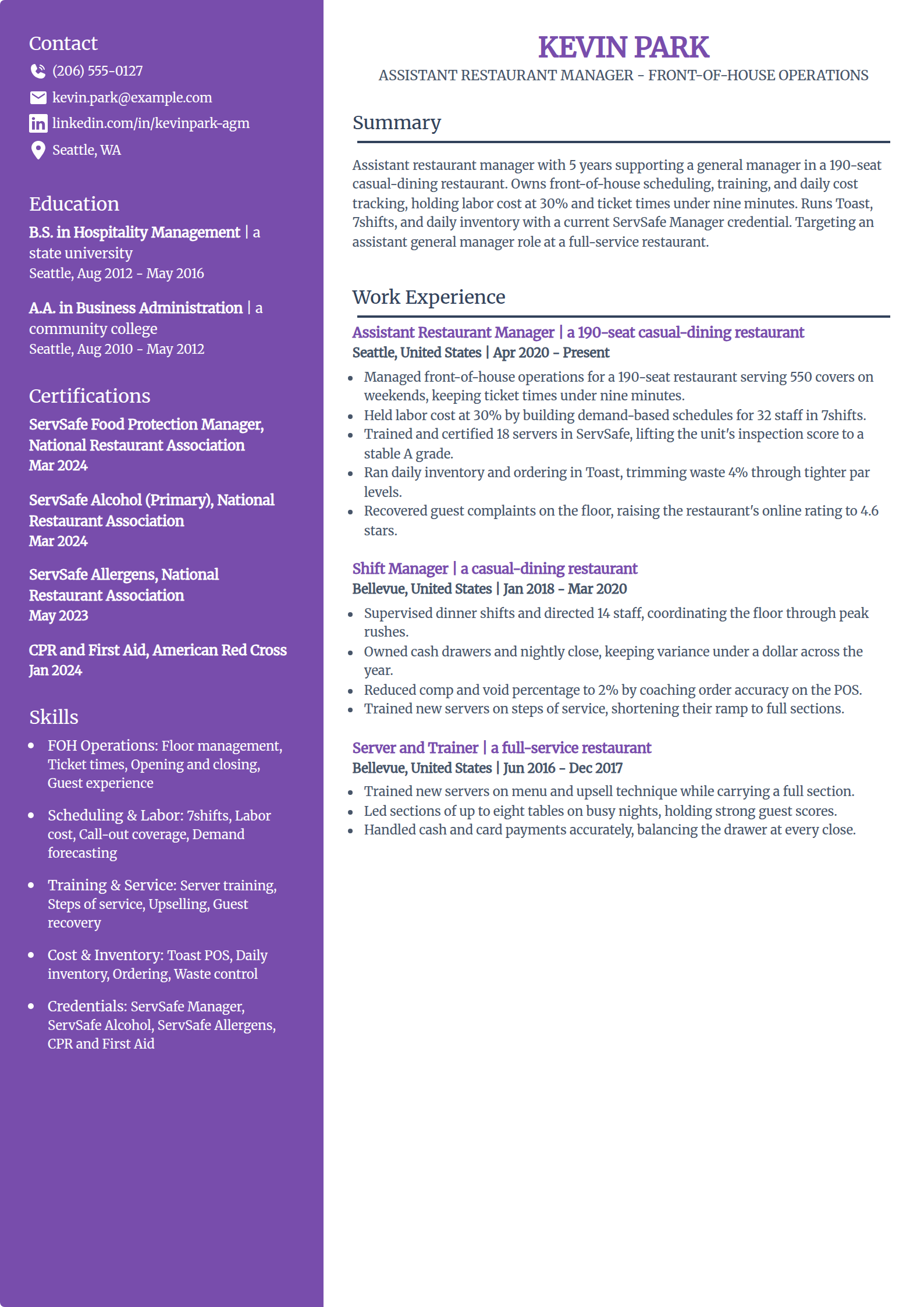
Assistant Restaurant Manager Resume Template
Why this resume example works?
- Leads with the support scope an AGM owns, 5 years backing a GM in a 190-seat casual-dining restaurant.
- Carries a department number, front-of-house labor held at 30% and ticket times under nine minutes.
- Shows the daily ownership below the GM, scheduling, training, and cost tracking.
- Names the tools an AGM runs, Toast, 7shifts, and daily inventory, with a ServSafe Manager credential.
- Uses a Medium layout that fits a five-year support record without empty space.
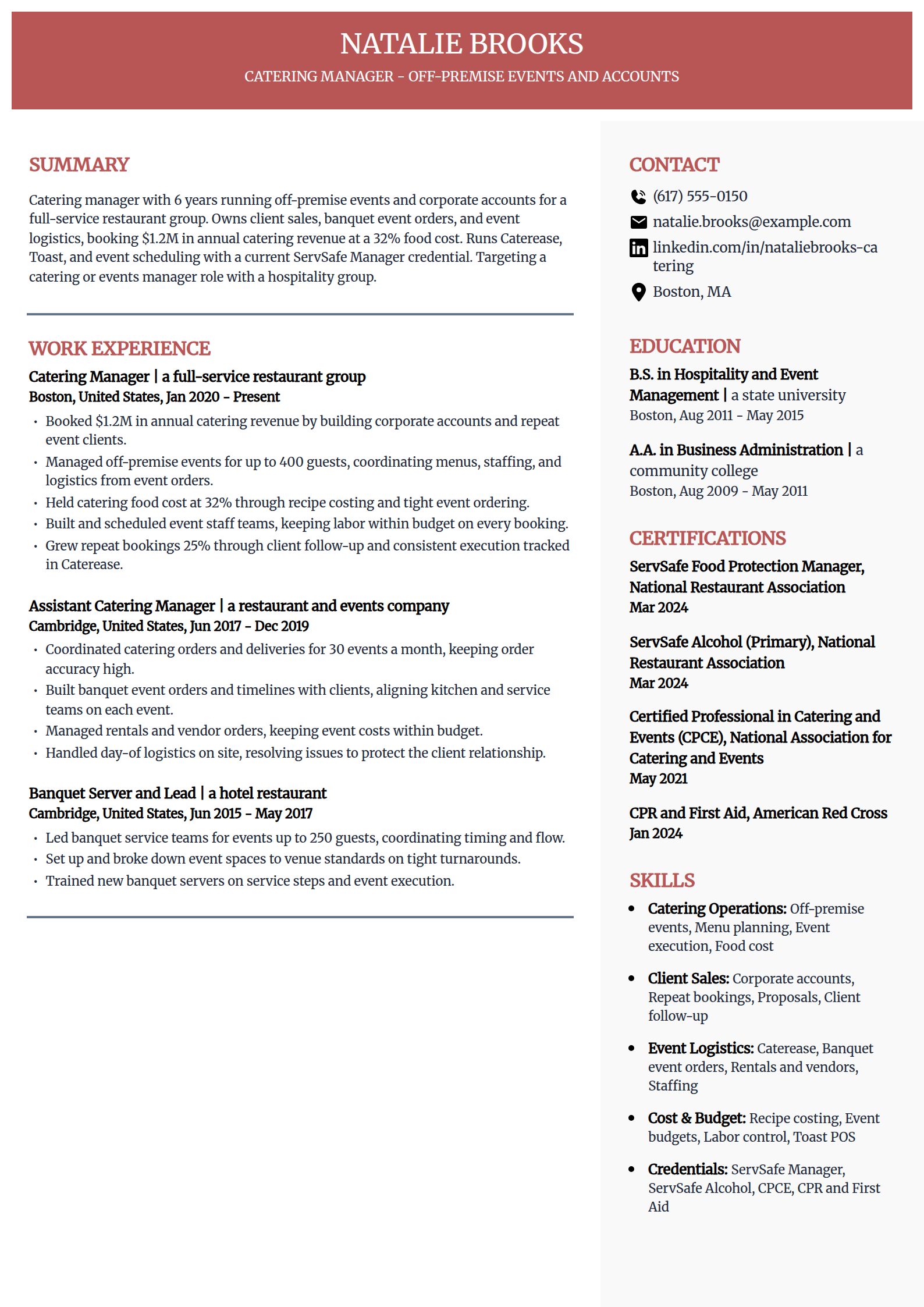
Catering Manager Resume Template
Why this resume example works?
- Leads with off-premise scope, booking $1.2M in annual catering revenue for a restaurant group.
- Shows the sales-and-logistics work catering rewards, client accounts and banquet event orders.
- Ties revenue to cost, events run at a 32% food cost while hitting the booking target.
- Names the catering stack, Caterease and Toast, plus the CPCE credential an events role verifies.
- Uses a refined layout that fits a six-year catering record cleanly on one page.
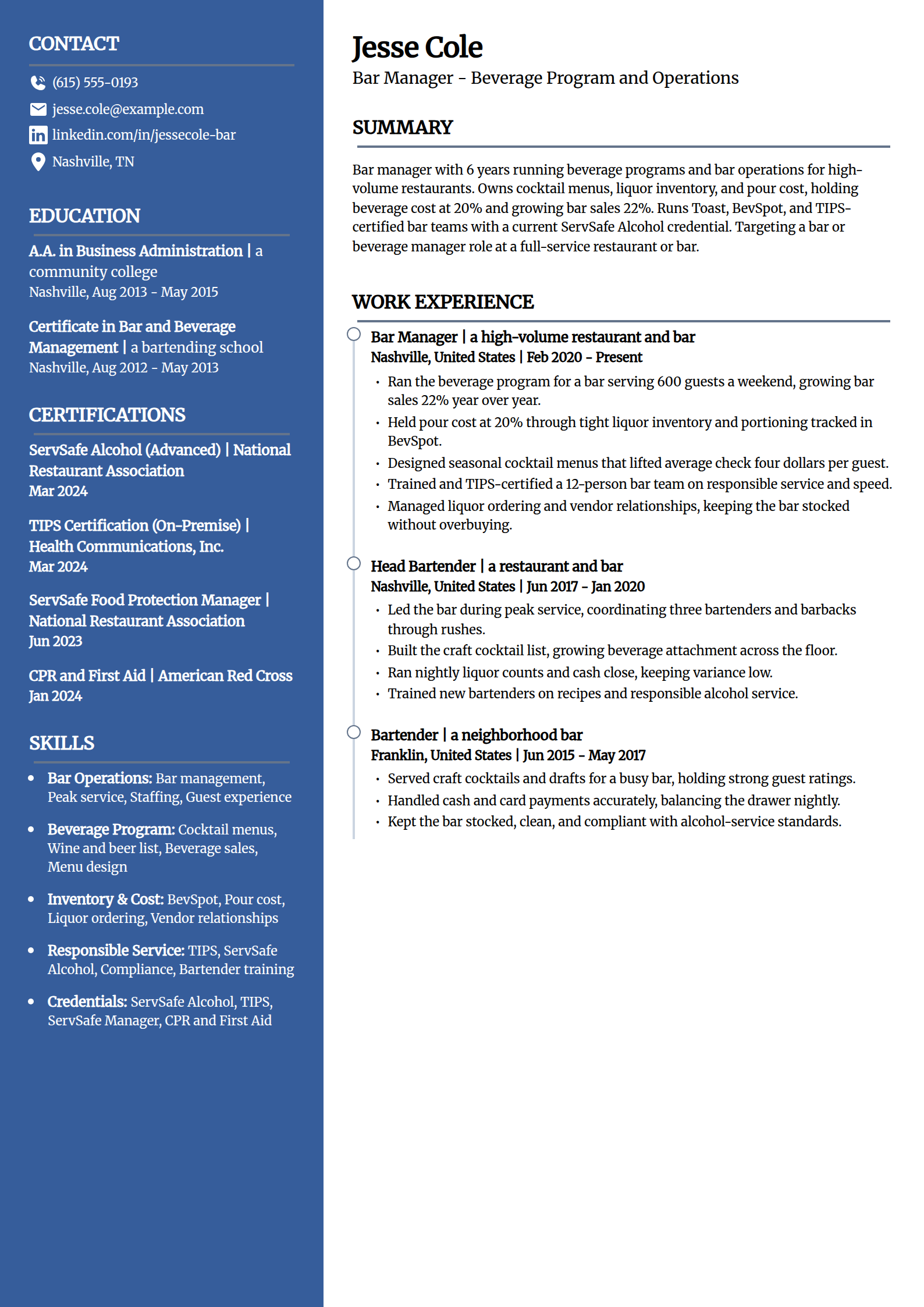
Bar Manager Resume Template
Why this resume example works?
- Leads with beverage-program scope, 6 years running bar operations for high-volume restaurants.
- Carries the number a bar manager owns, beverage cost held at 20% while growing bar sales 22%.
- Shows the responsible-service side, TIPS-certified bar teams and a ServSafe Alcohol credential.
- Names the bar stack, Toast and BevSpot, for pour cost and liquor inventory, not a vague line.
- Uses a distinctive layout that still reads cleanly for a recruiter.
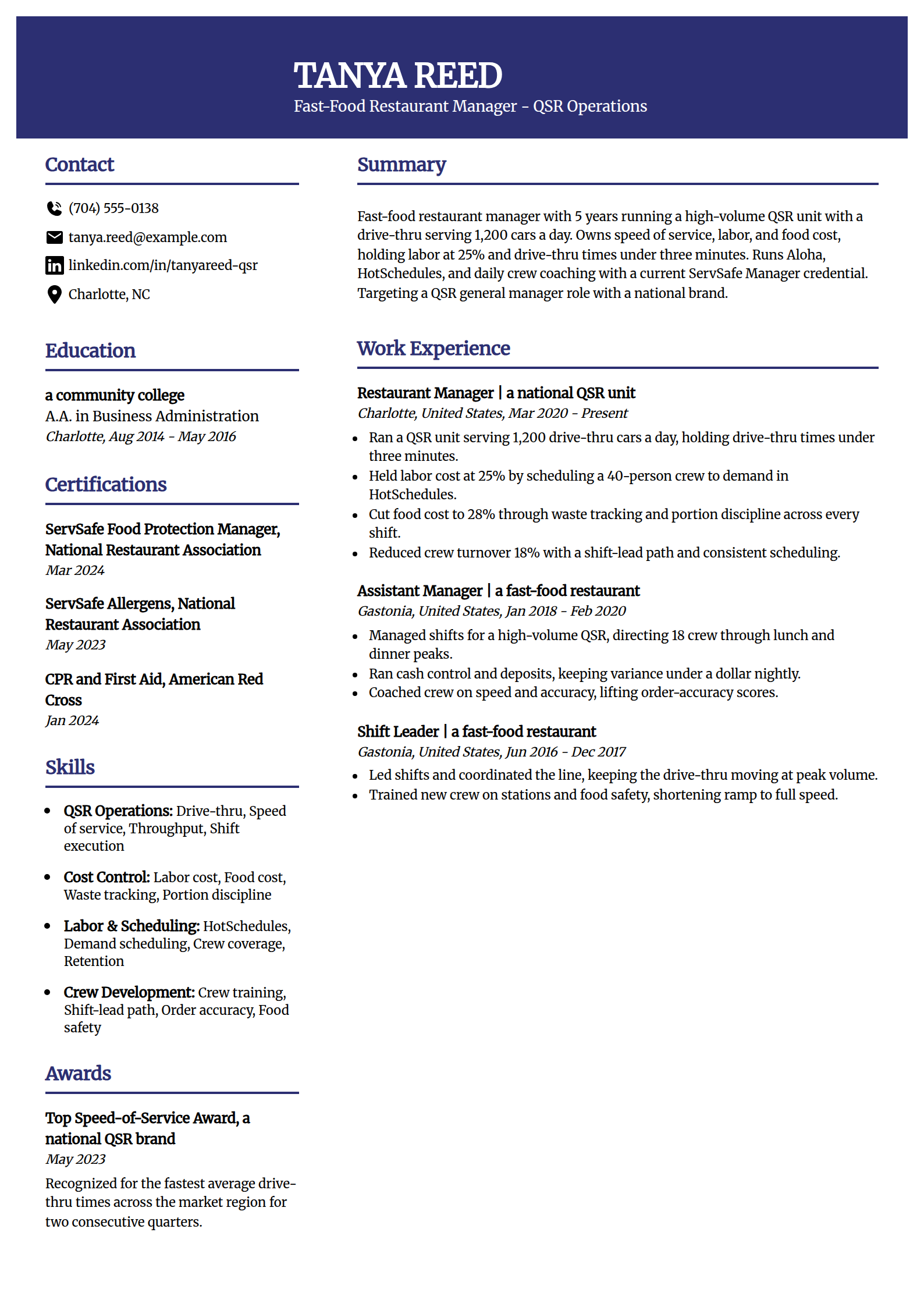
Fast-Food / QSR Manager Resume Template
Why this resume example works?
- Leads with QSR volume, running a drive-thru unit serving 1,200 cars a day.
- Carries the speed-and-labor numbers a QSR screens for, labor at 25% and drive-thru times under three minutes.
- Shows the crew-coaching work that holds a fast-food line together during peak volume.
- Names the QSR stack, Aloha and HotSchedules, plus a ServSafe Manager credential.
- Uses a roomy layout with an award so a five-year QSR record looks full.
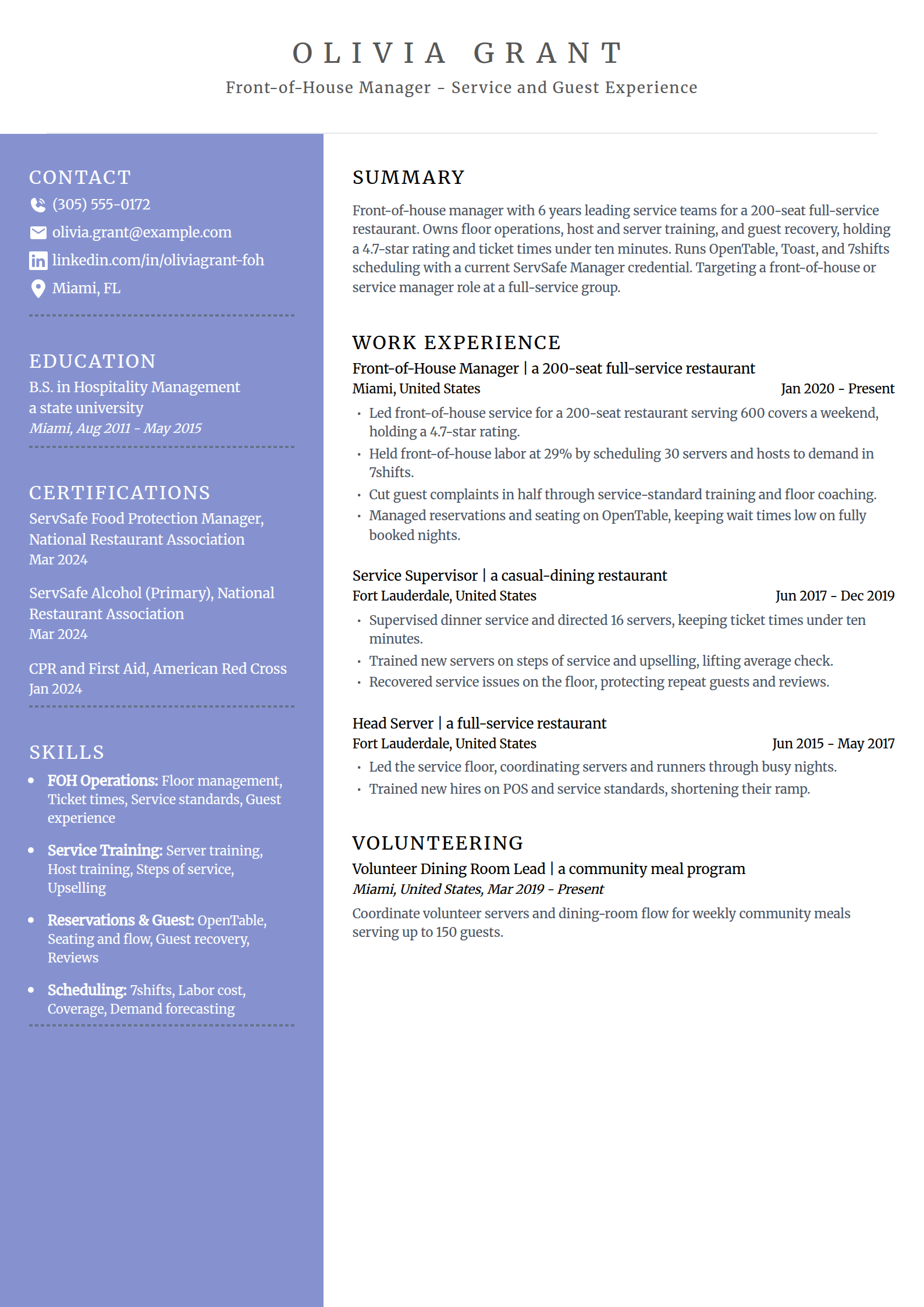
Front-of-House Manager Resume Template
Why this resume example works?
- Leads with service scope, 6 years leading the floor for a 200-seat full-service restaurant.
- Carries a guest number a FOH role rewards, a 4.7-star rating with ticket times under ten minutes.
- Shows the FOH ownership, host and server training and guest recovery on shift.
- Names the front-of-house stack, OpenTable, Toast, and 7shifts scheduling.
- Uses a roomy layout with a filled sidebar so a six-year service record looks complete.
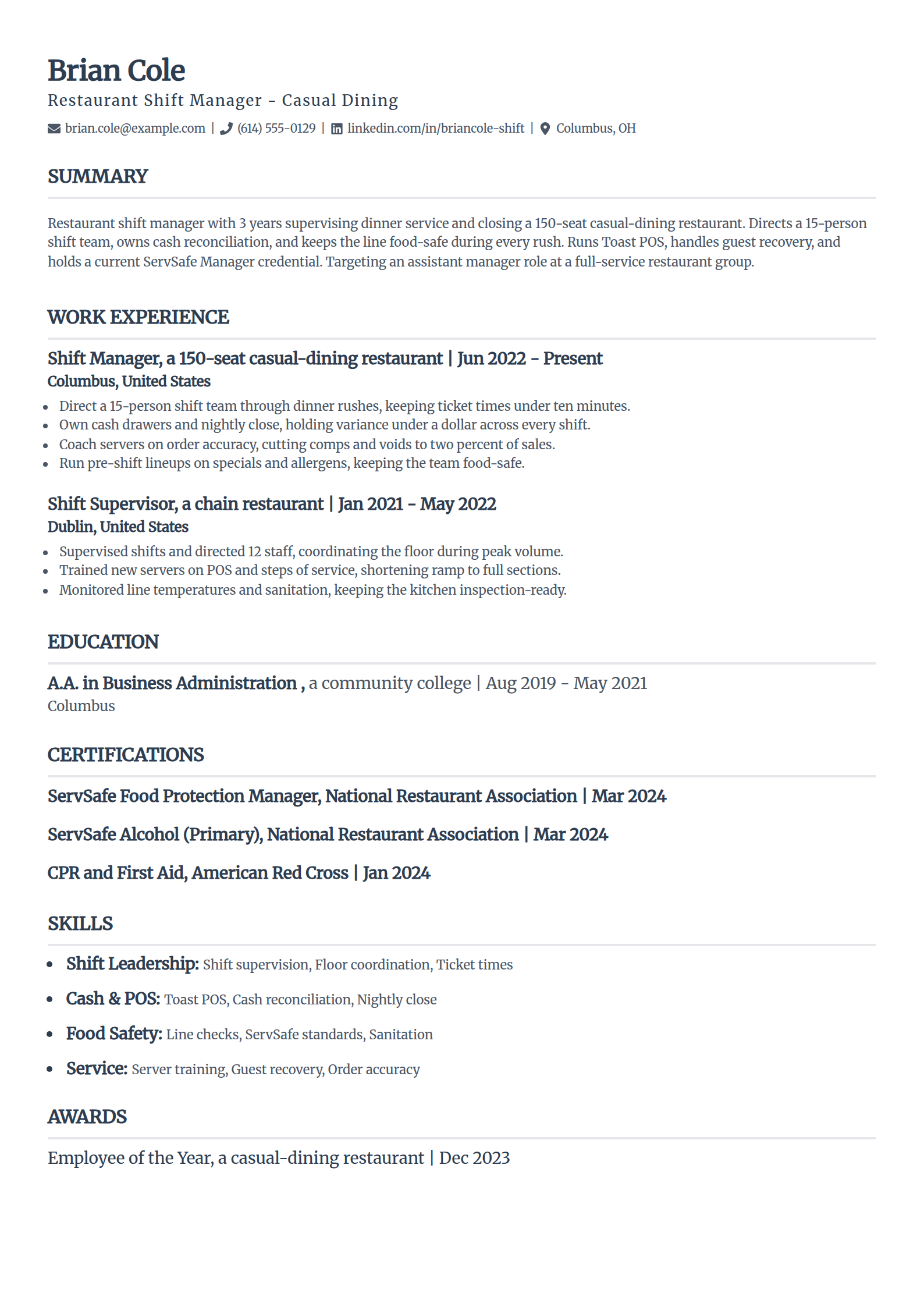
Shift Manager / Supervisor Resume Template
Why this resume example works?
- Written for the first rung, 3 years supervising dinner service and closing a 150-seat restaurant.
- Shows the ownership a shift lead has, a 15-person team and cash variance held under a dollar.
- Keeps results tied to service, comps and voids cut to two percent of sales through coaching.
- Names the tool a supervisor runs, Toast POS, with a ServSafe Manager credential earned early.
- Fills a tight, ATS-safe page without padding, the right shape for a first management resume.
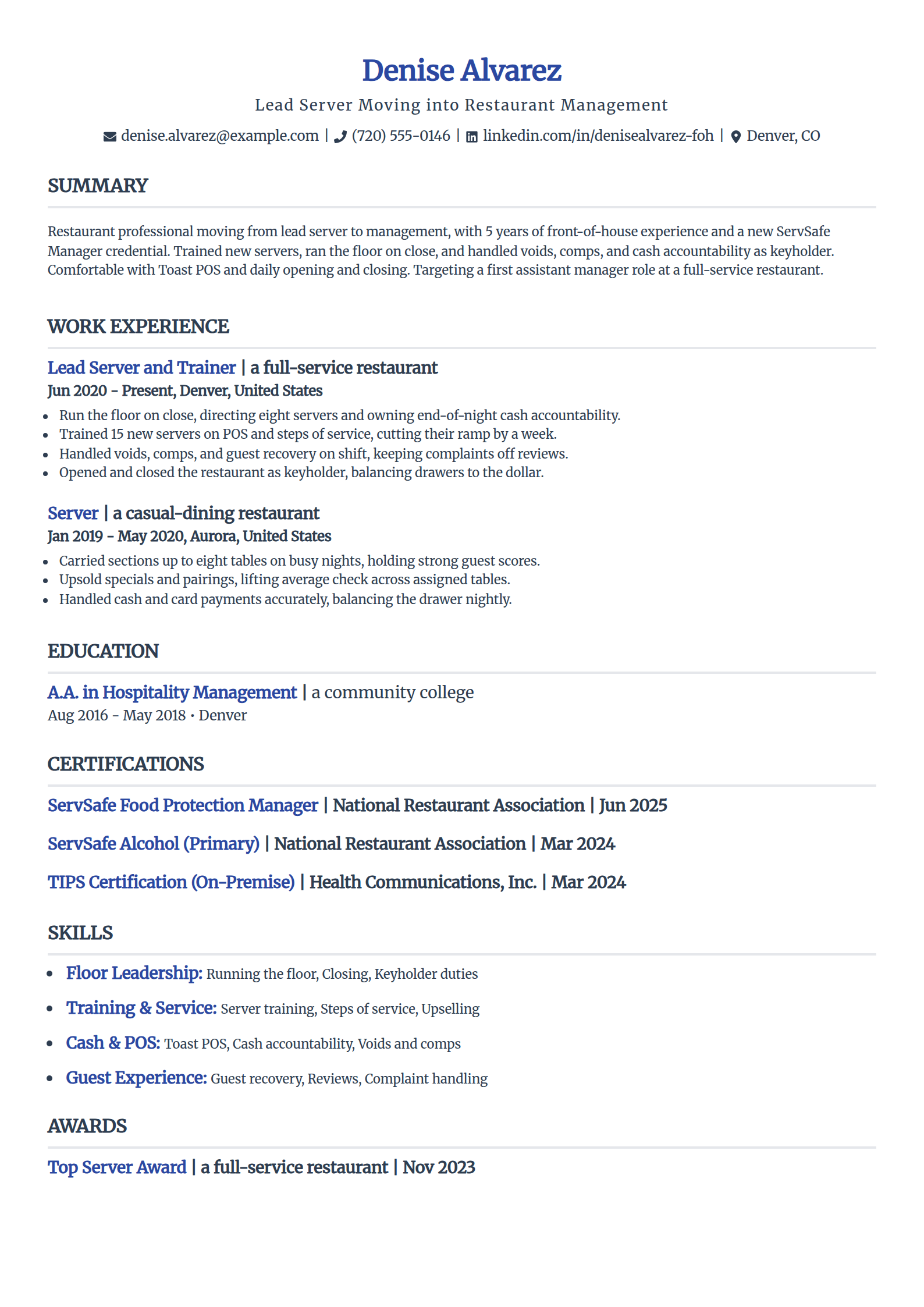
Server-to-Manager Resume Template
Why this resume example works?
- Written for the move up, a lead server with 5 years of front-of-house experience stepping into management.
- Leads with the keyholder work that proves readiness, running the floor on close and owning end-of-night cash.
- Shows the management signals already there, training 15 new servers and handling voids and comps on shift.
- Names the new ServSafe Manager credential that clears the first screen for a manager posting.
- Fills a tight, ATS-safe page with the FOH record a first assistant manager role wants to see.
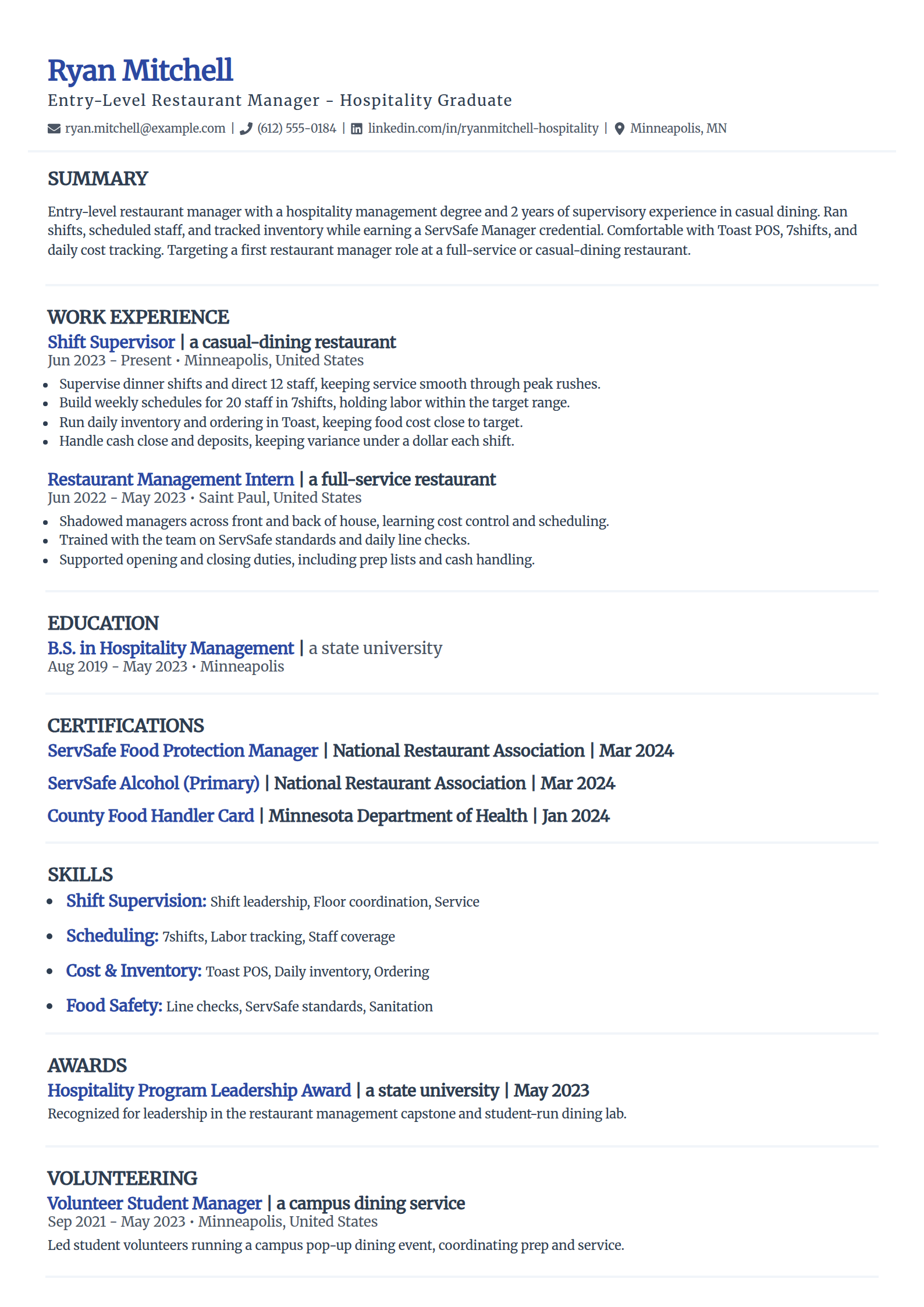
Entry-Level Restaurant Manager Resume Template
Why this resume example works?
- Written for a first manager job, leading with a hospitality management degree and 2 years supervising shifts.
- Shows the supervisory work already done, running shifts, scheduling staff, and tracking inventory.
- Names the ServSafe Manager credential earned before the first management title, an early screen-clearer.
- Keeps the tools honest and specific, Toast POS and 7shifts with daily cost tracking.
- Fills a tight, ATS-safe page with a degree and internship instead of padding.
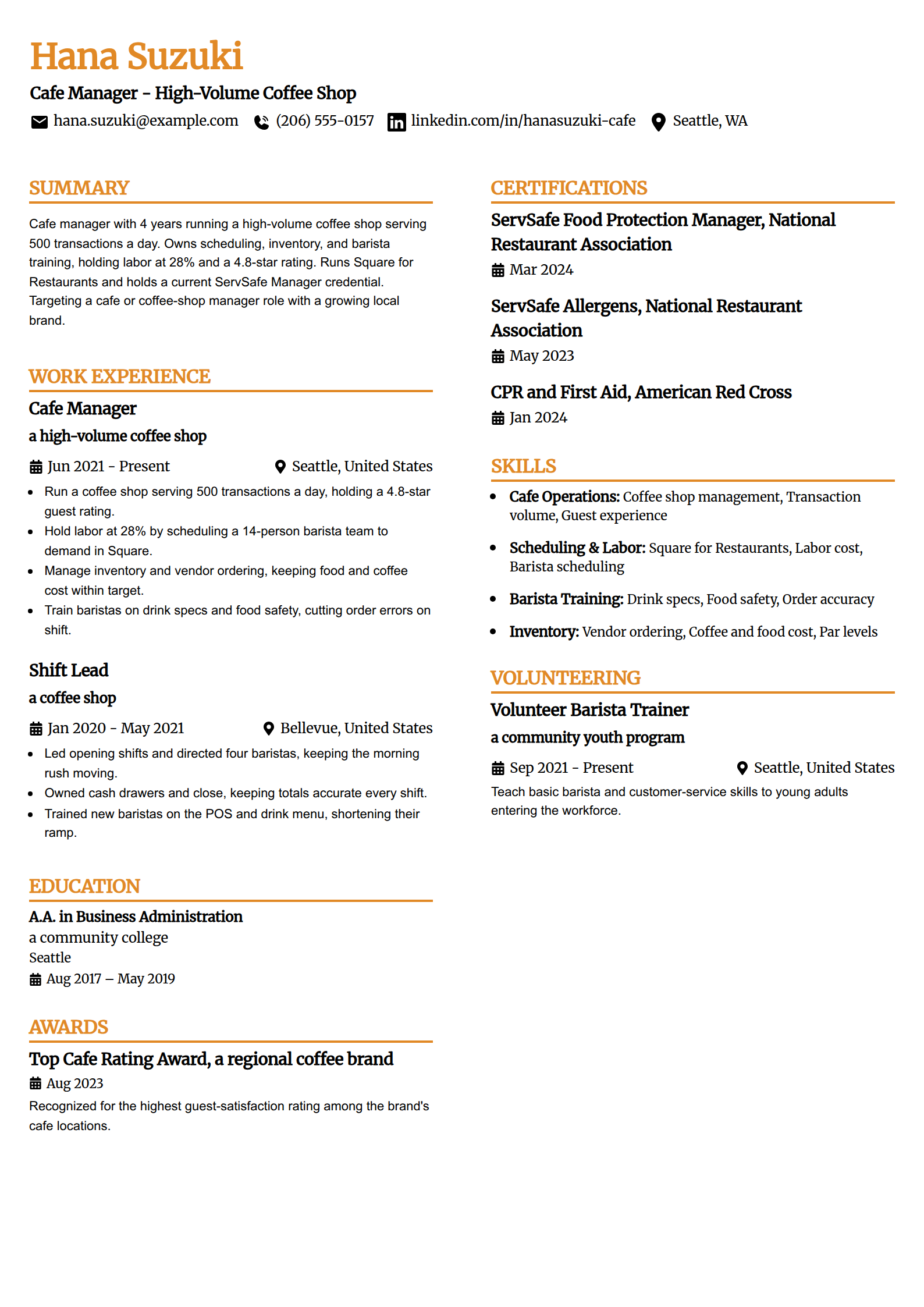
Cafe / Coffee-Shop Manager Resume Template
Why this resume example works?
- Leads with cafe volume, running a high-volume coffee shop serving 500 transactions a day.
- Carries the numbers a cafe owner rewards, labor held at 28% and a 4.8-star rating.
- Shows the work that fits a small-footprint unit, scheduling, inventory, and barista training.
- Names the tool an independent cafe runs, Square for Restaurants, with a ServSafe Manager credential.
- Fills a tight, ATS-safe page cleanly, the right shape for a cafe management resume.
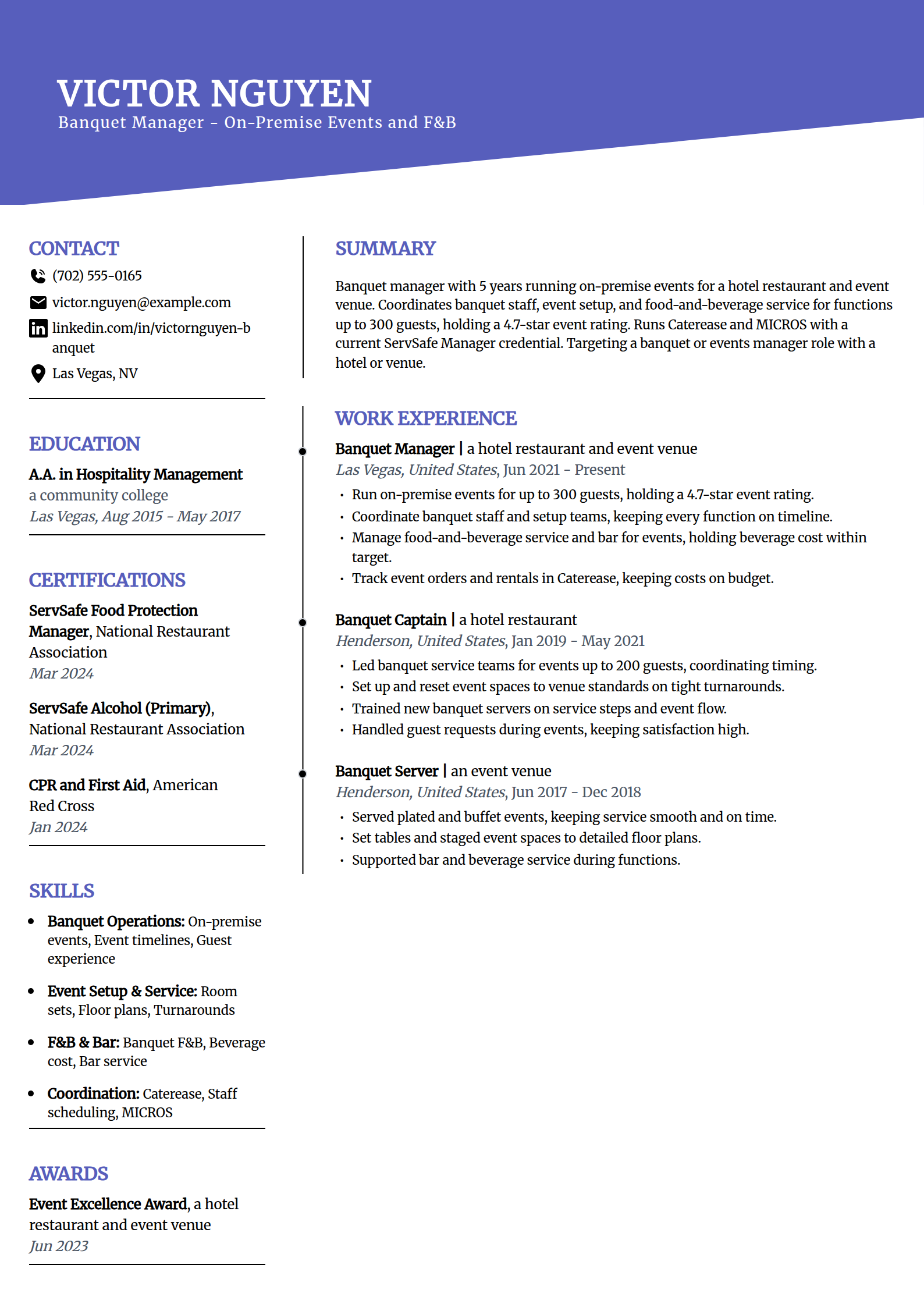
Banquet Manager Resume Template
Why this resume example works?
- Leads with on-premise event scope, running functions up to 300 guests for a hotel restaurant and venue.
- Carries an event number a venue rewards, a 4.7-star event rating across banquet functions.
- Shows the coordination banquets require, staffing, event setup, and food-and-beverage service.
- Names the venue stack, Caterease and MICROS, with a ServSafe Manager credential.
- Lists awards without long descriptions, keeping the layout clean and balanced.
Build your restaurant manager resume
Pick a template above and the editor keeps your layout clean and ATS-safe while you swap in your own P&L, cost percentages, and certifications.
Build my resumeHow to write a restaurant manager resume in 2026
A hiring group scans a restaurant manager resume for two things: what scope you have run, and whether you can prove cost control. Lead with a short summary that names your scope (single unit, multi-unit, or a department like FOH or BOH), your strongest cost number, and your certifications, then make every bullet a result with one number, like food cost percentage, labor cost, covers per shift, or an inspection score. Keep the format simple so a parser reads it as easily as a person does.
Open with a scope-and-numbers summary
Write three to four sentences that name your role and scope, your sales volume or unit count, your strongest cost number, your systems, and the role you are targeting. A general manager leads with full-unit P&L and prime cost; a kitchen manager leads with food cost and inspection scores; an assistant manager leads with the department they own. Keep it to about 60 words so it never spills past the top of the page.
Restaurant general manager with 9 years running full-service and casual-dining units up to $4.2M in annual sales. Owns P&L, hiring, and vendor contracts, holding food cost at 30% and prime cost under 62%. Skilled in Toast POS, Restaurant365, and 7shifts scheduling, with a current ServSafe Manager credential. Targeting a general manager role at a high-volume, full-service restaurant group.
Make every experience bullet a result with a number
This is what separates a manager resume from a server resume. Name what you ran, the action, and the outcome, then attach one credible number and the system or method that produced it.
- Use the numbers a manager owns: food cost percentage, labor cost, prime cost, covers or transactions per shift, check average, inspection scores, or turnover.
- Open with a strong verb like ran, owned, cut, grew, or coached, never "Responsible for" or "Helped with".
- Name the method or tool: "held food cost at 29% through portion controls and weekly inventory in Crunchtime".
- Keep numbers modest and level-accurate: a shift lead shows cash variance and ticket times, a GM shows P&L and prime cost; one number per bullet is plenty.
Show your certifications and the scope of your role
Your food-safety credentials and the exact scope you ran are the first things a hiring group verifies, so put them where they are easy to find. This is also where the GM, assistant manager, and shift-manager split shows up.
- List ServSafe Food Protection Manager first; most postings require it. Add ServSafe Alcohol or TIPS if you run a bar program, and HACCP for a kitchen role.
- A general manager owns full-unit P&L, hiring, and vendor contracts; say so plainly and back it with sales volume and prime cost.
- An assistant manager owns a department under the GM (front of house or back of house); name the department and the number you moved, not the whole unit's P&L.
- Moving up from server? Lead with keyholder duties, cash accountability, and training, and show the ServSafe Manager credential that clears the first screen.
Match skills and keywords to the job posting
A skills block should read like the posting, grouped so a recruiter and a parser both find what they need. List the systems and areas you have actually run, not a generic dump.
- Group by type: operations and P&L, cost control, front-of-house or back-of-house, and systems.
- Name the POS you run: Toast, Aloha, MICROS, or Square, and the back-office tools like Restaurant365, Crunchtime, HotSchedules, or 7shifts.
- Name the segment outright, full-service, fine dining, QSR, cafe, catering, or banquet, since hiring groups filter on it.
- If the posting says "P&L", "prime cost", or "labor management", use that exact phrasing where it fits, since that is what the applicant tracking system searches for.
Keep the format clean and ATS-safe
A restaurant manager resume is read by a parser first and a hiring manager second, so a clean layout with standard headings is the safe choice at every level.
- Use a single-column or simple two-column layout with standard headings a parser recognizes; skip heavy graphics and photos.
- Keep it to one page for under about ten years of experience; most restaurant managers fit a strong record on a single page.
- Save as a PDF so the formatting holds, then run it through our ATS resume checker for a quick format and keyword pass.
- Swap the numbers in the templates above for your own P&L, cost percentages, and certifications; do not copy them as is.
Common restaurant manager resume mistakes
- Writing a server resume with a manager title. If your bullets describe taking orders and running food instead of owning cost and a team, it reads as front-line work; lead with P&L, food and labor cost, and the size of the team you ran.
- Leaving out the numbers a manager owns. Replace "managed daily operations" with "held food cost at 30% and labor at 28% across a $3.8M unit". No cost numbers means no proof of scope.
- Blurring GM, assistant manager, and shift scope. A hiring group needs to know whether you ran a unit's full P&L, a department, or a single shift; state it plainly and back it with the right number.
- Hiding your ServSafe status. Most postings require ServSafe Food Protection Manager, so put it by your name or in a certifications block, not buried at the bottom.
- Dumping every system in one line. Group your POS, scheduling, and back-office tools into labeled skill categories a parser and a recruiter can both scan.
Frequently asked questions
What should a restaurant manager put on a resume?
Lead with a three-to-four-sentence summary that names your scope (single unit, multi-unit, or a department like front of house or back of house), your sales volume, your strongest cost number, and your certifications. Under each job, write results-first bullets that open with a strong verb and carry one credible number, like holding food cost at 30% or running 700 covers a day. Name the POS and back-office systems you ran, list ServSafe and any other certifications in their own block, and keep the whole thing to one clean, ATS-safe page.
What is the difference between a general manager and an assistant manager resume?
A general manager owns the full unit: P&L, hiring, vendor contracts, and the overall cost structure, so a GM resume leads with sales volume, prime cost, and food and labor cost across the unit. An assistant manager owns a department under the GM, usually front of house or back of house, so an AGM resume leads with the department they ran and the numbers they moved there, like front-of-house labor or ticket times, rather than the whole unit's P&L. Name your scope plainly so a hiring group does not have to guess.
How do you write a restaurant manager resume with no management experience?
Lead with what you do have. A server or shift lead moving up leads with keyholder duties, cash accountability, closing the restaurant, and training new staff, treating each as a real experience entry with quantified bullets. Show the ServSafe Food Protection Manager credential as an early signal that you are ready for a manager posting, and keep the scope honest: supervising a shift or a section, not running a unit's P&L yet. The shift-manager and server-to-manager examples above show the shape.
What metrics should a restaurant manager put on a resume?
Use the numbers that prove cost control and scale: food cost percentage, labor cost percentage, prime cost, sales volume, covers or transactions per shift, check average, health-inspection scores, and staff turnover or retention. Keep them modest and level-accurate, one number per bullet, and tie each to the method that produced it, like holding food cost at 29% through portion controls and weekly inventory. A general manager shows P&L and prime cost; a shift lead shows cash variance and ticket times.
Do you need ServSafe on a restaurant manager resume?
For most manager roles, yes. The ServSafe Food Protection Manager certification is required or strongly preferred on the majority of restaurant manager postings, so list it by your name or in a certifications block where it is easy to find. Add ServSafe Alcohol or TIPS if you run a bar or beverage program, and a HACCP manager certification for a kitchen or back-of-house role. If you are still scheduled to take the exam, say that plainly with the date rather than implying you already hold it.
How long should a restaurant manager resume be?
One page for most restaurant managers with under about ten years of experience, including shift leads, assistant managers, and single-unit GMs. A longer multi-unit, district, or director record can run to two pages, but only when the second page carries results, not filler. Lead with your most recent and highest-scope role, keep standard headings, and cut older or unrelated jobs so the space goes to the work that matches the role you want.
More restaurant manager resume resources
Build your restaurant manager resume
Pick a template above and the editor keeps your layout clean and ATS-safe while you swap in your own P&L, cost percentages, and certifications.