16 Chef Resume Examples, Prep Cook to Executive Chef
- ATS Friendly
- Chef & Cook
- 16 Real Examples
A full brigade, a single station on the line, the pastry program, or a private kitchen, this page has a resume built for your exact spot in the kitchen. Start from a layout below, then model your own on a real example. Your brigade size, food cost, and certifications, from ServSafe to your ACF credential, sit right where a hiring chef looks first.


540k+ resumes created
Editable chef and cook resume templates
Each template below is a real kitchen resume laid out in that format, sorted by role and level across executive chef, sous chef, pastry, line cook, catering, and private work. Pick one, then swap in your own covers, brigade size, food cost, and certifications. Every layout keeps your name, credentials, and impact bullets clean so a hiring chef reads your strongest service at a glance and an applicant tracking system parses it without trouble.
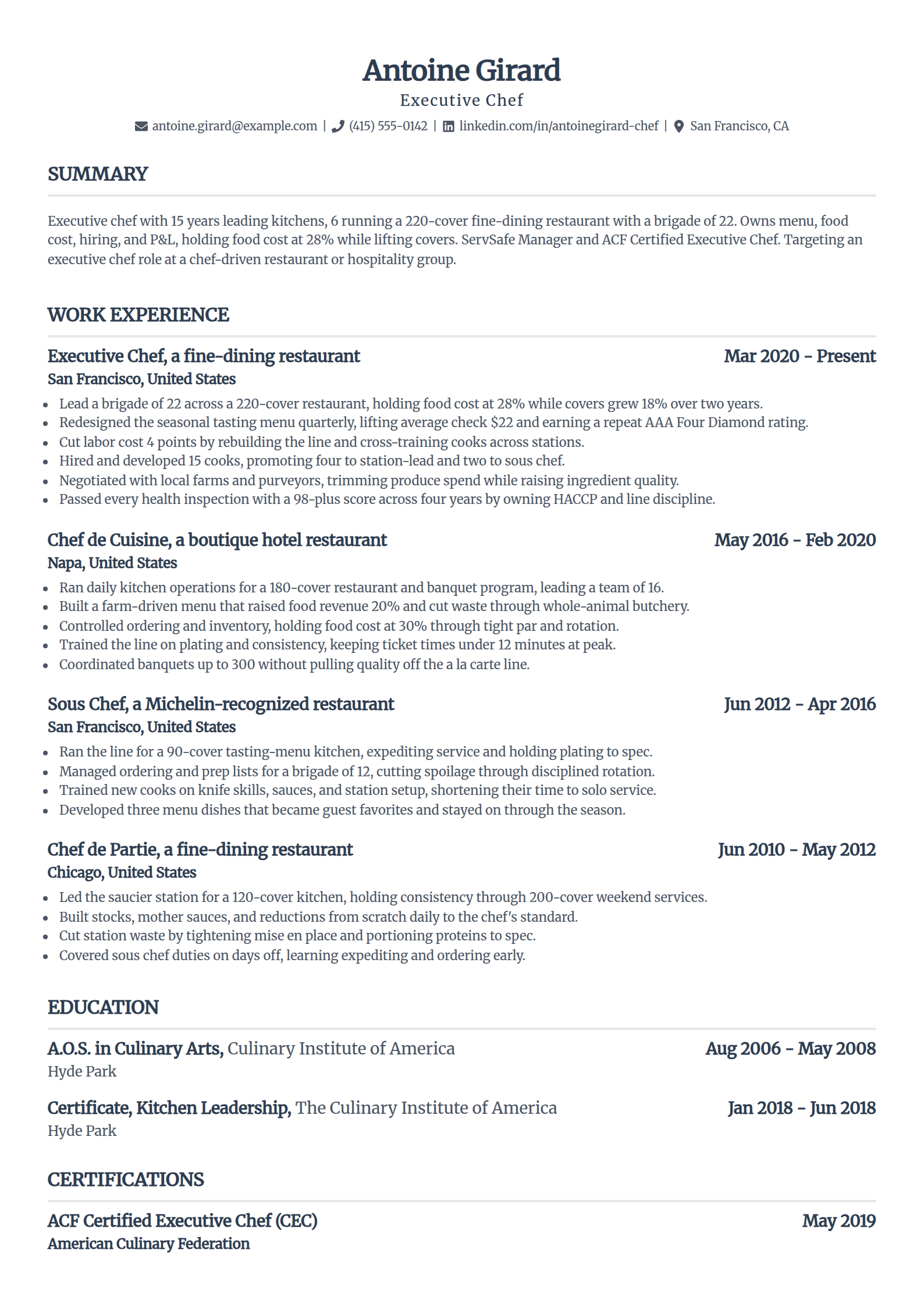
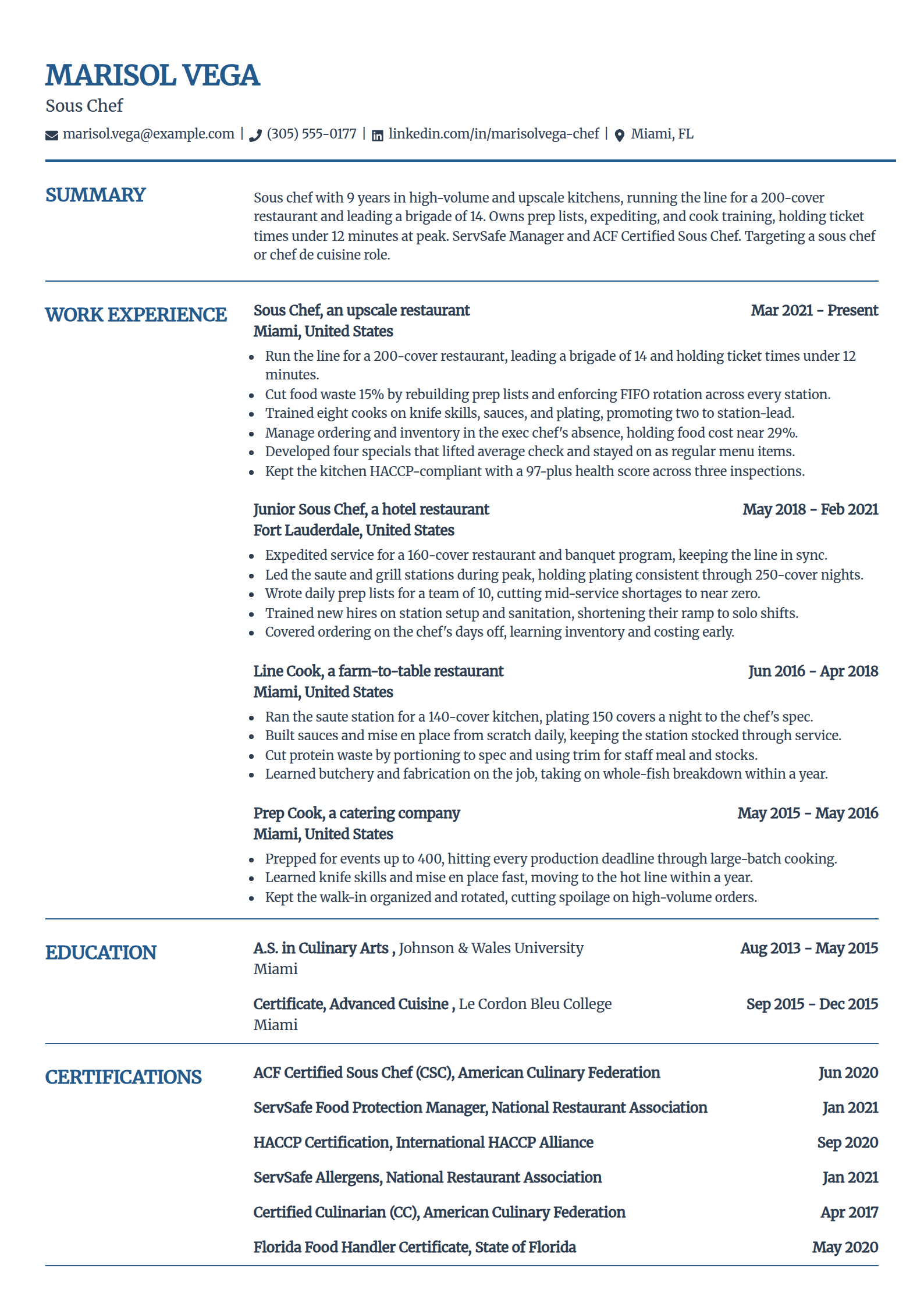
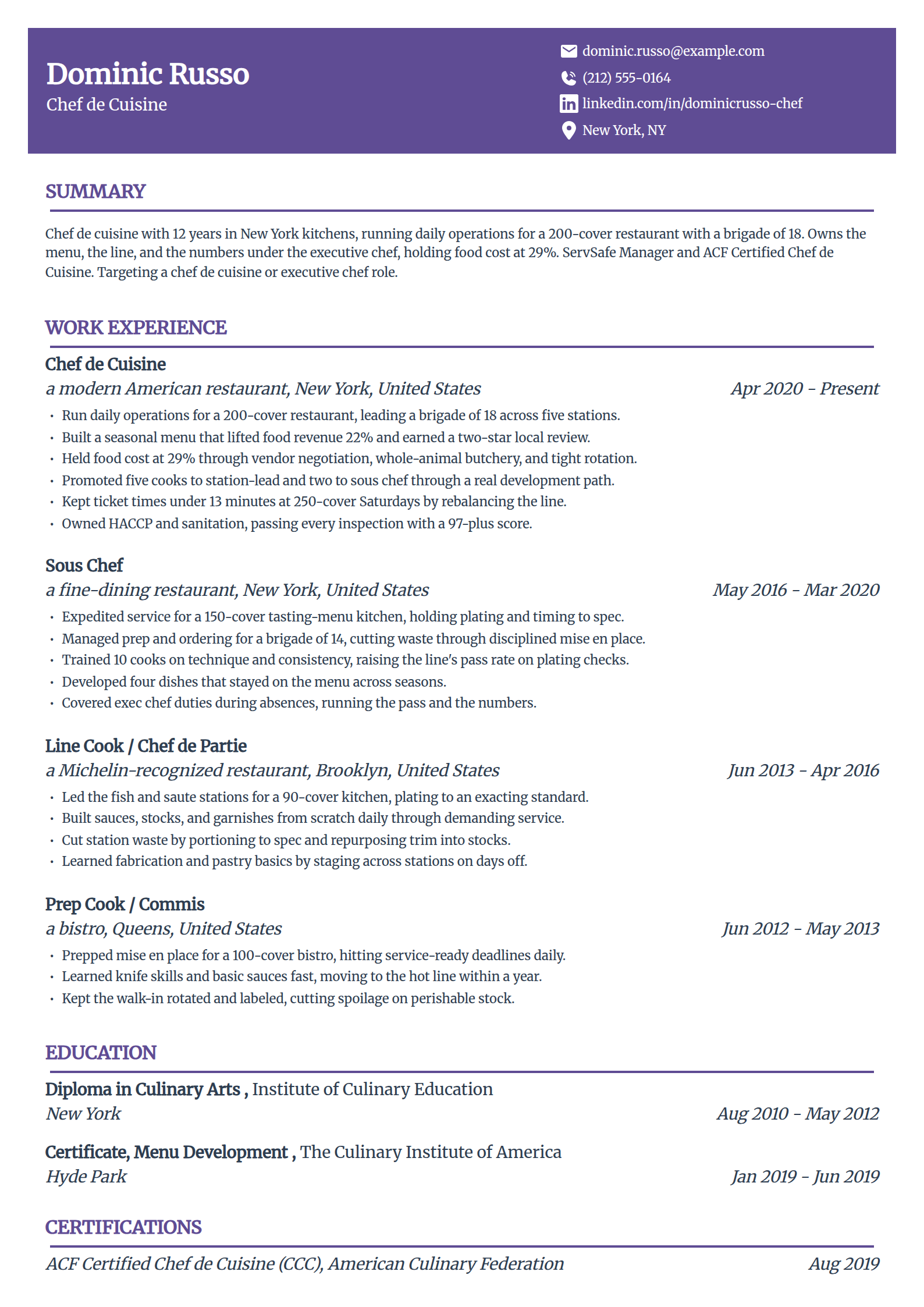
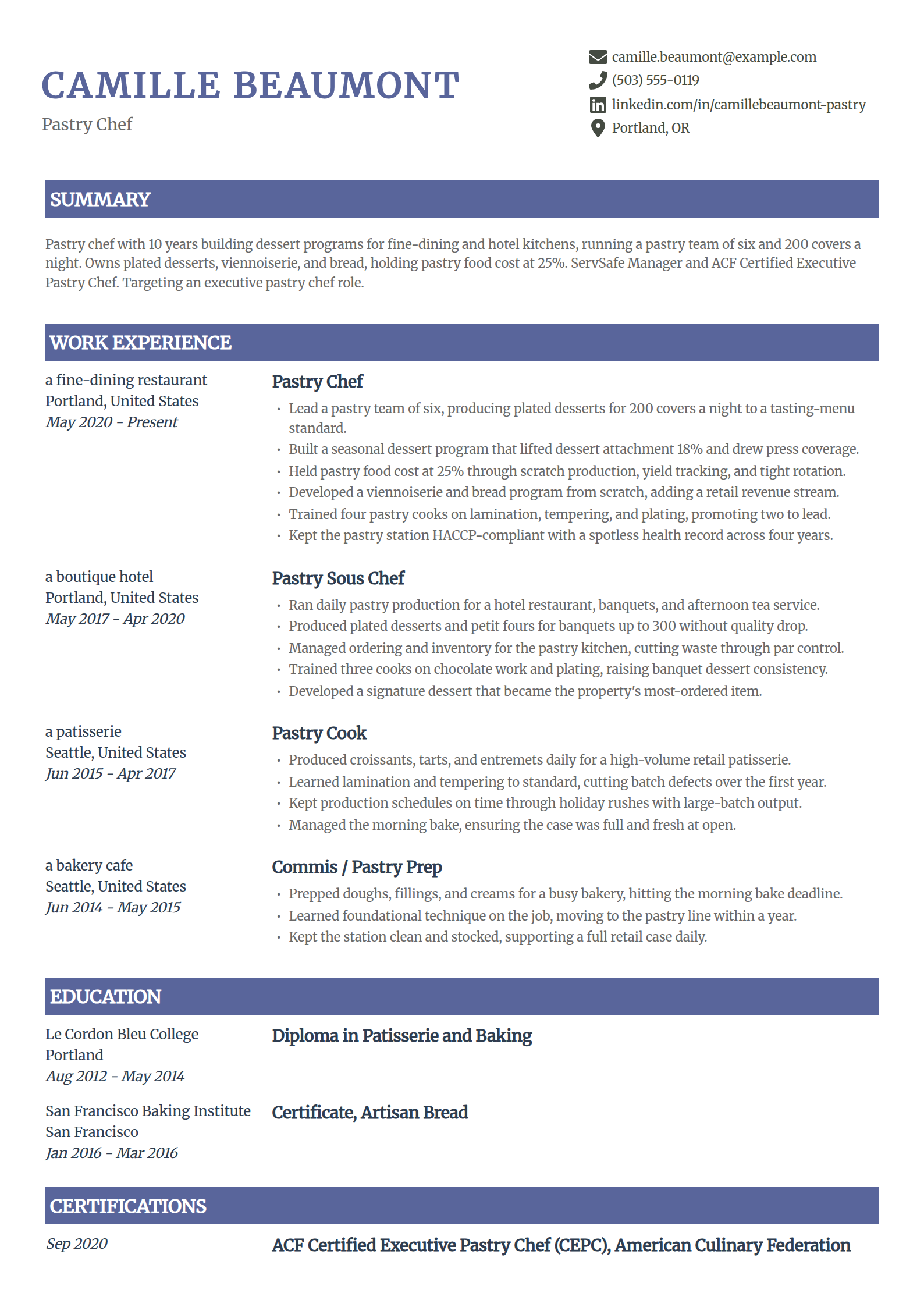
Executive Chef Resume Template
16 executive chef resume examples by kitchen: hotel, club, casino, catering and more →
Why this resume example works?
- Opens with the numbers a hiring group wants, a brigade of 22, a 220-cover restaurant, and food cost held at 28%.
- Shows executive scope, owning the menu, hiring, P&L, and purveyor negotiation, not just the line.
- Attaches one number to each bullet, like covers up 18% or labor cost cut 4 points.
- Names ServSafe Manager and the ACF Certified Executive Chef credential a top kitchen checks.
- Uses a clean, single-column layout an applicant tracking system parses without trouble.
Sous Chef Resume Template
Why this resume example works?
- Leads with sous scope, running the line for a 200-cover restaurant and a brigade of 14.
- Shows the work a chef promotes on, ticket times under 12 minutes and food waste cut 15%.
- Keeps ownership at the right level, prep lists, expediting, and cook training under the exec chef.
- Names ServSafe Manager and the ACF Certified Sous Chef credential.
- Uses a modern layout that carries a nine-year kitchen record on one clean page.
Chef de Cuisine & Head Chef Resume Template
Why this resume example works?
- Leads with daily-operations scope, a 200-cover restaurant, a brigade of 18, and five stations.
- Shows the results a group rewards, food revenue up 22% and food cost held at 29%.
- Pairs the menu with people, five cooks promoted to station-lead and two to sous chef.
- Names ServSafe Manager and the ACF Certified Chef de Cuisine credential.
- Uses a spacious layout that carries a 12-year kitchen record on one page.
Pastry Chef Resume Template
Why this resume example works?
- Opens with pastry scope, a team of six producing plated desserts for 200 covers a night.
- Shows the program a restaurant hires for, viennoiserie, bread, and dessert attachment up 18%.
- Keeps cost visible, pastry food cost held at 25% through scratch production and yield tracking.
- Names ServSafe Manager and the ACF Certified Executive Pastry Chef credential.
- Uses a modern two-column layout that carries a dense pastry history on one page.
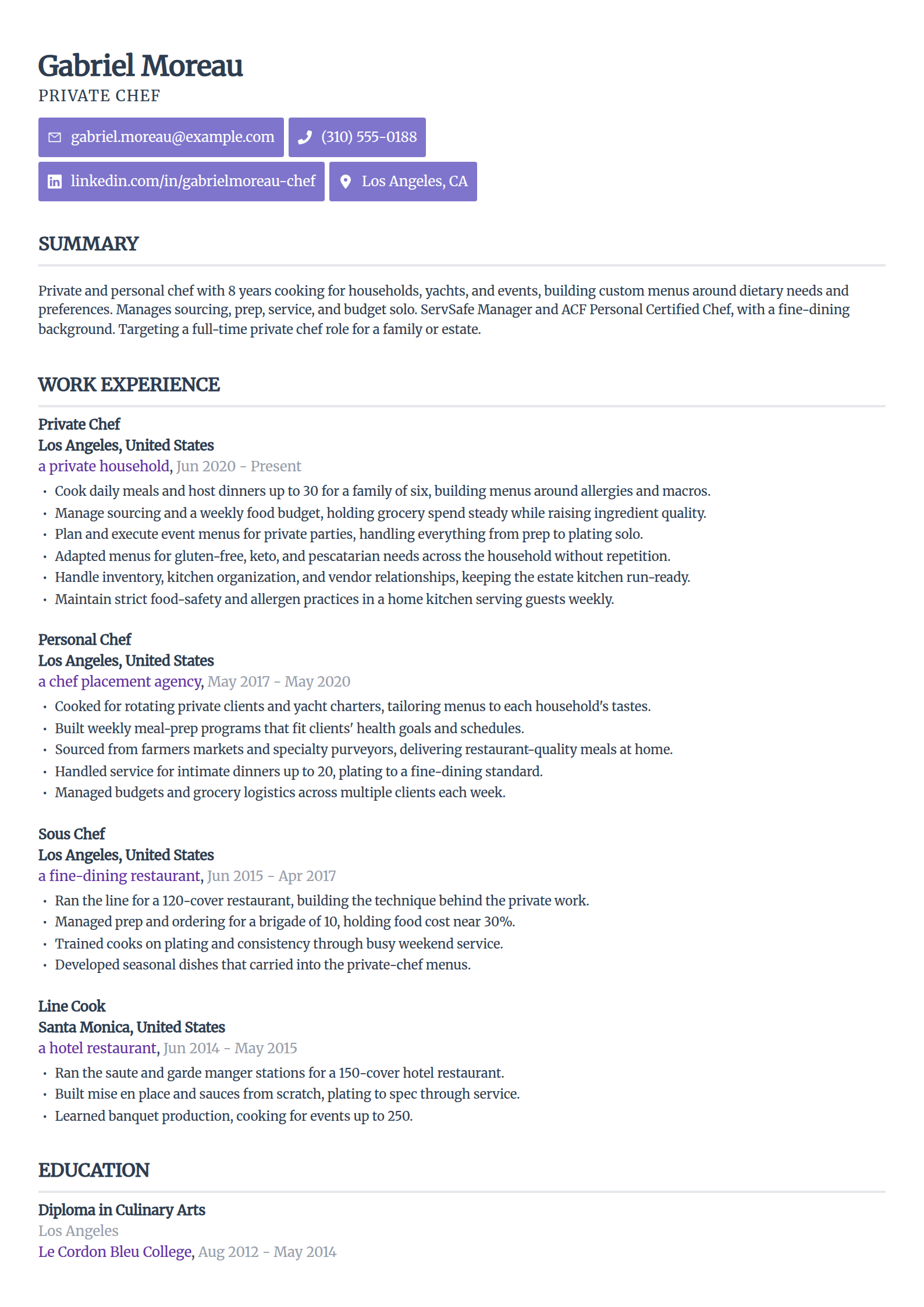
Private & Personal Chef Resume Template
Why this resume example works?
- Leads with private scope, daily meals and dinners up to 30 built around allergies and preferences.
- Shows the self-management a household needs, sourcing, budgets, and vendor relationships owned solo.
- Keeps the dietary work concrete, gluten-free, keto, and pescatarian menus without repetition.
- Names ServSafe Manager and the ACF Personal Certified Chef credential, plus a fine-dining background.
- Uses a clean, modern layout that carries a deep private-chef record on one page.
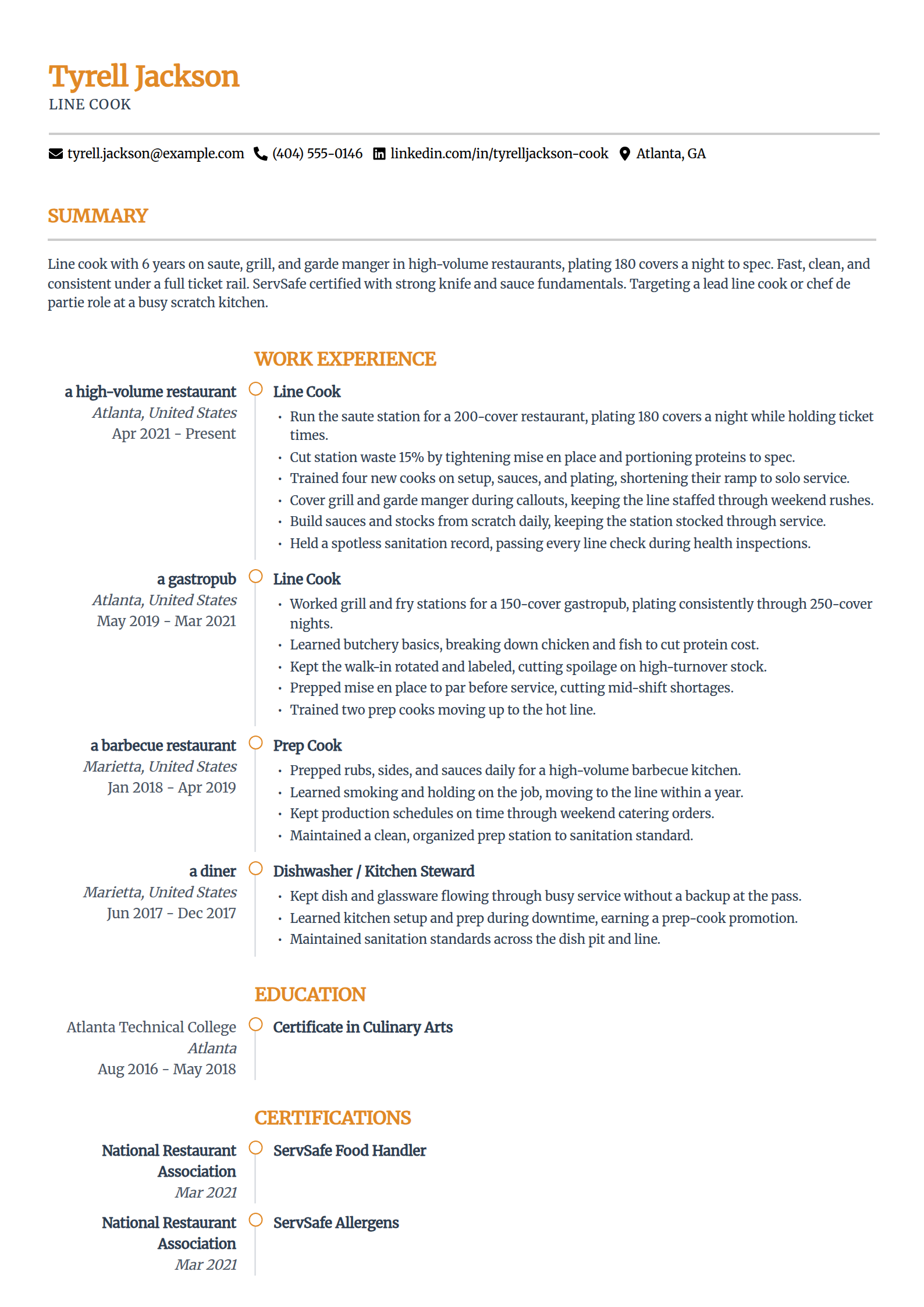
Line Cook Resume Template
Why this resume example works?
- Opens with line scope, running saute for a 200-cover restaurant and plating 180 covers a night.
- Keeps ownership at the right level, station mise, sauces, and consistency, not menu or costing.
- Attaches a number to the work, station waste cut 15% by tightening mise and portioning to spec.
- Names ServSafe and the ACF Certified Culinarian credential a scratch kitchen looks for.
- Uses a modern two-column layout that carries a six-year line record on one page.
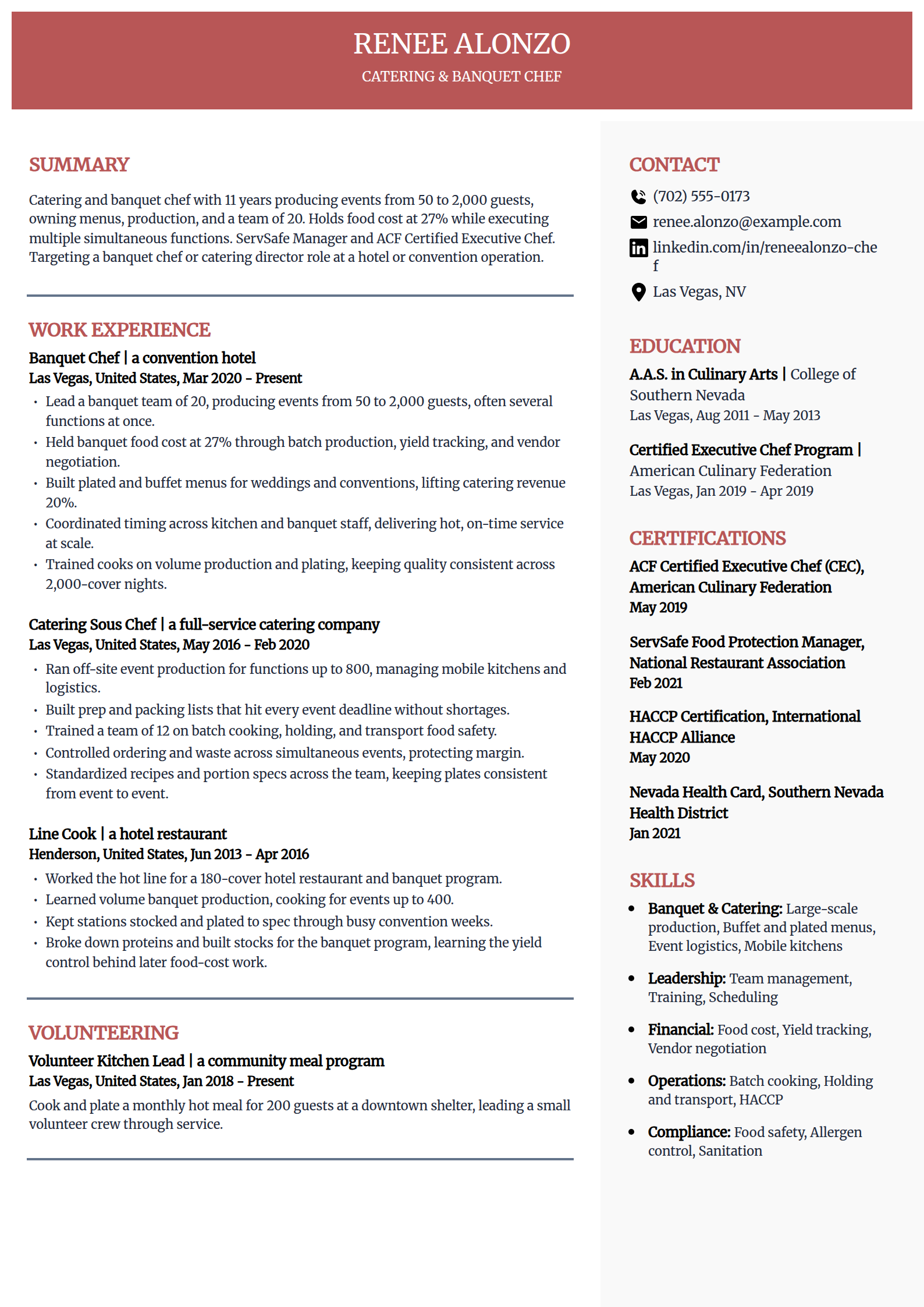
Catering & Banquet Chef Resume Template
Why this resume example works?
- Leads with scale, a banquet team of 20 producing events from 50 to 2,000 guests at once.
- Shows the numbers a hotel rewards, banquet food cost at 27% and catering revenue up 20%.
- Keeps the work specific, batch production, mobile kitchens, and timed service across functions.
- Names ServSafe Manager and the ACF Certified Executive Chef credential.
- Uses a refined two-column layout that fits an 11-year catering record cleanly on one page.
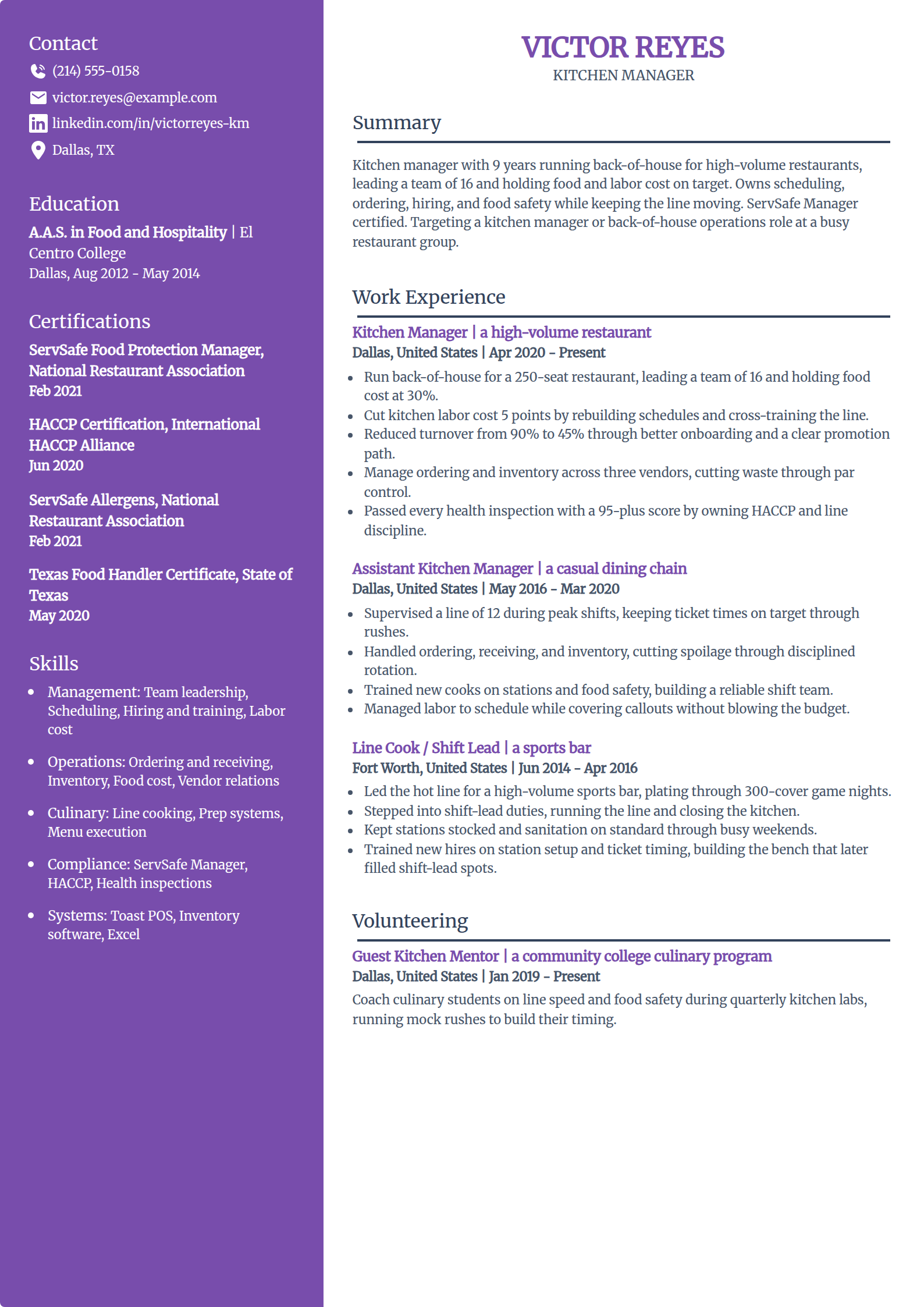
Kitchen Manager Resume Template
Why this resume example works?
- Leads with back-of-house scope, a 250-seat restaurant, a team of 16, and food cost at 30%.
- Shows the operations a group rewards, labor cost cut 5 points and turnover cut from 90% to 45%.
- Keeps the focus on running the kitchen, scheduling, ordering, hiring, and food safety.
- Names ServSafe Manager and HACCP, the credentials a manager role checks first.
- Uses a Medium layout that fits a nine-year management record without empty space.
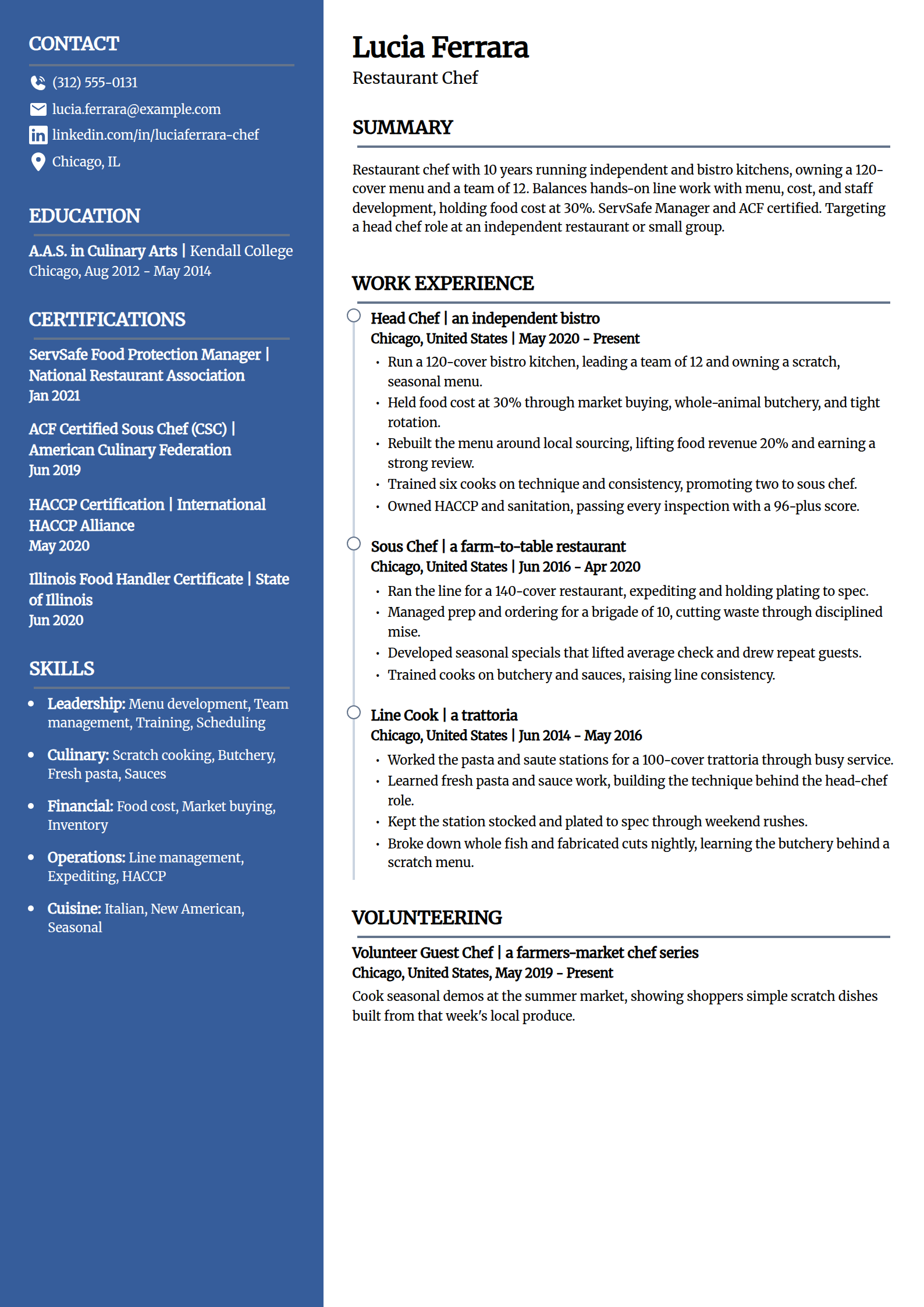
Restaurant & Bistro Chef Resume Template
Why this resume example works?
- Leads with head-chef scope, a 120-cover bistro, a team of 12, and a scratch seasonal menu.
- Shows the independent-kitchen work a small group rewards, food cost at 30% and revenue up 20%.
- Pairs hands-on line work with menu and staff development, two cooks promoted to sous chef.
- Names ServSafe Manager and the ACF Certified Sous Chef credential.
- Uses a distinctive layout that still reads cleanly for a hiring chef.
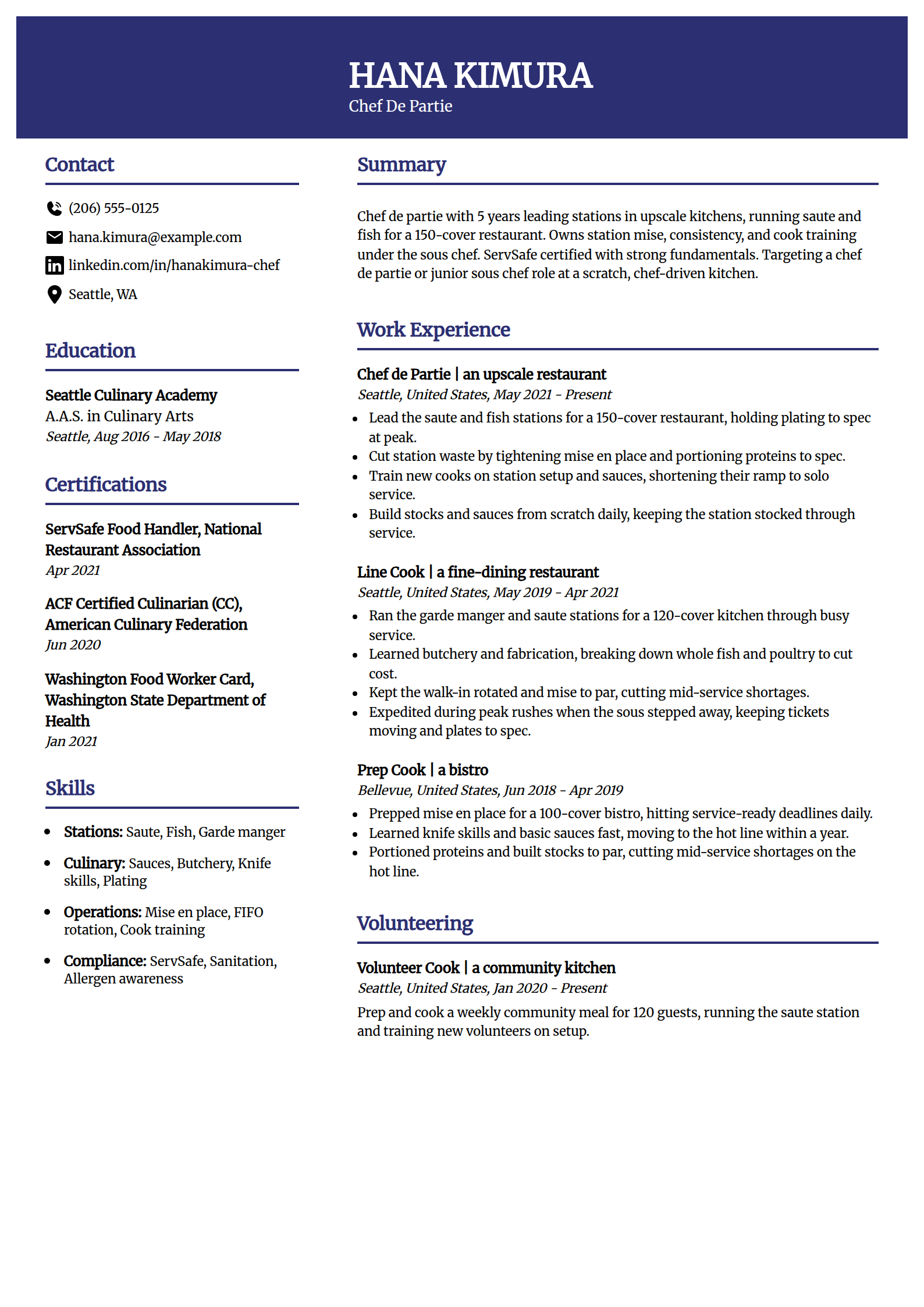
Chef de Partie & Station Chef Resume Template
Why this resume example works?
- Opens with station scope, leading saute and fish for a 150-cover restaurant.
- Keeps ownership at the right level, station mise, consistency, and training under the sous chef.
- Keeps the work concrete, stocks and sauces from scratch and station waste cut.
- Names ServSafe and the ACF Certified Culinarian credential.
- Uses a roomy layout with a filled sidebar so a focused five-year record still looks complete.
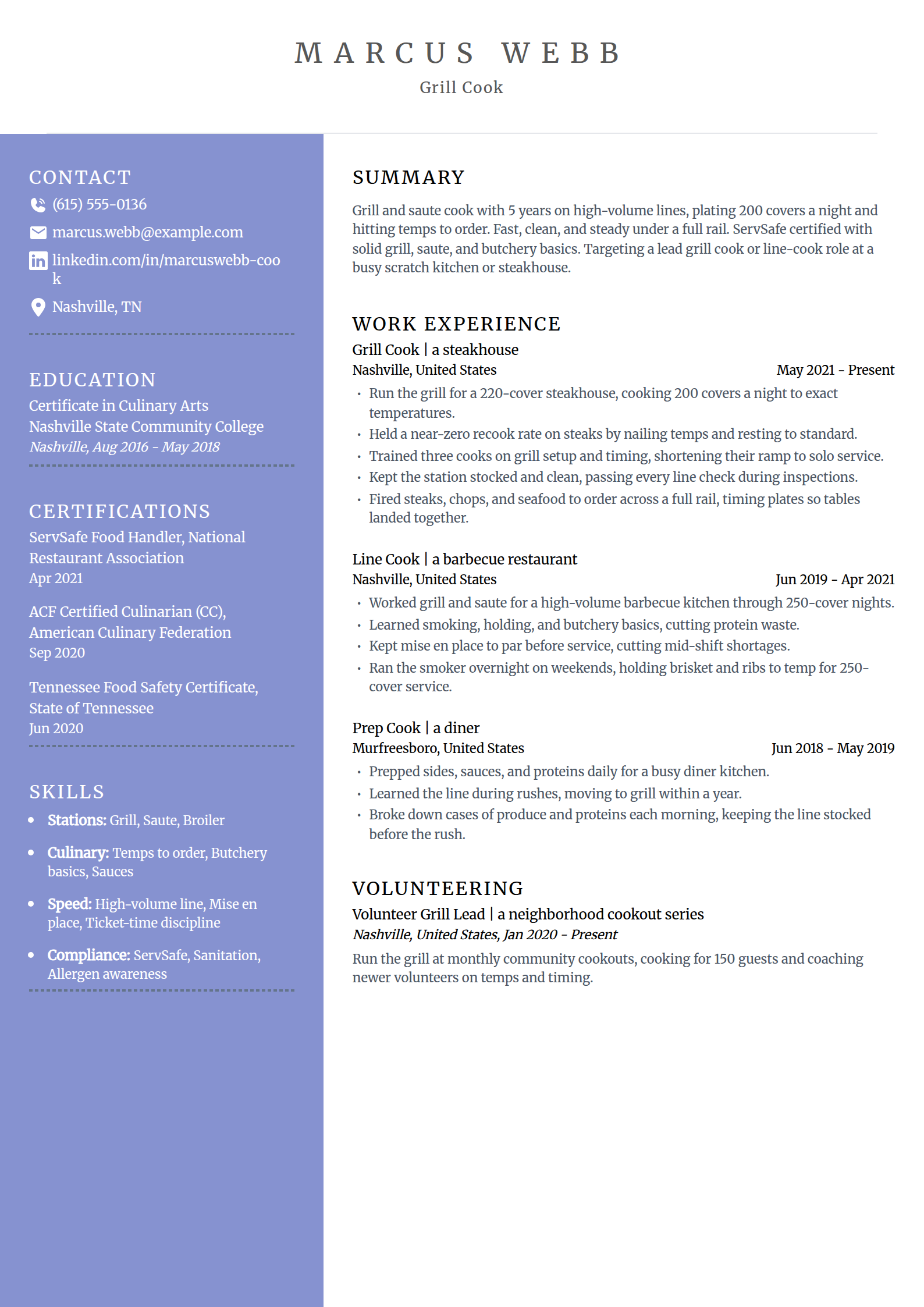
Grill & Sauté Cook Resume Template
Why this resume example works?
- Leads with the number a steakhouse cares about, 200 covers a night cooked to exact temperatures.
- Shows the result a grill role rewards, a near-zero recook rate on steaks.
- Keeps the work honest and specific, grill setup, timing, and butchery basics.
- Names ServSafe and the ACF Certified Culinarian credential.
- Uses a roomy layout with a filled sidebar so a five-year cook record still looks full.
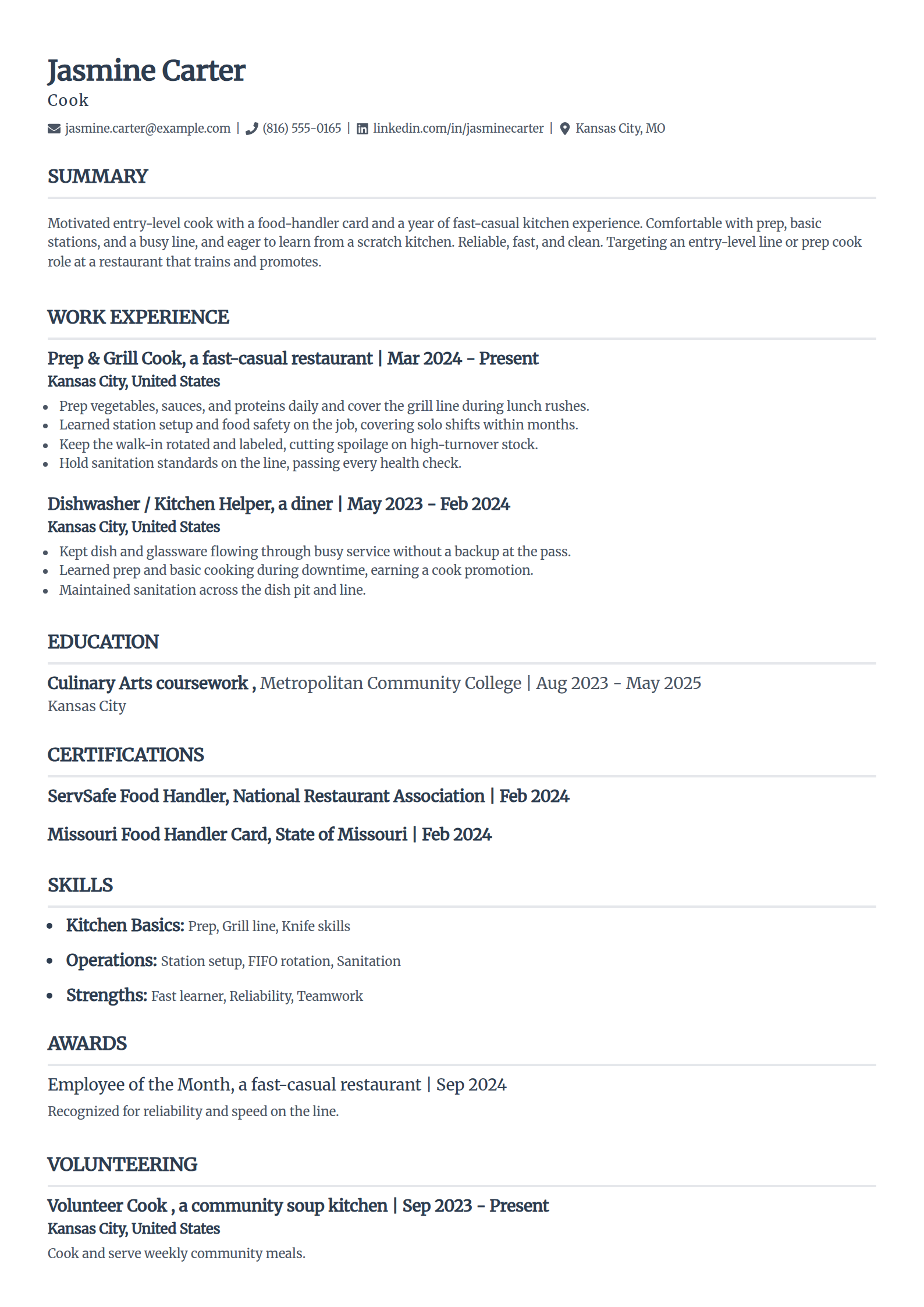
Entry-Level Cook Resume Template
Why this resume example works?
- Written for a new cook, leading with a food-handler card and a year of fast-casual kitchen work.
- Uses prep, grill, and a dishwasher-to-cook path as entries, honest about the experience so far.
- Keeps every bullet real, learning station setup and food safety and covering solo shifts.
- Shows the base a kitchen wants, prep, knife skills, rotation, and sanitation.
- Fills a tight, ATS-safe page with a culinary-coursework line, an award, and a volunteer role.
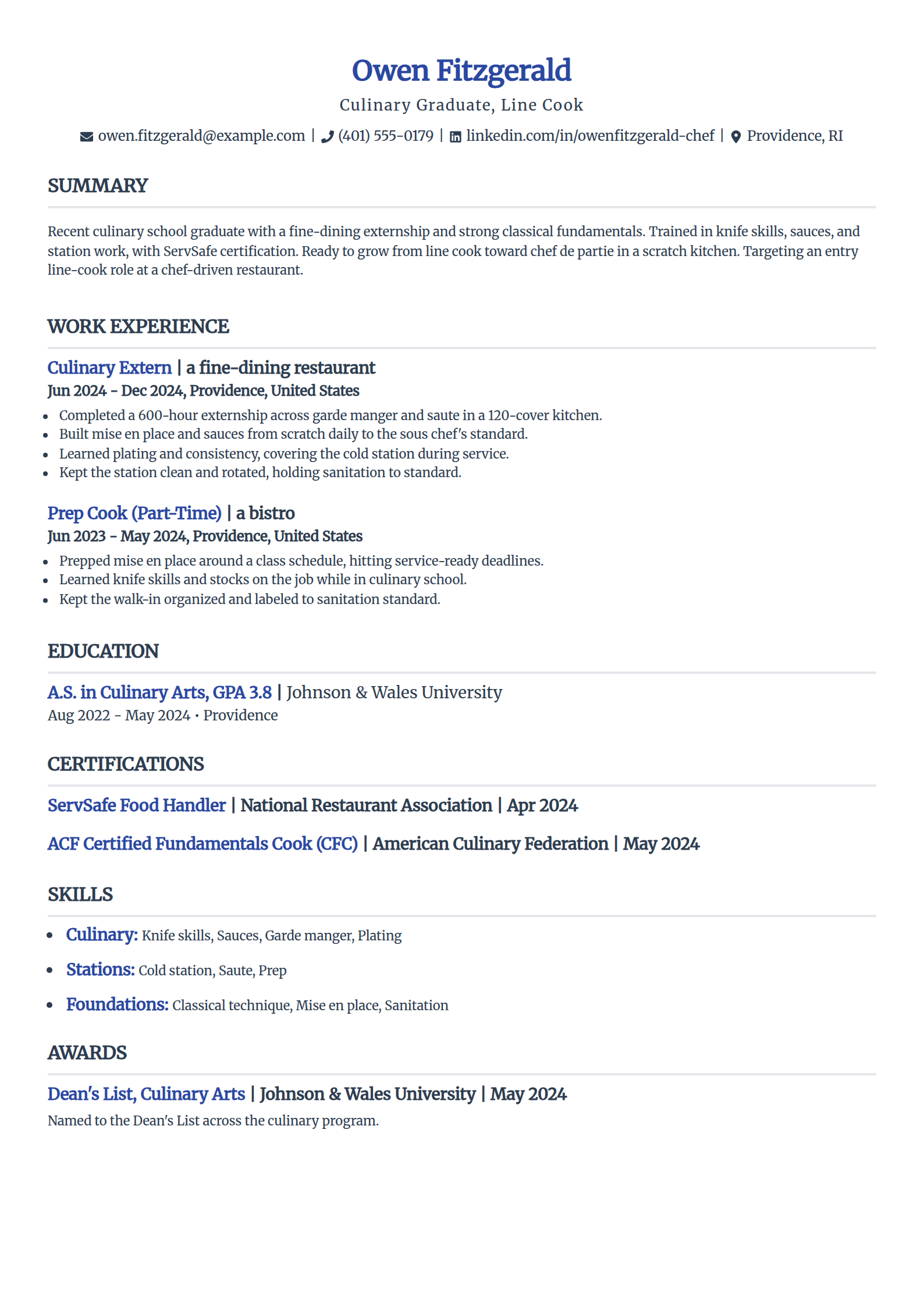
Culinary School Graduate Resume Template
Why this resume example works?
- Written for a new grad, leading with a 600-hour fine-dining externship and classical fundamentals.
- Uses the externship and a part-time prep role as entries, the right move without paid chef years.
- Keeps each bullet real, mise and sauces from scratch and covering the cold station in service.
- Names ServSafe and the ACF Certified Fundamentals Cook credential.
- Fills a plain, ATS-safe page with a GPA, a Dean's List award, and honest early kitchen work.
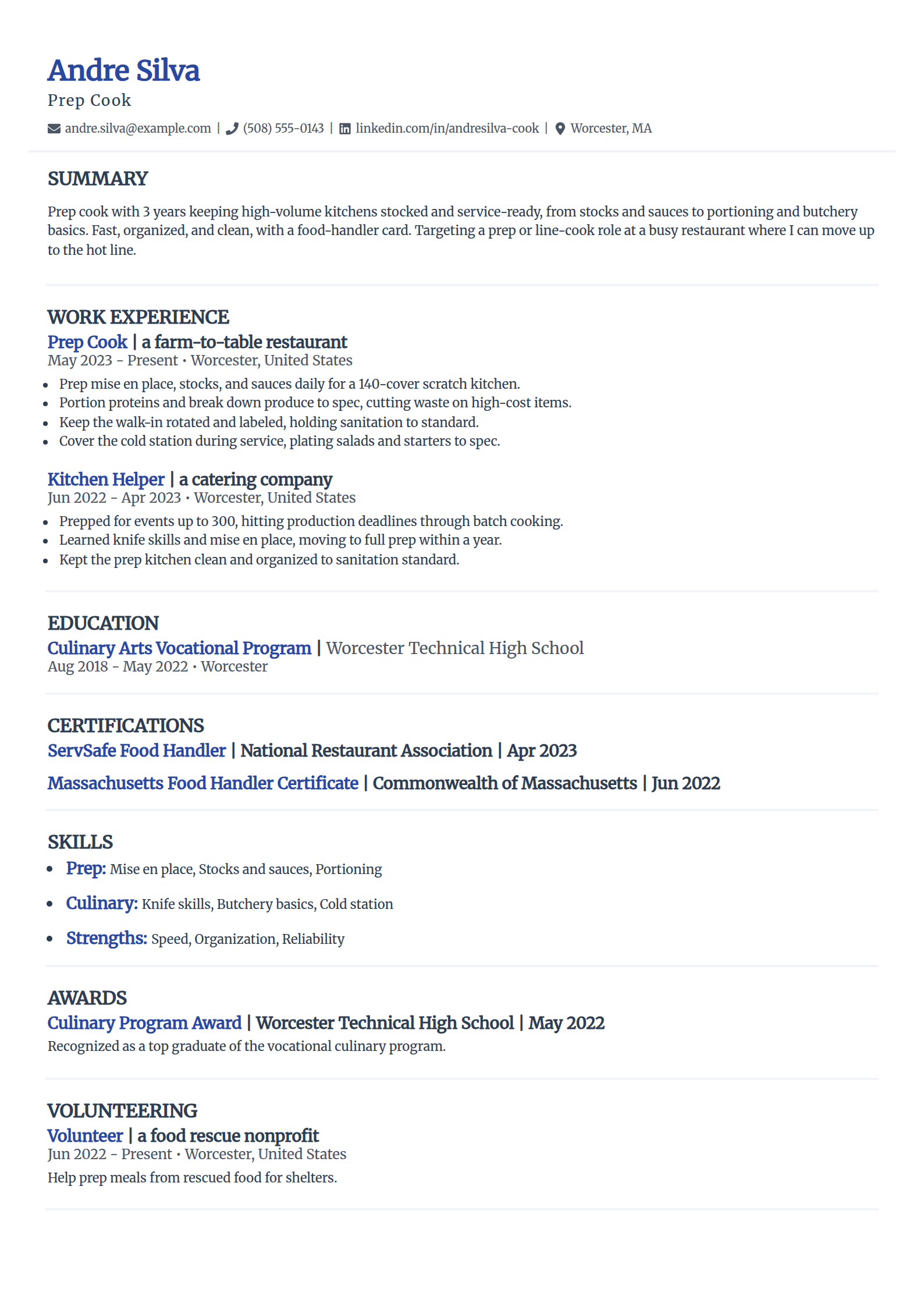
Prep Cook Resume Template
Why this resume example works?
- Written for a prep cook moving up, leading with mise, stocks, and sauces for a 140-cover kitchen.
- Shows the value a kitchen rewards, portioning to spec and cutting waste on high-cost items.
- Keeps the record honest, prep and cold-station work with a clear path to the hot line.
- Names ServSafe and a state food-handler card, the credentials a prep role needs.
- Fills a refined, ATS-safe page with a vocational-program award and a food-rescue volunteer role.
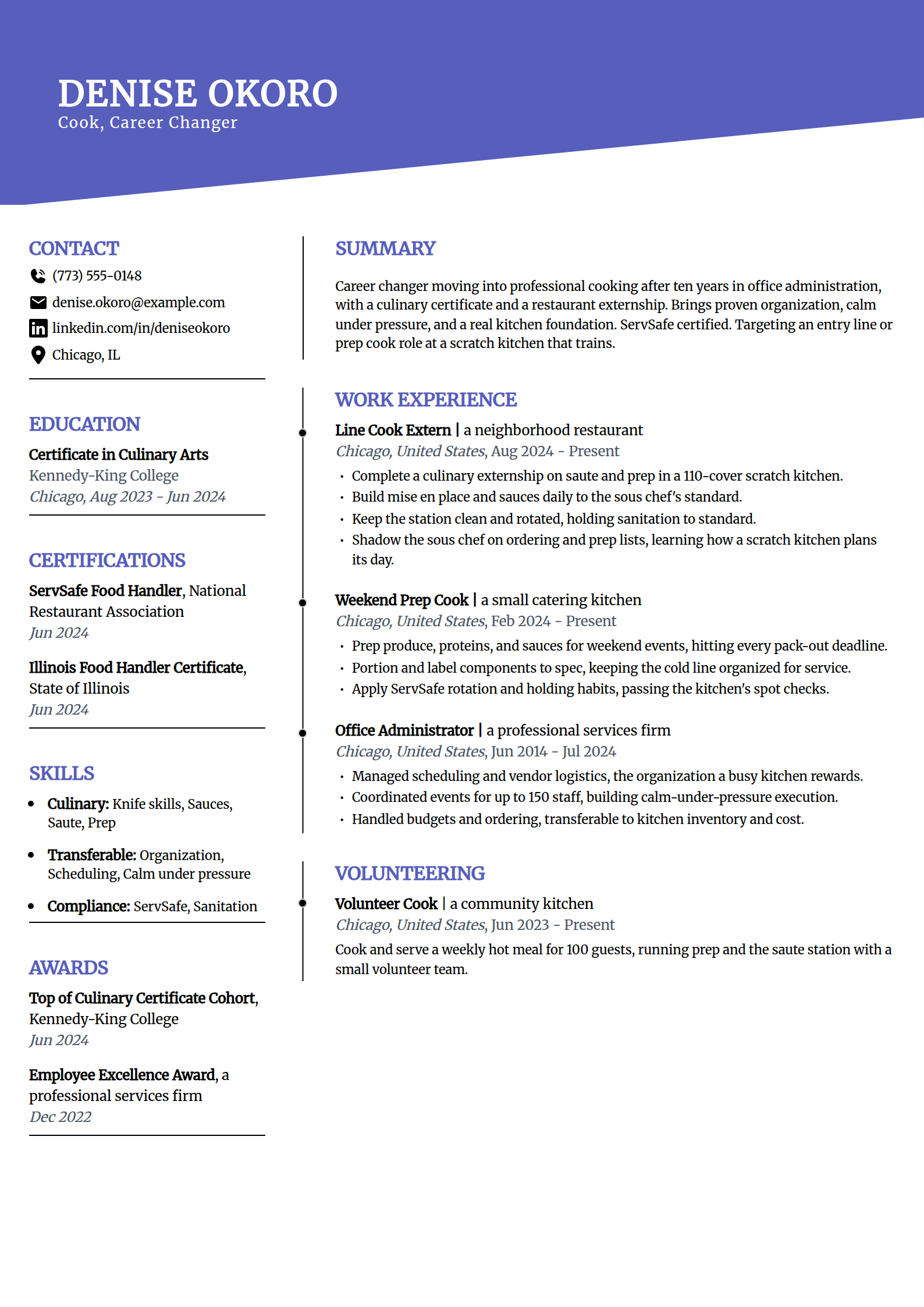
Career-Change Cook Resume Template
Why this resume example works?
- Names the pivot openly, moving into cooking after ten years in office administration.
- Shows recent proof, a culinary certificate and a line-cook externship in a scratch kitchen.
- Reframes prior work as an asset, organization and calm under pressure a busy line rewards.
- Names ServSafe and a state food-handler card, the credentials that make the switch real.
- Lists awards without long descriptions, keeping the layout clean and balanced.
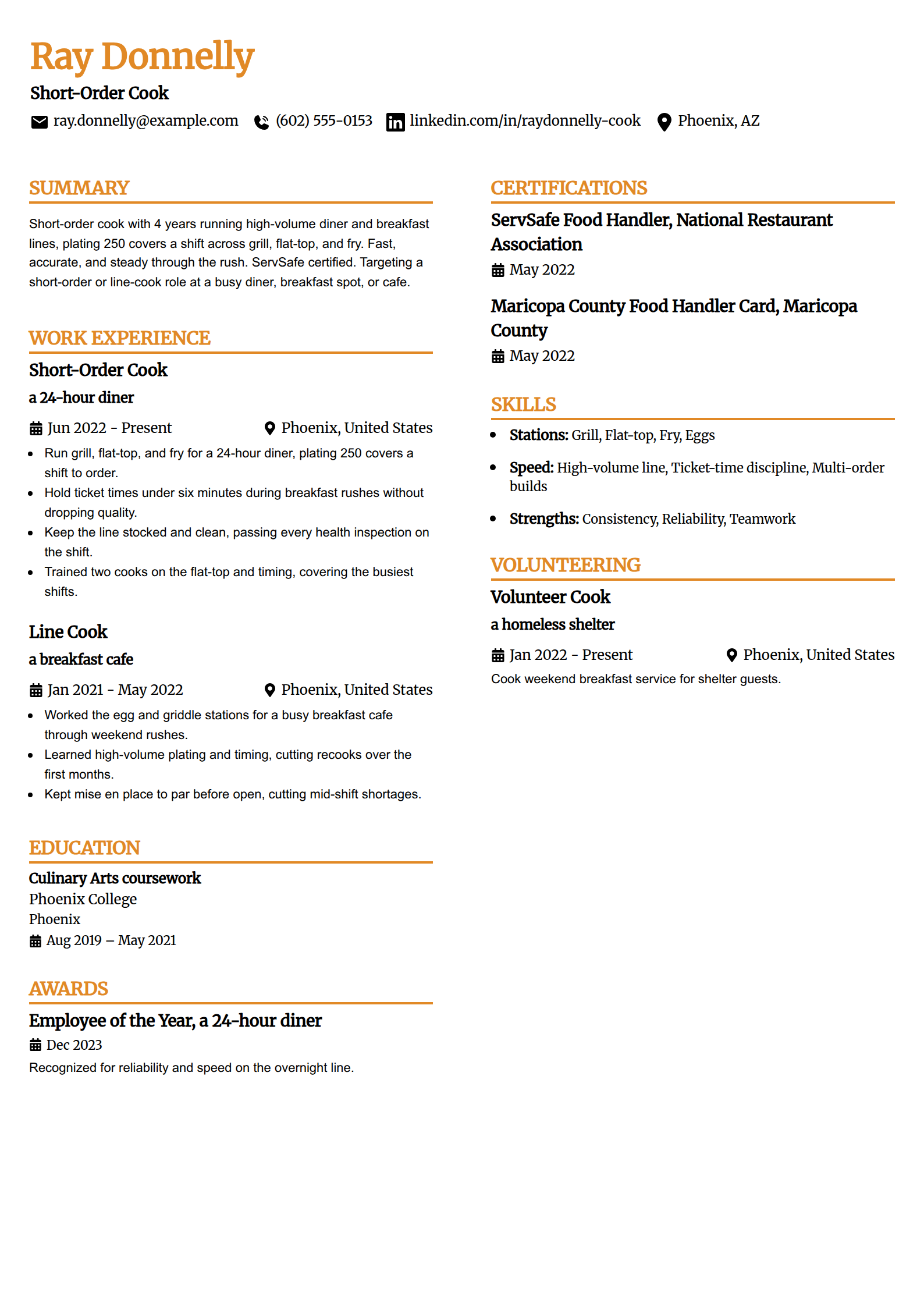
Short-Order & Diner Cook Resume Template
Why this resume example works?
- Leads with the number a diner cares about, 250 covers a shift across grill, flat-top, and fry.
- Shows the result a breakfast line rewards, ticket times under six minutes during the rush.
- Keeps the work honest and fast, station command and timing, not menu or costing.
- Names ServSafe and a county food-handler card.
- Fills a tight, ATS-safe page with an employee-of-the-year award and a shelter volunteer role.
Build your chef or cook resume
Pick a template above and the editor keeps your layout clean and ATS-safe while you swap in your own covers, brigade size, food cost, and certifications.
Build my resumeHow to write a chef or cook resume in 2026
A kitchen resume gets scanned fast by a chef who is short-staffed and knows exactly what they need. Lead with a short summary that names your level and your numbers, then prove each job with covers, brigade size, and one result. Keep the format clean and one page. The rules below apply to chefs and cooks alike; what changes is the scope you claim.
Open with a short, scope-first summary
Write three to four sentences that name your years and setting, your brigade size or station, your strongest number, and the role you are targeting. Chefs lead with brigade size, covers, and food cost; cooks lead with station and covers per shift. Keep it to about 60 words so it never spills past the top of the page.
Executive chef with 15 years leading kitchens, 6 running a 220-cover fine-dining restaurant with a brigade of 22. Owns menu, food cost, hiring, and P&L, holding food cost at 28% while lifting covers. ServSafe Manager and ACF Certified Executive Chef. Targeting an executive chef role at a chef-driven restaurant.
Make every experience bullet an accomplishment with a number
Open with a strong verb, then attach one credible number a hiring chef cares about. The work-experience section is where a kitchen resume is won or lost.
- Use kitchen numbers: covers per service, brigade or team size, food and labor cost, ticket time, waste reduction, or health-inspection score.
- Open with a verb like led, ran, built, cut, or plated, never "Responsible for" or "Helped with".
- Name the method: "held food cost at 28% through whole-animal butchery and tight rotation" or "cut ticket times to under 12 minutes by rebalancing the line".
- Keep claims true to your level: a chef owns the menu and the numbers; a line cook owns a station, speed, and consistency.
Put your credentials and education where a chef sees them
Kitchens screen on food safety and, at the top end, on real culinary certifications, so make them easy to find.
- List ServSafe Food Protection Manager (or Food Handler for cooks) and any HACCP certification near the top.
- Chefs add ACF certifications by level: Certified Culinarian, Certified Sous Chef, Certified Chef de Cuisine, Certified Executive Chef, or Certified Executive Pastry Chef.
- New grads and trainees lead with externship or stage hours, a culinary diploma, and classical fundamentals in place of years.
- Career-changers show the culinary certificate plus an externship, and reframe prior-industry strengths honestly.
Match skills to the station and the cuisine
A kitchen skills block should read like the job posting, grouped so a chef finds what they need fast.
- Chefs: menu development, food and labor cost, butchery, sauces, plating, and brigade management.
- Cooks: name your stations (saute, grill, garde manger, fry), plus knife skills, mise en place, and speed.
- Name the cuisines you actually cook, like French, Italian, New American, or seasonal farm-to-table.
- Add food-safety keywords a posting screens for: ServSafe, HACCP, allergen control, and sanitation.
Keep the format clean and one page
Chefs scan fast, and hotel and restaurant groups run applicant tracking systems, so a clean one-page layout is the safe choice for most cooks and chefs.
- Use a single-column or simple two-column layout with standard headings; skip colorful, elaborate designs.
- Cooks and most chefs fit one page; use a second only for a deep executive-chef record with real leadership history.
- Save as a PDF so the formatting holds, then run it through the ATS resume checker for a quick format pass.
- Swap the numbers in the templates above for your own covers, brigade size, food cost, and certifications; do not copy them as is.
Common chef and cook resume mistakes
- Writing duty lists with no number. Replace "cooked food and ran the line" with "plated 180 covers a night on saute and cut station waste 15%".
- Claiming a scope above your level. A line cook who writes "managed food cost and the menu" reads wrong; own your station, speed, and consistency instead.
- Hiding your covers and brigade size. A chef's covers per service and team size are the first things a hiring chef looks for, so put them up top.
- Leaving off food safety. List ServSafe and any HACCP certification; a kitchen assumes you have them and checks.
- A colorful, graphic-heavy template. Kitchens want a clean, readable resume on one page, not a design piece that a parser chokes on.
Frequently asked questions
How do you write a chef resume?
Lead with a three-to-four-sentence summary that names your level, your setting, your strongest number, and your certifications. Under each job, write results-first bullets that open with a strong verb and carry one credible number a hiring chef cares about, like leading a brigade of 22, holding food cost at 28%, or plating 180 covers a night. Put ServSafe, any HACCP, and your ACF certification near the top, match your skills to the station and cuisine, and keep the whole thing to one clean page.
What should an executive chef resume include?
An executive chef resume leads with scope and numbers a group hires on: brigade size, covers per service, food and labor cost, and P&L ownership. Show menu development, hiring and staff development, and vendor negotiation, each tied to a result like covers up 18% or food cost held at 28%. List ServSafe Food Protection Manager, HACCP, and the ACF Certified Executive Chef credential where a hiring group reads them first. Include any AAA, Forbes, or Michelin recognition, and keep it to one or two clean pages.
How do you write a chef resume with no experience?
Lead with your training and the hours you do have. A culinary school graduate leads with externship or stage hours, a diploma, and classical fundamentals like knife skills, sauces, and station work, then shows any part-time prep or line experience. A career-changer leads with a culinary certificate plus an externship and reframes prior-industry strengths honestly. Reliability and real, quantified kitchen work carry more weight than invented chef years, which a hiring chef will see through. The entry-level, culinary-grad, and career-change examples above show the shape.
What certifications should a chef put on a resume?
Start with ServSafe Food Protection Manager, the near-universal kitchen credential, plus ServSafe Allergens and any HACCP certification. Chefs add American Culinary Federation (ACF) certifications by level: Certified Culinarian (CC), Certified Sous Chef (CSC), Certified Chef de Cuisine (CCC), Certified Executive Chef (CEC), or Certified Executive Pastry Chef (CEPC). Cooks list ServSafe Food Handler and a state or county food-handler card. Put the credential that qualifies you for the role near the top, and list a culinary degree or diploma with it.
Should a chef resume be one page?
One page for almost every cook and chef. A line cook, sous chef, pastry chef, or kitchen manager should fit one clean page, and a hiring chef scanning fast will not read past it. Use a second page only for a deep executive-chef record with real multi-venue or leadership history that genuinely needs the room. Whichever length you use, lead with your most recent and most relevant kitchen, keep standard headings, and cut older, unrelated jobs so the space goes to your strongest service and your credentials.
What is the difference between a chef and a cook resume?
The difference is scope. A chef resume claims leadership and the numbers: brigade size, menu development, food and labor cost, hiring, and, for an executive chef, P&L. A cook resume claims station command, covers per shift, speed, and consistency, without menu ownership or costing. A cook who writes like a chef, claiming food-cost control or menu ownership they did not have, reads as a mismatch a hiring chef will catch. Match the scope you claim to the role you actually held, and target the resume to the job you want.
More chef resume resources
Build your chef or cook resume
Pick a template above and the editor keeps your layout clean and ATS-safe while you swap in your own covers, brigade size, food cost, and certifications.