Barista Resume Templates and Examples Built for a First Coffee Job
- ATS Friendly
- No Experience to Head Barista
- 16 Real Examples
No barista experience yet, or five years dialing in espresso and running the bar, this page has a resume built for your exact spot. Start from a layout below, then model your own on a real example that leads with what a cafe hires on first: a food handler card, speed at peak, and the drinks and machines you actually run. The examples cover the whole path, from a first coffee job backed only by retail or school work to head barista, chain to third-wave specialty.


540k+ resumes created
Barista resume templates for every level and cafe
Each template below is a real barista resume laid out in that format, sorted from a first coffee job with no barista experience up through head barista, and across chain, specialty, drive-thru, bakery-cafe, hotel, and mobile-events work. Pick one, then swap in your own drinks per shift, POS system, brew methods, and food handler card. Every layout keeps your certifications, speed numbers, and coffee skills readable so a busy cafe manager sees your fit at a glance and an applicant tracking system parses it cleanly.
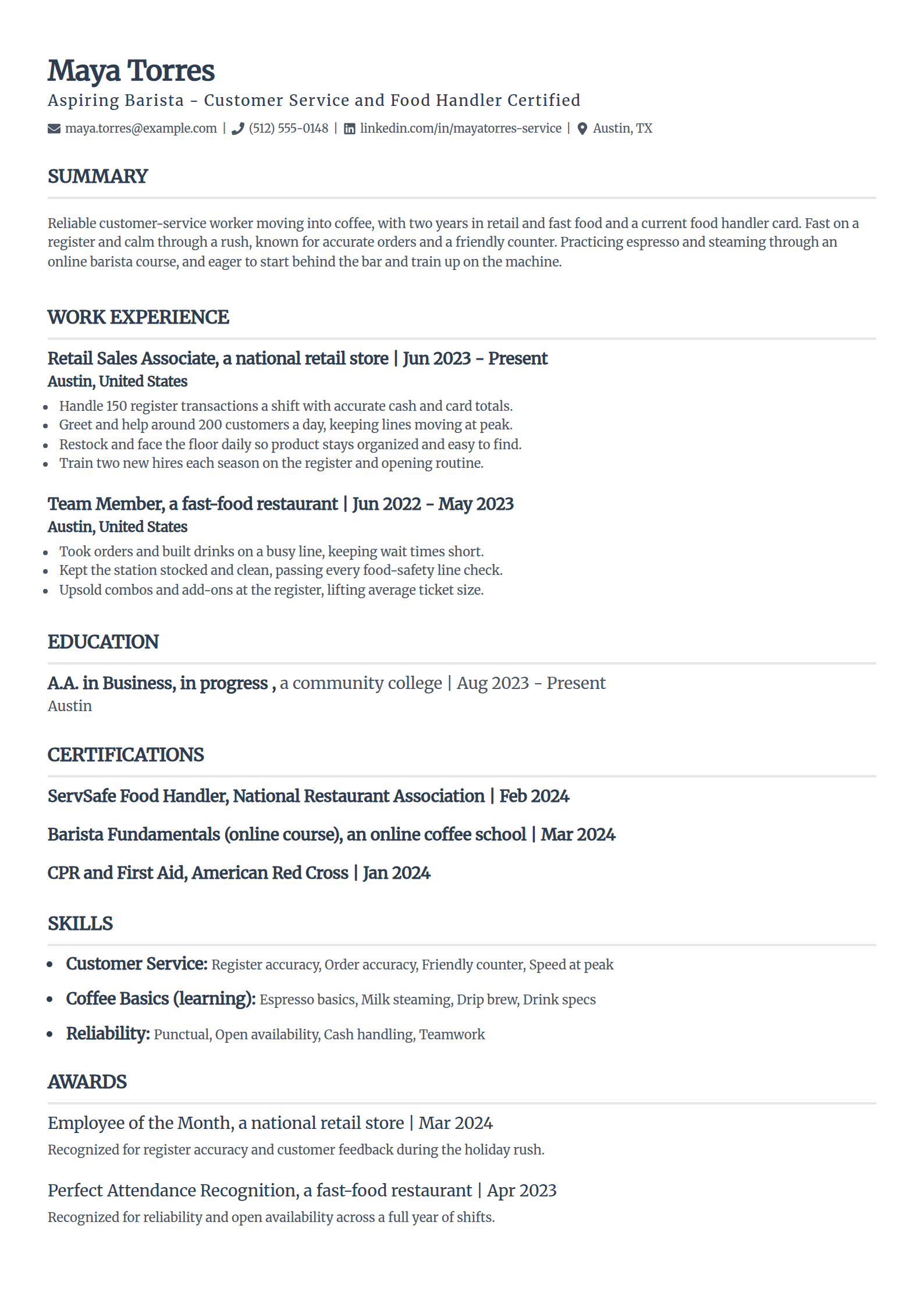
Entry-Level Barista Resume Template (No Experience)
Why this resume example works?
- Written for a first coffee job, leading with two years of retail and fast-food work and a food handler card.
- Stays honest about experience, showing register, service, and food-safety work instead of invented barista years.
- Names the one credential an entry cafe role needs, a ServSafe Food Handler card, right under the summary.
- Shows coffee is being learned on purpose, an online barista course plus espresso and steaming practice at home.
- Fills a tight, ATS-safe page with two jobs and two awards, the right shape for a no-experience resume.
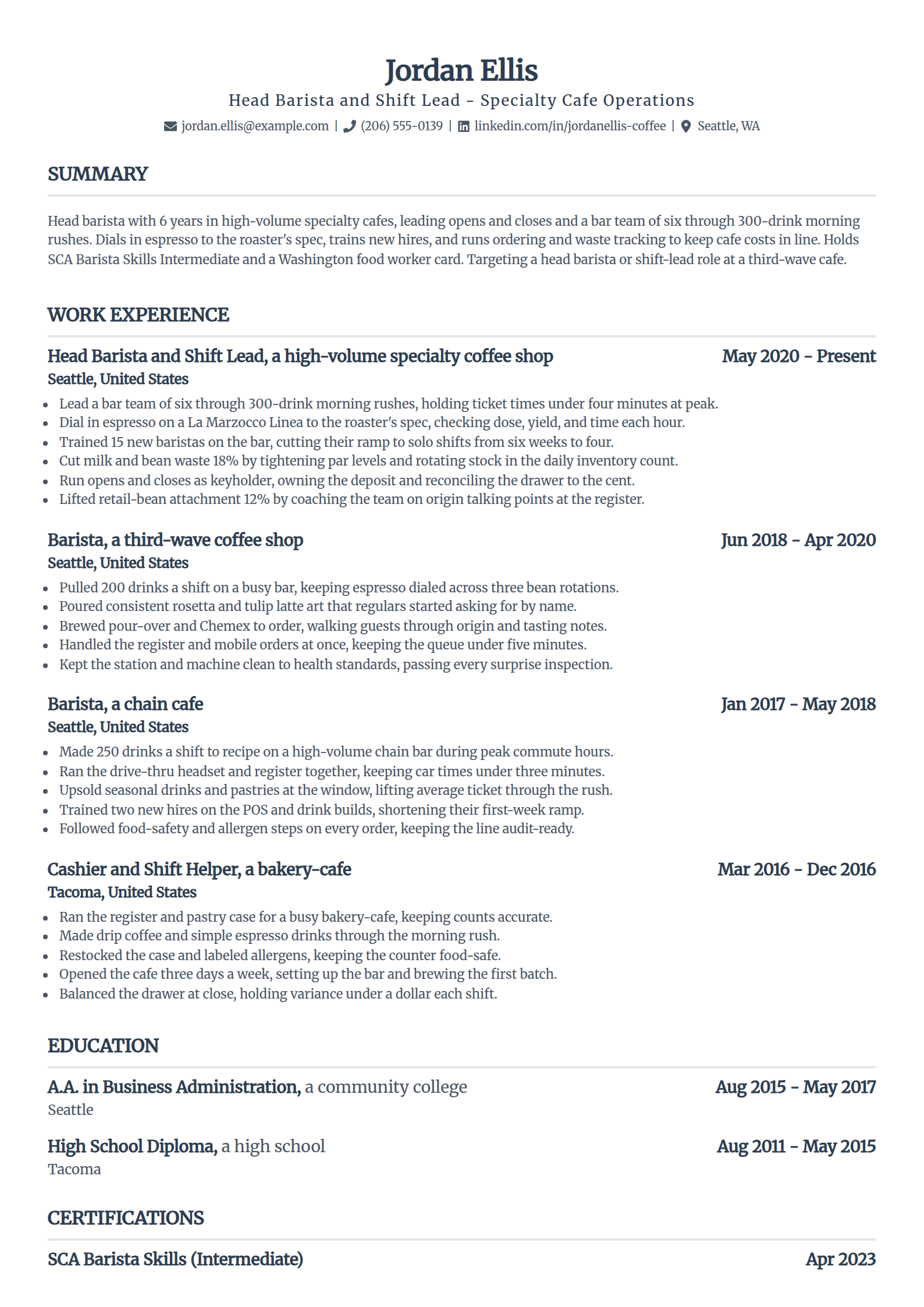
Head Barista & Shift Lead Resume Template
Why this resume example works?
- Opens with lead scope, running opens and closes and a bar team of six through 300-drink morning rushes.
- Ties the craft to a spec, espresso dialed on a La Marzocco Linea by dose, yield, and time each hour.
- Shows the supervisor work a shop rewards, 15 baristas trained and milk and bean waste cut 18%.
- Names the specialty credentials, SCA Barista Skills Intermediate and a Washington food worker card.
- Uses a clean, single-column layout an applicant tracking system reads without trouble.
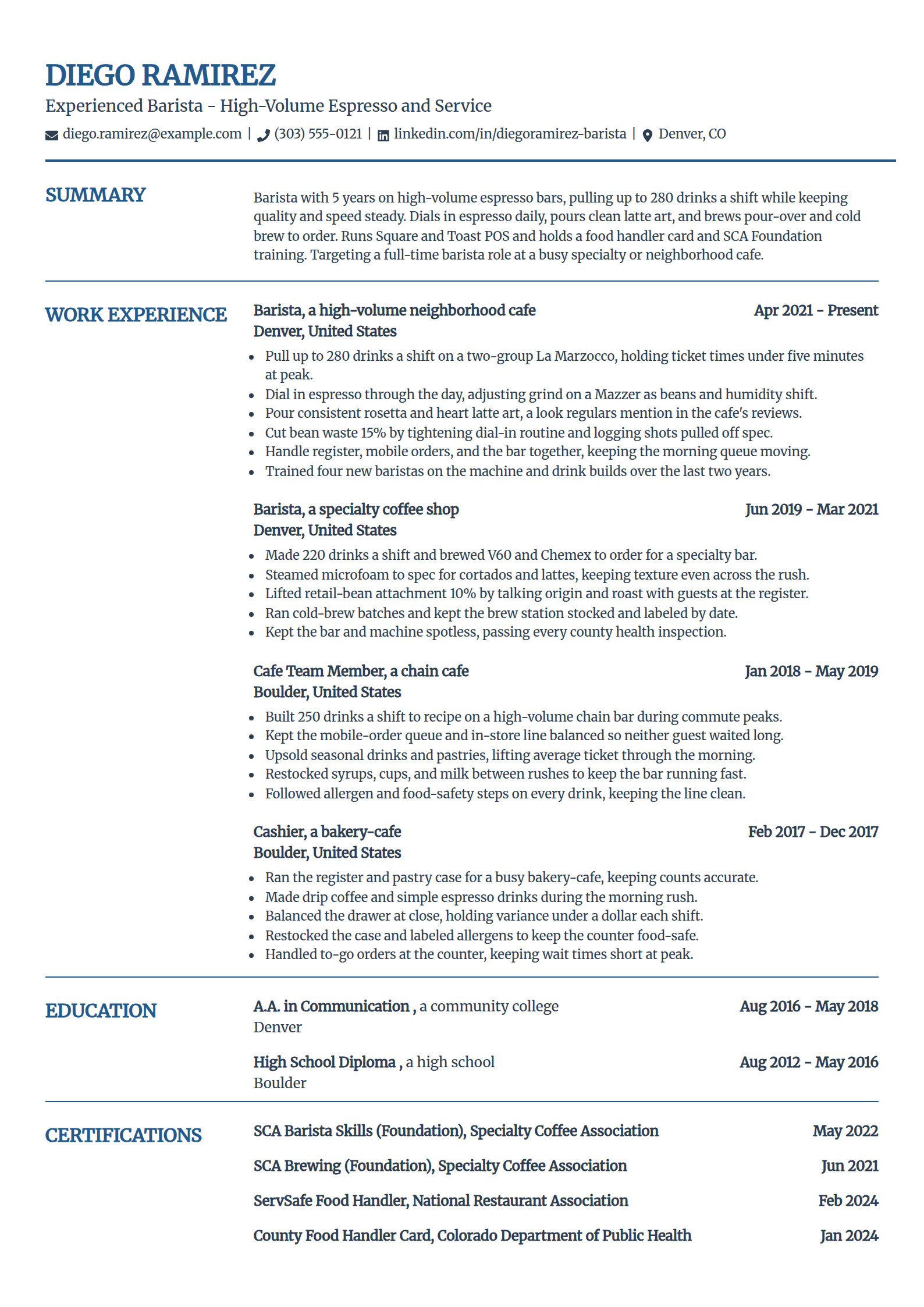
Experienced Barista Resume Template
Why this resume example works?
- Leads with volume a busy cafe wants, 5 years pulling up to 280 drinks a shift while holding quality.
- Keeps the craft visible, daily espresso dial-in on a Mazzer and clean rosetta and heart latte art.
- Attaches one honest number per bullet, like bean waste cut 15% or retail-bean attachment up 10%.
- Names the POS a cafe runs, Square and Toast, plus a food handler card and SCA Foundation training.
- Uses a modern layout that carries a five-year coffee record on one page.
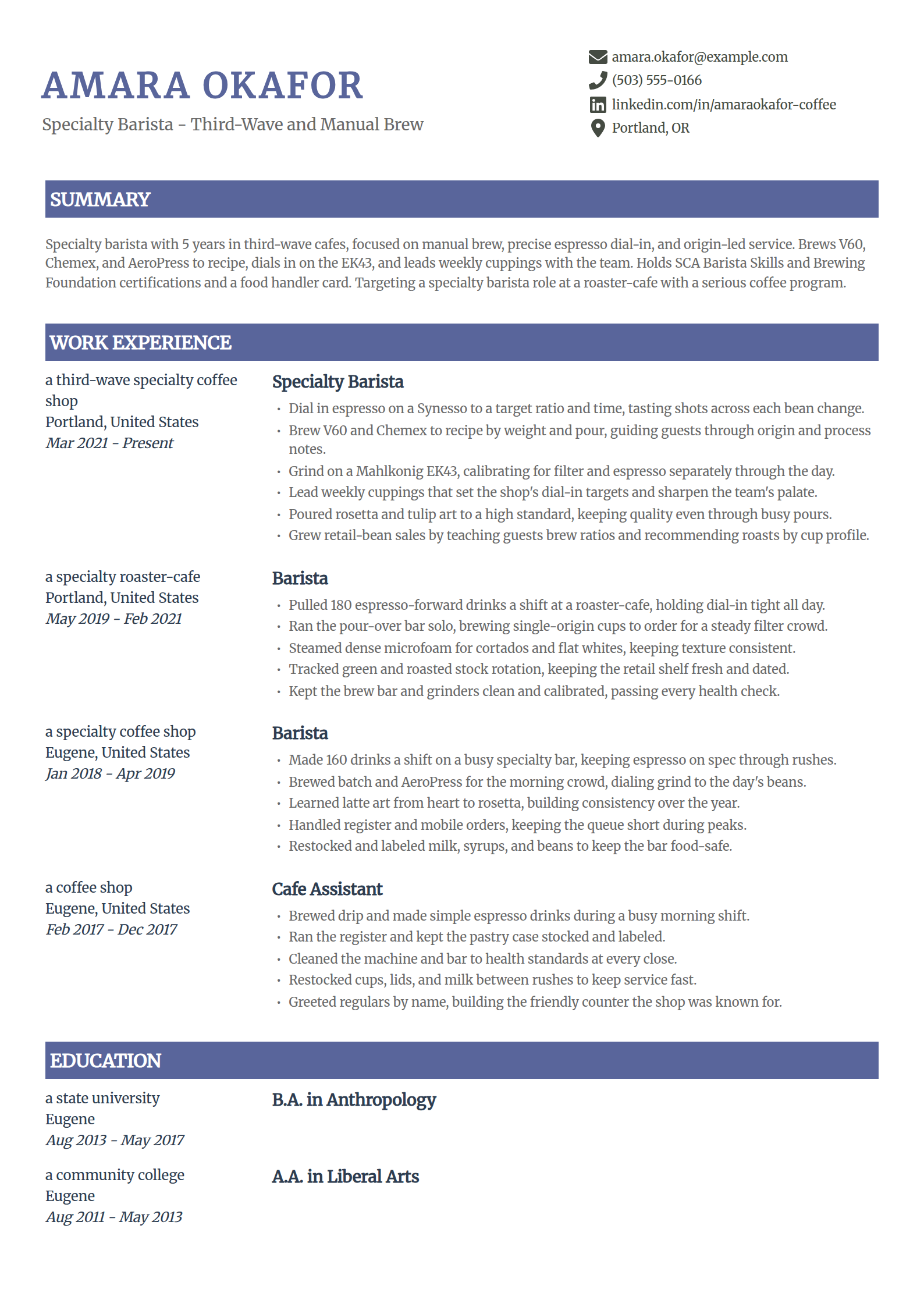
Specialty & Third-Wave Barista Resume Template
Why this resume example works?
- Leads with the craft a third-wave shop screens for, espresso dial-in by ratio on a Synesso and manual brew to recipe.
- Names the methods and gear that prove it, V60, Chemex, and AeroPress ground on a Mahlkonig EK43.
- Shows coffee knowledge beyond the bar, leading weekly cuppings and talking origin and process with guests.
- Carries the specialty credential ladder, SCA Barista Skills, Brewing, and Green Coffee certifications.
- Uses a modern two-column layout that carries a deep specialty record on one clean page.
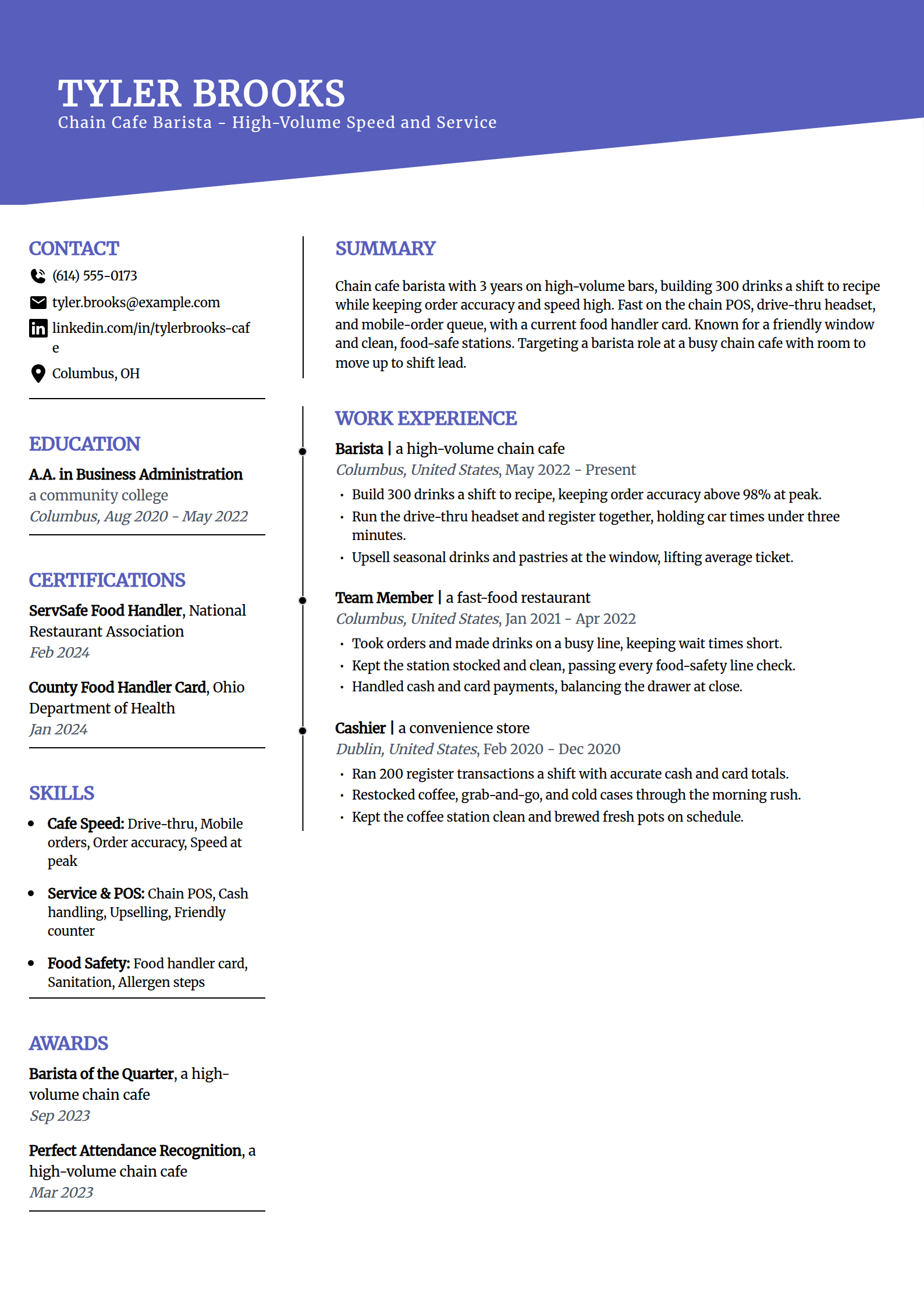
Chain Cafe Barista Resume Template
Why this resume example works?
- Leads with the numbers a chain screens for, 300 drinks a shift to recipe and order accuracy above 98%.
- Shows the speed a high-volume window rewards, drive-thru headset and register run together under three minutes.
- Keeps the tools true to a chain, a proprietary chain POS and mobile-order queue, not a specialty setup.
- Names the one credential the role needs, a food handler card, without padding on certifications.
- Lists awards without long descriptions, keeping the layout clean and balanced.
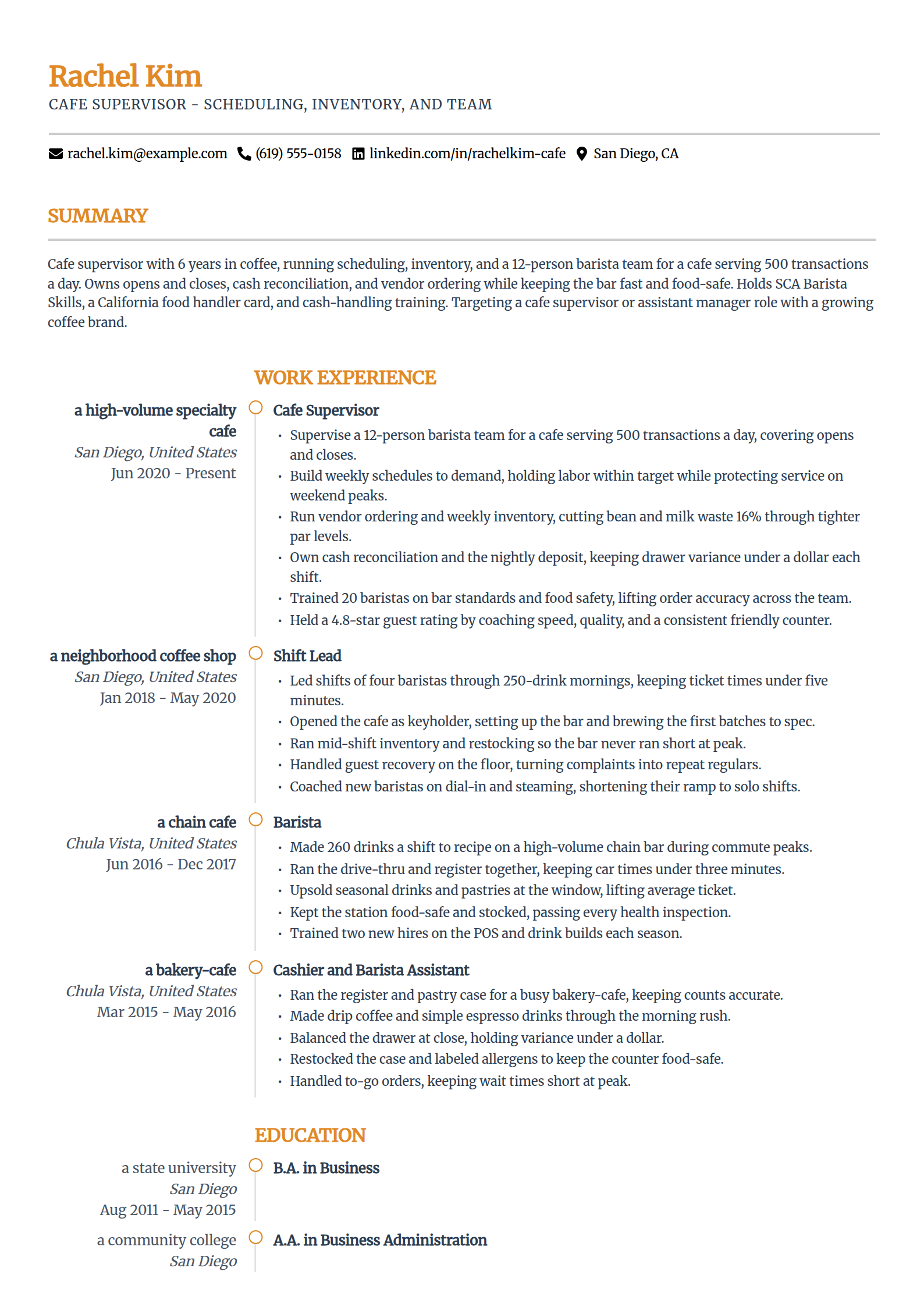
Cafe Supervisor Resume Template
Why this resume example works?
- Opens with supervisor scope, a 12-person barista team and a cafe serving 500 transactions a day.
- Shows the ownership above the bar, scheduling to demand, vendor ordering, and cash reconciliation.
- Ties leadership to a number, bean and milk waste cut 16% through tighter par levels and inventory.
- Names the credentials a lead role verifies, SCA Barista Skills and a California food handler card.
- Uses a modern layout that carries a dense supervisor record on one clean page.
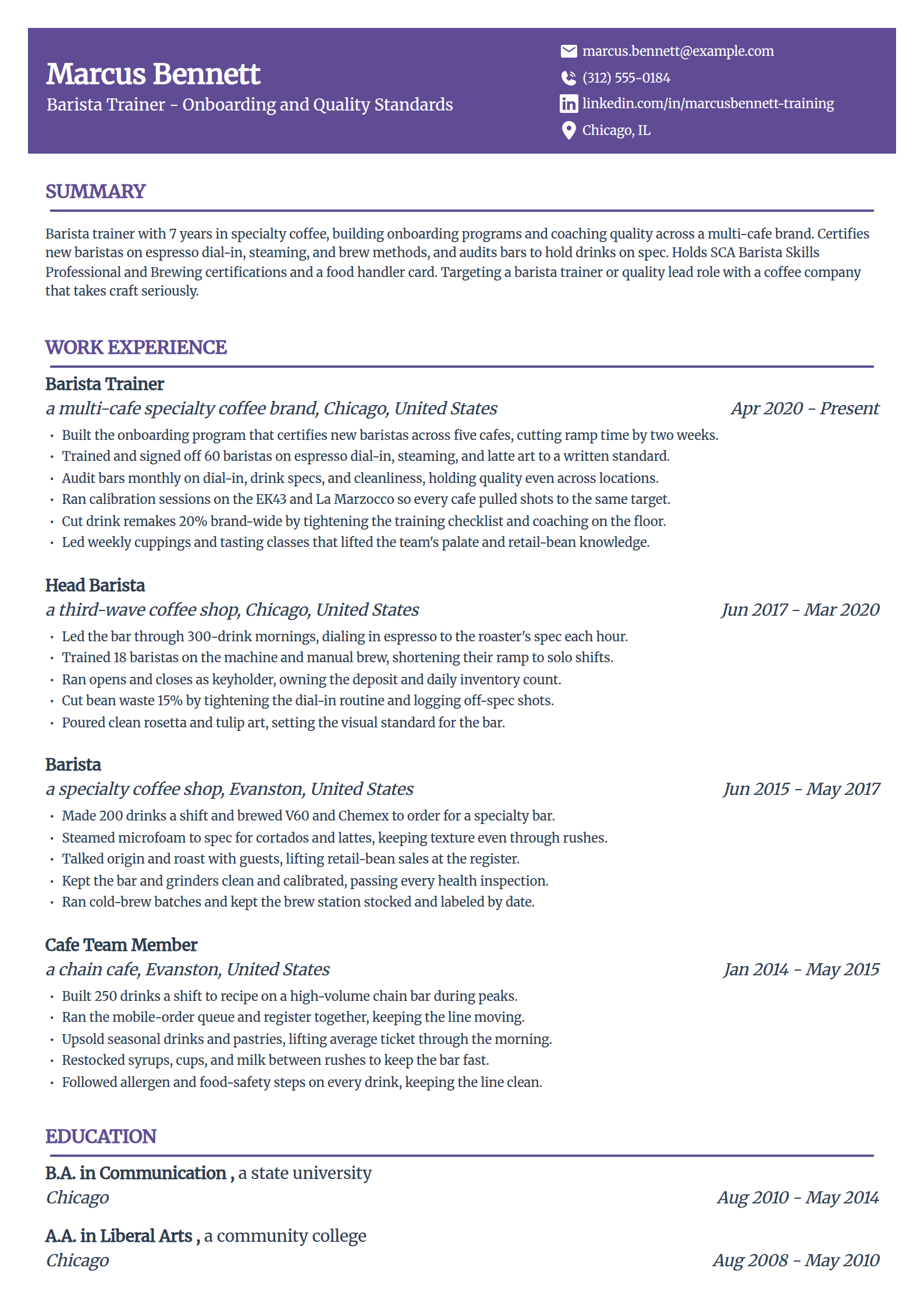
Barista Trainer Resume Template
Why this resume example works?
- Leads with the training scope a brand rewards, an onboarding program certifying baristas across five cafes.
- Shows the quality work, monthly bar audits and calibration that held drinks on spec across locations.
- Attaches a result to the coaching, drink remakes cut 20% brand-wide through a tighter training checklist.
- Names the top of the credential ladder, SCA Barista Skills Professional and Brewing certifications.
- Uses a spacious layout that carries a seven-year training record on one page.
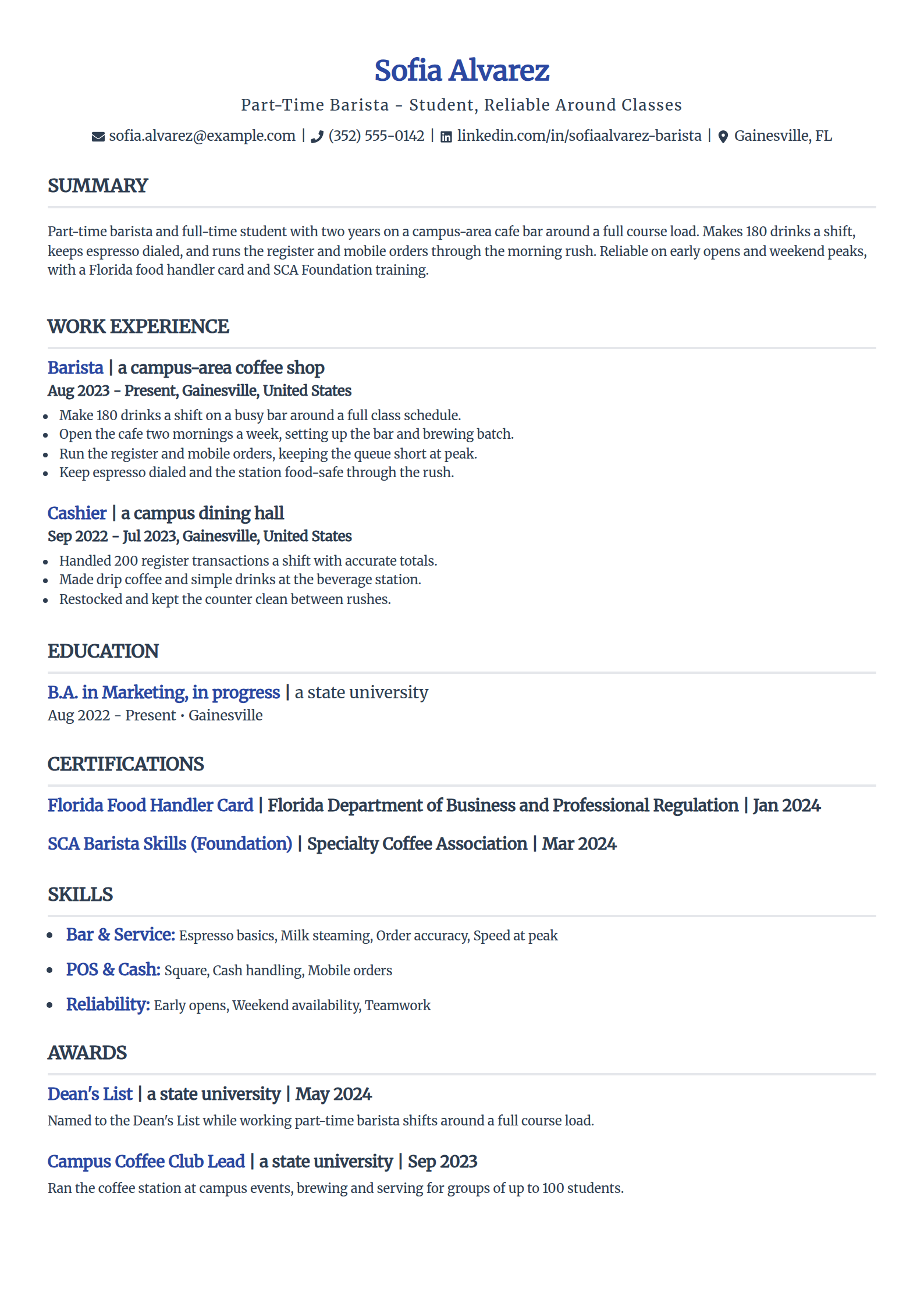
Student & Part-Time Barista Resume Template
Why this resume example works?
- Written for a student, leading with two years on a campus-area bar around a full course load.
- Shows the reliability a cafe needs, 180 drinks a shift and early opens two mornings a week.
- Keeps the record honest and tight, real cafe and dining-hall work plus a Florida food handler card.
- Fills the sidebar with a Dean's List note and a campus coffee-club lead instead of padding.
- Uses a clean, ATS-safe layout that fits school and part-time work on one page.
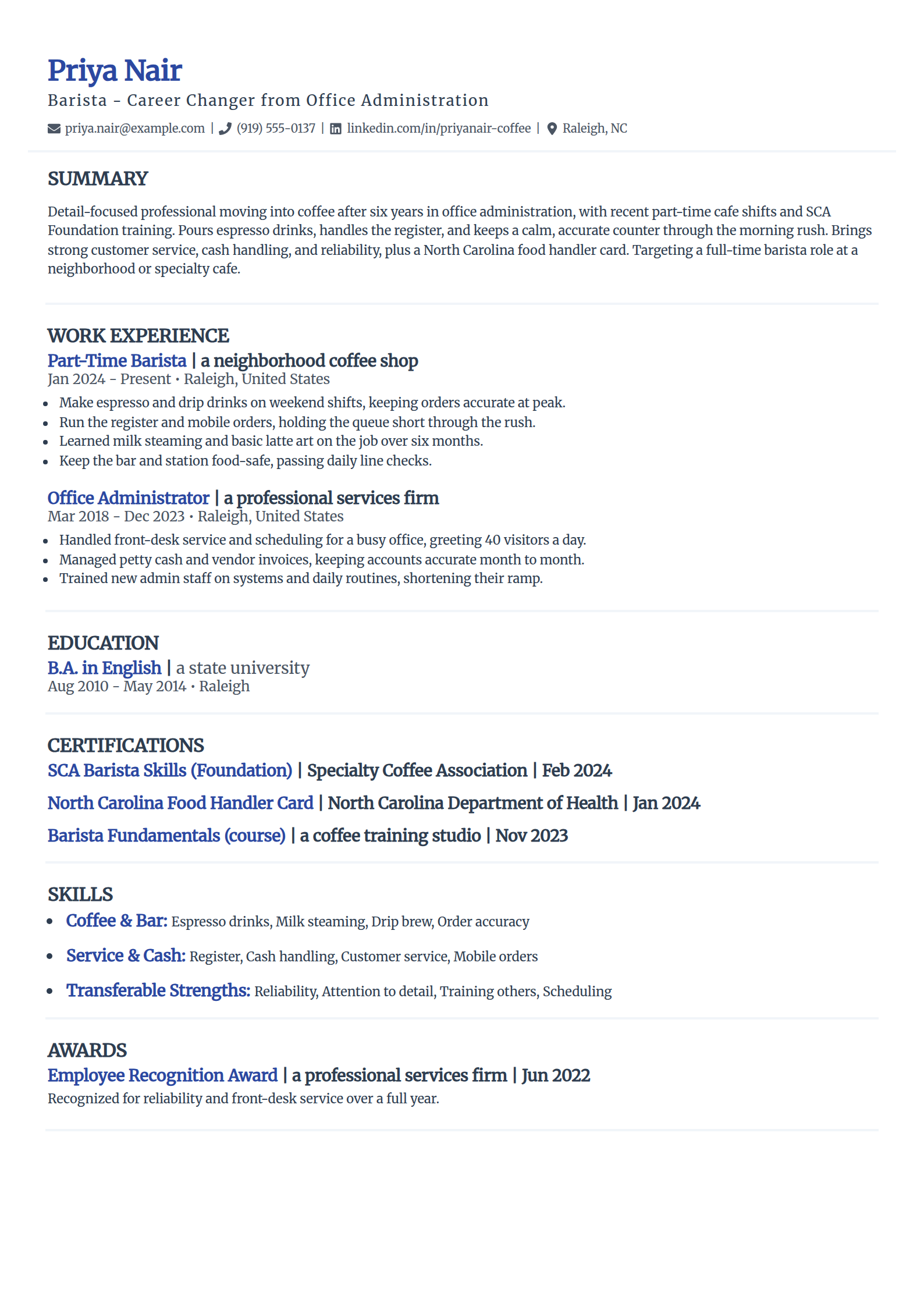
Career-Change Barista Resume Template
Why this resume example works?
- Names the pivot openly, moving into coffee after six years in office administration.
- Shows recent proof, weekend cafe shifts pouring espresso and drip with accurate orders.
- Reframes prior work as an asset, cash handling, scheduling, and reliability a busy cafe rewards.
- Names the credentials that make the switch real, SCA Foundation and a North Carolina food handler card.
- Uses a refined, ATS-safe layout that keeps the focus on service and reliability.
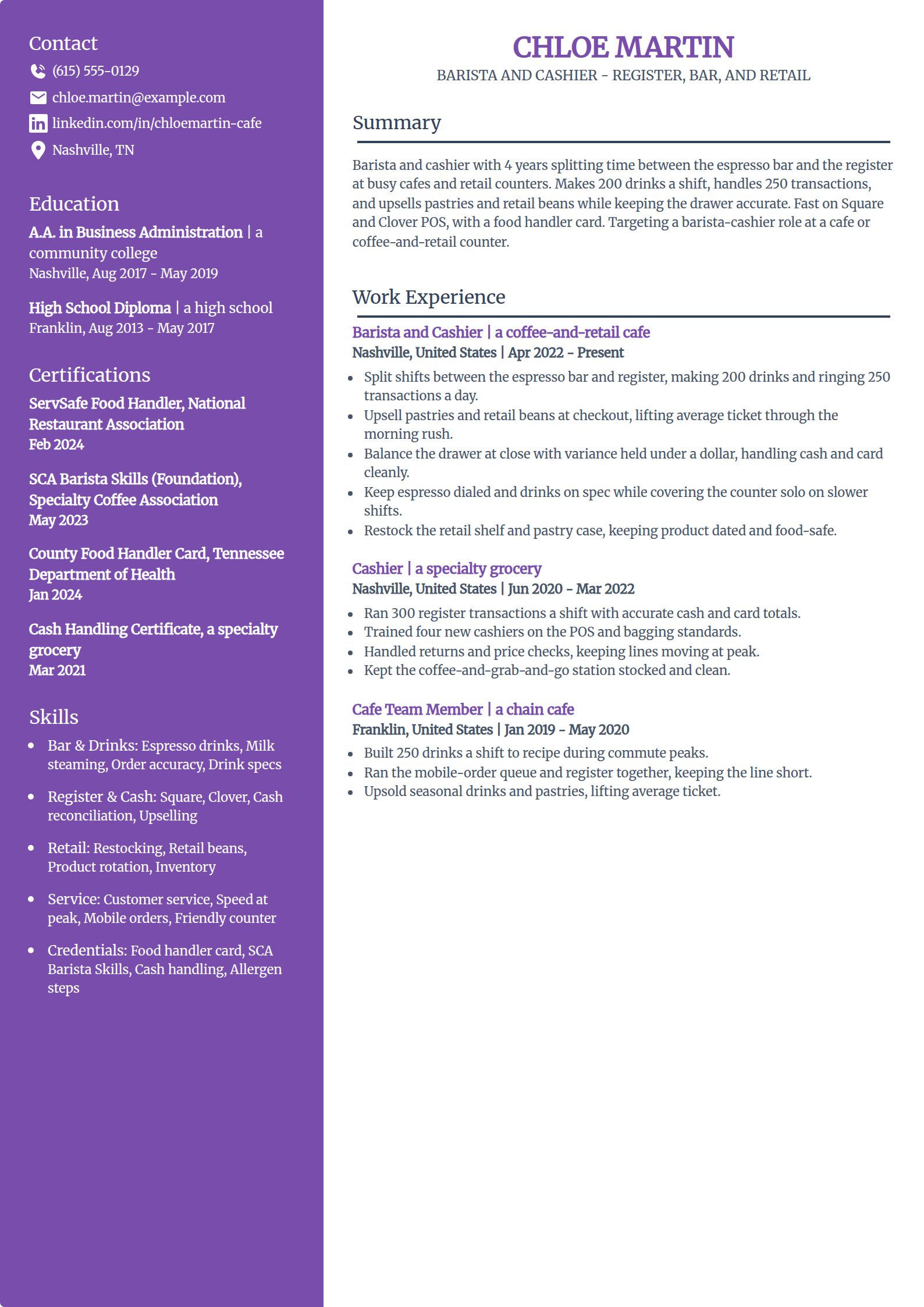
Barista & Cashier Resume Template
Why this resume example works?
- Leads with the double role, splitting the espresso bar and the register at busy cafes and counters.
- Carries both numbers, 200 drinks and 250 transactions a shift with the drawer balanced at close.
- Shows the register value a counter rewards, upselling pastries and retail beans at checkout.
- Names the POS a cafe-and-retail counter runs, Square and Clover, with a food handler card.
- Uses a Medium layout that fits a four-year bar-and-register record without empty space.
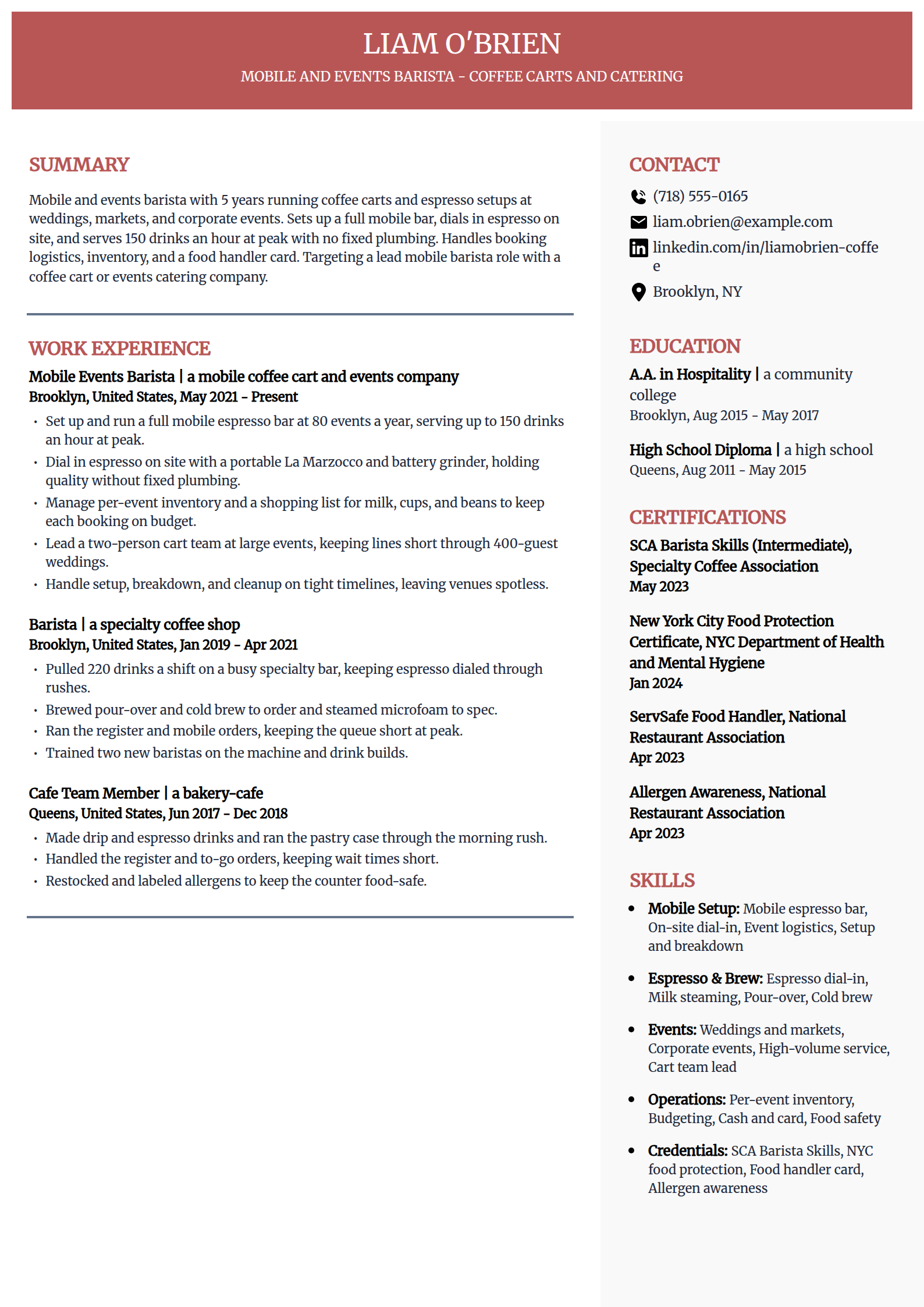
Mobile & Events Barista Resume Template
Why this resume example works?
- Opens with the events selling point, a full mobile espresso bar at 80 events a year.
- Shows the volume skill a caterer hires for, up to 150 drinks an hour with no fixed plumbing.
- Keeps the work concrete, on-site dial-in on a portable La Marzocco plus per-event inventory and budgets.
- Names the credentials an events role checks, SCA Barista Skills and a NYC food protection certificate.
- Uses a refined layout that fits a five-year mobile record cleanly on one page.
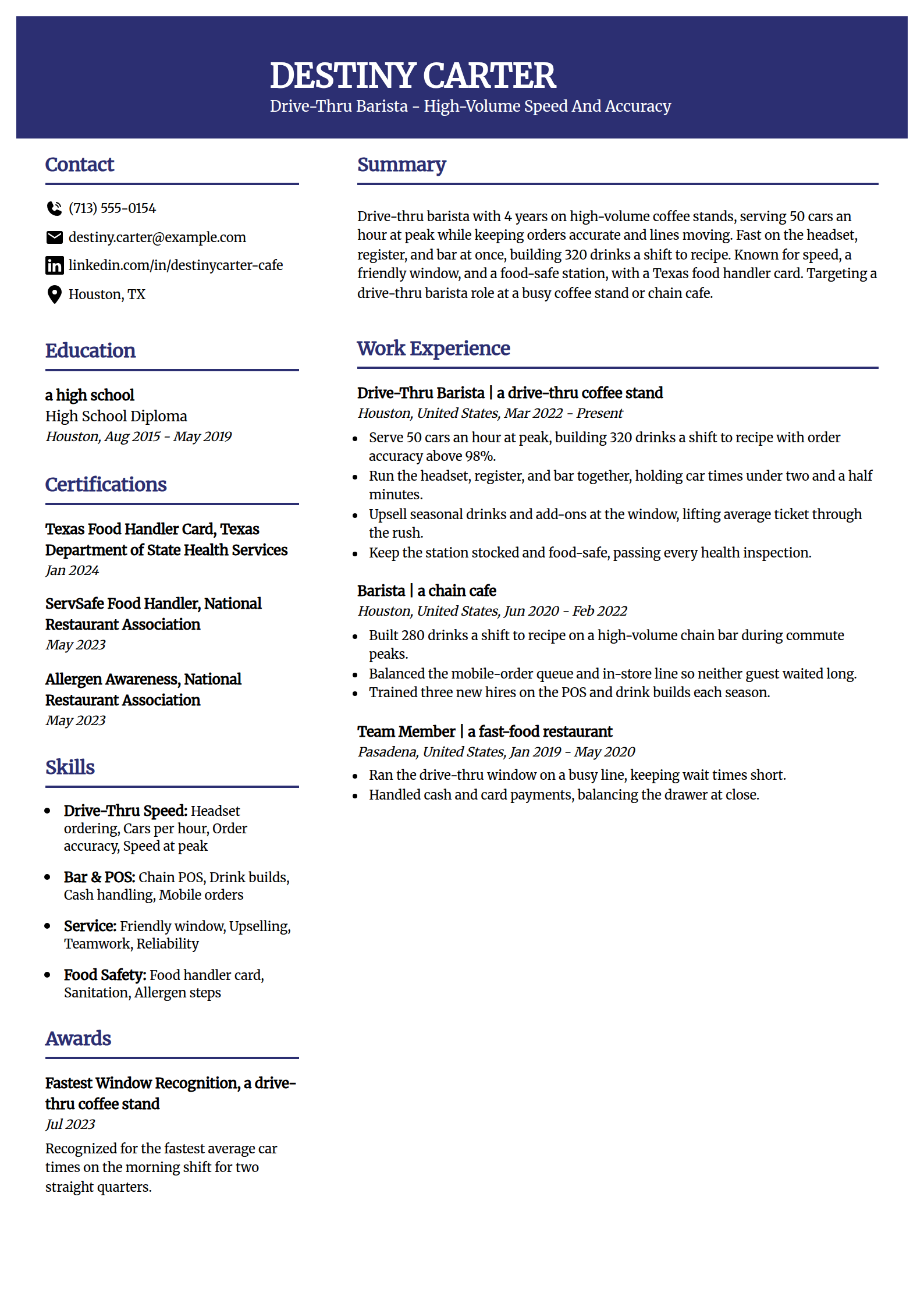
Drive-Thru & High-Volume Barista Resume Template
Why this resume example works?
- Leads with the number a stand cares about, 50 cars an hour at peak and 320 drinks a shift.
- Shows the speed a window rewards, headset, register, and bar run together under two and a half minutes.
- Keeps order accuracy front and center, above 98% through the rush, the metric a drive-thru screens for.
- Names the food handler card the role needs, without inflating certifications for an hourly job.
- Uses a roomy layout with an award so a four-year drive-thru record looks full.
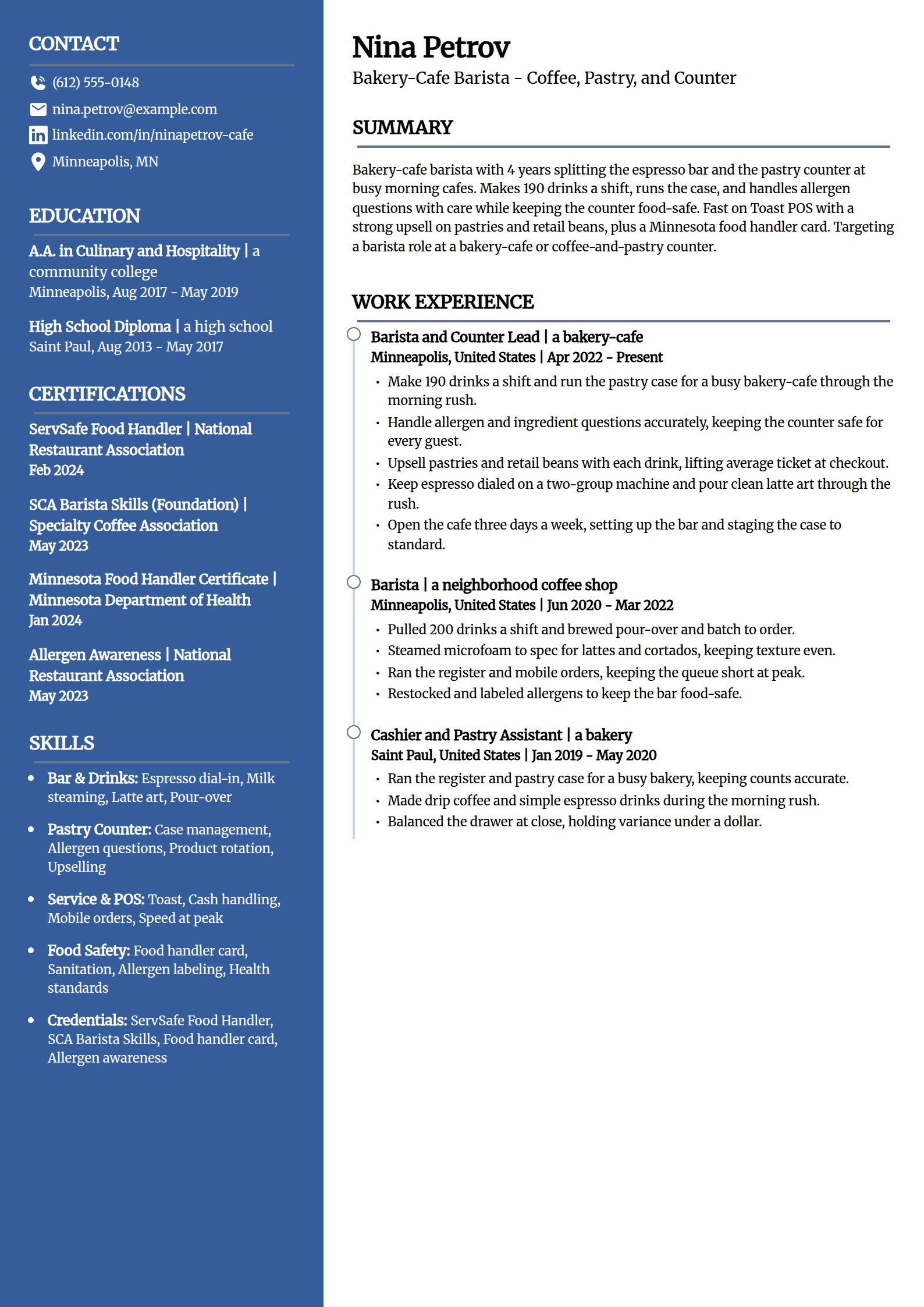
Bakery-Cafe Barista Resume Template
Why this resume example works?
- Leads with the split role, 190 drinks a shift on the bar plus running the pastry case.
- Shows the food-safety care a bakery-cafe needs, handling allergen and ingredient questions accurately.
- Ties the counter to sales, upselling pastries and retail beans with each drink at checkout.
- Names the POS and card a bakery-cafe runs, Toast and a Minnesota food handler card.
- Uses a distinctive layout that still reads cleanly for a busy hiring manager.
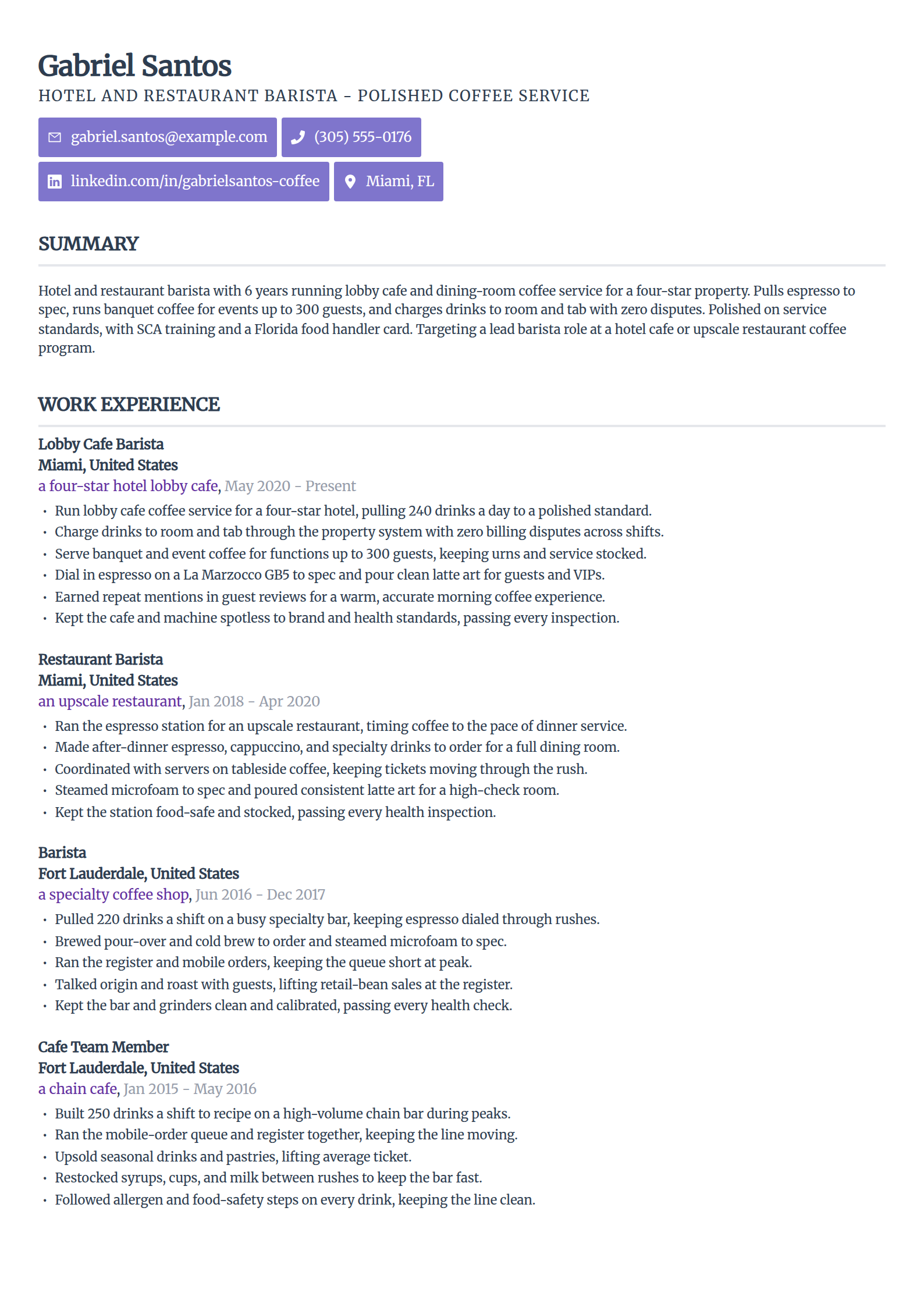
Hotel & Restaurant Barista Resume Template
Why this resume example works?
- Leads with polished service, a four-star lobby cafe and banquet coffee for events up to 300 guests.
- Shows the billing accuracy a hotel screens for, drinks charged to room and tab with zero disputes.
- Keeps the craft visible, espresso dialed on a La Marzocco GB5 and clean latte art for guests and VIPs.
- Names the credentials a property verifies, SCA Barista Skills and a Florida food handler card.
- Uses a clean, modern layout that carries a six-year hotel-cafe record on one page.
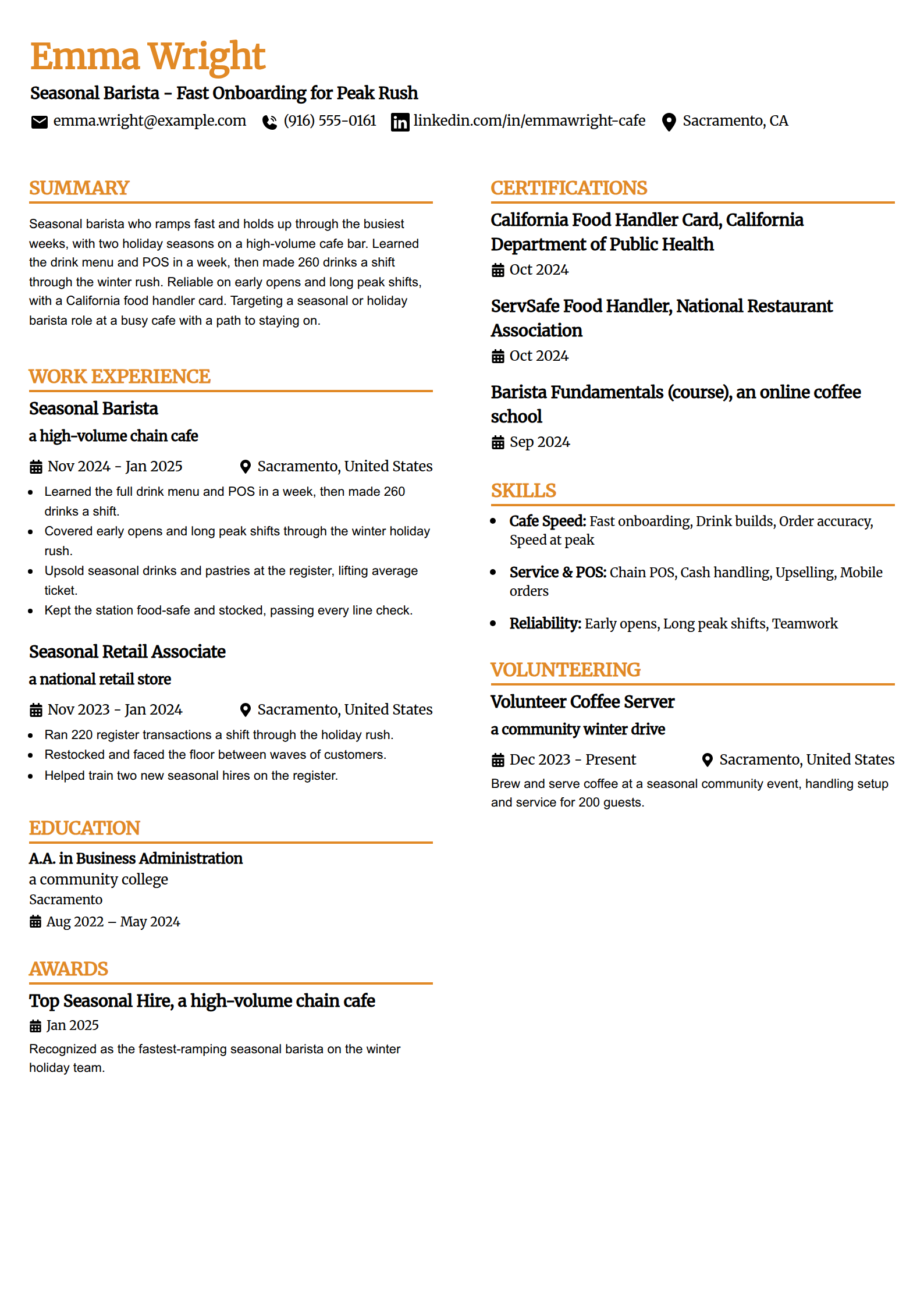
Seasonal & Holiday Barista Resume Template
Why this resume example works?
- Written for a seasonal hire, leading with fast onboarding, the drink menu and POS learned in a week.
- Shows the peak-week value a cafe wants, 260 drinks a shift through the winter holiday rush.
- Keeps the record honest, two holiday seasons plus a California food handler card, no invented tenure.
- Fills a tight, ATS-safe page with an award and a community volunteer role instead of padding.
- Uses a refined layout that fits short, high-intensity seasonal work on one page.
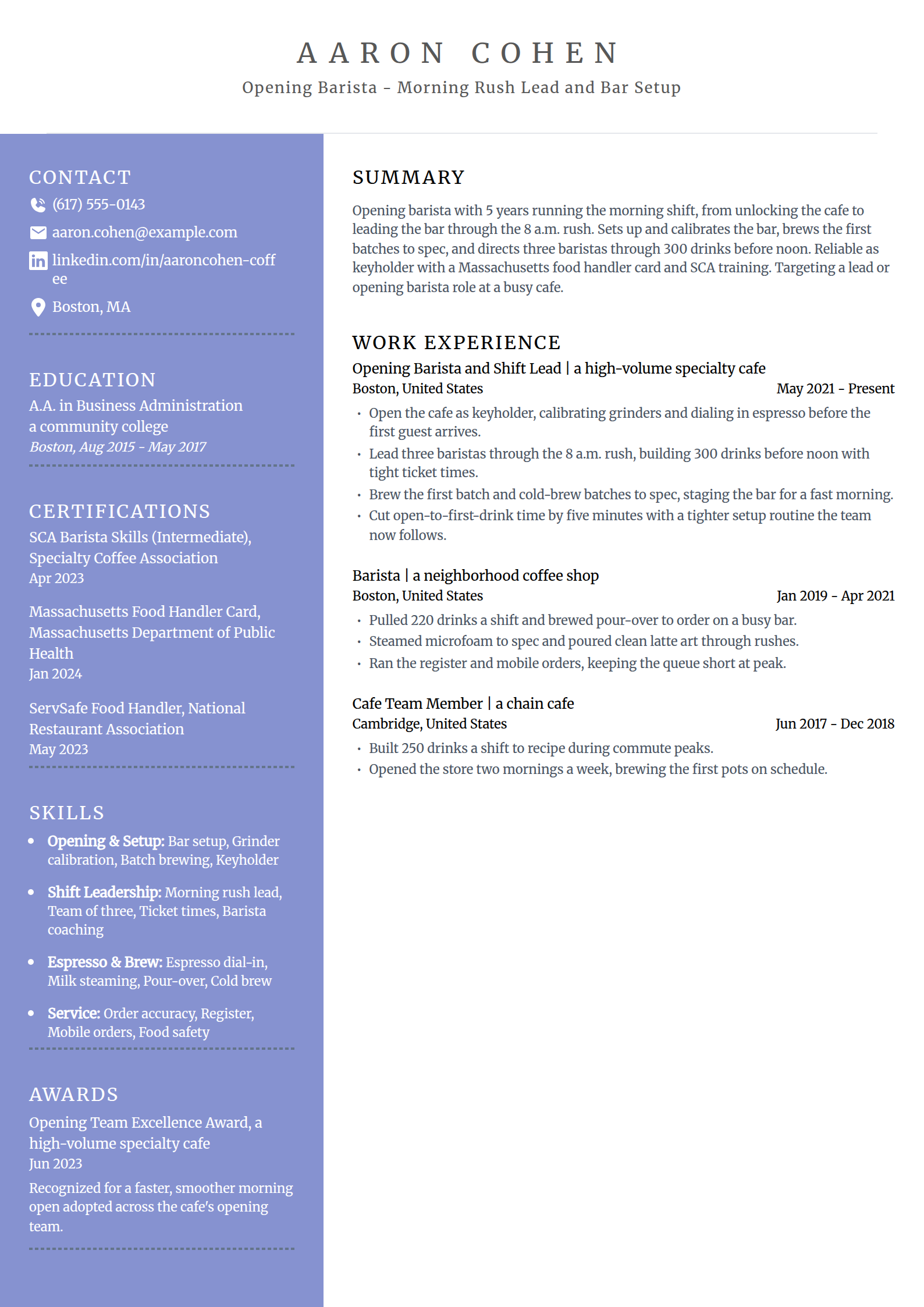
Lead & Opening Barista Resume Template
Why this resume example works?
- Leads with the opening shift, opening the cafe and calibrating the bar before the first guest.
- Shows morning-rush leadership, directing three baristas through 300 drinks before noon.
- Ties the setup work to a result, open-to-first-drink time cut five minutes with a tighter routine.
- Names the trust and credentials a keyholder role needs, SCA Barista Skills and a Massachusetts food handler card.
- Uses a roomy layout with an award so a five-year opening record looks complete.
Build your barista resume
Pick a template above and the editor keeps your layout clean and ATS-safe while you swap in your own drinks per shift, POS, brew methods, and food handler card.
Build my resumeHow to write a barista resume in 2026
A cafe manager scans a barista resume in seconds during a rush, looking for two things: whether you can work fast and clean, and whether you have a food handler card. Lead with a short summary that names your setting and your card, then prove each job with one number a cafe cares about, like drinks per shift or order accuracy. If you have no barista experience yet, that is fine and common. Lead with the transferable work and the card you do have, and be honest about it.
Open with a short, honest summary
Write three to four sentences that name your years and setting, your strongest number (drinks per shift, transactions, or cars per hour), your food handler card, and the role you are targeting. With no barista experience, lead instead with transferable retail or food-service work, your food handler card, and a genuine eagerness to learn the machine. Keep it to about 60 words so it never spills past the top of the page.
Reliable customer-service worker moving into coffee, with two years in retail and fast food and a current food handler card. Fast on a register and calm through a rush, known for accurate orders and a friendly counter. Practicing espresso and steaming through an online barista course, and eager to start behind the bar and train up on the machine.
Make every experience bullet a result with a number
Open with a strong verb, then attach one credible number a cafe manager actually tracks. A duty list reads like every other applicant's.
- Use cafe numbers: drinks per shift or per hour at peak, transactions per shift, ticket or queue time, order accuracy, waste percentage, or pastry and retail-bean upsell.
- Open with a verb like pulled, brewed, dialed, trained, or cut, never "Responsible for" or "Helped with".
- Name the method or gear: "dialed in espresso on a La Marzocco to dose, yield, and time" or "cut bean waste 15% by logging off-spec shots".
- Keep numbers modest and true to the venue: a drive-thru does 50 cars an hour, a specialty bar does fewer drinks at higher care. One number per bullet is plenty.
Put your food handler card and certifications where they get seen
A food handler card is the one credential most cafes require, so it is a screening item, not a footnote. Match the rest to the kind of shop you want.
- List your food handler card by its real name, like a ServSafe Food Handler card or a state or county card (California Food Handler Card, Washington Food Worker Card).
- For a specialty or third-wave shop, add SCA (Specialty Coffee Association) Barista Skills or Brewing certifications, which those owners actually recognize.
- A barista does not need an alcohol permit unless the cafe serves alcohol, so do not pad the list with credentials the role never asks for.
- No barista experience yet? Lead with the food handler card and any barista course you have taken, plus retail or food-service work that proves speed and reliability.
Match skills and keywords to the cafe
A skills block should read like the job posting. A high-volume chain and a third-wave specialty shop want different things, so tailor it.
- Core barista skills: espresso dial-in, milk steaming, latte art, brew methods (pour-over, batch, cold brew), register accuracy, and food safety.
- Chain and drive-thru: name speed and order accuracy, mobile-order handling, and the POS and headset you have run.
- Specialty and third-wave: name grinder calibration, brew ratios, origin and roast knowledge, and your SCA training.
- Name the POS you know outright, like Square, Toast, or Clover, since a posting often screens for the exact one.
Keep the format clean and one page
Cafe managers scan fast, and many coffee groups run an applicant tracking system, so a clean one-page layout is the safe choice at every level.
- Use a single-column or simple two-column layout with standard headings; skip heavy graphics that distract from your highlights.
- Keep it to one page. Almost every barista, from first job to head barista, fits a strong record on a single page.
- Save as a PDF so the formatting holds, then run it through our ATS resume checker for a quick format and keyword pass.
- Swap the numbers in the templates above for your own drinks per shift, POS, and food handler card; do not copy them as is.
Common barista resume mistakes
- Inventing barista experience you do not have. A manager sees through it fast; with no coffee job yet, lead with your food handler card and real retail or food-service work instead.
- Leaving off the food handler card. It is the one credential most cafes require, so put it near the top, not buried at the bottom or left out entirely.
- Writing duty lists with no number. Replace "made coffee and helped customers" with "pulled 220 drinks a shift and kept order accuracy above 98%".
- Sending a chain resume to a specialty shop, or the reverse. A third-wave cafe wants dial-in and brew methods; a drive-thru wants speed and accuracy, so match the resume to the shop.
- Running two pages for a cafe job. Keep it to one clean page and let your real shifts, speed, and food handler card carry it.
Frequently asked questions
How do you write a barista resume with no experience?
Lead with what you do have. With no barista job yet, open with a food handler card and transferable work like retail, fast food, cashiering, or volunteering, and treat each as a real experience entry with quantified bullets. Show that you are learning coffee on purpose, through an online barista course or espresso practice at home, and be honest rather than inventing barista years a manager will see through. Reliability, speed on a register, and a friendly counter carry real weight for a first cafe job. The entry-level, student, and career-changer examples above show the shape.
What skills should a barista put on a resume?
Name the ones the cafe actually uses: espresso dial-in, milk steaming, latte art, brew methods like pour-over, batch, and cold brew, register accuracy, and food safety. Add the POS you have run, such as Square, Toast, or Clover, since a posting often screens for the exact one. Tailor the list to the shop: a chain or drive-thru wants speed, order accuracy, and mobile-order handling, while a specialty or third-wave cafe wants grinder calibration, brew ratios, and origin knowledge. Back the top skills with a bullet that proves them, not just a keyword list.
Do you need a certification to be a barista?
Most cafes require a food handler card, and it is the one credential to get first. List it by its real name, like a ServSafe Food Handler card or a state or county card such as the California Food Handler Card or Washington Food Worker Card. For a specialty or third-wave shop, SCA (Specialty Coffee Association) Barista Skills or Brewing certifications help, since those owners recognize them. A barista does not need an alcohol permit unless the cafe serves alcohol, so do not pad the list with credentials the role never asks for.
What is the difference between a chain and a specialty coffee barista resume?
The structure is the same, but the numbers and skills change. A chain or drive-thru resume leads with speed and volume, like drinks per shift, cars per hour, order accuracy, and mobile-order handling, and names the chain POS and headset. A specialty or third-wave resume leads with craft, like espresso dial-in by ratio, grinder calibration, named brew methods, cupping, and origin knowledge, and names SCA certifications. Match the resume to the shop you are applying to: the chain-cafe and specialty examples above show each one.
How do you write a head barista or shift lead resume?
Lead with scope, not just drinks. A head barista or shift lead resume opens with the team you run, the opens and closes you own as keyholder, and the training you deliver, then backs it with numbers like drinks per rush, waste cut, and baristas trained. Keep the coffee craft visible too, such as dialing espresso to the roaster's spec, and list your food handler card and any SCA certifications. The head barista and cafe supervisor examples above show how to lead with leadership while keeping the bar skills front and center.
How long should a barista resume be?
One page for almost everyone. A barista resume should fit one clean page, and a cafe manager scanning during a rush will not read past it. This holds from a first coffee job through head barista and cafe supervisor. Use a second page only in the rare case of a long multi-cafe management record that genuinely needs the room. For every other level, keep it to one page and cut older, unrelated jobs so the space goes to your cafe work, your speed numbers, and your food handler card.
More barista resume resources
Build your barista resume
Pick a template above and the editor keeps your layout clean and ATS-safe while you swap in your own drinks per shift, POS, brew methods, and food handler card.