A Housekeeping Resume Is Read in Credits, Not Adjectives
- ATS Friendly
- Hotel Specific
- 16 Housekeeping Jobs
Every hotel in the country screens housekeeping on numbers it already has: rooms or credits a shift, what kind of rooms they were, the size of the property, and how many came back for rework. The sixteen examples below are full one-page resumes carrying exactly that, one for each job inside a housekeeping department. Start from the one closest to the posting you are answering.


540k+ resumes created
A housekeeping department is six different jobs
Sixteen jobs sit under one department name, and a hotel screens each of them on its own numbers: credits for a room attendant, pounds a day for laundry, pass rates for an inspector, labor hours and budget for an executive housekeeper. Work from the template built for the posting in front of you, and the numbers it is screened on are already in place.
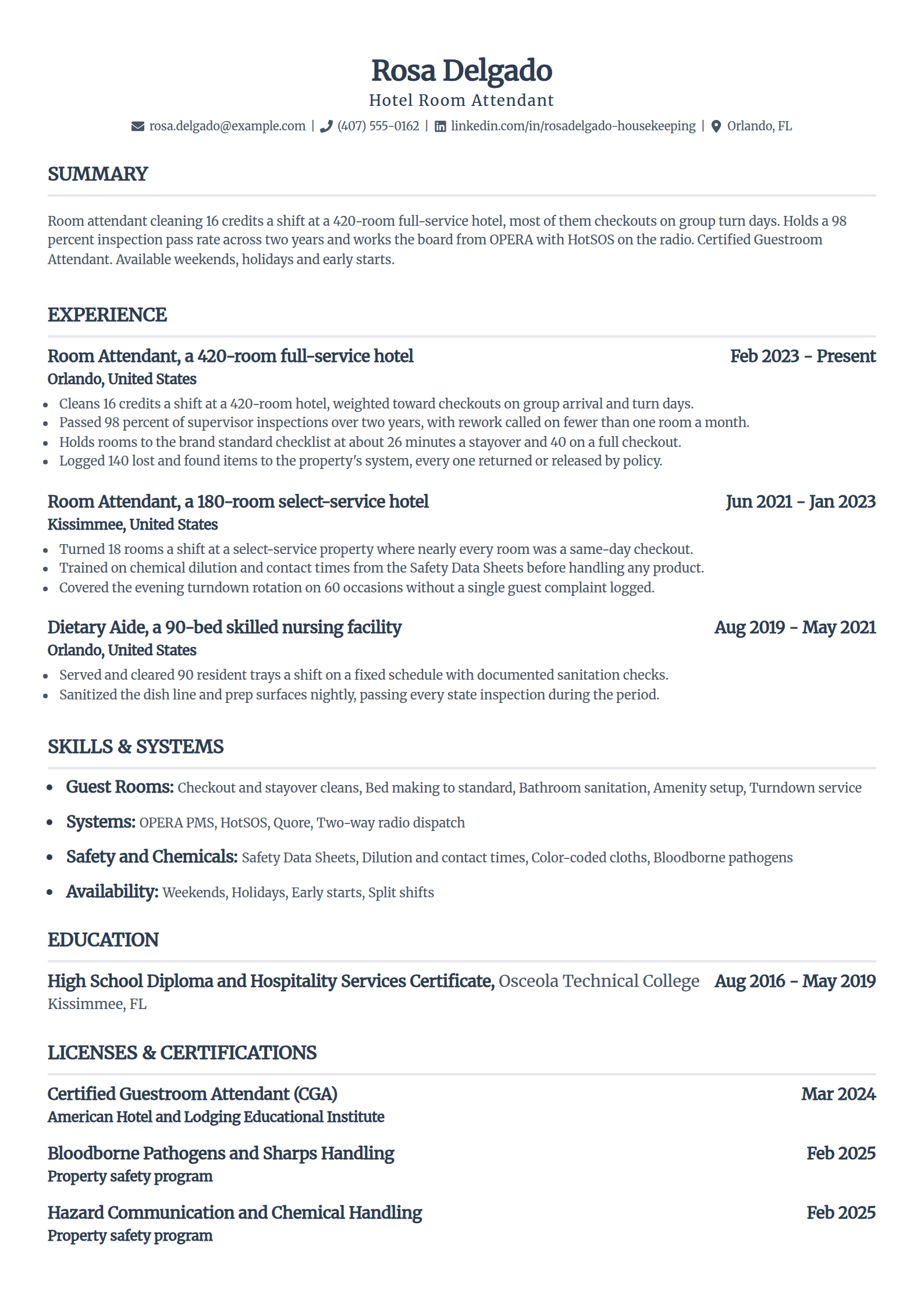
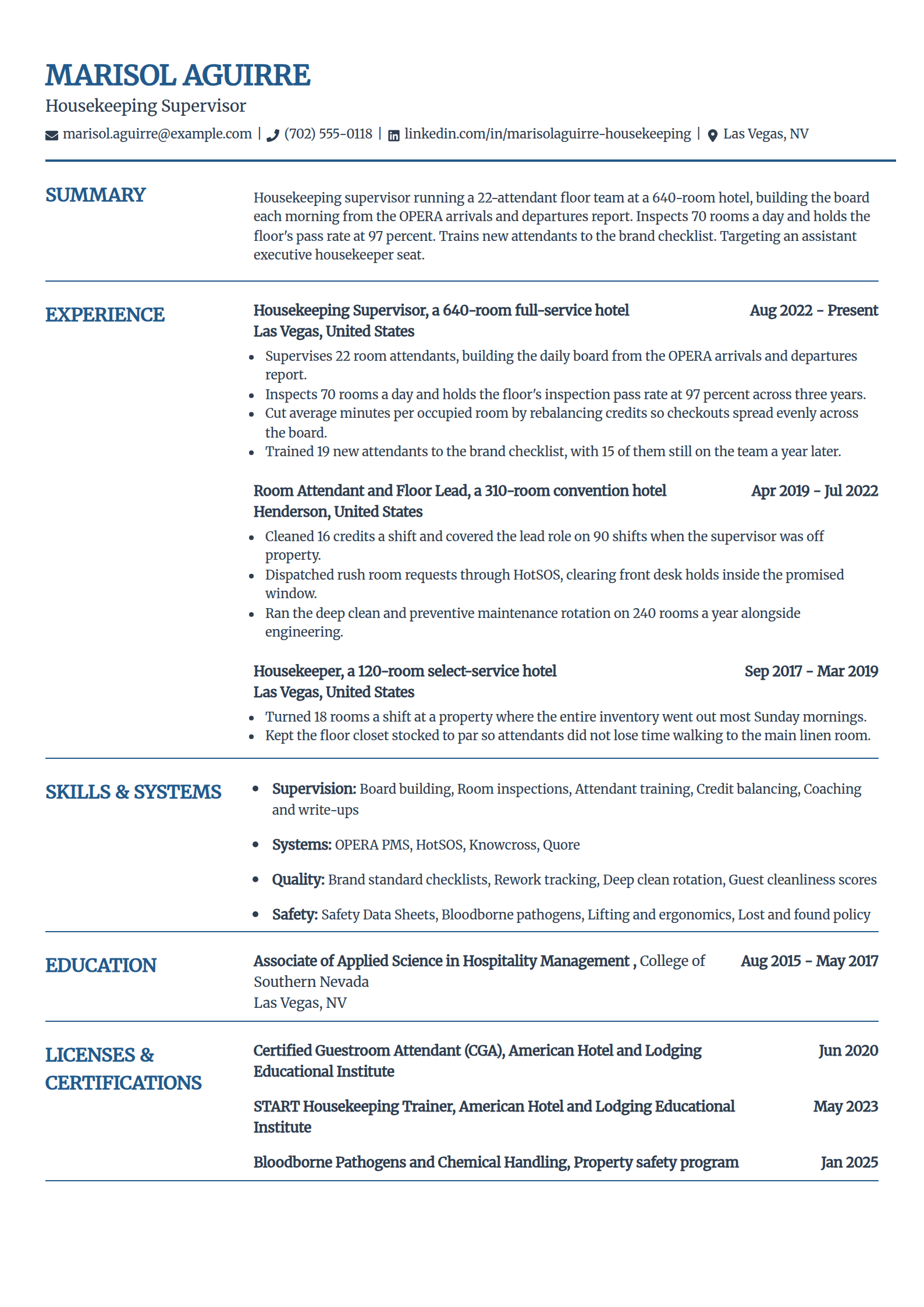
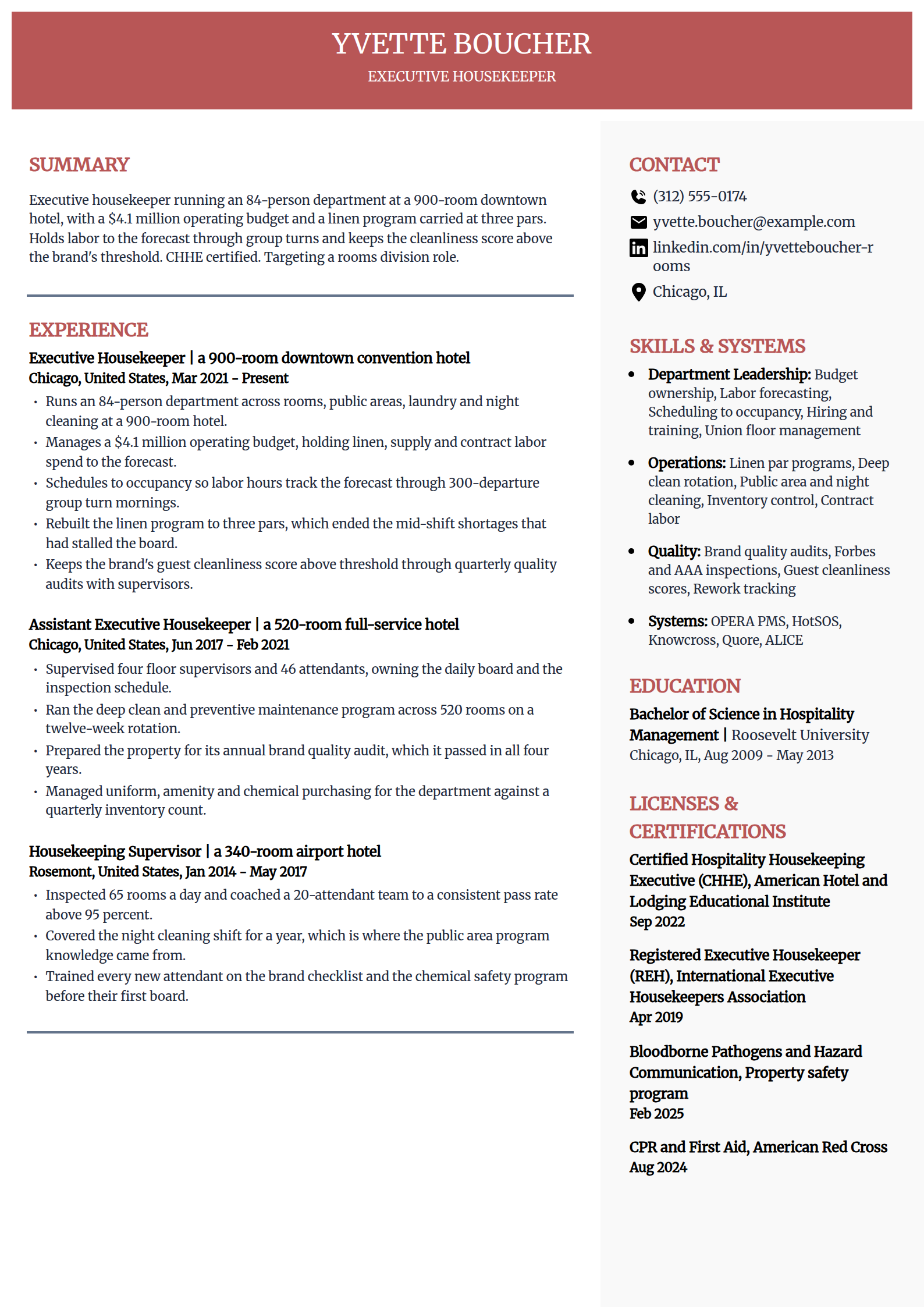
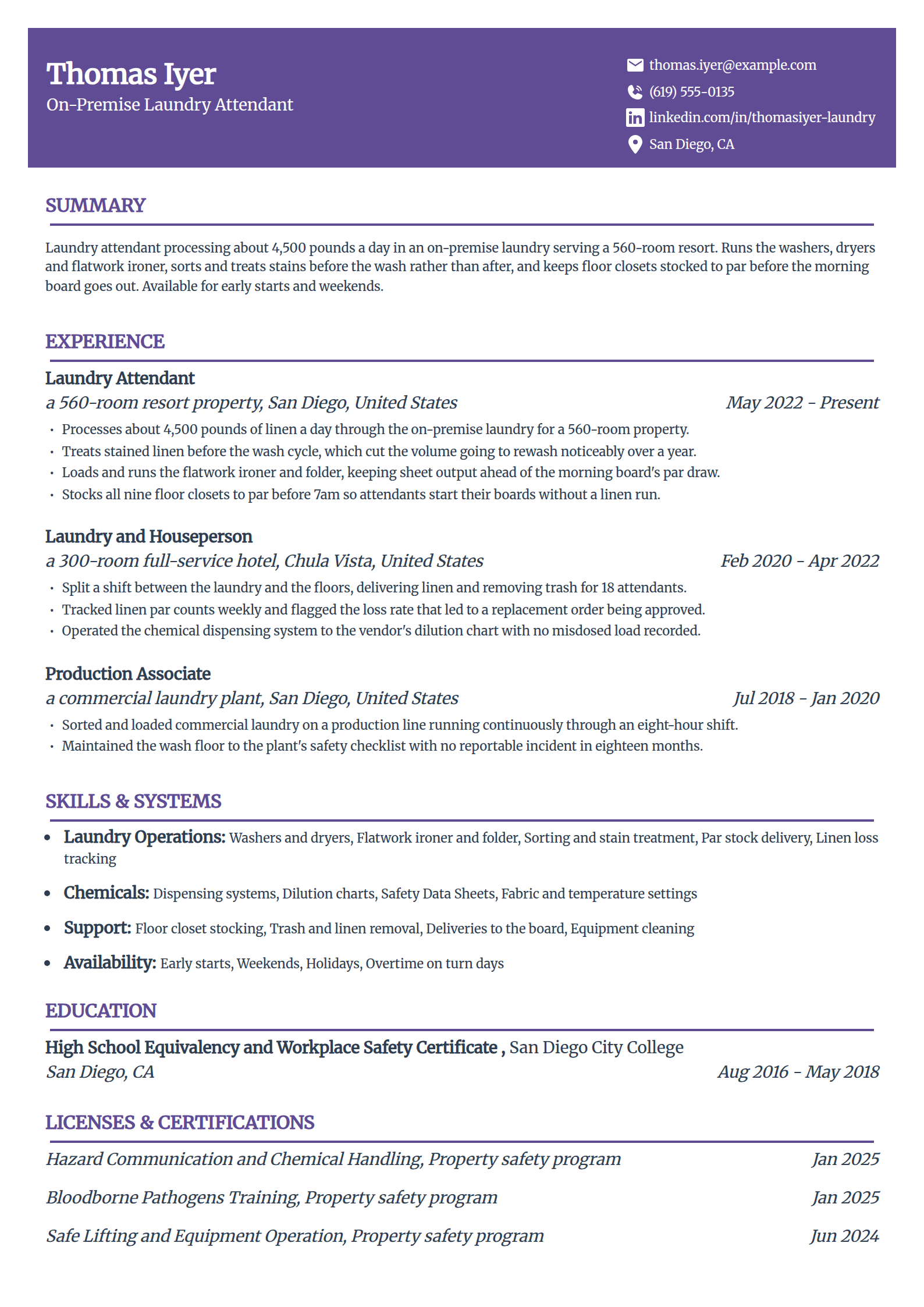
Hotel Room Attendant Resume Template
Why this resume example works?
- Says credits rather than rooms, which is how a property management system actually assigns a board.
- Puts the property size and the room type next to the number, so 16 a shift reads as the real workload it is.
- Gives the inspection pass rate and the rework rate, the two numbers a supervisor already has on a screen.
- States the pace in minutes by room type, which tells a reader this person knows what the standard is.
- Names OPERA and HotSOS, plus Safety Data Sheets and contact times, instead of writing attention to detail.
Housekeeping Supervisor Resume Template
Why this resume example works?
- Leads with team size and the board, because building the board from the arrivals report is the job itself.
- Counts rooms inspected a day, which is the supervisor equivalent of an attendant's credit count.
- Shows credit balancing as a result, not a duty: spreading checkouts evenly is what moves minutes per room.
- Counts attendants trained and how many stayed a year, which separates training from onboarding.
- Keeps the attendant years visible, because a supervisor who never worked a board is not credible on one.
Executive Housekeeper Resume Template
Why this resume example works?
- Opens with headcount and budget, the two numbers a rooms division manager screens an executive housekeeper on.
- Shows labor scheduled against the forecast through group turns, which is where the department's cost is won.
- Names a specific fix, rebuilding the linen program to three pars, and what it ended rather than what it was.
- Carries the brand quality audit record, which is the external verification of everything else on the page.
- Lists the CHHE and REH certifications, which have real experience requirements behind them.
Laundry Attendant Resume Template
Why this resume example works?
- Uses pounds a day, which is the unit an on-premise laundry is measured in and the one a posting asks for.
- Names the equipment specifically, including the flatwork ironer and folder, rather than listing machines.
- Shows the stain treatment habit as a cause and the rewash volume as its effect.
- Ties the job to the floors: closets stocked to par before 7am is why the morning board does not stall.
- Keeps chemical dispensing and dilution charts on the page, which is the safety half of this role.
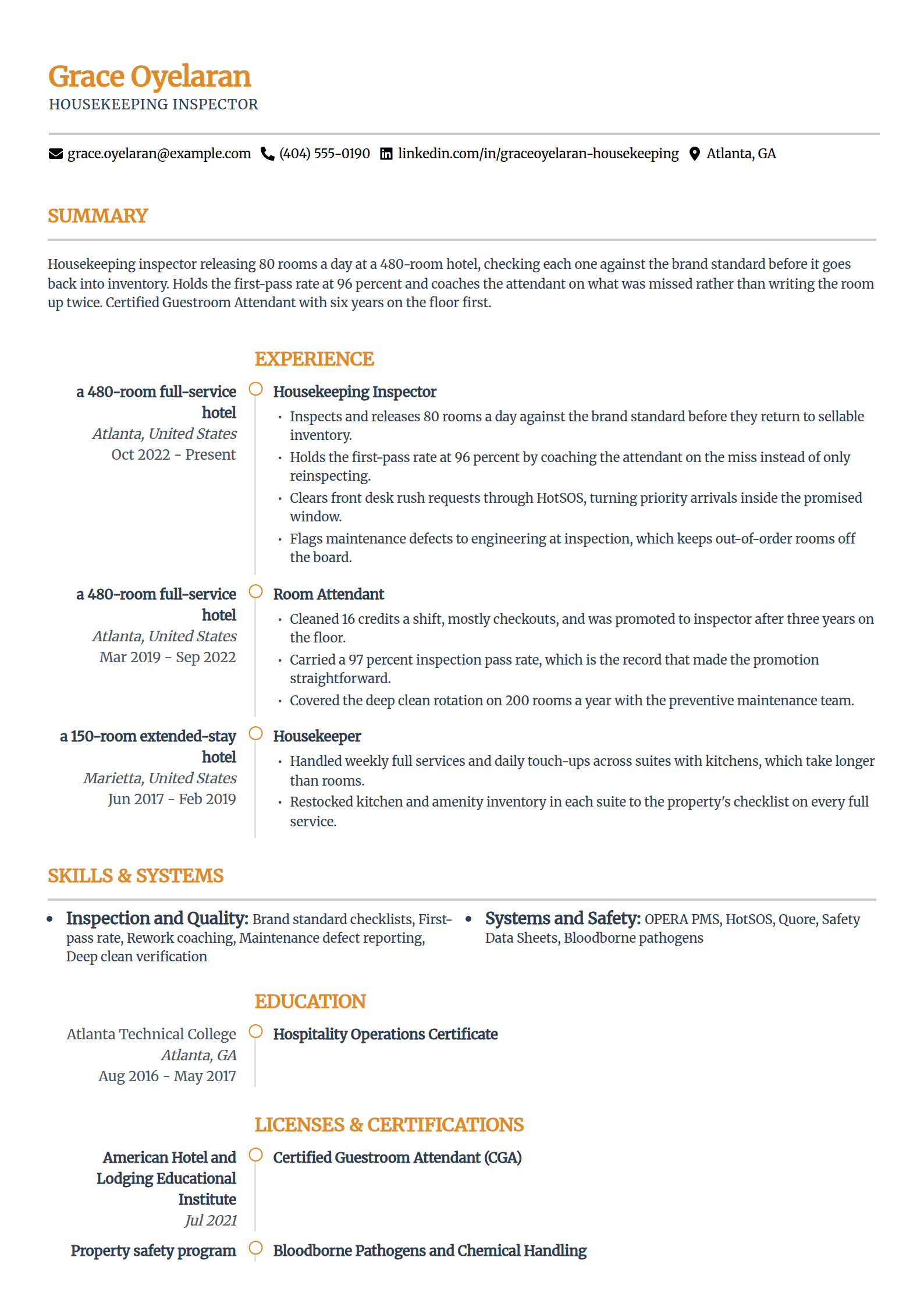
Housekeeping Inspector Resume Template
Why this resume example works?
- Counts rooms released a day, which is the inspector's throughput number and the one a schedule is built on.
- Reports the first-pass rate rather than a generic quality claim, and says how it is held up.
- Shows coaching at the miss instead of silent reinspection, which is what actually moves a floor's numbers.
- Includes defect reporting to engineering, the part of inspecting that protects sellable inventory.
- Keeps three years on the floor underneath, because that record is why the promotion happened.
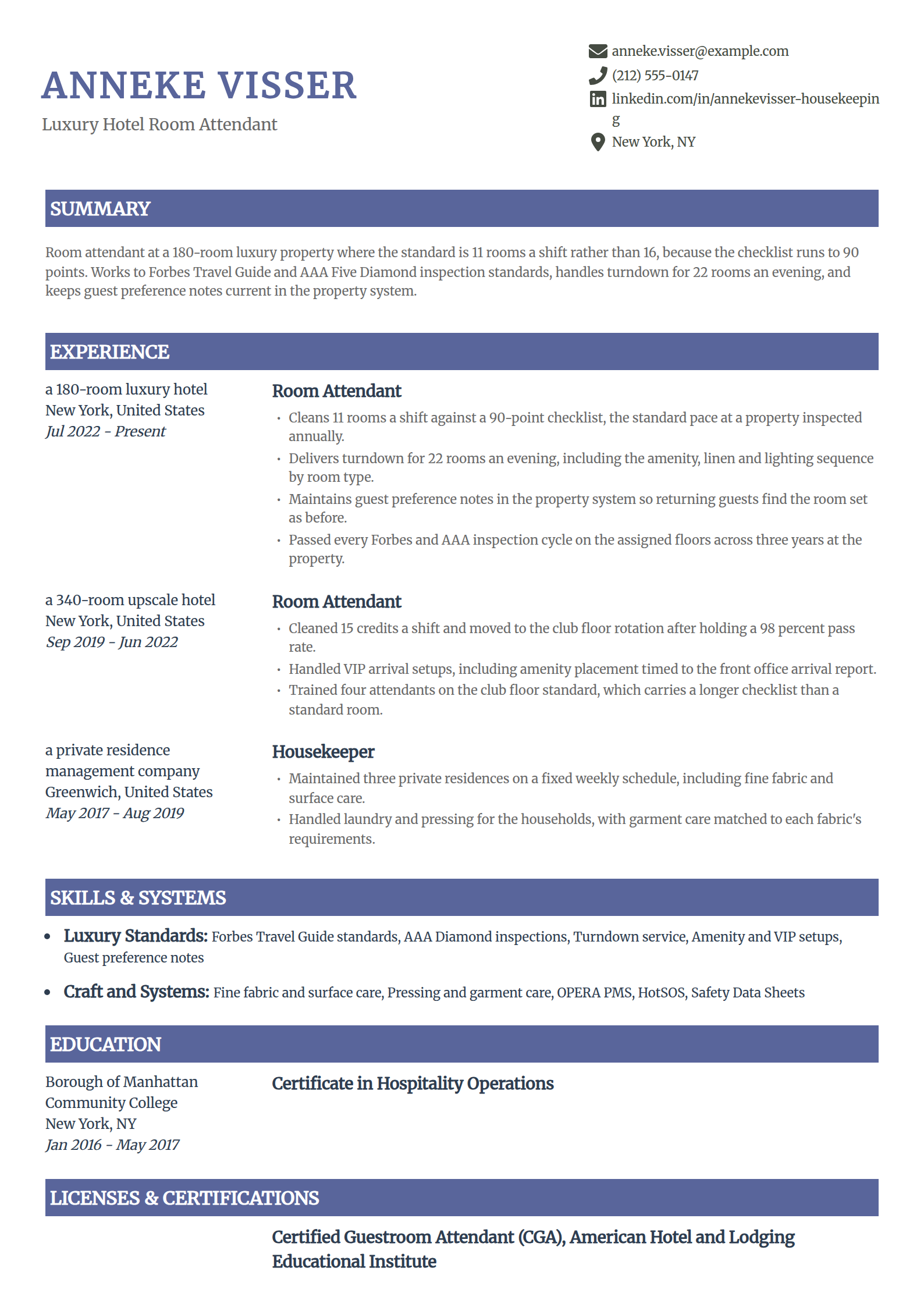
Luxury Hotel Housekeeper Resume Template
Why this resume example works?
- Explains the lower room count instead of hiding it: 11 a shift against a 90-point checklist is the standard here.
- Names Forbes Travel Guide and AAA Diamond inspections, the standards a luxury property is actually held to.
- Counts turndown rooms an evening, a second shift's work that most housekeeping resumes leave off entirely.
- Shows guest preference notes kept current, which is the part of luxury housekeeping that earns repeat stays.
- Carries private residence work underneath, where fine fabric and garment care were learned.
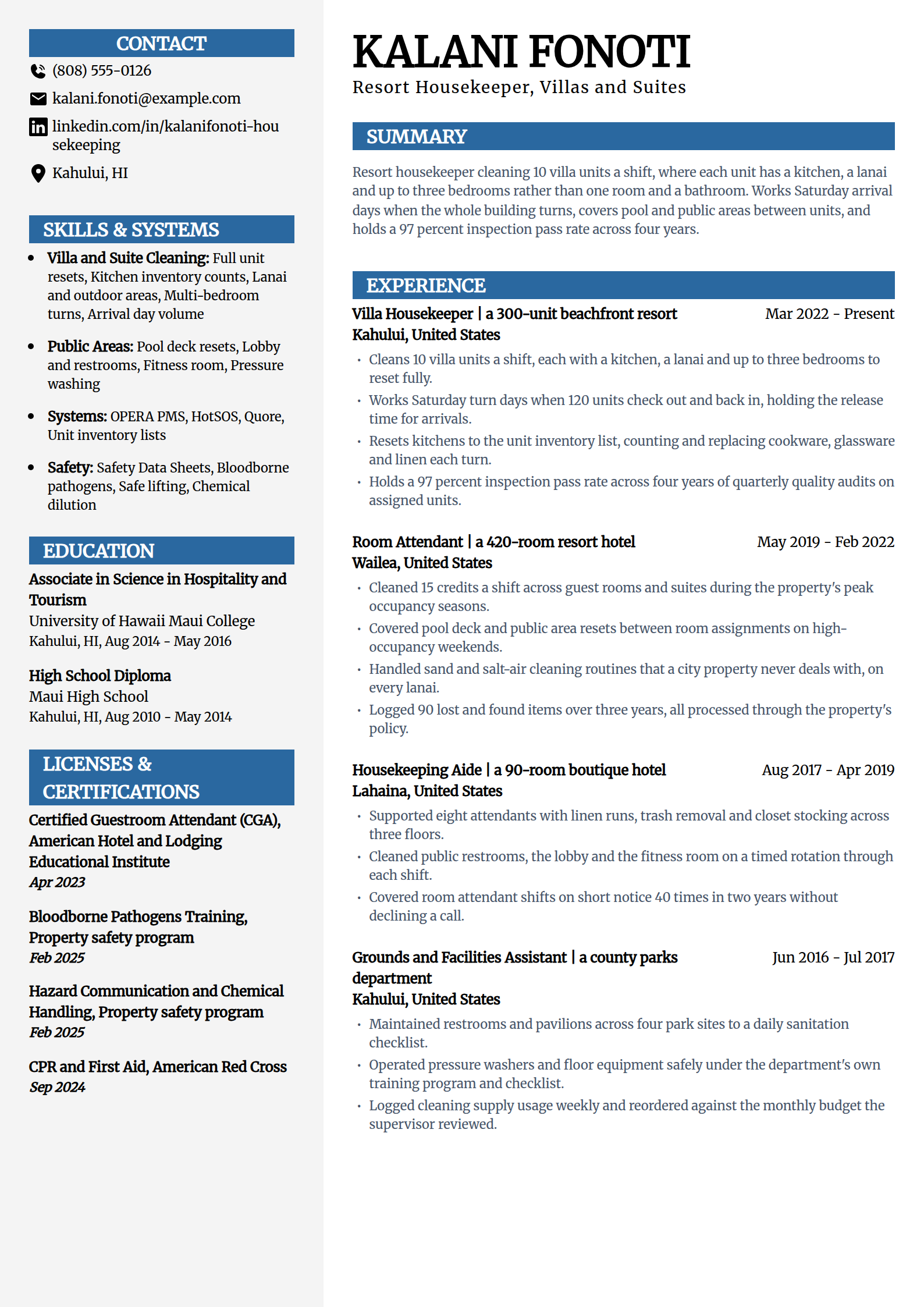
Resort Housekeeper Resume Template
Why this resume example works?
- States what a unit is before stating the count, because a three-bedroom villa is not comparable to a guest room.
- Shows the arrival-day volume, which is how resort housekeeping actually breaks: everything turns at once.
- Includes the kitchen inventory reset, a task list a city hotel attendant never touches.
- Names the sand and salt-air routines, the detail that proves this is resort experience rather than hotel experience.
- Keeps the public area and grounds work visible, since resorts expect attendants to cover both.
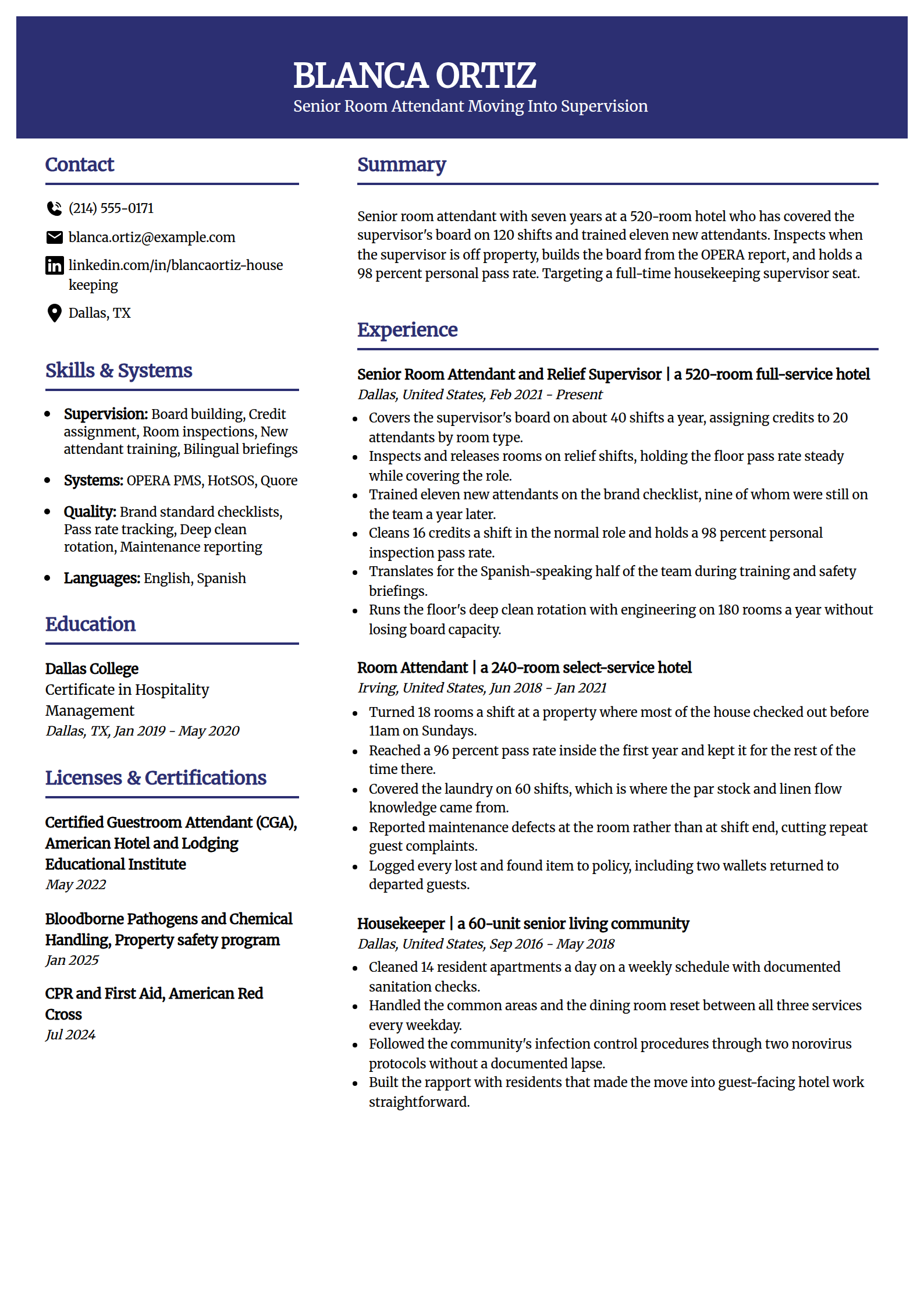
Housekeeping Supervisor Track Resume Template
Why this resume example works?
- Shows the supervisor work already being done on relief shifts rather than asking to be given the role.
- Keeps the personal pass rate on the page, because a supervisor who could not clean to standard is a hard sell.
- Counts attendants trained and how many were still there a year later, which is the retention argument.
- Puts translating for the team on the page as the operational contribution it is at most properties.
- Keeps the senior living job, where infection control procedures were followed through two real outbreaks.
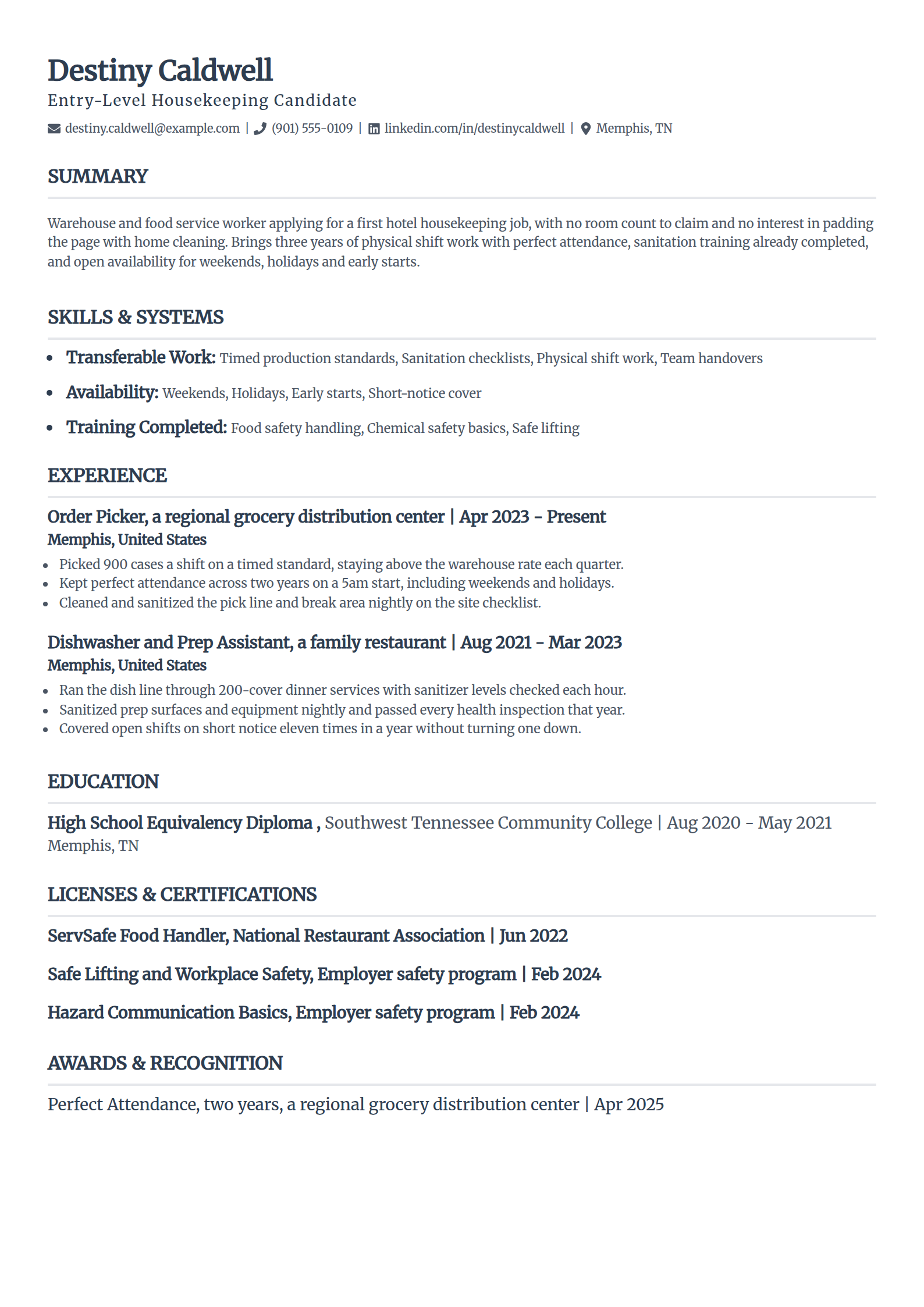
Housekeeping Resume Template With No Experience
Why this resume example works?
- Leads with skills rather than experience, correctly, because there is no hotel work history to lead with.
- Refuses to pad: no square footage of home cleaning, no invented room count, and it says so in the summary.
- Counts what the warehouse and restaurant jobs actually measured, which is a pick rate and a sanitation record.
- Puts attendance and availability on the page, which is what a housekeeping manager screens for at this level.
- Shows sanitation and safety training already completed, so the first week of onboarding is shorter.
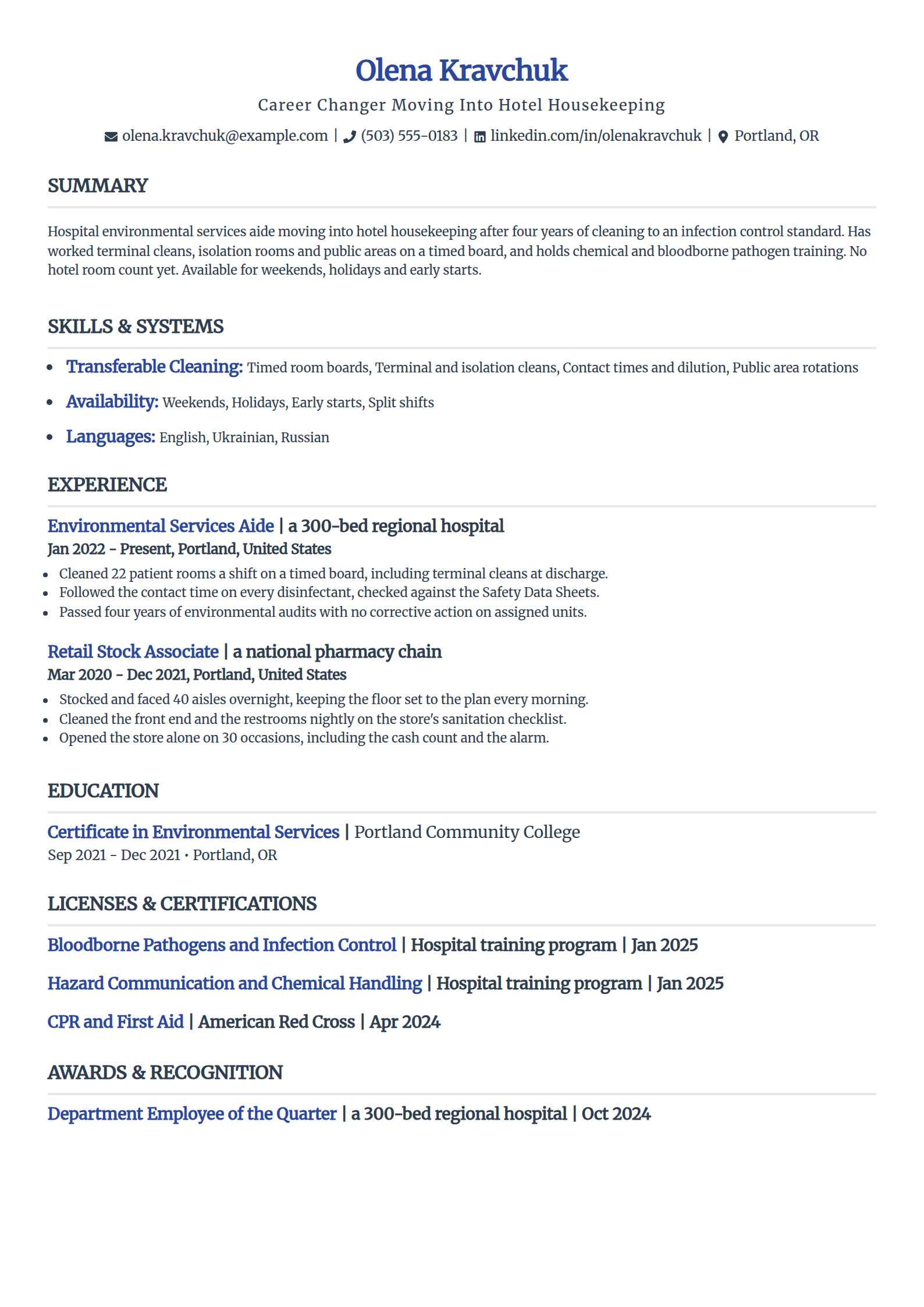
Career Change to Hotel Housekeeping Resume Template
Why this resume example works?
- Picks the closest real analogue, hospital environmental services, and shows the timed board behind it.
- Names terminal cleans and contact times, which are a harder standard than most hotel rooms require.
- Says plainly there is no hotel room count yet, the second of only two examples here that lead with skills.
- Puts the languages spoken on the page, which on a housekeeping floor shortens every shift briefing.
- Keeps the audit record, because passing four years of environmental audits is verifiable in a reference call.
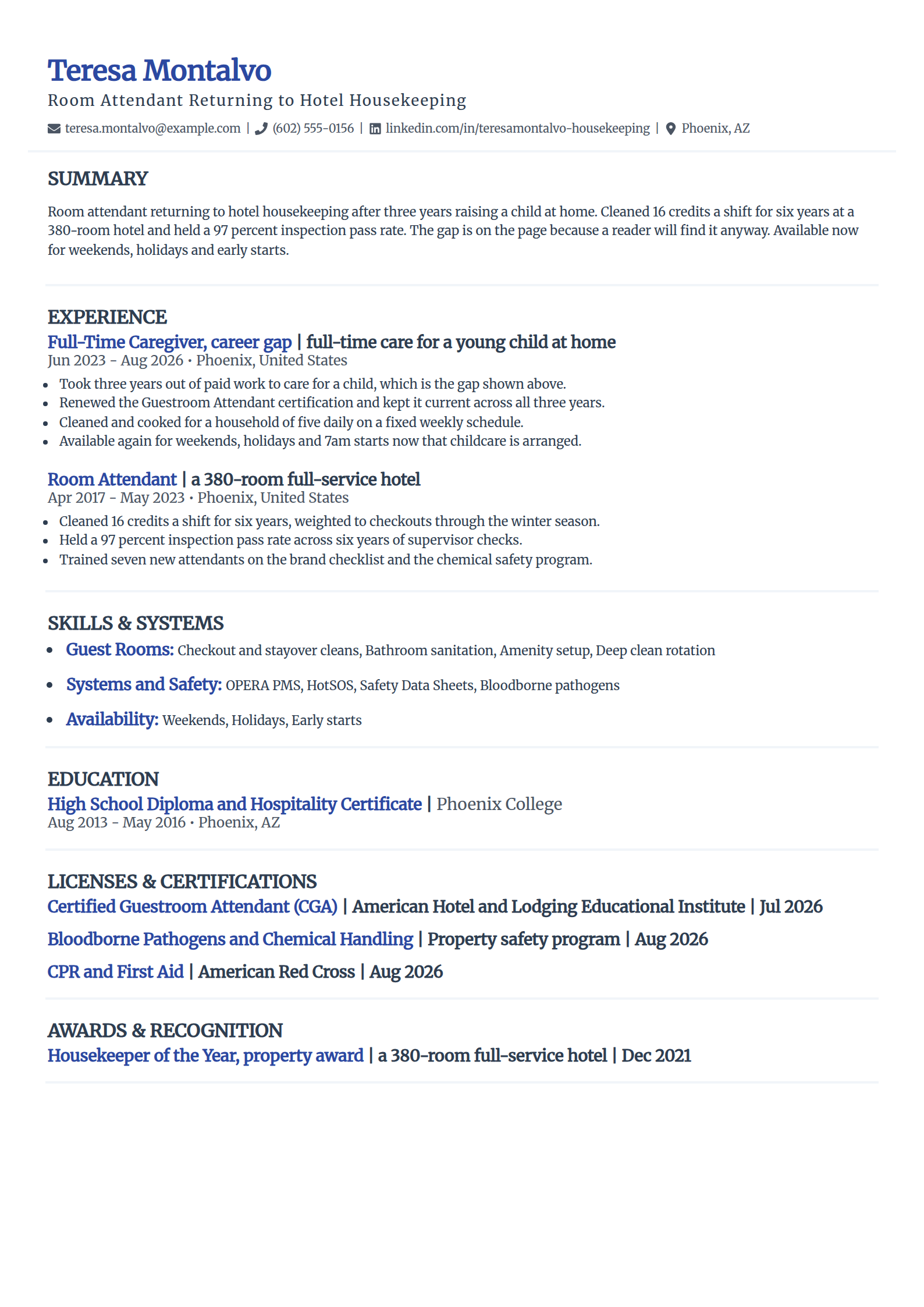
Returning to Housekeeping After a Gap Resume Template
Why this resume example works?
- Dates the gap as its own entry with the reason given, rather than leaving a three-year hole to be guessed at.
- Puts six years of credits and a pass rate directly underneath, so the record follows the explanation at once.
- Shows the certification renewed during the gap, which answers the only real objection to rehiring.
- States childcare arranged and availability restored, because that is the practical question behind the objection.
- Keeps the property award, which is the kind of recognition a reference call can confirm in one sentence.
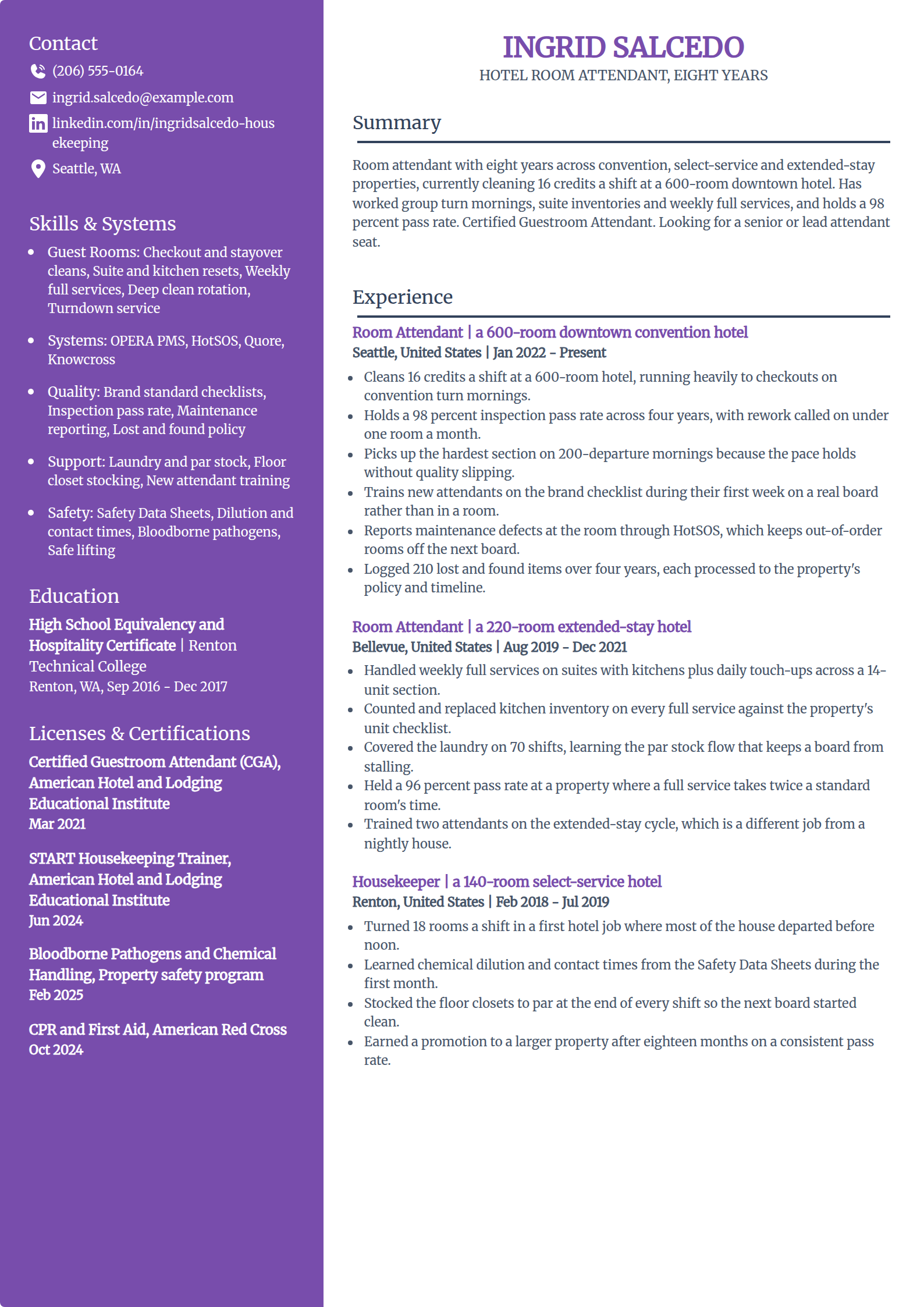
Experienced Hotel Housekeeper Resume Template
Why this resume example works?
- Covers three property types in eight years, which is a wider range than most housekeeping resumes can claim.
- Shows the hardest section taken on turn mornings, a reliability claim a supervisor can verify in a reference call.
- Keeps the extended-stay cycle separate from the nightly house, because they are genuinely different jobs.
- Counts lost and found items logged, which is a trust credential and costs nothing to state.
- Fits eight years on one page by cutting detail from the oldest job, never the property context from recent ones.
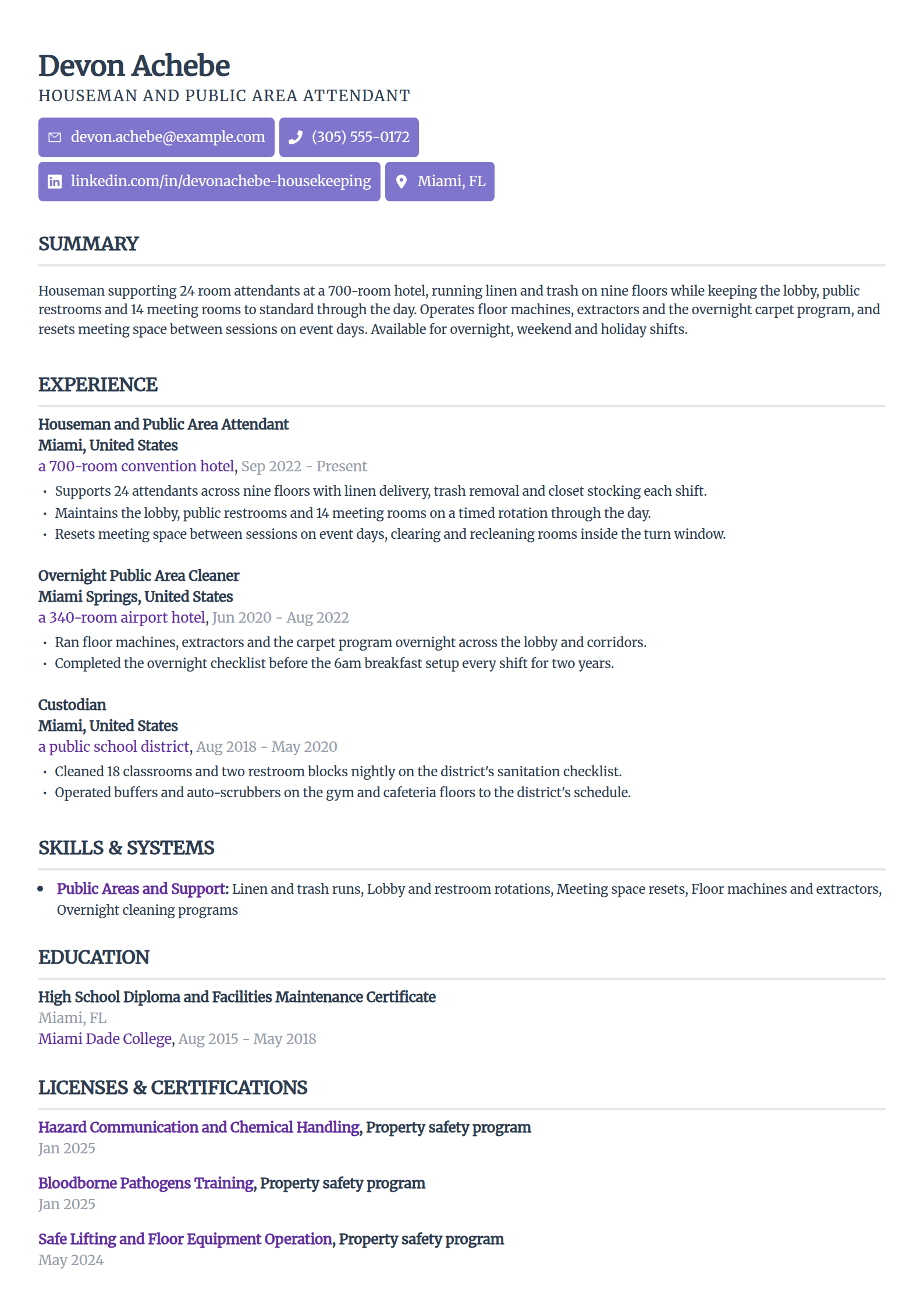
Houseman and Public Area Attendant Resume Template
Why this resume example works?
- Sizes the support job by the people it serves, 24 attendants on nine floors, not by a list of duties.
- Separates public area work from room work, since they are different postings with different equipment.
- Names floor machines, extractors and the overnight carpet program, which a room attendant resume never carries.
- Includes meeting space resets on event days, the part of the job that has a hard turn window attached.
- Keeps the custodial background, where the same equipment was run on a nightly schedule.
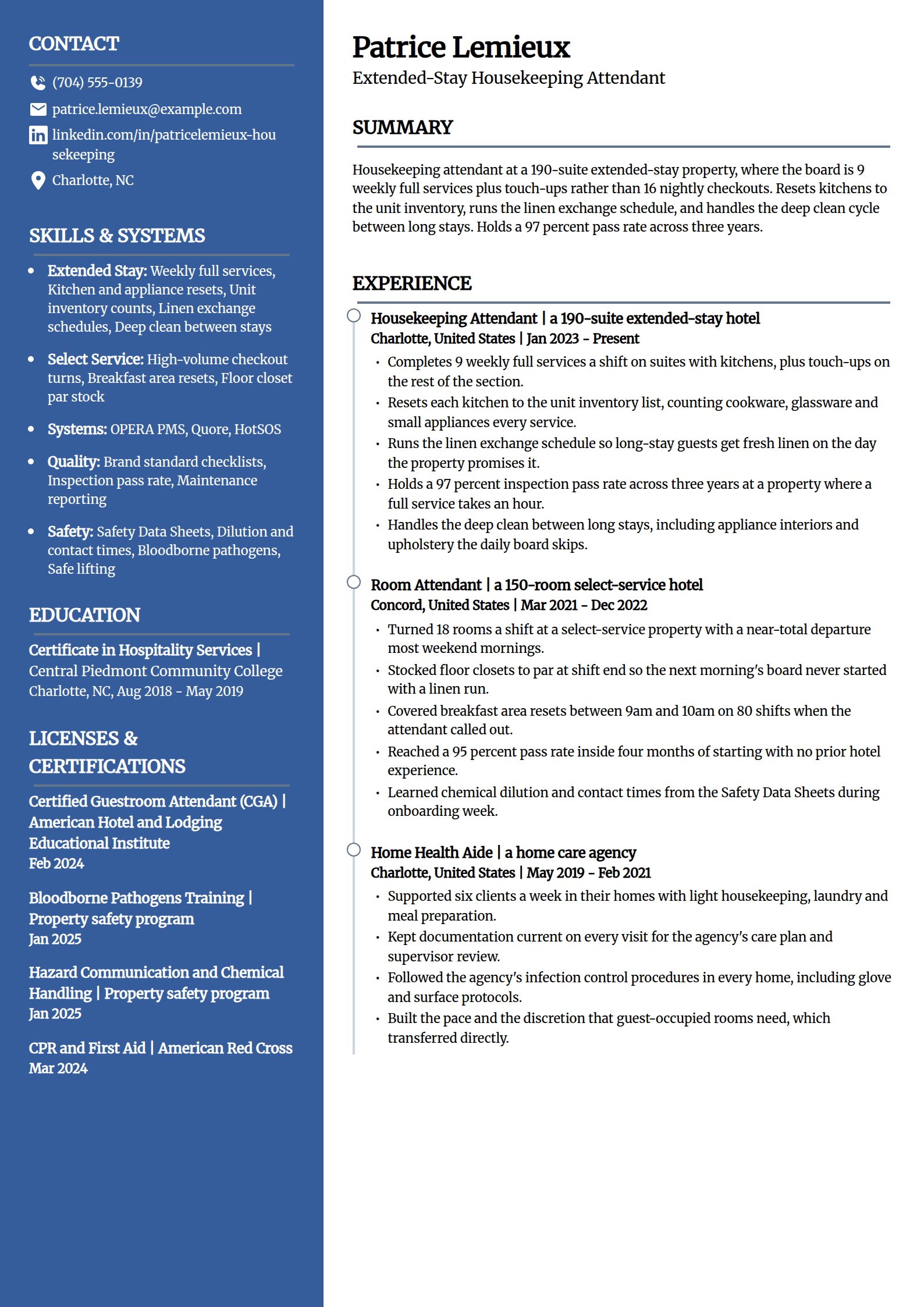
Extended-Stay Housekeeping Resume Template
Why this resume example works?
- Explains the board before giving the number: 9 weekly full services is not comparable to 16 nightly checkouts.
- Shows the kitchen inventory count, which is the task that makes an extended-stay service take an hour.
- Carries the select-service experience separately, where the entire house departs most weekend mornings.
- Puts the linen exchange schedule on the page, because long-stay guests notice the day it is promised for.
- Keeps the home health work, where pace and discretion in an occupied space were already required.
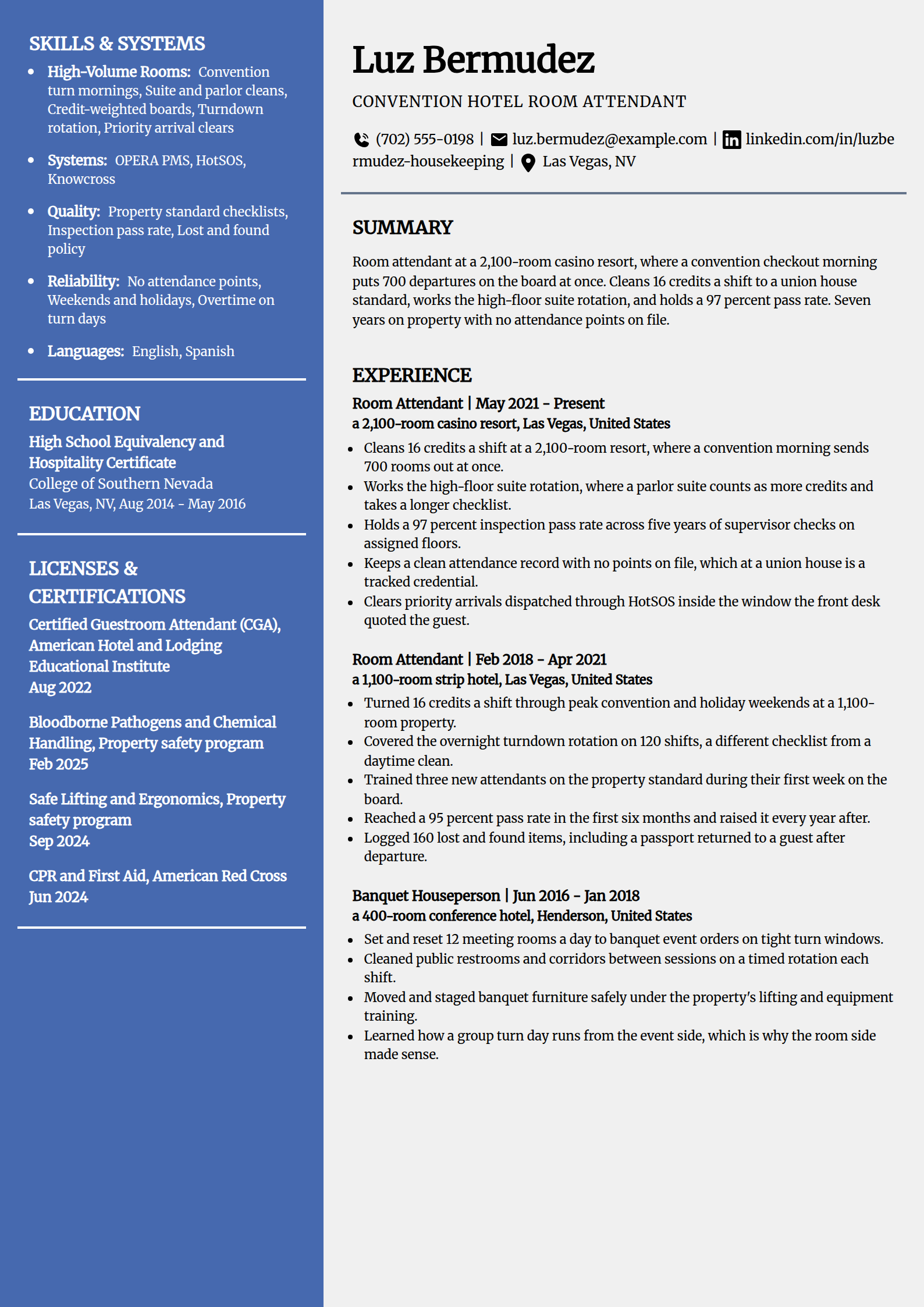
Convention Hotel Housekeeper Resume Template
Why this resume example works?
- Gives the scale that makes the job specific: 700 departures on one morning at a 2,100-room property.
- Shows the suite rotation and explains why a parlor suite counts as more credits than a standard room.
- Treats a clean attendance record as the tracked credential it is at a union house, rather than as a personality trait.
- Includes priority arrival clears dispatched through HotSOS, which is the pressure part of a big-house shift.
- Keeps the banquet houseperson start, which is where the group turn day first made sense from the event side.
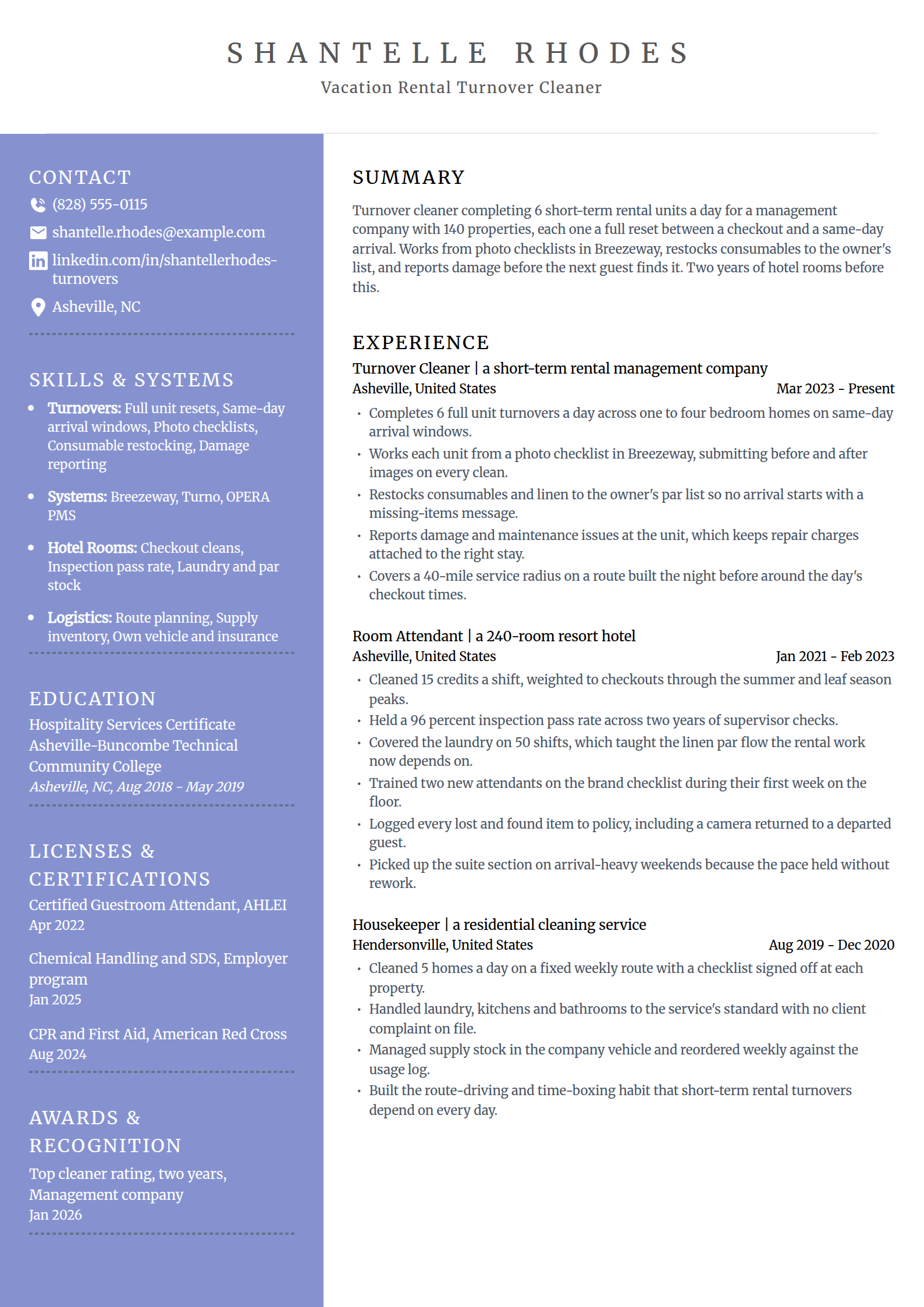
Vacation Rental Turnover Cleaner Resume Template
Why this resume example works?
- Counts full unit turnovers a day rather than rooms, because a turnover is a whole home reset between guests.
- Names Breezeway and Turno and the photo checklist, which is how short-term rental work is actually verified.
- Shows the consumable par list, the thing that generates a complaint message when it is missed.
- Puts the service radius and route planning on the page, since this job is driven as much as it is cleaned.
- Keeps two years of hotel rooms underneath, which is what makes the cleaning standard credible to either employer.
Build your housekeeping resume
Take the example closest to the job you want, put your own credits, pass rate and availability in place of its numbers, and the editor holds the one-page layout a hotel portal can parse.
Build my resumeHow to write a hotel housekeeping resume
A housekeeping manager reads applications between room checks, often fifty of them for one opening. Everything that earns a callback is already recorded somewhere: the board, the inspection log, the guest survey, the attendance record. This page is about moving those onto one page.
Give the room count, the room type and the property
Open with how many rooms or credits you clean a shift, then say what kind of rooms and how big the property is. Property standards and postings in our research put a full shift at roughly sixteen to eighteen guest rooms at about twenty-four to thirty minutes each, but a checkout takes far longer than a stayover, so the number alone proves nothing.
Cleans 16 credits a shift at a 420-room hotel, weighted toward checkouts on group arrival and turn days.
What makes a room count readable to someone who has not seen your property:
- Credits rather than rooms where your property assigns them, because a suite and a stayover are not worth the same.
- The room type mix: checkouts, stayovers, suites, villas, or weekly full services in an extended-stay house.
- The property size and type, from a 90-room select-service hotel to a 2,100-room convention resort.
- Whether the shift includes turndown, public areas or laundry cover, since those are separate workloads.
Replace attention to detail with the numbers your hotel already keeps
Every applicant for this job writes attention to detail, cleanliness and physical stamina, so none of it screens anyone in or out. Your supervisor already has the numbers that do.
The numbers a housekeeping manager recognizes immediately:
- Inspection pass rate, and how often a room came back for rework.
- The cleanliness score in the brand's guest survey for the floors you worked.
- Brand quality audit or third-party inspection results, including AAA Diamond and Forbes Travel Guide where the property carries them.
- Minutes per occupied room, team size and labor hours, if you are applying for a supervisor or executive housekeeper seat.
- Pounds processed a day, par levels and linen loss, for laundry roles.
- Lost and found items logged and returned, which costs nothing to state and reads as trustworthy.
Lead with experience, unless you have no paid work a hotel would count
Housekeeping is hired on a work record, so experience sits above skills on almost every version of this page. Fourteen of the sixteen examples here are built that way.
On this page two examples lead with skills instead. Use that order only when:
- You have never worked in a hotel and have no cleaning, healthcare or facilities job that a hotel would read as adjacent.
- You are changing careers and the transferable standard is the argument, as with hospital environmental services.
- Coming from senior living, hospital cleaning, home care or a cleaning service does NOT qualify: that experience is your argument, so it leads.
- Either way, say in the summary that you have no hotel room count yet rather than inventing one.
Do not pad a first hotel job with home cleaning
Published advice tells candidates with no experience to list personal cleaning projects, quantified by square footage. A housekeeping manager reads that as filler, and it pushes out the two things that genuinely get a callback at this level.
What belongs there instead:
- Availability, stated exactly: weekends, holidays, 7am starts, split shifts, short-notice cover.
- Your attendance record, if it is good. At a property that tracks points, this is a real credential.
- Any previous job where an employer measured your work: a pick rate, a timed standard, a sanitation inspection, a ticket count.
- Training already done, such as food safety, chemical handling or bloodborne pathogens, which shortens your first week.
- Most hotels train room attendants. Reliability is what they cannot train, so lead with it.
Name the systems, the chemicals and the standard you worked to
Hotels run housekeeping on software, and a posting names it. Saying you followed safety procedures says nothing; saying you worked to the Safety Data Sheet contact times says you were trained properly.
What to name on the page:
- The property systems: OPERA PMS, HotSOS, Quore, Knowcross or ALICE, and what you did in each.
- Short-term rental platforms if you have worked turnovers, such as Breezeway or Turno with their photo checklists.
- Chemical handling done precisely: Safety Data Sheets, dilution charts, contact or dwell times, color-coded cloth systems.
- The standard you worked to: the brand checklist, a Forbes or AAA inspection standard, or an infection control protocol.
- Equipment you actually operate, including flatwork ironers, extractors, auto-scrubbers and floor machines.
Put certification on the page, because it exists and most applicants skip it
Housekeeping has real credentials and almost nobody lists them. The American Hotel and Lodging Educational Institute certifies guestroom attendants after a training program and an exam, and certifies housekeeping executives for candidates with five years in hospitality housekeeping including two in management.
What belongs in the licenses and certifications block:
- Certified Guestroom Attendant for line staff, with the year.
- Certified Hospitality Housekeeping Executive for managers, which carries the five-year experience requirement above.
- The International Executive Housekeepers Association's Registered or Certified Executive Housekeeper, the latter requiring five years plus 200 hours of approved continuing education and an exam.
- Bloodborne pathogen and hazard communication training, which most properties run annually anyway.
- CPR and first aid, and food safety handling if your property has you near a pantry or minibar.
Write a summary of three to four sentences and keep it to one page
Fifty to seventy words, opening with your role and your room count rather than an adjective. Every example on this page does that, and every one of them fits on a single page, including an executive housekeeper running an 84-person department.
Room attendant cleaning 16 credits a shift at a 420-room full-service hotel, most of them checkouts on group turn days. Holds a 98 percent inspection pass rate across two years and works the board from OPERA with HotSOS on the radio. Certified Guestroom Attendant. Available weekends, holidays and early starts.
What a housekeeping summary has to carry:
- The job and the count, with the room type and property attached.
- One quality number: pass rate, audit record, or guest cleanliness score.
- The systems and the certification a posting would name.
- Your availability, which at this level belongs in the first six lines rather than at the bottom.
Common hotel housekeeping resume mistakes
- A resume made of adjectives. Attention to detail, hardworking, reliable and dedicated appear on every application for the job, so they decide nothing. Replace each one with its countable version: credits a shift, inspection pass rate, rework rate, attendance record, lost and found items logged.
- A room count with no context. Sixteen rooms means one thing when they are stayovers at a 90-room select-service hotel and something else when they are checkouts on a 700-departure convention morning. State the room type and the property size next to every number you claim.
- Padding a first hotel job with home cleaning. Published advice suggests listing personal cleaning projects by square footage. A housekeeping manager reads that as filler and it crowds out your availability and your attendance record, which are what actually get a callback when the hotel is going to train you anyway.
- Leaving the systems and the chemicals off. Postings name OPERA, HotSOS and Quore, and safety training is a condition of the job. Followed all safety procedures tells a reader nothing; worked to the Safety Data Sheet contact times and the color-coded cloth system tells them you were trained.
- Hiding a gap instead of dating it. A three-year break with no explanation reads worse than the reason behind it almost every time. Put it on the page as its own dated entry with one line of context, then put your record directly underneath it.
Frequently asked questions
What should a hotel housekeeping resume include?
A hotel housekeeping resume needs a three-to-four-sentence summary that opens with your room or credit count and the property it was earned at, an experience section listing each property with counted results underneath, a skills block naming the systems and the chemical handling you were trained on, education, and a licenses and certifications block. The numbers are what most housekeeping resumes are missing: credits a shift with the room type and property size attached, your inspection pass rate, how often rooms came back for rework, guest cleanliness scores, and lost and found items logged. Put your availability near the top, because weekends, holidays and early starts are screened for at this level. One page is enough at every level, including an executive housekeeper running a department of 84.
How many rooms a day should you put on a housekeeping resume?
Put the number you actually clean, with the two pieces of context that make it readable. Property standards and postings put a full shift at roughly sixteen to eighteen guest rooms at about twenty-four to thirty minutes each, but that varies enormously by room type and property. A checkout takes far longer than a stayover. Eleven rooms a shift at a luxury property with a ninety-point checklist is a harder day than sixteen stayovers at a select-service hotel, and nine weekly full services in an extended-stay suite with a kitchen is a different job again. Where your property assigns credits rather than rooms, say credits, because that is immediate proof you have worked a real board and because a suite is not worth the same as a standard room.
How do you write a housekeeping resume with no experience?
Lead with skills instead of experience, which is the one case where that order is correct, and say in the summary that you have no hotel room count yet rather than inventing one. Do not pad the page with home cleaning quantified by square footage, which is common published advice and which a housekeeping manager reads as filler. Instead, count what your previous employers measured: a pick rate, a timed production standard, health inspections passed, customers handled, a perfect attendance record. Then state your availability precisely, meaning weekends, holidays, early starts and short-notice cover, because most hotels will train a room attendant and reliability is the thing they cannot train. Two examples on this page are built exactly this way.
What skills do hotels look for in housekeeping?
Name the work, the systems and the safety training rather than personality traits. The work is checkout and stayover cleans, bed making to the brand standard, bathroom sanitation, amenity setup, turndown service, deep clean rotations, kitchen and unit resets in suites or villas, and public area rotations. The systems are OPERA PMS, HotSOS, Quore, Knowcross or ALICE, and short-term rental tools like Breezeway or Turno if you have done turnovers. The safety side is Safety Data Sheets, dilution charts, contact or dwell times, color-coded cloth systems, bloodborne pathogen training and safe lifting. Add equipment you genuinely operate, such as flatwork ironers, extractors and auto-scrubbers. Leave out attention to detail and hardworking, which every other application already has.
Do you need a certification to work in hotel housekeeping?
No, most properties hire and train room attendants without one, which is exactly why listing a certification sets an application apart. The American Hotel and Lodging Educational Institute certifies guestroom attendants after a training program, which a hotel may run on the job or in a classroom, followed by an exam. For management, its Certified Hospitality Housekeeping Executive requires five years in hospitality housekeeping including two in a management role, plus an exam covering sanitation and safety, guest relations, budgeting, inventory control and personnel management. The International Executive Housekeepers Association offers the Registered and Certified Executive Housekeeper programs, the latter requiring five years in the industry plus 200 hours of approved continuing education and an exam. Bloodborne pathogen and chemical handling training is usually provided by the property and should still go on the page.
How long should a housekeeping resume be?
One page, at every level. Every example on this page is a single page, including a room attendant with eight years across three property types and an executive housekeeper running an 84-person department with a multimillion dollar budget. Hotel applications usually go through a portal or a tablet kiosk before a person reads them, so a clean one-page layout with standard headings parses more reliably than anything creative. If you are running out of room, cut detail from your oldest job rather than the property context from the recent ones, because that context is what makes your room counts mean anything. A manager reading fifty applications between room checks will not get to a second page anyway.
More hotel housekeeping resume resources
Build your housekeeping resume
Take the example closest to the job you want, put your own credits, pass rate and availability in place of its numbers, and the editor holds the one-page layout a hotel portal can parse.