16 Police & Law Enforcement Resume Templates
- ATS Friendly
- POST & Academy Ready
- 16 Real Examples
Patrol, detective, deputy, trooper, or command, this page has a resume built for your exact track and rank. Start from a layout below, then model your own on a real example, from an academy graduate to a captain. Your POST certification, academy graduation, and specialty training sit where a hiring board looks first.


540k+ resumes created
Editable police officer and law enforcement resume templates
Each template below is a real law enforcement resume laid out in that format, sorted by track and rank across patrol, investigations, supervision, and command. Pick one, then swap in your own assignments, credentials, and numbers. Every layout keeps your POST certification, academy graduation, and activity metrics clean so a hiring board reads your strongest work at a glance and an applicant tracking system parses it without trouble.
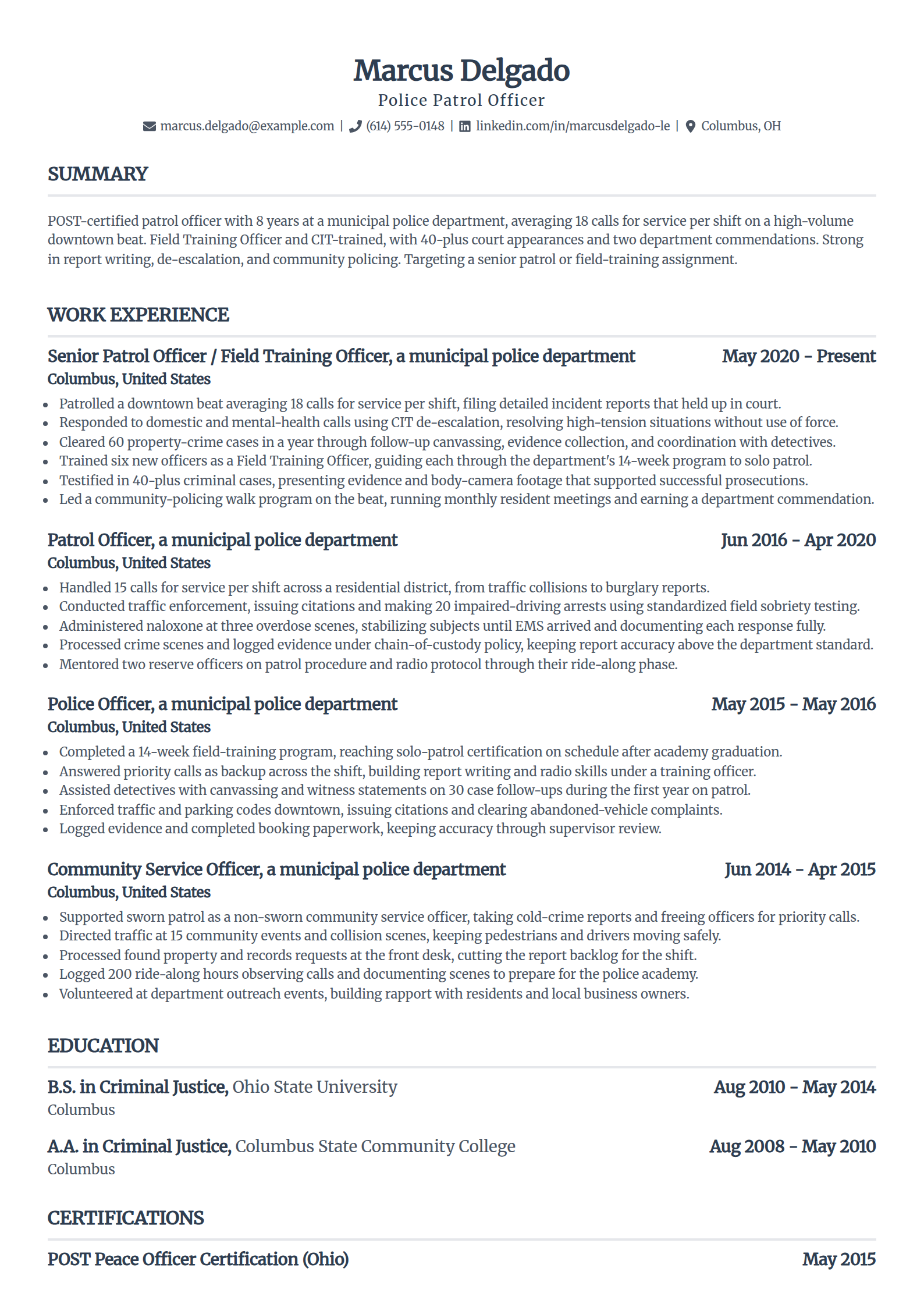
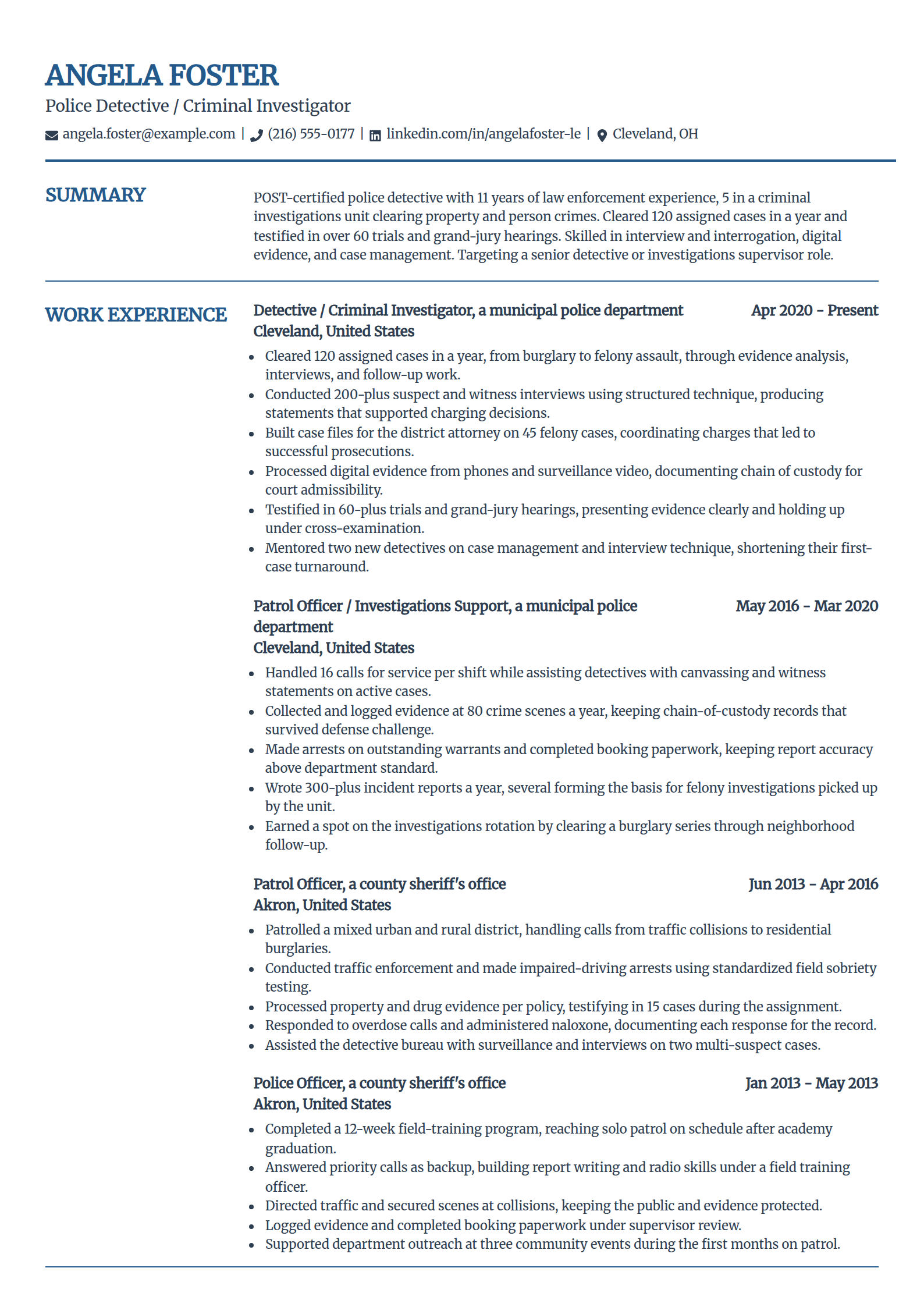
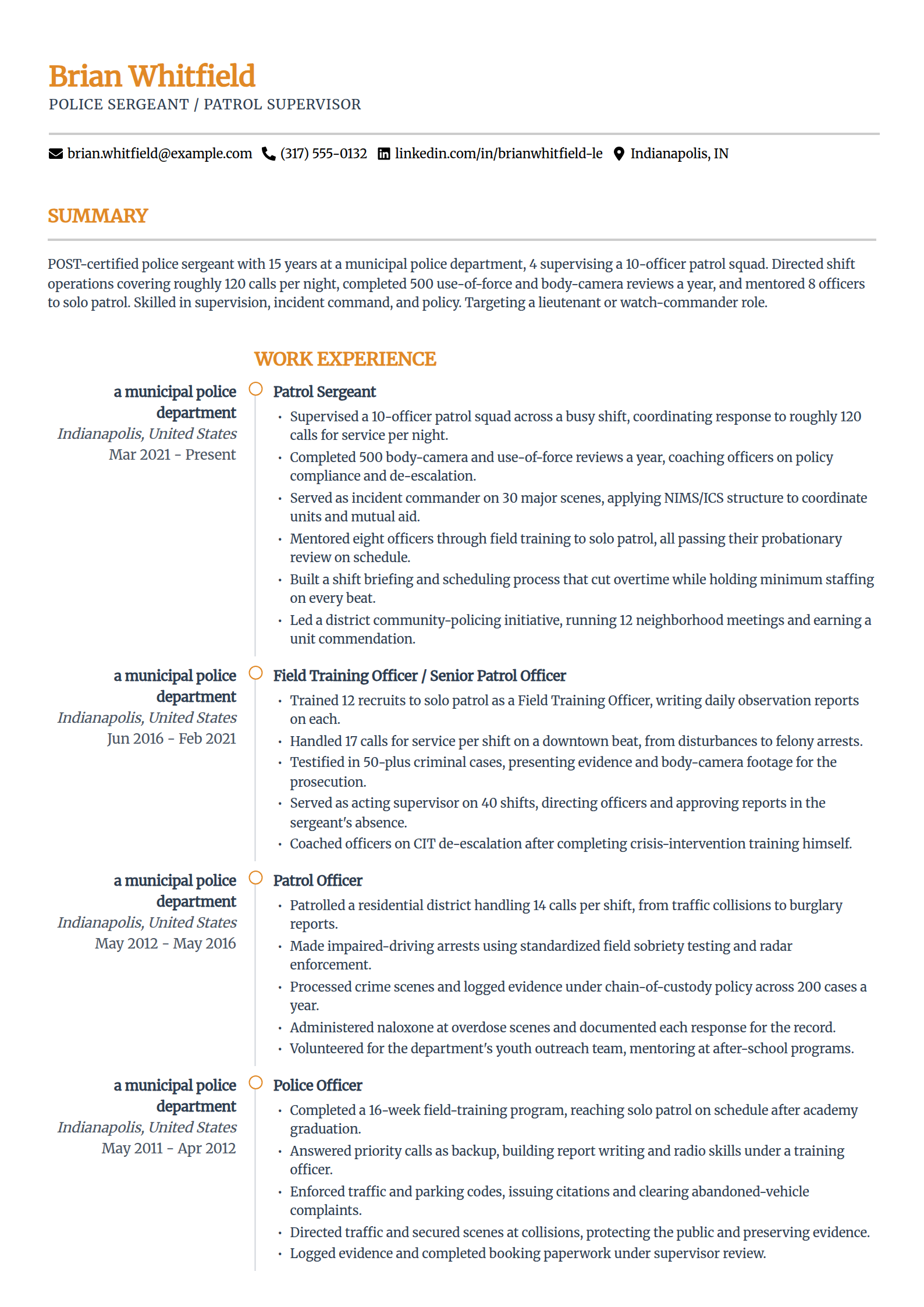
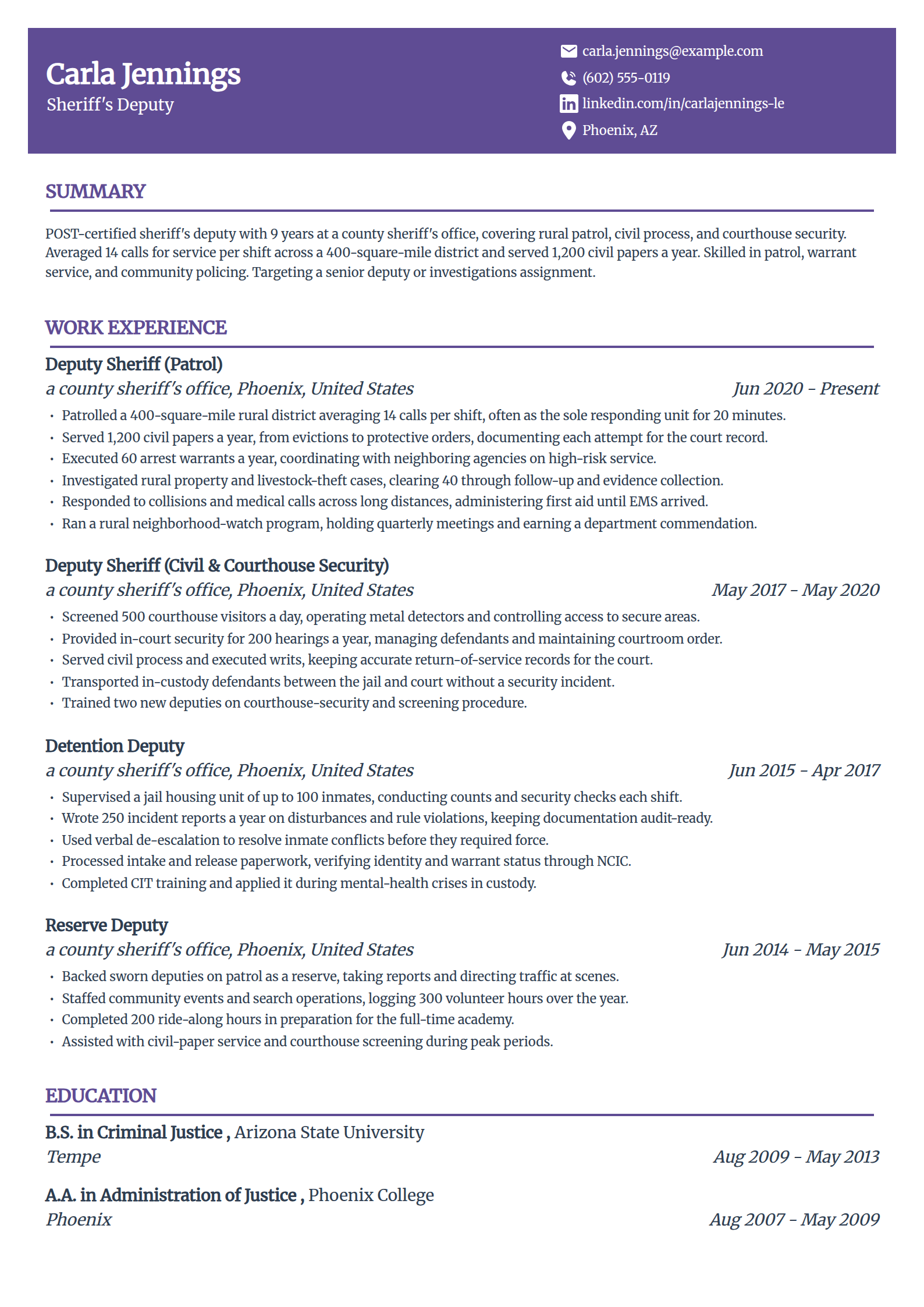
Patrol Officer Resume Template
Why this resume example works?
- Opens with a summary that names 8 years, POST certification, FTO status, and 18 calls for service per shift on a downtown beat.
- Attaches one honest, individual number to most bullets, like 60 property-crime cases cleared or six recruits trained to solo patrol.
- Keeps every metric in scope an officer owns, cases cleared and court appearances, not a fabricated crime-reduction claim.
- Names the credentials a board screens for, POST, CIT, FTO, EVOC, and naloxone, in a dedicated certifications block.
- Uses a clean, single-column layout an applicant tracking system parses without trouble.
Police Detective & Investigator Resume Template
Why this resume example works?
- Leads with investigative output a bureau hires for, 120 cases cleared in a year and 200-plus interviews conducted.
- Shows the court thread that matters, 45 felony case files built for the district attorney and 60-plus trials testified in.
- Names the real skills a posting lists, interview and interrogation, digital evidence, and chain of custody.
- Keeps each result countable and believable for an individual investigator, tied to a specific case type.
- Uses a modern layout that carries a dense 11-year investigations history on one clean page.
Police Sergeant Resume Template
Why this resume example works?
- Opens with supervisory scope, a 10-officer squad and roughly 120 calls per night coordinated across a shift.
- Shows the review work a promotion board rewards, 500 body-camera and use-of-force reviews completed in a year.
- Pairs incident command with people, 30 major scenes run under NIMS/ICS and eight officers mentored to solo patrol.
- Names supervision, NIMS/ICS, FTO, and CIT, the credentials a sergeant-to-lieutenant path screens for.
- Uses a structured layout that fits a 15-year record with a leadership section on one page.
Sheriff's Deputy Resume Template
Why this resume example works?
- Leads with the range a sheriff's office wants, rural patrol, 1,200 civil papers served, and courthouse security.
- Shows breadth across assignments, patrol, civil process, and detention, the way a real deputy career runs.
- Keeps each number in an individual's scope, 60 warrants served or a 100-inmate housing unit supervised.
- Names the credentials a posting lists, POST, detention officer, CIT, and EVOC, in a clear block.
- Uses a spacious two-column layout that carries a nine-year, multi-assignment record on one page.
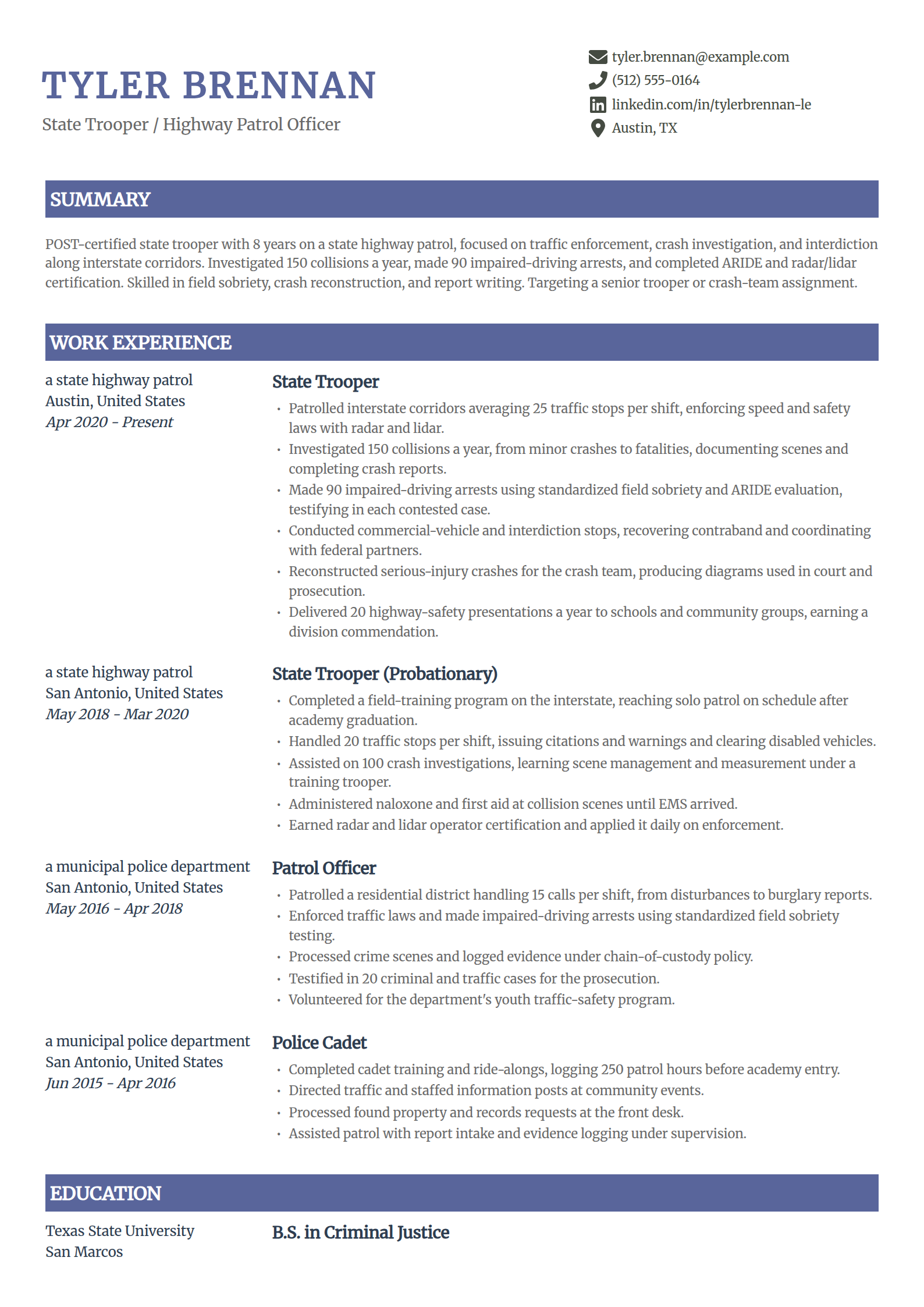
State Trooper & Highway Patrol Resume Template
Why this resume example works?
- Opens with the work a highway patrol hires for, 150 collisions investigated a year and 90 impaired-driving arrests.
- Shows the specialty credentials that set a trooper apart, ARIDE, radar and lidar, and crash investigation.
- Ties each result to a real task, a crash reconstructed for court or a highway-safety talk delivered to schools.
- Keeps every metric factual and individual, traffic stops and arrests, never an invented outcome claim.
- Uses a modern two-column layout that carries a dense traffic-enforcement record on one page.
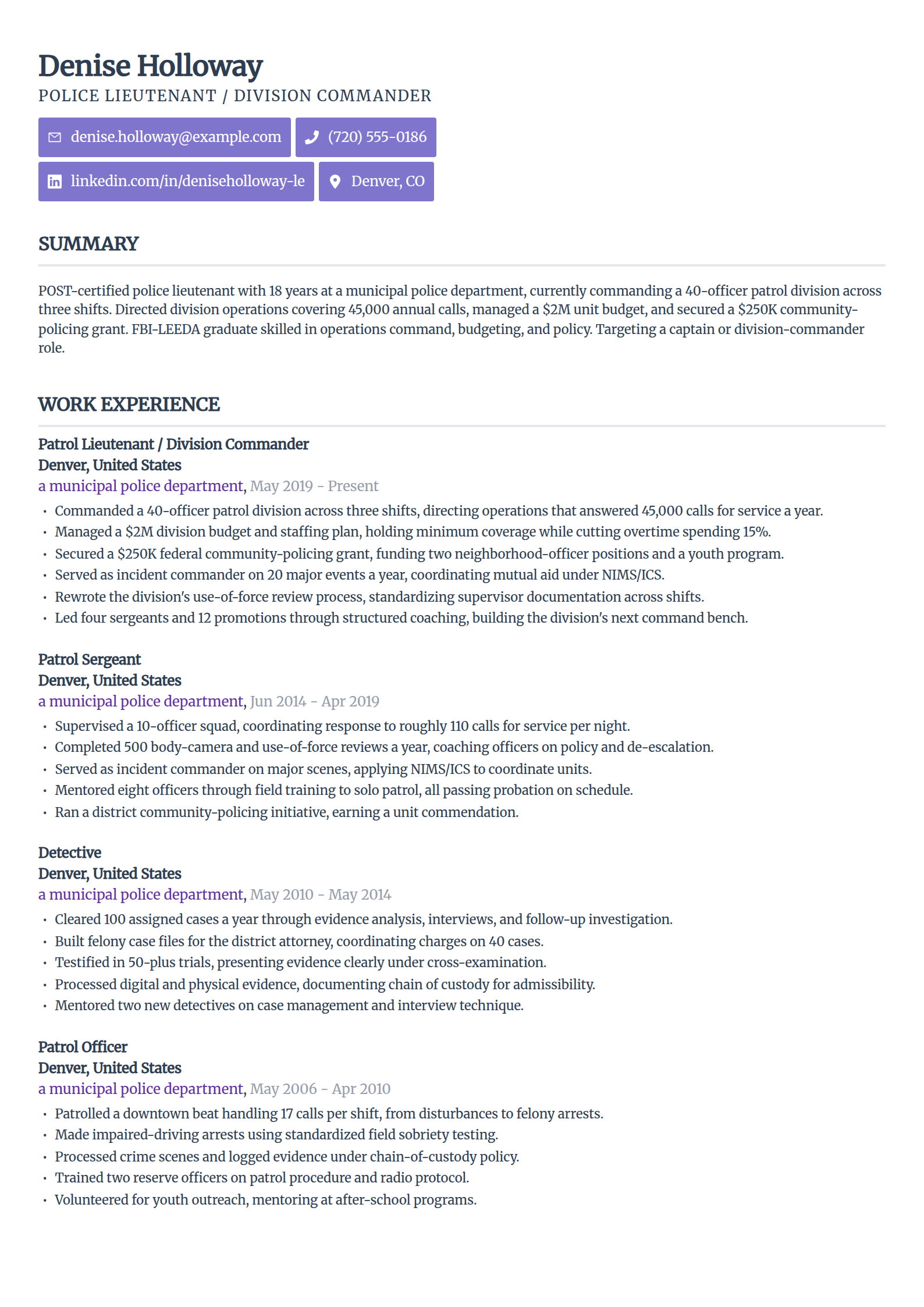
Police Lieutenant & Command Resume Template
Why this resume example works?
- Leads with command scope, a 40-officer division and 45,000 annual calls directed across three shifts.
- Shows the administrative wins a captain board rewards, a $2M budget managed and a $250K grant secured.
- Keeps the record honest, a grant the lieutenant wrote and overtime the division cut, not a citywide claim.
- Names FBI-LEEDA, NIMS/ICS 300-400, and an M.P.A., the credentials a command track screens for.
- Uses a refined layout that fits an 18-year command record cleanly on one page.
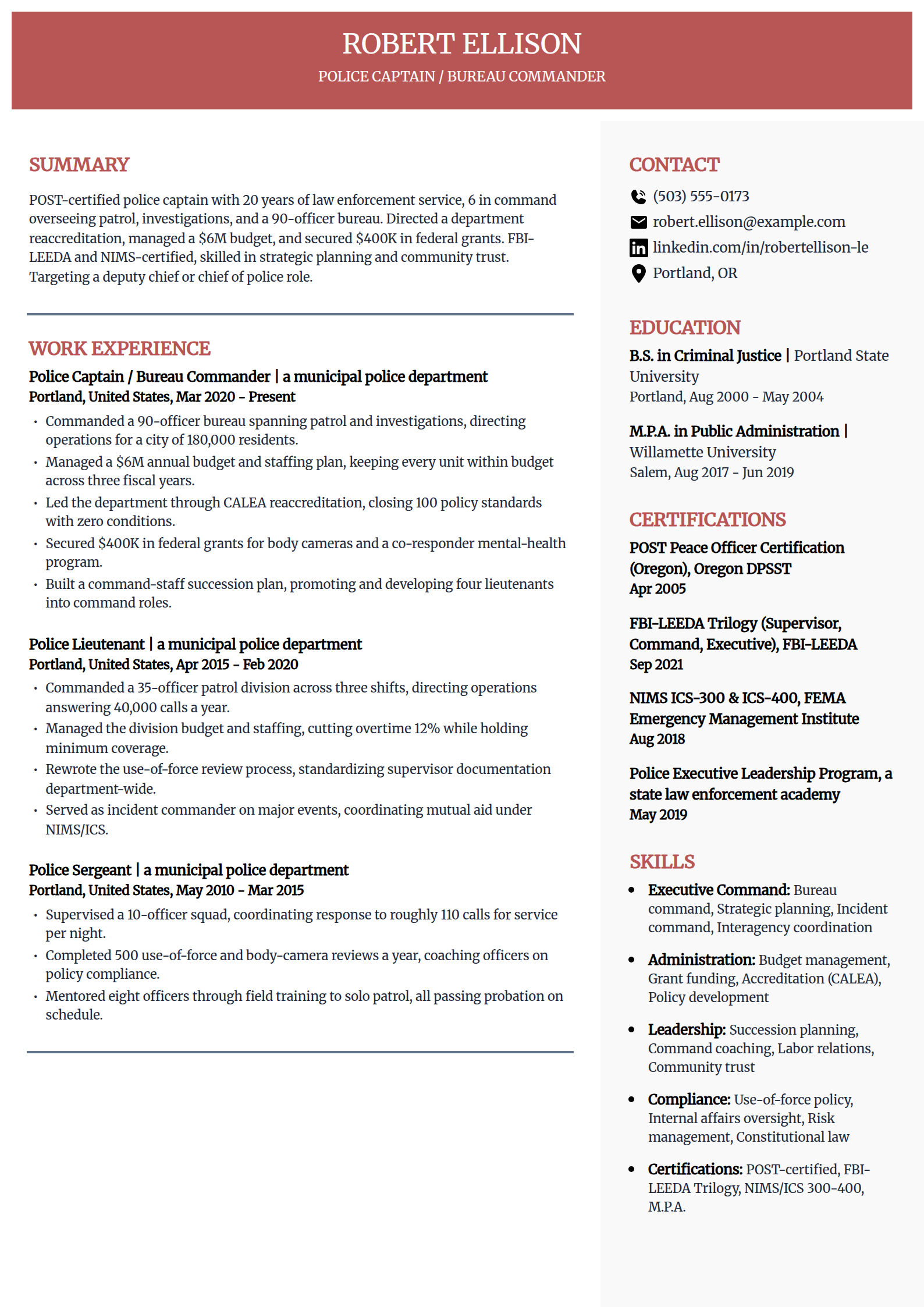
Police Captain & Chief Resume Template
Why this resume example works?
- Opens with executive scope, a 90-officer bureau spanning patrol and investigations directed for a city of 180,000.
- Shows the results a chief search rewards, a CALEA reaccreditation led and $400K in federal grants secured.
- Pairs administration with people, a $6M budget managed and four lieutenants developed into command roles.
- Names FBI-LEEDA Trilogy, NIMS/ICS, and an M.P.A., the credentials an executive posting lists.
- Uses a refined two-column layout that fits a 20-year command record on one page.
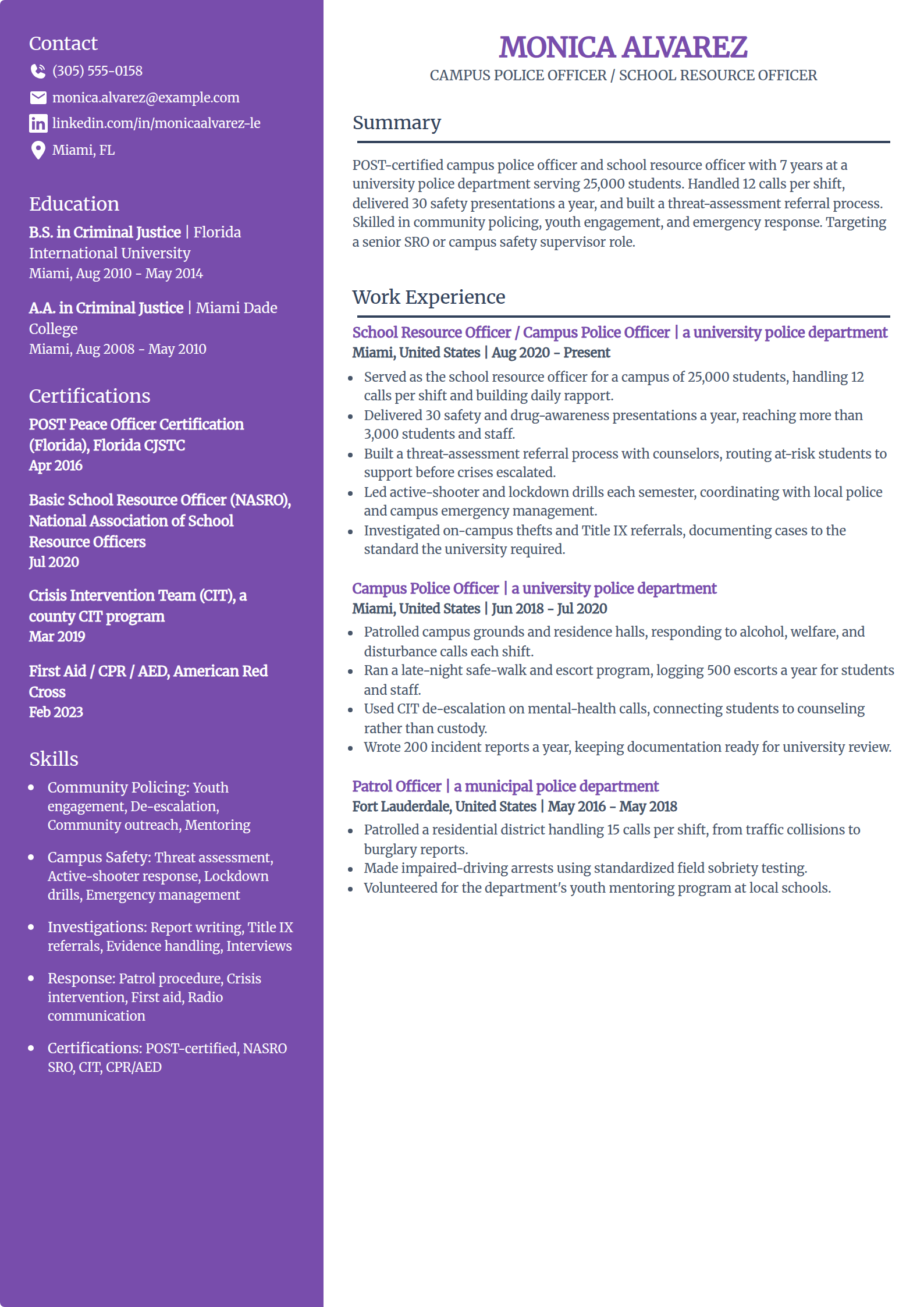
Campus Police & School Resource Officer Resume Template
Why this resume example works?
- Leads with the community work an SRO role hires for, 30 safety presentations a year for a campus of 25,000.
- Shows the prevention thread that matters, a threat-assessment referral process built with counselors.
- Keeps each result in scope, escorts logged and drills led, not an inflated safety-outcome claim.
- Names the credentials a posting lists, POST, NASRO school resource officer, and CIT.
- Uses a Medium layout that fits a seven-year campus record without empty space.
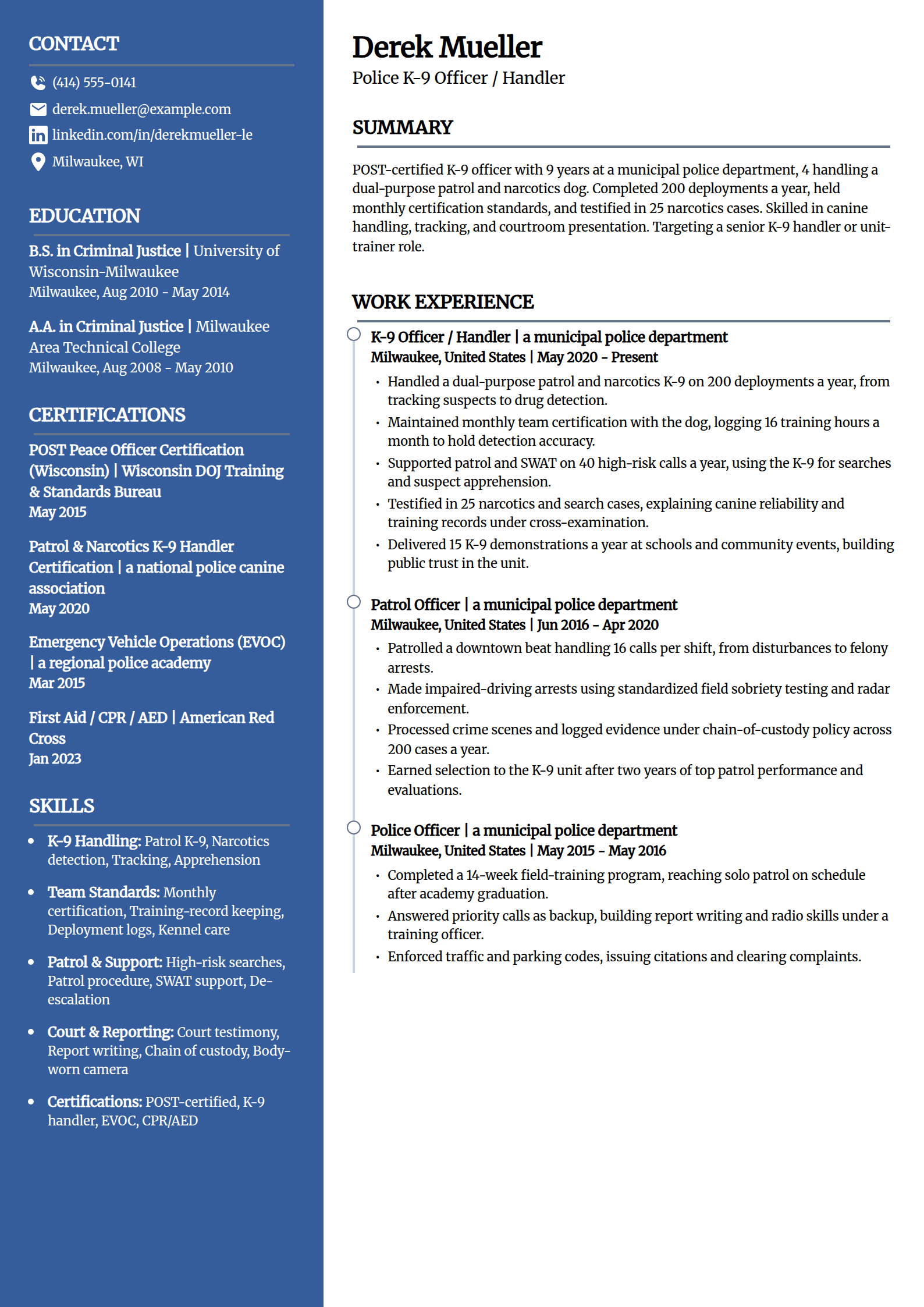
K-9 Officer & Specialized Unit Resume Template
Why this resume example works?
- Opens with unit scope, a dual-purpose patrol and narcotics K-9 handled on 200 deployments a year.
- Shows the discipline a K-9 role screens for, monthly team certification and 16 training hours a month logged.
- Ties results to court, 25 narcotics cases testified in with training records that held up on cross-examination.
- Names K-9 handling, tracking, and detection alongside POST and EVOC certification.
- Uses a distinctive layout that still reads cleanly for a promotion board.
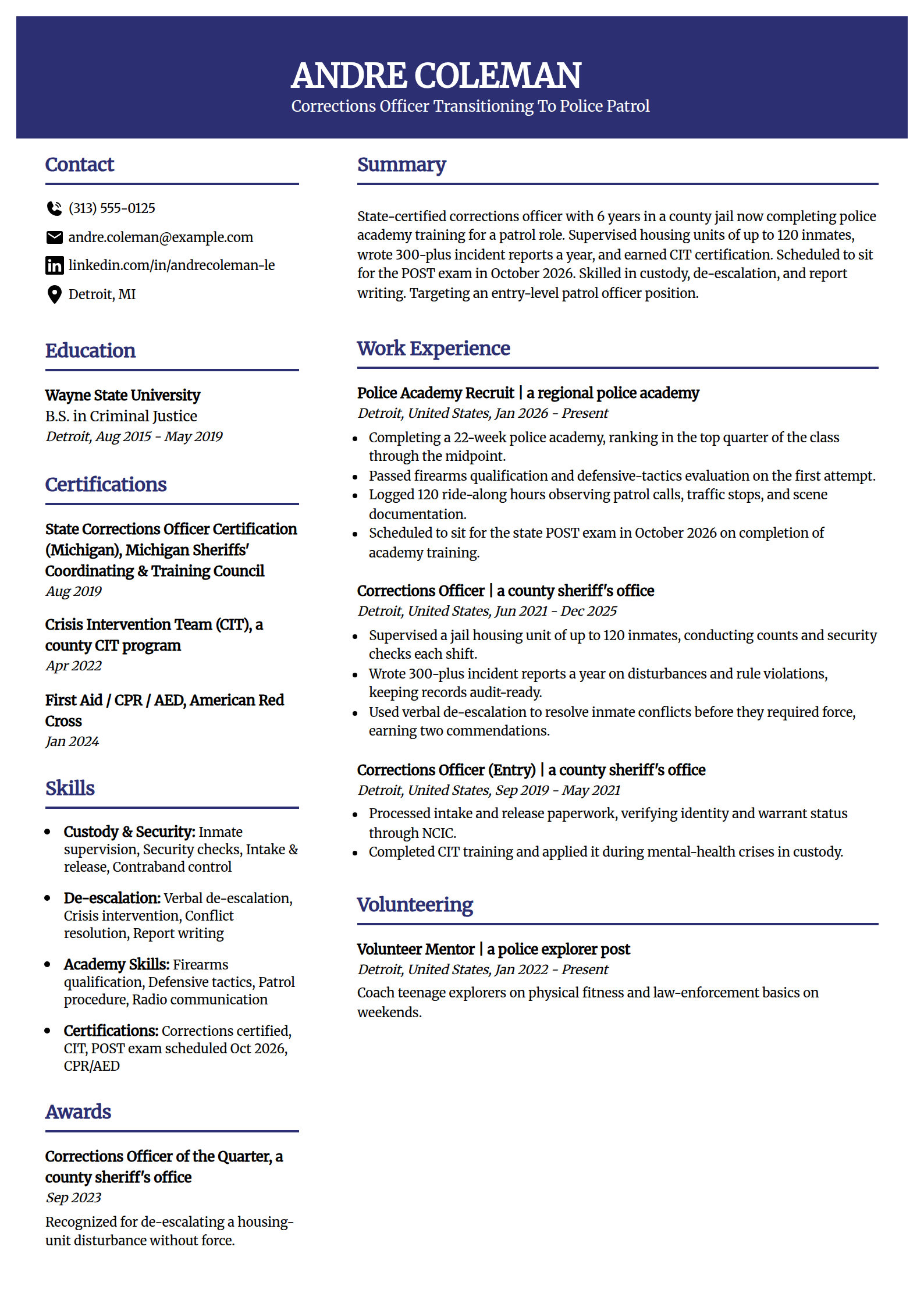
Corrections-to-Patrol Transition Resume Template
Why this resume example works?
- Names the transition openly, six years in corrections now completing academy training for a patrol role.
- Phrases the credential precisely, scheduled to sit for the POST exam in October 2026, never overstated.
- Reframes custody work as an asset, a 120-inmate unit supervised and de-escalation used before force.
- Keeps the academy line honest, firearms and defensive tactics passed and ride-along hours logged.
- Fills a roomy layout with a commendation and an explorer-mentor role so the page looks complete.
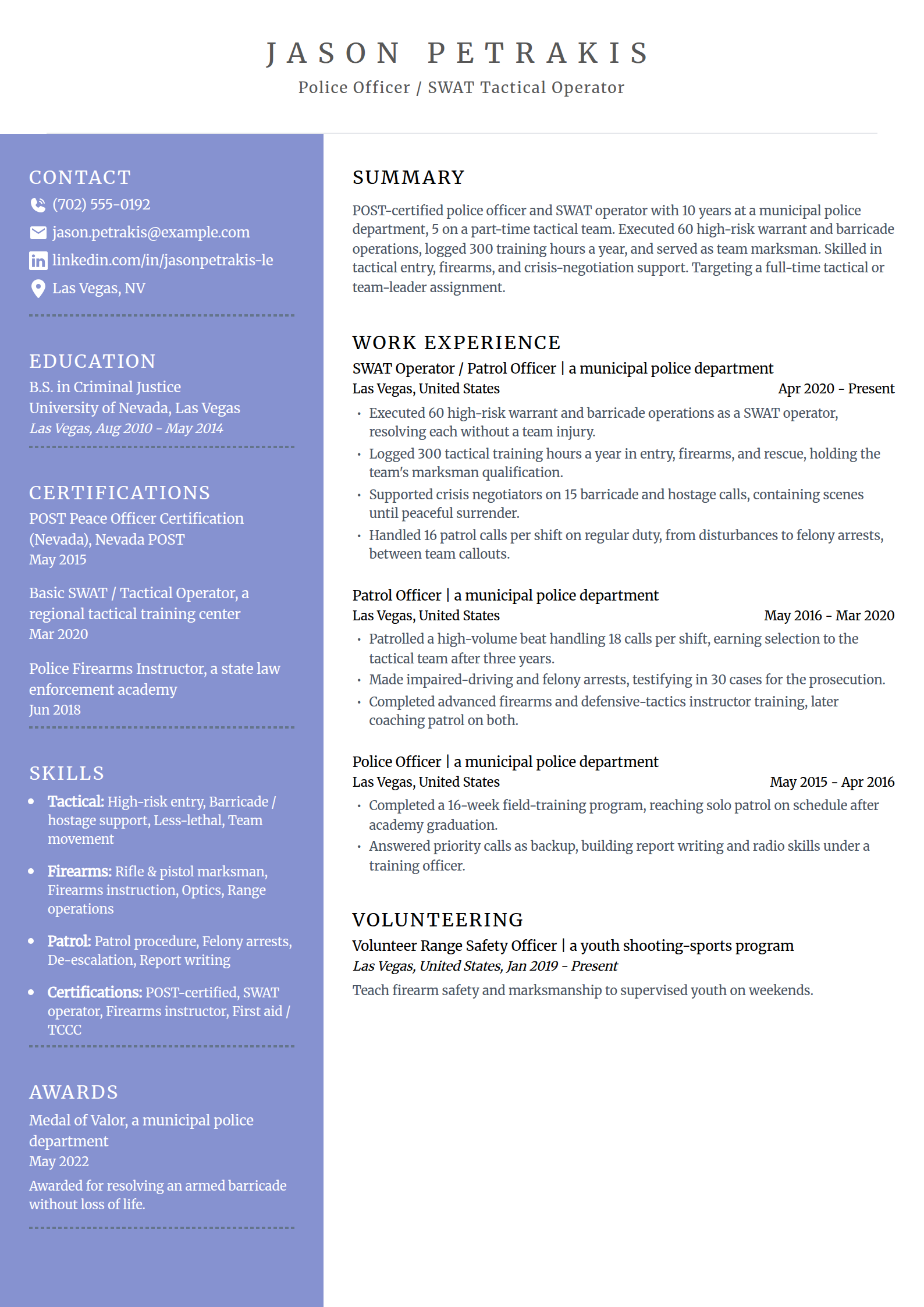
SWAT & Tactical Officer Resume Template
Why this resume example works?
- Leads with tactical scope, 60 high-risk warrant and barricade operations executed without a team injury.
- Shows the discipline a team screens for, 300 training hours a year logged and a marksman qualification held.
- Keeps the patrol foundation visible, 16 calls per shift handled between team callouts.
- Names SWAT operator, firearms instructor, and POST certification in a clear block.
- Fills a roomy layout with a valor award and a range-safety volunteer role so nothing looks thin.
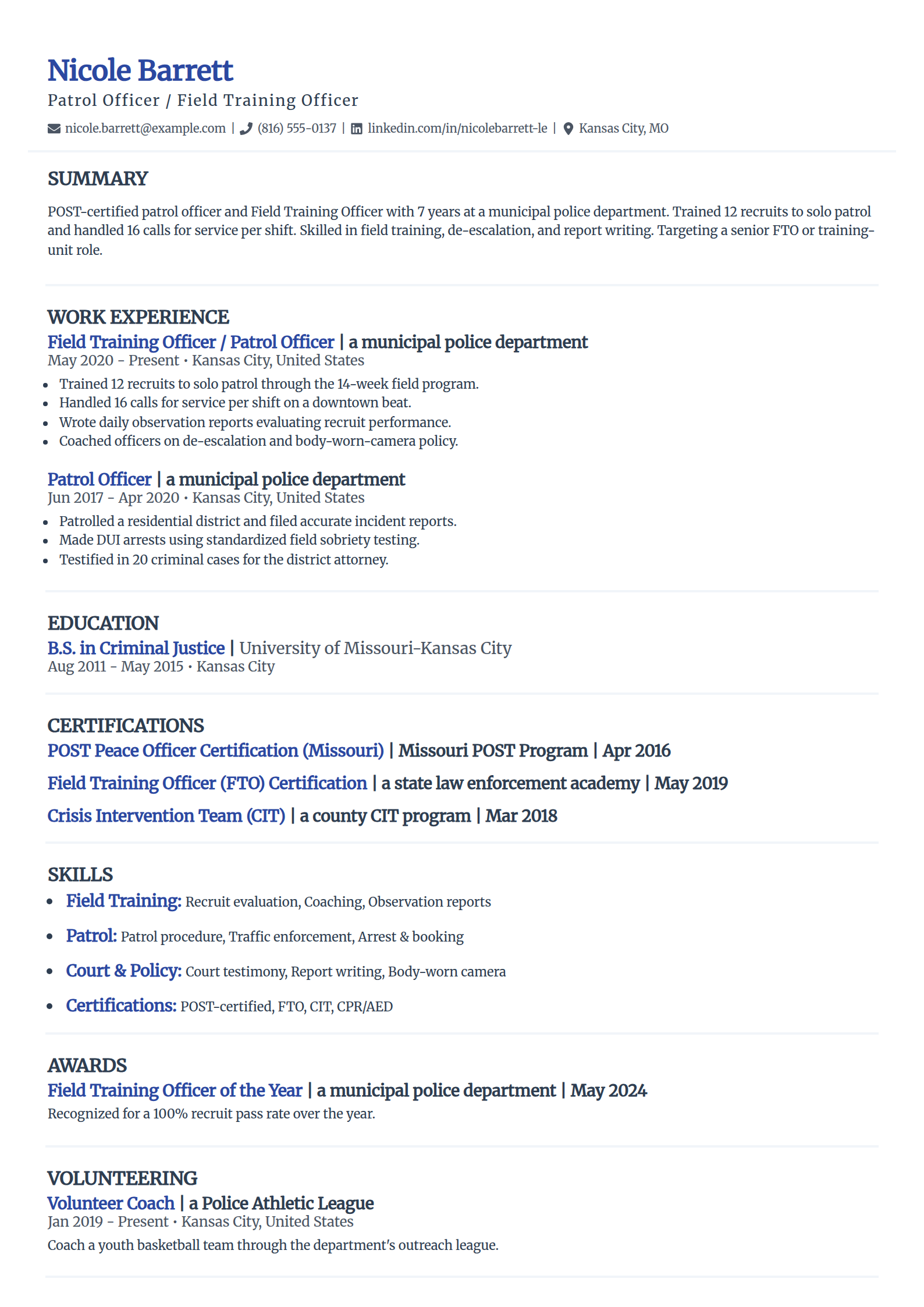
Field Training Officer Resume Template
Why this resume example works?
- Written for an FTO, leading with 12 recruits trained to solo patrol through the field program.
- Keeps a focused seven-year record tight, each bullet carrying one number like 16 calls per shift.
- Names the credentials an FTO posting lists, POST, FTO certification, and CIT.
- Fills a refined, ATS-safe page with an FTO-of-the-year award and a youth-league coaching role.
- Uses a clean layout that keeps the focus on training and reliable patrol work.
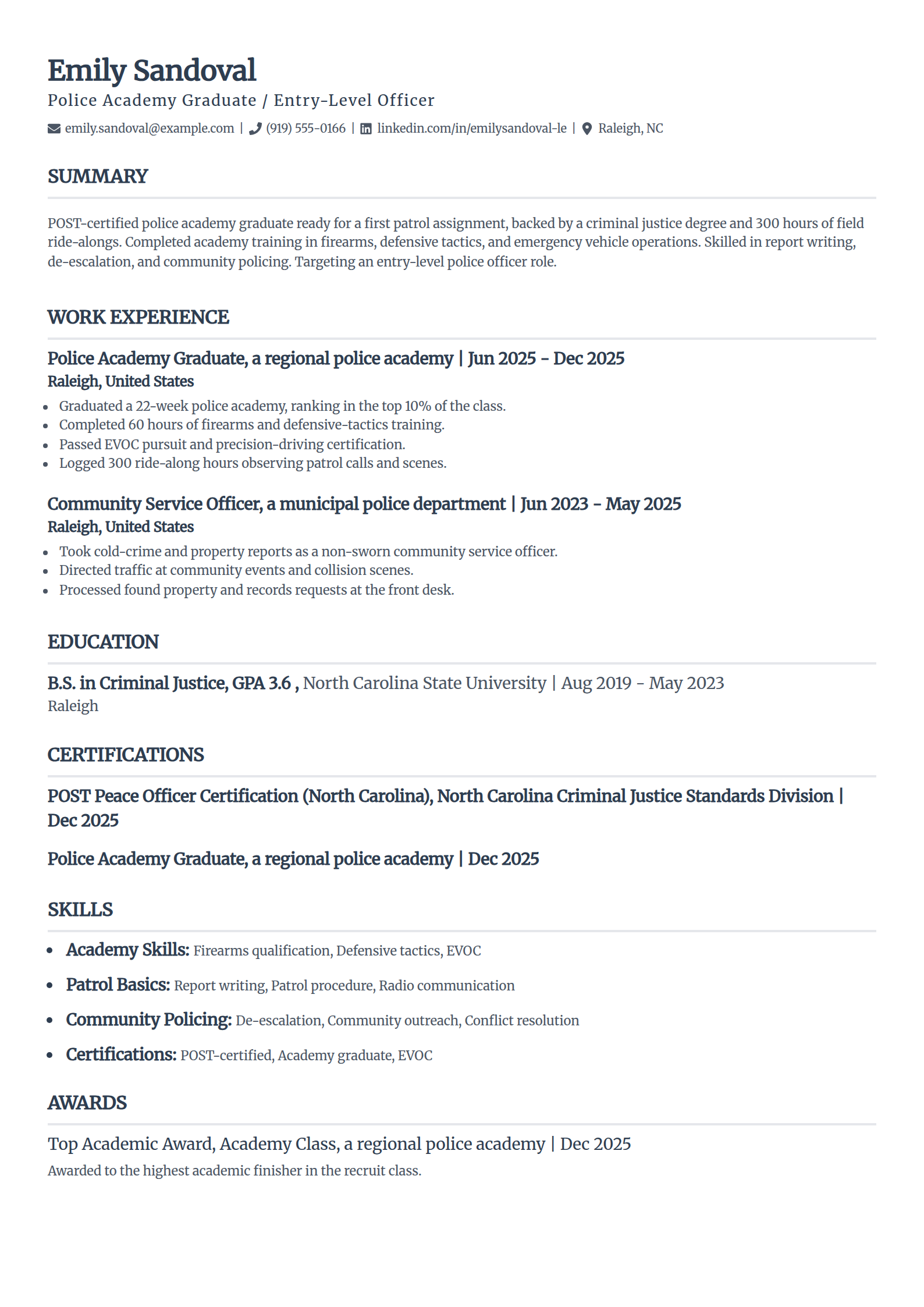
Entry-Level & Academy Graduate Resume Template
Why this resume example works?
- Written for a new academy graduate, leading with POST certification and a criminal justice degree.
- Uses academy training and 300 ride-along hours as entries, the right move before sworn patrol experience.
- Keeps every bullet honest and quantified, firearms hours completed and EVOC certification passed.
- Shows the credentials a first-job screen checks, POST, academy graduation, and CPR/AED.
- Fills a tight, ATS-safe page with a top-academic award and an explorer-advisor role instead of padding.
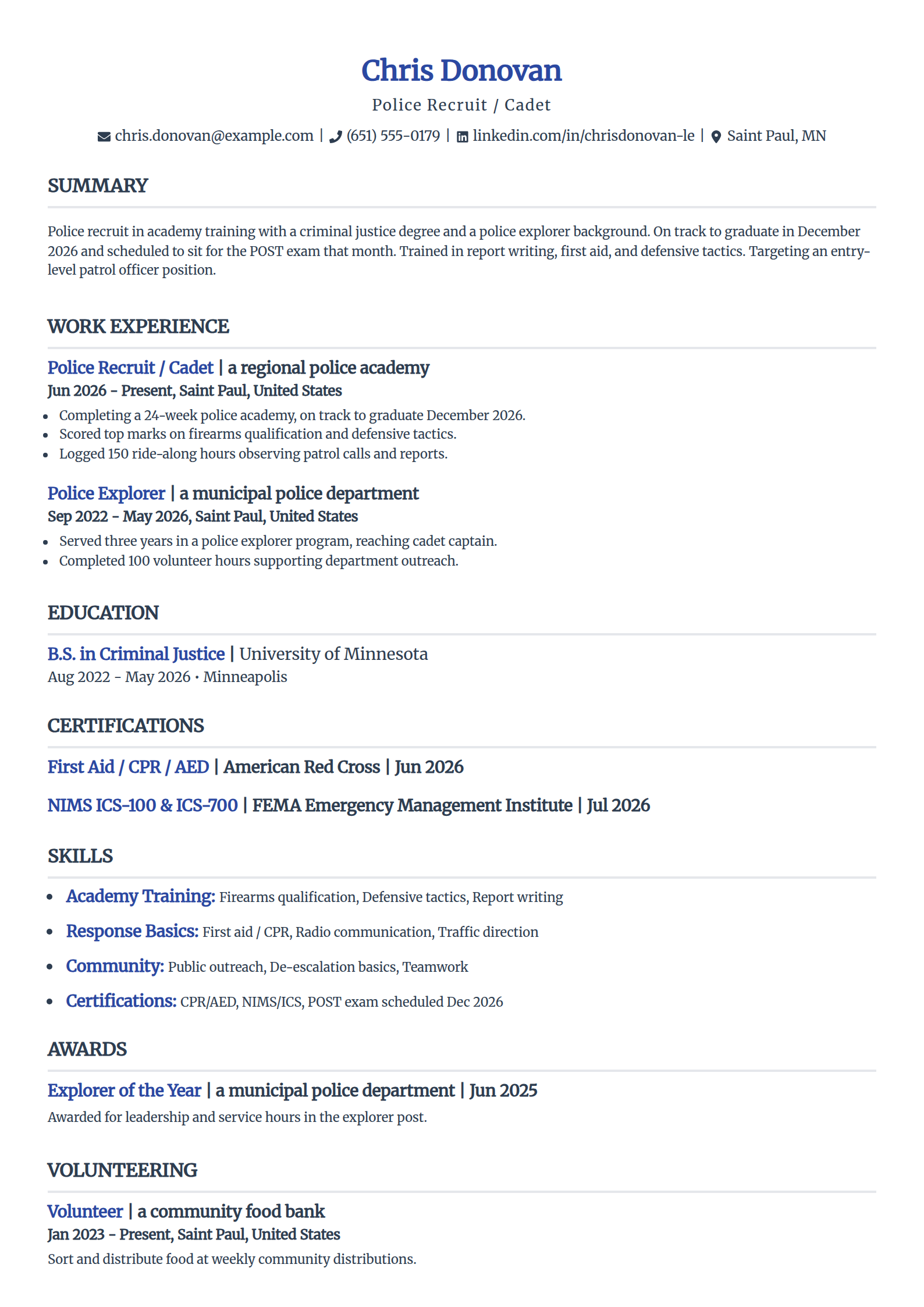
Police Recruit & Cadet Resume Template
Why this resume example works?
- Written for a recruit in training, leading with academy progress and a criminal justice degree.
- Phrases the credential precisely, scheduled to sit for the POST exam in December 2026, not overstated.
- Uses a three-year explorer background and ride-along hours as real entries, not invented jobs.
- Shows the early credentials a screen wants, first aid, CPR/AED, and NIMS/ICS.
- Fills a plain, ATS-safe page with an explorer-of-the-year award and community volunteering.
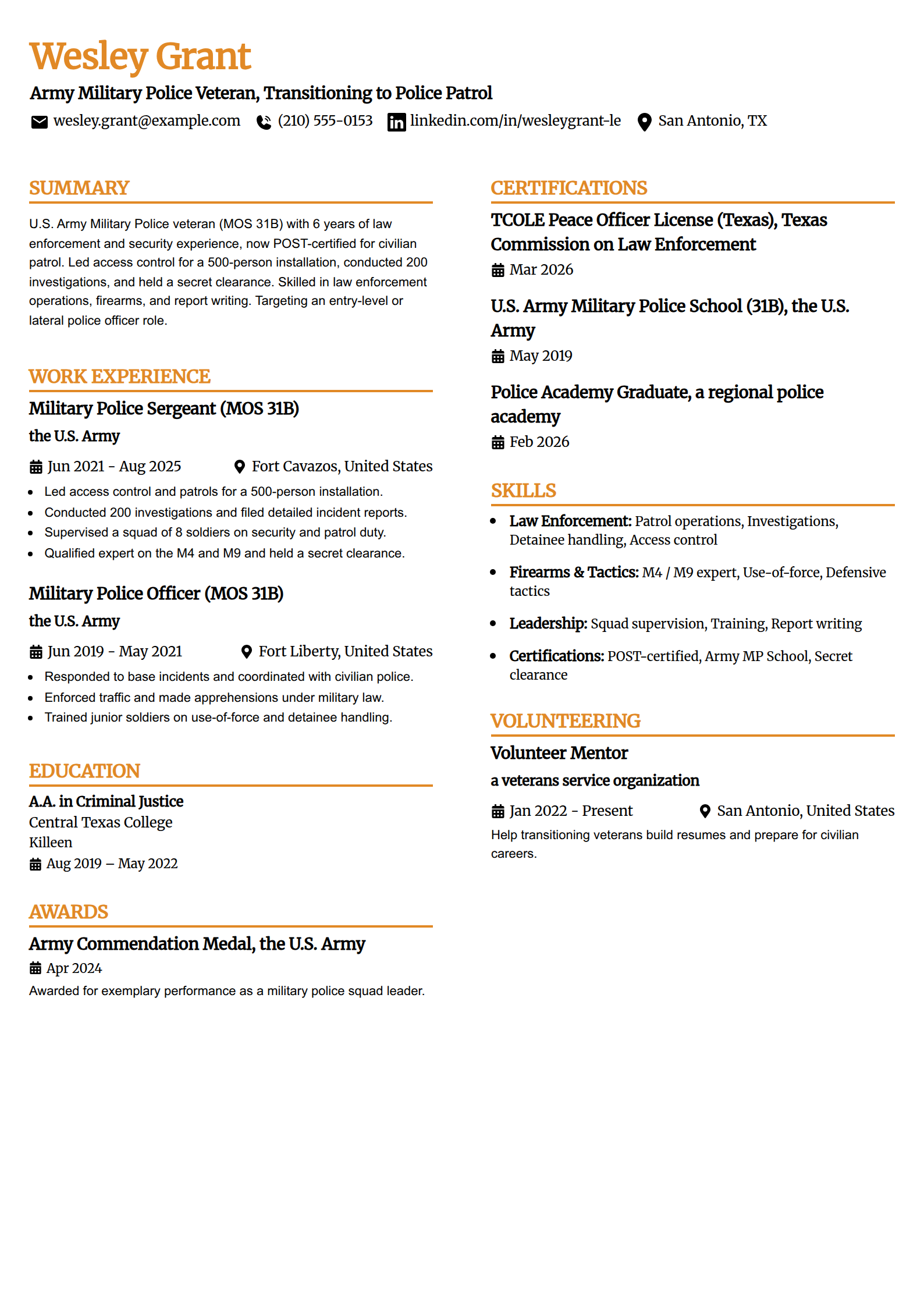
Military-to-Police Transition Resume Template
Why this resume example works?
- Maps the military background honestly, an Army Military Police veteran (MOS 31B) with six years of service.
- Shows transferable law enforcement work, a 500-person installation secured and 200 investigations conducted.
- Keeps the civilian credential precise, POST-certified and a police academy graduate for a lateral role.
- Names the assets a board values, firearms expert qualification and a held secret clearance.
- Fills a tight page with an Army Commendation Medal and a veterans-mentor volunteer role.
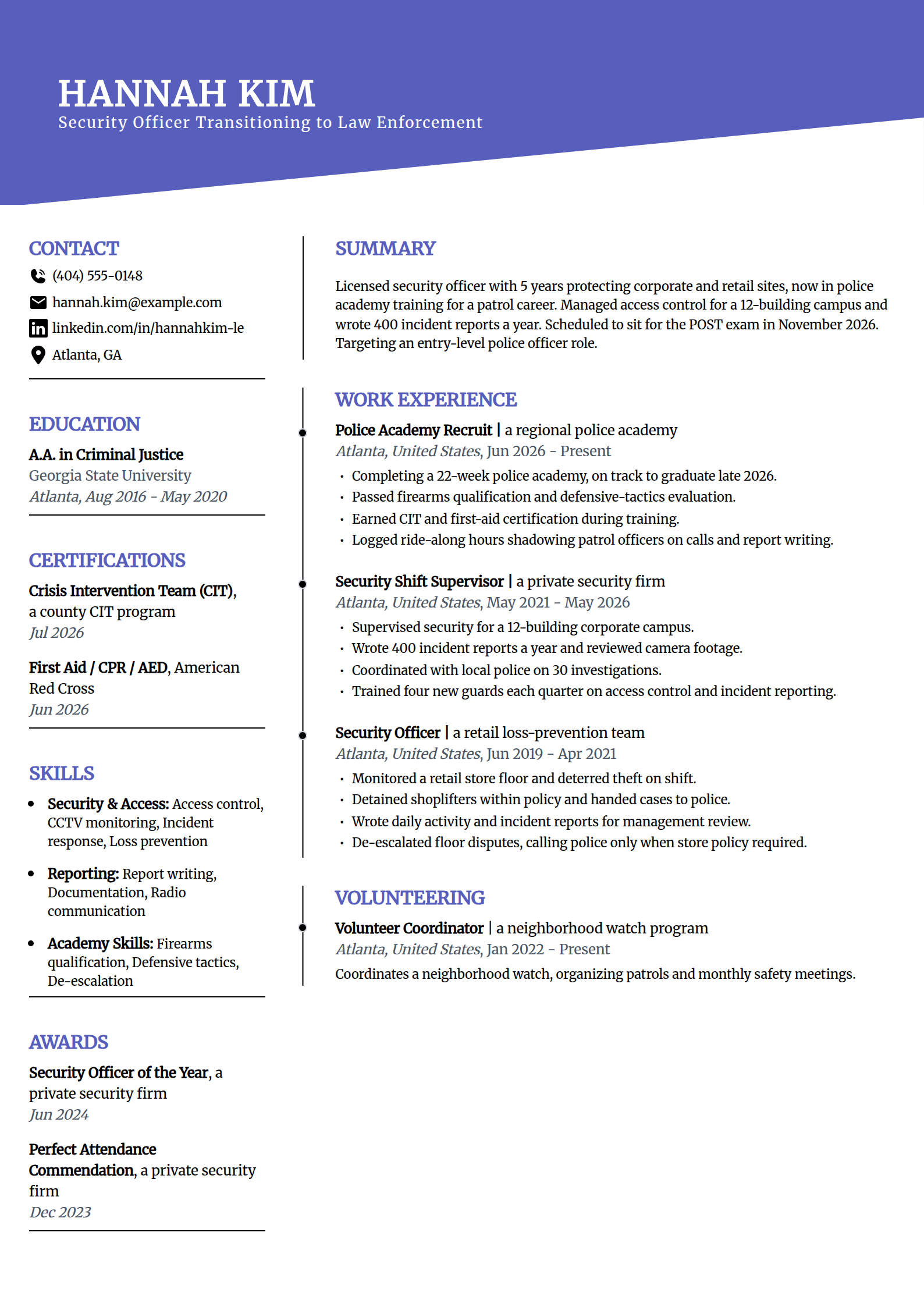
Security-to-Law-Enforcement Resume Template
Why this resume example works?
- Names the pivot openly, five years in security now completing academy training for a patrol career.
- Reframes prior work as relevant, a 12-building campus secured and 400 incident reports written a year.
- Phrases the credential precisely, scheduled to sit for the POST exam in November 2026.
- Keeps new skills concrete, firearms qualification, defensive tactics, and CIT earned in training.
- Lists awards without long descriptions, keeping the Orbit layout clean and balanced.
Build your police officer resume
Pick a template above and the editor keeps your layout clean and ATS-safe while you swap in your own assignments, certifications, and metrics.
Build my resumeHow to write a police officer resume in 2026
A law enforcement resume gets read by a hiring board checking two things: are you certified and trained for the job, and can you prove what you have done on shift. Put your POST status and academy graduation up top, then make every bullet an activity you can stand behind with a number. Keep the format clean so a parser reads it as easily as a person does.
Open with a certification-first summary
Write three to four sentences that name your POST status and years, your assignment, your strongest activity metric, and the rank or role you are targeting. An experienced officer leads with calls handled and cases cleared; an academy graduate leads with training and POST certification. Keep it to about 60 words so it never spills past the top of the page.
POST-certified patrol officer with 8 years at a municipal police department, averaging 18 calls for service per shift on a downtown beat. Field Training Officer and CIT-trained, with 40-plus court appearances. Targeting a senior patrol or field-training assignment.
Make every experience bullet an activity you can own
Name what you did, how, and the result, then attach one credible number in your own scope. This is what separates a resume that earns an interview from a duty list.
- Use activity metrics an officer owns: calls for service handled, cases cleared, reports filed, arrests or citations, recruits mentored, court appearances.
- Open with a strong verb like patrolled, investigated, cleared, trained, or testified, never "Responsible for" or "Duties included".
- Name the method: "cleared 60 property-crime cases through follow-up canvassing and evidence collection".
- Never claim a citywide outcome like a crime-rate drop. That is not an individual's number, and a board reads it as inflated.
Put POST, academy, and certifications where a board looks first
The certification spine is the center of a law enforcement resume, so give it a dedicated section near the top and keep the phrasing precise.
- List POST certification with the state and board, and show academy graduation as its own line.
- Add the specialty credentials a posting names: FTO, CIT, EVOC, ARIDE, radar/lidar, firearms, naloxone, and NIMS/ICS.
- If you are still testing, write "scheduled to sit for the POST exam in <month>", never "currently sitting for".
- Career-changers and academy graduates lead with training and credentials, since sworn experience is limited or new.
Match skills and keywords to the posting
A skills block should read like the job announcement, grouped so a board member and a parser both find what they need. List what you have actually done, not a generic dump.
- Group by type: patrol and enforcement, investigations, community policing, court and policy, certifications, and systems.
- Name specific systems: CAD dispatch, RMS records, and NCIC/LEADS, matched to the role.
- Mirror the announcement's exact phrasing where it fits, since that is what the applicant tracking system searches for.
- For a transition, name the transferable skills honestly (custody, security, military police) without claiming sworn years.
Keep the format clean and ATS-safe
A law enforcement resume is read by a parser first and a person second, so a clean layout with standard headings is the safe choice at every rank.
- Use a single-column or simple two-column layout with standard headings a parser recognizes; skip heavy graphics and photos.
- Most officers fit one page; use a second only when a command record genuinely needs it.
- Save as a PDF so the formatting holds, then run it through the ATS resume checker for a quick format pass.
- Swap the numbers in the templates above for your own assignments, credentials, and metrics; do not copy them as is.
Common police officer resume mistakes
- Burying your POST status and academy graduation. Put them in a certifications block near the top, with the state and board named.
- Writing a duty list instead of activities. Replace "patrolled assigned area" with "handled 18 calls for service per shift and cleared 60 property-crime cases".
- Claiming outcomes you cannot own. "Reduced city crime 30%" is not an individual's number and reads as inflated; use calls handled, cases cleared, and arrests instead.
- Vague credential phrasing. Write "POST-certified" or "scheduled to sit for the POST exam in October", never "currently sitting for".
- Inflammatory or graphic detail. Keep every bullet factual and professional; a hiring board wants judgment, not war stories.
Frequently asked questions
How do you write a police officer resume?
Lead with a three-to-four-sentence summary that names your POST status, your years and assignment, your strongest activity metric, and the rank you are targeting. Put your certifications, POST and academy graduation first, in a dedicated block near the top. Under each assignment, write activity-first bullets that open with a strong verb and carry one credible number, like handling 18 calls for service per shift or clearing 60 property-crime cases. Keep the whole thing to one clean, ATS-safe page for most ranks.
What should a police officer resume include?
A certification-first summary, a certifications block with POST and academy graduation up top, experience bullets with individual-scope numbers, a grouped skills block, and your criminal justice education. Name the specialty credentials a posting screens for, FTO, CIT, EVOC, ARIDE, radar/lidar, firearms, naloxone, and NIMS/ICS, wherever you hold them. Keep every metric to something an officer owns, calls handled, cases cleared, reports filed, recruits mentored, and court testimony, never a citywide crime-rate claim.
How do you write a police resume with no experience?
Lead with your training and credentials. An academy graduate leads with POST certification, academy graduation, firearms and EVOC training, a criminal justice degree, and ride-along hours. A recruit still in the academy writes "scheduled to sit for the POST exam in <month>" and shows explorer or cadet experience and any first-aid and NIMS/ICS certifications. Military and security career-changers reframe prior public-safety work honestly, custody, access control, or military police duty, without inventing sworn-officer years. The academy graduate, recruit, and transition examples above show the shape.
What skills and keywords do police officer resumes need?
Match the announcement, then group specific skills: patrol and enforcement (patrol procedure, traffic enforcement, field sobriety), investigations (report writing, evidence collection, interviews), community policing (de-escalation, crisis intervention), and court and policy (court testimony, body-worn camera, use-of-force policy). Name the systems a role uses, CAD dispatch, RMS records, and NCIC/LEADS, and the certifications you hold. Mirror the posting's exact phrasing where it fits, since that is what the applicant tracking system searches for.
How long should a police officer resume be?
One page for most officers, including recruits, academy graduates, and experienced patrol officers. Use a second page only when a sergeant, lieutenant, or captain has enough supervision, command, and budget experience to justify it, and never pad to reach it. Whichever length you use, lead with your certifications and most recent assignment, keep standard headings, and cut older or unrelated work so the space goes to what matches the role you want.
Do you put POST certification on a police resume, and where?
Yes. POST (Peace Officer Standards and Training) certification is the first thing a law enforcement board checks, so give it a dedicated certifications block near the top with the state and certifying board named, plus the year. Show academy graduation on its own line right beside it. If you have not tested yet, write "scheduled to sit for the POST exam in <month>", never "currently sitting for". Add your specialty credentials, FTO, CIT, EVOC, ARIDE, and NIMS/ICS, in the same block so a screener sees your full training at a glance.
More police officer resume resources
Build your police officer resume
Pick a template above and the editor keeps your layout clean and ATS-safe while you swap in your own assignments, certifications, and metrics.