Firefighter Resume Templates and Examples, Certifications First
- ATS Friendly
- Certifications First
- 16 Real Examples
Fire departments screen for one thing before anything else: your certifications. Start from a template below, then model your own on a real example built for your track, from an academy recruit with a fresh EMT card to a captain running a company. Every example puts Firefighter I and II, EMT, and CPAT where a hiring officer reads them first.


540k+ resumes created
Editable firefighter resume templates
Each template below is a real firefighter resume laid out in that format, sorted by rank and specialty across suppression, EMS, apparatus, wildland, and prevention. Choose one, then swap in your own certifications, call volume, and station work. Every layout keeps your name, contact line, and a prominent certifications section clean so a hiring officer finds your credentials fast and an applicant tracking system parses them without trouble.
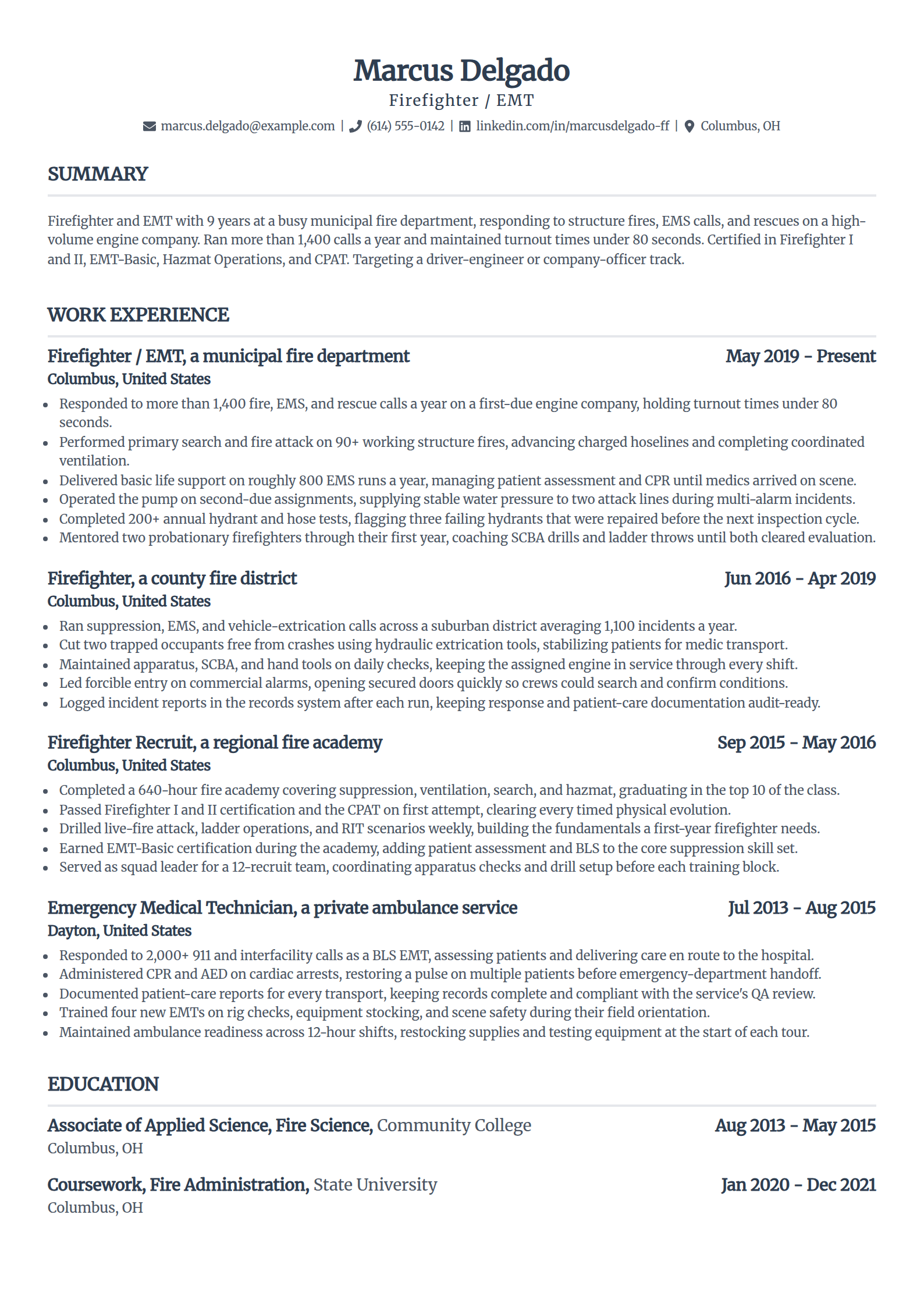
Experienced Firefighter Resume Template
Why this resume example works?
- Opens with a summary that names 9 years, 1,400+ calls a year, and turnout times under 80 seconds on a busy engine company.
- Uses a clean, single-column layout that an applicant tracking system and a conservative fire department both parse cleanly.
- Leads each bullet with a strong verb and one credible number, like 90+ working structure fires or 200+ hydrant and hose tests.
- Puts Firefighter I and II, EMT-Basic, Hazmat Operations, and CPAT in a certifications block a hiring officer reads first.
- Balances suppression, EMS, and apparatus work so the resume reads as a well-rounded firefighter ready to promote.
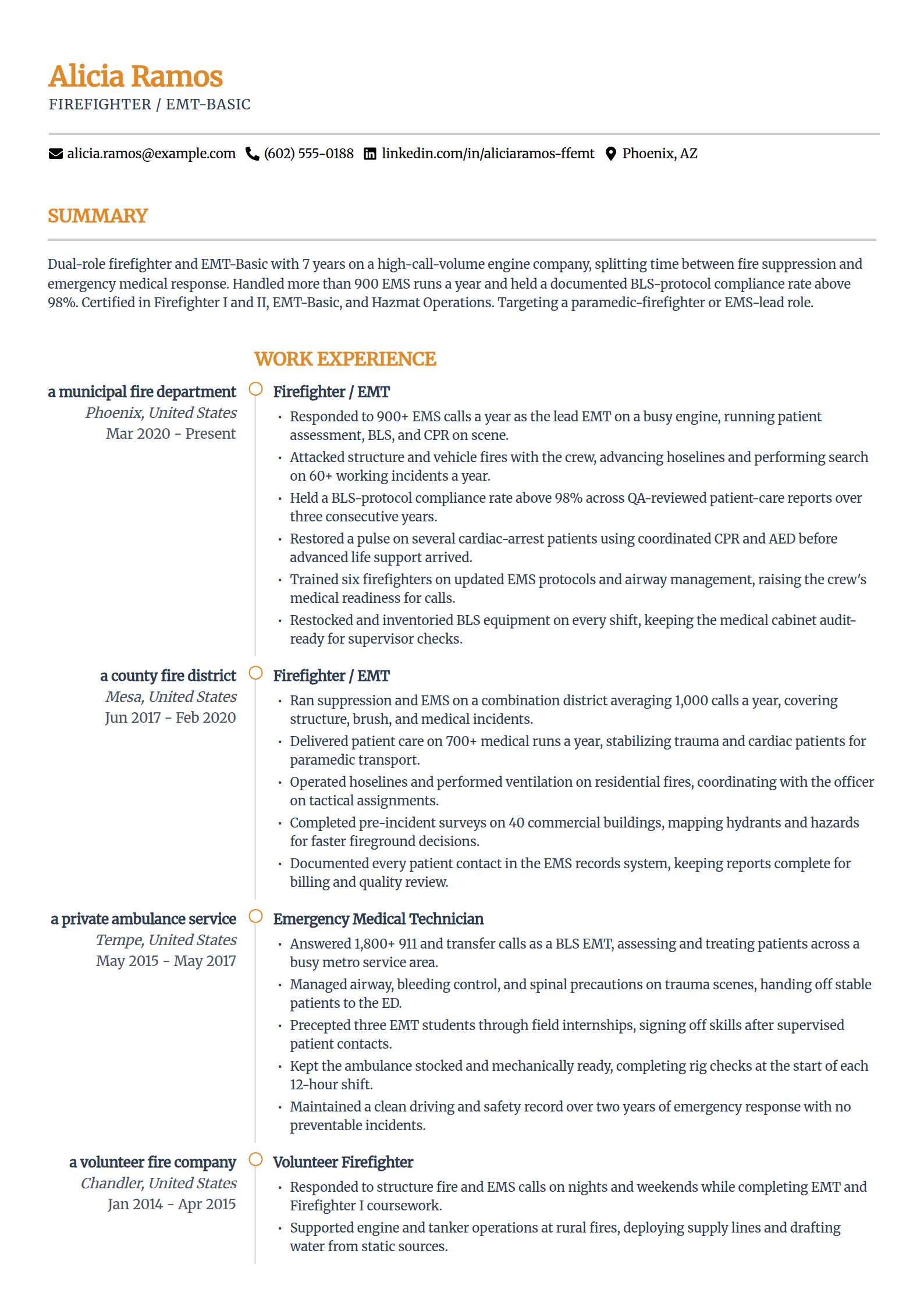
EMT-Firefighter Resume Template
Why this resume example works?
- Frames a dual-role firefighter and EMT-Basic who runs 900+ EMS calls a year alongside fire suppression.
- Leads the medical story with real proof, a BLS-protocol compliance rate above 98% across QA-reviewed reports.
- Keeps each bullet concrete, like restoring a pulse with CPR and AED or training six firefighters on EMS protocols.
- Puts EMT-Basic, Firefighter I and II, and Hazmat Operations up front where a department screens for medical scope.
- Uses a modern one-page layout that carries a dense fire-and-EMS record without crowding.
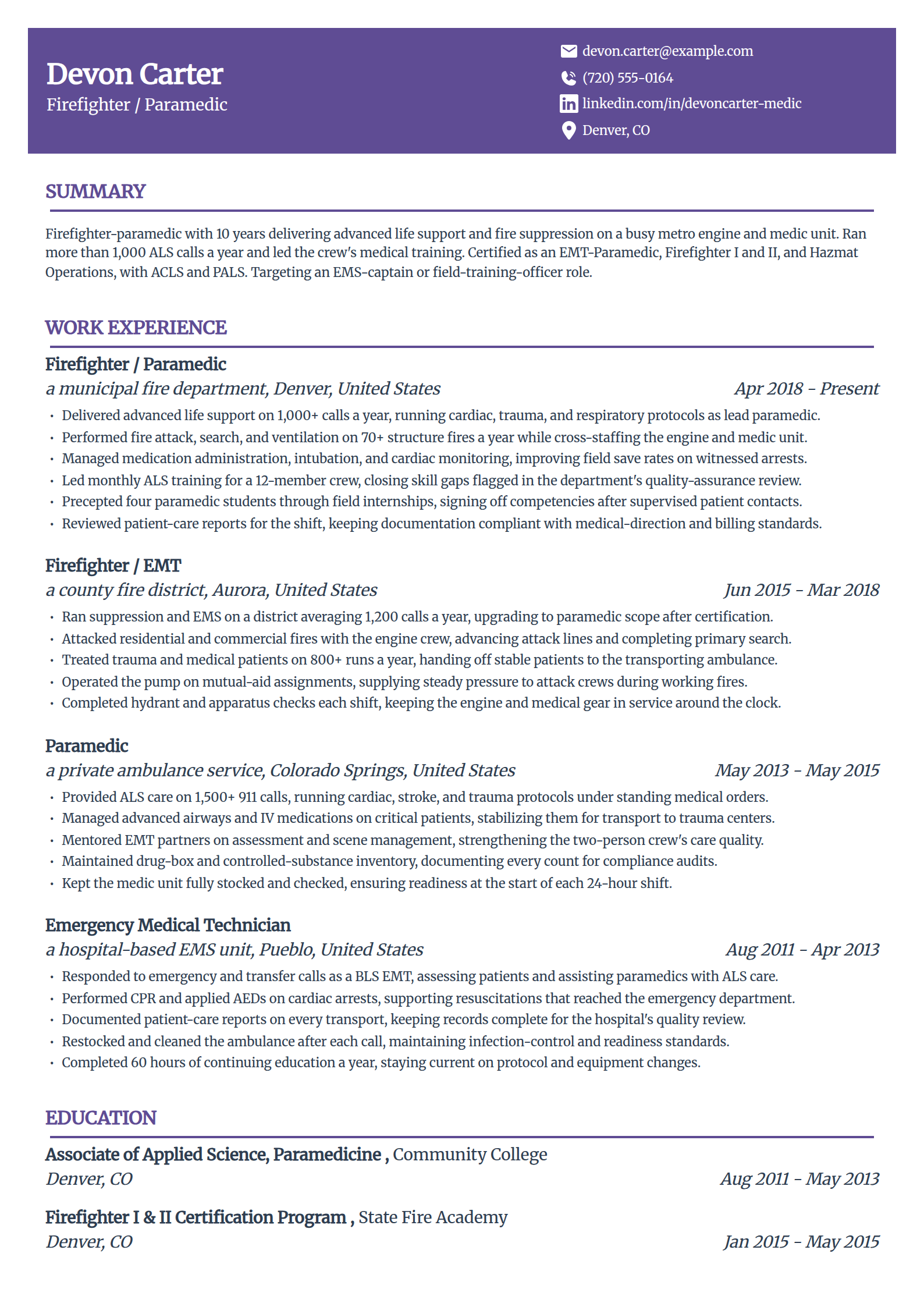
Firefighter-Paramedic Resume Template
Why this resume example works?
- Leads with paramedic scope, 1,000+ ALS calls a year plus fire attack and search on 70+ structure fires.
- Shows the advanced skills a medic posting lists, cardiac monitoring, intubation, and IV medications under standing orders.
- Backs the work with EMT-Paramedic, ACLS, and PALS alongside Firefighter I and II, a credential set that carries the role.
- Keeps each result modest and believable, one number per bullet, so the seniority reads as earned.
- Uses a clean, modern layout that fits a deep fire-and-medic history on one page.
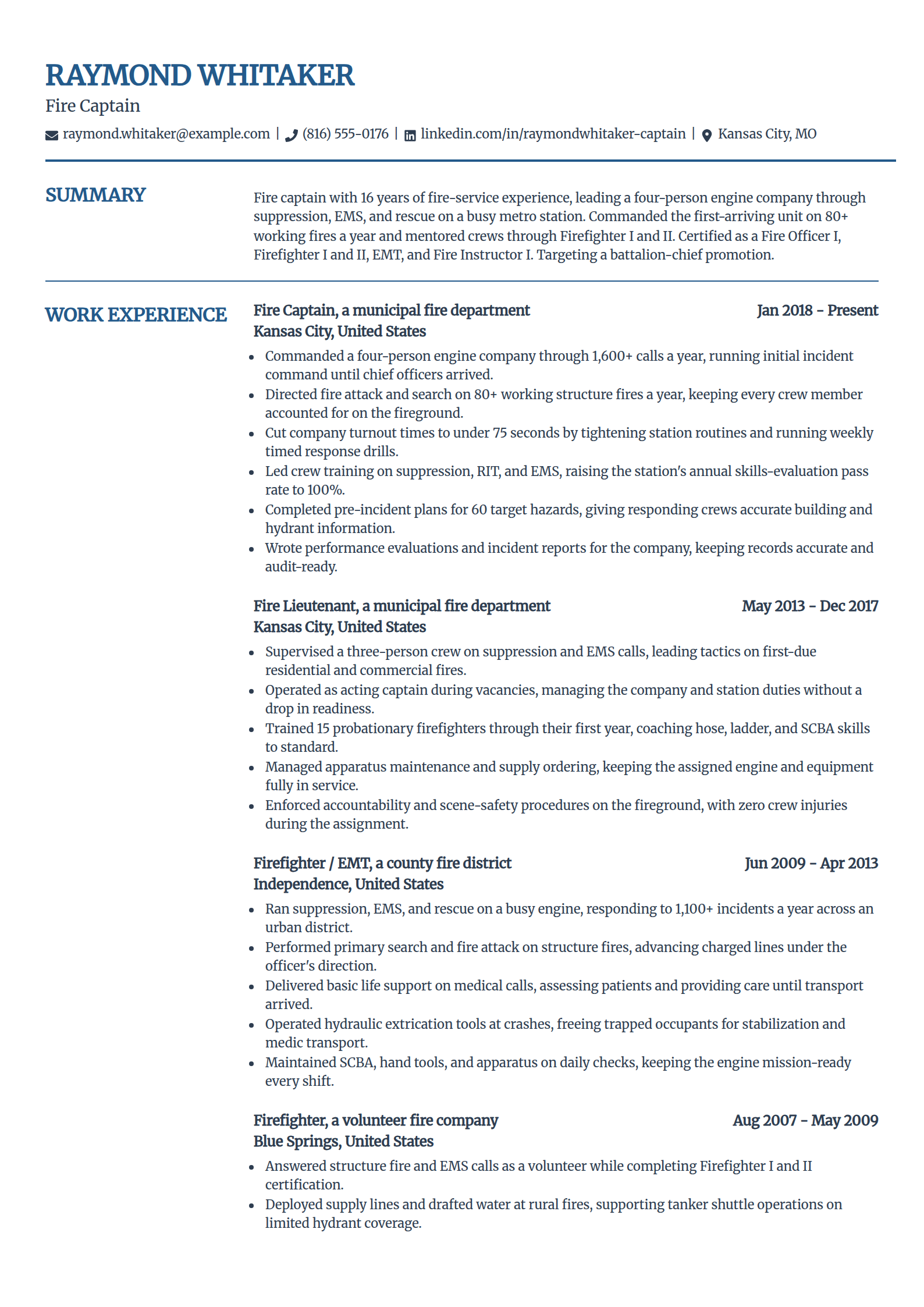
Fire Captain & Company Officer Resume Template
Why this resume example works?
- Leads with command scope, 16 years, a four-person engine company, and initial incident command on 80+ working fires a year.
- Turns delivery into leadership, cutting turnout times under 75 seconds and mentoring crews to a 100% skills-evaluation pass rate.
- Names the officer credentials a promotion board expects, Fire Officer I, Fire Instructor I, and ICS-300 and 400.
- Shows the prevention work a captain owns, completing pre-incident plans for 60 target hazards.
- Uses a modern layout that carries a long command history on one clean page.
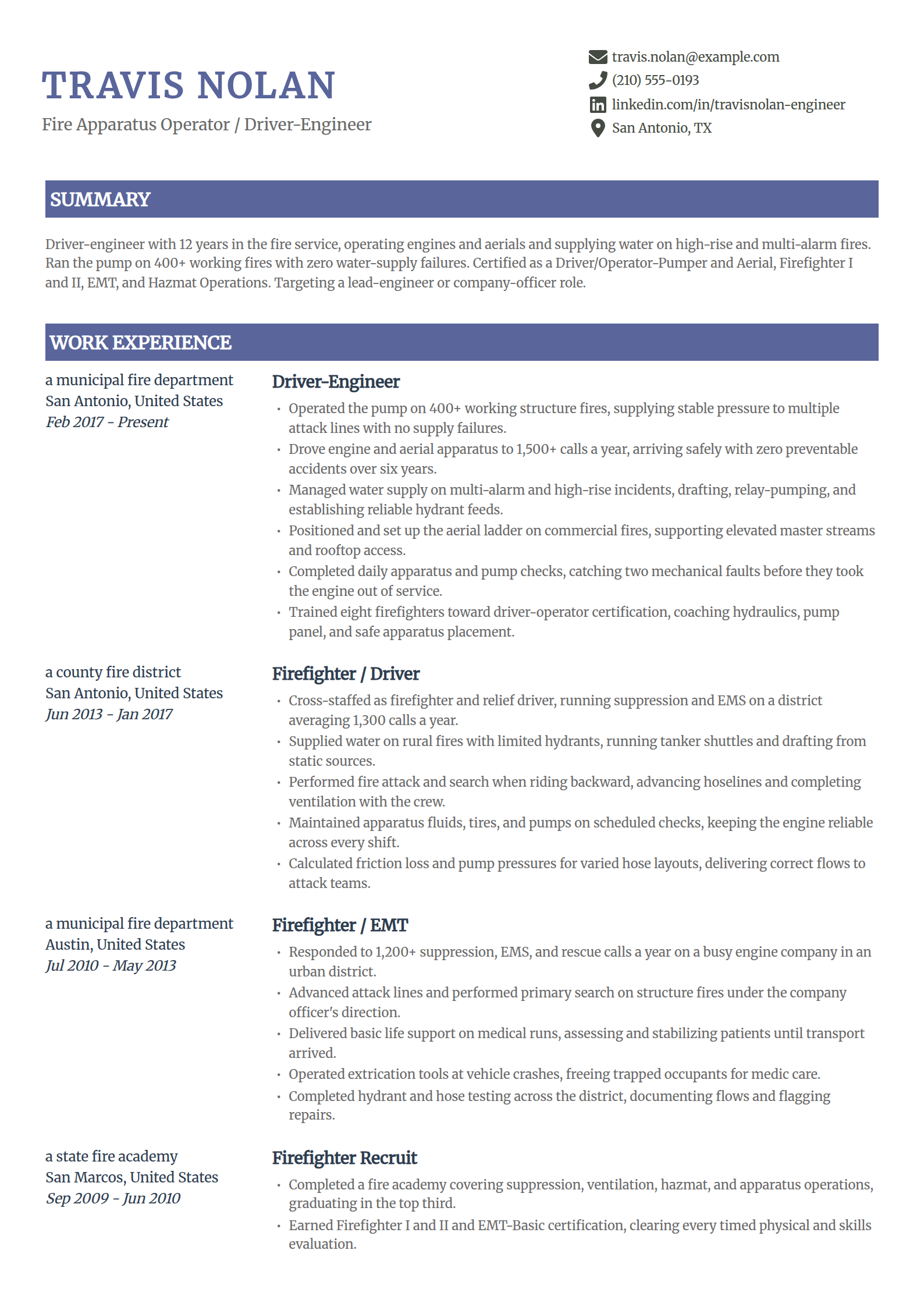
Driver-Engineer & Apparatus Operator Resume Template
Why this resume example works?
- Opens with the number that matters for the seat, the pump run on 400+ working fires with no water-supply failures.
- Names the operator credentials a posting screens for, Driver/Operator-Pumper and Aerial under NFPA 1002.
- Shows measurable safety, driving to 1,500+ calls a year with zero preventable accidents over six years.
- Proves the technical depth, drafting, relay-pumping, friction-loss math, and safe apparatus placement on multi-alarm fires.
- Uses a clean, results-first layout that stays easy to skim in one pass.
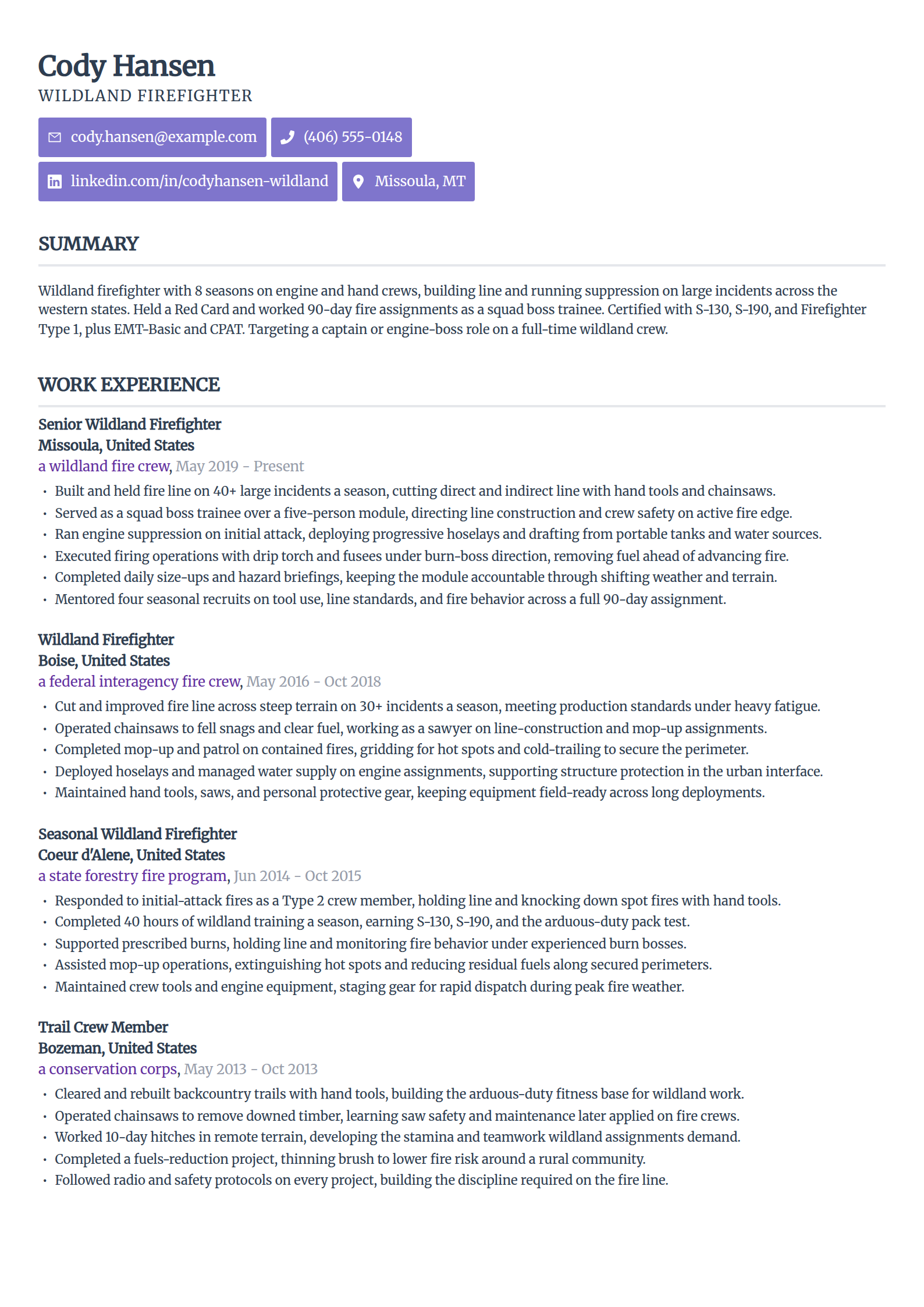
Wildland Firefighter Resume Template
Why this resume example works?
- Leads with wildland scope, 8 seasons building line on 40+ large incidents a year as a squad boss trainee.
- Names the wildland credentials a crew screens for, the Red Card, S-130, S-190, and the arduous pack test.
- Shows real fire-line work, chainsaw and hand-tool line construction, firing operations, and mop-up and patrol.
- Keeps the record honest with a structural Firefighter I and EMT-Basic for interface and medical assignments.
- Uses a clean, modern layout that carries a dense multi-season history on one page.
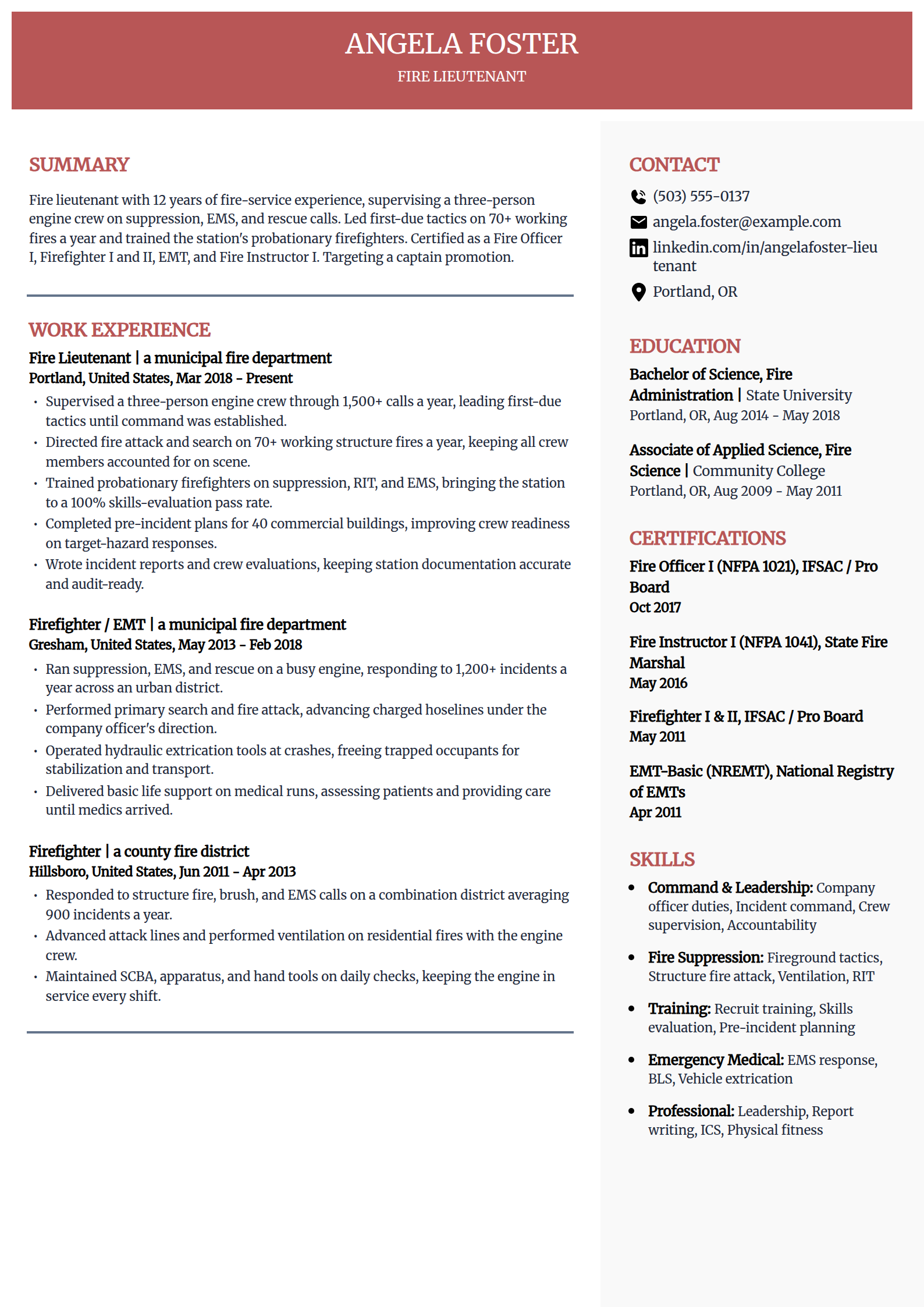
Fire Lieutenant Resume Template
Why this resume example works?
- Leads with supervisory scope, a three-person crew, 1,500+ calls a year, and first-due tactics on 70+ working fires.
- Shows the officer work a captain board rewards, training probationary firefighters to a 100% evaluation pass rate.
- Names the credentials that move a lieutenant up, Fire Officer I and Fire Instructor I alongside Firefighter I and II.
- Keeps three focused roles tight and readable instead of padding a long history.
- Uses a refined, executive layout that fits a supervisory record cleanly on one page.
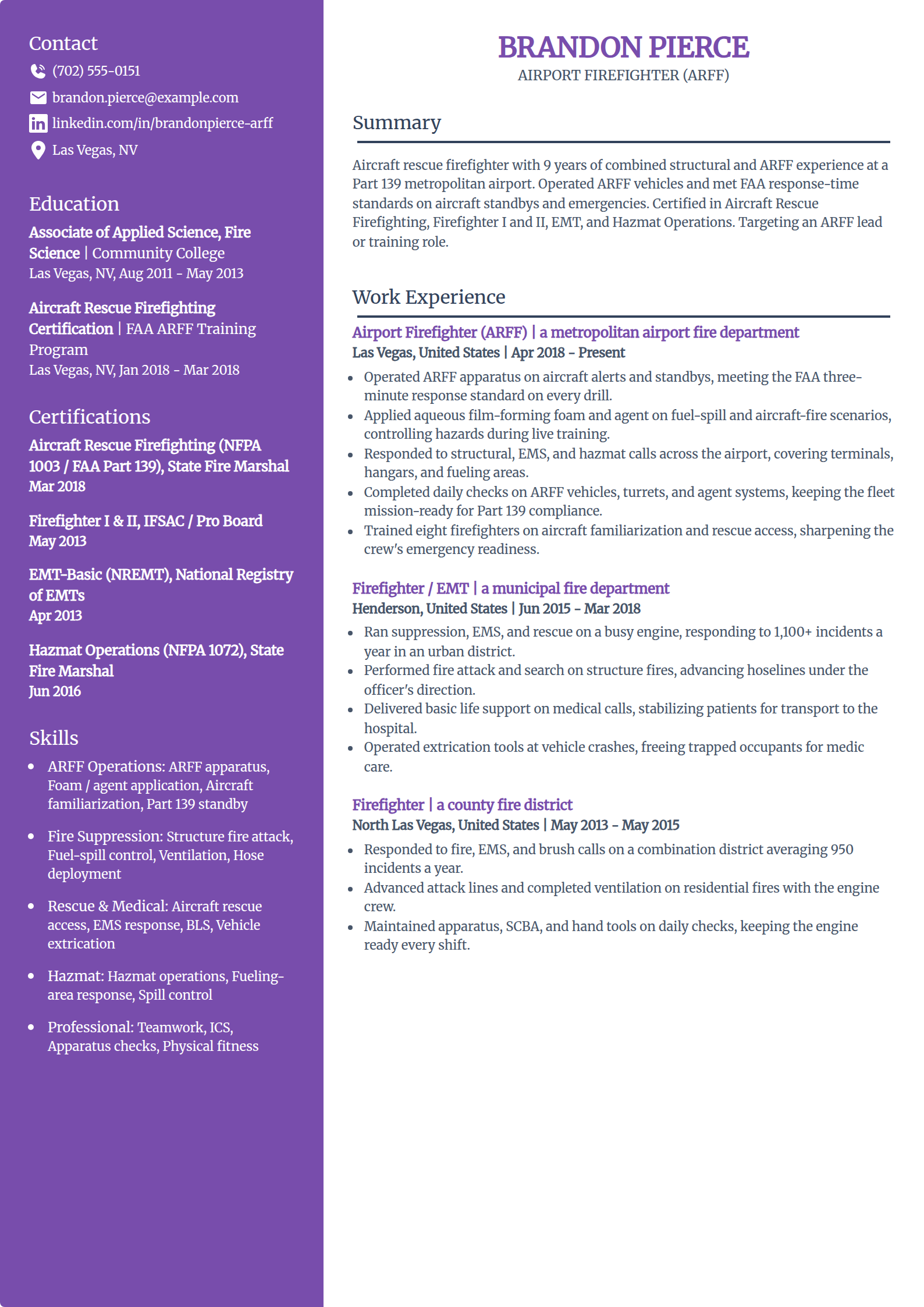
Airport (ARFF) Firefighter Resume Template
Why this resume example works?
- Opens with the ARFF standard, meeting the FAA three-minute response on aircraft alerts at a Part 139 airport.
- Names the specialty credential up front, Aircraft Rescue Firefighting under NFPA 1003 and FAA Part 139.
- Shows the agent work an ARFF posting expects, foam application on fuel-spill and aircraft-fire scenarios.
- Keeps the structural base visible with Firefighter I and II, EMT, and Hazmat Operations for airport-wide calls.
- Uses a modern layout that fits a combined structural and ARFF record without crowding.
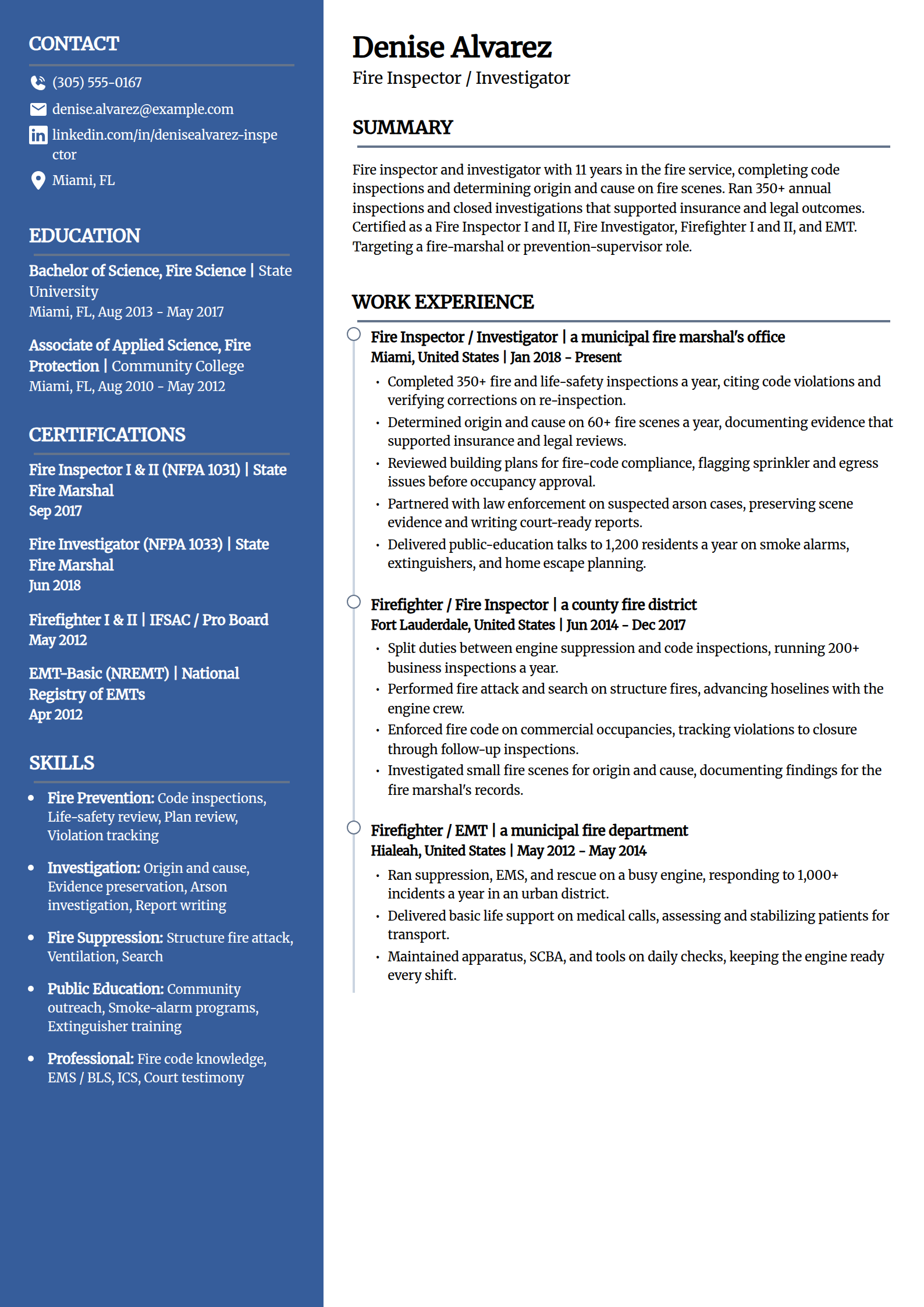
Fire Inspector & Investigator Resume Template
Why this resume example works?
- Leads with prevention scope, 350+ inspections a year and origin-and-cause work on 60+ fire scenes.
- Names the credentials a fire-marshal office screens for, Fire Inspector I and II and Fire Investigator under NFPA 1031 and 1033.
- Shows court-ready work, preserving evidence and partnering with law enforcement on suspected arson cases.
- Adds the public-education duty an inspector owns, reaching 1,200 residents a year on smoke alarms and escape planning.
- Uses a two-column layout with a full sidebar so the credentials and skills read at a glance.
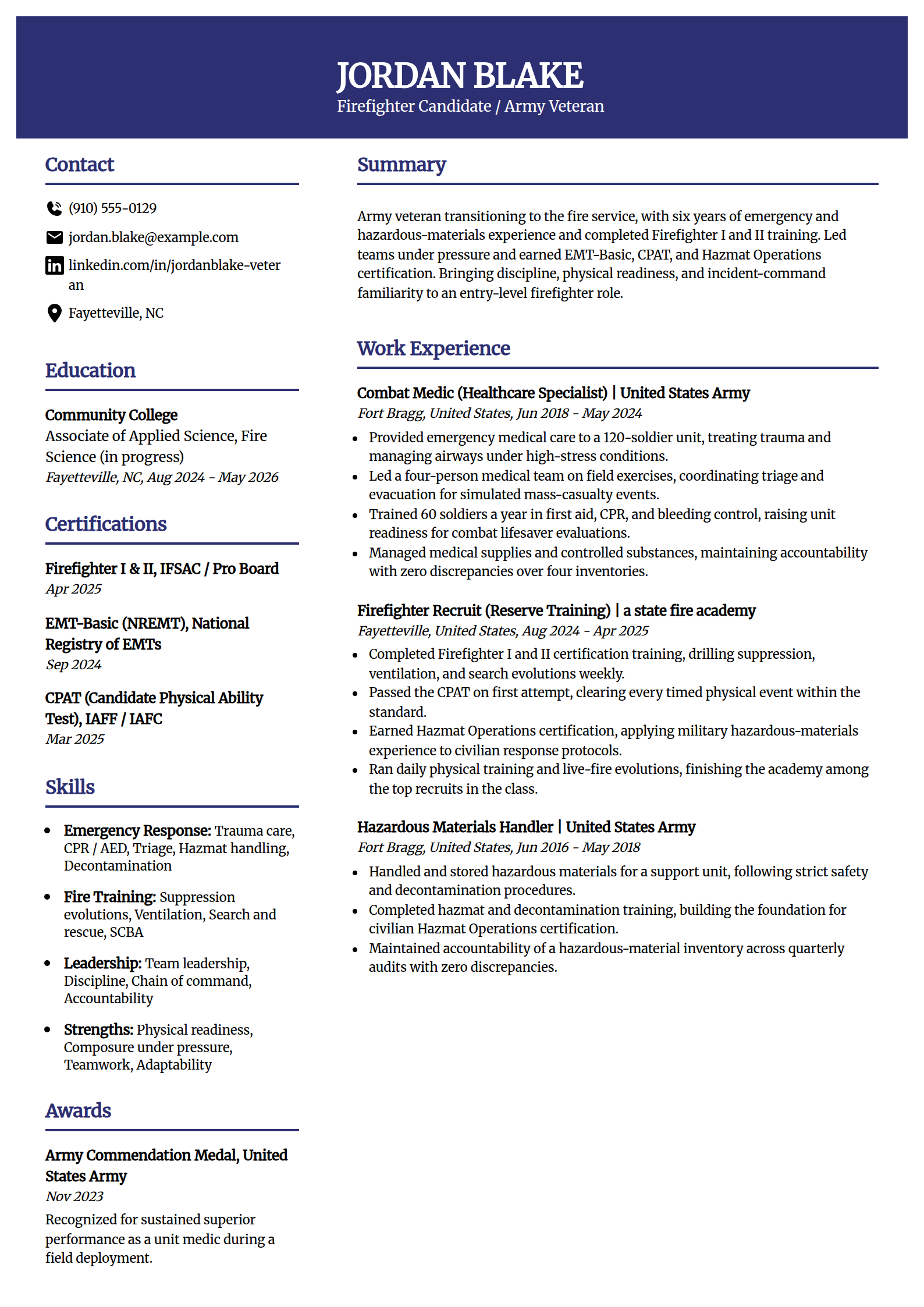
Military-to-Firefighter Resume Template (Veteran Transition)
Why this resume example works?
- Names the pivot openly, reframing six years as an Army combat medic as fire-ready emergency experience.
- Shows recent commitment with completed Firefighter I and II training, EMT-Basic, and a passed CPAT.
- Pulls transferable proof forward, leading a four-person medical team and handling hazardous materials under strict safety rules.
- Leads the skills list with what a department values, trauma care, hazmat handling, and composure under pressure.
- Uses a roomy layout with the sidebar filled so an entry-level fire record still reads complete.
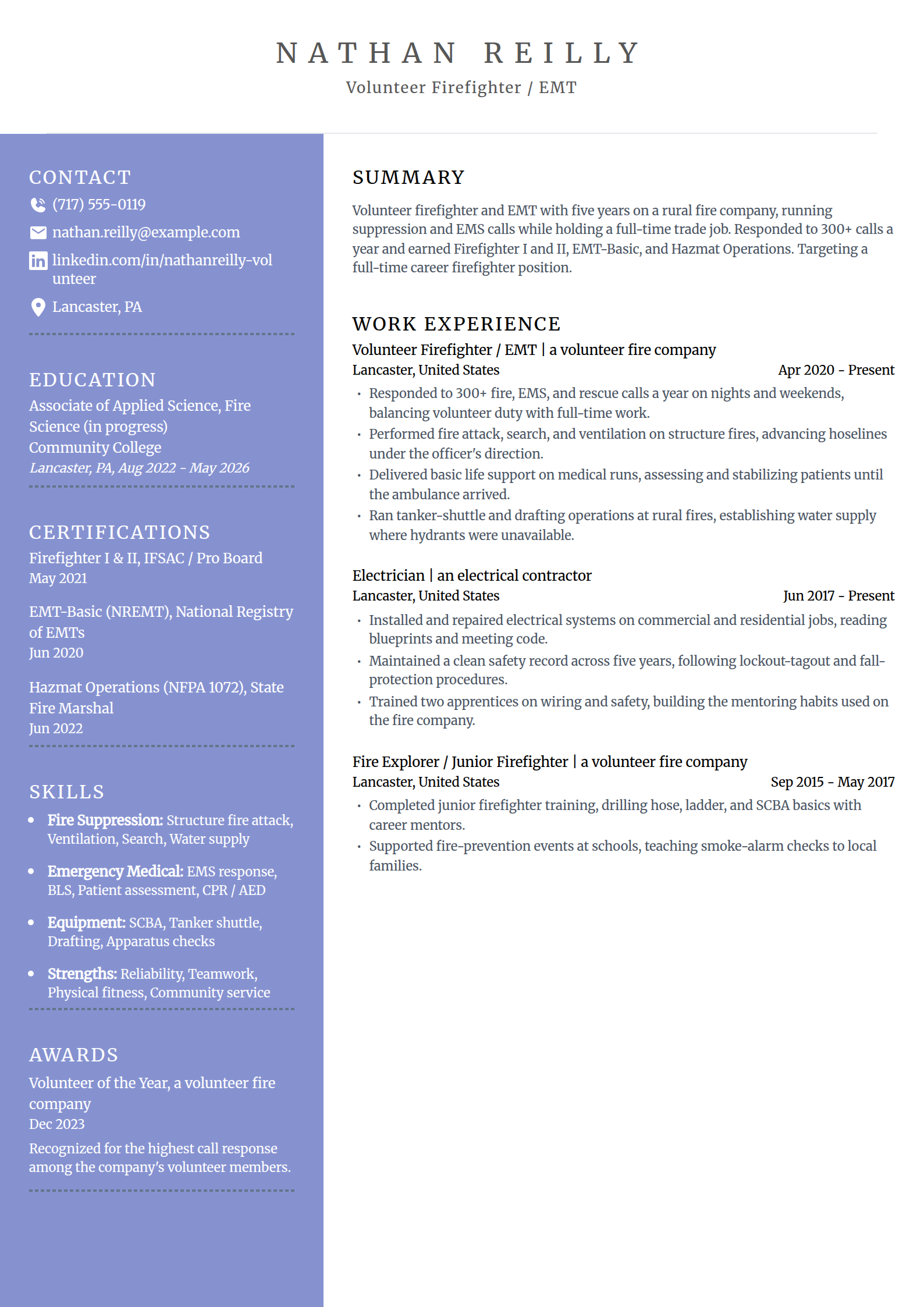
Volunteer Firefighter Resume Template
Why this resume example works?
- Frames volunteer service as real experience, 300+ calls a year run on nights and weekends around a full-time trade job.
- Shows the rural skills a combination department needs, tanker shuttle and drafting where hydrants are unavailable.
- Puts Firefighter I and II, EMT-Basic, and Hazmat Operations up front to prove the volunteer is career-ready.
- Adds a Volunteer of the Year award that signals reliability, the trait a first paid job screens hardest for.
- Uses a roomy layout with a filled sidebar so a volunteer record still looks full.
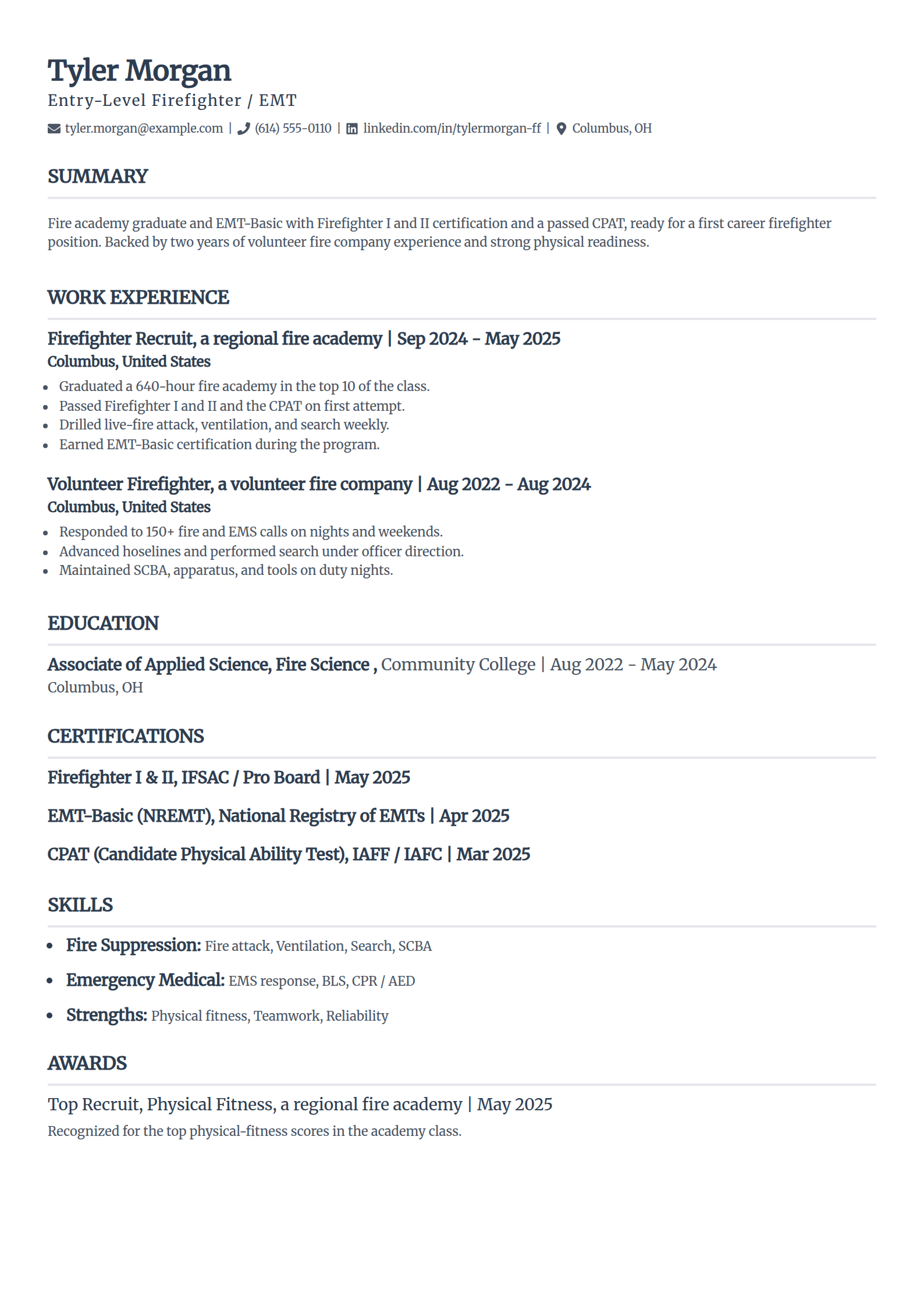
Entry-Level Firefighter Resume Template (Academy Graduate)
Why this resume example works?
- Written for a new fire academy graduate, leading with Firefighter I and II, a passed CPAT, and EMT-Basic.
- Leans on believable early proof, a top-10 academy finish and two years of volunteer fire company calls.
- Keeps each bullet concrete and short, like passing Firefighter I and II and the CPAT on first attempt.
- Fills the page honestly with a physical-fitness award instead of padding thin experience.
- Uses a tight, ATS-safe single-column layout that fits a beginner's record without empty space.
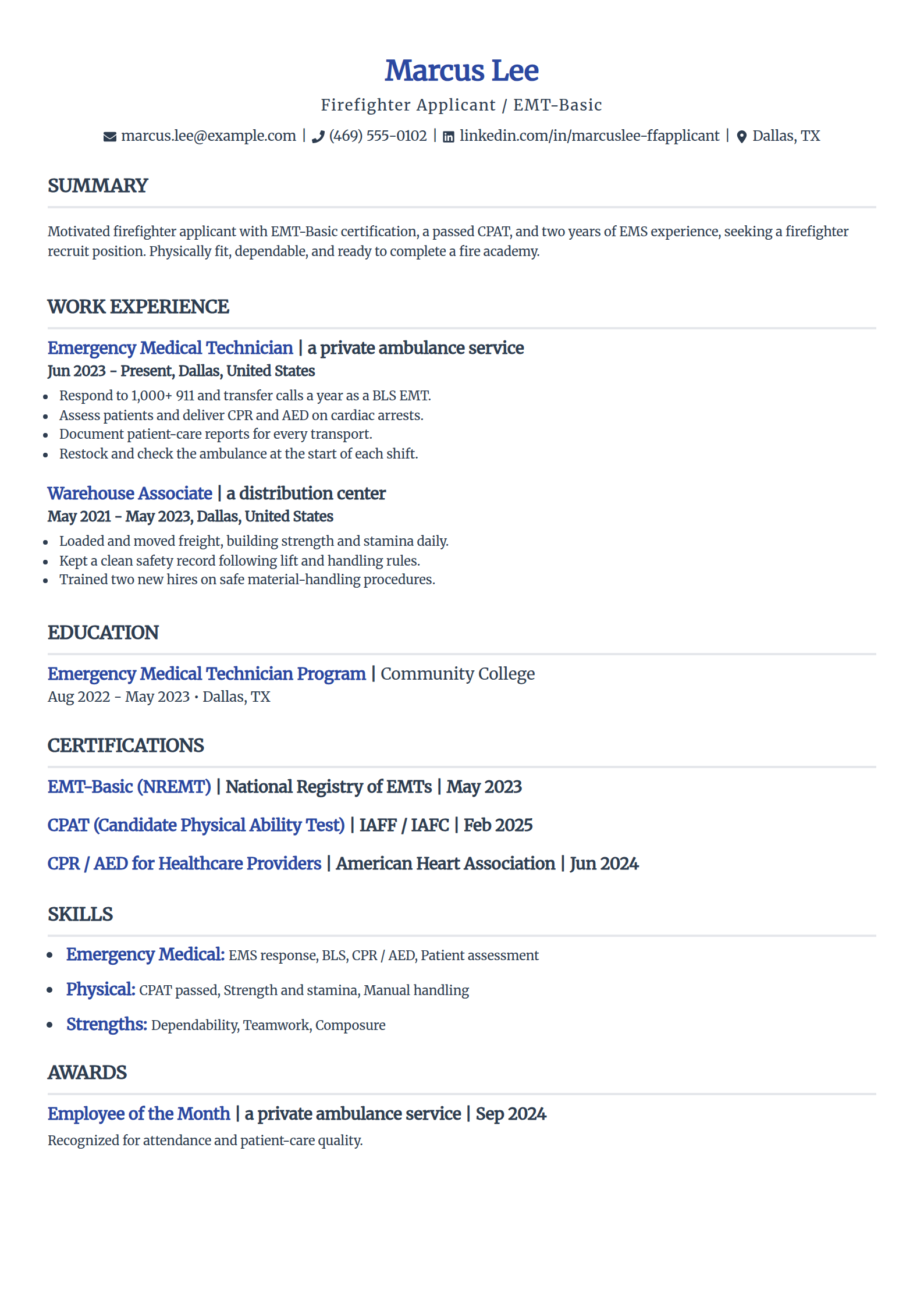
Firefighter Resume Template With No Experience
Why this resume example works?
- Written for an applicant with no fire time, leading with EMT-Basic, a passed CPAT, and two years of EMS work.
- Turns real EMS calls into proof, 1,000+ 911 and transfer runs a year with CPR and AED on cardiac arrests.
- Uses physically demanding warehouse work to show the strength and stamina a recruit needs.
- Puts certifications up front so a department sees the candidate is ready to enter an academy.
- Uses a plain, ATS-safe layout that fills the page without inventing firefighting experience.
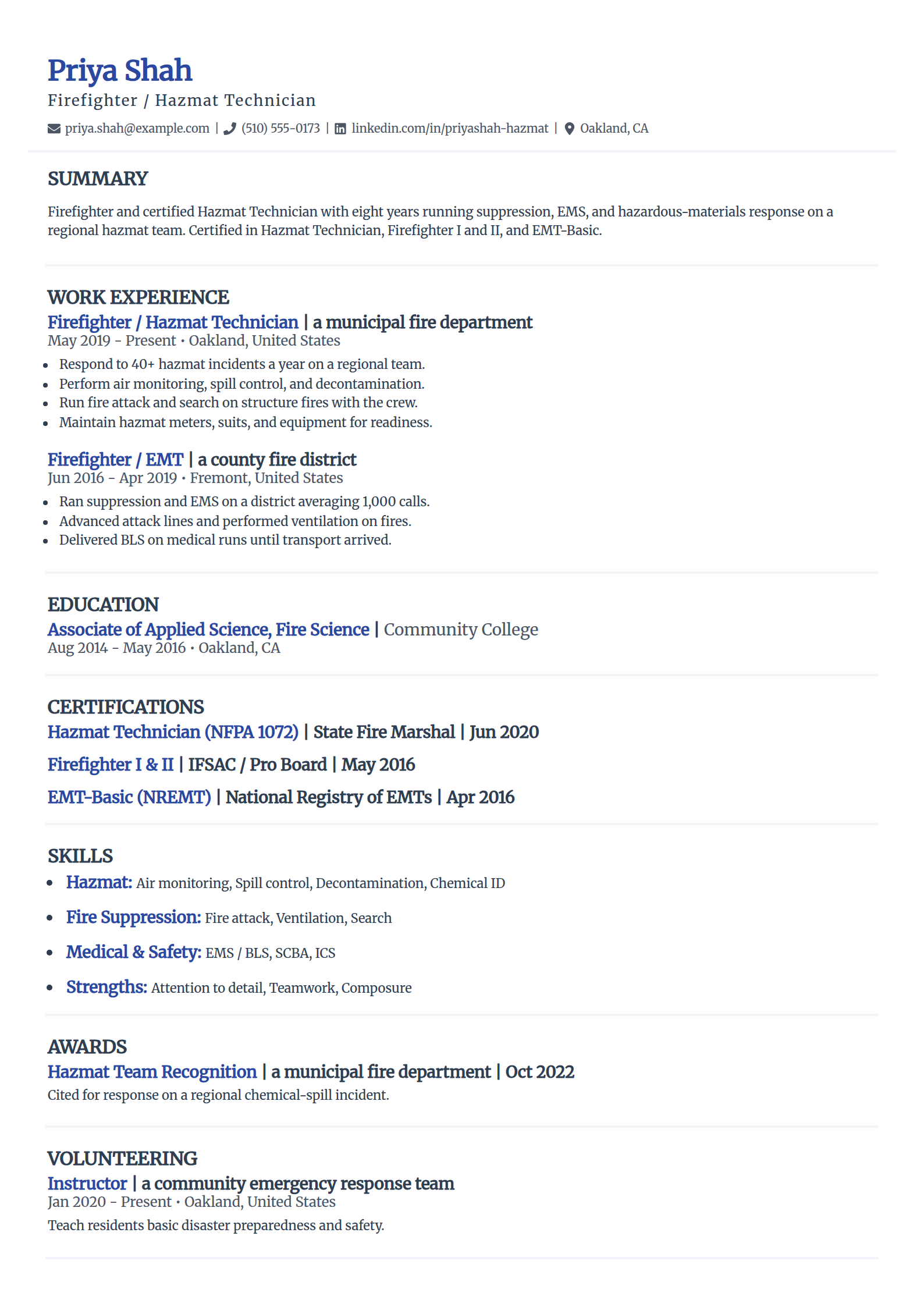
Hazmat Technician Firefighter Resume Template
Why this resume example works?
- Leads with the specialty credential, Hazmat Technician under NFPA 1072, alongside Firefighter I and II and EMT.
- Shows the technician work a team lists, air monitoring, spill control, decontamination, and chemical identification.
- Keeps the suppression base visible so the resume reads as a firefighter first, technician second.
- Keeps two focused roles tight, with the sidebar filled by a hazmat recognition and a CERT instructor role.
- Uses a refined layout that fits a focused specialty record on one clean page.
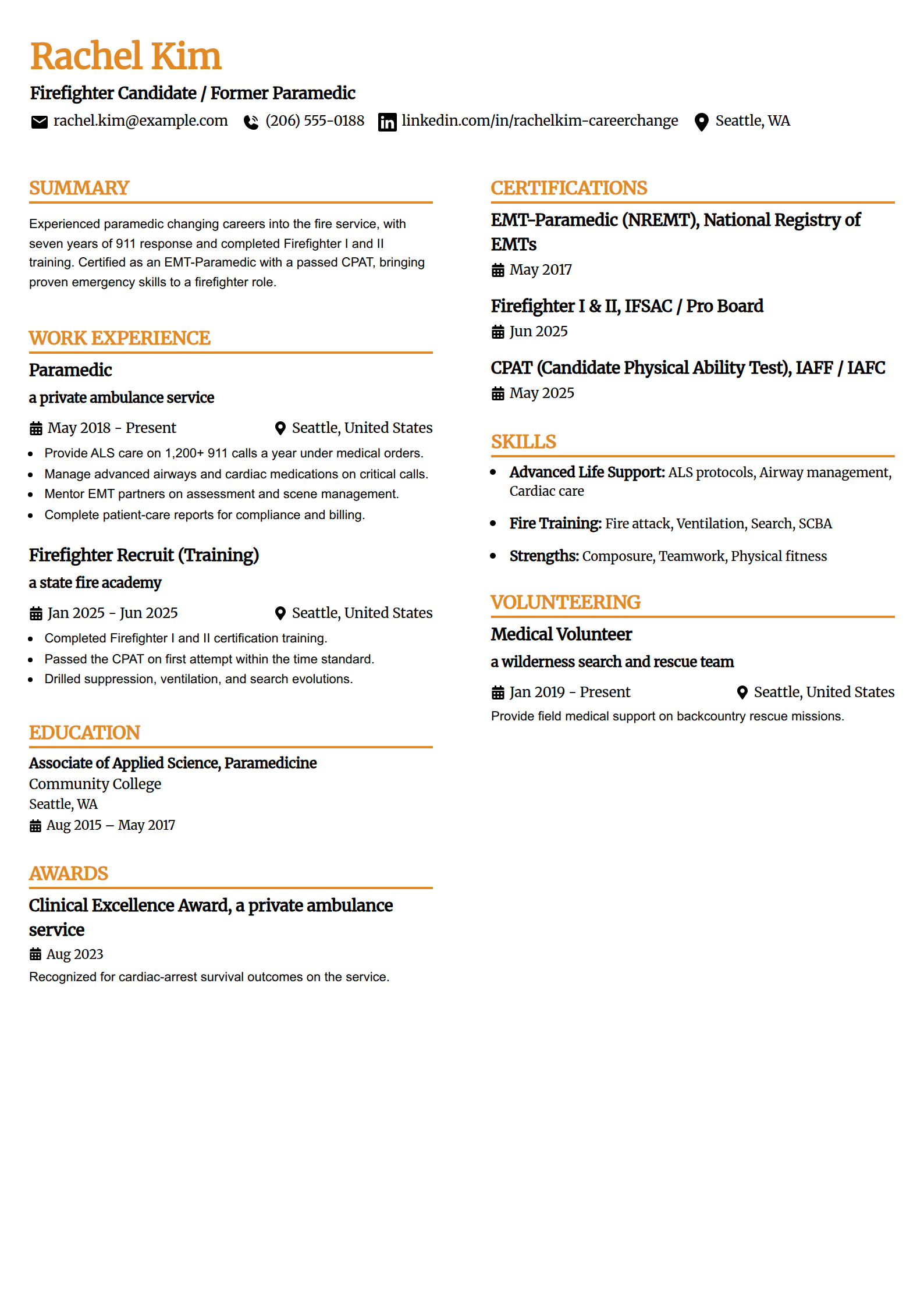
Career-Change Firefighter Resume Template
Why this resume example works?
- Names the pivot openly, a working paramedic moving into the fire service with completed Firefighter I and II training.
- Pulls transferable proof forward, 1,200+ ALS calls a year with advanced airways and cardiac medications.
- Shows recent commitment, a passed CPAT and fresh suppression, ventilation, and search drills.
- Leads the skills list with what transfers, ALS scope plus new fire-attack fundamentals.
- Uses a refined layout that fits a focused career-change record on one clean page.
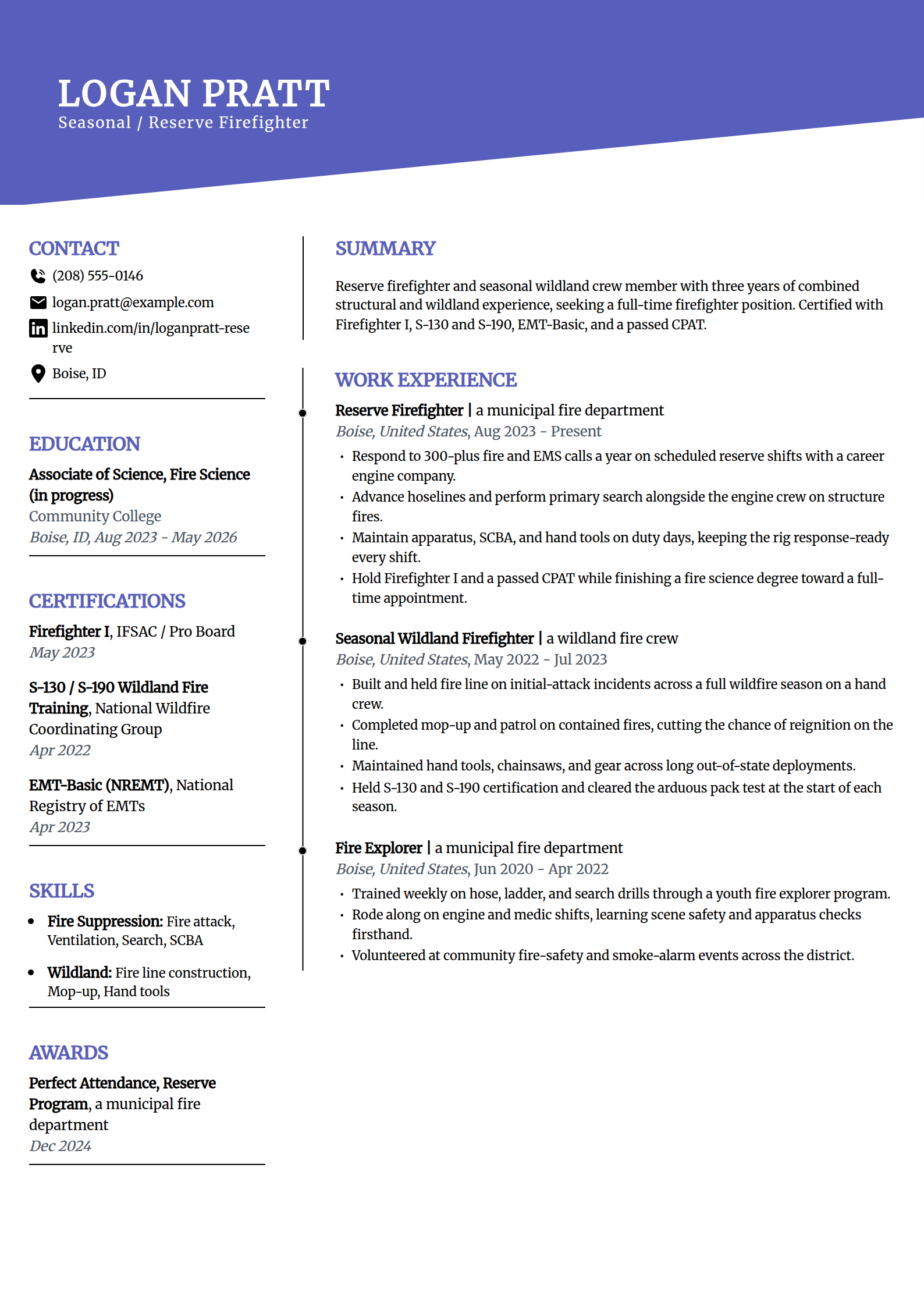
Seasonal & Reserve Firefighter Resume Template
Why this resume example works?
- Combines real fire-service tracks, scheduled reserve shifts plus a full wildland season, into one credible entry-level story.
- Puts Firefighter I, S-130 and S-190, and EMT-Basic up front to show the reserve is ready for full-time work.
- Attaches a number or credential to each bullet, like 300-plus calls a year and clearing the arduous pack test every season.
- Lists awards without long descriptions, keeping the layout clean and balanced.
- Uses a distinctive layout that still reads cleanly for a hiring officer.
Build your firefighter resume
Pick a template above and the editor keeps your layout clean, single-column, and ATS-safe while you put your certifications up front and swap in your own call volume and station work.
Build my resumeHow to write a firefighter resume in 2026
A firefighter resume is read fast by a hiring officer checking two things: are you certified, and can you prove real fire and EMS work. Lead with a short summary or objective, put your certifications where they are seen first, and back each role with one quantified result. These moves make yours easy to skim and easy for an applicant tracking system to parse.
Use a summary or an objective, not both
A firefighter with about a year or more of paid or volunteer fire experience should open with a two to three sentence summary that names years, call volume, the strongest number, and the certifications a posting lists. A true entry-level or career-change applicant uses a short objective instead, naming the certifications and the recruit position they are targeting. You use one or the other, never both, and either way you lead with what you bring, not what you want from the department.
Firefighter and EMT with 9 years at a busy municipal fire department, responding to structure fires, EMS calls, and rescues on a high-volume engine company. Ran more than 1,400 calls a year and held turnout times under 80 seconds. Certified in Firefighter I and II, EMT-Basic, Hazmat Operations, and CPAT.
Lead experience with real fire work and the number
The work a firefighter resume is hired for is measurable, so name the task and attach one credible number to each bullet. Open every line with a strong verb, never "Responsible for".
- Call volume: state the runs and your response, like responding to 1,400+ fire and EMS calls a year with turnout times under 80 seconds.
- Suppression: name the fireground task, such as performing primary search and fire attack on 90+ working structure fires a year.
- EMS: use patient outcomes, like delivering BLS on 800 runs a year and restoring a pulse with CPR and an AED before medics arrived.
- Apparatus and prevention: name the operation, such as operating the pump on multi-alarm fires or completing 200+ hydrant and hose tests.
Put certifications and licenses where they are seen first
Fire departments screen hard on credentials, so make your certifications section prominent and easy to scan.
- Lead with the core set: EMT-Basic or Paramedic through the NREMT, Firefighter I and II through IFSAC or the Pro Board, and a passed CPAT.
- Add the credentials your track needs: Hazmat Awareness or Operations, CPR and AED, ICS-100, 200, and 700, and a driver or pump-operator card.
- Wildland applicants list the Red Card, S-130, and S-190; ARFF applicants list Aircraft Rescue Firefighting; inspectors list Fire Inspector I.
- Keep dates and issuers clean and current so a hiring officer and a parser both read your credentials at a glance.
Match skills to the tools and keywords a department screens for
A firefighter skills list should read like the job posting. Split it so a hiring officer and a parser both find what they need.
- Fire suppression: structure fire attack, ventilation, forcible entry, hose deployment, search and rescue, and overhaul.
- Emergency medical: EMS response, patient assessment, BLS or ALS, CPR and AED, airway management, and trauma care.
- Apparatus and rescue: pump operations, SCBA, vehicle extrication, RIT, hydrant and hose testing, and apparatus checks.
- Specialty and command: hazmat operations, wildland line construction, fire inspection, ICS, size-up, and scene accountability.
Keep it to one clean, ATS-friendly page
The fire service is a conservative-format field and departments run applicant tracking systems, so a clean one-page resume is the standard for nearly every candidate.
- Use a single-column or simple layout with standard headings a parser recognizes; skip heavy graphics, photos, and color blocks.
- Hold it to one page and lead with your most recent role; only very senior officers with long command histories run to two.
- Save as a PDF so the formatting holds, then run it through the ATS resume checker for a quick format pass.
- Swap the numbers in the templates above for your own certifications, call volume, and station work; do not copy them as is.
Common firefighter resume mistakes
- Burying your certifications at the bottom. A hiring officer scans for EMT, Firefighter I and II, and CPAT first, so put them in a prominent section near the top.
- Writing vague lines like "fought fires" or "helped on calls" with no number. Say what you did: "performed primary search and fire attack on 90+ working structure fires a year".
- Listing an objective and a summary. A resume has one or the other. Experienced firefighters use a summary; entry-level and career-change applicants use a short objective.
- Hiding the proof entry-level candidates do have. Fire academy standing, EMT clinicals, volunteer runs, CPAT, and military service are real experience, so lead with them.
- Choosing a busy, graphics-heavy design that an applicant tracking system cannot read. A clean, single-column page that parses cleanly is the safe choice for the fire service.
Frequently asked questions
How do you write a firefighter resume?
Open with a two to three sentence summary or a short objective, then a prominent certifications section that lists EMT, Firefighter I and II, and CPAT where a hiring officer reads them first. Under each role, write results-first bullets that open with a strong verb and carry one credible number, like responding to 1,400+ calls a year or performing primary search on 90+ working structure fires. Name the fire and EMS work a posting lists, such as suppression, ventilation, apparatus operation, and BLS, and keep the whole resume to one clean, single-column page.
What certifications should be on a firefighter resume?
Lead with the core set every department screens for: EMT-Basic or Paramedic through the NREMT, Firefighter I and II through IFSAC or the Pro Board, and a passed CPAT. Add the credentials your track needs, such as Hazmat Awareness or Operations, CPR and AED, and ICS-100, 200, and 700. Wildland applicants add the Red Card, S-130, and S-190; driver-engineers add a pump-operator card; airport applicants add Aircraft Rescue Firefighting; and inspectors add Fire Inspector I. Keep the dates and issuers current so both a hiring officer and an applicant tracking system read them at a glance.
How do I write an entry-level firefighter resume with no experience?
Lead with the proof you do have. Put your certifications up front, then use the fire academy, EMT certification and clinicals, CPAT, volunteer fire company time, EMS work, and military service as your experience. A top academy finish, a passed CPAT, and real volunteer or EMS calls carry more weight than an inflated claim, which reads as invented to a hiring officer. Fill the page honestly with a relevant award or physical-fitness recognition rather than padding. The entry-level, no-experience, and veteran examples above show the shape.
Should a firefighter resume be one page?
Yes for nearly every candidate, from an academy recruit to a captain. The fire service is a conservative-format field, departments run applicant tracking systems, and hiring officers read fast, so a single, skimmable page led by your most recent role is what they expect. Only a very senior officer with a long command history runs to two pages, and never longer. Cut older, unrelated jobs to make room for your certifications, call volume, and station work.
Do you use a summary or an objective on a firefighter resume?
Use one, never both. A firefighter with about a year or more of paid or volunteer fire experience opens with a summary that names years, call volume, the strongest number, and certifications. A true entry-level or career-change applicant uses a short objective that names the certifications and the recruit position they are targeting. Either way, lead with what you bring, not what you want from the department, and keep it to two or three sentences.
More firefighter resume resources
Build your firefighter resume
Pick a template above and the editor keeps your layout clean, single-column, and ATS-safe while you put your certifications up front and swap in your own call volume and station work.