18 Paralegal Resume Examples, Litigation to First Internship
- ATS Friendly
- By Practice Area
- 18 Real Examples
A paralegal resume example should show four things a hiring attorney checks first: your practice area, your active file count, your exact credential, and the systems you work in. Pick a clean layout below, then model your own on a real example built for your track, from a litigation or corporate paralegal to a certified paralegal or a student with one internship. Every example stays inside scope: research, drafting under attorney supervision, discovery, docketing, and trial prep, never practicing law.


540k+ resumes created
Paralegal resume templates by practice area and level
Each template below is a real paralegal resume laid out in that format, sorted by practice area and experience across litigation, corporate, personal injury, real estate, immigration, IP, family law, criminal, estate planning, e-discovery, employment, and bankruptcy, plus the routes in for a certified paralegal, an entry-level graduate, a student with only an internship, and a career changer. Pick one, then swap in your own caseload, filings, certifications, and systems. Every layout keeps your name, certification, and dates clean so a hiring attorney reads your experience at a glance and an applicant tracking system parses it without trouble.
Litigation Paralegal Resume Template
Why this resume example works?
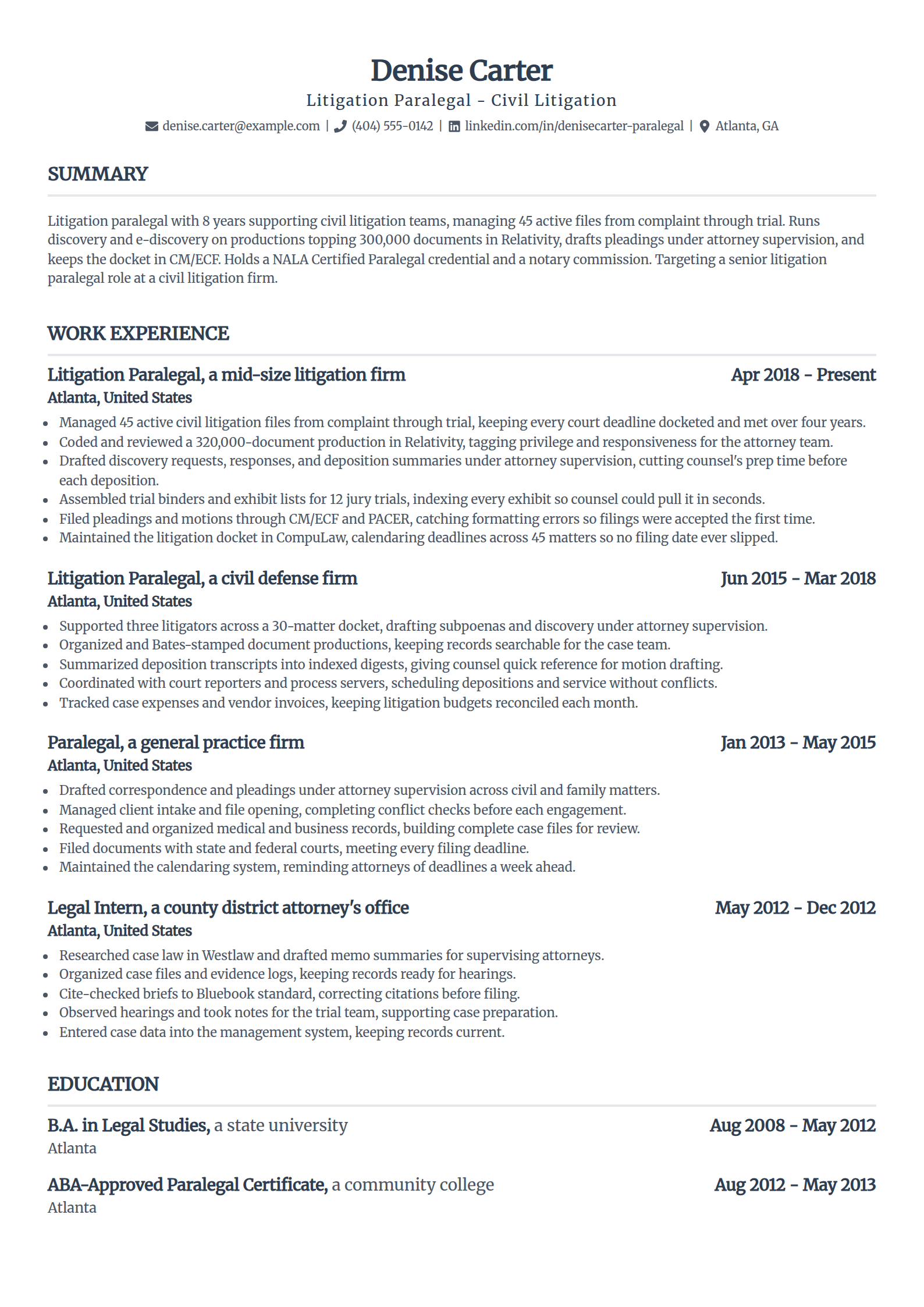
- Opens with a summary that names 8 years, a 45-file caseload, and a NALA Certified Paralegal credential.
- Keeps every task in scope: discovery, drafting under attorney supervision, cite-checking, and trial prep, never practicing law.
- Names the litigation stack a posting screens for, Relativity, CM/ECF, PACER, and CompuLaw docketing.
- Attaches one number to most bullets, like a 320,000-document review or trial binders for 12 jury trials.
- Uses a clean single-column layout that an applicant tracking system parses without trouble.
Corporate Paralegal Resume Template
Why this resume example works?
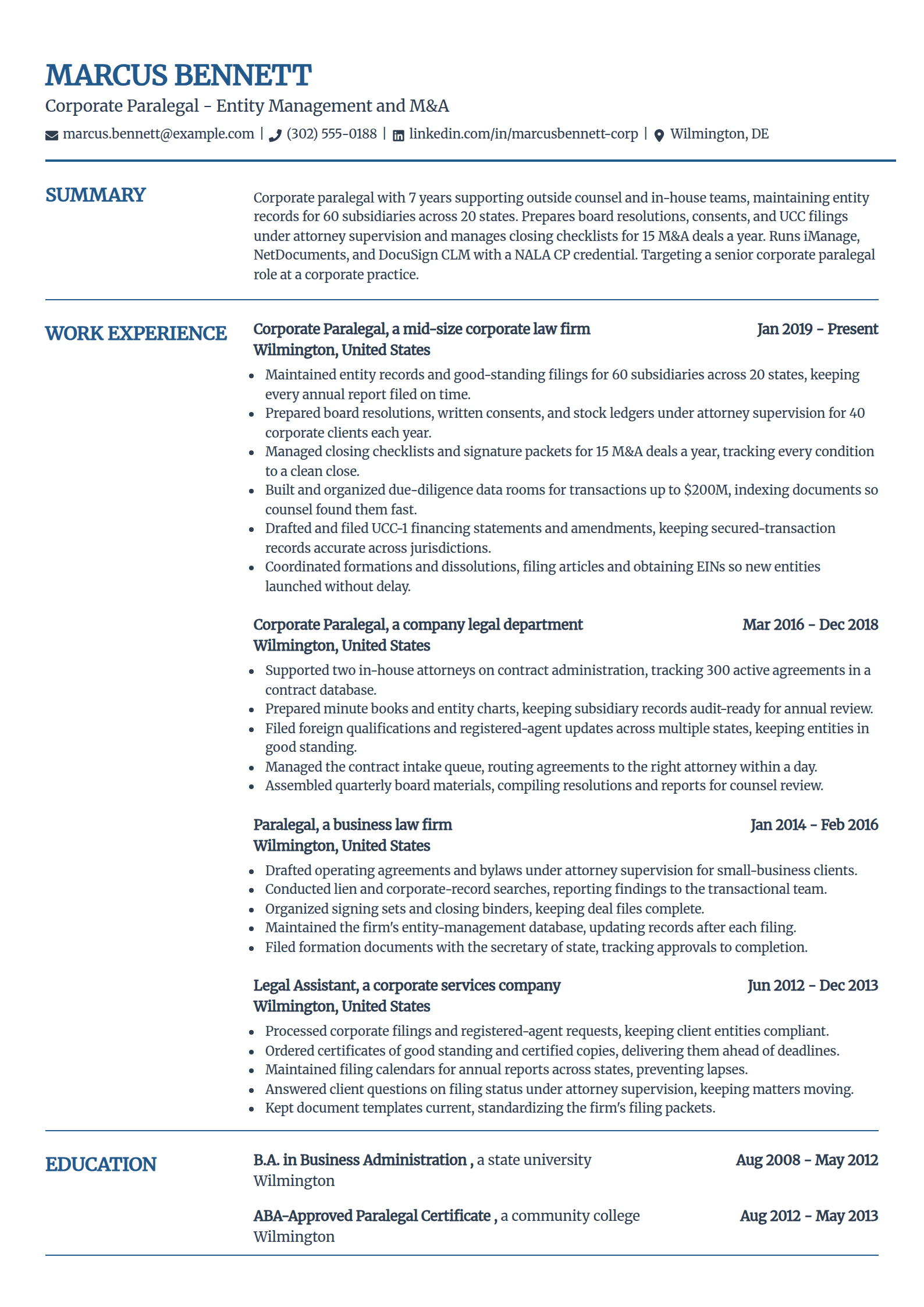
- Frames transactional scope, entity records for 60 subsidiaries and closing checklists for 15 M&A deals a year.
- Keeps drafting under attorney supervision, resolutions, consents, and UCC filings, never crossing into legal advice.
- Names the corporate stack, iManage, NetDocuments, and DocuSign CLM, as applicant-tracking keywords.
- Shows deal work a corporate team values, due-diligence data rooms on transactions up to $200M.
- Uses a clean, modern layout that carries a dense corporate history on one page.
Personal Injury Paralegal Resume Template
Why this resume example works?
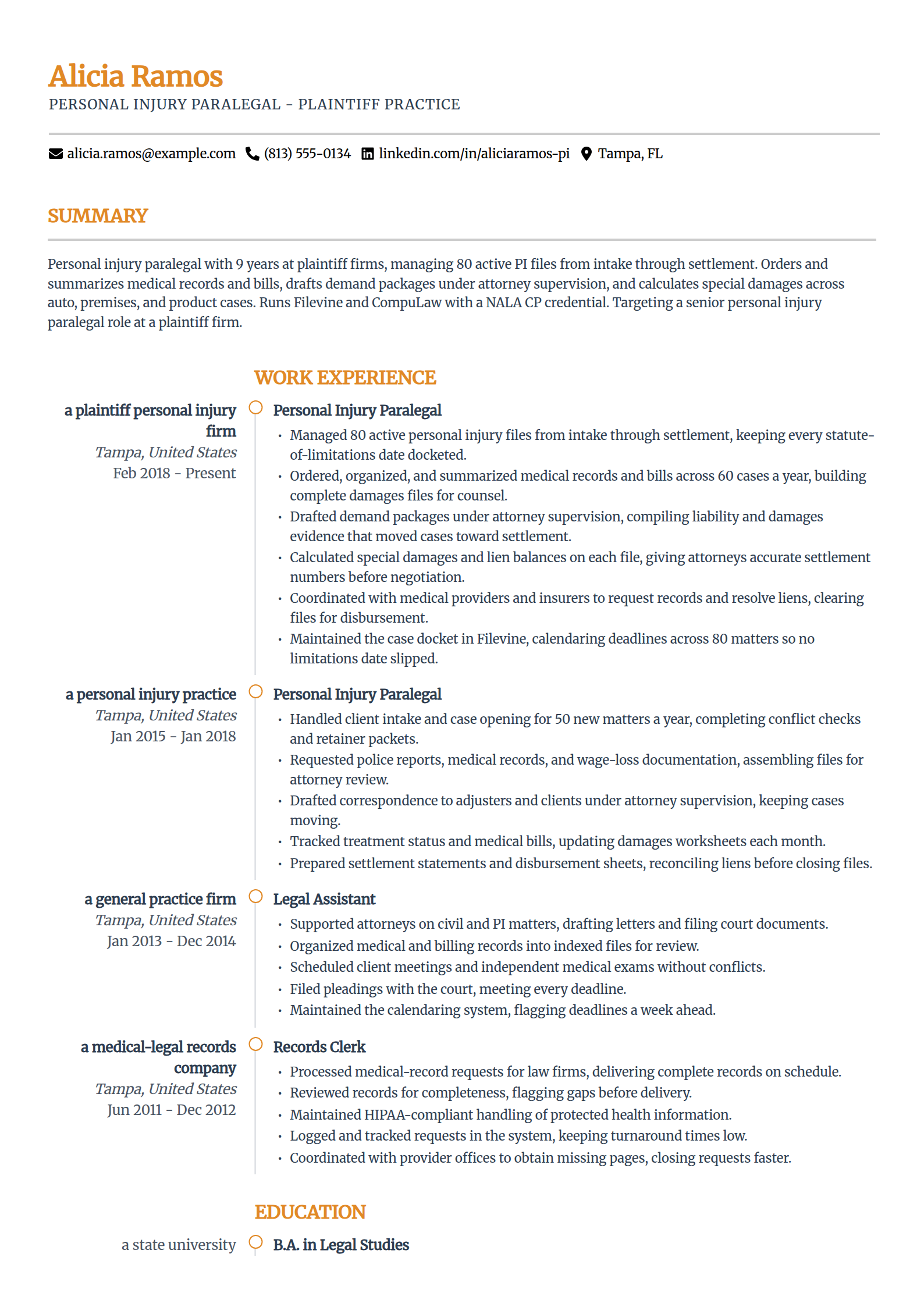
- Leads with plaintiff-side scope, 80 active PI files managed from intake through settlement.
- Shows the damages work a PI role hires for, medical-record summaries and demand packages under attorney supervision.
- Names the tools a plaintiff firm runs on, Filevine case management and CompuLaw docketing.
- Keeps the numbers modest and real, 60 cases of records a year and lien balances reconciled before disbursement.
- Uses a modern layout that carries a deep PI-support history on one clean page.
Real Estate Paralegal Resume Template
Why this resume example works?
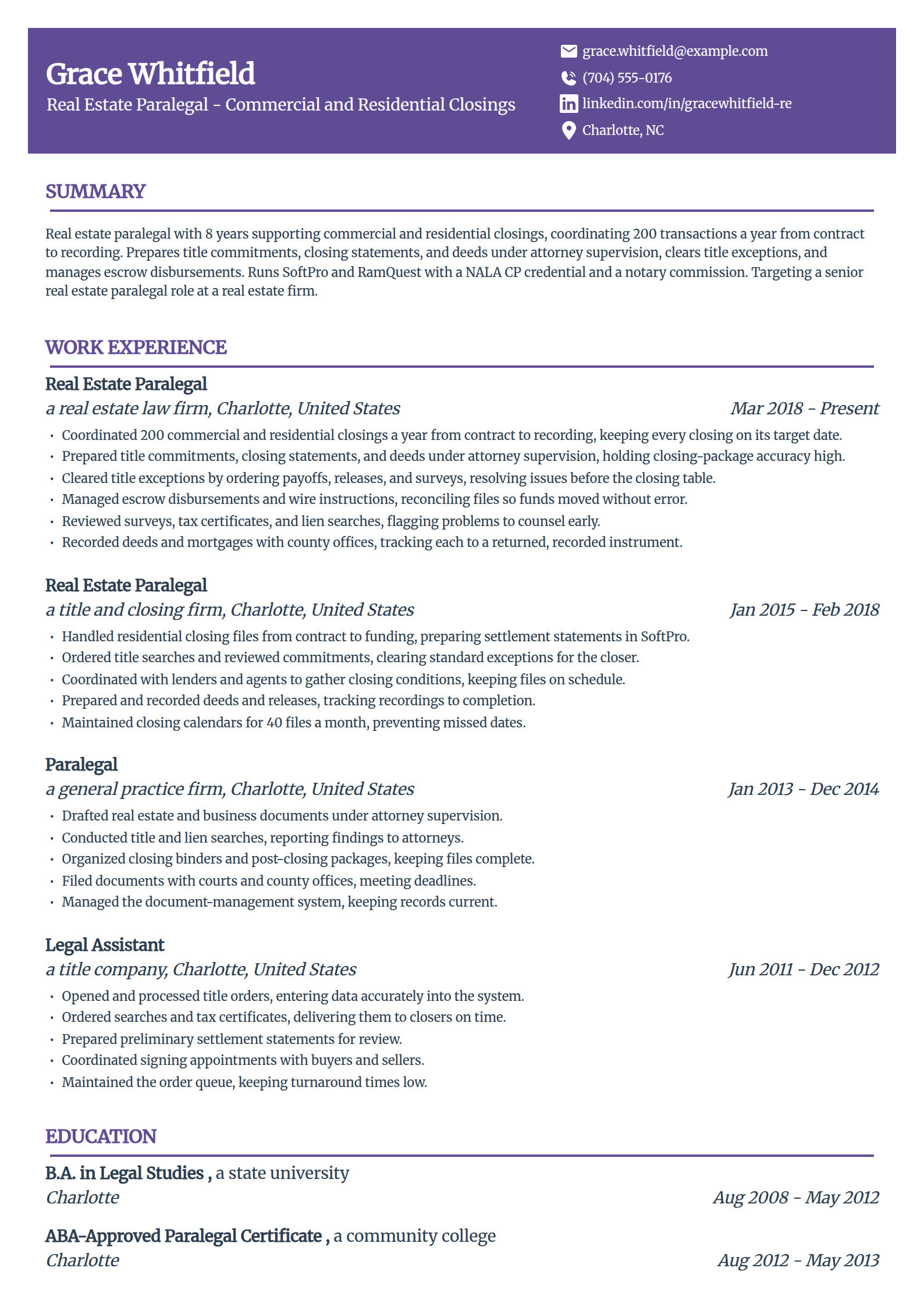
- Opens with closing scope, 200 commercial and residential transactions a year from contract to recording.
- Keeps drafting under attorney supervision, title commitments, closing statements, and deeds, never giving advice.
- Names the closing stack a posting lists, SoftPro and RamQuest, with a notary commission up top.
- Shows the title work that clears a file, ordering payoffs and releases to resolve exceptions before closing.
- Uses a spacious layout that carries a dense real estate record on one page.
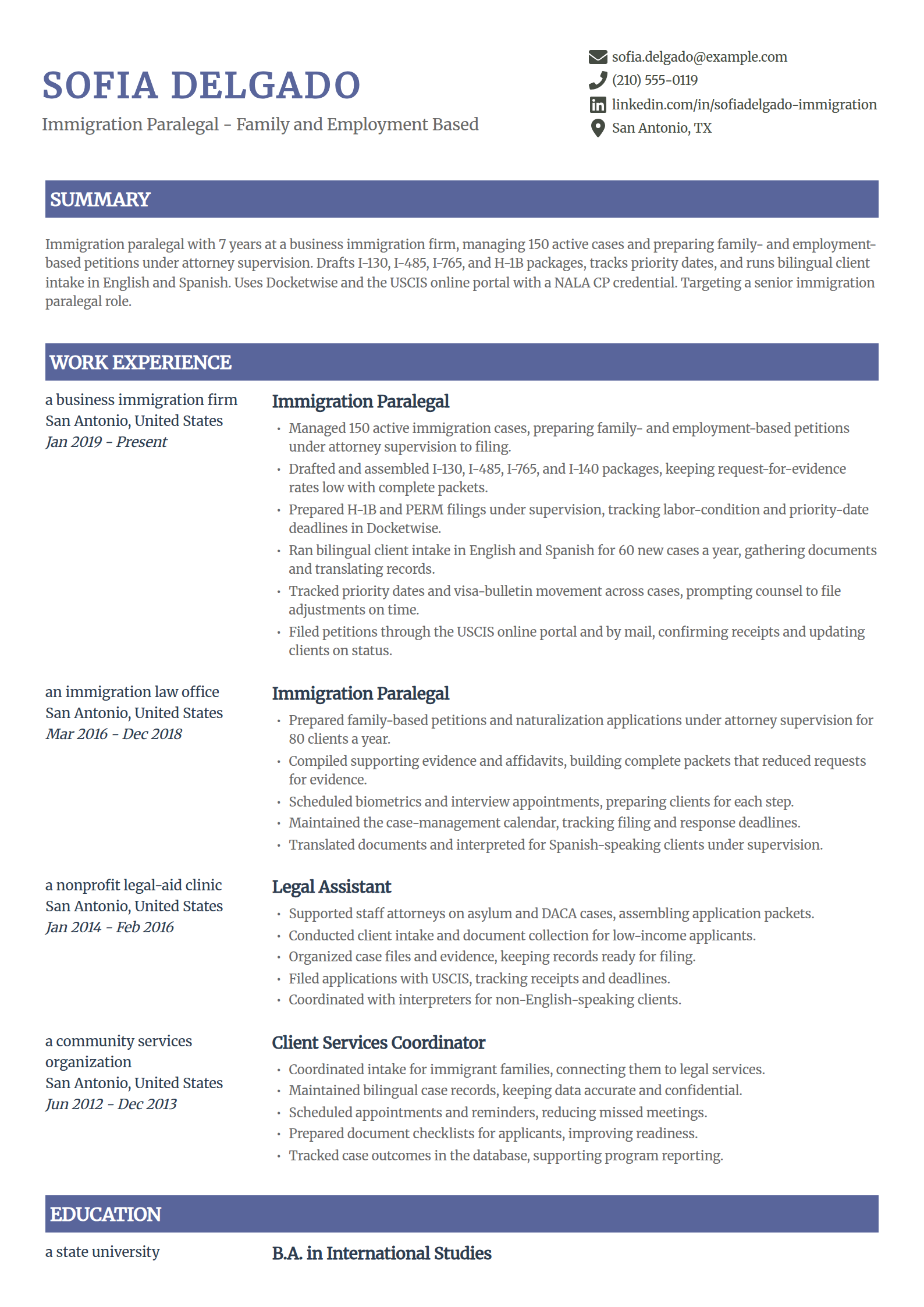
Immigration Paralegal Resume Template
Why this resume example works?
- Leads with immigration scope, 150 active cases and petitions prepared under attorney supervision.
- Names the USCIS forms a posting lists, I-130, I-485, I-765, and H-1B, plus Docketwise case management.
- Shows the bilingual intake an immigration practice needs, gathering documents in English and Spanish.
- Keeps scope honest: prepares forms and evidence packets under supervision, never giving legal advice.
- Uses a modern two-column layout that stays easy to skim in one pass.
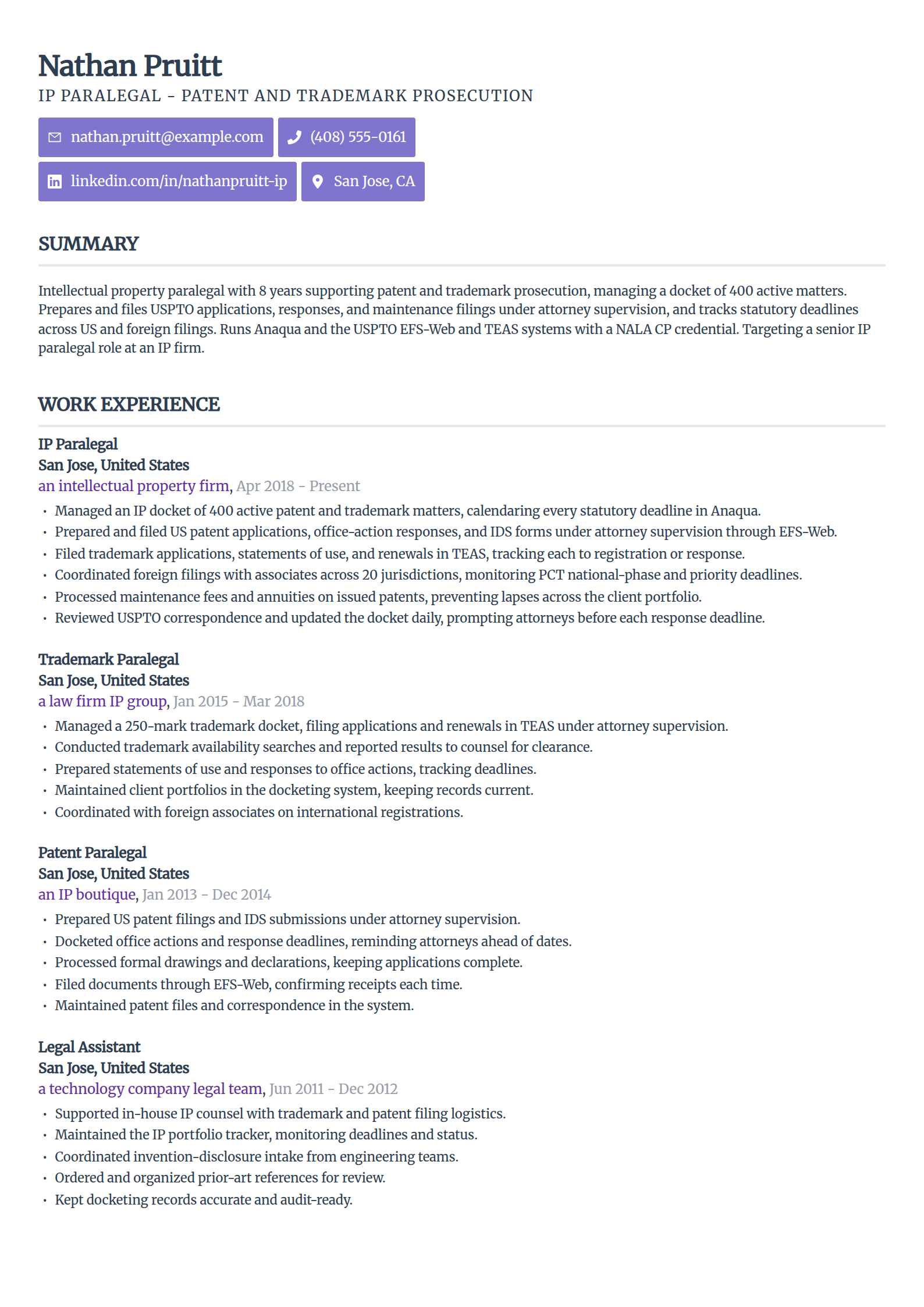
IP Paralegal Resume Template
Why this resume example works?
- Frames prosecution scope, a 400-matter patent and trademark docket with every statutory deadline calendared.
- Keeps filings under attorney supervision, applications, office-action responses, and renewals, never legal advice.
- Names the IP stack a posting requires, Anaqua docketing and the USPTO EFS-Web and TEAS systems.
- Shows the deadline discipline an IP role lives on, maintenance fees paid and foreign filings tracked across jurisdictions.
- Uses a clean, modern layout that carries a dense IP-docketing record on one page.
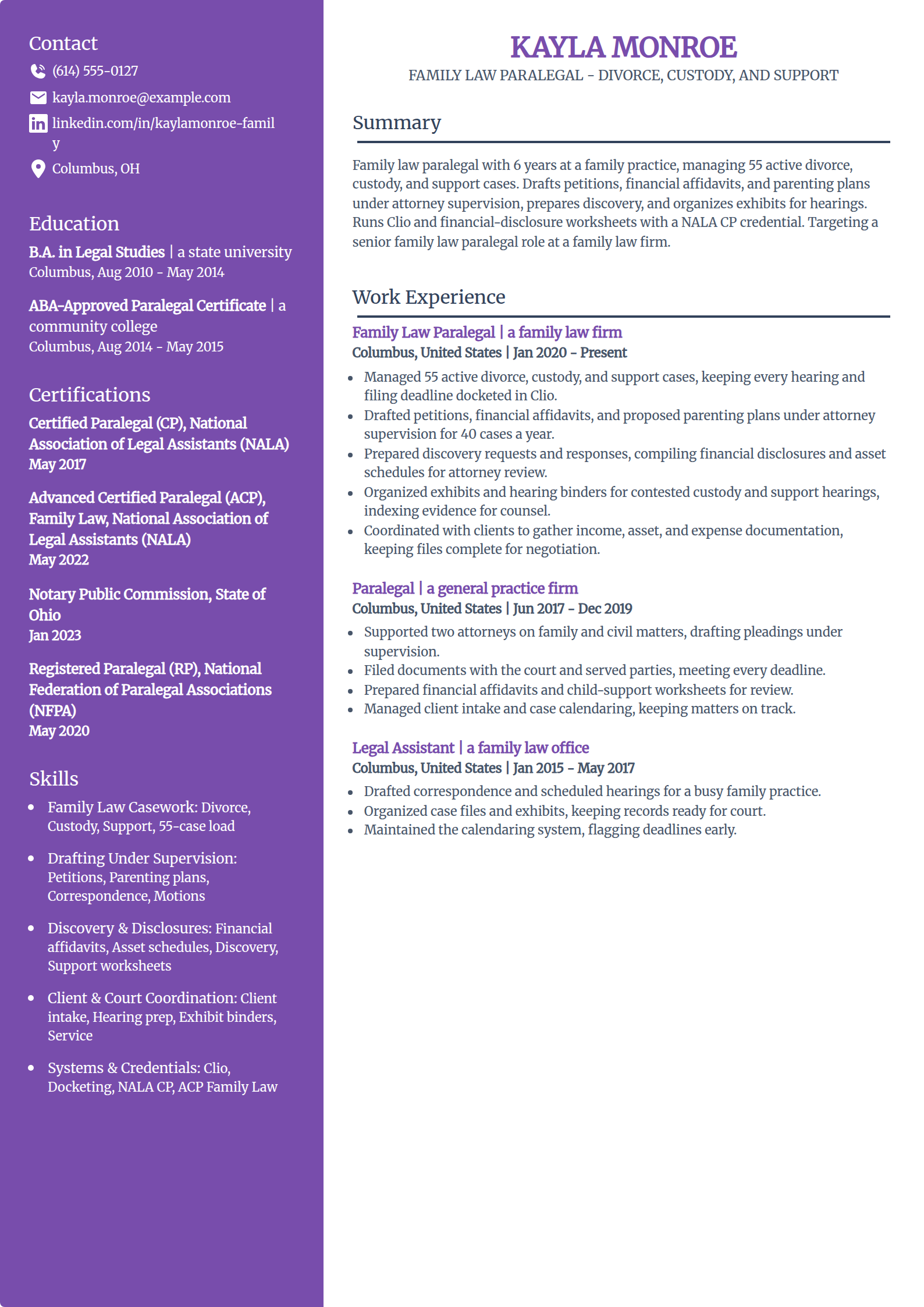
Family Law Paralegal Resume Template
Why this resume example works?
- Opens with family-law scope, 55 active divorce, custody, and support cases docketed in Clio.
- Keeps drafting under attorney supervision, petitions, financial affidavits, and proposed parenting plans.
- Shows the disclosure work a family practice needs, discovery and asset schedules compiled for review.
- Backs the practice with a NALA CP and an ACP in Family Law, credentials a firm recognizes at once.
- Uses a Medium layout that fits a focused family-law record without empty space.
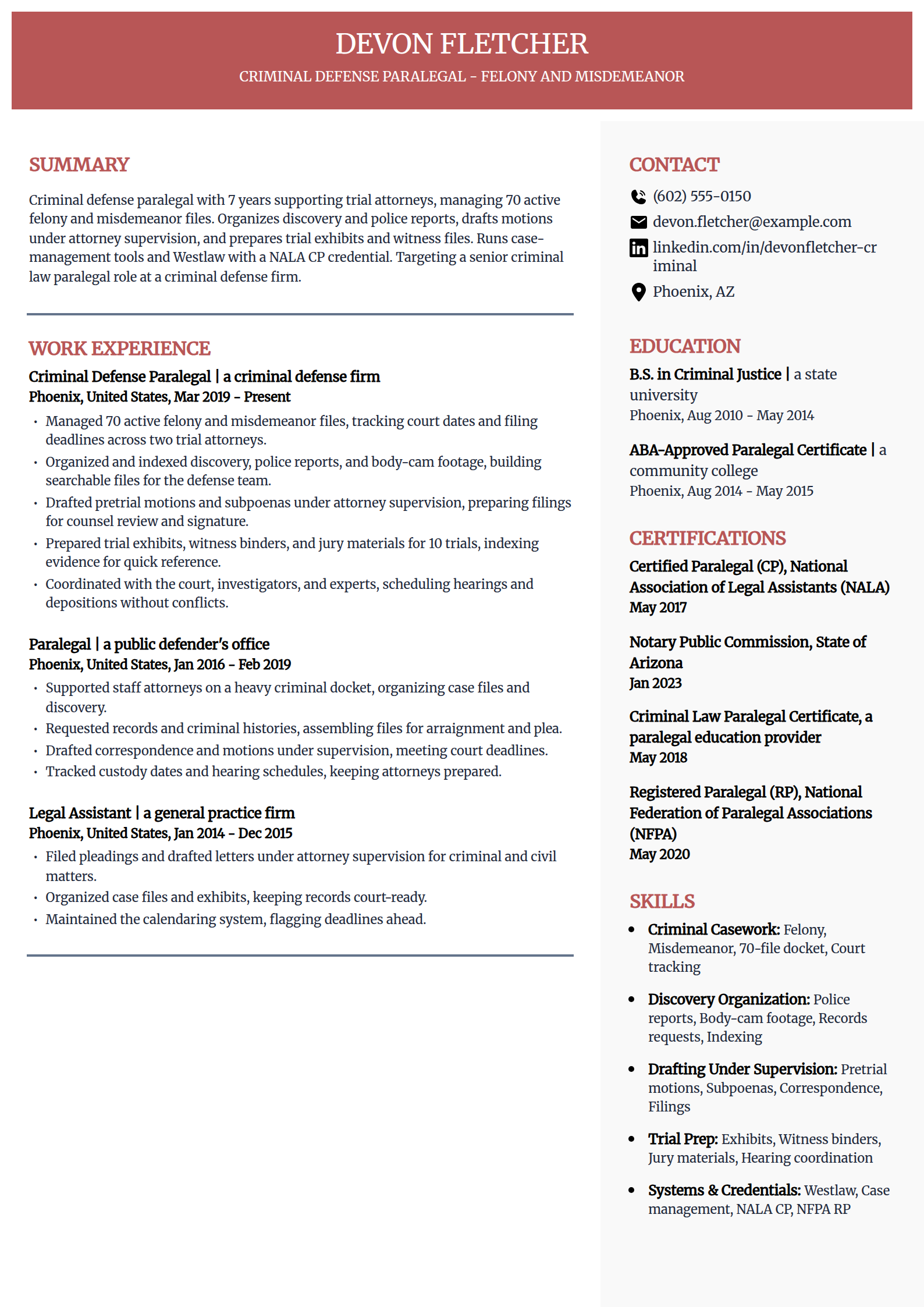
Criminal Law Paralegal Resume Template
Why this resume example works?
- Leads with defense scope, 70 active felony and misdemeanor files tracked across two trial attorneys.
- Keeps drafting under attorney supervision, pretrial motions and subpoenas prepared for counsel review.
- Shows the discovery work a defense team relies on, police reports and body-cam footage organized and indexed.
- Names the trial-prep tasks a criminal role owns, exhibits and witness binders assembled for 10 trials.
- Uses a refined layout that fits a criminal-defense record cleanly on one page.
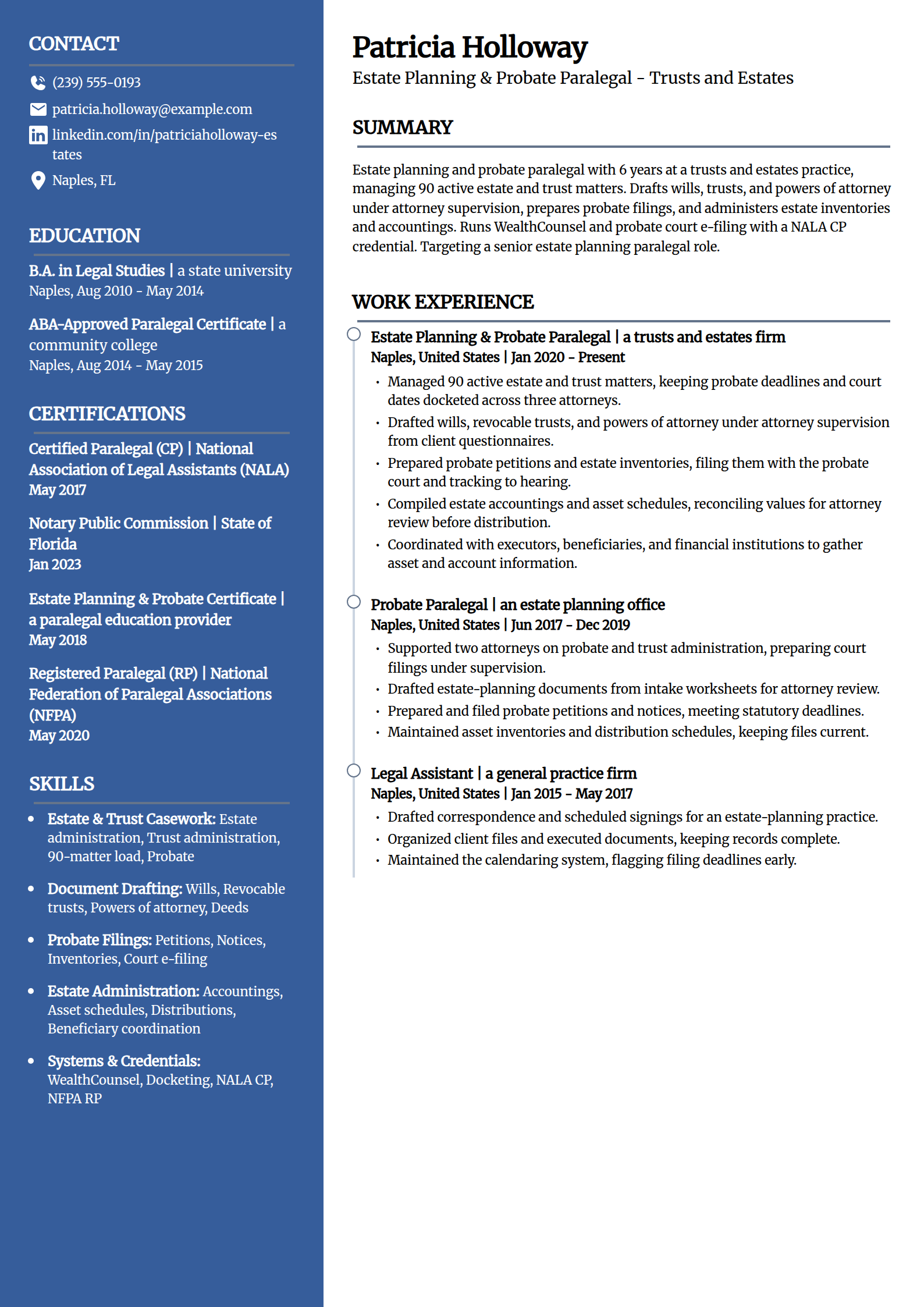
Estate Planning & Probate Paralegal Resume Template
Why this resume example works?
- Opens with trusts-and-estates scope, 90 active estate and trust matters docketed across three attorneys.
- Keeps drafting under attorney supervision, wills, revocable trusts, and powers of attorney from questionnaires.
- Shows the administration work a probate role owns, inventories, accountings, and asset schedules for review.
- Names the practice tools a posting lists, WealthCounsel drafting and probate court e-filing.
- Uses a distinctive layout that still reads cleanly for a hiring attorney.
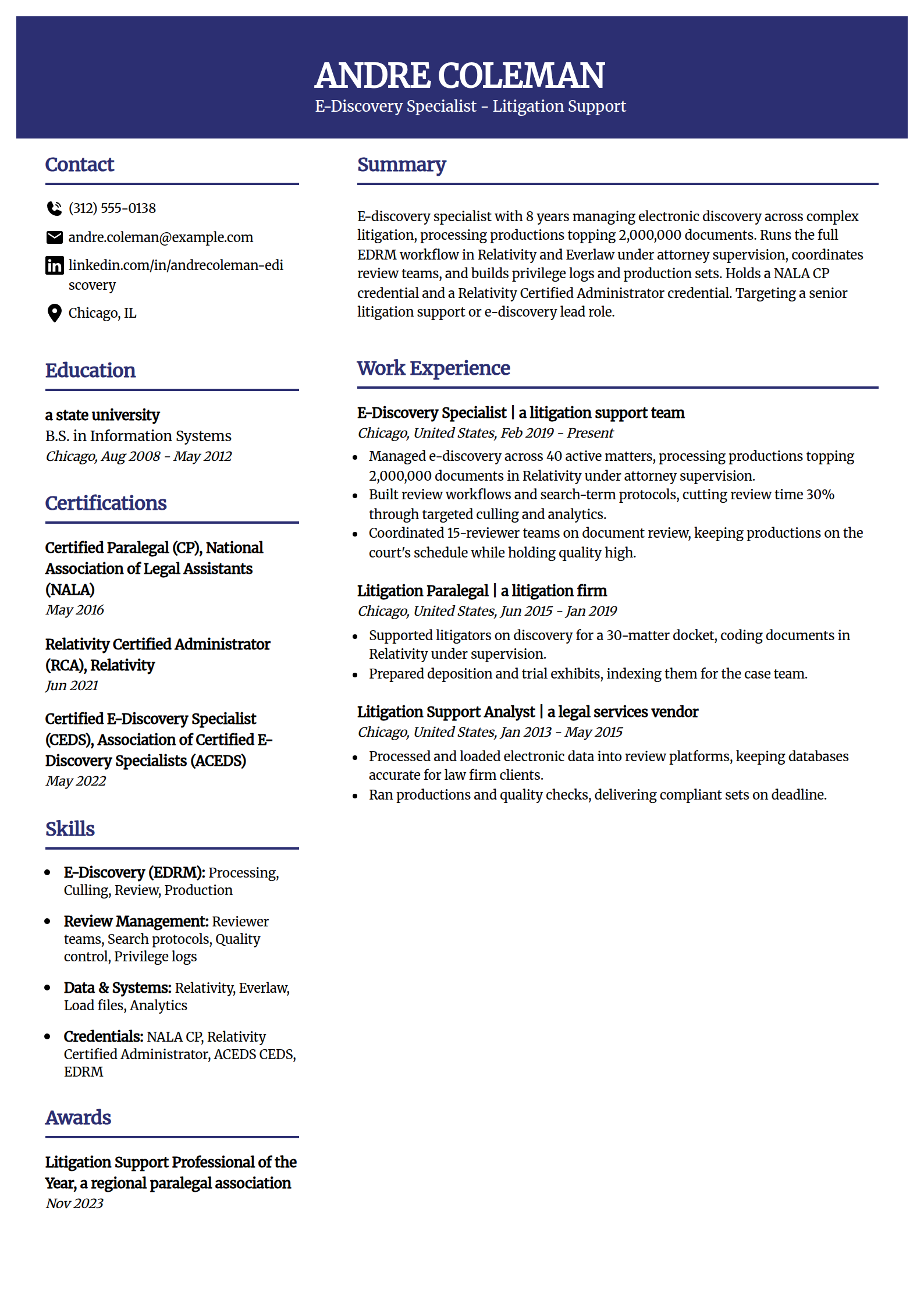
E-Discovery Specialist Resume Template
Why this resume example works?
- Frames litigation-support scope, e-discovery across 40 matters on productions topping 2,000,000 documents.
- Keeps the work under attorney supervision, review workflows and privilege logs, never legal advice.
- Names the specialist credentials that clear the screen, a Relativity Certified Administrator and an ACEDS CEDS.
- Shows measurable results a case team values, review time cut 30% through targeted culling and analytics.
- Uses a roomy two-column layout with the sidebar filled so the page reads complete.
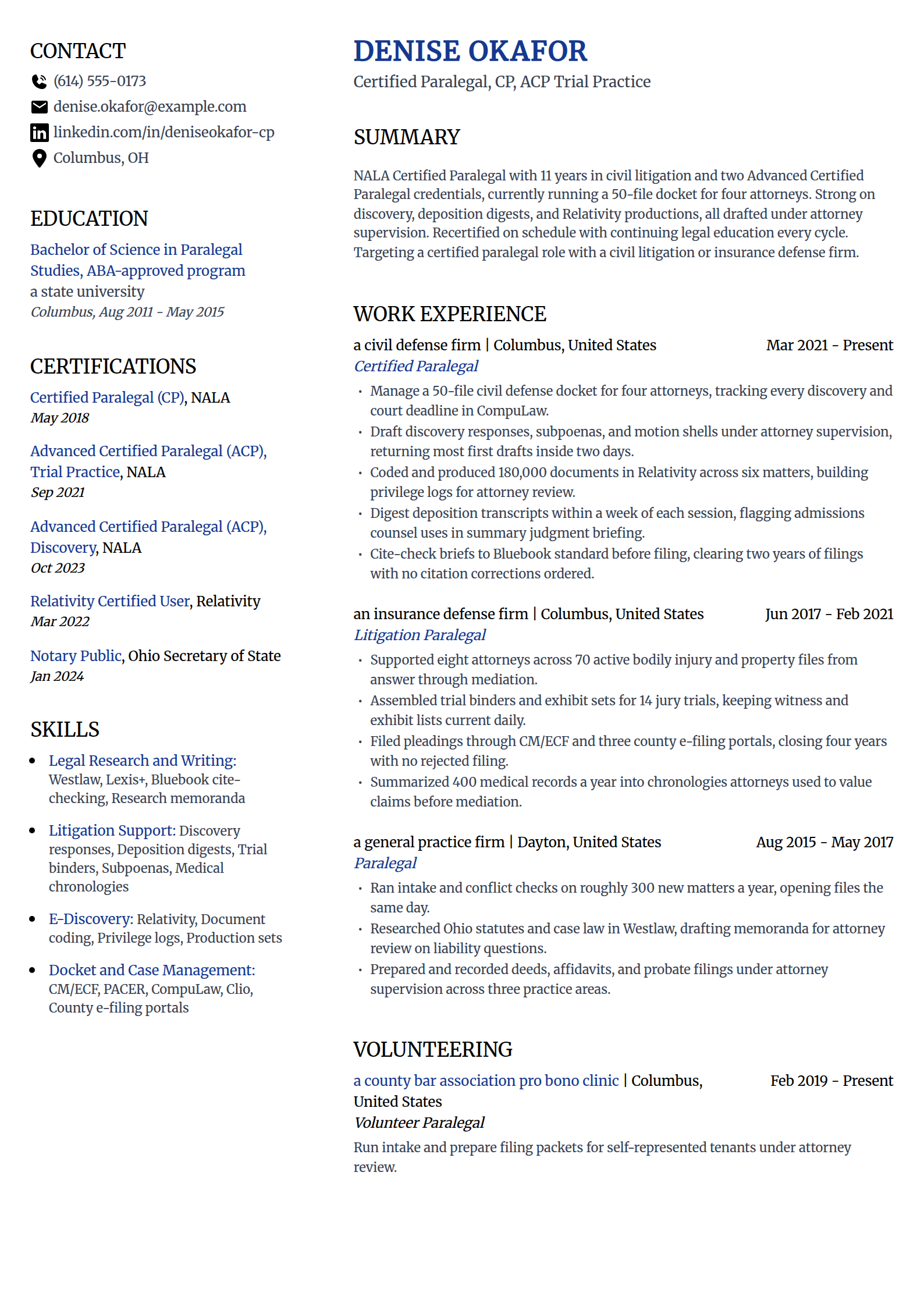
Certified Paralegal Resume Template
Why this resume example works?
- Puts the credential where a screener looks first, in the headline under the name and again in a credentials block.
- Names each credential exactly, a NALA Certified Paralegal plus two Advanced Certified Paralegal specialties, so a reviewer can verify it.
- Works the same way for an NFPA Registered Paralegal: swap the letters, keep the placement and the issuing body.
- Backs the letters with matching work, a 50-file docket and a 180,000-document Relativity production, so the credential reads earned.
- Shows currency without clutter by noting continuing legal education, which is what recertification actually requires.
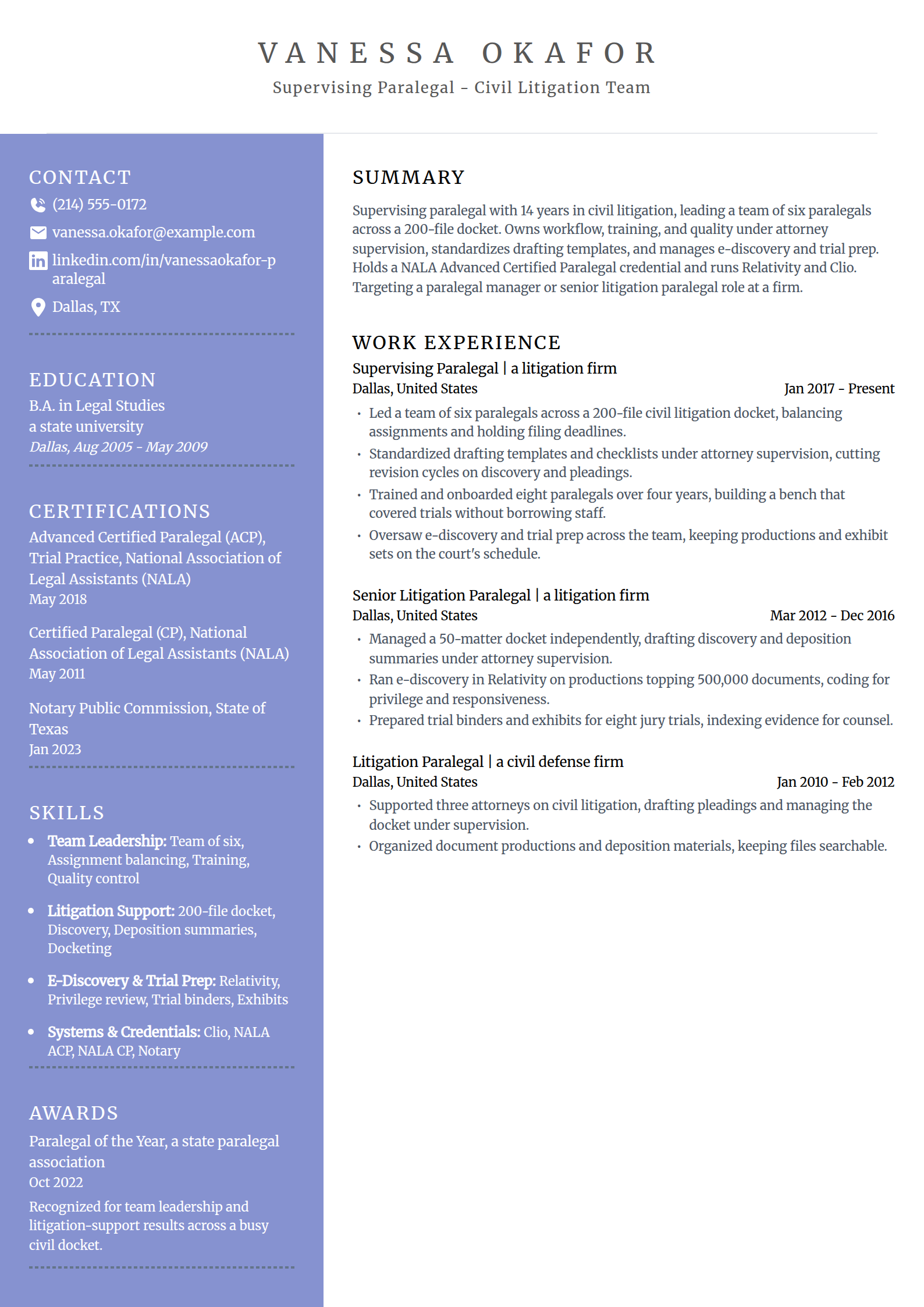
Senior & Supervising Paralegal Resume Template
Why this resume example works?
- Leads with senior scope, 14 years in civil litigation leading a team of six across a 200-file docket.
- Keeps supervision to workflow, training, and quality under attorney supervision, not practicing law.
- Backs the seniority with a NALA Advanced Certified Paralegal credential a firm recognizes.
- Shows the leadership work that matters at this level, standardized templates and eight paralegals trained.
- Uses a roomy layout with a filled sidebar so a senior record still looks full.
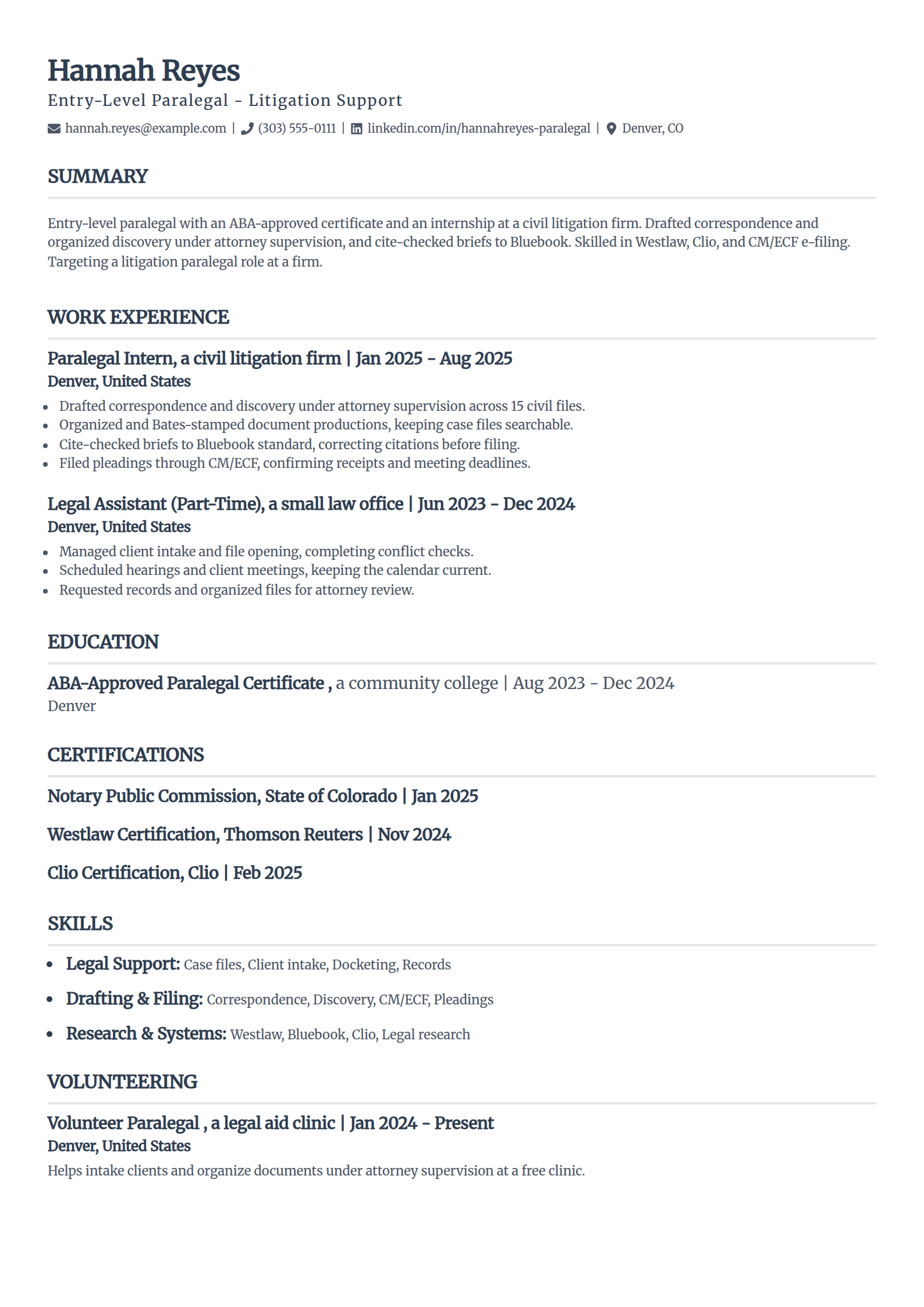
Entry-Level Paralegal Resume Template
Why this resume example works?
- Written for a new grad, leading with an ABA-approved certificate and a litigation-firm internship.
- Shows real supervised work, drafting correspondence and organizing discovery under attorney supervision.
- Names the tools a first posting checks, Westlaw, Clio, and CM/ECF, plus Bluebook cite-checking.
- Fills the page honestly with a legal-aid volunteer role rather than padding thin experience.
- Uses a tight, ATS-safe single-column layout that fits a beginner's record without empty space.
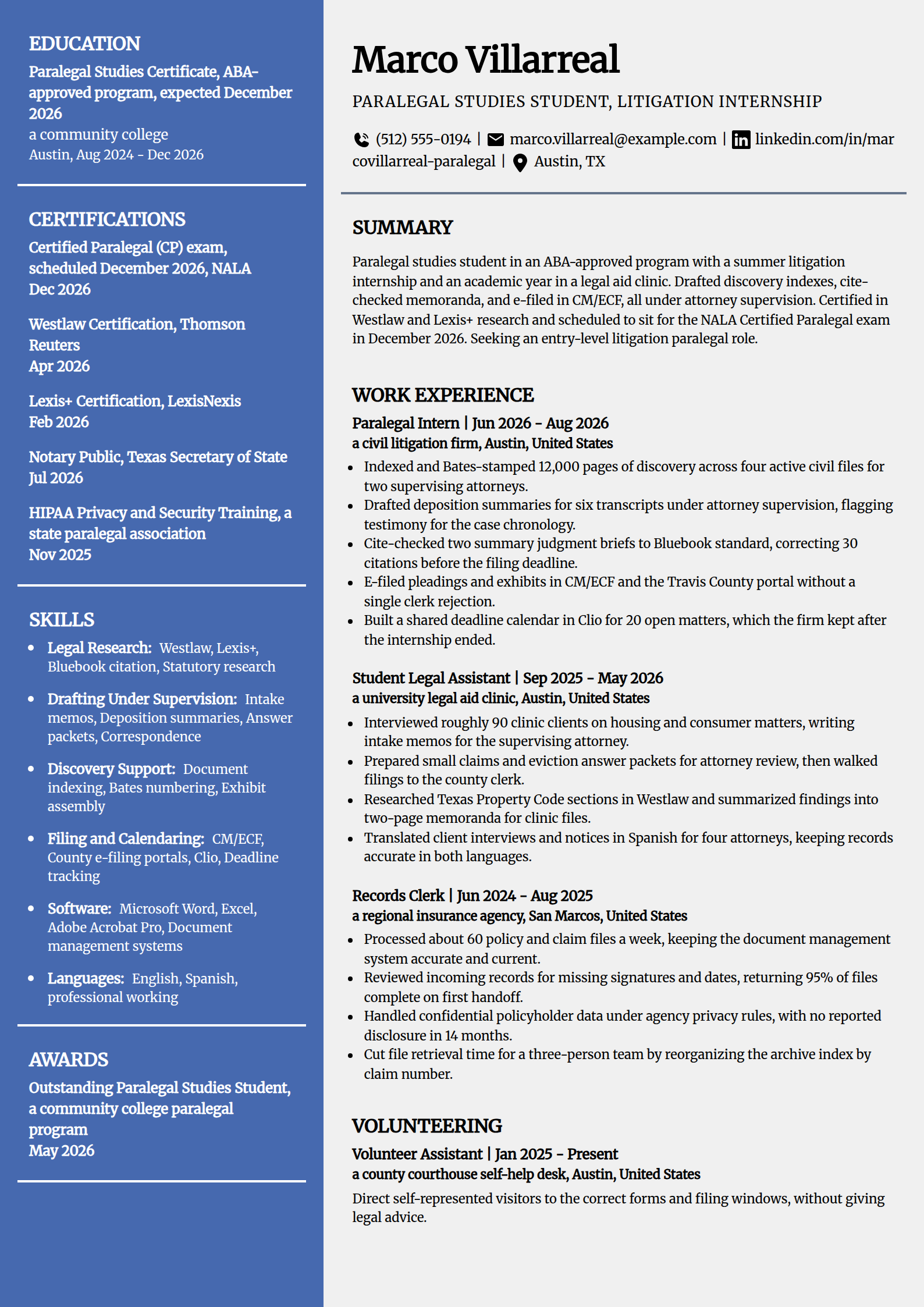
Paralegal Internship Resume Template
Why this resume example works?
- Treats one summer internship as real experience, with 12,000 pages indexed and six deposition summaries drafted under supervision.
- Fills a full page honestly from a clinic year and a records job, never padding with coursework lists.
- States the credential status precisely: scheduled to sit for the Certified Paralegal exam, not certified yet.
- Puts the transferable job last and frames it in records and confidentiality terms a legal employer recognizes.
- Leads the sidebar with an in-progress ABA-approved program, which is the strongest thing a student has to show.
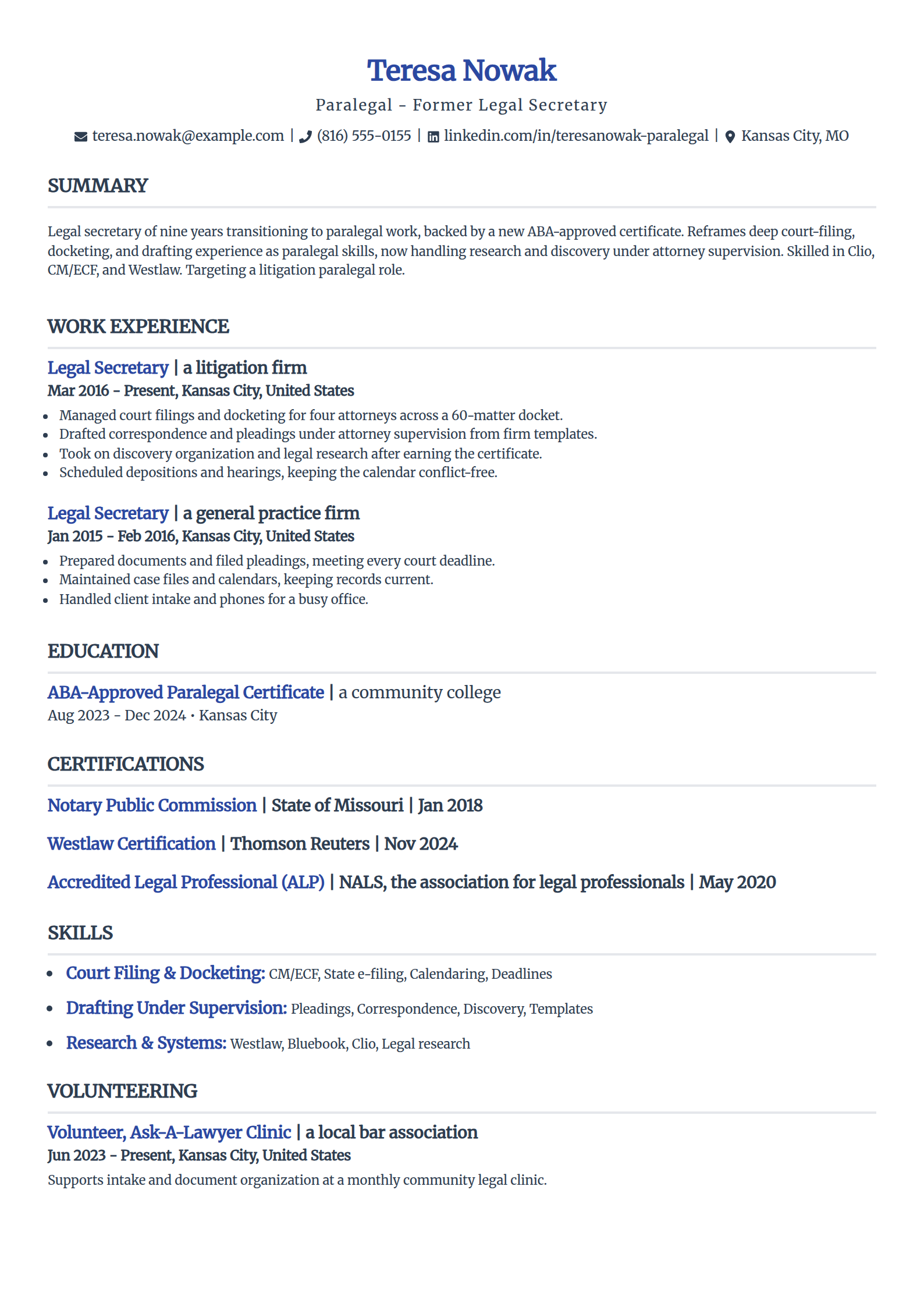
Career-Change Paralegal Resume Template
Why this resume example works?
- Names the change openly and reframes nine years of legal-secretary work as paralegal-ready skills.
- Shows recent commitment with a new ABA-approved certificate and paralegal-track work already taken on.
- Keeps scope honest: court filing, docketing, drafting, and research under attorney supervision.
- Pulls transferable strengths forward, CM/ECF filing and calendaring, so the pivot reads intentional.
- Uses a plain, ATS-safe layout that keeps the focus on transferable legal experience.
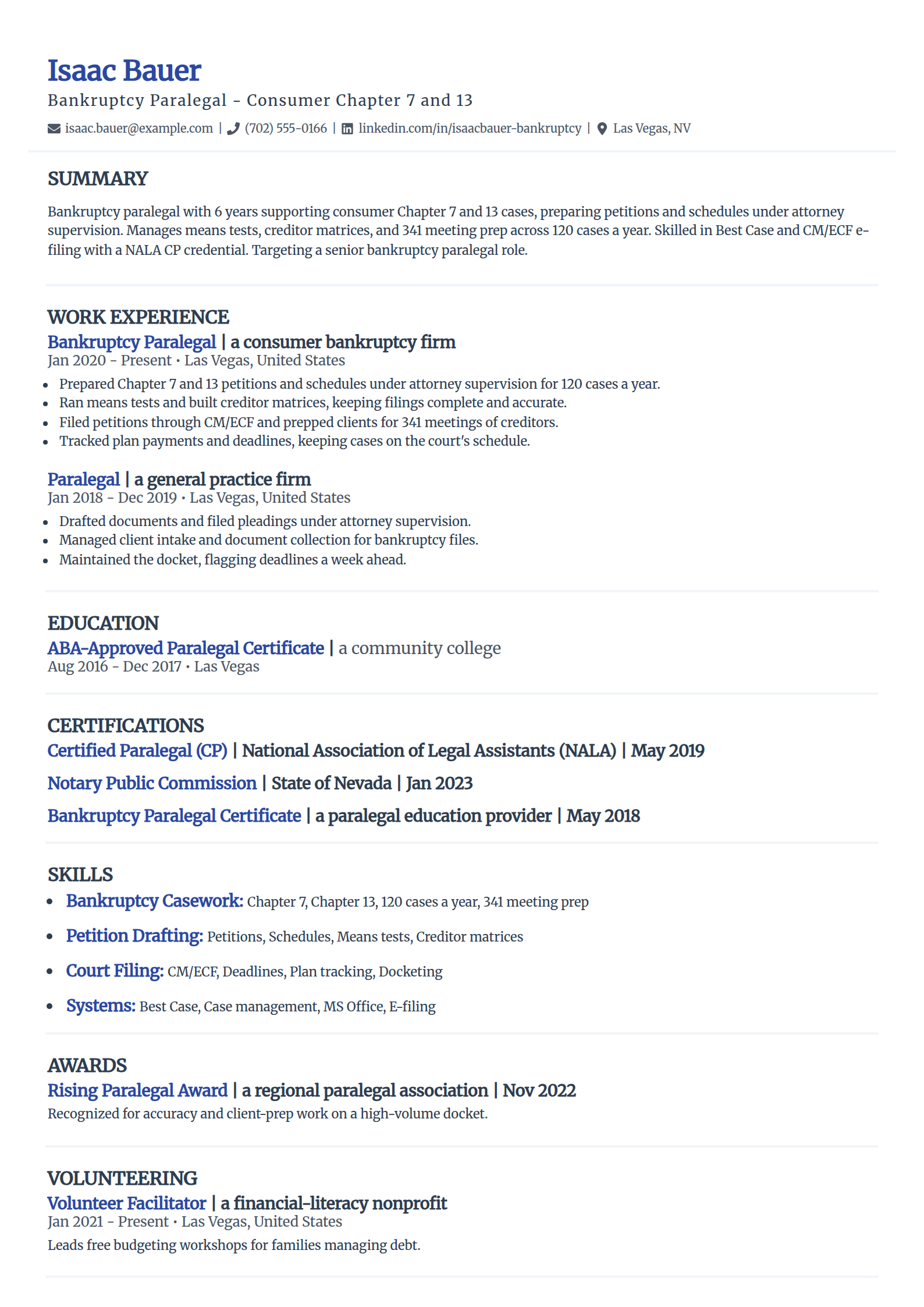
Bankruptcy Paralegal Resume Template
Why this resume example works?
- Opens with consumer scope, Chapter 7 and 13 petitions and schedules prepared for 120 cases a year.
- Keeps drafting under attorney supervision, means tests and creditor matrices built for counsel review.
- Names the tools a bankruptcy posting lists, Best Case software and CM/ECF e-filing.
- Shows the client work a practice needs, 341 meeting prep and plan-payment deadlines tracked.
- Uses a refined, uncluttered layout that fits a focused bankruptcy record on one clean page.
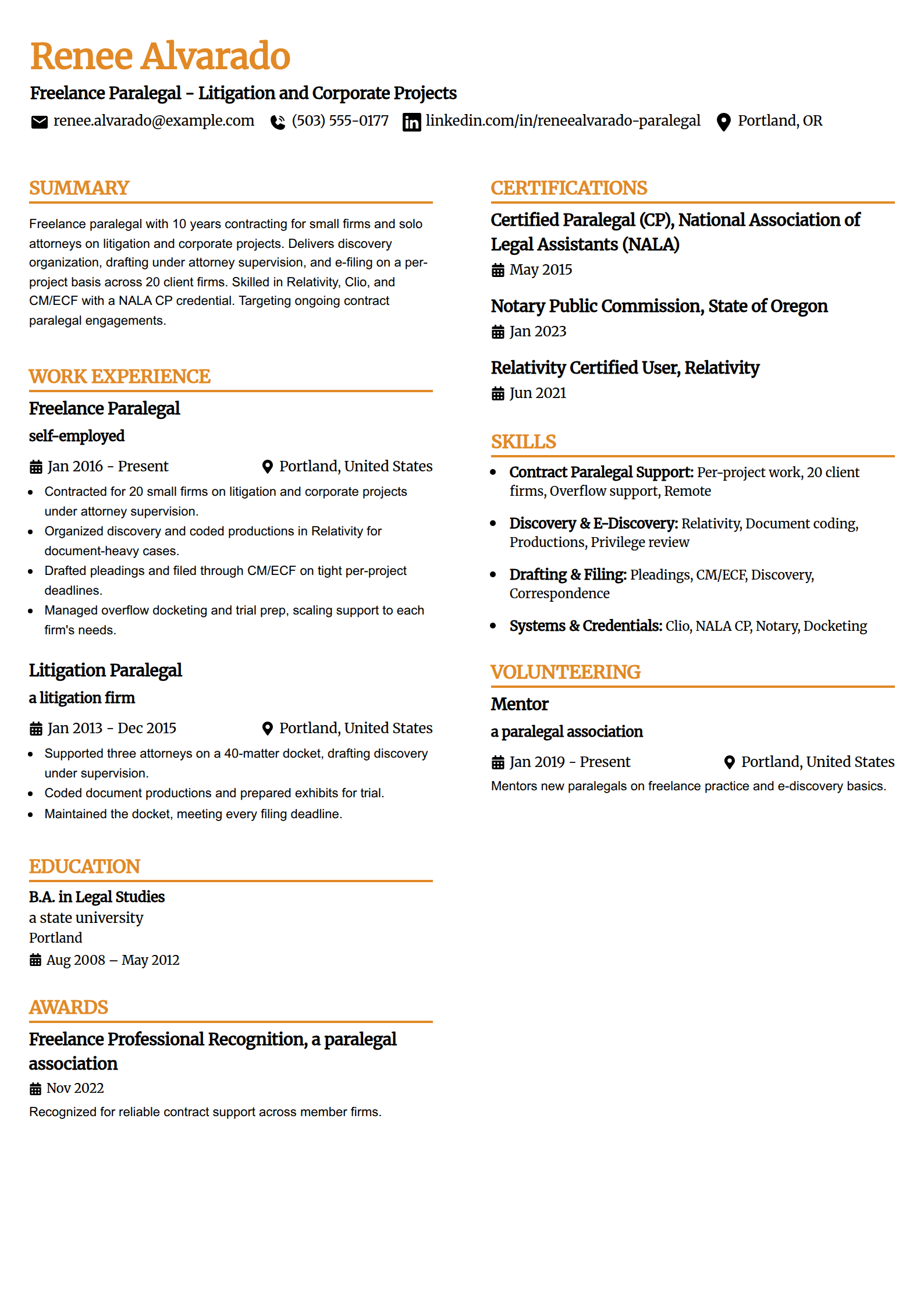
Freelance Paralegal Resume Template
Why this resume example works?
- Leads with contract scope, 10 years supporting 20 small firms on litigation and corporate projects.
- Keeps every engagement under attorney supervision, discovery, drafting, and e-filing on a per-project basis.
- Names the freelance stack, Relativity for document coding and CM/ECF for filing.
- Shows the flexibility a firm hires a contractor for, overflow docketing and trial prep scaled to need.
- Uses a tight, ATS-safe layout that fits a per-project record cleanly on one page.
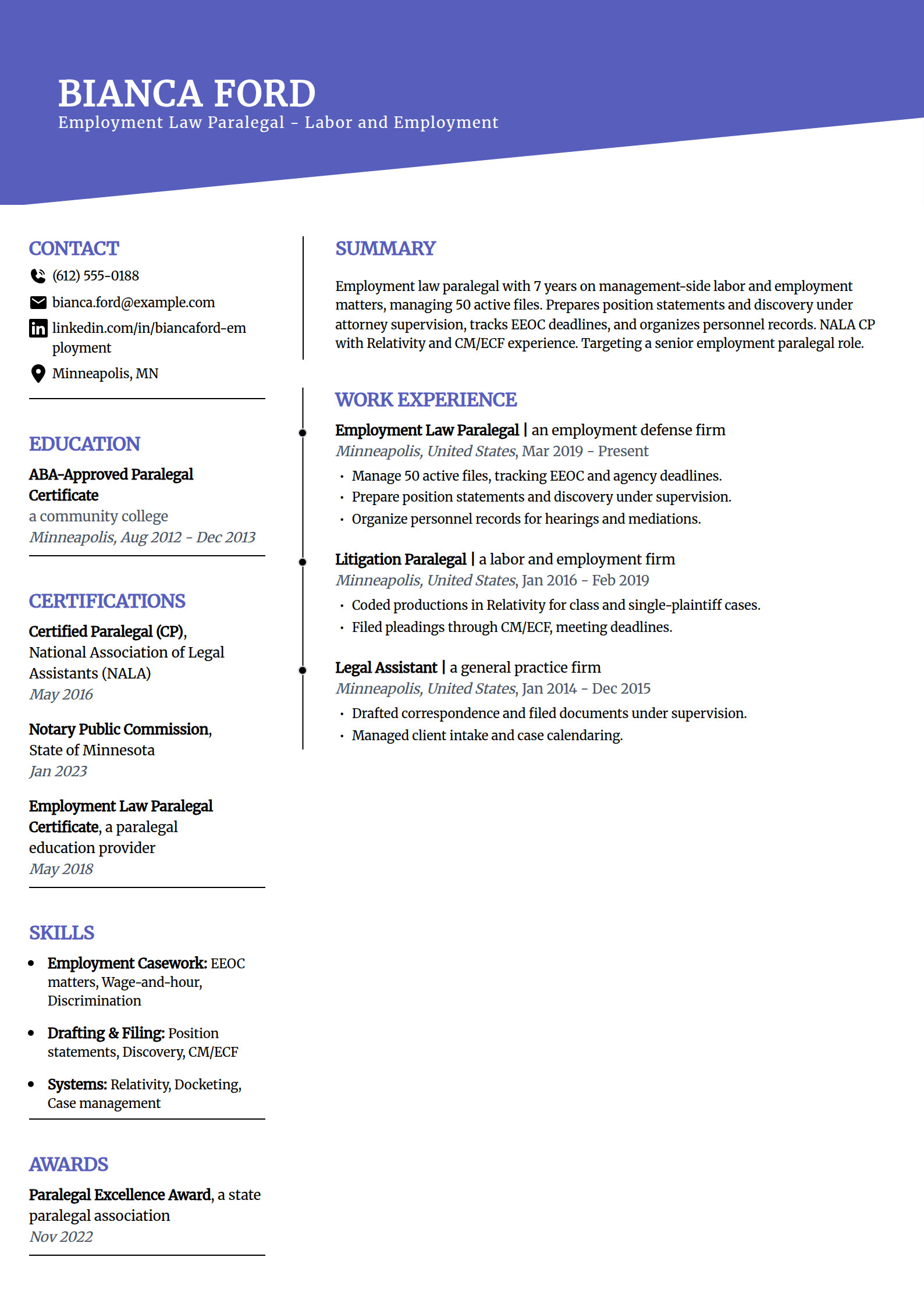
Employment Law Paralegal Resume Template
Why this resume example works?
- Leads with employment scope, 50 active files with EEOC and agency deadlines tracked.
- Keeps drafting under attorney supervision, position statements and discovery prepared for review.
- Names the tools a labor-and-employment posting lists, Relativity and CM/ECF.
- Shows the records work a practice needs, personnel files organized for hearings and mediations.
- Lists an award without a long description, keeping the two-column layout clean and balanced.
Build your paralegal resume
Pick a template above and the editor keeps your layout clean and ATS-safe while you swap in your own caseload, filings, certifications, and systems.
Build my resumeHow to write a paralegal resume in 2026
A paralegal resume is read by a hiring attorney who checks two things first: your certification and whether the work fits paralegal scope. Lead with a short summary that names your practice area, caseload, certification, and systems, then prove your experience with matters, drafting, and results, one number each. Keep every task inside scope, and keep the format clean so a parser reads it as easily as a person does.
Open with a practice-area summary
Write three to four sentences that name your years and practice area, your caseload or file count, one or two systems you use, and your certification, then the role you are targeting. A litigation paralegal leads with caseload and e-discovery; a corporate paralegal leads with entity work and closings; an immigration paralegal leads with case volume and USCIS forms. Keep it to about 60 words so it never spills past the top of the page.
Litigation paralegal with 8 years supporting civil litigation teams, managing 45 active files from complaint through trial. Runs discovery and e-discovery on productions topping 300,000 documents in Relativity, drafts pleadings under attorney supervision, and keeps the docket in CM/ECF. Holds a NALA Certified Paralegal credential. Targeting a senior litigation paralegal role.
Lead experience with caseload, drafting, and results
The work a paralegal resume is hired for is concrete, so name it and attach one modest number to each bullet. Open every line with a strong verb, never "Responsible for" or "Helped with".
- Caseload: state your active files and their type, like managing 45 civil litigation matters from complaint through trial.
- Drafting: name what you draft and add "under attorney supervision", such as 60 discovery requests and deposition summaries a year.
- Discovery: name the platform and scale, like coding a 300,000-document production in Relativity or Everlaw.
- Results the role can own: documents reviewed, filings drafted, entity records maintained, or trials supported, never cases won.
Keep the resume inside paralegal scope (the honest rule)
This is the section most guides skip, and the fastest way to get screened out is to claim work a paralegal cannot own. Practice-area specificity is what separates a strong paralegal resume from a generic legal-assistant or admin one, so name the area and its real tasks, and keep every claim in scope.
- A paralegal does not practice law, give legal advice, represent clients, or win cases. Use research, drafting under attorney supervision, discovery, cite-checking, docketing, e-filing, and trial prep.
- Do not write "advised clients", "argued motions", or "negotiated settlements on behalf of the client"; those read as unauthorized practice and sink the resume.
- Show the practice area outright, litigation, corporate, immigration, real estate, or IP, with the tasks and tools it actually uses, so the resume does not read as a generic office role.
- Claim outcomes your role owns: a paralegal supports the attorneys who argue and settle, and says so, tying results to documents drafted, files managed, or productions reviewed.
State your certification and when it matters
You do not always need a certification to work as a paralegal, but stating the right credential in the right place helps clear the first screen, especially when a posting asks for one.
- List a NALA Certified Paralegal (CP) or NFPA Registered Paralegal (RP) near the top, in the summary or a credentials line, since a hiring attorney looks for it early.
- Name your ABA-approved paralegal certificate and, if you have one, a NALA Advanced Certified Paralegal (ACP) in your practice area, like Trial Practice or Real Estate.
- State a certification when the posting requires or prefers one; if you are not certified, lead with your certificate, experience, and supervised work instead of leaving a gap.
- Add a notary public commission where you hold one, and keep credential names exact so a reviewer can verify them.
Match your skills to the posting's keywords
A paralegal skills list should read like the job description. Split it so a hiring attorney and a parser both find what they need.
- Research and writing: Westlaw, LexisNexis, Bluebook citation, legal research, and drafting under attorney supervision.
- Litigation: e-discovery in Relativity or Everlaw, CM/ECF e-filing, PACER, docketing, and deposition or trial prep.
- Corporate and transactional: entity management, due diligence, data rooms, UCC filings, and CLM tools like iManage or DocuSign.
- Practice systems: case management like Clio or MyCase, immigration tools like Docketwise, real estate tools like SoftPro, and IP tools like Anaqua.
Keep it to one clean, ATS-safe page
Law firms and corporate legal departments run applicant tracking systems, and the profession is conservative, so a clean one-page resume is the standard for most paralegals.
- Use a single-column or simple two-column layout with standard headings a parser recognizes; skip heavy graphics and photos.
- Hold it to one page and lead with your most recent role in reverse-chronological order; a seasoned paralegal with a long record may run to two.
- Save as a PDF so the formatting holds, then run it through our ATS resume checker for a quick format and keyword pass.
- Swap the numbers in the templates above for your own caseload, filings, and systems; do not copy them as is.
Common paralegal resume mistakes
- Overstating into practicing law. "Advised clients" or "argued motions" reads as unauthorized practice; keep every task to supervised work like research, drafting, and discovery.
- Writing a generic office resume. "Handled legal documents" tells an attorney nothing; name your practice area and its real tasks, like preparing I-130 packages or coding a Relativity production.
- Leaving off your caseload. Say how many active files you manage and their type, like "45 active civil litigation matters", so the scope of your work is clear.
- Listing Relativity or Clio with no result. Tie each tool to what you produced, like a coded 300,000-document production or a 200-file docket kept on schedule.
- Burying your certification. Put your NALA CP, NFPA RP, or paralegal certificate near your name or in a credentials block, not at the bottom of the page.
- Calling yourself certified when you hold a program certificate. A paralegal program awards a certificate of completion; certified means you passed NALA's CP exam or NFPA's PACE exam. List what you actually hold, under its exact name.
Frequently asked questions
What should a paralegal put on a resume?
Lead with a three-to-four-sentence summary that names your practice area, your caseload or file count, your certification, and the systems you use. Under each job, write results-first bullets that open with a strong verb and carry one credible number, like managing 45 active litigation files or coding a 300,000-document production in Relativity. Add your certification, such as a NALA Certified Paralegal, near the top, list your tools and practice-area skills, and keep the whole thing to one clean, ATS-safe page.
What skills and certifications go on a paralegal resume?
Group skills into research and writing, litigation, corporate or transactional, and practice systems, and name the tools you actually use, like Westlaw, Relativity, CM/ECF, Clio, Docketwise, SoftPro, or Anaqua. For certifications, list a NALA Certified Paralegal (CP) or NFPA Registered Paralegal (RP), your ABA-approved paralegal certificate, and a NALA Advanced Certified Paralegal (ACP) in your practice area if you hold one. Add a notary public commission where you have one, and keep every credential name exact so a reviewer can verify it.
How do you write a paralegal resume with no experience?
Lead with the legal work you have done in school or in a supervised role. A new paralegal leads with an ABA-approved certificate, an internship, and any drafting, research, or discovery done under attorney supervision, treating each as a real experience entry with quantified bullets. Name the tools you learned, like Westlaw, Clio, and CM/ECF, and fill the page honestly with a legal-aid volunteer role or a program honor rather than padding. The entry-level and career-changer examples above show the shape.
What is the difference between a paralegal and a legal assistant resume?
The difference is the level of substantive legal work. A paralegal resume leads with case-based work under attorney supervision: legal research, drafting pleadings and discovery, e-discovery, cite-checking, and trial prep, tied to a practice area and its tools. A legal assistant or legal secretary resume leads with administrative support: scheduling, court filing, docketing, and client intake. If you do substantive research and drafting, frame the resume as a paralegal and name your certification; if the role is mostly administrative, a legal assistant resume fits better, and our legal page covers that track.
How long should a paralegal resume be?
One page for most paralegals, including entry-level, career-changers, and mid-level candidates. A single, skimmable page led by your most recent role is what a hiring attorney expects, and it parses cleanly in an applicant tracking system. A seasoned or supervising paralegal with a long, relevant record may run to two pages, but only when the second page carries results, not filler. Cut older or unrelated jobs so the space goes to caseload, filings, and the systems the posting names.
Do you need a certification to be a paralegal?
Not always. Many paralegals work without a formal certification, but a NALA Certified Paralegal (CP), an NFPA Registered Paralegal (RP), or an ABA-approved paralegal certificate helps clear the first screen, and some postings prefer or require one. State the credential you hold near the top of the resume, under its exact name and issuing body. Keep the two kinds of credential separate: a paralegal program awards a certificate of completion, while certified means you passed an exam, so finishing a course does not make you a Certified Paralegal. If you are not certified, lead with your paralegal certificate, your supervised experience, and your practice-area skills instead of leaving a gap, and say you are scheduled to sit for the exam if a date is set.
More paralegal resume resources
Build your paralegal resume
Pick a template above and the editor keeps your layout clean and ATS-safe while you swap in your own caseload, filings, certifications, and systems.