16 Legal Resume Examples, Associate Attorney to Paralegal
- ATS Friendly
- Lawyer & Paralegal
- 16 Real Examples
A legal resume is judged on two things a reviewer checks first: your credentials and whether the work matches your role. Pick a clean layout below, then model your own on a real example built for your track, from a litigation associate to a corporate paralegal. Attorney examples state bar admission precisely and paralegal examples stay inside paralegal scope.


540k+ resumes created
Editable legal resume templates
Each template below is a real legal resume laid out in that format, sorted by track and seniority across the whole legal field. Choose one, then swap in your own caseload, filings, credentials, and systems. Every layout keeps your name, bar admission or certification, and dates clean so a hiring partner reads your experience at a glance and an applicant tracking system parses it without trouble.
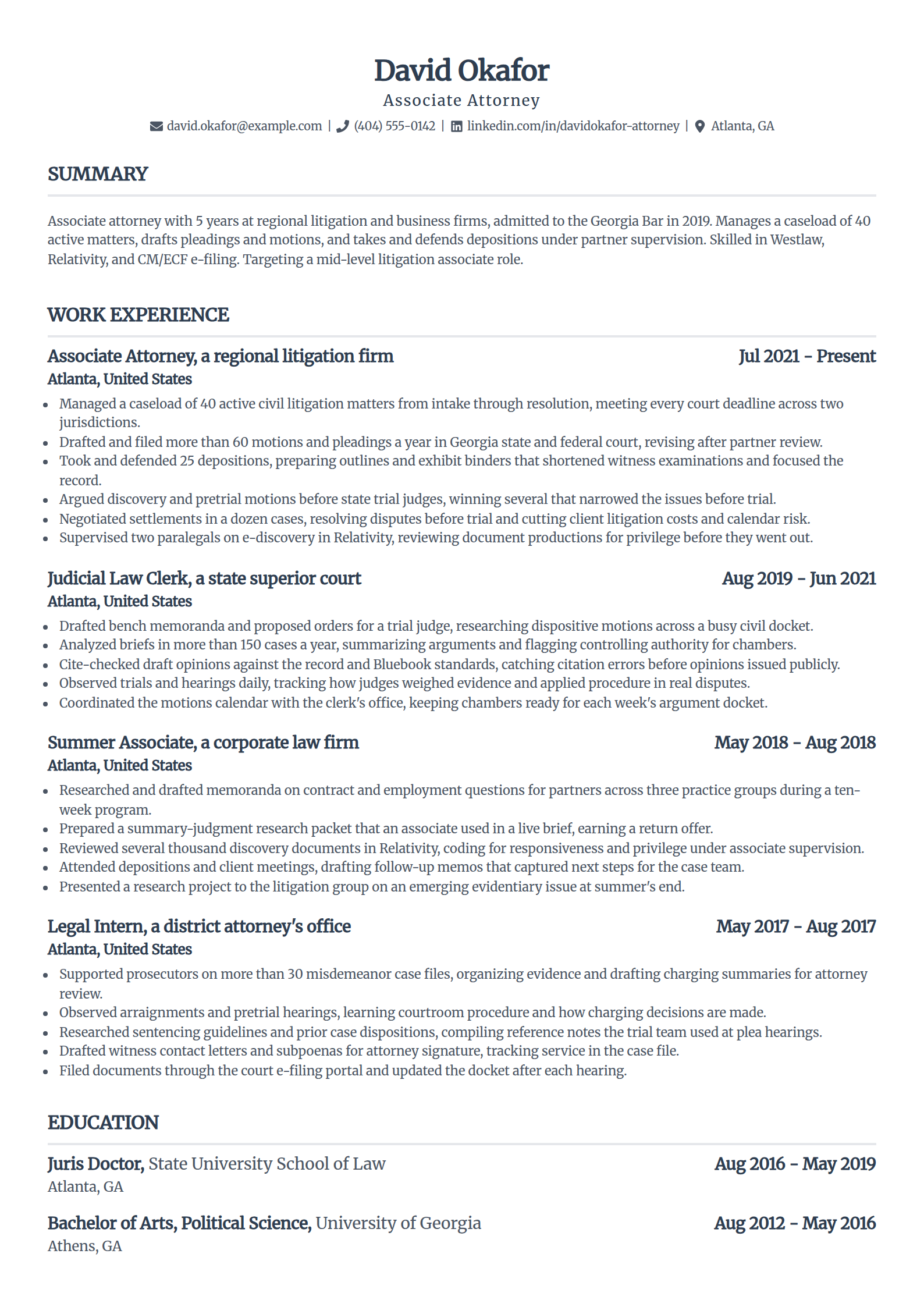
Associate Attorney Resume Template
Why this resume example works?
- Opens with a summary that names 5 years, admission to the Georgia Bar in 2019, and a 40-matter caseload.
- States bar admission with the state and year, the first thing a hiring partner checks on a legal resume.
- Leads each bullet with a strong verb and one number, like drafting 60 motions a year or defending 25 depositions.
- Names the tools litigators run on, Westlaw, Relativity, and CM/ECF e-filing, as applicant-tracking keywords.
- Uses a clean single-column layout that an applicant tracking system parses without trouble.
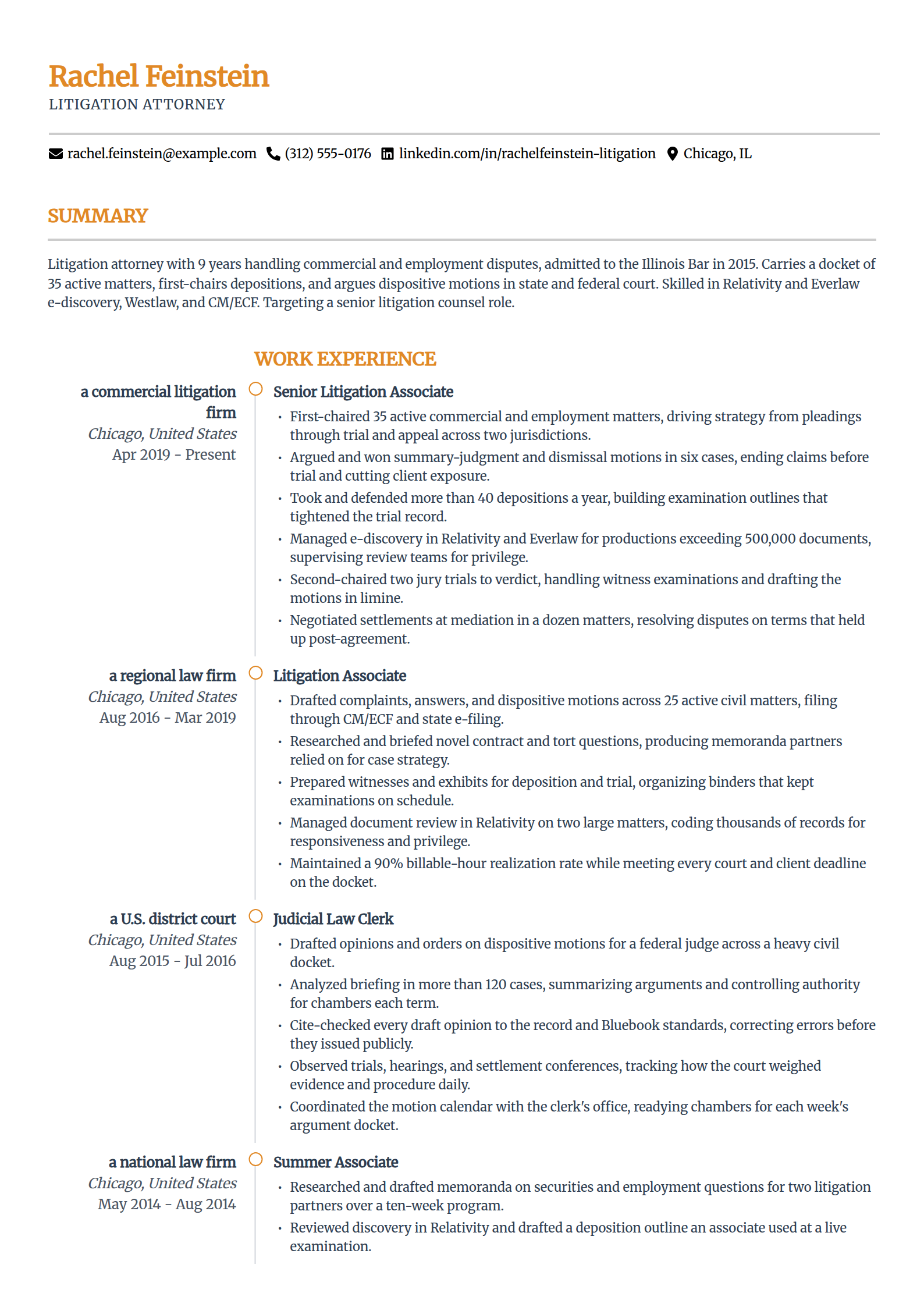
Litigation Attorney Resume Template
Why this resume example works?
- Frames a 9-year litigator up top, admitted to the Illinois Bar in 2015, first-chairing a 35-matter docket.
- Shows courtroom results an interviewer can quote, winning summary judgment in six cases and second-chairing two trials.
- Names e-discovery platforms by name, Relativity and Everlaw, on a production exceeding 500,000 documents.
- Keeps each bullet to one credible number so the seniority reads as earned rather than inflated.
- Uses a modern layout that carries a deep litigation history on one clean page.
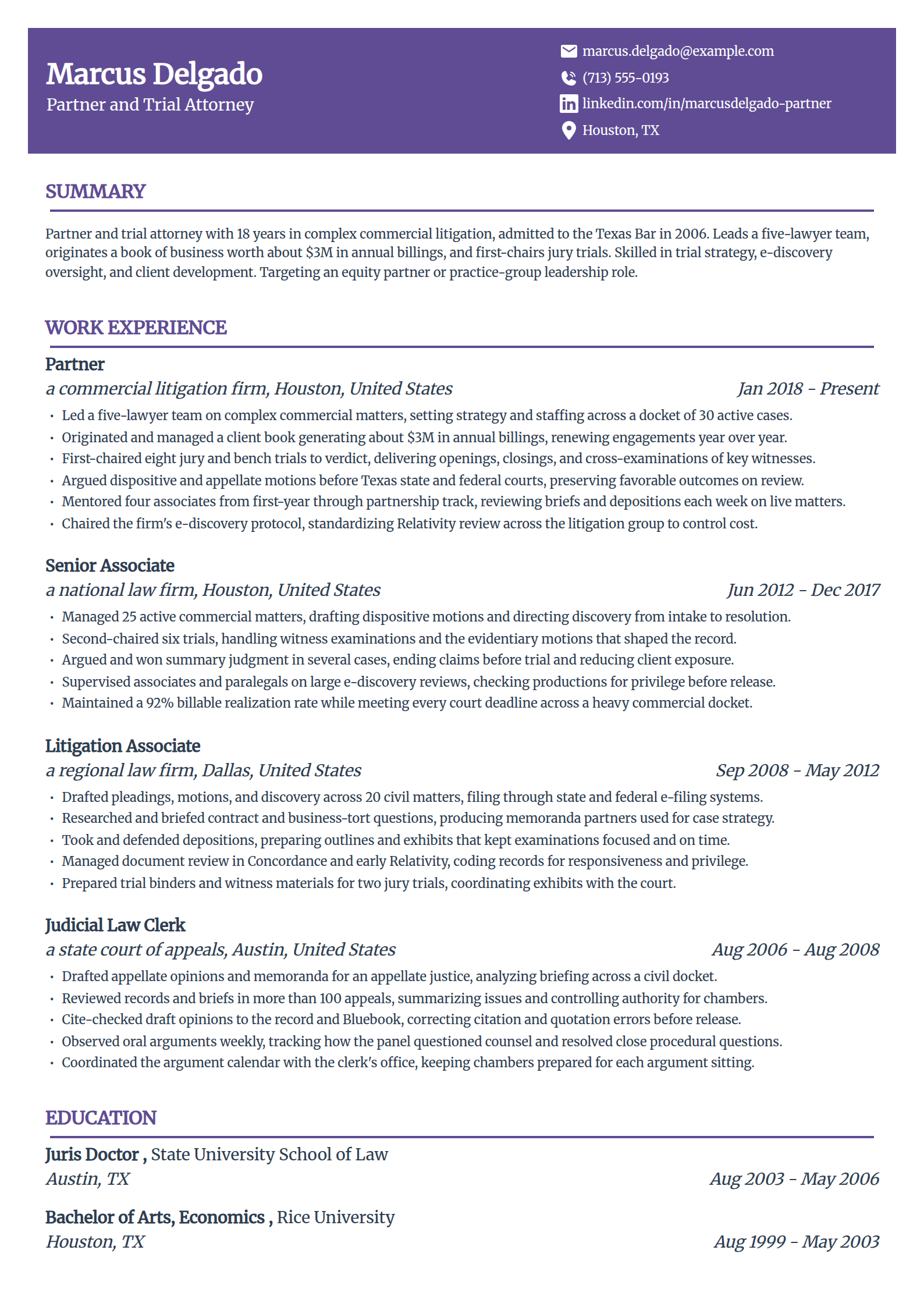
Senior Attorney & Partner Resume Template
Why this resume example works?
- Leads with partner scope, an 18-year Texas Bar admission, a five-lawyer team, and about $3M in annual billings.
- Turns trial work into leadership, first-chairing eight trials and mentoring associates toward partnership.
- Backs seniority with a Board Certification in Civil Trial Law, a credential a firm recognizes at once.
- Balances origination and courtroom bullets so the resume reads as a working trial partner, not a title.
- Uses a modern layout that fits four roles and a long record without crowding the page.
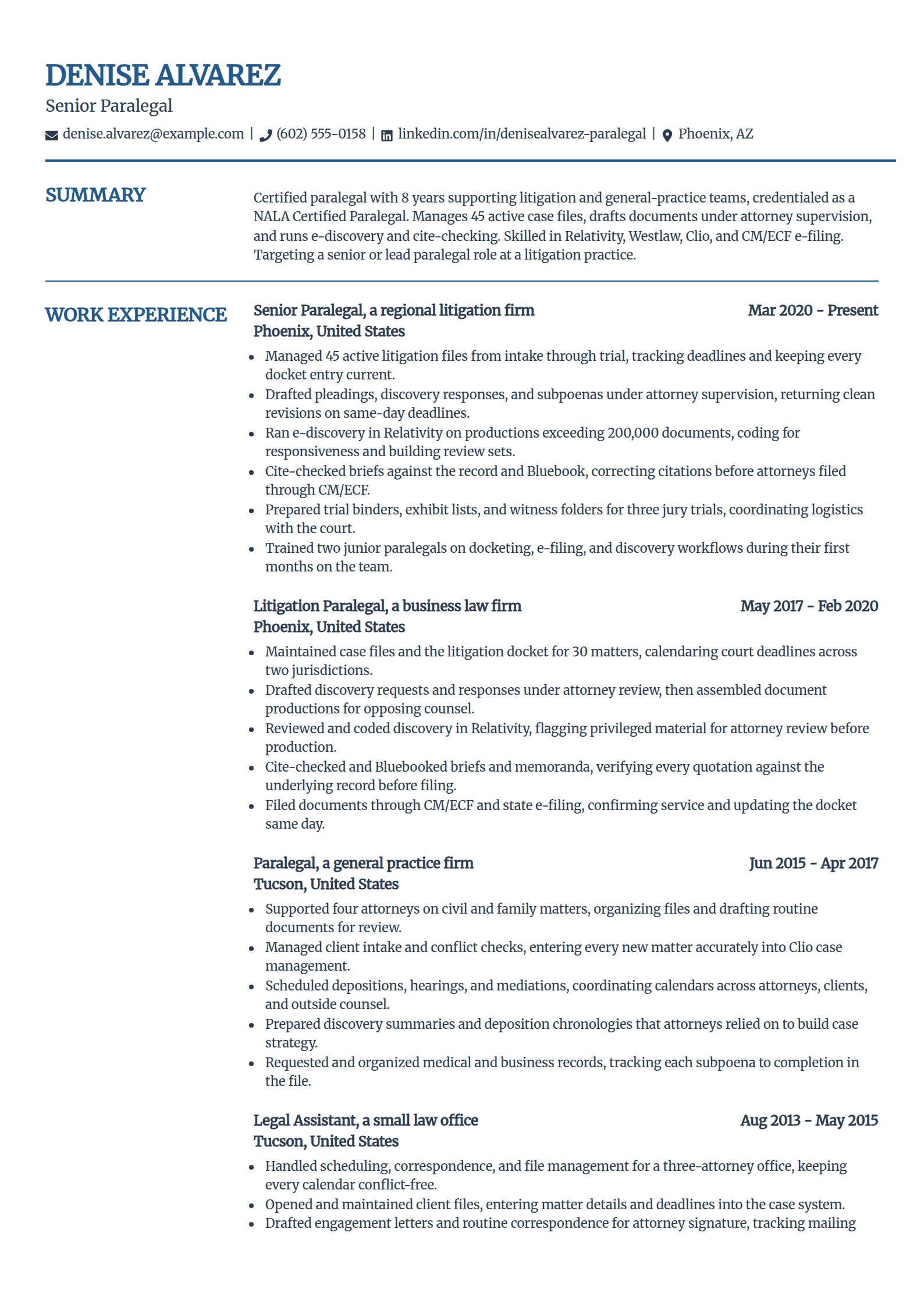
Experienced Paralegal Resume Template
Why this resume example works?
- Leads with the paralegal work firms hire for, managing 45 files and running e-discovery on 200,000 documents.
- Keeps every task in scope: drafting under attorney supervision, cite-checking, docketing, and trial prep, never practicing law.
- Names the credential up front, a NALA Certified Paralegal, plus Relativity and Clio as keywords.
- Attaches one number to most bullets so the experience reads concrete rather than generic.
- Uses a clean layout that fits a full litigation-support history on one page.
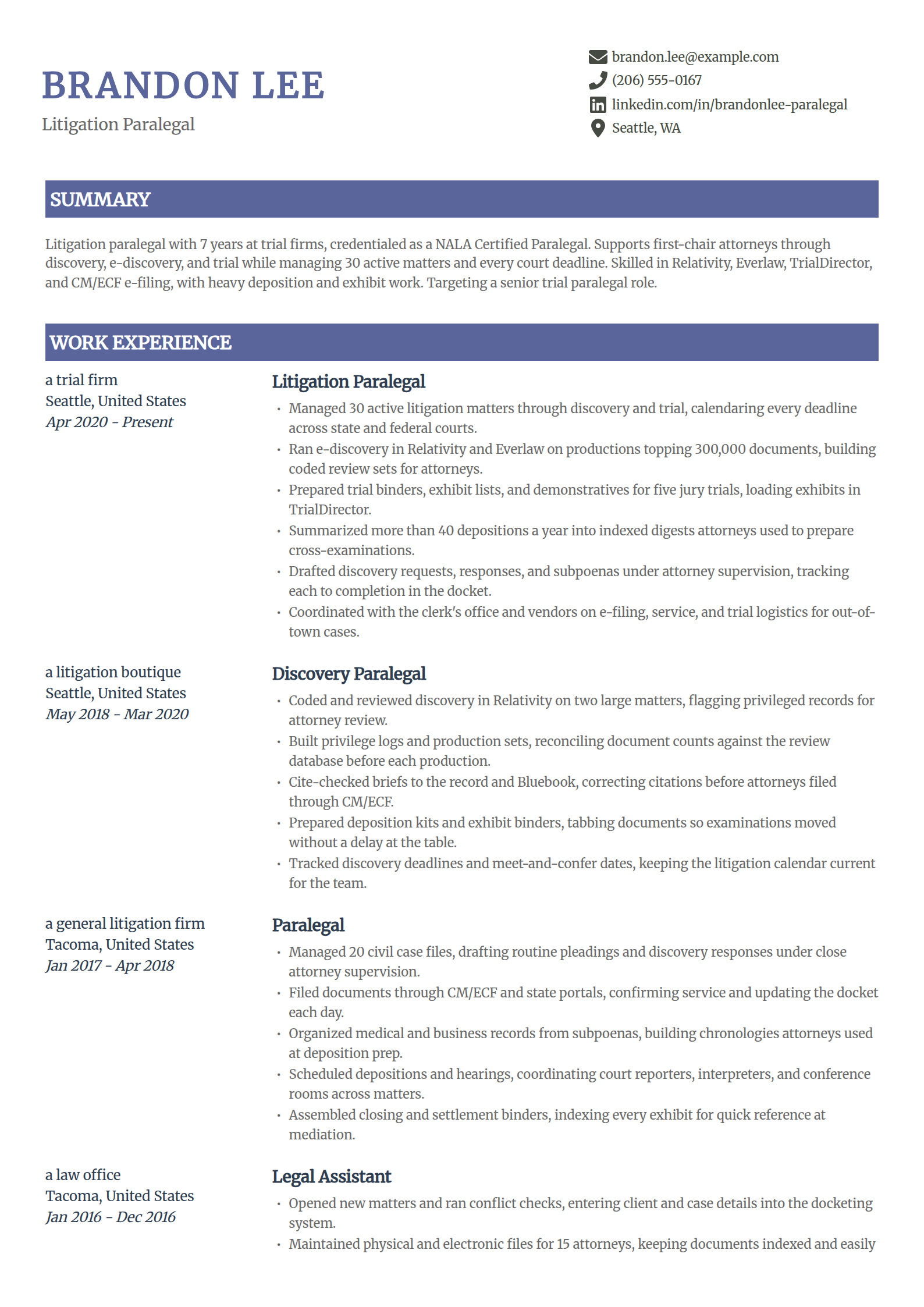
Litigation Paralegal Resume Template
Why this resume example works?
- Opens with trial-support scope, 30 active matters and exhibit work in TrialDirector for five jury trials.
- Stays inside paralegal scope: discovery, deposition digests, e-filing, and trial binders under attorney supervision.
- Names the e-discovery stack, Relativity and Everlaw, on a production topping 300,000 documents.
- Shows the deposition and exhibit tasks a trial team needs, summarized into indexed digests for counsel.
- Fills a visually rich two-column layout while staying easy to skim in one pass.
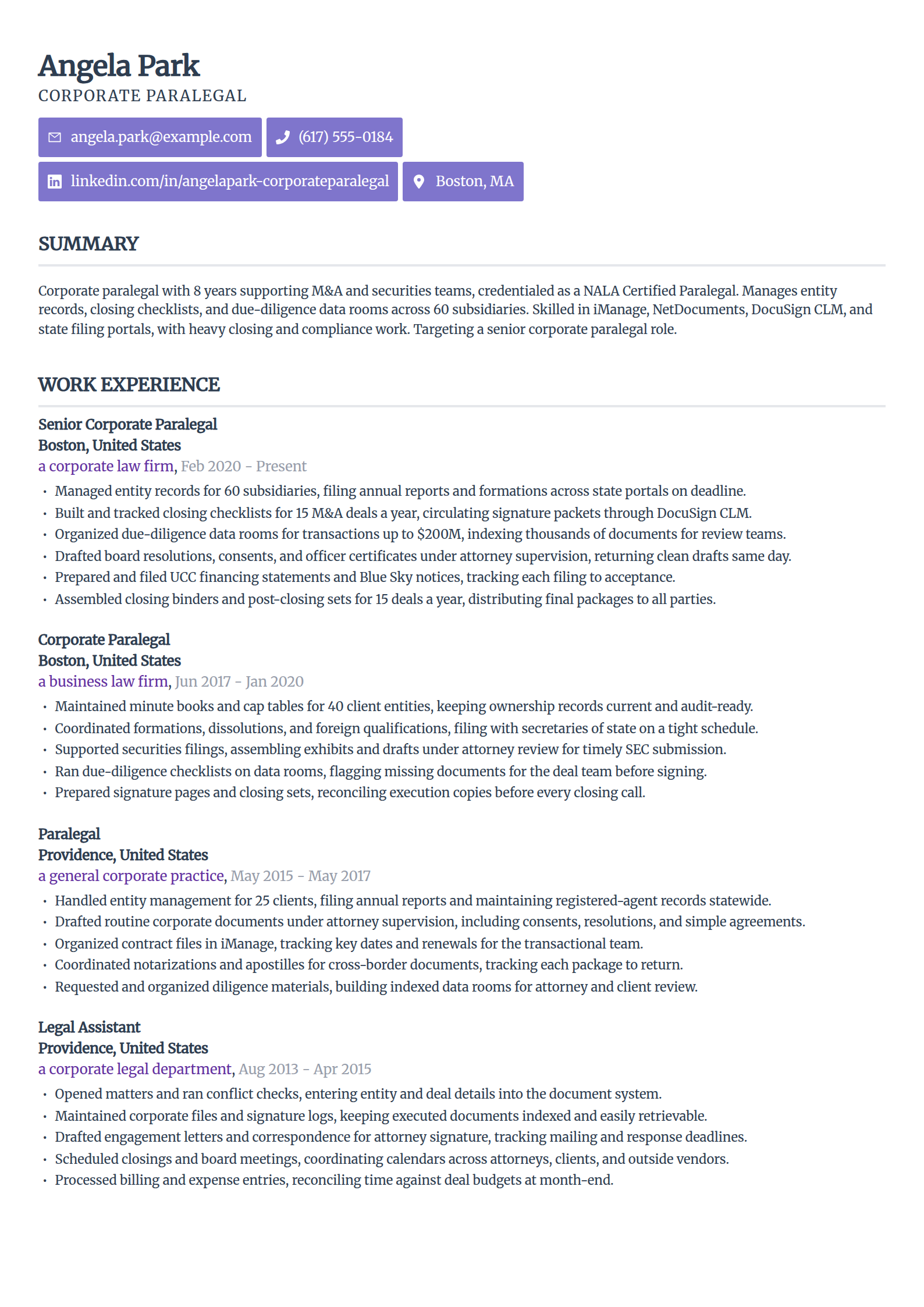
Corporate Paralegal Resume Template
Why this resume example works?
- Frames transactional scope, entity records for 60 subsidiaries and closing checklists for 15 M&A deals a year.
- Keeps drafting under attorney supervision, resolutions, consents, and UCC filings, never crossing into legal advice.
- Names the corporate stack, iManage, NetDocuments, and DocuSign CLM, as applicant-tracking keywords.
- Shows deal work a corporate team values, due-diligence data rooms on transactions up to $200M.
- Uses a clean, modern layout that carries a dense corporate history on one page.
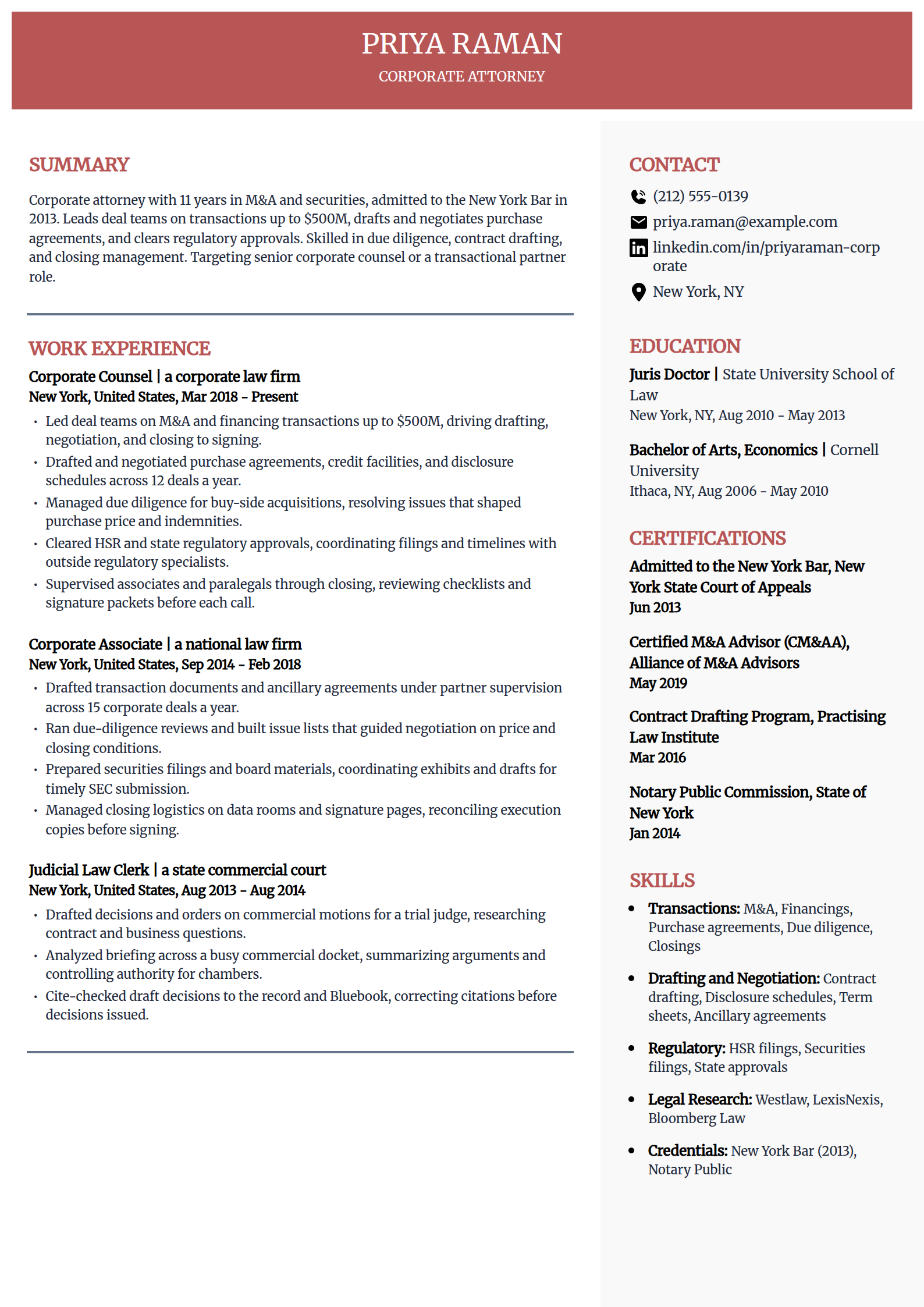
Corporate & Transactional Attorney Resume Template
Why this resume example works?
- Leads with deal scope, admission to the New York Bar in 2013 and transactions up to $500M.
- States bar admission with the state and year and shows negotiation across 12 deals a year.
- Names the transactional work an interviewer expects, purchase agreements, due diligence, and HSR clearance.
- Keeps a Medium layout with three focused roles instead of padding a shorter history.
- Uses a refined, executive layout that fits a senior corporate record cleanly.
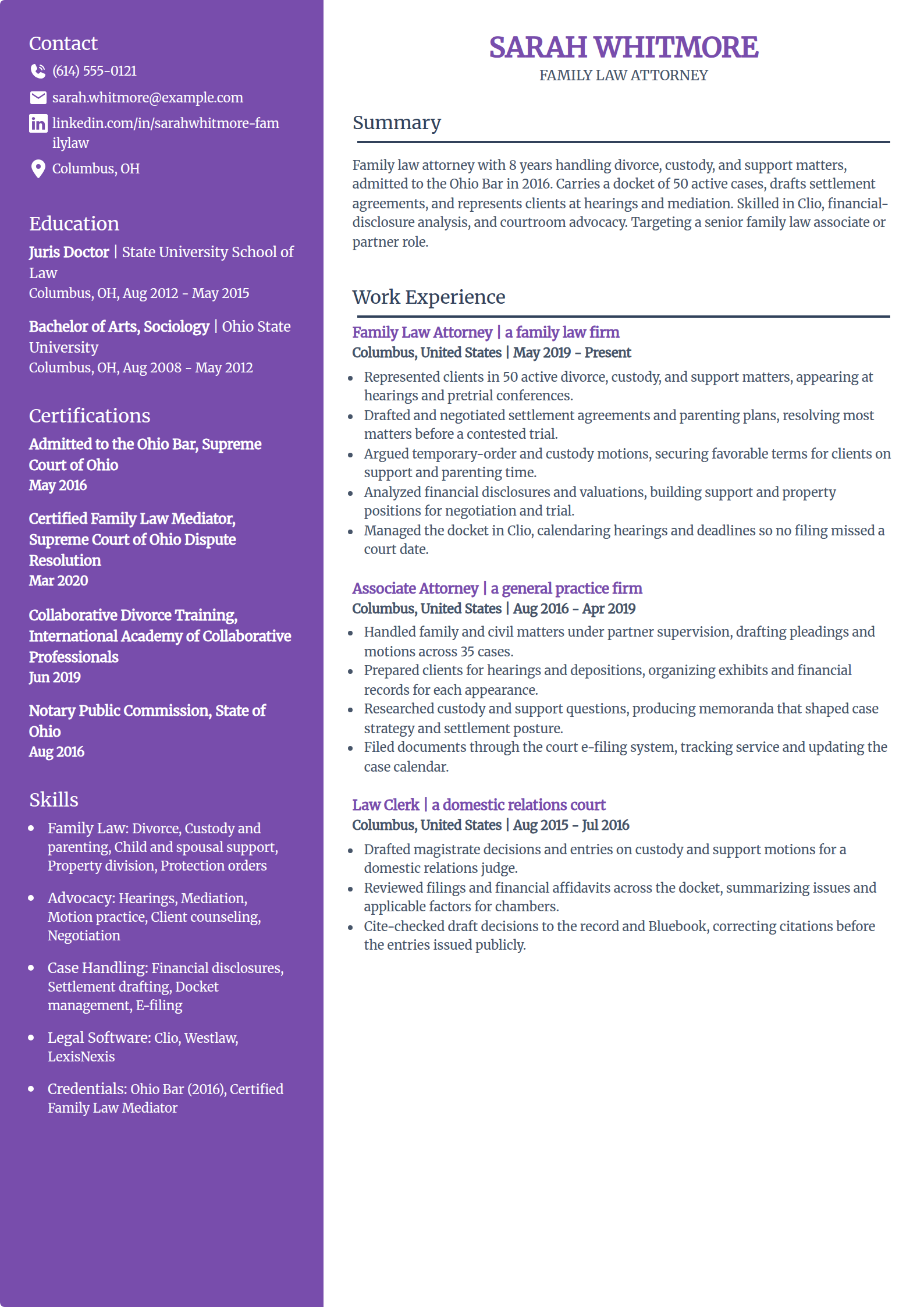
Family Law Attorney Resume Template
Why this resume example works?
- Opens with family-law scope, an Ohio Bar admission in 2016 and a 50-case docket of divorce and custody matters.
- Shows advocacy an interviewer can picture, arguing custody motions and negotiating parenting plans.
- Backs the practice with a Certified Family Law Mediator credential that fits the setting.
- Names Clio and financial-disclosure analysis, the daily tools of a family practice.
- Uses a Medium layout that fits an eight-year record without empty space.
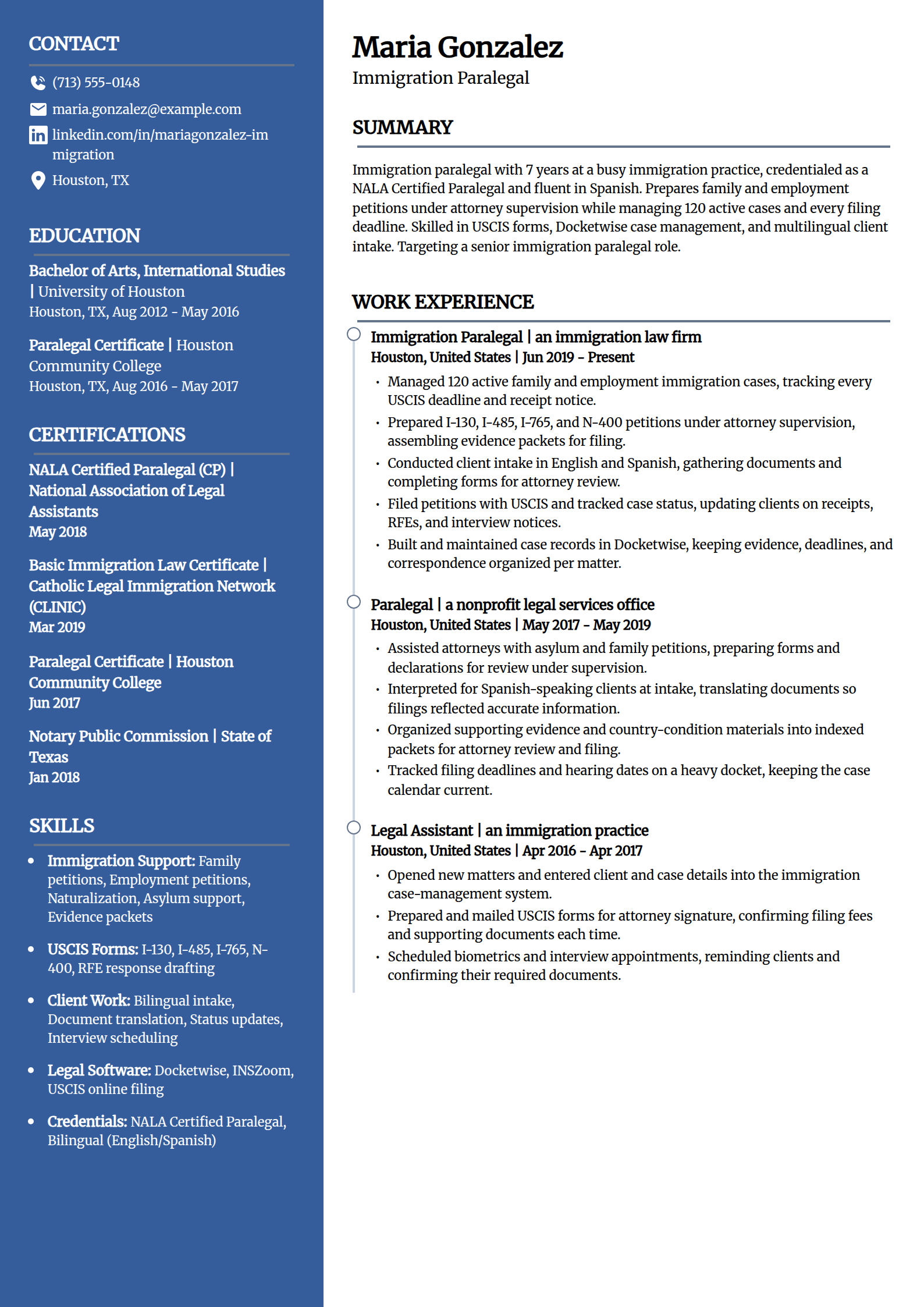
Immigration Paralegal Resume Template
Why this resume example works?
- Leads with immigration scope, 120 active cases and petitions prepared under attorney supervision.
- Names the USCIS forms a posting lists, I-130, I-485, I-765, and N-400, plus Docketwise case management.
- Shows the bilingual intake an immigration practice needs, gathering documents in English and Spanish.
- Keeps scope honest: prepares forms and evidence packets under supervision, never giving legal advice.
- Uses a distinctive layout that still reads cleanly for a hiring attorney.
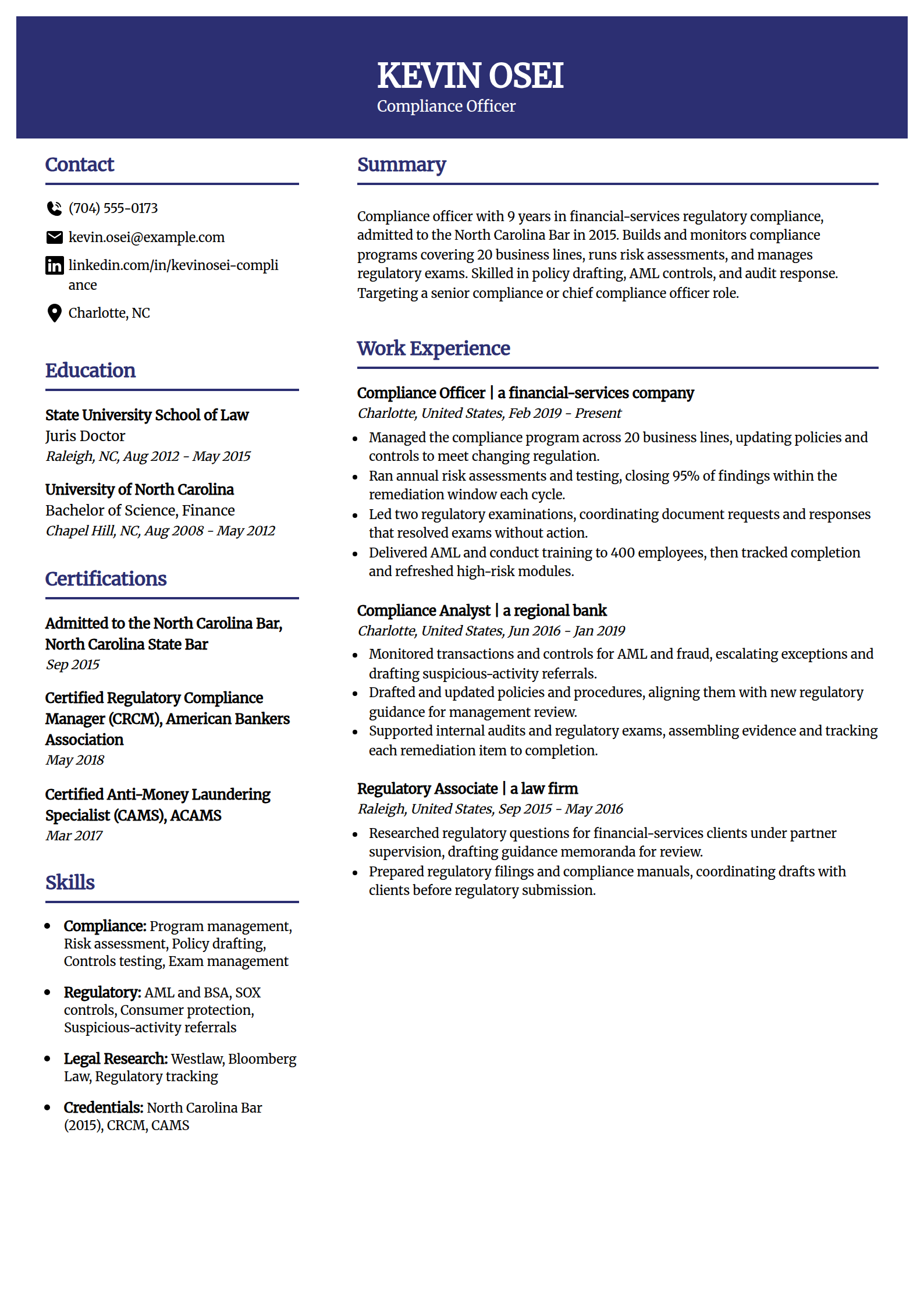
Compliance Specialist & Officer Resume Template
Why this resume example works?
- Frames compliance scope, a North Carolina Bar admission in 2015 and a program across 20 business lines.
- Shows measurable results, closing 95% of findings on time and resolving two regulatory exams without action.
- Names the credentials a compliance team screens for, CRCM and CAMS, alongside the bar admission.
- Uses a roomy two-column layout with the sidebar filled so the page reads complete.
- Keeps every metric modest and believable for a compliance role.
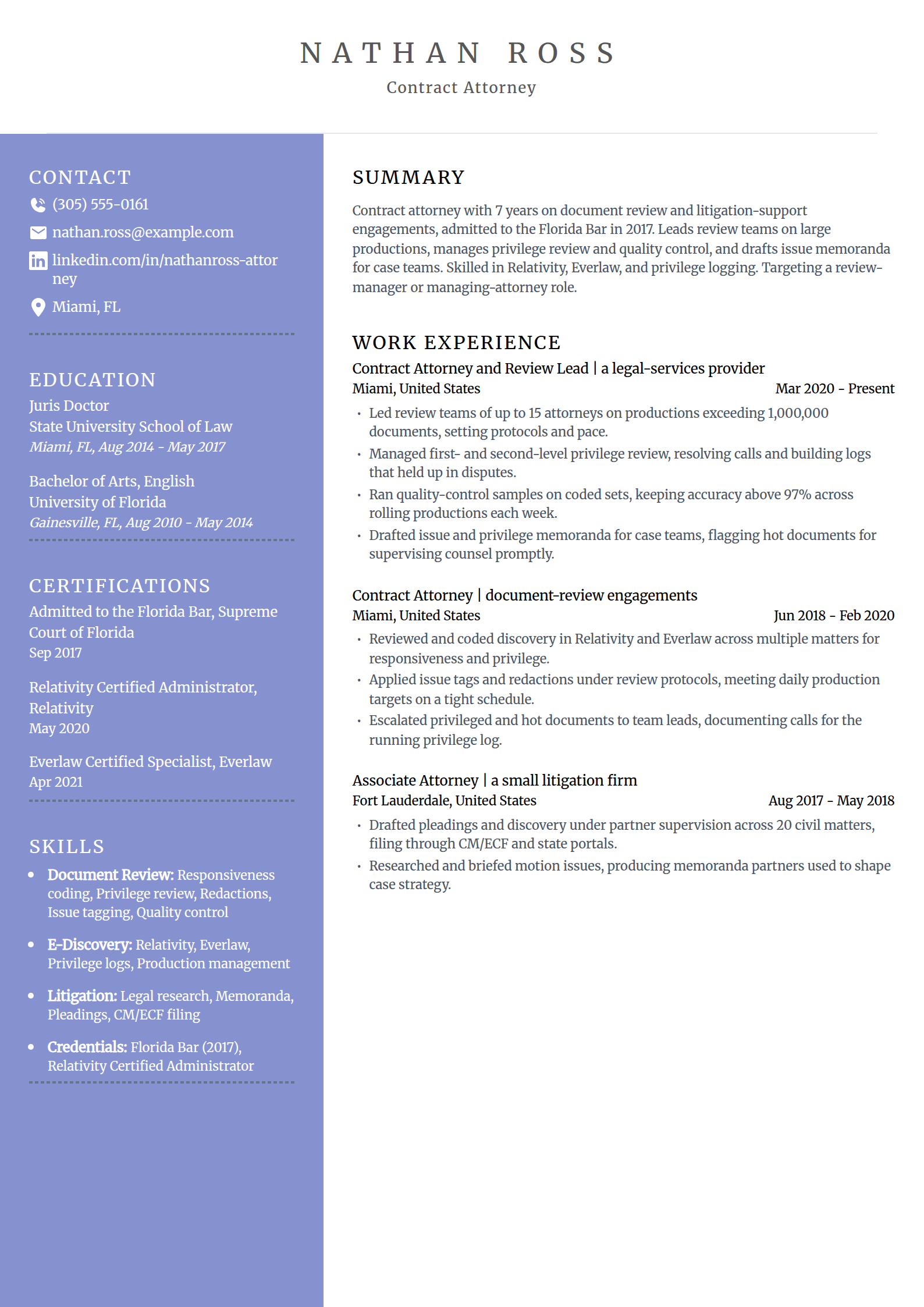
Contract Attorney Resume Template
Why this resume example works?
- Opens with review scope, a Florida Bar admission in 2017 and teams of up to 15 attorneys on 1,000,000-document productions.
- Shows quality a case team values, privilege logs that held up and review accuracy above 97%.
- Names the review platforms, Relativity and Everlaw, that a document-review posting requires.
- States bar admission precisely so the contract role reads as attorney-level work.
- Uses a roomy layout with a filled sidebar so a focused record still looks full.
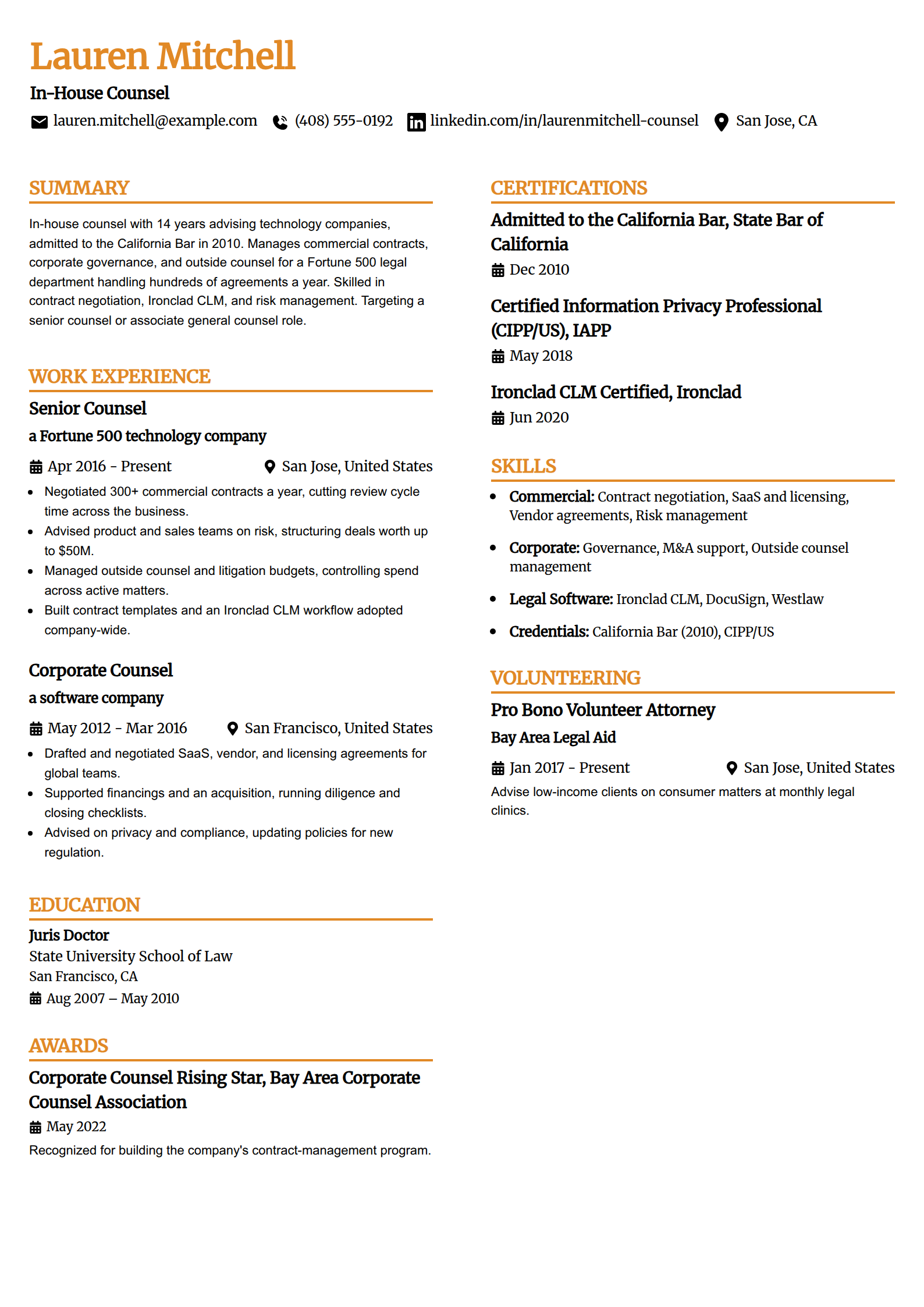
In-House Counsel Resume Template
Why this resume example works?
- Leads with in-house scope, a California Bar admission in 2010 and more than 300 commercial contracts a year.
- Shows business impact counsel is hired for, structuring deals up to $50M and managing outside counsel spend.
- Names the contract stack, Ironclad CLM and DocuSign, plus a CIPP/US privacy credential.
- Keeps two focused senior roles tight and readable on one page.
- Fills the sidebar with a pro bono role and a recognition that fit an in-house profile.
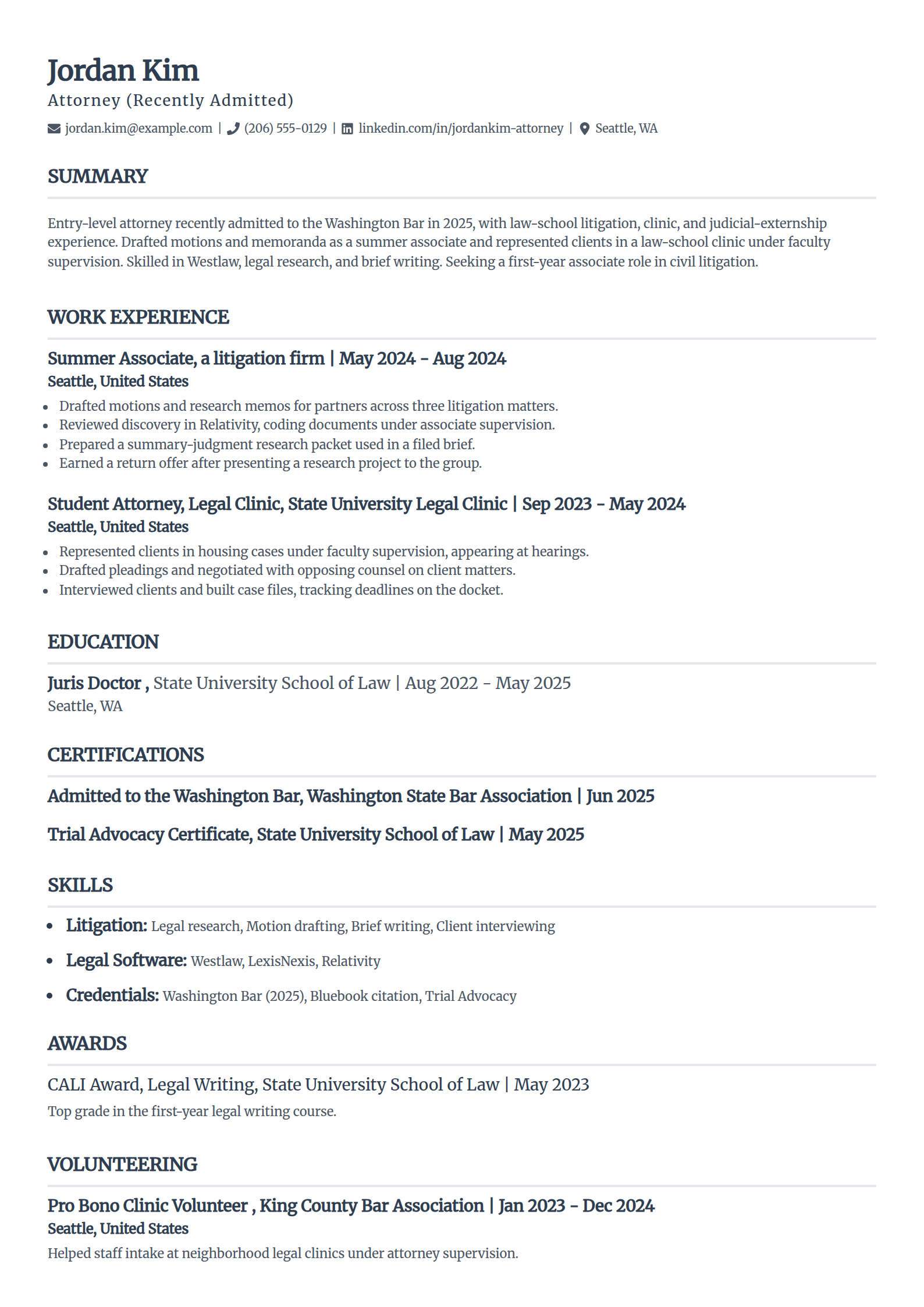
Entry-Level Attorney Resume Template (Recent JD)
Why this resume example works?
- Written for a recent grad, leading with a Washington Bar admission in 2025 and law-school litigation experience.
- States status precisely as recently admitted, never 'currently sitting for', which reads as a mistake to a reviewer.
- Uses a summer associate role and a supervised clinic to show real drafting and client work.
- Fills the page honestly with a legal-writing award and pro bono volunteering rather than padding.
- Uses a tight, ATS-safe single-column layout that fits a beginner's record without empty space.
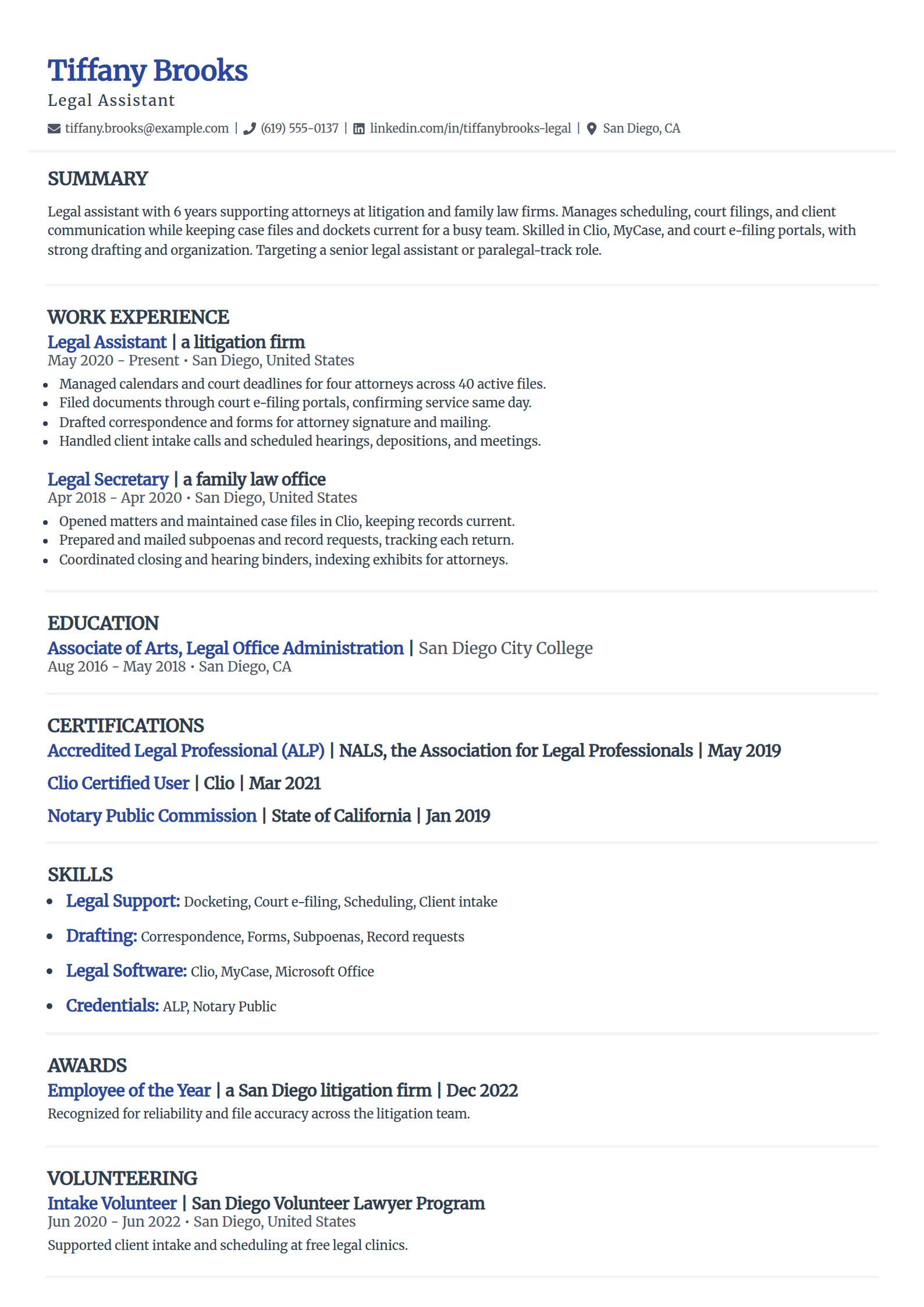
Legal Assistant Resume Template
Why this resume example works?
- Written for administrative legal support, leading with scheduling, court filings, and client intake for four attorneys.
- Keeps the role in scope: docketing, e-filing, and drafting correspondence, not practicing law.
- Names Clio, MyCase, and court e-filing portals, the tools a legal-support posting lists.
- Backs the experience with an Accredited Legal Professional credential and a notary commission.
- Uses a refined, uncluttered layout that fits a six-year record on one clean page.
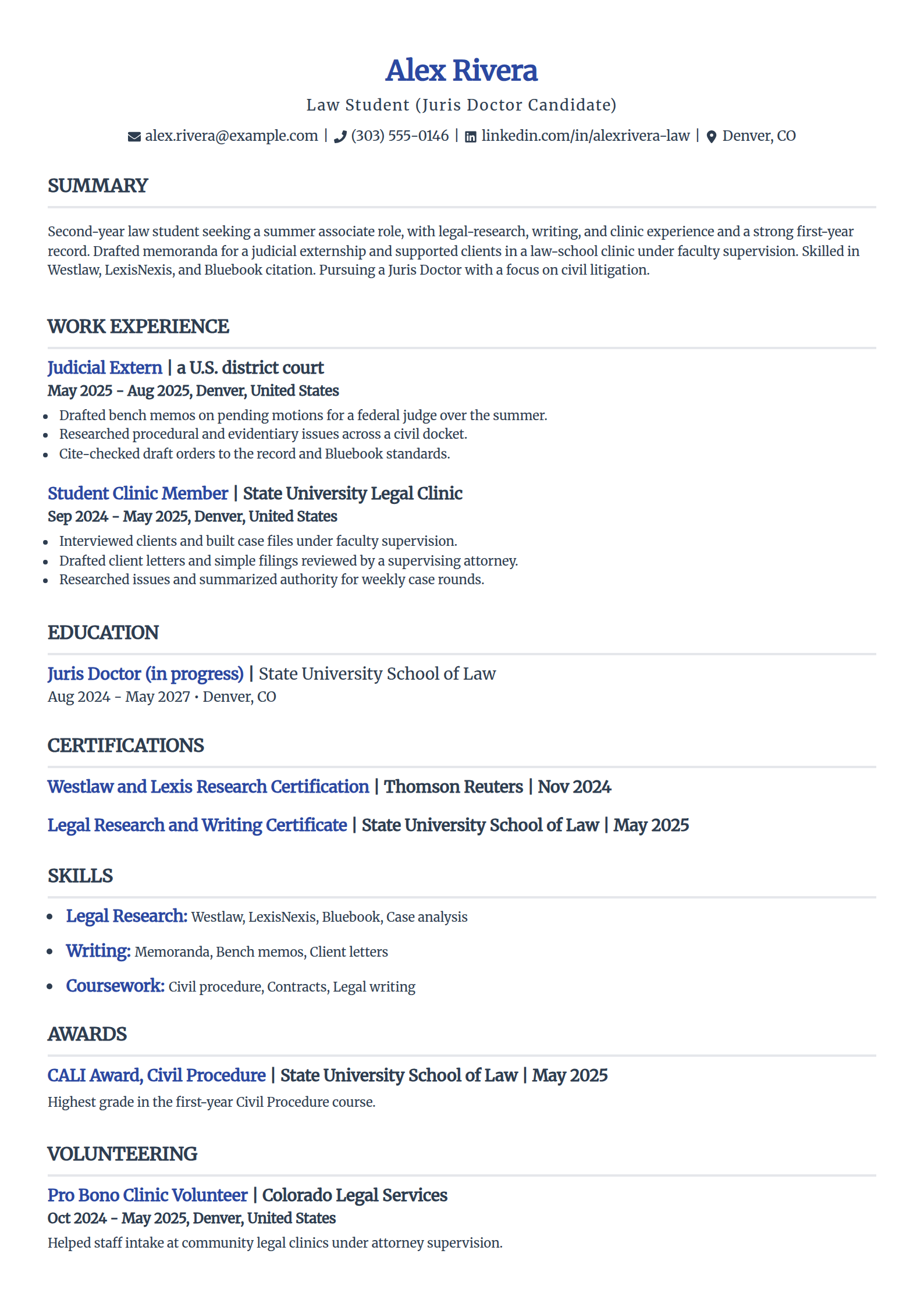
Law Student & Summer Associate Resume Template
Why this resume example works?
- Written for a 2L seeking a summer associate role, leading with a judicial externship and a supervised clinic.
- Shows real legal work, drafting bench memos and cite-checking orders to the record and Bluebook.
- Names Westlaw, LexisNexis, and Bluebook citation, the research tools a firm expects.
- Fills the page honestly with a CALI Award and pro bono volunteering rather than inflated bullets.
- Uses a plain, ATS-safe layout that keeps the focus on research and writing.
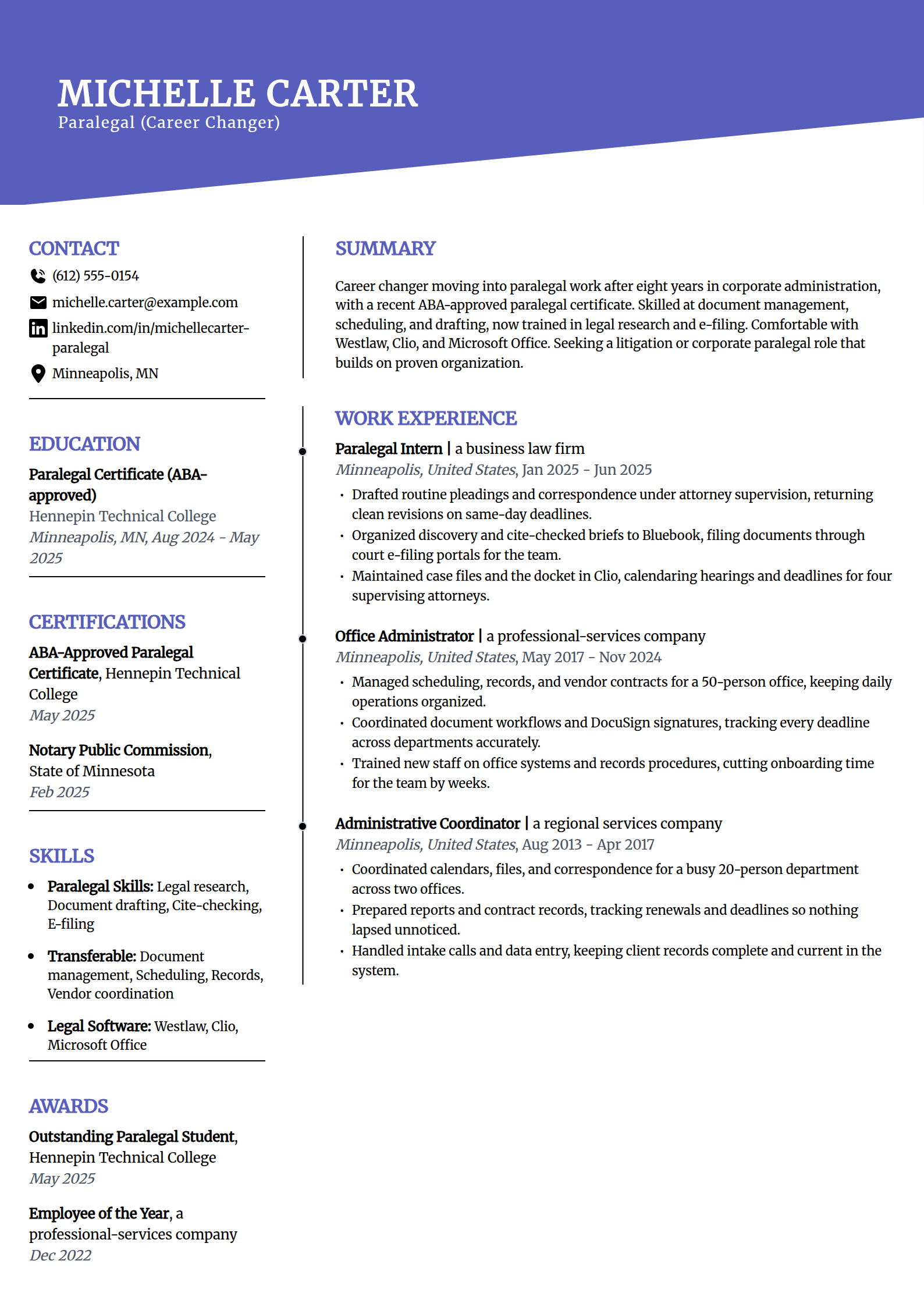
Career-Change Paralegal Resume Template
Why this resume example works?
- Names the change openly and reframes eight years of corporate administration as paralegal-ready skills.
- Shows recent commitment with an ABA-approved paralegal certificate and supervised intern drafting.
- Keeps scope honest: research, cite-checking, and e-filing under attorney supervision, never legal advice.
- Pulls transferable work forward, document management and scheduling, so the pivot reads intentional.
- Lists awards without long descriptions, keeping the two-column layout clean and balanced.
Build your legal resume
Pick a template above and the editor keeps your layout clean and ATS-safe while you swap in your own caseload, filings, credentials, and systems.
Build my resumeHow to write a legal resume in 2026
A legal resume is read by someone who checks two things first: your credentials and whether the work matches your role. Lead with your bar admission or certification, then prove your experience with caseload, filings, and results, one number each. These moves make yours easy to skim and easy for an applicant tracking system to parse.
Open with a short legal summary
Write three to four sentences that name your role and years, your practice area or case scope, one or two systems you use, and the role you are targeting. For attorneys, put your bar admission in the first two lines; for paralegals, name your certification. Lead with what you have done, not what you want from the employer.
Litigation attorney with 6 years handling commercial disputes, admitted to the Texas Bar in 2018. Manages a docket of 30 active matters, drafts dispositive motions, and takes depositions. Skilled in Westlaw, Relativity, and CM/ECF e-filing. Targeting a senior litigation associate role.
Lead experience with matters, drafting, and results
The work a legal resume is hired for is concrete, so name it and attach one modest number to each bullet. Open every line with a strong verb, never "Responsible for".
- Caseload: state your active matters and their type, like managing 40 civil litigation matters through trial.
- Drafting: name what you draft, such as 60 motions and pleadings a year, and for paralegals add "under attorney supervision".
- Discovery: name the platform and scale, like coding a 300,000-document production in Relativity or Everlaw.
- Results: use outcomes the role can own, such as motions won or deals closed for attorneys, documents reviewed for support staff.
State bar admission and credentials the right way
This is the section a legal reviewer reads most carefully, so get the exact wording right.
- Attorneys: list bar admission with the state and year, like "Admitted to the California Bar, 2019", plus any federal courts.
- Recent grads: state exam status on a date, "Sat for the July 2026 New York Bar exam, results pending" or "recently admitted", never "currently sitting for".
- Attorneys: list your JD and law school, and add a board certification or specialty where you have one.
- Paralegals: list your certification (NALA Certified Paralegal or NFPA RP) and paralegal certificate, plus a notary commission if you hold one.
Keep the resume inside its scope (the honest rule)
The fastest way to get screened out is to claim work your role cannot own. Match the resume to what you are actually licensed and hired to do.
- A paralegal does not practice law, give legal advice, represent clients, or win cases. Use research, drafting under attorney supervision, discovery, cite-checking, docketing, and trial prep.
- Do not write "advised clients", "argued motions", or "negotiated settlements on behalf of the client" on a paralegal resume; those read as unauthorized practice.
- An attorney resume must be precise about bar status. A reviewer will check the state and year, so never round up or leave it vague.
- Claim outcomes your role owns: an attorney wins motions and closes deals; a paralegal supports the attorneys who do, and says so.
Match your skills to the posting's keywords
A legal skills list should read like the job description. Split it so a hiring manager and a parser both find what they need.
- Research and writing: Westlaw, LexisNexis, Bluebook citation, legal research, and brief or memo drafting.
- Litigation: e-discovery in Relativity or Everlaw, CM/ECF e-filing, PACER, docketing, and deposition or trial prep.
- Corporate: contract drafting, due diligence, data rooms, entity management, and CLM tools like Ironclad or DocuSign.
- Practice systems: case management like Clio, iManage, or NetDocuments, and immigration tools like Docketwise or USCIS filing.
Keep it to one clean, ATS-safe page
Law firms and corporate legal departments run applicant tracking systems, and the profession is conservative, so a clean one-page resume is the standard for most candidates.
- Use a single-column or simple two-column layout with standard headings a parser recognizes.
- Hold it to one page and lead with your most recent role in reverse-chronological order; very senior attorneys may run to two.
- Save as a PDF so the formatting holds, then run it through the ATS resume checker for a quick format pass.
- Swap the numbers in the templates above for your own caseload, filings, and systems; do not copy them as is.
Common legal resume mistakes
- Writing vague duties like "handled cases". Say what you did: "managed 40 civil litigation matters through trial".
- Leaving bar admission off an attorney resume, or stating it vaguely. Name the state and the year you were admitted.
- A paralegal resume that overstates into practicing law. "Advised clients" or "argued motions" reads as unauthorized practice; keep it to supervised work.
- Listing Westlaw or Relativity with no result. Tie each tool to what you produced, like a coded 300,000-document production.
- Running to two pages for a mid-level role, or using a heavy design with tables. Keep one clean page a firm and an ATS both read easily.
Frequently asked questions
What should a lawyer or attorney resume include?
A lawyer resume needs your contact details, a short summary, bar admission, work history in reverse-chronological order, education with your JD, and a skills list. State bar admission with the state and year, like "Admitted to the California Bar, 2019", because it is the first thing a reviewer checks. Lead each role with your caseload and results: matters managed, motions drafted and won, depositions taken, and deals closed. Name your tools, such as Westlaw, LexisNexis, and Relativity. Keep it to one clean page for most candidates.
What do you put on a paralegal resume?
A paralegal resume leads with the support work attorneys hire for: legal research, drafting under attorney supervision, discovery and e-discovery, document review, cite-checking to Bluebook, docketing, e-filing, and trial or deposition prep. Name your certification, such as a NALA Certified Paralegal (CP) or NFPA RP, and your paralegal certificate. Add the systems you use, like Relativity, Westlaw, and Clio. Keep every bullet inside paralegal scope: a paralegal does not practice law, give legal advice, or represent clients, so never write "advised clients" or "argued motions".
How do I list bar admission on a resume?
List bar admission with the state and the year you were admitted, like "Admitted to the Illinois Bar, 2015", and add any federal courts, such as "U.S. District Court, Northern District of Illinois". Put it near the top, in the summary or a short credentials line, because a legal reviewer looks for it first. If you are a recent graduate, state your exam status precisely and on a date: "Sat for the July 2026 New York Bar exam, results pending" or "recently admitted to the Washington Bar in 2025". Never write "currently sitting for the bar", since an exam is sat once, on a date.
What is the difference between a lawyer resume and a paralegal resume?
The difference is scope and credentials. A lawyer resume states bar admission and claims work an attorney owns: arguing and winning motions, negotiating settlements, closing deals, and advising clients. A paralegal resume states a paralegal certification instead of bar admission and stays within supervised work: research, drafting under attorney supervision, discovery, cite-checking, docketing, and trial prep. A paralegal does not practice law or represent clients, so a paralegal resume never claims to have argued a motion or won a case; it supports the attorneys who do.
How do I write a legal resume with no experience?
Lead with the legal work you have done in school or in a supervised role. A recent JD leads with bar admission or exam status, a summer associate role, a judicial externship, and a law-school clinic where you worked under faculty supervision. A new paralegal leads with an ABA-approved certificate, an internship, and any drafting or research done under attorney supervision. Fill the page honestly with a relevant award or pro bono volunteering rather than padding. The entry-level attorney and career-changer examples above show the shape.
How long should a legal resume be?
One page for most candidates. Associates, paralegals, and recent graduates should keep a single, skimmable page led by their most recent role. Very senior attorneys with a long trial record or a book of business may run to two pages, but never longer. Keep the roles and results that matter for the job you are targeting, and summarize or drop older, unrelated positions to make room for caseload, filings, and the systems the posting names.
More legal resume resources
Build your legal resume
Pick a template above and the editor keeps your layout clean and ATS-safe while you swap in your own caseload, filings, credentials, and systems.