Property Manager Resume Templates for Assistants Through Regional PMs
- ATS Friendly
- Property Manager Specific
- 16 Real Examples
A property manager resume gets skimmed fast, so it has to show your occupancy, your software, and the money you managed at a glance. Pick a clean template below, then model your own on a real example built for your track, from an assistant or leasing role to commercial, HOA, affordable housing, or a regional portfolio. Every example names the systems a posting lists and backs each bullet with one modest number.


540k+ resumes created
Property manager resume templates, sorted by specialty and level
Each template below is a real property manager resume laid out in that format, grouped by specialty and experience level. Choose one, then swap in your own occupancy and delinquency numbers, the software your portfolio runs, and your license and certifications. Every layout keeps your name, title, and dates clean so a regional manager or owner reads your results at a glance and an applicant tracking system parses it without trouble.
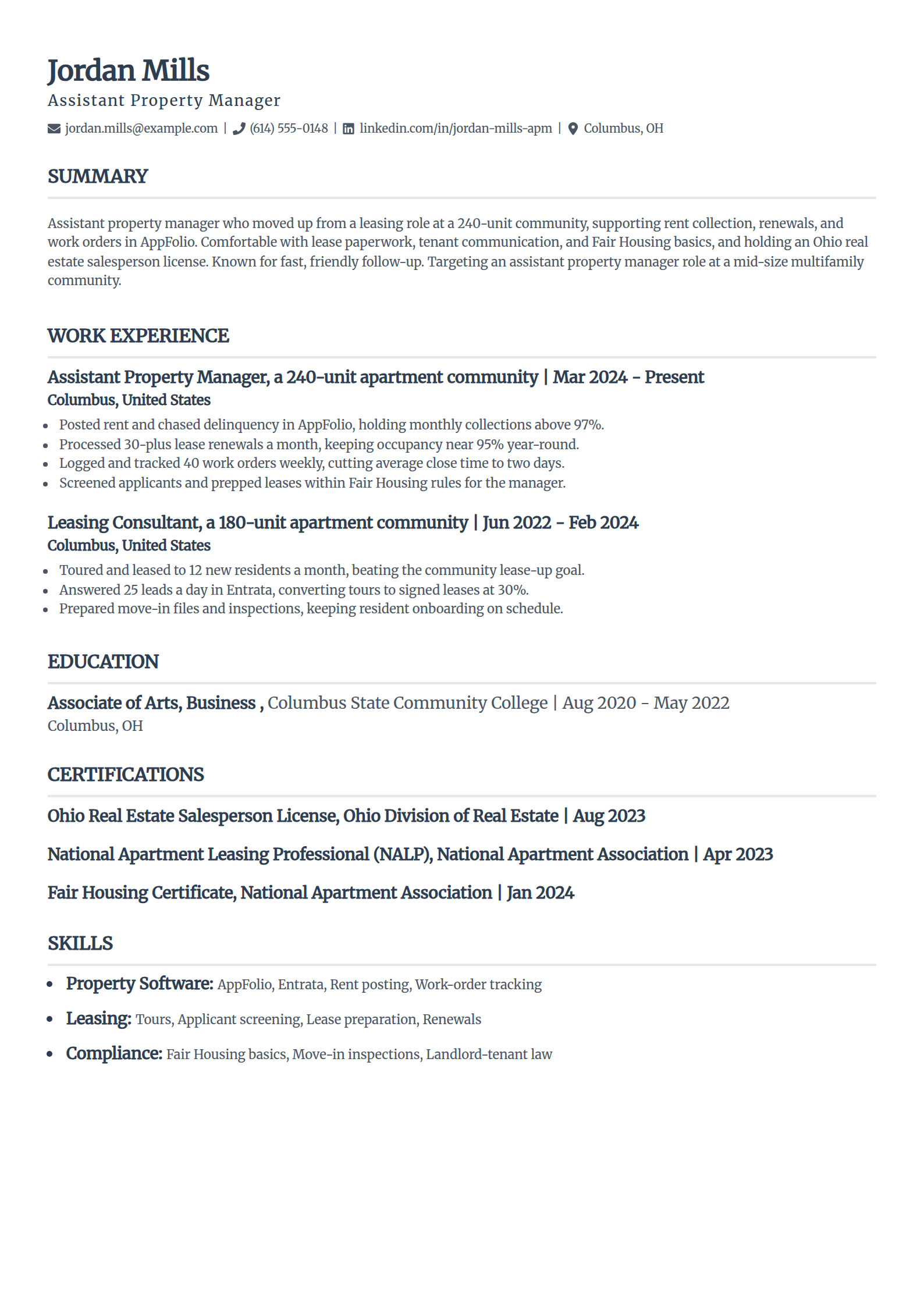
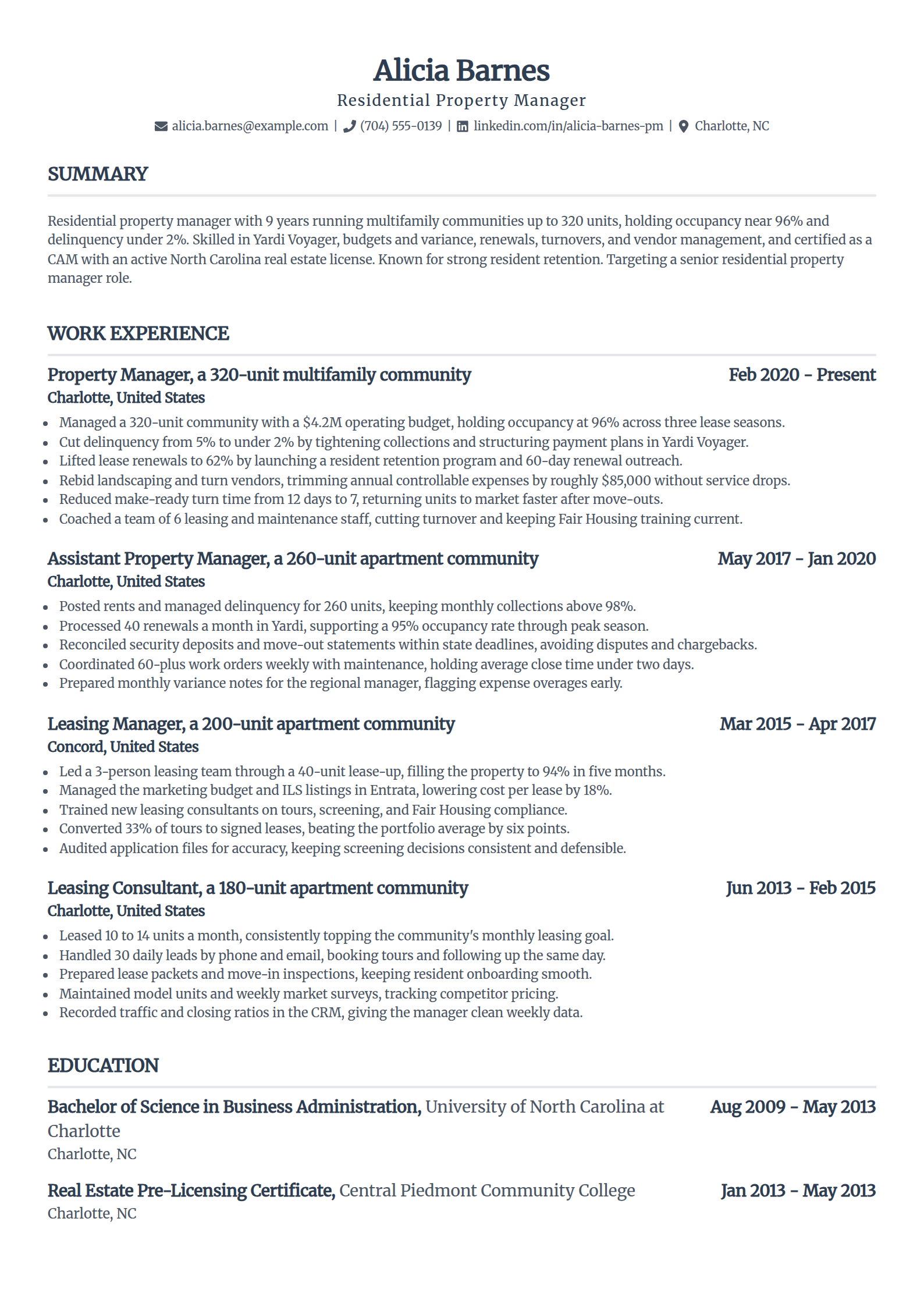
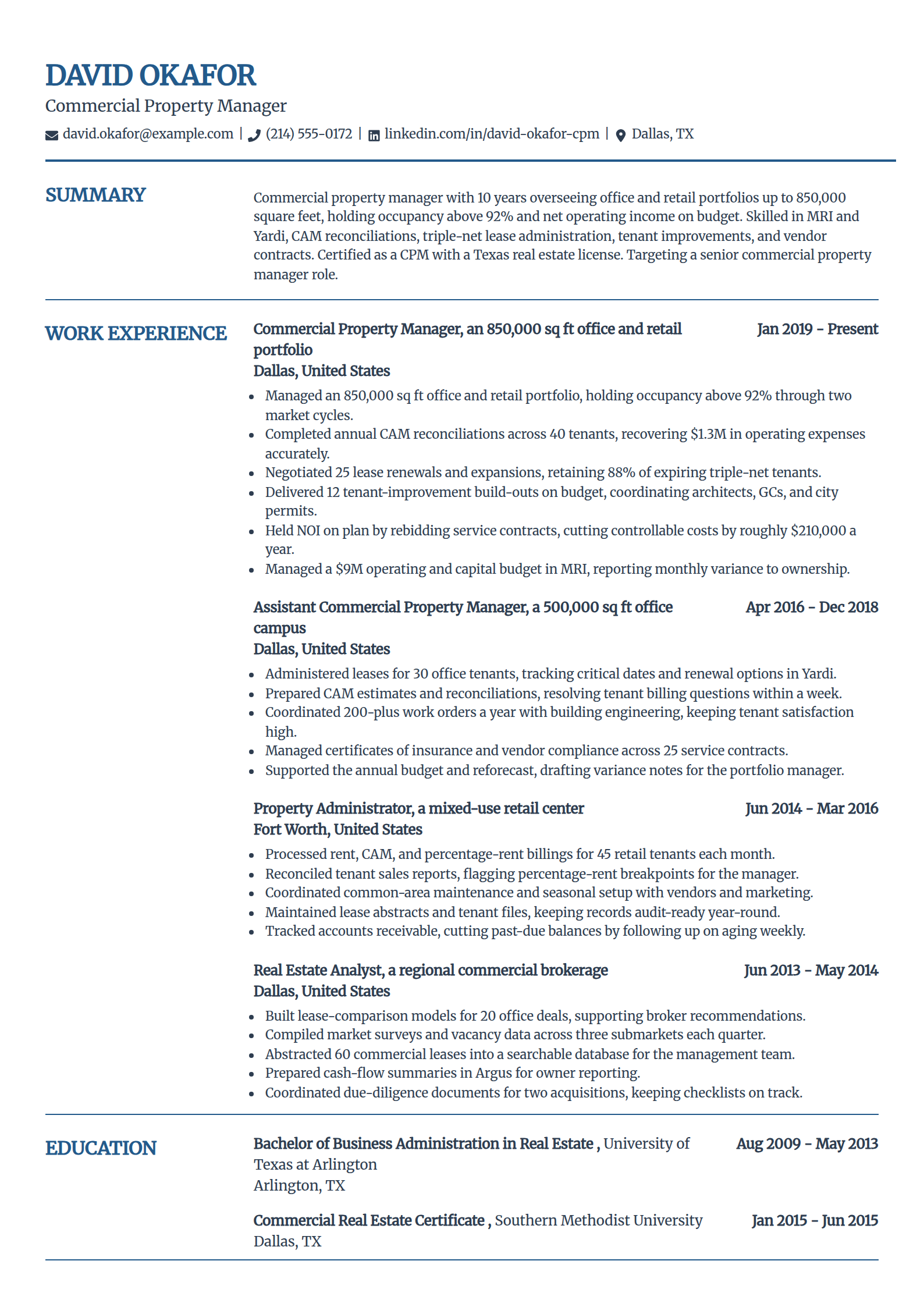
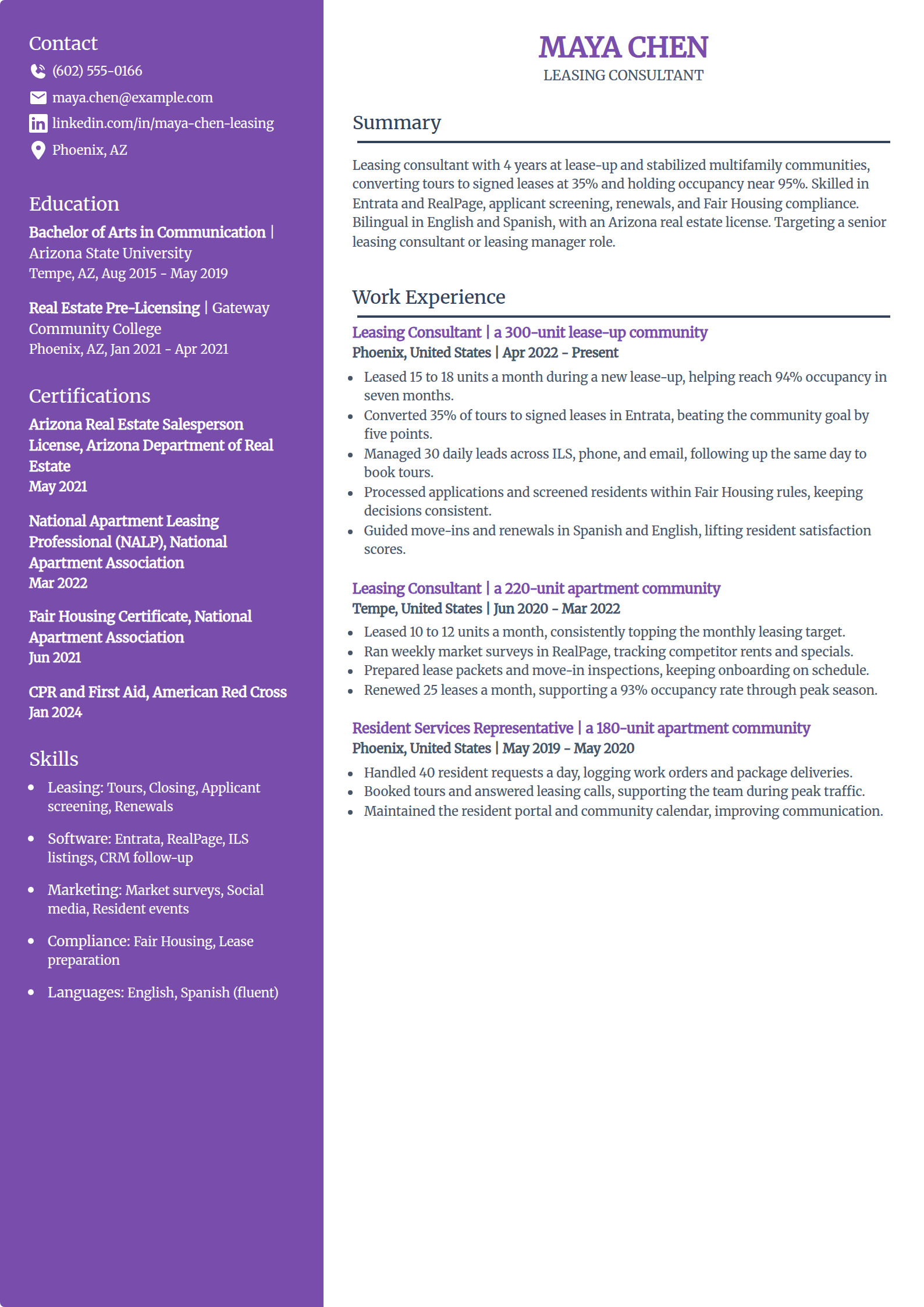
Assistant Property Manager Resume Template
Why this resume example works?
- Written for someone stepping up from leasing, it leads with rent collection above 97% and a 95% occupancy rate.
- Shows the daily assistant-PM work a manager checks for, delinquency chasing, renewals, and work-order tracking in AppFolio.
- Turns a prior leasing role into relevant experience with tour-to-lease conversion, not vague duties.
- Lists the credentials a screener wants first, an Ohio real estate license and a NALP leasing certificate.
- Uses a tight, ATS-safe single-column layout that fills the page cleanly without padding.
Residential Property Manager Resume Template
Why this resume example works?
- Opens with the numbers an owner reads first, a 320-unit community at 96% occupancy with delinquency under 2%.
- Leads each bullet with a strong verb and one modest number, like cutting turn time from 12 days to 7.
- Names the systems a posting lists, Yardi Voyager and Entrata, as applicant-tracking keywords.
- Backs the role with a CAM and a North Carolina real estate license, the credentials residential owners screen for.
- Uses a clean single-column layout that carries a full nine-year history on one page.
Commercial Property Manager Resume Template
Why this resume example works?
- Frames commercial scope an owner values, an 850,000 sq ft office and retail portfolio held above 92% occupancy.
- Shows the commercial-specific work, CAM reconciliations recovering $1.3M and triple-net renewals at 88% retention.
- Keeps the money visible, a $9M operating and capital budget managed in MRI with monthly variance to ownership.
- Names the credentials a commercial posting screens for, a CPM and a Texas real estate license.
- Uses a clean, modern layout that fits a dense ten-year commercial history on one page.
Leasing Consultant Resume Template
Why this resume example works?
- Leads with the leasing metric that gets hired, a 35% tour-to-lease conversion during a new lease-up.
- Shows the daily volume a leasing office runs on, 30 leads a day worked in Entrata with same-day follow-up.
- Adds a bilingual skill, English and Spanish, that a community values, without inflating the record.
- Names an Arizona real estate license and a NALP leasing credential a posting screens for.
- Uses a Medium layout that fits a focused four-year leasing record without empty space.
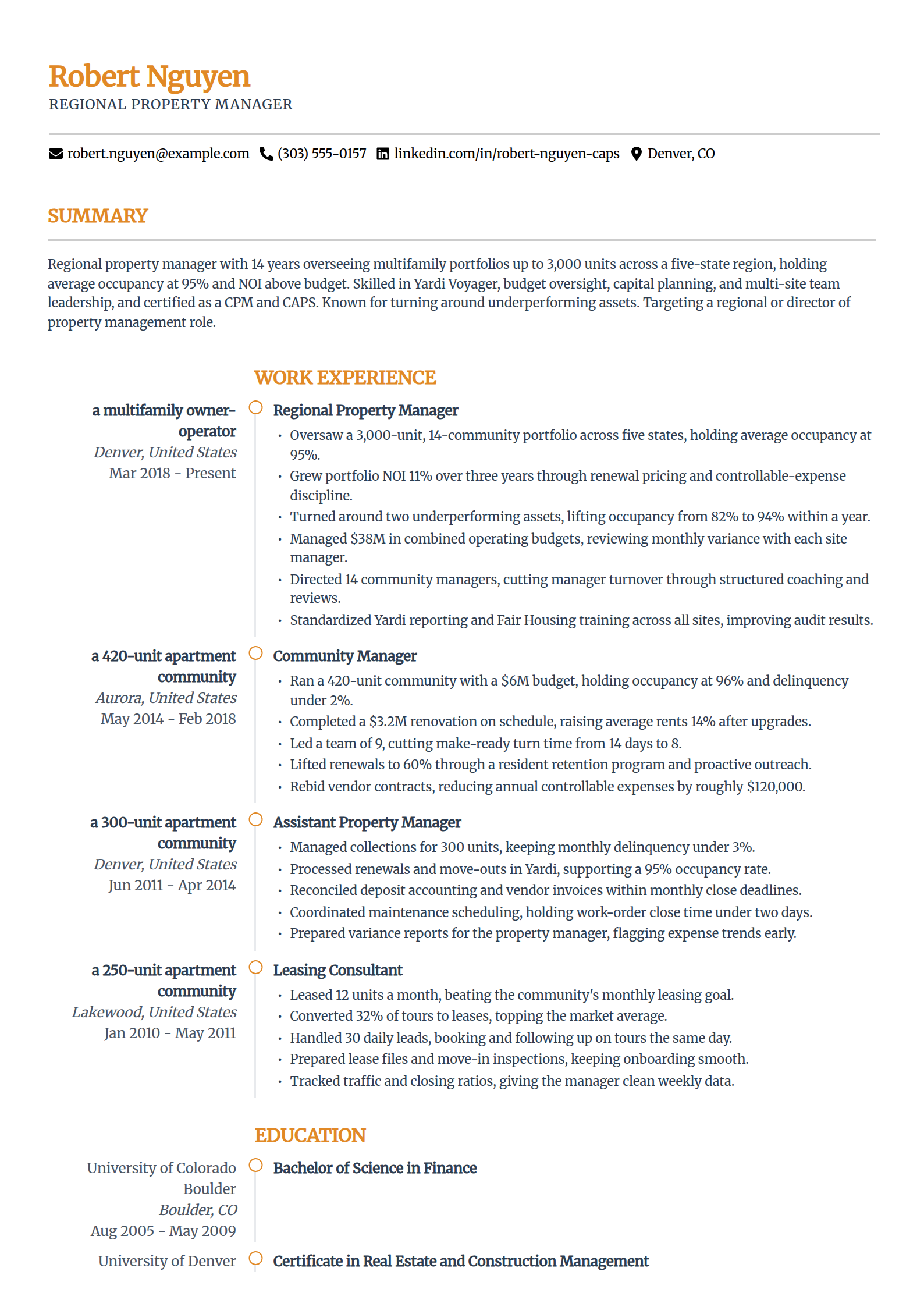
Regional Property Manager Resume Template
Why this resume example works?
- Opens at portfolio scope, a 3,000-unit, 14-community region held at 95% average occupancy.
- Shows the results a regional role is hired for, 11% NOI growth and two asset turnarounds from 82% to 94%.
- Makes the leadership concrete, directing 14 community managers with $38M in combined budgets.
- Backs the role with a CPM and CAPS and a Colorado broker license, the credentials for a regional seat.
- Uses a modern two-column layout that carries a deep 14-year history on one clean page.
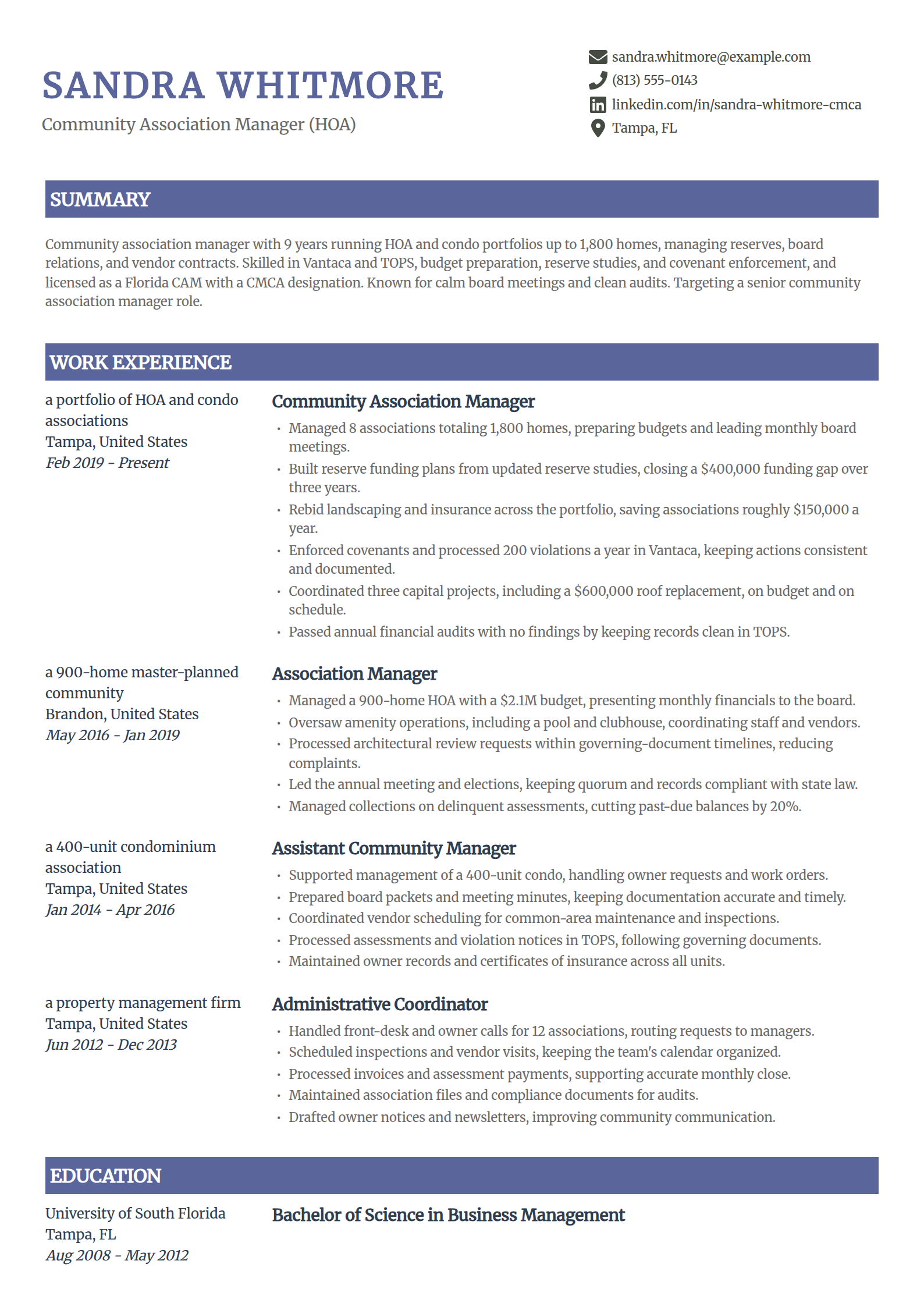
HOA & Community Association Manager Resume Template
Why this resume example works?
- Frames association scope, 8 associations and 1,800 homes with budgets and monthly board meetings.
- Shows the HOA-specific work, reserve funding plans closing a $400,000 gap and covenant enforcement in Vantaca.
- Keeps governance visible, annual meetings, elections, and audits cleared with no findings in TOPS.
- Backs the role with a Florida CAM license, a CMCA, and a PCAM, the credentials a board wants.
- Uses a visually rich two-column layout that fits a dense association history on one page.
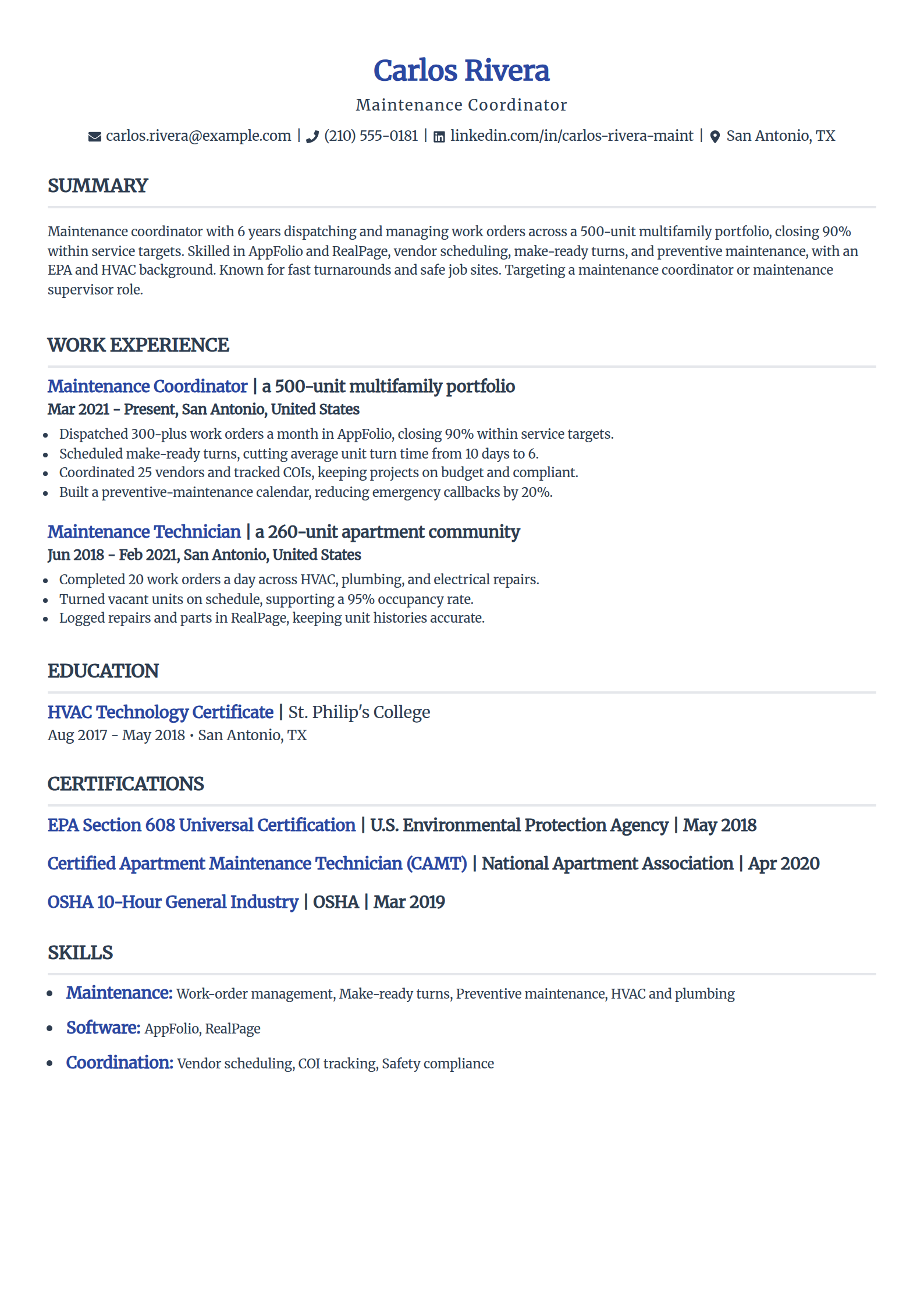
Maintenance Coordinator Resume Template
Why this resume example works?
- Leads with the coordinator metric that matters, 300-plus work orders a month closed at 90% within target.
- Shows the turn work a portfolio depends on, cutting average make-ready time from 10 days to 6.
- Keeps vendor management concrete, 25 vendors coordinated with COIs tracked for compliance.
- Backs the trade with an EPA 608 certification and a CAMT, the credentials a maintenance posting lists.
- Uses a plain, parser-friendly layout that fits a six-year record on one clean page.
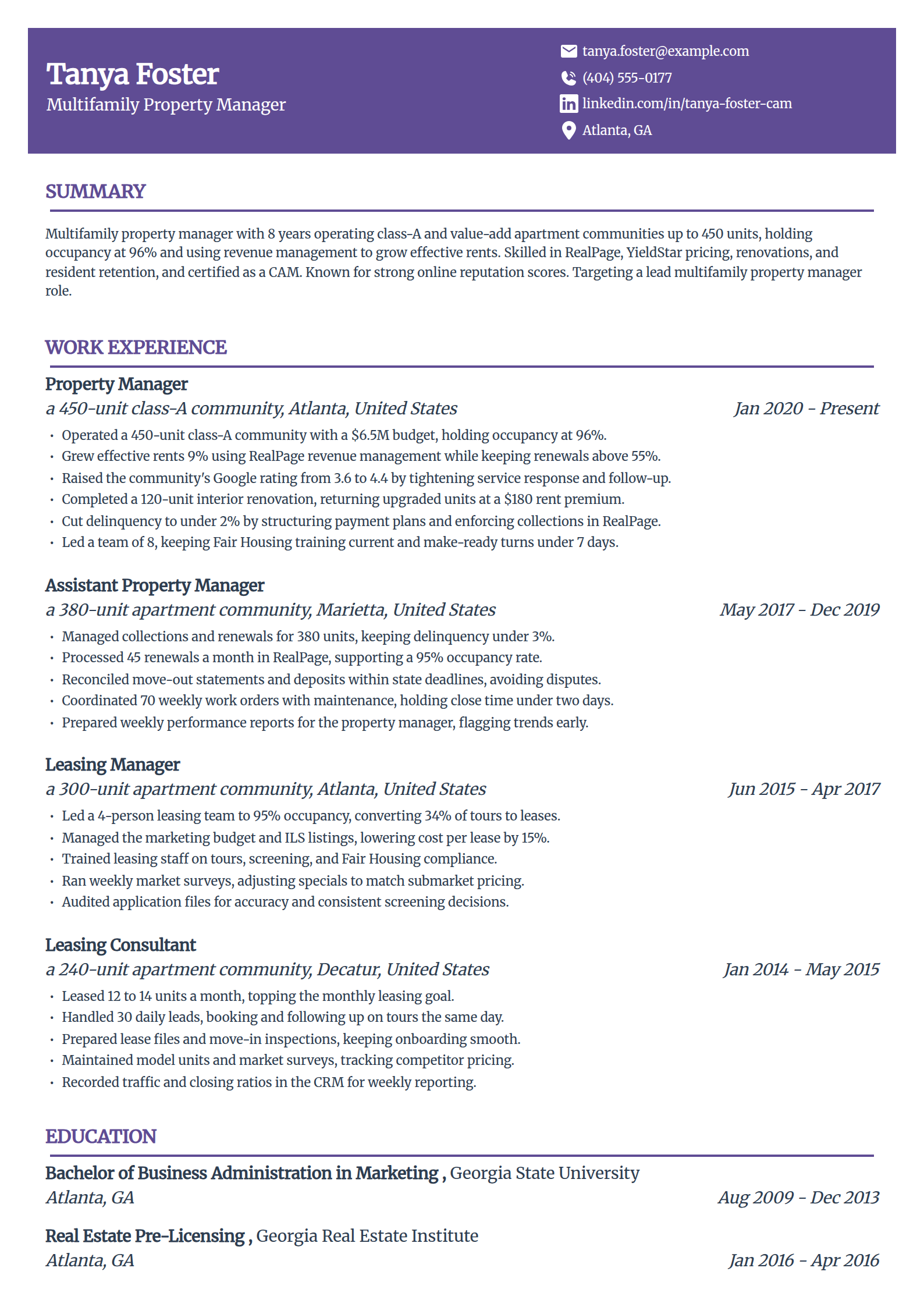
Multifamily Property Manager Resume Template
Why this resume example works?
- Opens with class-A scope, a 450-unit community at 96% occupancy using revenue management to grow rents.
- Shows a result a multifamily owner reads, effective rents up 9% with renewals held above 55%.
- Adds the reputation work that fills communities, a Google rating raised from 3.6 to 4.4.
- Names RealPage and YieldStar, the revenue-management tools a multifamily posting lists.
- Uses a modern layout that carries a busy eight-year multifamily history on one page.
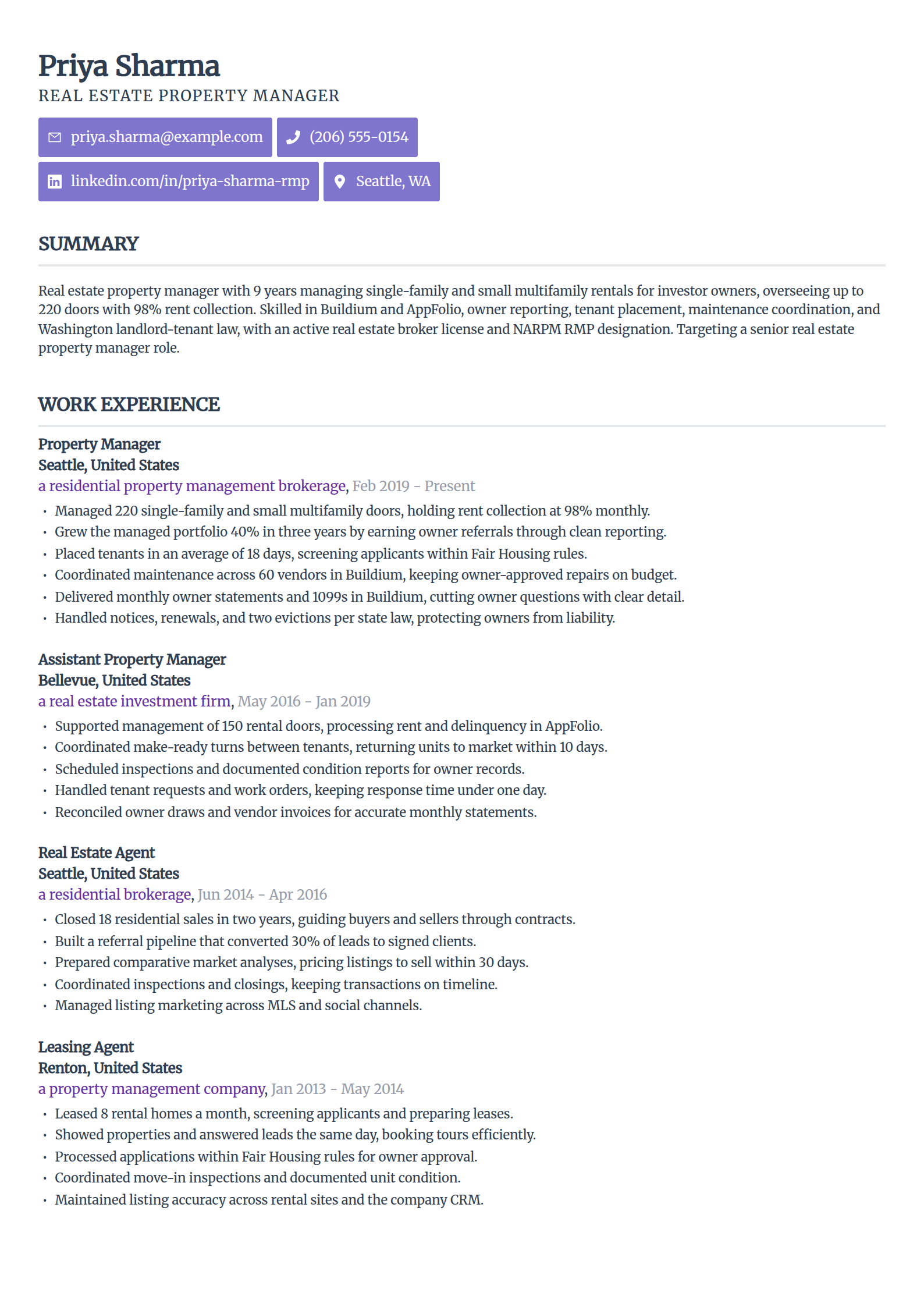
Real Estate Property Manager Resume Template
Why this resume example works?
- Frames third-party scope, 220 single-family and small multifamily doors at 98% rent collection.
- Shows what wins owner accounts, a portfolio grown 40% in three years through referrals and clean reporting.
- Keeps owner work visible, monthly statements and 1099s delivered in Buildium with fewer owner questions.
- Backs the role with a Washington broker license and a NARPM RMP, the credentials owners trust.
- Uses a clean, modern layout that carries a nine-year management history on one page.
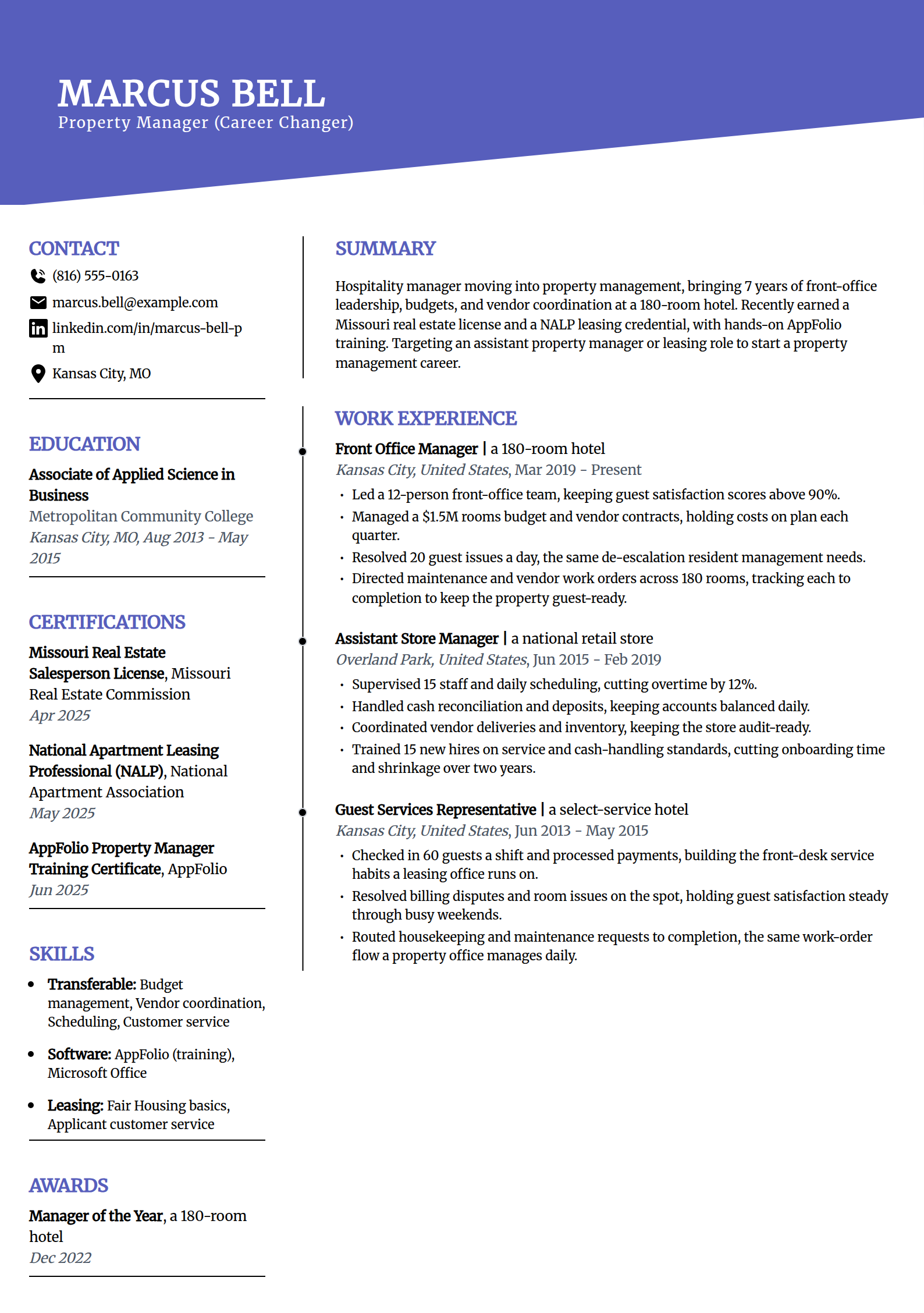
Career-Change Property Manager Resume Template
Why this resume example works?
- Names the move openly, a hospitality manager stepping into property management with a new real estate license.
- Reframes transferable strengths honestly, a $1.5M budget, vendor contracts, and daily de-escalation.
- Shows real preparation, a Missouri real estate license, a NALP credential, and hands-on AppFolio training.
- Avoids inventing property-manager numbers, using hotel and retail results instead of fabricated occupancy stats.
- Uses a two-column layout with a full sidebar so a first-time PM resume still reads complete.
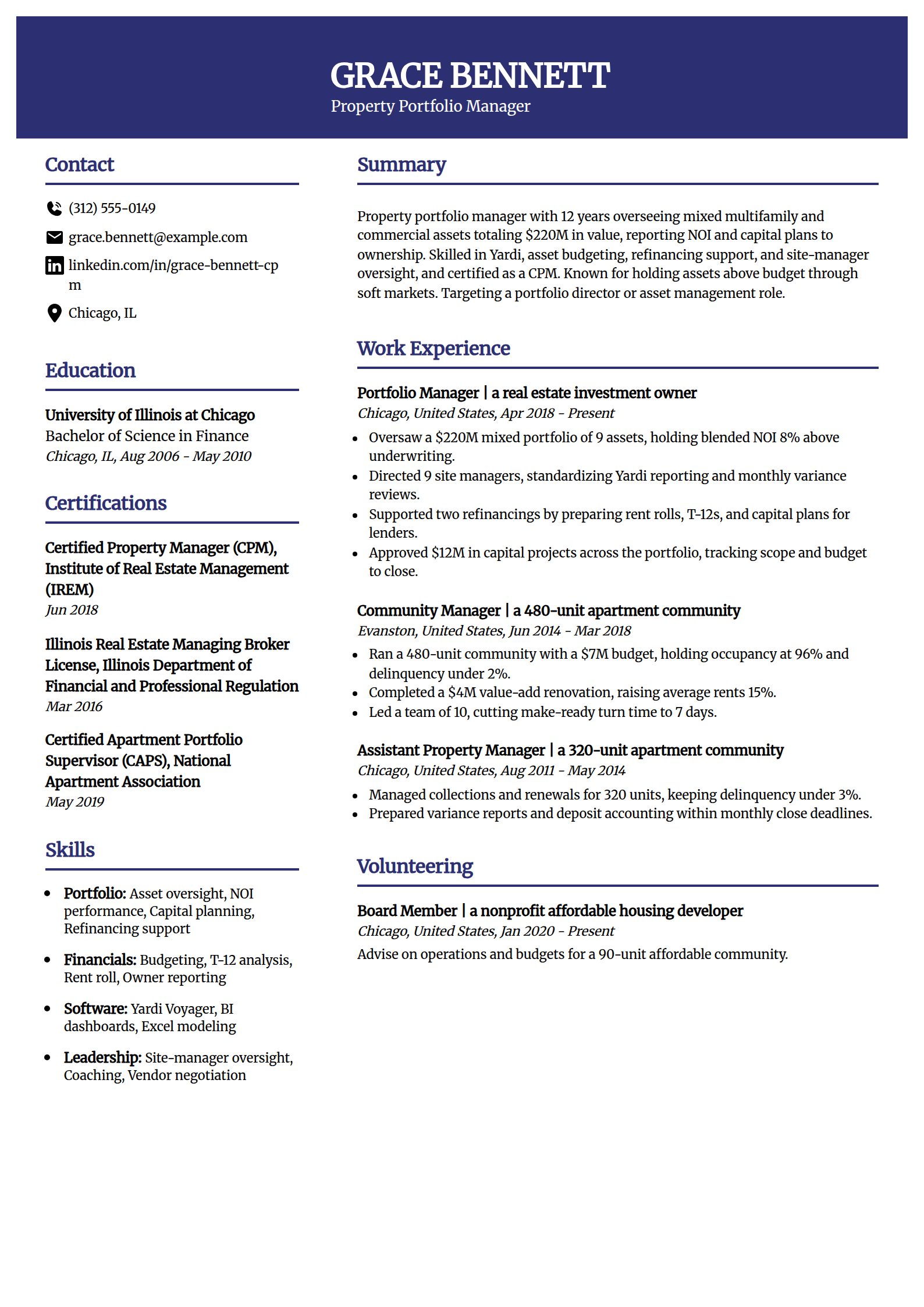
Property Portfolio Manager Resume Template
Why this resume example works?
- Opens at ownership scope, a $220M mixed portfolio held 8% above underwriting on blended NOI.
- Shows the asset-management work, two refinancings supported with rent rolls, T-12s, and capital plans.
- Makes the leadership concrete, 9 site managers directed with standardized Yardi reporting.
- Backs the role with a CPM and an Illinois managing broker license, the credentials for a portfolio seat.
- Uses a roomy two-column layout with the sidebar filled so a senior record reads complete.
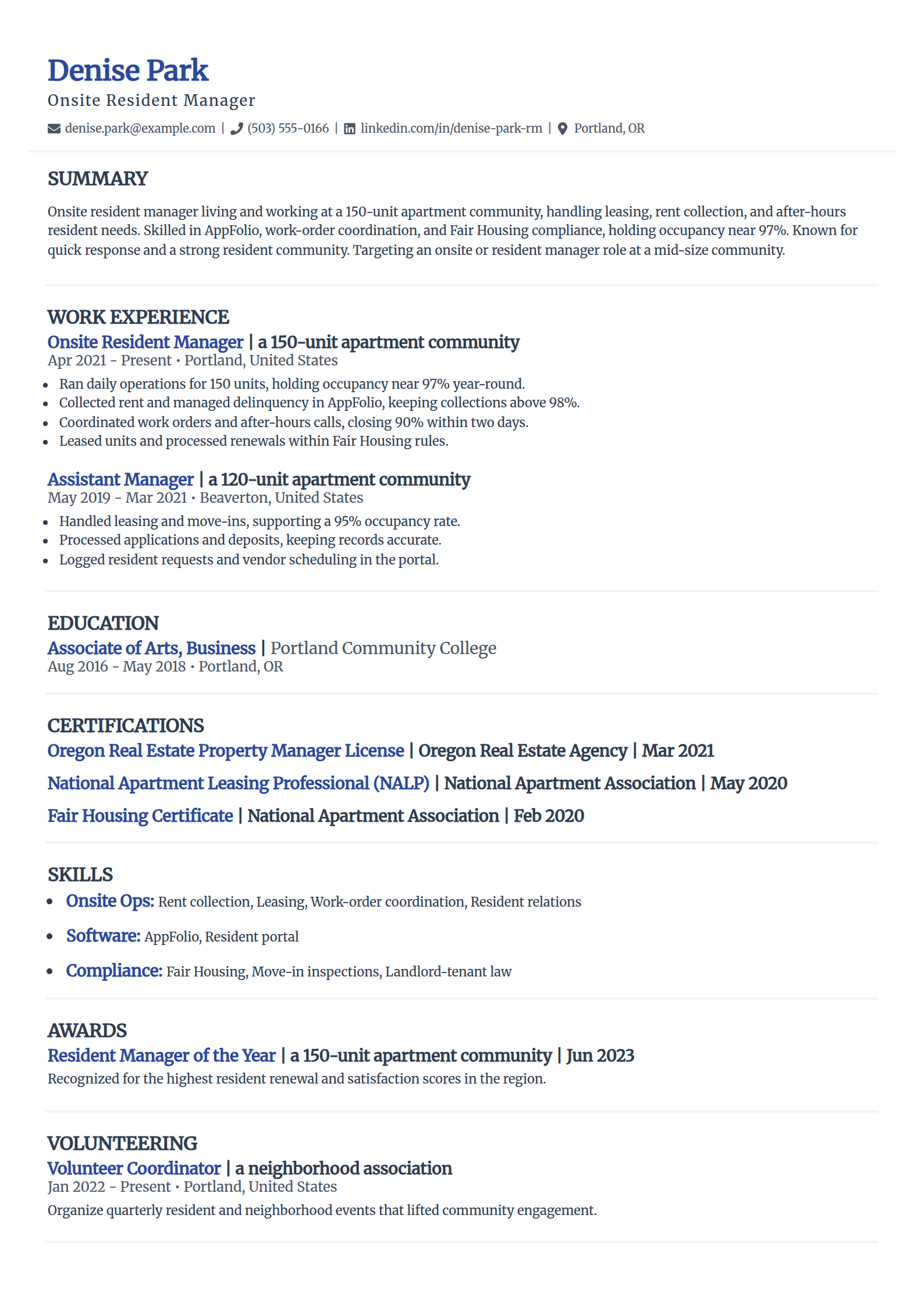
Onsite Resident Manager Resume Template
Why this resume example works?
- Frames onsite scope, running a 150-unit community while living on site with occupancy near 97%.
- Shows the always-on work an onsite role needs, after-hours calls and work orders closed at 90% within two days.
- Keeps collections concrete, rent posted and delinquency managed in AppFolio above 98%.
- Lists an Oregon property manager license and a NALP credential a posting screens for.
- Uses a refined layout with a filled sidebar so a focused five-year record reads complete.
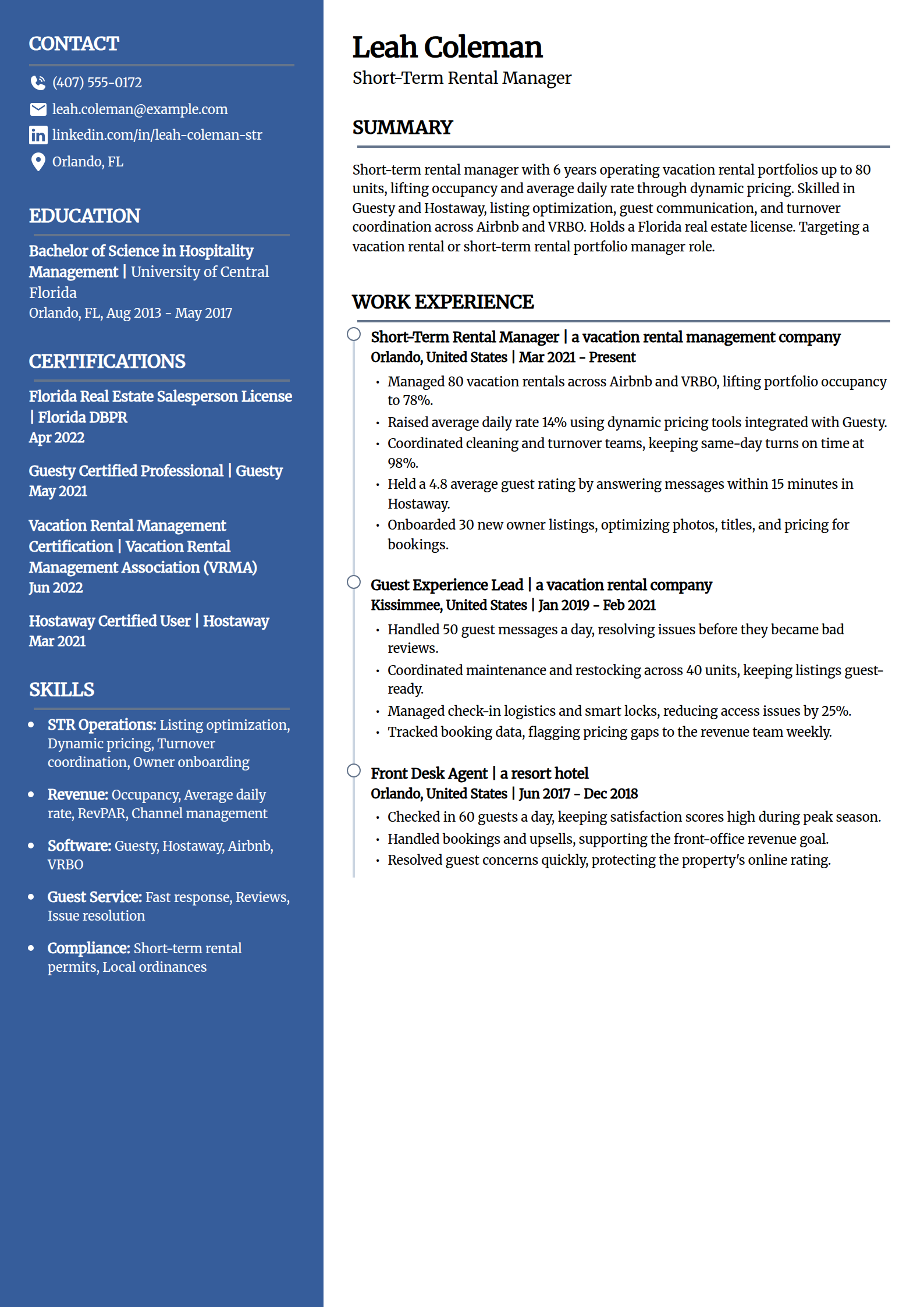
Short-Term Rental Manager Resume Template
Why this resume example works?
- Opens with vacation-rental scope, 80 Airbnb and VRBO units with occupancy lifted to 78%.
- Shows the revenue lever a portfolio hires for, average daily rate raised 14% through dynamic pricing.
- Keeps guest service concrete, a 4.8 rating held by answering messages within 15 minutes in Hostaway.
- Names Guesty and Hostaway, the channel-management tools a short-term rental posting lists.
- Fills a distinctive layout while staying easy for an owner to skim in one pass.
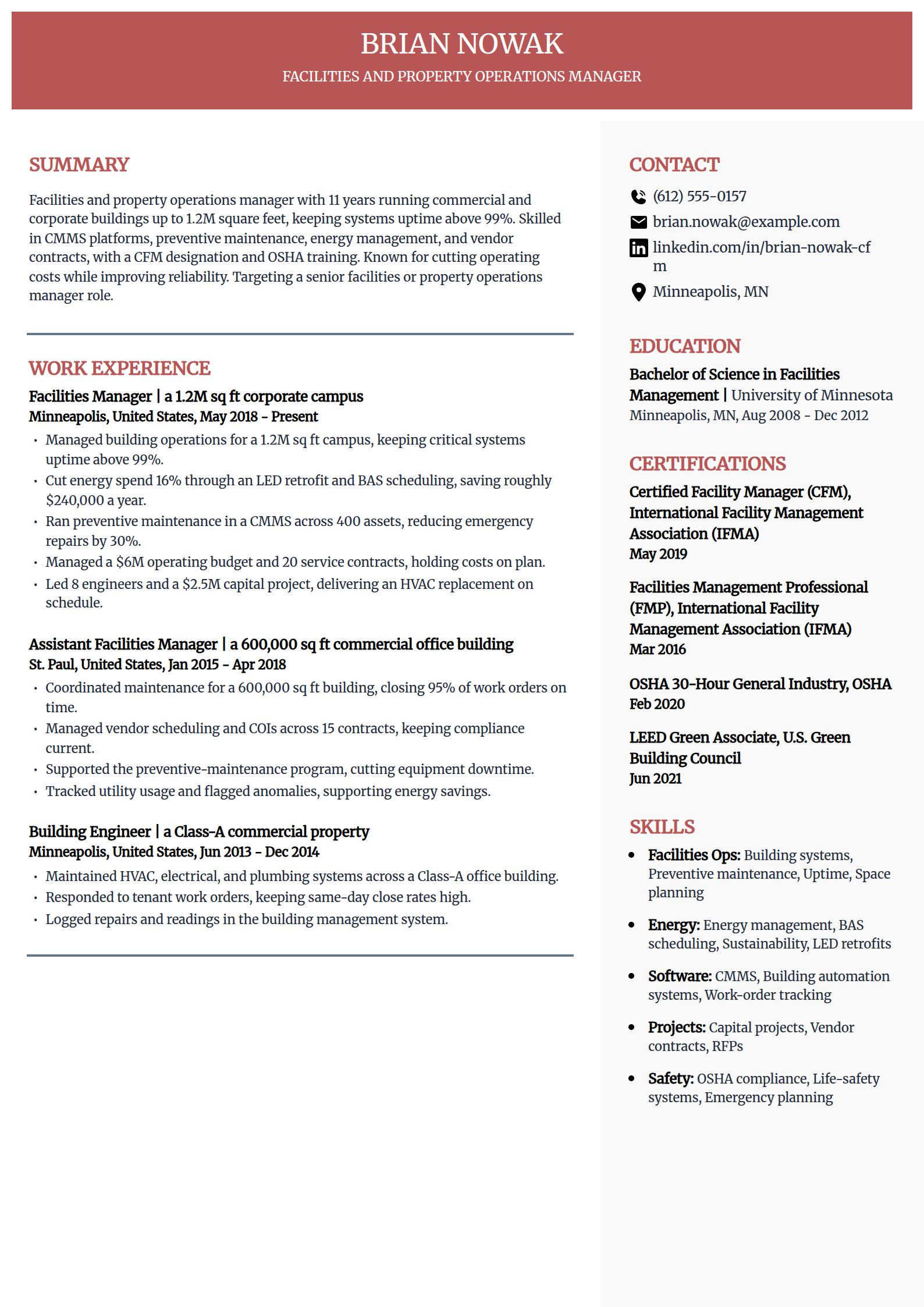
Facilities & Property Operations Manager Resume Template
Why this resume example works?
- Frames operations scope, a 1.2M sq ft campus with critical-systems uptime held above 99%.
- Shows a result an owner reads, energy spend cut 16% for roughly $240,000 a year in savings.
- Keeps the reliability work concrete, preventive maintenance across 400 assets in a CMMS.
- Backs the role with a CFM and an FMP, the facilities credentials a corporate posting lists.
- Uses a refined, executive layout that fits an eleven-year operations record cleanly.
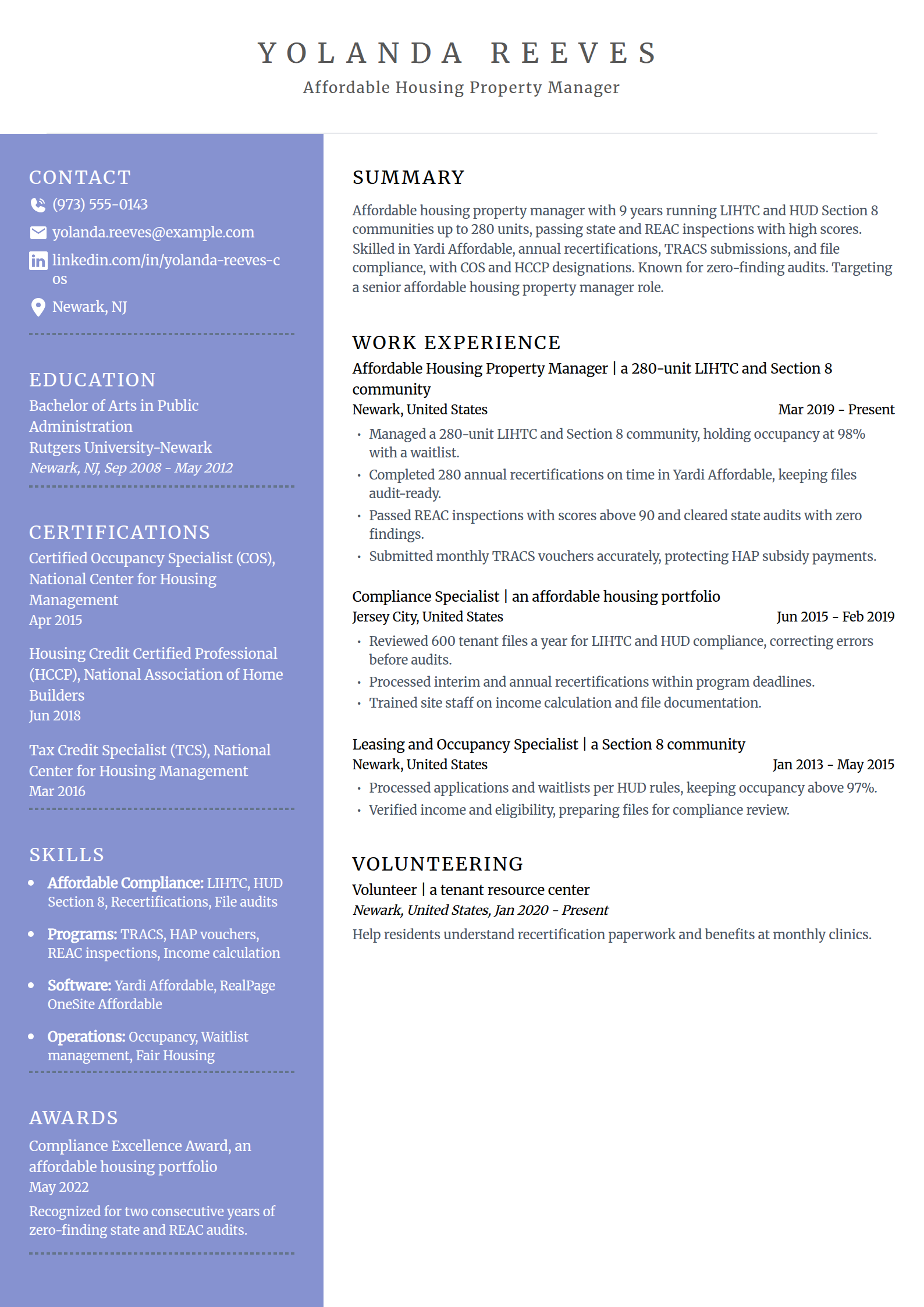
Affordable Housing (Section 8 & LIHTC) Resume Template
Why this resume example works?
- Frames affordable scope, a 280-unit LIHTC and Section 8 community held at 98% occupancy with a waitlist.
- Shows the compliance work this track is hired for, 280 recertifications on time and zero-finding audits.
- Keeps the programs concrete, monthly TRACS vouchers submitted to protect HAP subsidy payments.
- Backs the role with a COS and an HCCP, the affordable-housing credentials a posting screens for.
- Uses a roomy two-column layout with a filled sidebar so the page reads complete.
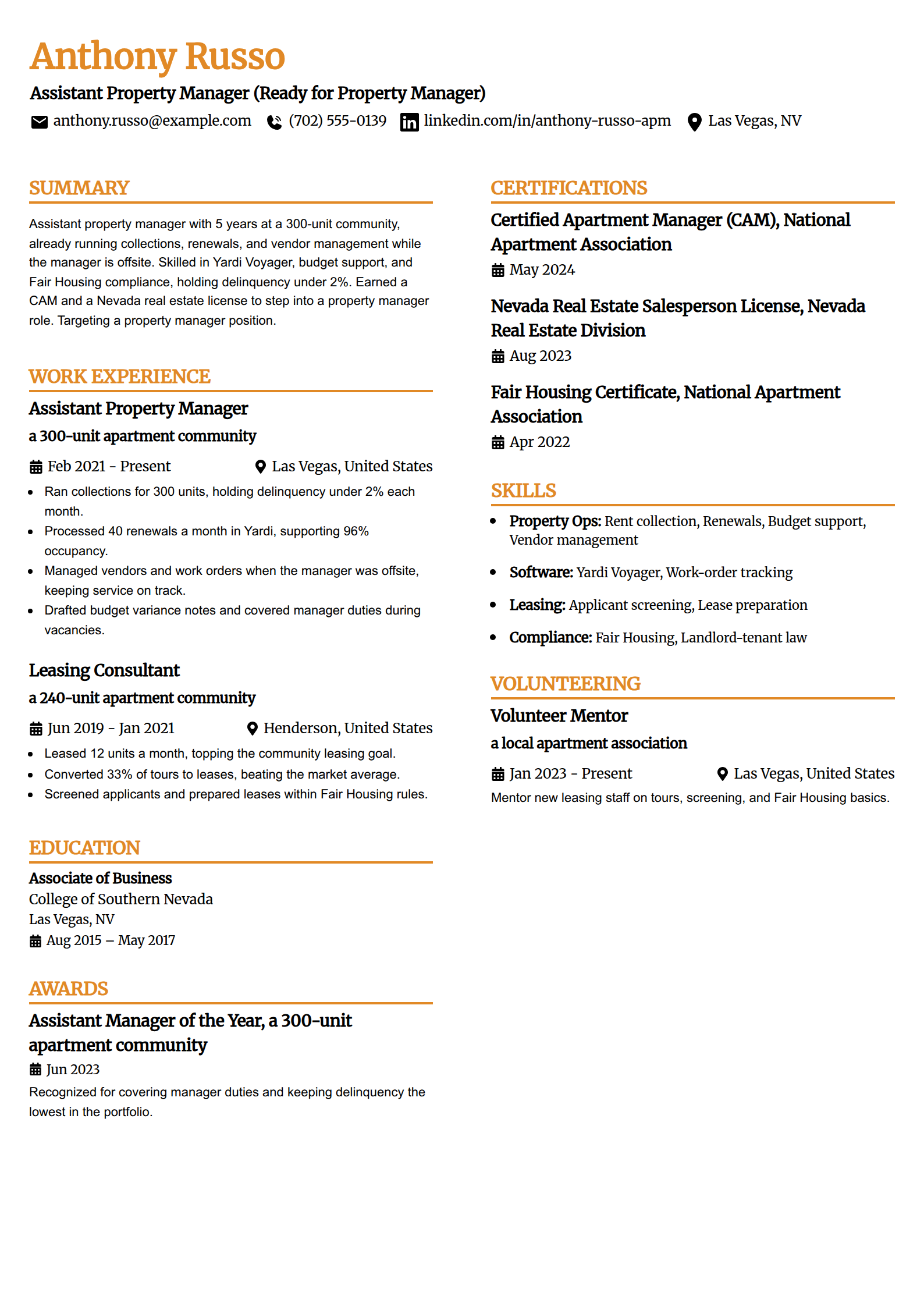
Assistant PM to Property Manager Promotion Resume Template
Why this resume example works?
- Makes the promotion case directly, an assistant PM already covering manager duties when the manager is offsite.
- Shows PM-level results, collections run for 300 units with delinquency held under 2%.
- Keeps the readiness concrete, a new CAM and a Nevada real estate license earned to step up.
- Names Yardi Voyager and the budget-support work a property manager posting expects.
- Uses a tight, ATS-safe layout that fits a focused five-year record without empty space.
Build your property manager resume
Pick a template above and the editor keeps your layout clean and ATS-safe while you swap in your own occupancy, budget, and the software your portfolio runs.
Build my resumeHow to write a property manager resume in 2026
A property manager resume is read by someone who checks two things fast: the size of what you have run and whether your software matches the posting. Lead with occupancy, delinquency, and the budget you managed, then name the platform you used, one modest number per line. These moves make yours easy to skim and easy for an applicant tracking system to parse.
Open with a short property manager summary
Write three to four sentences that name your years and the size of what you manage, your occupancy or collection number, one or two systems you use, and the role you are targeting. If you are new, lead with a leasing or assistant role and your software training instead of years. Say what you have run, not what you want from the employer.
Residential property manager with 9 years running communities up to 320 units, holding occupancy near 96% and delinquency under 2%. Skilled in Yardi Voyager, budgets and variance, renewals, and vendor management, and certified as a CAM with an active real estate license. Targeting a senior residential property manager role.
Lead experience with occupancy, delinquency, and budget
The work a property manager resume is hired for is measurable, so name it and attach one modest number to each bullet. Open every line with a strong verb, never "Responsible for".
- Occupancy: state the size and the rate, like holding a 320-unit community at 96% across three lease seasons.
- Delinquency and collections: name the move, such as cutting delinquency from 5% to under 2% in Yardi.
- Budget and NOI: name the money, like managing a $4.2M operating budget or holding NOI on plan.
- Turnovers and renewals: use numbers an owner reads, such as cutting turn time to 7 days or renewals to 62%.
List your license and certifications the right way
This is the section a regional manager or owner checks, so match it to your track and get the wording right.
- Name your state real estate salesperson or broker license with the issuing body and a current date.
- Add the designation that fits your track: CAM or CAPS for apartments, CPM or ARM for portfolios, RMP for single-family.
- For HOA roles, list your state community association manager license plus CMCA, AMS, or PCAM.
- For affordable housing, list COS, HCCP, or TCS, since compliance credentials are what those postings screen for.
Match your skills to the posting's keywords
A property manager skills list should read like the job description. Split it so a hiring manager and a parser both find what they need.
- Software: name the platform outright, like Yardi, AppFolio, RealPage, Buildium, Entrata, or MRI, matching the posting.
- Operations: occupancy, delinquency control, renewals, turnovers, work orders, and vendor management.
- Financials: budget and variance, NOI, rent roll, and monthly reporting; add CAM reconciliation for commercial.
- Compliance: Fair Housing, landlord-tenant law, and deposit accounting; add LIHTC or HUD for affordable housing.
Do you need a CAM or CPM to get hired? (the honest answer)
Job boards push certifications hard, but the timing is the opposite of what they imply. The credential follows the experience, so do not wait on it to apply.
- The CAM needs about a year of industry experience and the CPM needs about three, so a first-timer cannot lead with them.
- If you are new, lead with software fluency, a state real estate license, and any leasing or assistant results instead.
- List a certification as "in progress" only when you are enrolled, and name the expected completion date.
- Once you have the designation, put it after your name and in a certifications block, not buried in a skills list.
Keep it to one clean, ATS-safe page
Management companies and owners run applicant tracking systems, so a clean one-page resume is the standard for almost every property manager.
- Use a single-column or simple two-column layout with standard headings a parser recognizes.
- Hold it to one page and lead with your most recent role in reverse-chronological order.
- Save as a PDF so the layout holds, then run it through our ATS resume checker for a format and keyword pass.
- Swap the numbers in the templates above for your own occupancy, budget, and software; do not copy them as is.
Common property manager resume mistakes
- Writing vague duties like "handled tenant relations". Say what changed: "cut delinquency from 5% to under 2% in Yardi".
- Leaving out the software. Name the platform you used, like AppFolio, RealPage, or Yardi, since postings screen for it.
- Skipping the numbers. Occupancy, delinquency, budget size, and renewal rate are what an owner reads first, so lead with them.
- Waiting on a CAM or CPM to apply. Those need one to three years of experience; lead with your license and results instead.
- Mixing up your track. A commercial resume needs CAM reconciliation and NNN leases; an affordable one needs LIHTC and recertifications.
Frequently asked questions
What should a property manager resume include?
A property manager resume needs your contact details, a short summary, your real estate license and certifications, work history in reverse-chronological order, education, and a skills list. Lead each role with the size of what you managed and the numbers an owner reads first: occupancy rate, delinquency, budget size, renewals, and turnover time. Name the software you used, such as Yardi, AppFolio, RealPage, Buildium, or MRI. Match the specialty to the job, so a commercial resume shows CAM reconciliation and an affordable one shows LIHTC compliance. Keep it to one clean page.
How do I write a property manager resume with no experience?
Lead with a leasing or assistant role and the results you already have, then your software training and license instead of years. If you are changing careers, reframe transferable work honestly: budgets you managed, vendors you coordinated, and the customer service that resident management needs. Get a state real estate license and a leasing credential like NALP, and take AppFolio or Yardi training so you can name the software a posting lists. Do not invent occupancy numbers you have not earned. The career-change and assistant examples above show the shape.
What skills should I put on a property manager resume?
Split your skills so a hiring manager and a parser both find what they need. Software: name the platform outright, like Yardi, AppFolio, RealPage, Buildium, Entrata, or MRI, matching the posting. Operations: occupancy, delinquency control, renewals, turnovers, work orders, and vendor management. Financials: budget and variance, NOI, rent roll, and monthly reporting. Compliance: Fair Housing, landlord-tenant law, and deposit accounting. Add track-specific skills where they fit, such as CAM reconciliation for commercial or LIHTC recertifications for affordable housing.
Do I need a CAM or CPM certification to get a property manager job?
No, and you usually cannot get them first. The CAM from the National Apartment Association needs about a year of industry experience, and the CPM from IREM needs about three, so a new candidate cannot lead with either. If you are starting out, lead with a state real estate license, software fluency, and any leasing or assistant results instead. List a certification as in progress only when you are enrolled, with an expected completion date. Once you earn the designation, put it after your name and in a certifications block.
How do I list Yardi, AppFolio, or RealPage on my resume?
Name the exact platform in your skills section and tie it to what you did in your experience bullets, since applicant tracking systems screen for the software the posting names. Instead of a bare "property management software", write the system: "cut delinquency to under 2% in Yardi Voyager" or "processed 45 renewals a month in RealPage". If a posting names a platform you have used, match its wording exactly. If you only trained on it, say so honestly, like "AppFolio (training)", rather than implying years of use.
How long should a property manager resume be?
One page for almost every property manager, including assistants and those with under ten years. Lead with your most recent role and keep the numbers that matter for the track you are targeting, summarizing or dropping older jobs to make room for occupancy, delinquency, budget, and the software the posting names. Regional managers and portfolio managers with a long history and many assets can run to a second page, but a single skimmable page reads best and parses cleanly.
More property manager resume resources
Build your property manager resume
Pick a template above and the editor keeps your layout clean and ATS-safe while you swap in your own occupancy, budget, and the software your portfolio runs.