19 HR Resume Examples, Coordinator to Business Partner
- ATS Friendly
- HR Specific
- 19 Sub-Role Examples
A strong HR resume example shows four things: a summary naming your level and the headcount you support, bullets carrying HR numbers such as time-to-fill and turnover, your HRIS and ATS named outright, and certifications with honest status. You screen resumes for a living, so yours has to clear the same bar. Every example below is a full HR resume in a parser-safe template.


540k+ resumes created
Editable HR resume templates
Every template below is a real HR resume laid out in that format, filtered by the level and specialty you are targeting. Pick one, then swap in your own headcount, systems, and results. Each keeps your name, dates, and contact details where an applicant tracking system expects them.
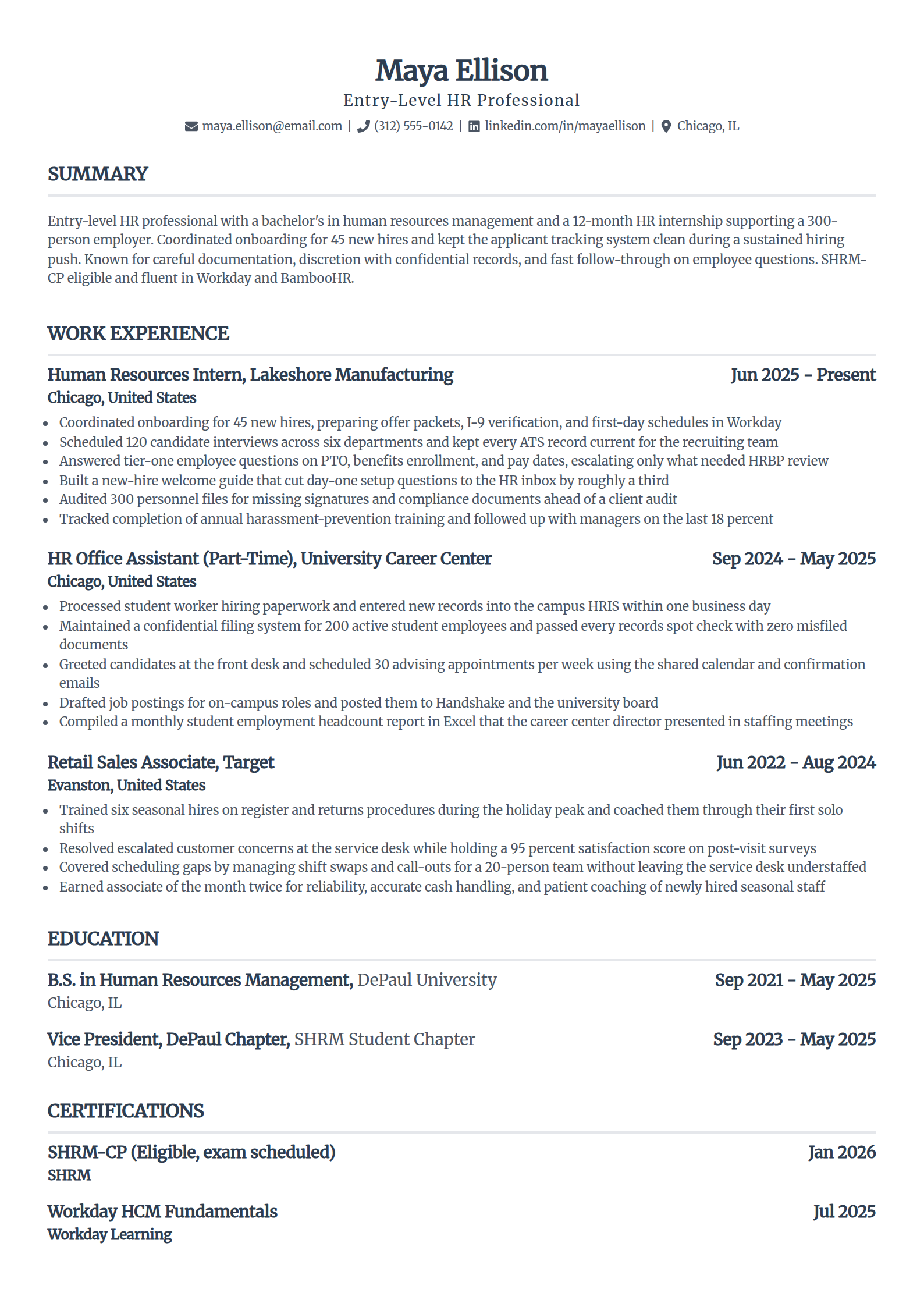
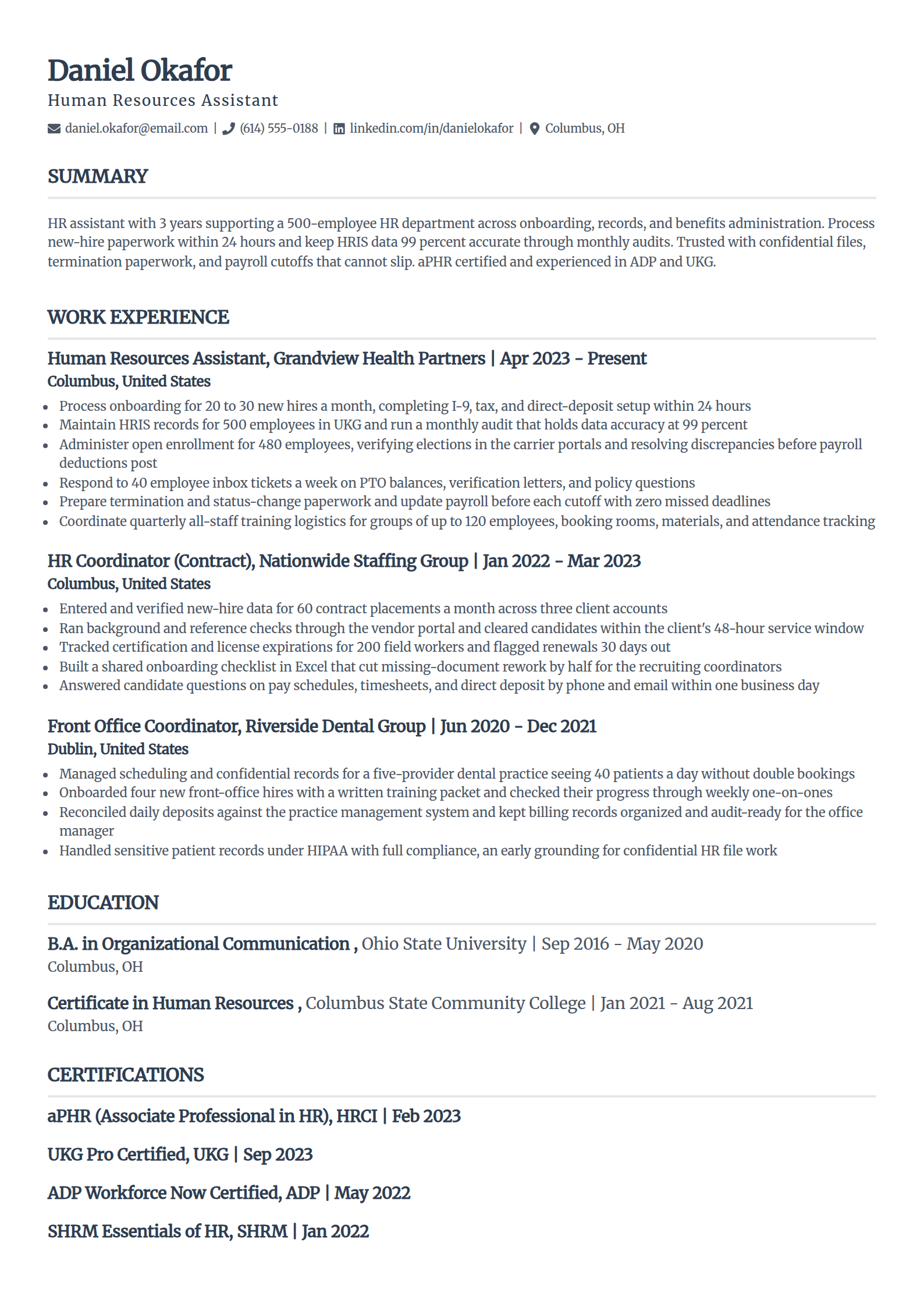
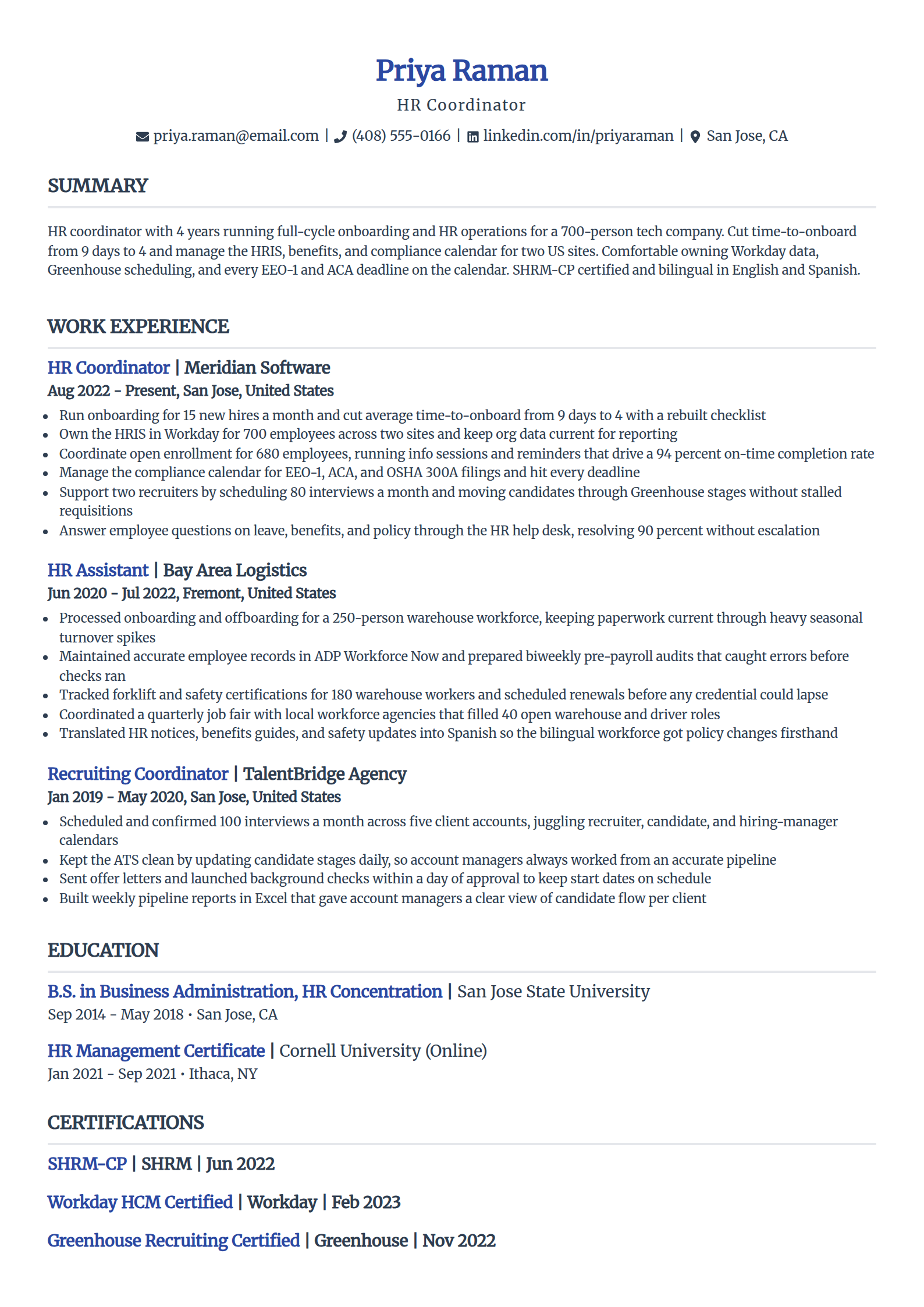
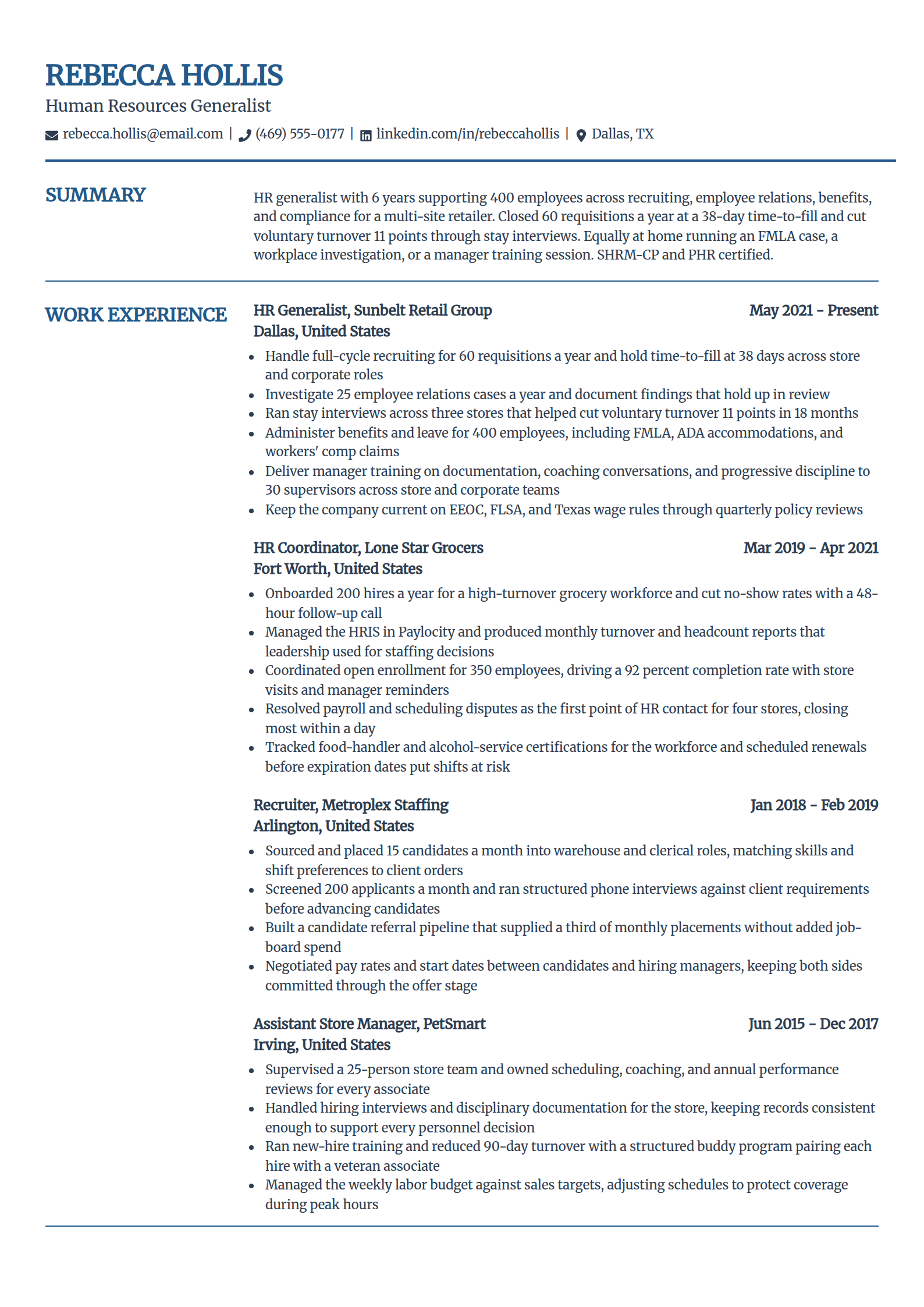
Entry-Level HR Resume Template
Why this resume example works?
- Names the target level in the first clause so a recruiter reads a limited history for potential, not tenure.
- Turns a 12-month internship into proof by naming the 45 onboarding hires it handled.
- Lists the systems an HR posting screens for, Workday and BambooHR, instead of claiming to be a fast learner.
- States SHRM-CP eligibility honestly, with the exam scheduled, rather than implying the credential is already earned.
- Keeps the tone confident about real tasks, so the lack of a full-time HR title reads as a starting point.
HR Assistant Resume Template
Why this resume example works?
- Leads with the department size, 500 employees, so the scale of the support role is clear.
- Pairs a speed metric, 24-hour onboarding, with an accuracy one, 99 percent HRIS data, so neither looks gamed.
- Names UKG and ADP outright, the systems an assistant posting expects.
- Shows the weekly ticket load, 40, so the workload behind the title is concrete.
- Keeps the compliance work visible, which is where assistant roles carry real responsibility.
HR Coordinator Resume Template
Why this resume example works?
- Opens on a before-and-after result, cutting time-to-onboard from 9 days to 4, not a duty.
- Shows ownership of the HRIS for 700 employees across two sites, which signals coordinator-level trust.
- Names the compliance filings a coordinator manages: EEO-1, ACA, and OSHA 300A.
- Carries a completion rate, 94 percent on open enrollment, that an HR manager can verify.
- Adds a bilingual line that maps to a real workforce, not a generic language claim.
HR Generalist Resume Template
Why this resume example works?
- Covers the four generalist pillars in one line: recruiting, employee relations, benefits, and compliance.
- Backs the recruiting claim with a real pair of numbers, 60 requisitions a year at a 38-day time-to-fill.
- Ties a retention result, turnover down 11 points, to a specific action, stay interviews.
- Names the laws a generalist must know, EEOC, FLSA, and FMLA, so the compliance depth is clear.
- Shows investigation volume, 25 cases a year, which is the harder half of the generalist job.
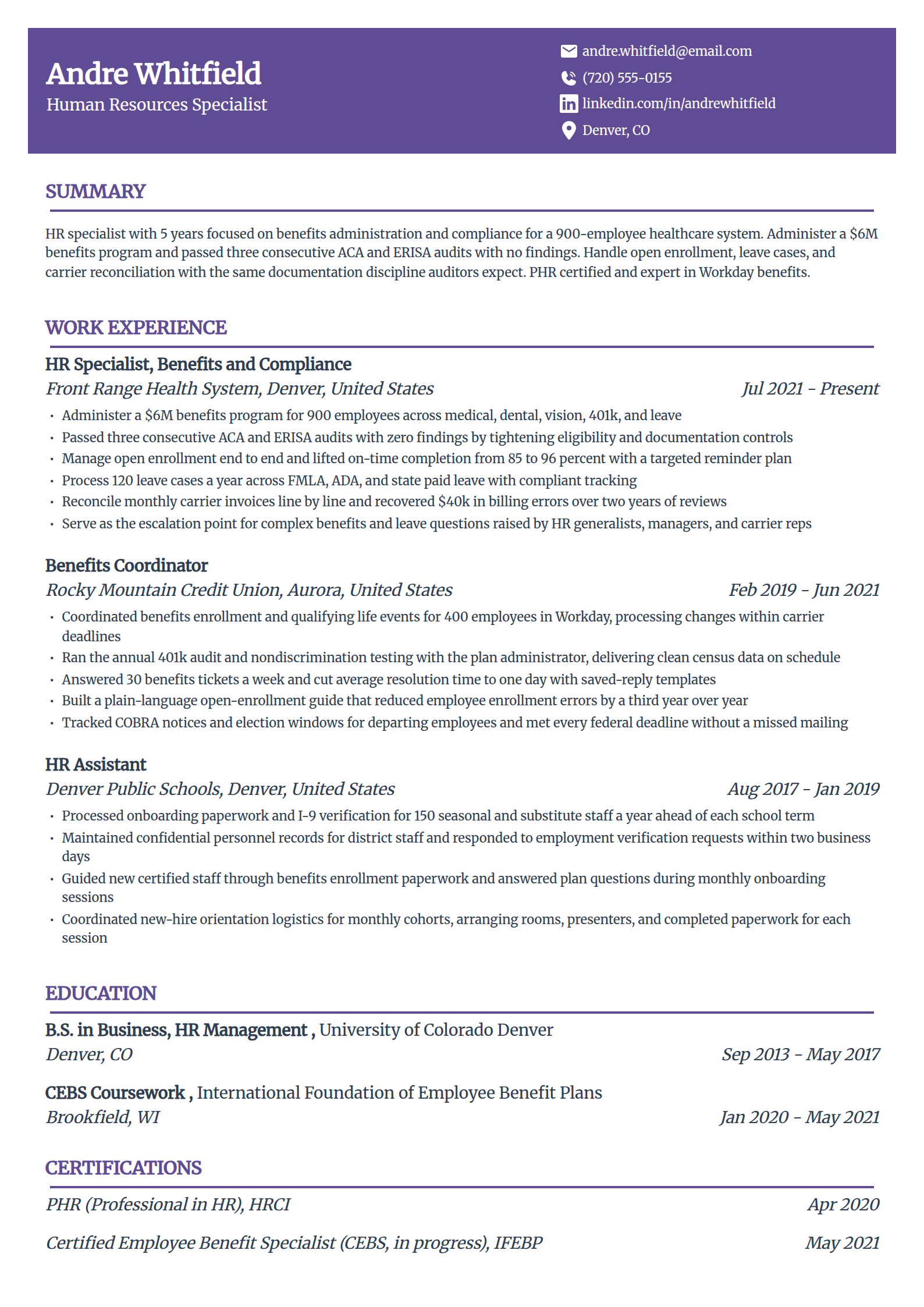
HR Specialist Resume Template
Why this resume example works?
- Declares the specialty up front, benefits and compliance, so the resume is not read as a generalist's.
- Leads with the program size, a $6M benefits program, that frames the scope.
- Names a checkable compliance result, three clean ACA and ERISA audits, that specialists are hired to deliver.
- Quantifies recovered savings, $40k in carrier billing errors, from a concrete habit.
- Keeps the leave caseload, 120 cases a year, visible so the depth is not just theory.
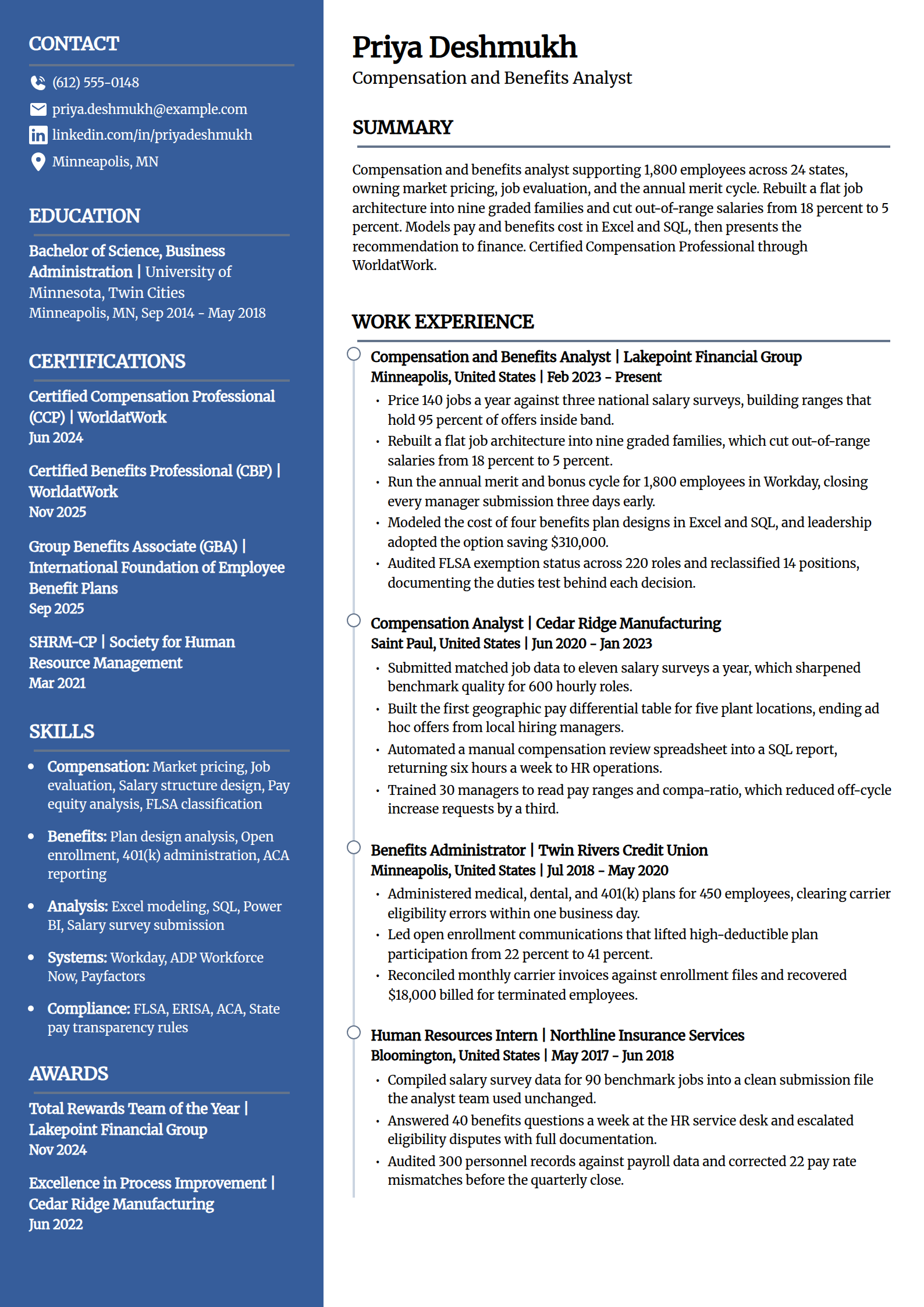
Compensation & Benefits Analyst Resume Template
Why this resume example works?
- Puts analysis ahead of administration in the first line, so it is not read as a benefits coordinator's resume.
- Leads with what comp analysts are hired to do: pricing 140 jobs a year against three national salary surveys.
- Shows a structural fix with a before and after, out-of-range salaries down from 18 percent to 5 percent.
- Names Excel, SQL, and Payfactors, the modeling and market-data tools a compensation posting screens for.
- Carries CCP and CBP from WorldatWork, the credentials that separate a comp analyst from a generalist.
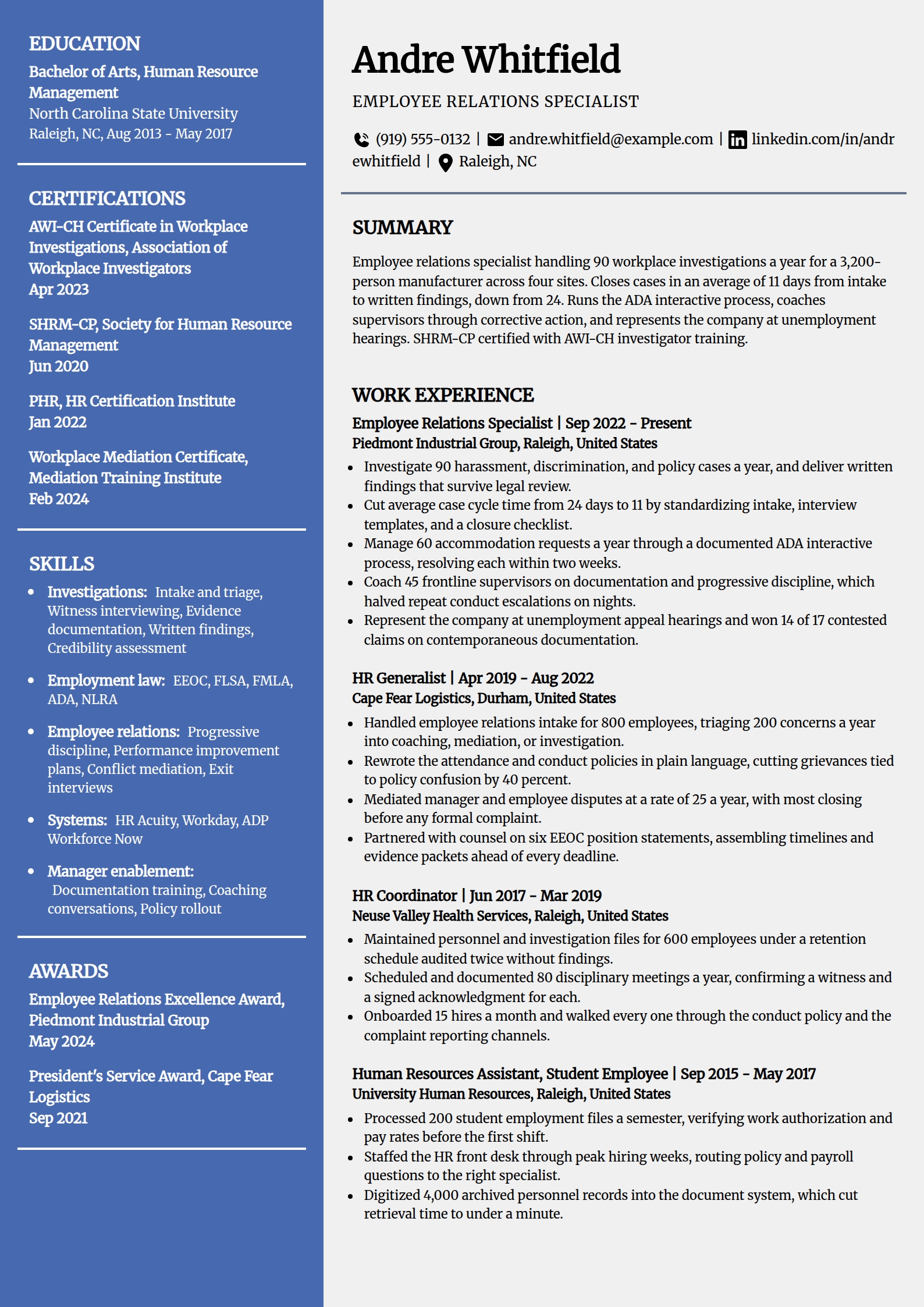
Employee Relations Specialist Resume Template
Why this resume example works?
- States case volume up front, 90 investigations a year, which is how employee relations scope gets measured.
- Pairs speed with rigor: cycle time from 24 days to 11 by standardizing intake and closure, not by rushing.
- Names HR Acuity, the case management system an employee relations posting expects to see.
- Shows the ADA interactive process and unemployment hearings, work a generalist resume rarely proves.
- Carries the AWI-CH certificate, which tells a hiring manager the interviews were run properly.
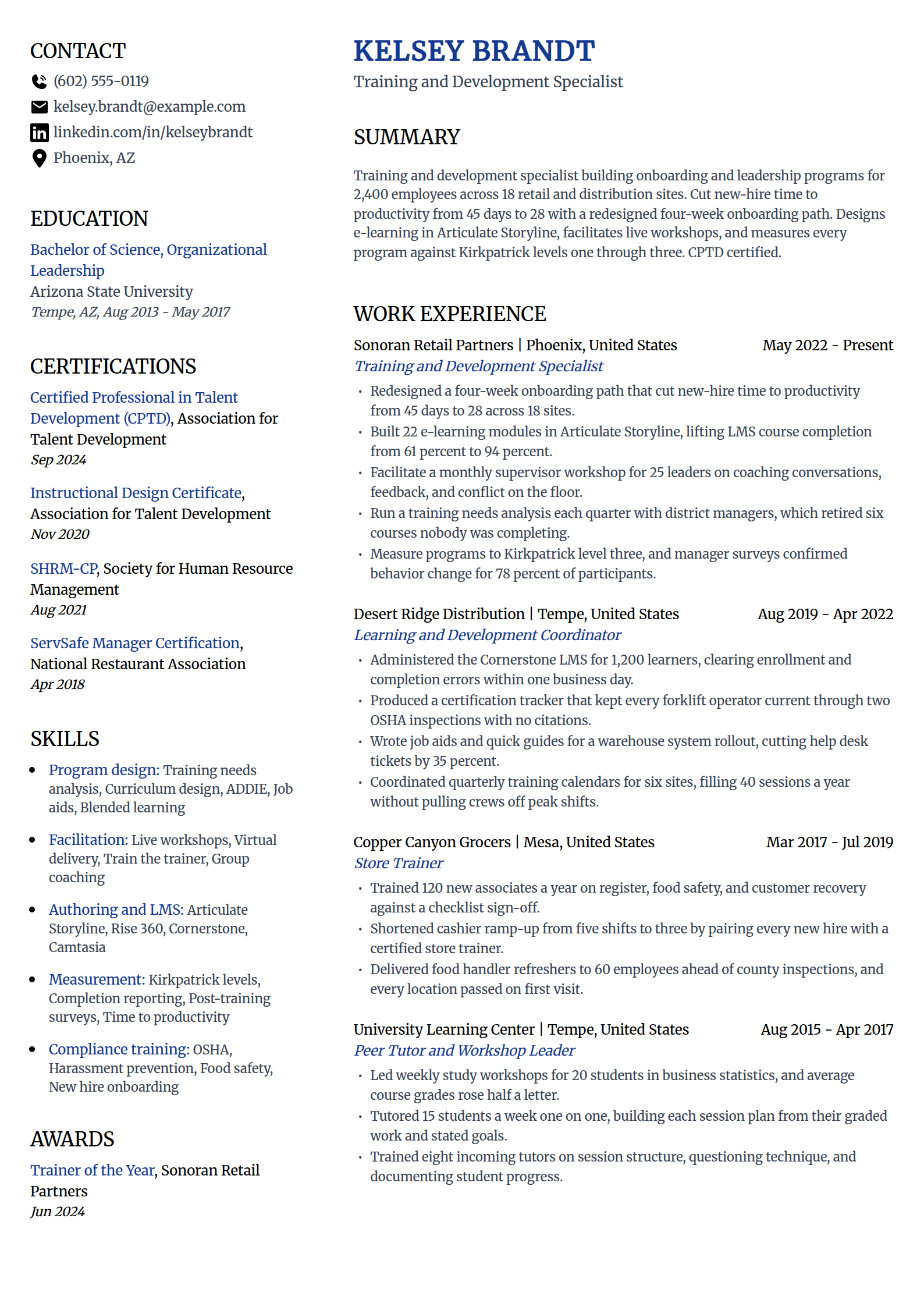
Training & Development Specialist Resume Template
Why this resume example works?
- Leads with a business result, new-hire time to productivity cut from 45 days to 28, not a course count.
- Names Articulate Storyline and Cornerstone, the authoring and LMS keywords an L&D posting matches on.
- Measures past attendance by naming Kirkpatrick level three and what the manager surveys actually found.
- Proves the unglamorous half of the job: a quarterly needs analysis that retired six unfinished courses.
- Carries the CPTD, the talent development credential a corporate training posting recognizes.
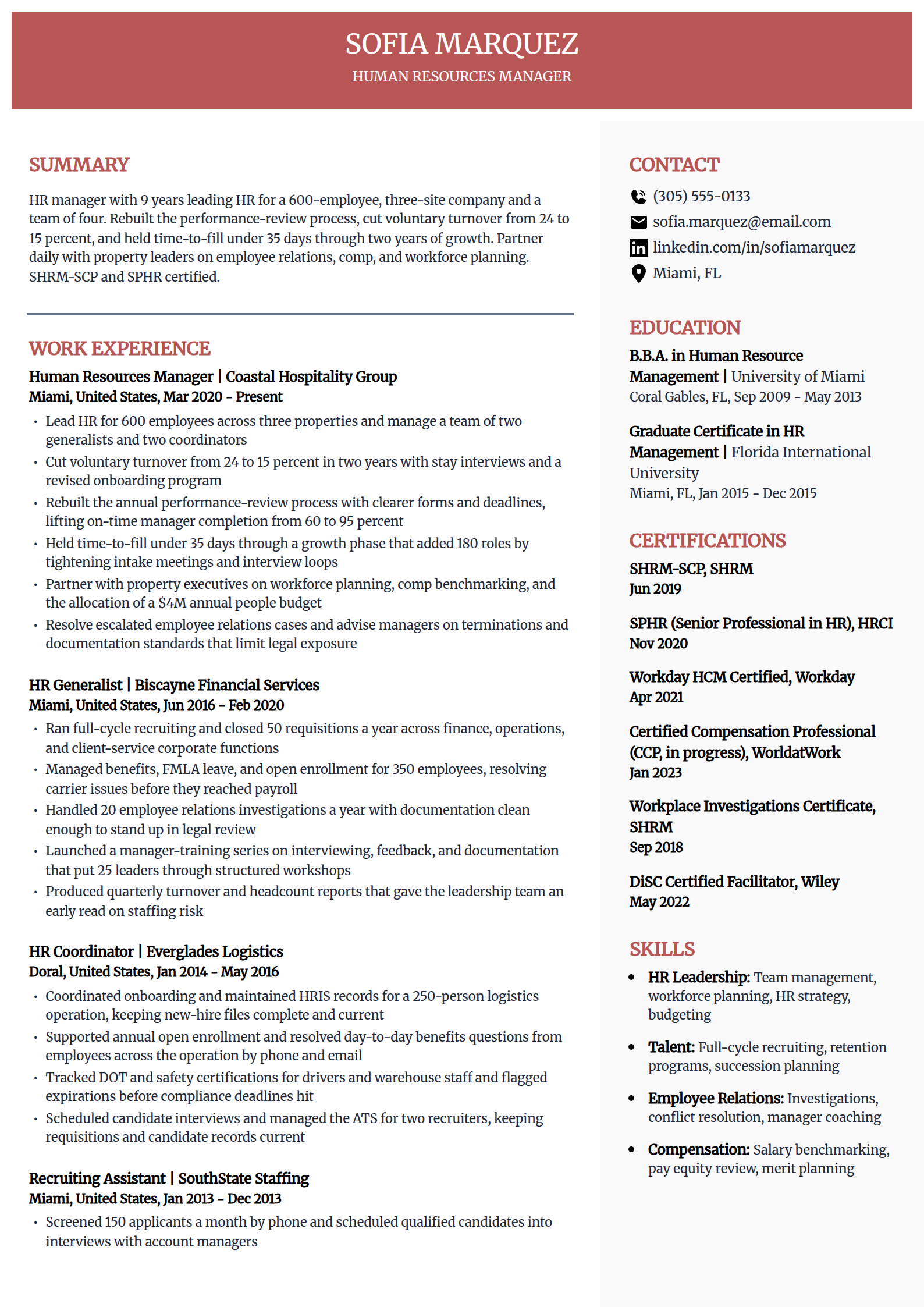
HR Manager Resume Template
Why this resume example works?
- Separates leadership scope, 600 employees and a team of four, from individual-contributor work.
- Shows a retention result with a before and after, turnover from 24 to 15 percent, tied to two named levers.
- Names the budget owned, $4M, so the accountability of the role is unambiguous.
- Claims the manager's real work: workforce planning, comp benchmarking, and escalated cases.
- Carries SHRM-SCP and SPHR, the senior credentials a manager posting looks for.
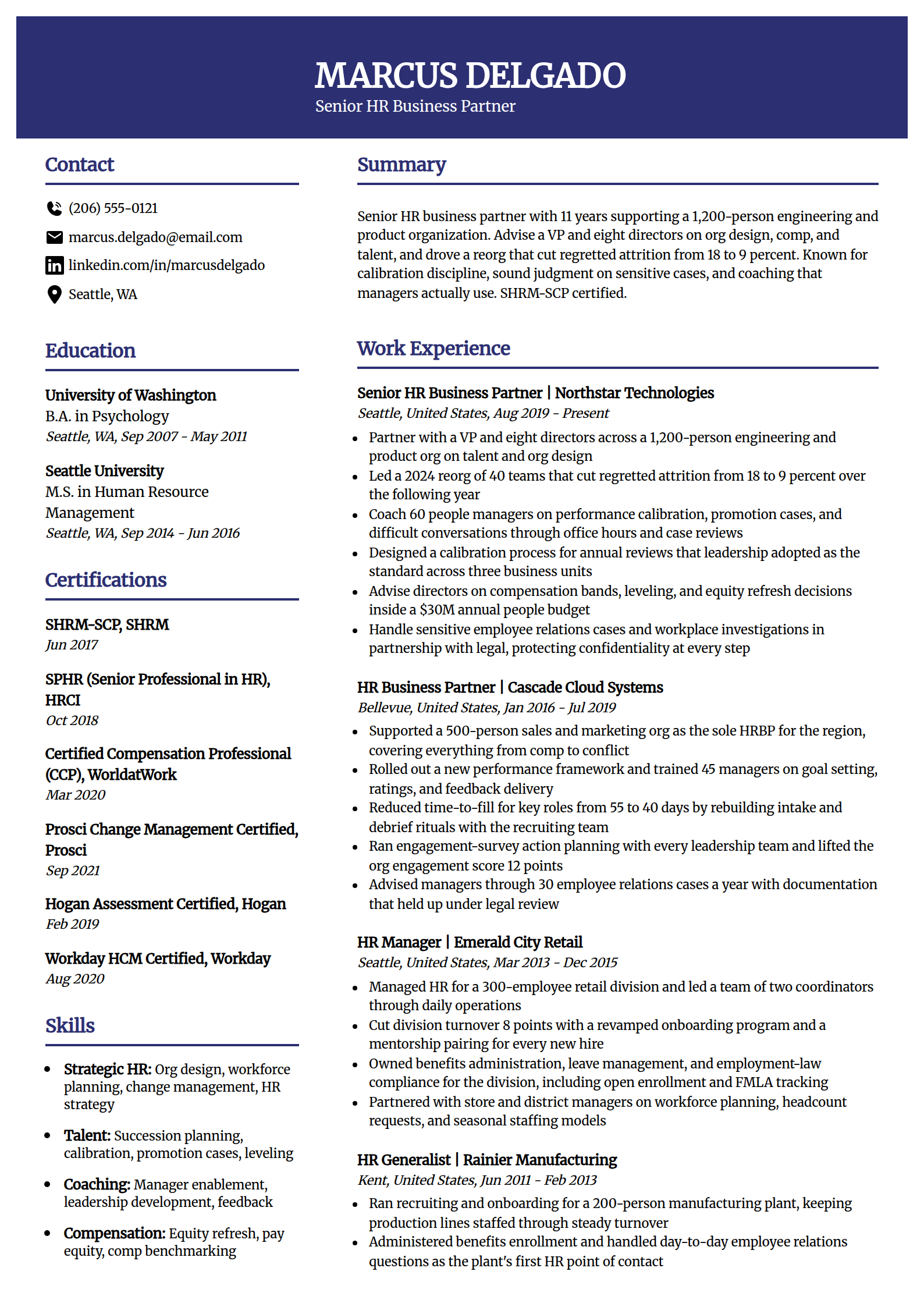
HR Business Partner (HRBP) Resume Template
Why this resume example works?
- Frames the role by who it advises, a VP and eight directors, which is how HRBP scope is measured.
- Leads a bullet with the reorg outcome, regretted attrition from 18 to 9 percent, the metric leadership tracks.
- Shows the coaching load, 60 people managers, that separates a partner from an administrator.
- Names a process the person built, calibration adopted across three business units, not just tasks run.
- Keeps the comp scope, a $30M people budget, so the seniority is concrete.
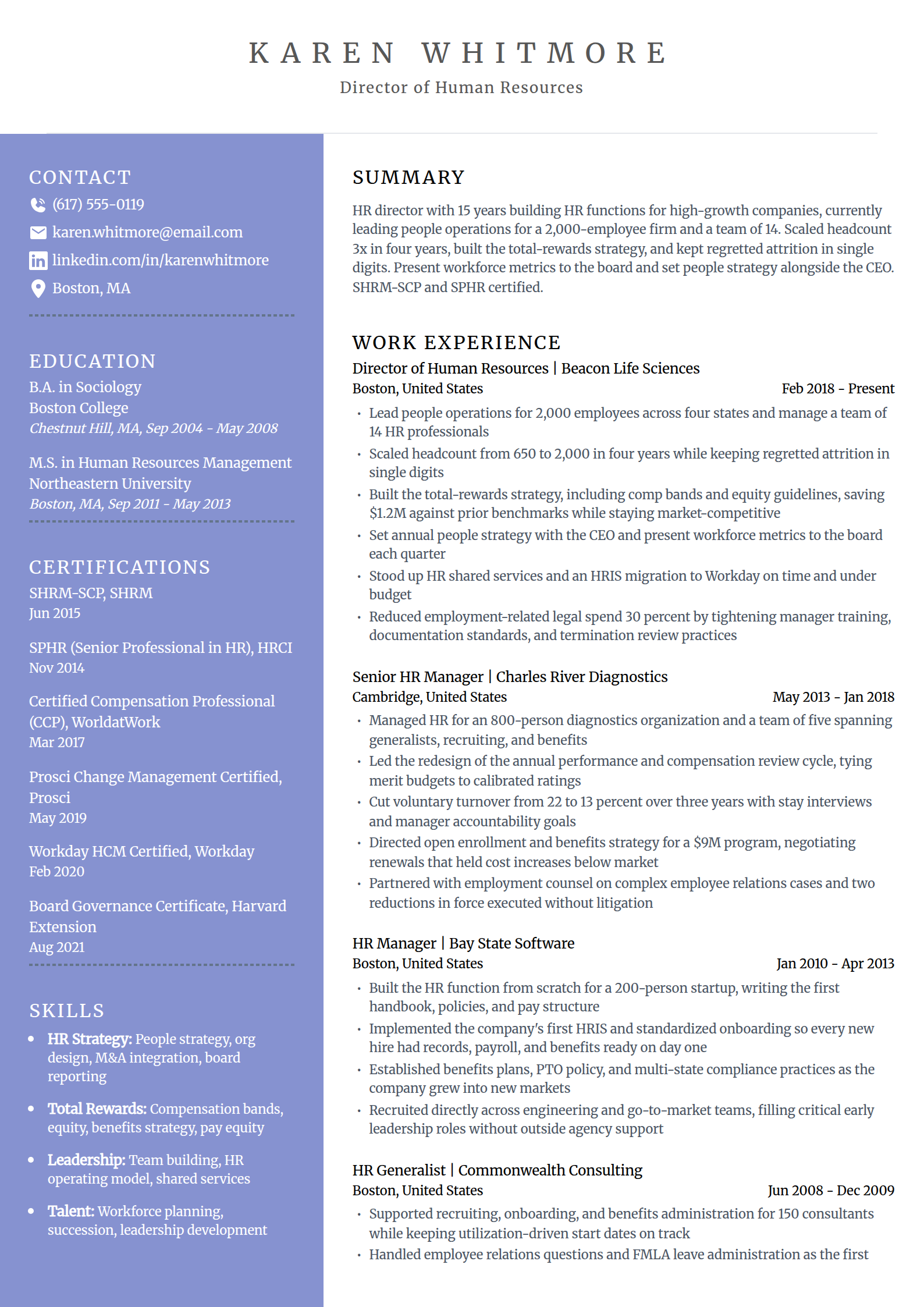
HR Director Resume Template
Why this resume example works?
- Opens on the org led, 2,000 employees across four states, and a team of 14, the director-level markers.
- Shows the scaling story, headcount from 650 to 2,000, that a director is hired to run.
- Ties a savings figure, $1.2M against benchmarks, to a strategy the person built, not a vendor.
- Names board-level work, quarterly workforce metrics to the board, that a manager resume would not carry.
- Reads as strategy, total rewards and an HRIS migration, rather than a longer list of HR tasks.
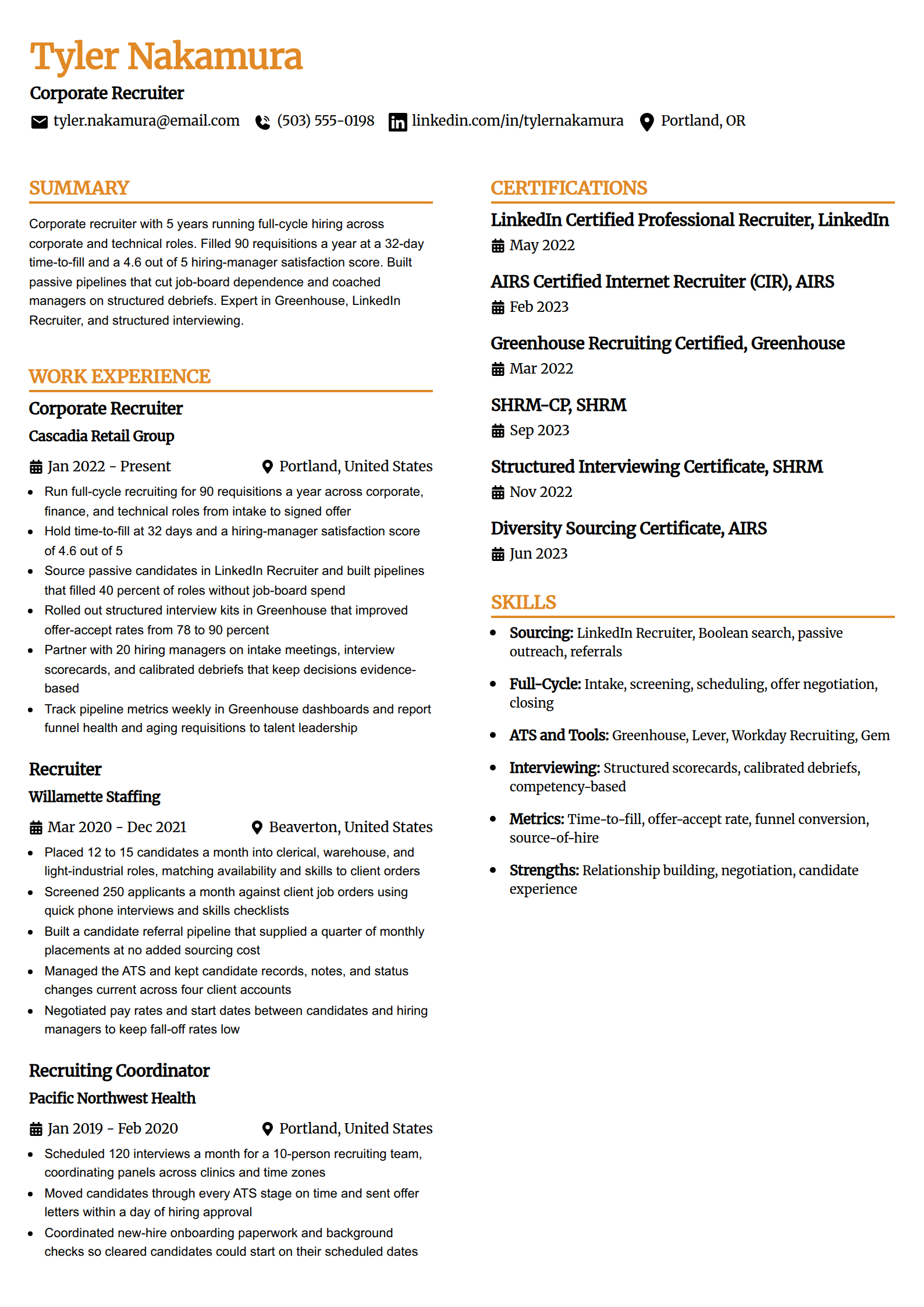
Recruiter Resume Template
Why this resume example works?
- Leads with the two numbers recruiters are judged on, 90 requisitions a year at a 32-day time-to-fill.
- Adds a quality signal, a 4.6 hiring-manager satisfaction score, so speed is not the only proof.
- Names the stack, Greenhouse and LinkedIn Recruiter, that a recruiting posting matches on.
- Shows a process improvement, structured interview kits lifting offer-accept to 90 percent, not just activity.
- Keeps sourcing outcomes visible, 40 percent of roles filled without job-board spend.
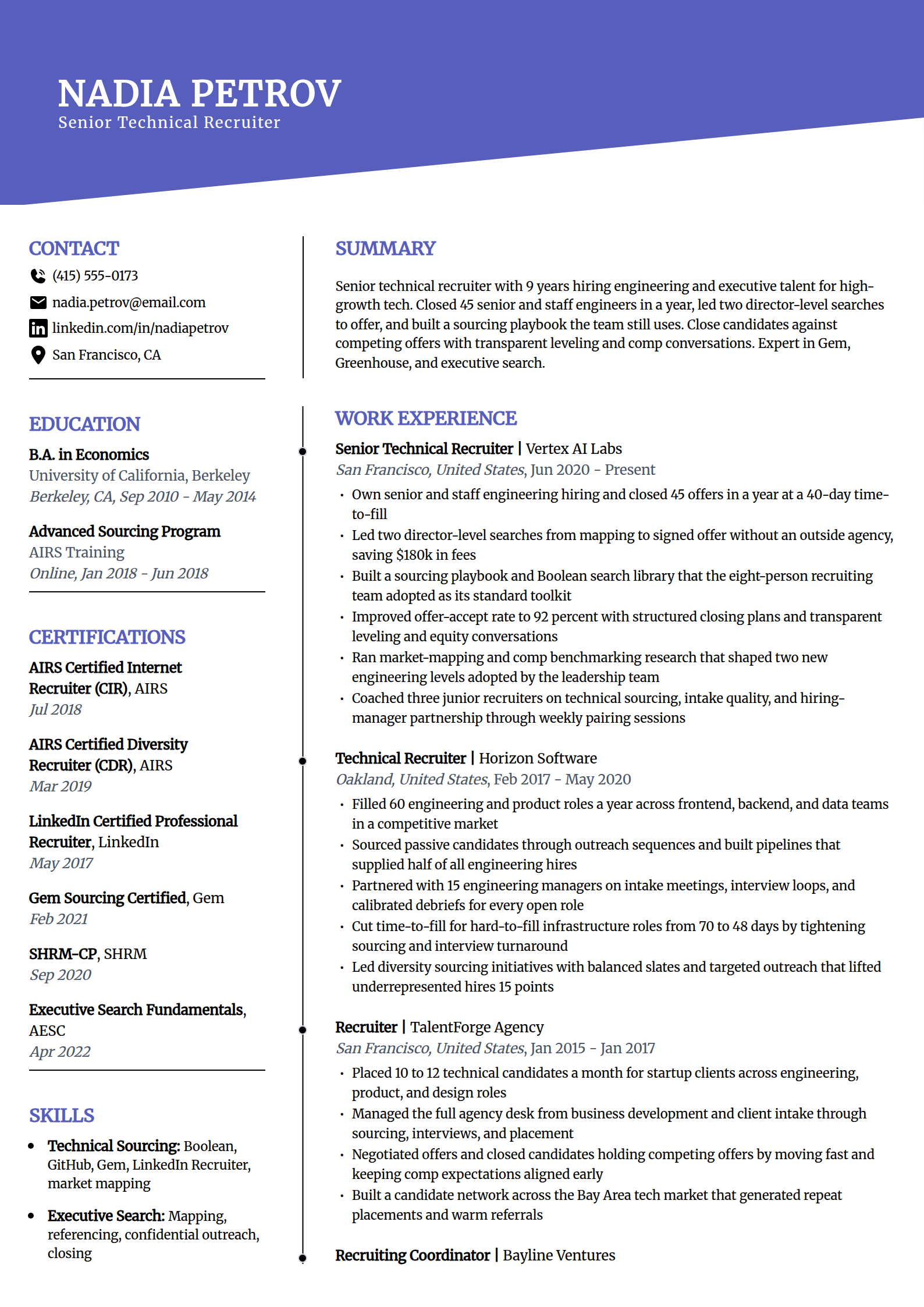
Senior & Executive Recruiter Resume Template
Why this resume example works?
- Signals the level with the roles filled, senior and staff engineers, plus two director searches.
- Quantifies the value of in-house search, $180k in agency fees saved, which executive recruiting is measured on.
- Shows leadership without a manager title: a sourcing playbook the whole team adopted.
- Carries an offer-accept rate, 92 percent, that proves closing skill at the senior level.
- Names diversity sourcing results, underrepresented hires up 15 points, a real senior-recruiter mandate.
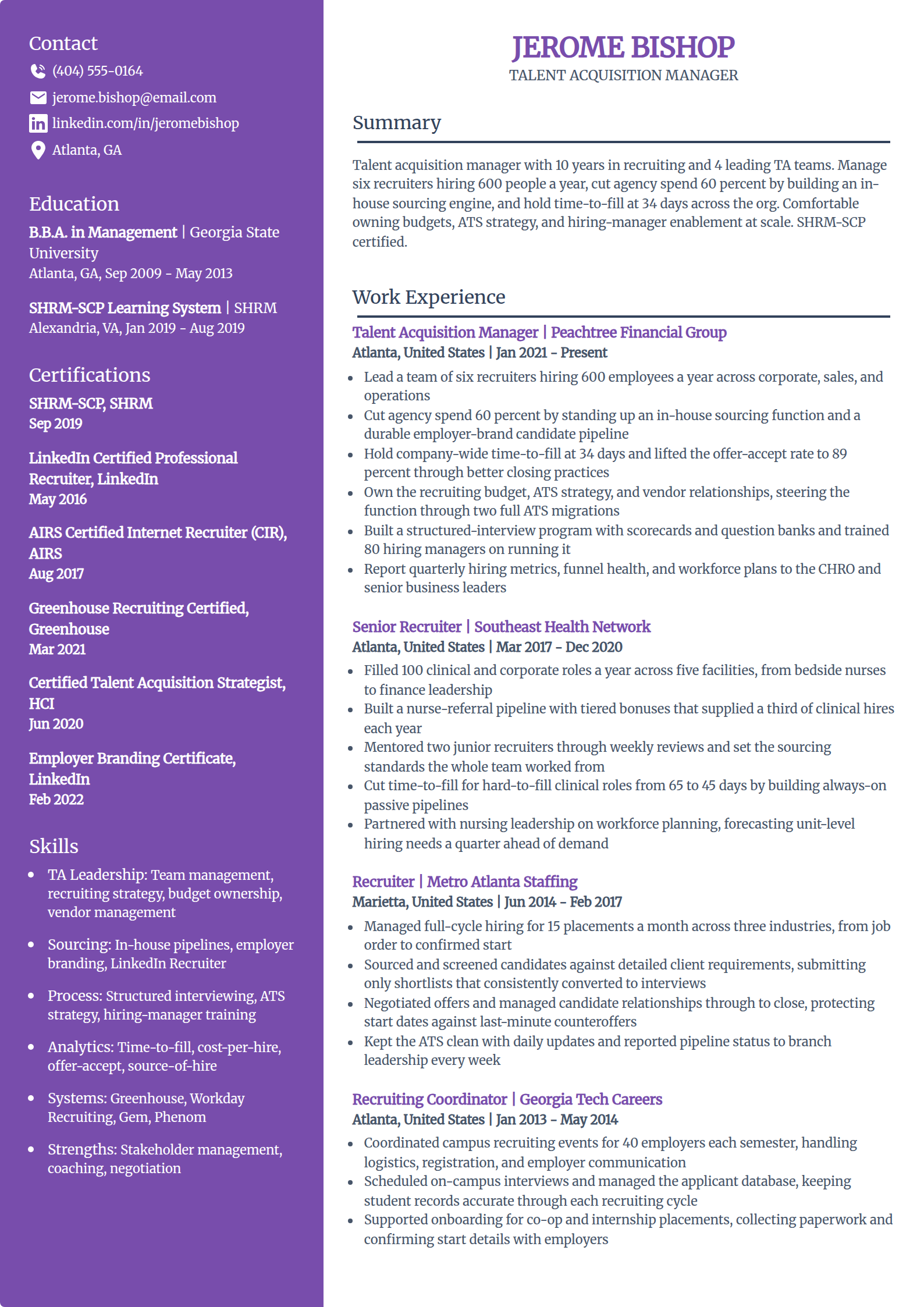
Talent Acquisition Manager Resume Template
Why this resume example works?
- Names the team led, six recruiters, and the hiring volume, 600 a year, so the management scope is clear.
- Leads with a budget result, agency spend cut 60 percent, tied to building an in-house function.
- Shows org-wide impact, time-to-fill held at 34 days, not one desk's numbers.
- Claims the strategic work: recruiting budget, ATS strategy, and two ATS migrations.
- Keeps hiring-manager enablement visible, 80 managers trained on structured interviewing.
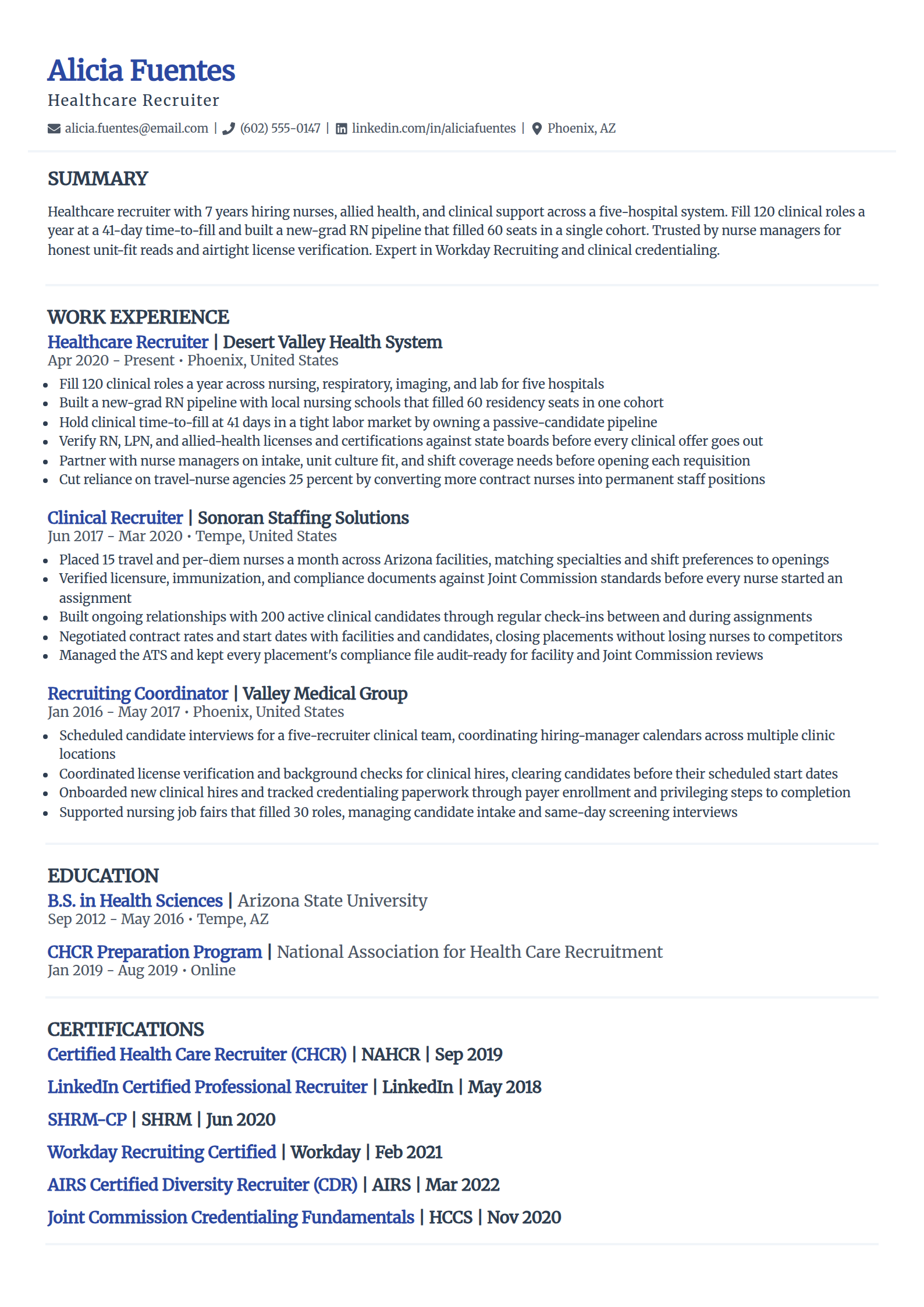
Healthcare Recruiter Resume Template
Why this resume example works?
- Names the specialty and setting up front, clinical roles across a five-hospital system.
- Shows a pipeline win specific to healthcare, a new-grad RN cohort that filled 60 residency seats.
- Carries the compliance work that clinical recruiting requires: license and credential verification.
- Ties a cost result, travel-nurse agency reliance down 25 percent, to permanent-hire conversion.
- Keeps the annual fill volume, 120 clinical roles, so the throughput in a tight market is clear.
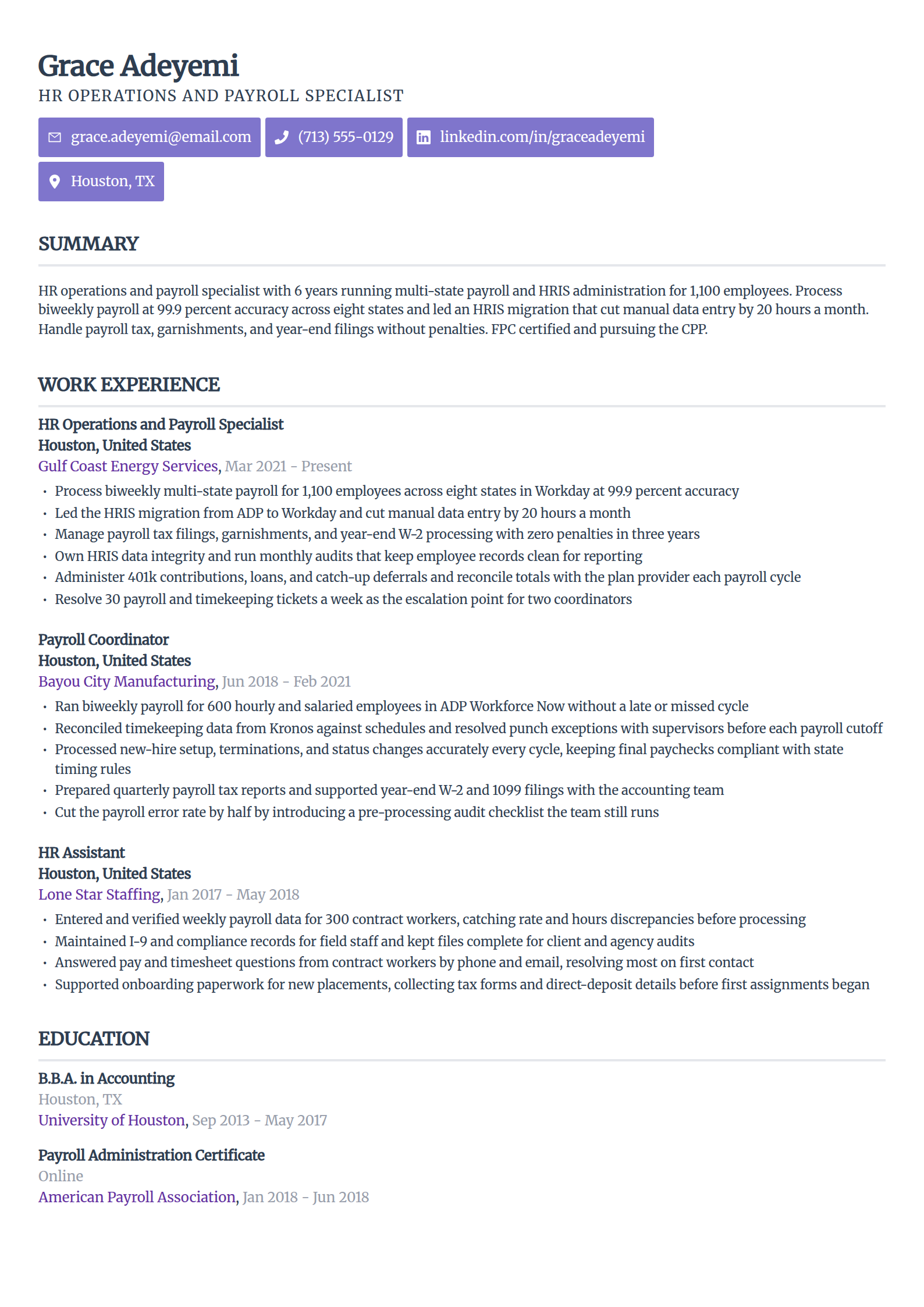
HR Operations & Payroll Resume Template
Why this resume example works?
- Leads with the accuracy bar that defines payroll, 99.9 percent across eight states.
- Shows a systems win, an HRIS migration that cut 20 hours of manual entry a month.
- Names a compliance result payroll teams live by: zero tax penalties in three years.
- Keeps the ticket load, 30 a week as the escalation point, so the operations role is concrete.
- Carries the FPC certification, the credential a payroll posting recognizes.
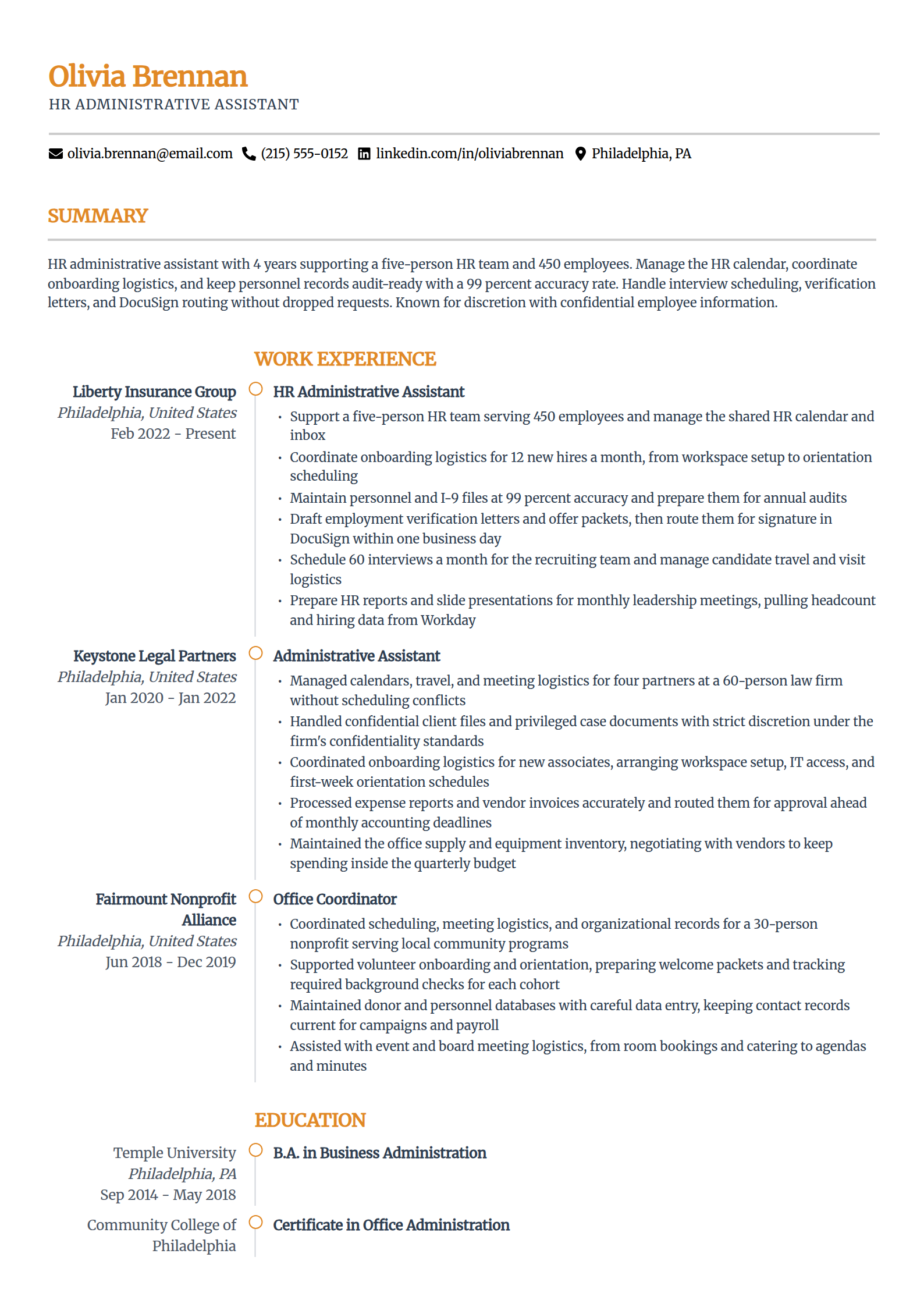
HR Administrative Assistant Resume Template
Why this resume example works?
- States the support scope plainly, a five-person HR team and 450 employees.
- Backs the records claim with a number, 99 percent accuracy on personnel and I-9 files.
- Shows the coordination work, onboarding logistics for 12 hires a month, that the role turns on.
- Names the tools an admin posting expects, Workday, BambooHR, and DocuSign.
- Calls out discretion with confidential information, the trait HR admins are trusted for.
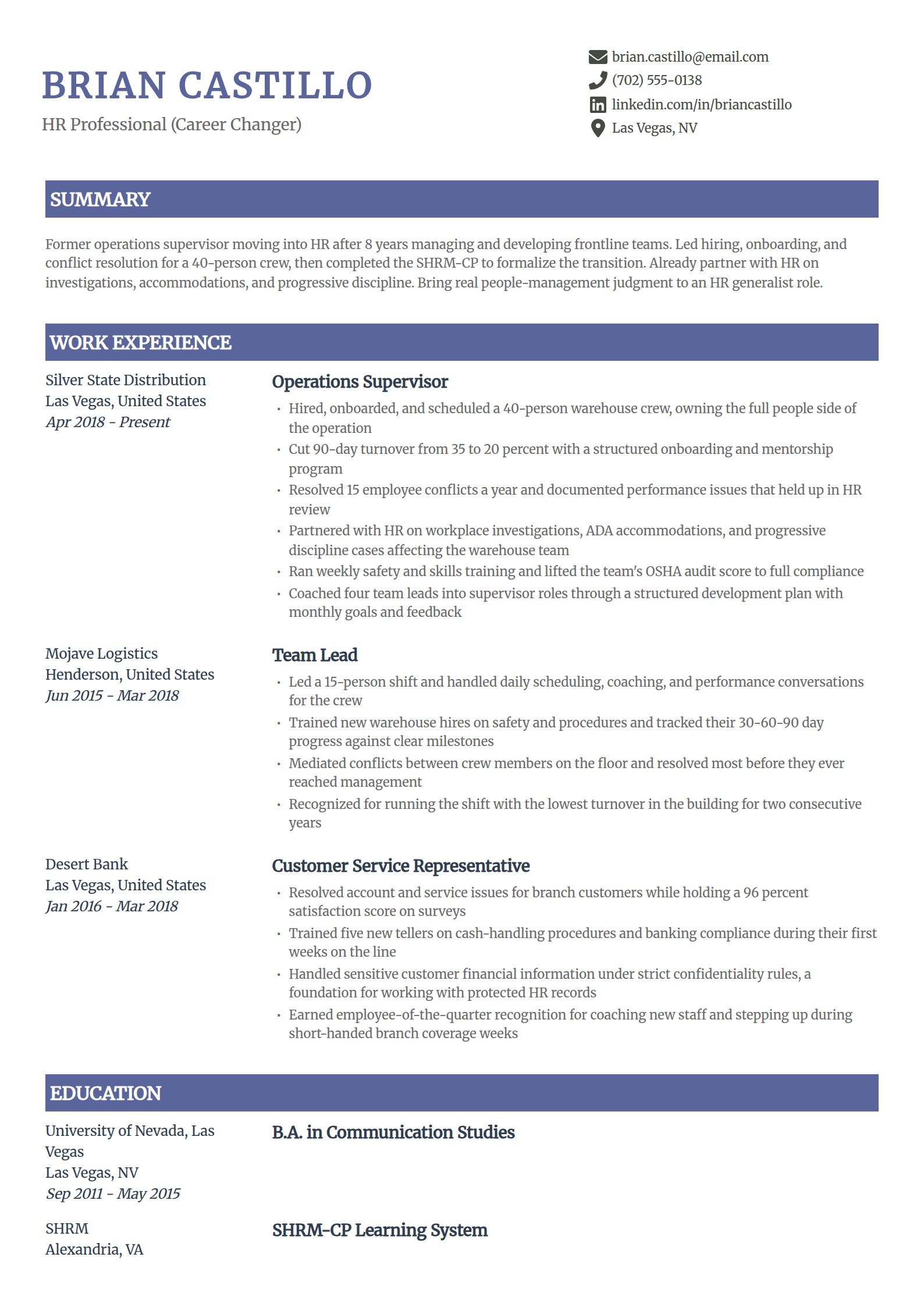
Career-Change HR Resume Template
Why this resume example works?
- Frames the prior career as an asset, eight years managing and developing frontline teams.
- Translates supervisor work into HR proof: hiring, onboarding, and conflict resolution for a 40-person crew.
- Quantifies a transferable result, 90-day turnover cut from 35 to 20 percent, that HR hiring managers value.
- Shows the person closed the credential gap by completing the SHRM-CP for the move.
- Leads with the current role so the career-change story stays honest and easy to follow.
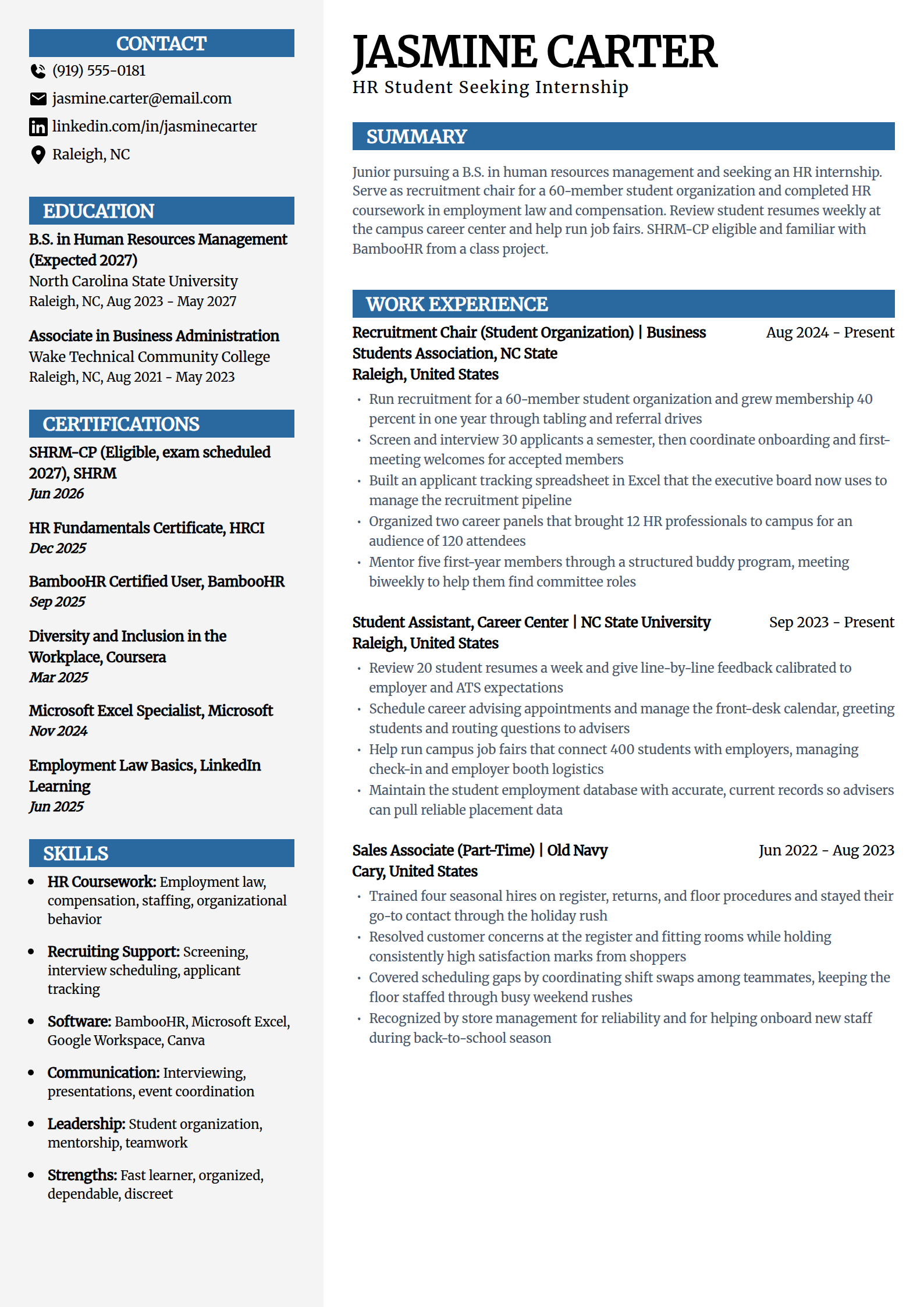
HR Resume Template With No Experience
Why this resume example works?
- States the goal, an HR internship, so a recruiter reads the resume for potential.
- Turns a student leadership role into real HR work: screening and onboarding 30 applicants a semester.
- Shows a countable result, membership up 40 percent, from work that maps to recruiting.
- Names relevant coursework, employment law and compensation, in place of a work history.
- Keeps SHRM-CP eligibility honest, with the exam scheduled after graduation.
Build your HR resume
Pick a template above and the editor keeps the layout parser-safe while you swap in your own headcount, systems, and results.
Build my resumeHow to write an HR resume in 2026
You already know what a strong resume looks like, so the challenge is proving it about yourself. These moves satisfy the ATS keyword match and the HR reviewer who will spot a generic resume in seconds.
Lead with a summary that names your level and one HR metric
Write two to three sentences that open with your title, name the headcount or workforce you support, and land on one number a hiring manager recognizes. Entry-level and student candidates use the same shape with internship, coursework, or student-org proof.
HR generalist with 6 years supporting 400 employees across recruiting, employee relations, and benefits, holding time-to-fill at 38 days and cutting voluntary turnover 11 points.
Quantify with the numbers HR hiring managers scan for
Lead each bullet with a verb, then attach the scale or the result. These are the metrics an HR reviewer reads first.
- Scale: headcount supported, requisition load, or number of employees onboarded.
- Speed and cost: time-to-fill, time-to-onboard, cost-per-hire, or agency spend reduced.
- Retention and risk: voluntary turnover moves, offer-accept rate, and clean audit or investigation outcomes.
Name your systems, do not just say HRIS
An applicant tracking system matches the exact tool the posting lists, so write the platforms out by name where they are true.
- HRIS and payroll: Workday, BambooHR, ADP Workforce Now, UKG, Paylocity.
- Recruiting and ATS: Greenhouse, Lever, Workday Recruiting, LinkedIn Recruiter, Gem.
- Compliance and law you apply: EEOC, FLSA, FMLA, ADA, ACA, and your state's wage rules.
Show judgment, not just process
Screening, filing, and scheduling are table stakes, so prove the harder work HR is trusted with. Point to a saved hire, a resolved investigation, or a retention move, with the outcome attached, rather than claiming you are a people person.
List your certifications precisely
HR credentials carry weight, but only when the status is accurate. State what you hold and phrase in-progress credentials honestly.
- Earned: SHRM-CP or SHRM-SCP, PHR, SPHR, or aPHR, with the issuing body.
- In progress: write "SHRM-CP, exam scheduled" or "CCP, in progress", never imply it is complete.
- Specialty: CEBS for benefits, FPC or CPP for payroll, CIR or CDR for recruiting.
Keep the format ATS-safe
HR resumes get parsed before a person reads them, and you know that better than most applicants. A clean single-column layout keeps your data readable.
- Skip tables, text boxes, and icon columns that scramble in a parser.
- Keep your name and contact details in the body, not the header or footer.
- Save as a PDF unless the posting asks for a Word document.
Common HR resume mistakes
- Writing a summary you would flag on someone else's resume. "Passionate HR professional" is filler; "HR manager supporting 600 employees, turnover cut from 24 to 15 percent" is proof.
- Listing duties instead of outcomes. "Handled recruiting" is a task; "closed 60 requisitions a year at a 38-day time-to-fill" is a result.
- Hiding the systems a posting screens for, or writing "HRIS" instead of naming Workday, BambooHR, or ADP.
- Overstating a credential. "SHRM-CP" when the exam is still scheduled is the kind of error an HR reviewer catches immediately.
- Using a two-column, icon-heavy template that a resume parser cannot read cleanly, then wondering why the ATS mangled your experience.
Frequently asked questions
What should an HR resume include?
A two to three sentence summary that names your level and one HR metric, a work section where every bullet leads with a verb and a number such as headcount, time-to-fill, or turnover, a skills section that names your systems by name, your certifications with accurate status, and your education. Keep it to one page unless you have more than about ten years to show.
How do I write a human resources resume summary?
Write two to three sentences. Open with your title and the headcount or workforce you support, name one number a hiring manager recognizes such as time-to-fill, retention, or requisition load, and close with your strongest specialty. Entry-level candidates lead with internship, coursework, or student-org proof instead of years.
What skills and keywords should I put on an HR resume?
Balance the systems you use with the judgment you can prove. Name your HRIS and recruiting tools outright, such as Workday, BambooHR, ADP, Greenhouse, and LinkedIn Recruiter, and pair them with employee relations, compliance knowledge (EEOC, FLSA, FMLA, ADA), and the HR credential you hold. Mirror the exact phrasing the job posting uses so the ATS matches your resume.
How do I write an entry-level HR resume with no experience?
Lead with the target level, then turn an internship, student organization, coursework, or a people-facing job into real bullets with numbers, such as onboarding hires or screening applicants. Name any HR system you have touched, list HR coursework like employment law and compensation, and state SHRM-CP eligibility honestly if your exam is scheduled.
Which resume template is best for HR?
A clean single-column template with standard headings, such as Standard, Classic, or Simple above. Those layouts parse cleanly in applicant tracking systems and keep your title, systems, and dates where a hiring manager expects them. Save the visually rich formats for a portfolio, not an HR application, since you know what your own ATS does to a two-column file.
Is human resources a good field to build a resume for in 2026?
Yes. The Bureau of Labor Statistics projects employment of human resources specialists to grow 6 percent from 2025 to 2035, faster than the average for all occupations, with about 73,700 openings a year. The transactional work is shifting to software, so employers screen harder for the judgment those tools lack: employee relations, workforce planning, and compliance. Build your resume around those, not around the tasks a system now handles.
More human resources resume resources
Build your HR resume
Pick a template above and the editor keeps the layout parser-safe while you swap in your own headcount, systems, and results.