16 Finance Resume Examples, Banking to Corporate FP&A
- ATS Friendly
- Finance Specific
- 16 Role Examples
Pick an ATS-safe layout, then model your own on a finance resume from your track. Every role below shows a full resume built in that template, with the credentials, tools, and numbers a hiring manager reads first.


540k+ resumes created
Editable finance resume templates
Each template below is a real finance resume laid out in that format, sorted by what you need. Choose one, then swap in your own function, tools, credentials, and results. All of them keep your name, contact details, and dates where an applicant tracking system expects to read them.
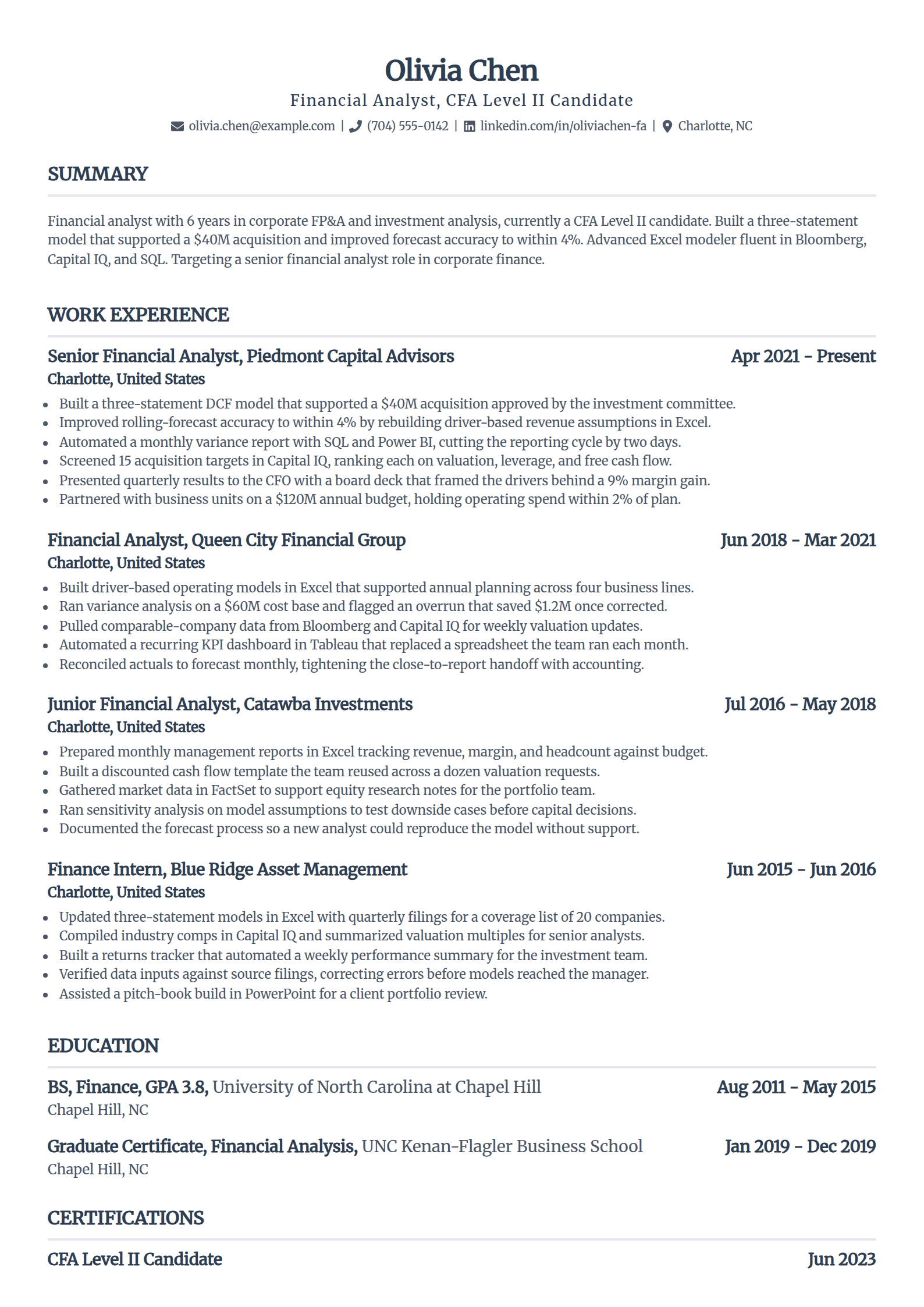
Financial Analyst Resume Template
Why this resume example works?
- States the CFA Level II candidate status in the header, phrased by level the way finance recruiters expect.
- Leads with a model that supported a $40M acquisition, the kind of result an analyst is hired to produce.
- Names Excel, Bloomberg, Capital IQ, and SQL by hand, the exact tools an ATS matches on a finance posting.
- Ties forecast accuracy to within 4% to a rebuilt driver model, so the metric reads as method, not a claim.
- Keeps a clean single-column layout that a resume parser reads top to bottom without dropping a section.
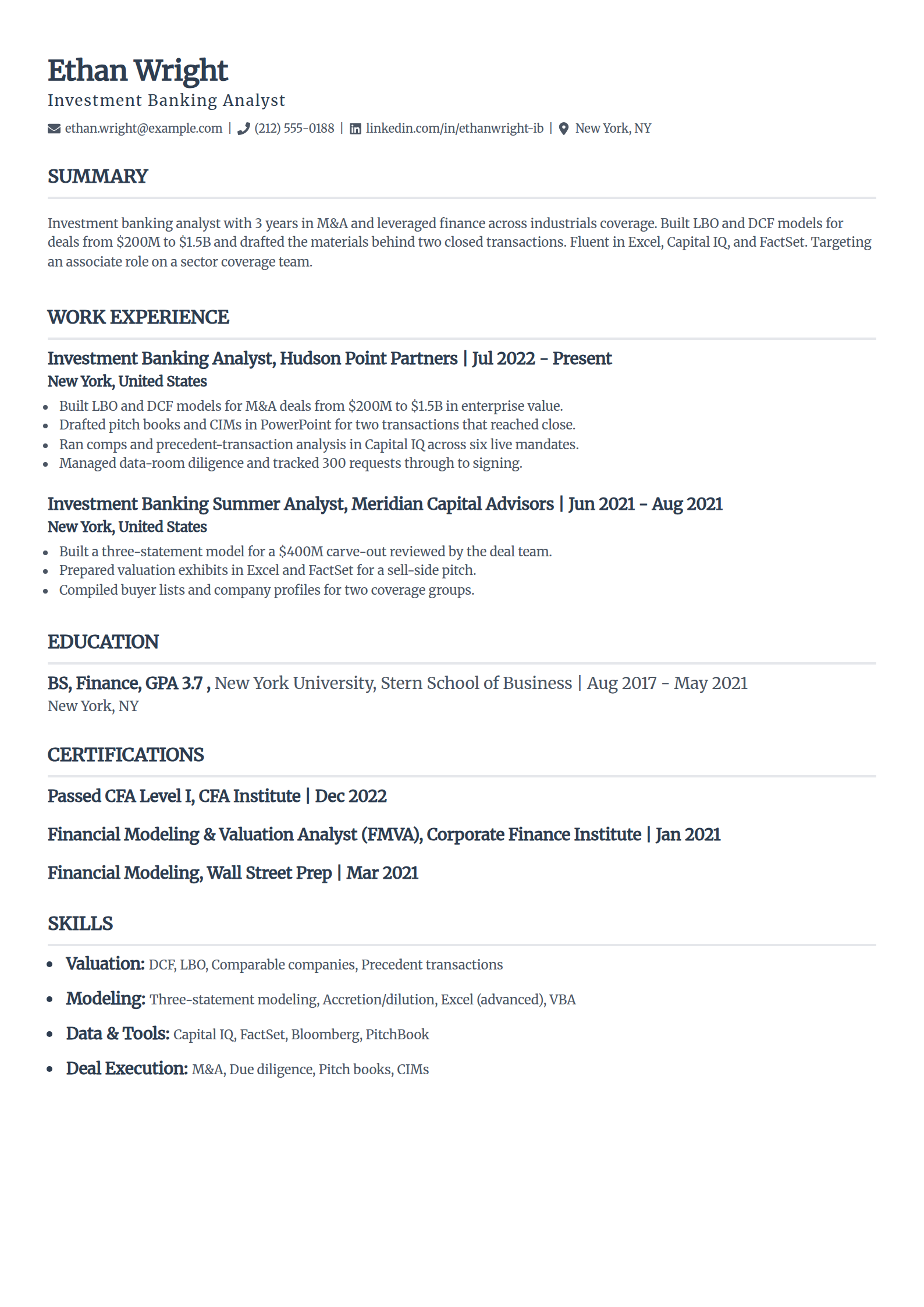
Investment Banking Analyst Resume Template
Why this resume example works?
- Frames the scope as M&A and leveraged finance with deal sizes, the first thing a coverage team scans.
- Leads with LBO and DCF models for $200M to $1.5B deals, the modeling work an IB analyst owns.
- Names Capital IQ, FactSet, and pitch books, the deal-tool keywords a banking screen looks for.
- Keeps it to one page with tight bullets, the length norm bankers expect from an analyst.
- Phrases the credential precisely as Passed CFA Level I, not a vague claim that reads as a red flag.
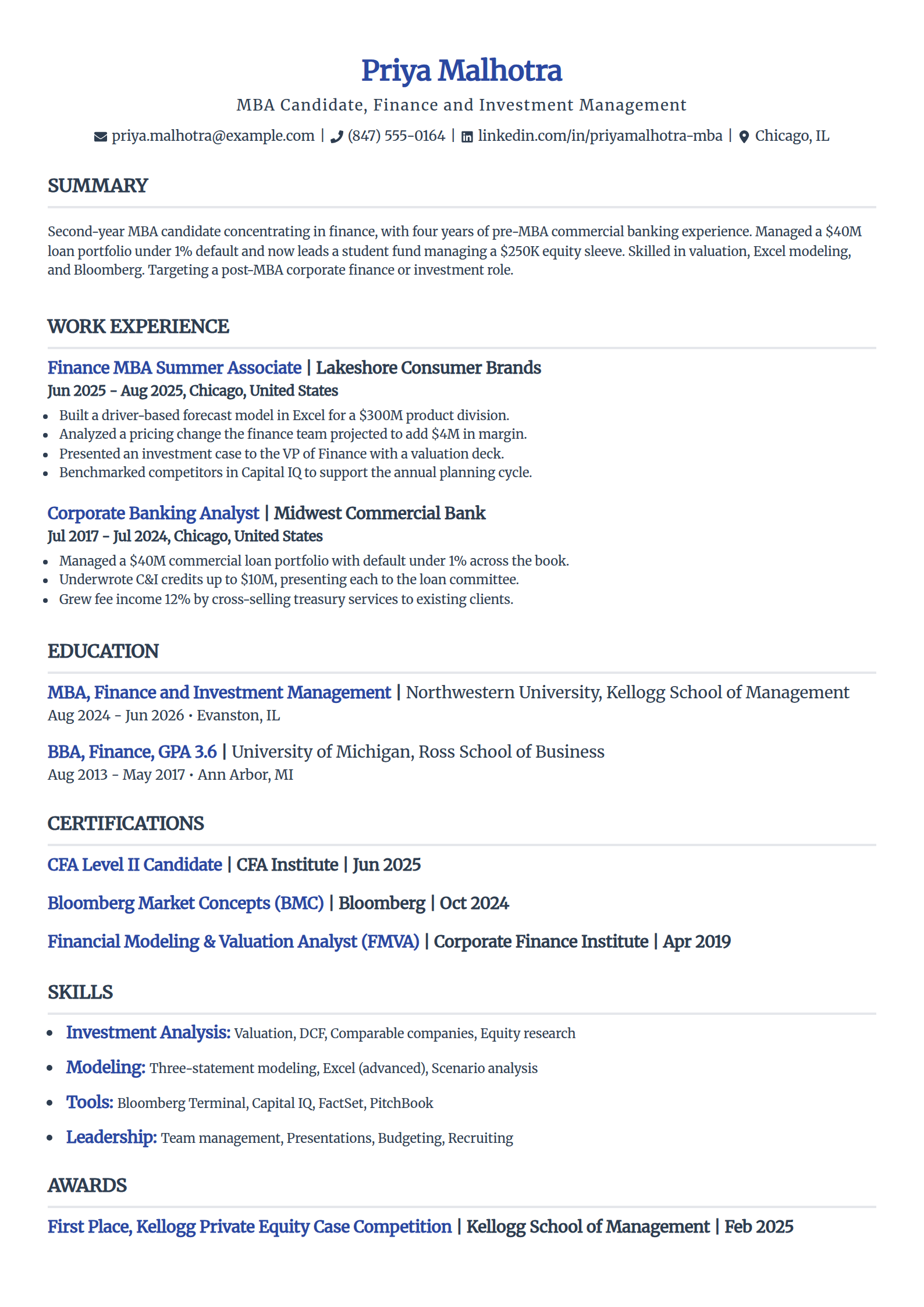
MBA Resume Template (Finance)
Why this resume example works?
- Leads with pre-MBA banking scope, a $40M portfolio, so the resume shows real work behind the degree.
- Shows the Kellogg MBA and the Ross undergrad with GPA, the education a recruiter reads first here.
- Adds a case-competition win and a student-fund role, the campus signals MBA employers look for.
- Phrases the credential as CFA Level II Candidate, the correct way to state an in-progress charter.
- Keeps it to one page, the standard every MBA career center enforces.
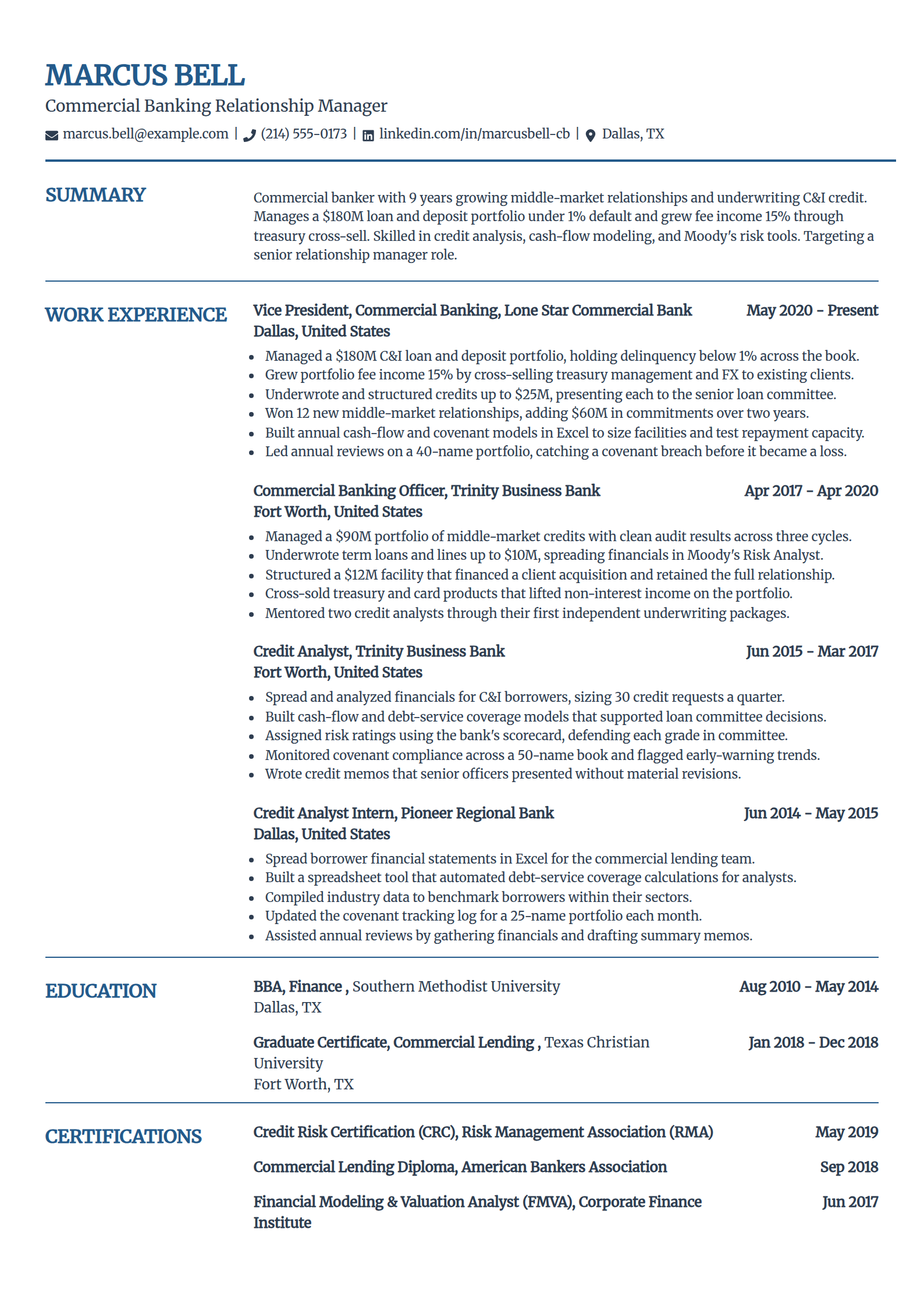
Commercial Banking Resume Template
Why this resume example works?
- Leads with a $180M portfolio under 1% default, the risk-and-scale number a bank hires a manager on.
- Shows fee-income growth from treasury cross-sell, the revenue result banking managers are judged on.
- Names Moody's Risk Analyst, nCino, and covenant analysis, the underwriting keywords on the posting.
- Carries the RMA Credit Risk Certification, the credential a senior lending role screens for.
- Traces a covenant catch to a restructure before a loss, so the credit judgment reads as real work.
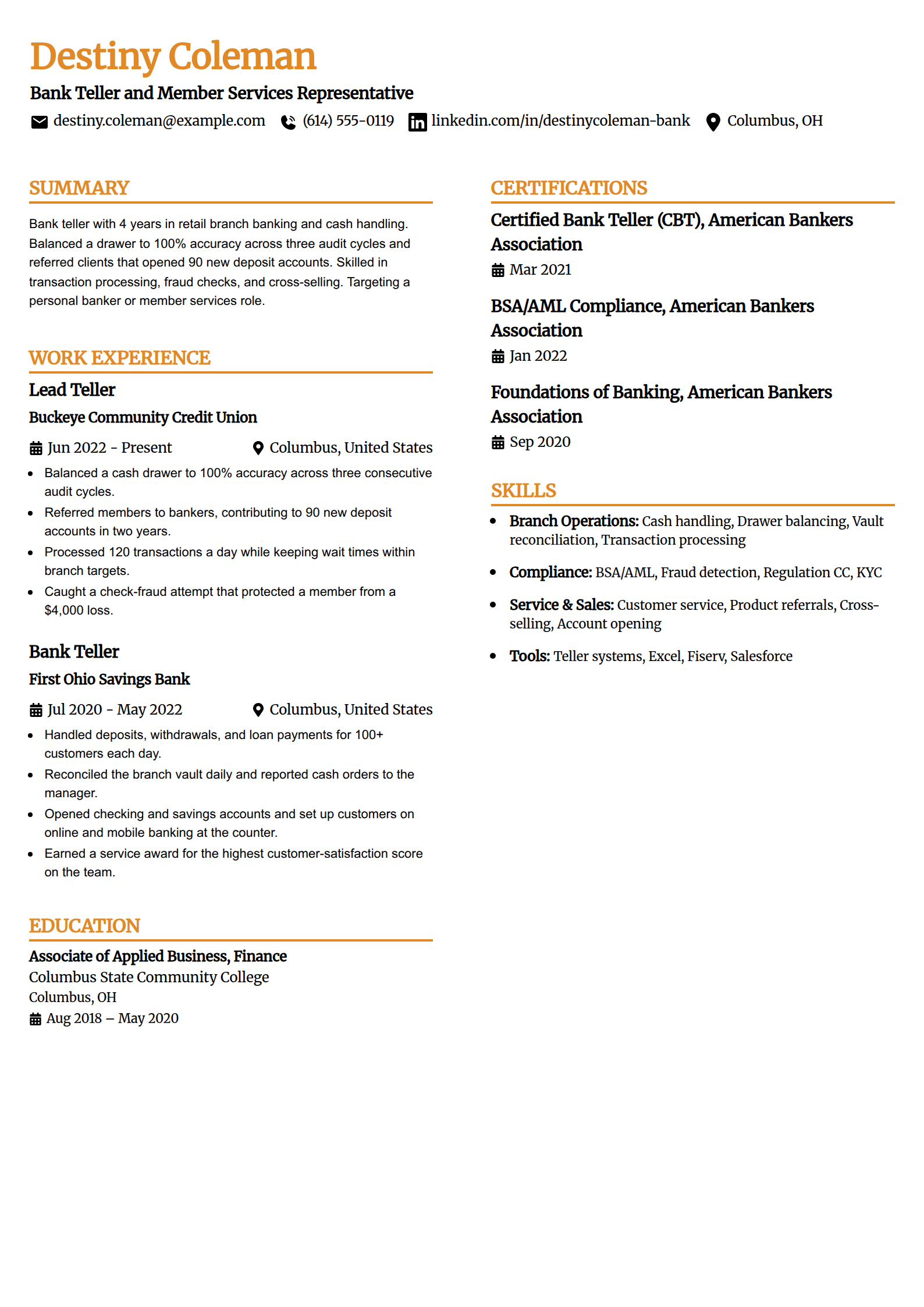
Bank Teller Resume Template
Why this resume example works?
- Leads with 100% drawer accuracy across audit cycles, the reliability a branch screens a teller on.
- Shows referrals that opened 90 deposit accounts, the sales signal that moves a teller toward personal banker.
- Names BSA/AML, fraud detection, and KYC, the compliance terms a bank posting expects to see.
- Keeps modest, level-appropriate numbers so nothing reads out of scope for an early-career role.
- Uses a tight two-entry layout that fits early-career experience on one clean page.
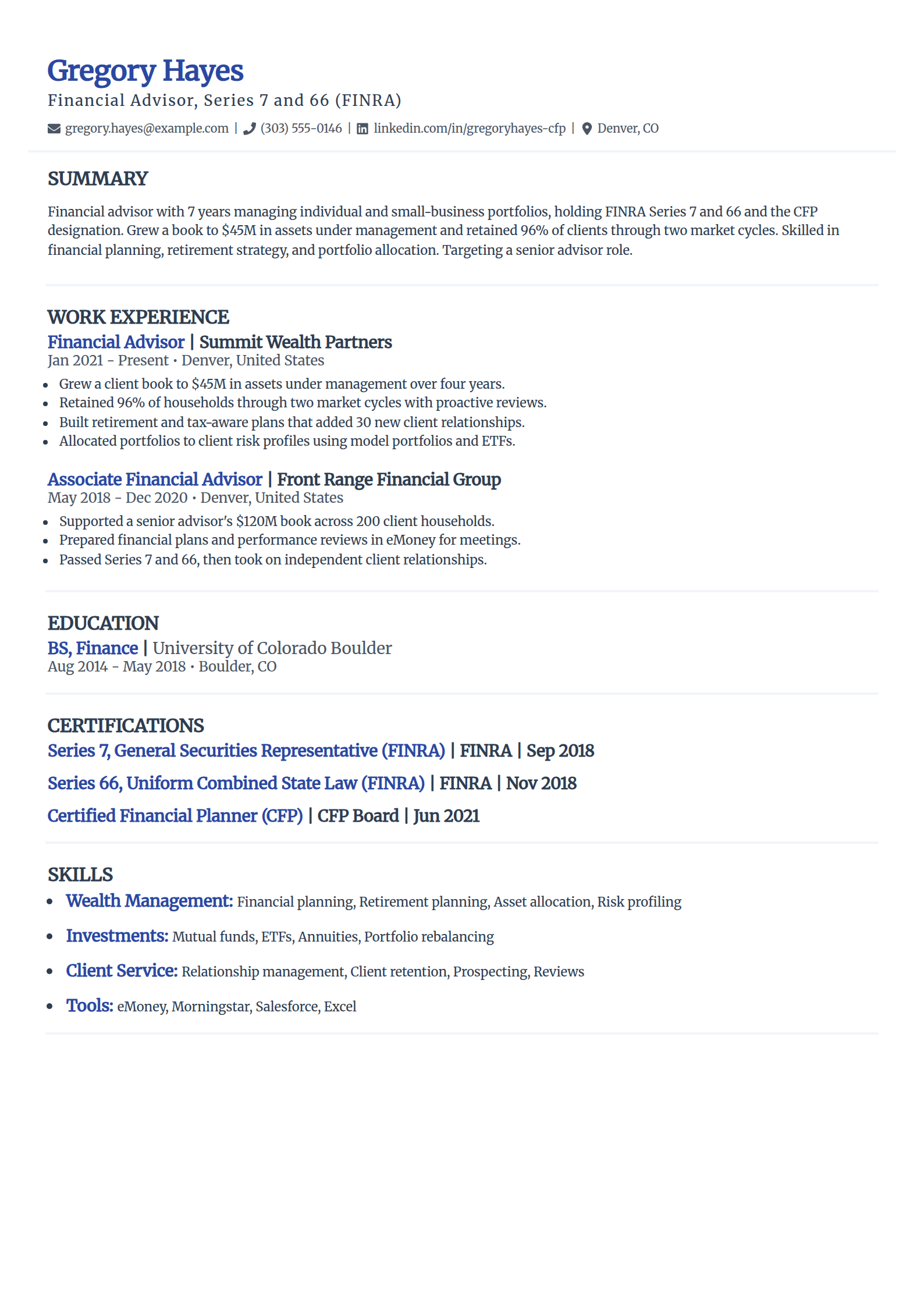
Financial Advisor Resume Template
Why this resume example works?
- States Series 7 and 66 with FINRA in the header, the licenses an advisory role requires up front.
- Leads with a $45M book and 96% retention, the AUM-and-retention numbers an advisor is measured on.
- Adds the CFP designation, the planning credential clients and firms trust.
- Names eMoney and Morningstar, the planning and research tools an advisor posting lists.
- Keeps the layout clean and one page, matching how advisors present to clients and recruiters.
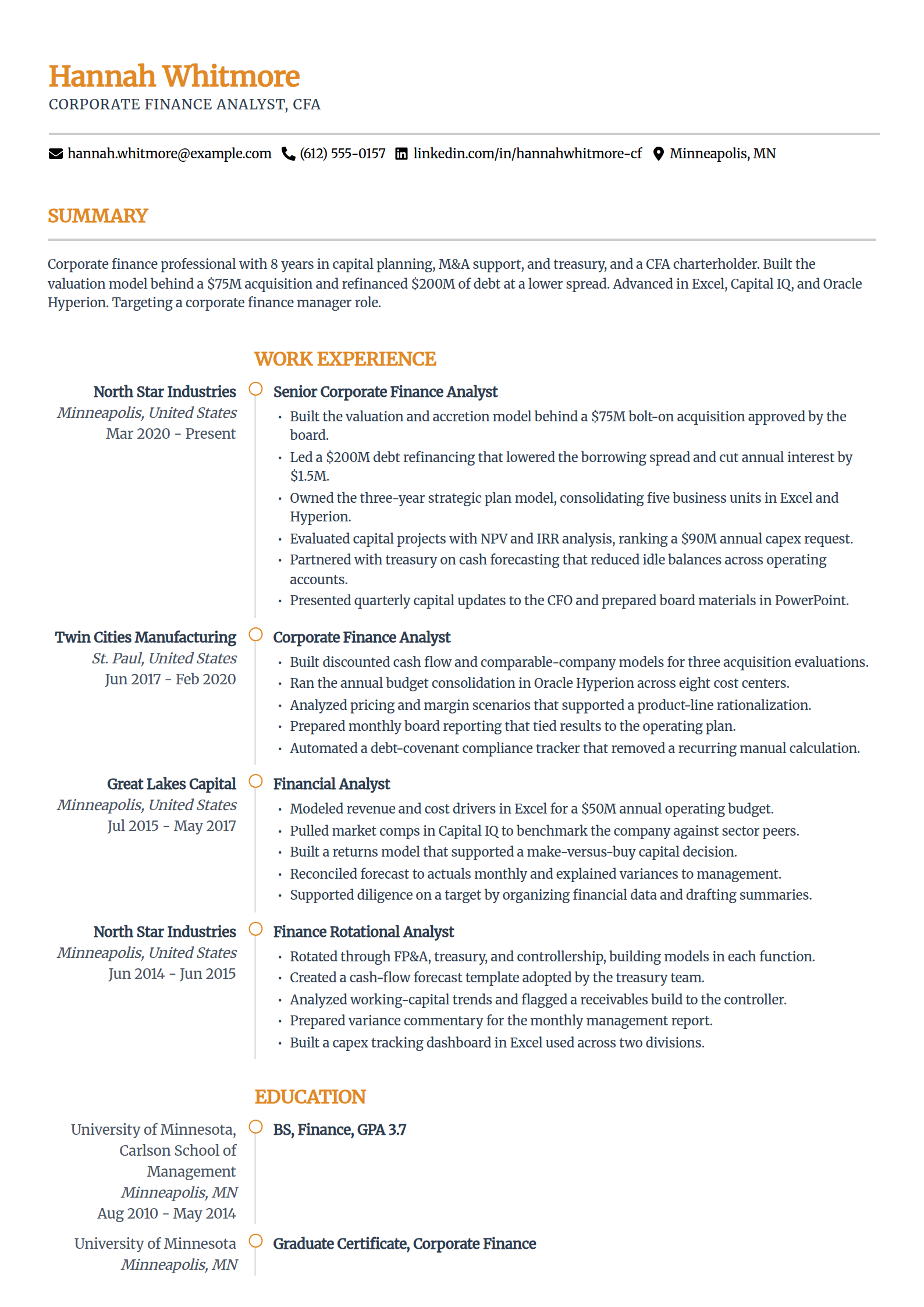
Corporate Finance Resume Template
Why this resume example works?
- Names the CFA charterholder status precisely, the finished credential rather than a candidate level.
- Leads with a $75M acquisition model and a $200M refinancing, the capital work corporate finance owns.
- Names Oracle Hyperion, Capital IQ, and NPV and IRR analysis, the systems and methods on the posting.
- Shows the strategic-plan model across five business units, proving scope beyond a single analysis.
- Fills a dense two-column layout without crowding, so the depth reads organized rather than padded.
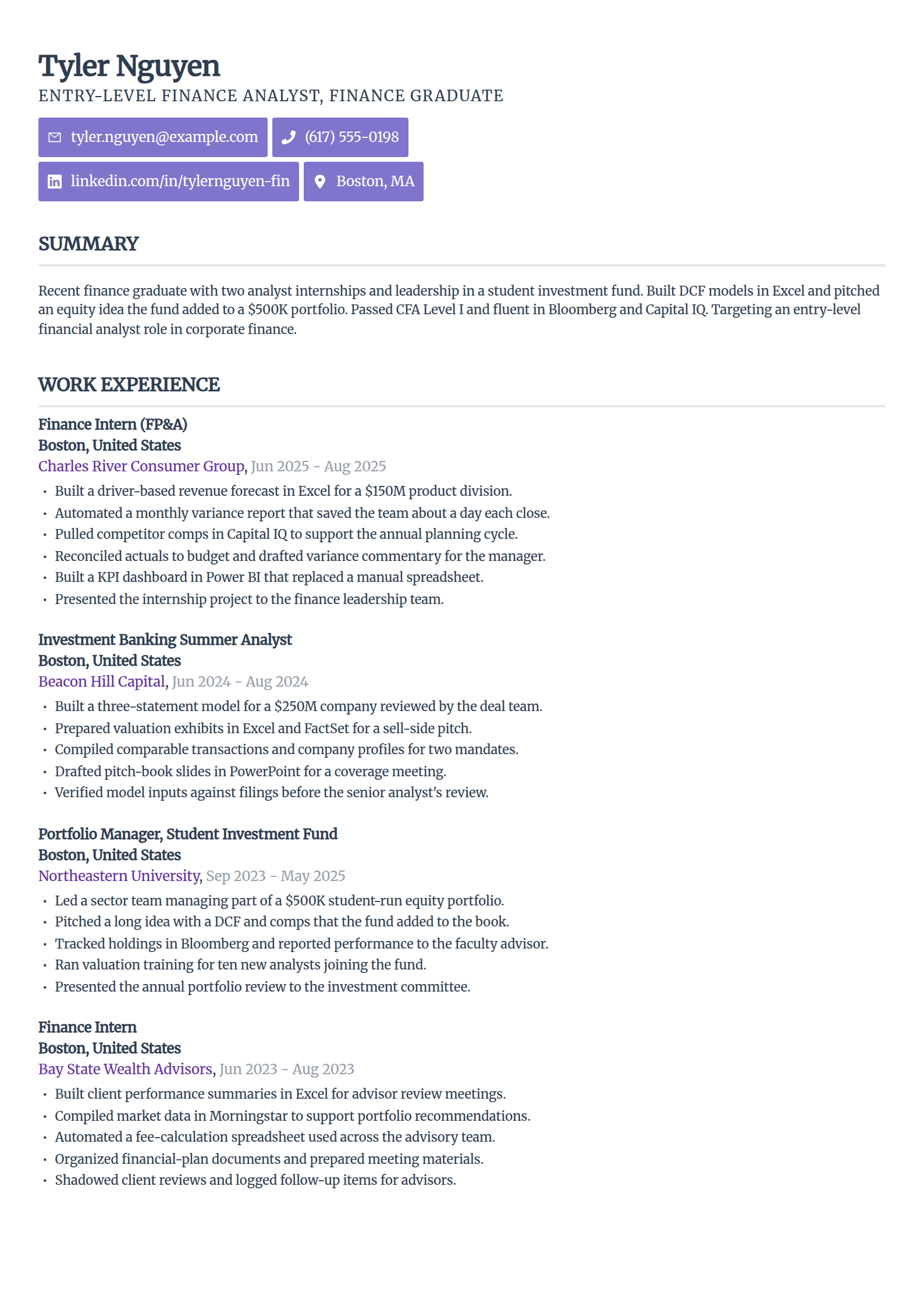
Entry-Level Finance Resume Template
Why this resume example works?
- Leads with Passed CFA Level I and two analyst internships, the strongest early-career signals to show first.
- Turns a student investment fund into real experience with a $500K portfolio and an equity pitch.
- Names Excel, Bloomberg, Capital IQ, and FactSet, so a screener sees the tools even without full-time work.
- Fills the page with internships, campus leadership, and an exchange, not a thin one-job history.
- Keeps modest, believable numbers that stay in scope for a new graduate.
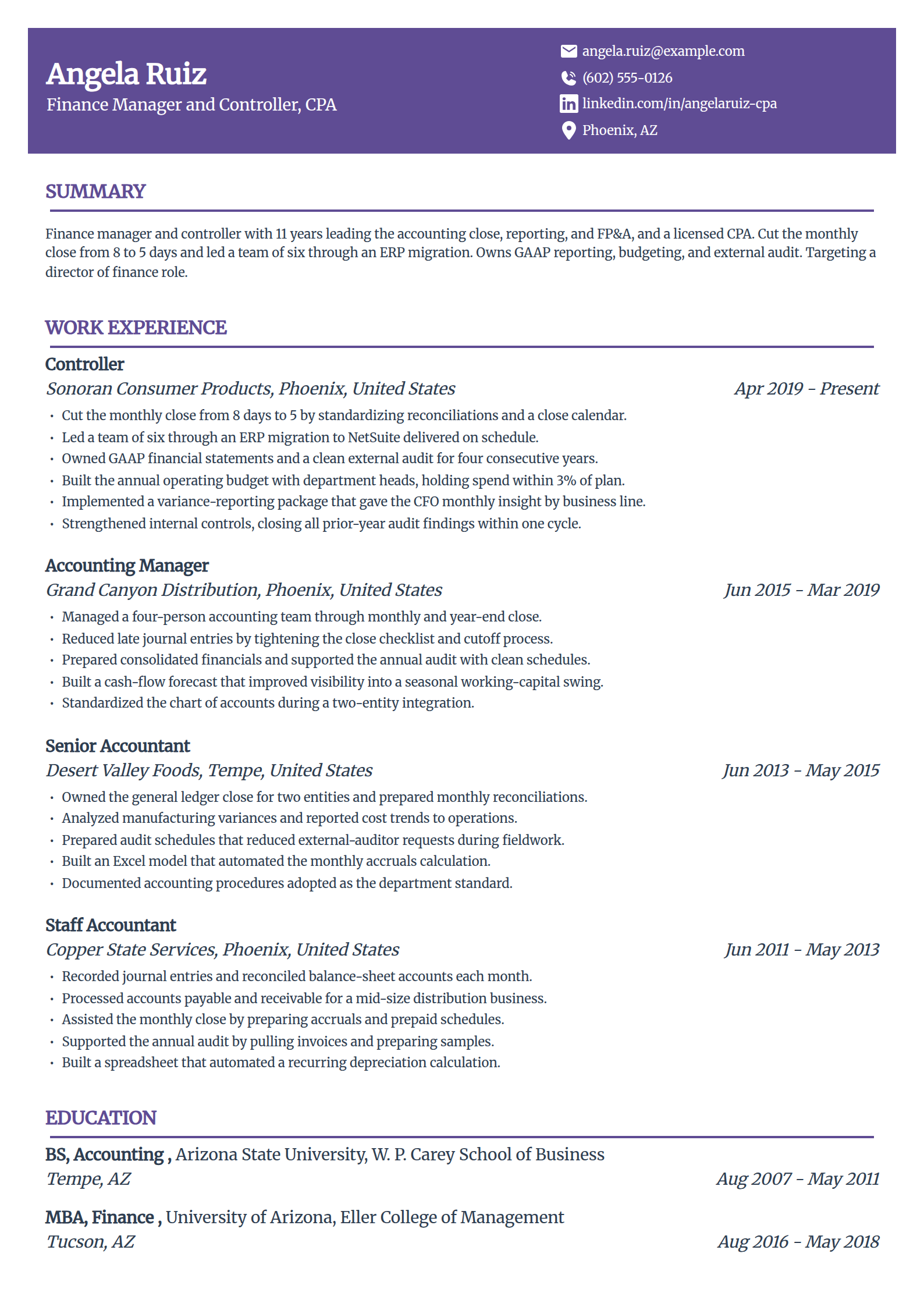
Finance Manager & Controller Resume Template
Why this resume example works?
- Leads with a close cut from 8 to 5 days, the operational result a controller is hired to deliver.
- Names the CPA license and the CMA, the credentials a controller or finance-manager role screens for.
- Shows a NetSuite ERP migration and a clean four-year audit, the ownership a director looks for.
- Names GAAP, consolidations, and internal controls, the reporting keywords the posting matches.
- Keeps a full, scannable page so the close, budget, and audit scope all read at a glance.
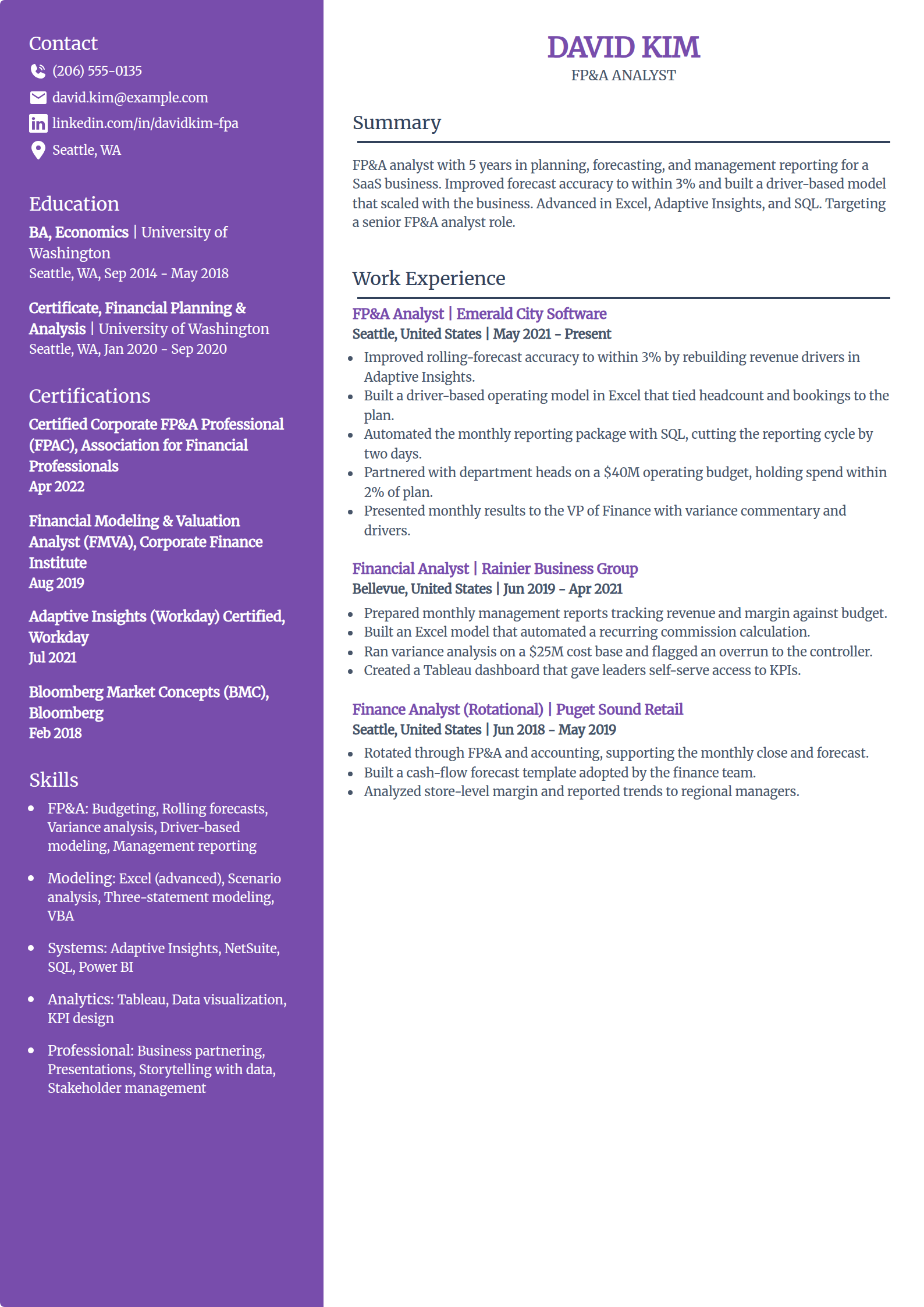
FP&A Analyst Resume Template
Why this resume example works?
- Leads with forecast accuracy to within 3%, the precision an FP&A team is measured on.
- Names Adaptive Insights, SQL, and driver-based modeling, the planning stack on the posting.
- Shows a reporting cycle cut by two days through automation, tying a tool to a time result.
- Carries the FPAC credential, the analysis certification an FP&A role recognizes.
- Keeps three focused roles so the planning-and-reporting story reads clean, not padded.
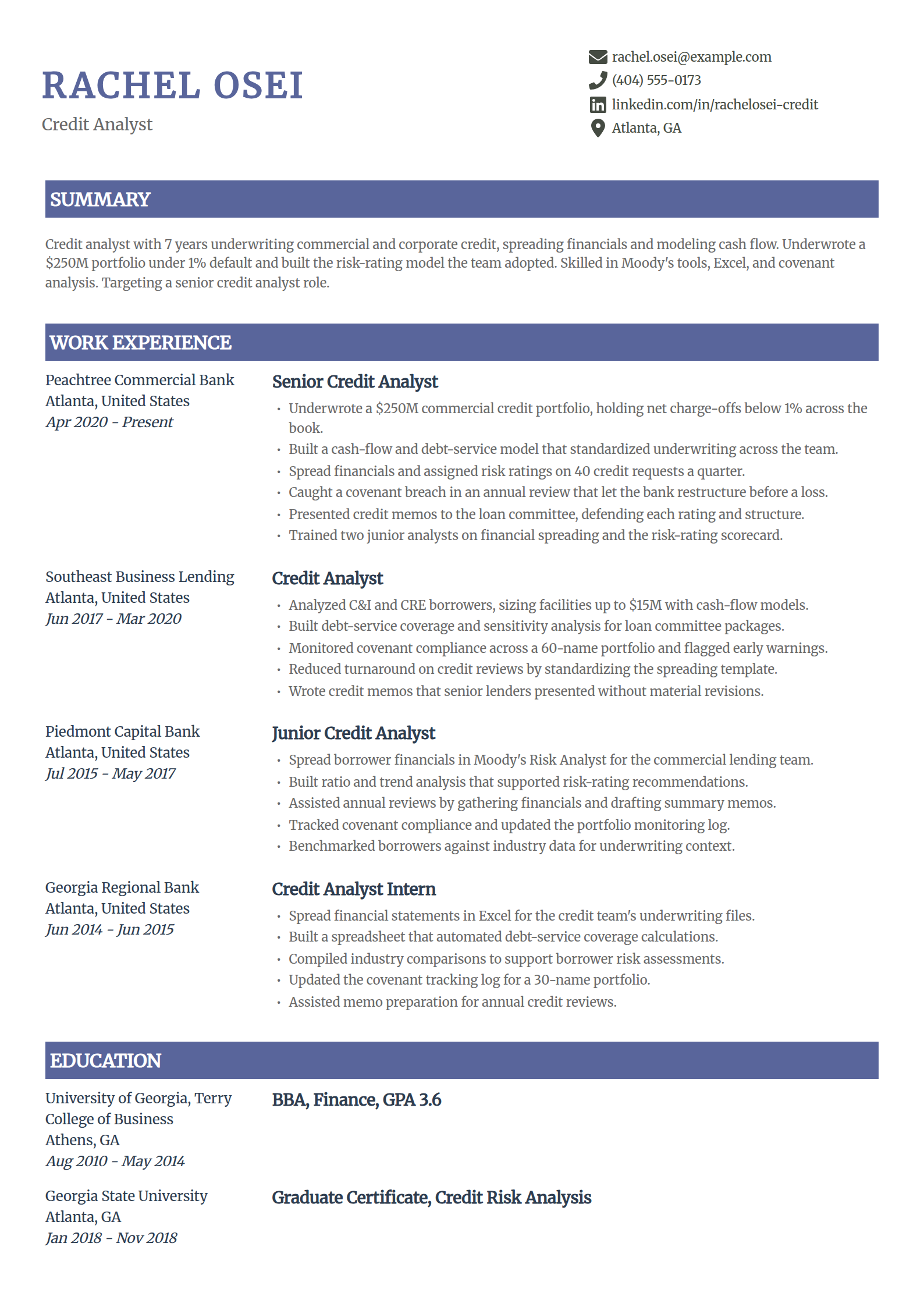
Credit Analyst Resume Template
Why this resume example works?
- Leads with a $250M portfolio under 1% charge-offs, the risk result a credit team hires on.
- Names Moody's Risk Analyst, debt-service coverage, and covenant analysis, the underwriting keywords.
- Shows a covenant breach caught before a loss, proving credit judgment past the spreadsheet.
- Carries the RMA Credit Risk Certification and a Passed CFA Level I, both phrased precisely.
- Fills a rich layout with four progressive roles that show the analyst path clearly.
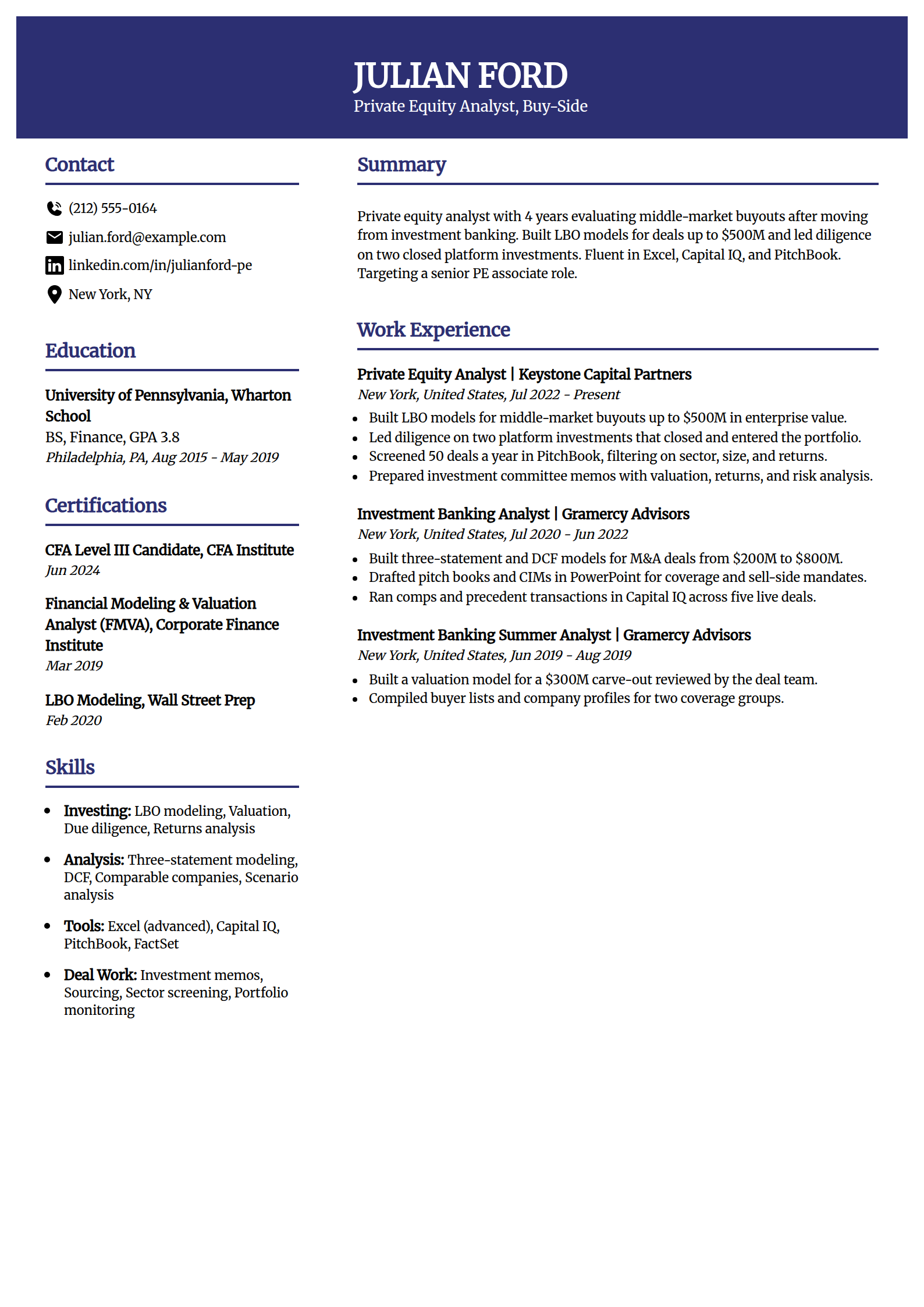
Private Equity & Buy-Side Resume Template
Why this resume example works?
- Frames the move from banking to the buy-side, the exact path a PE analyst role expects.
- Leads with LBO models for buyouts up to $500M and two closed platform deals.
- Names PitchBook, Capital IQ, and returns analysis, the sourcing-and-diligence tools on the posting.
- Phrases the credential as CFA Level III Candidate, the correct in-progress stage.
- Keeps a roomy layout focused on deals, so the investment work carries the page.
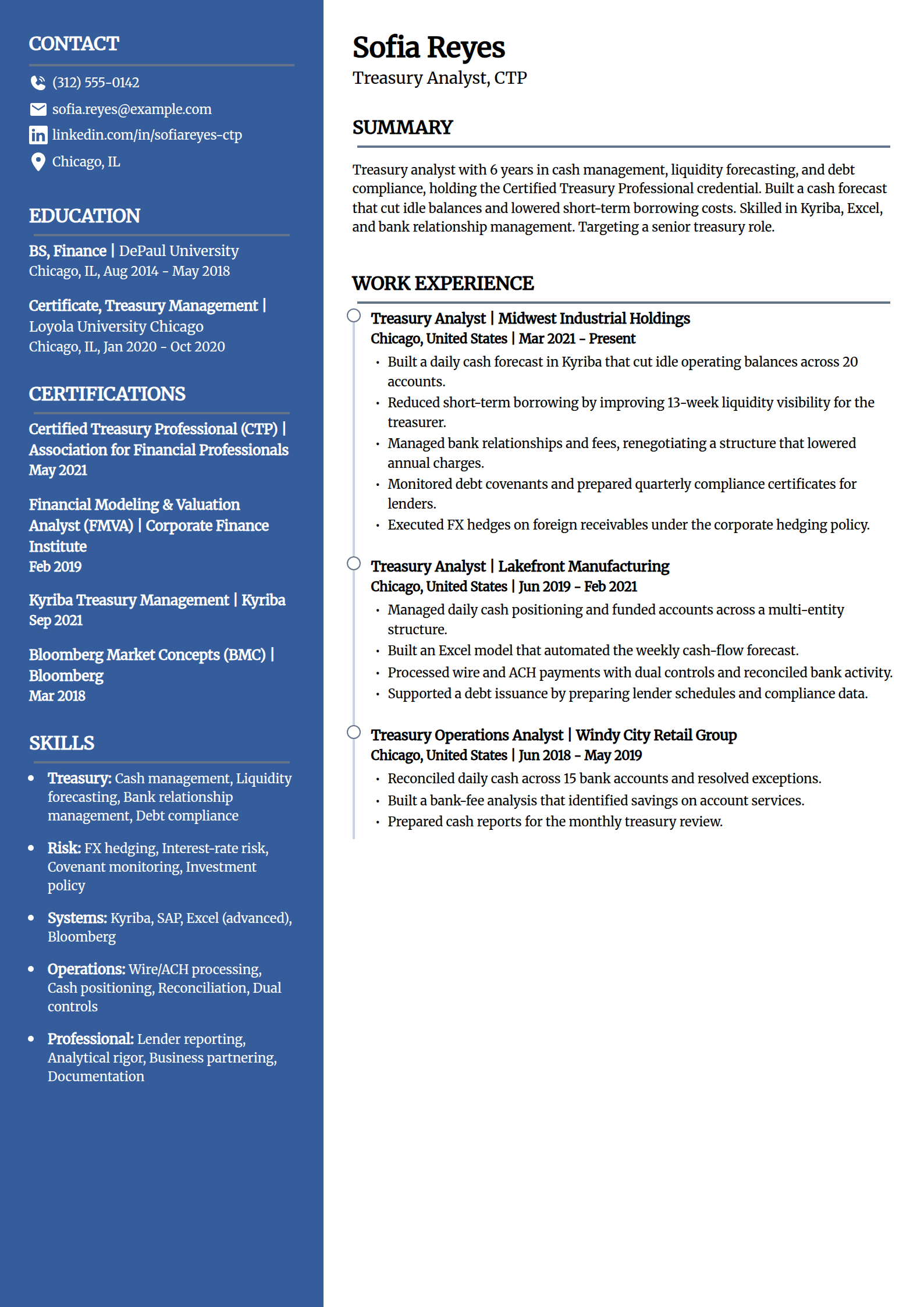
Treasury Analyst Resume Template
Why this resume example works?
- Leads with a cash forecast that cut idle balances, the liquidity result a treasury team values.
- Names Kyriba, FX hedging, and covenant compliance, the treasury keywords a posting screens for.
- Carries the Certified Treasury Professional credential, the standard for the function.
- Shows bank-relationship and debt-compliance work, proving scope beyond daily cash positioning.
- Uses a modern layout that keeps the treasury focus clear without crowding.
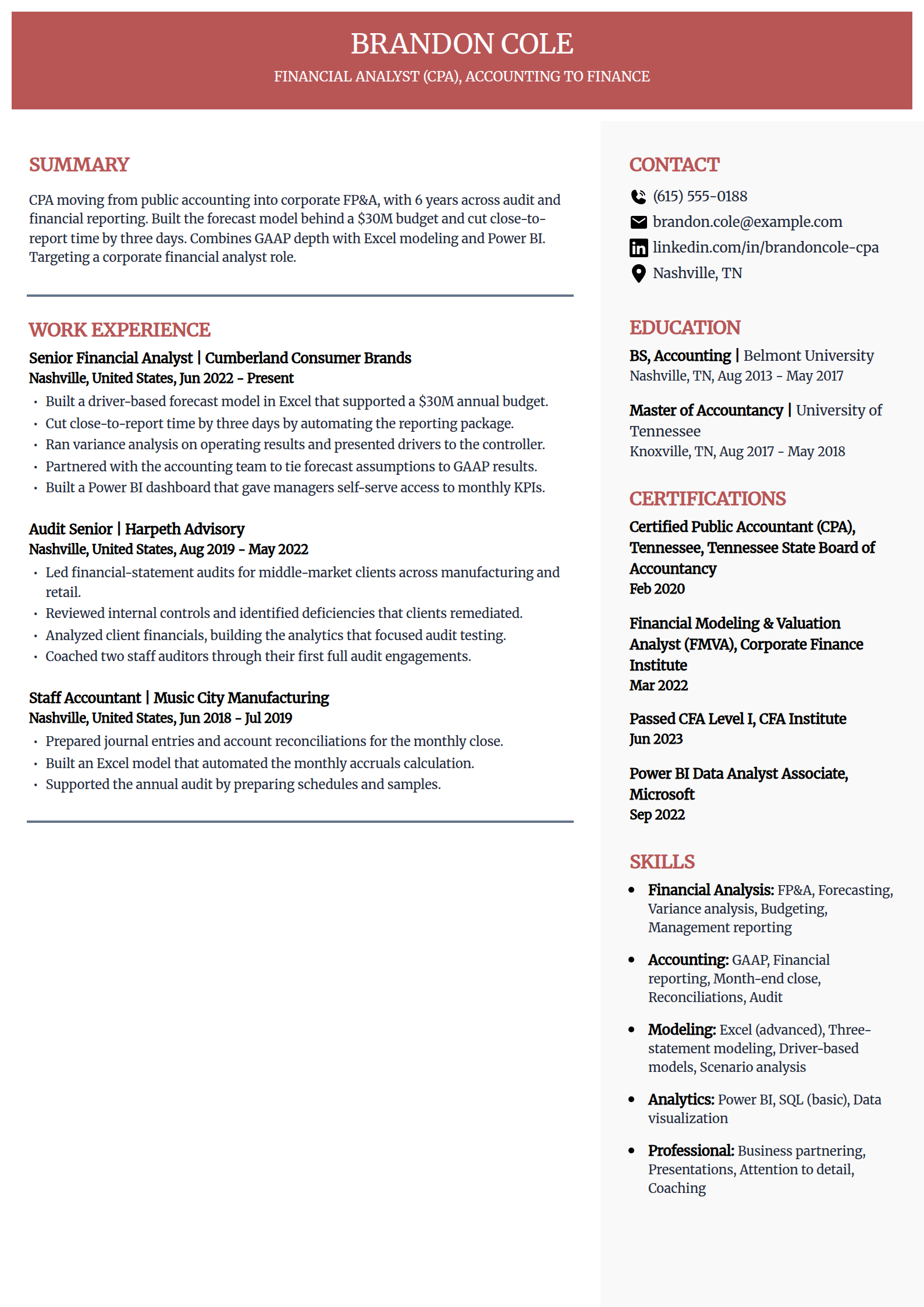
Accounting-to-Finance Resume Template
Why this resume example works?
- Frames the CPA move from audit into FP&A, the career-change story stated up front.
- Leads with a forecast model behind a $30M budget and a close cut by three days.
- Names GAAP depth alongside Excel modeling and Power BI, bridging accounting and finance.
- Shows audit-senior experience, proving the reporting foundation a finance team wants.
- Keeps three roles that map the transition cleanly from staff accountant to analyst.
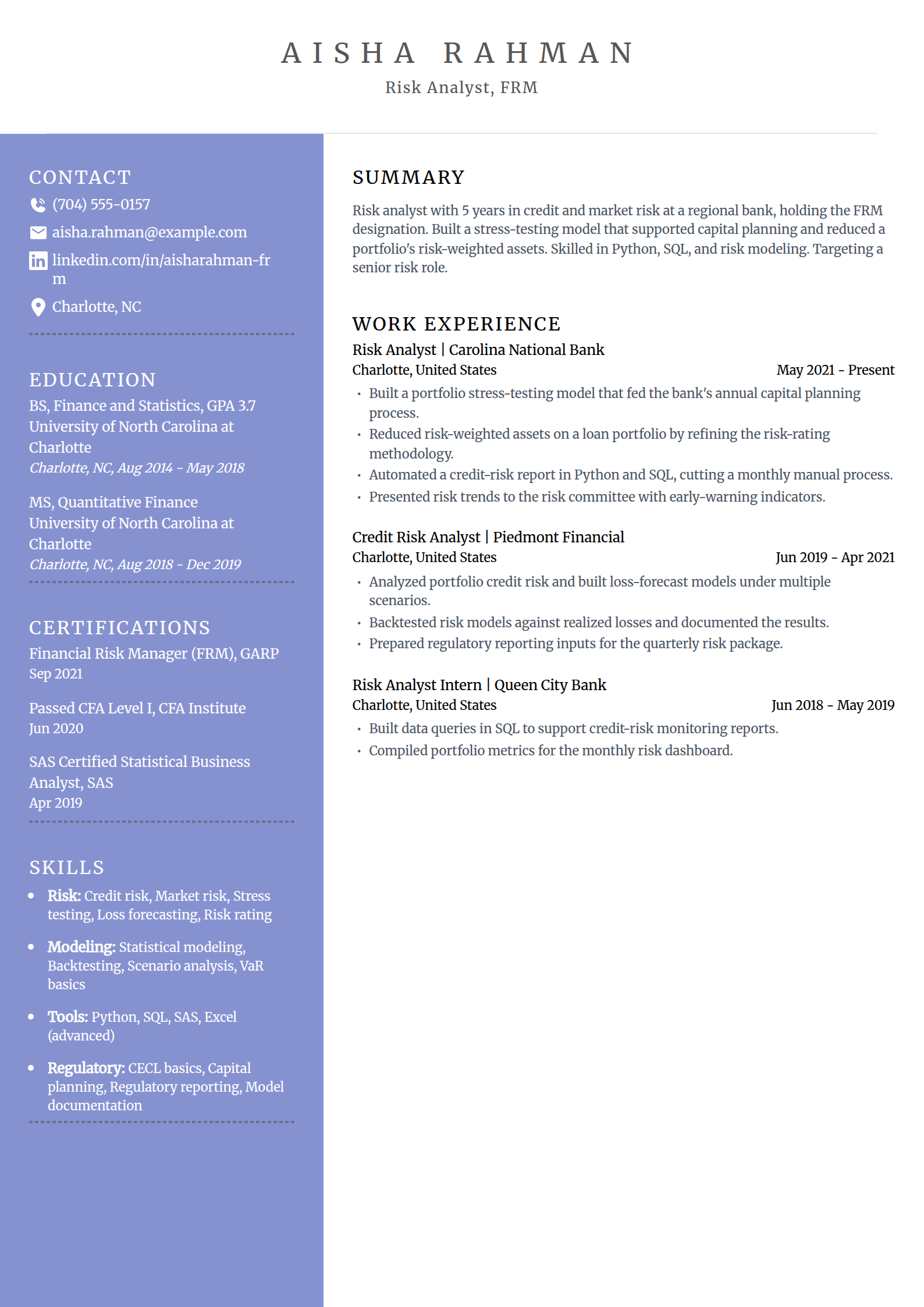
Risk Analyst Resume Template
Why this resume example works?
- Leads with a stress-testing model that fed capital planning, the risk work a bank hires on.
- Names Python, SQL, and SAS, the quantitative tools a modern risk posting lists.
- Carries the FRM designation, the risk-management credential the role recognizes.
- Shows backtesting and regulatory reporting, proving the model work holds up to review.
- Keeps a roomy layout so the credit-and-market risk focus reads clearly.
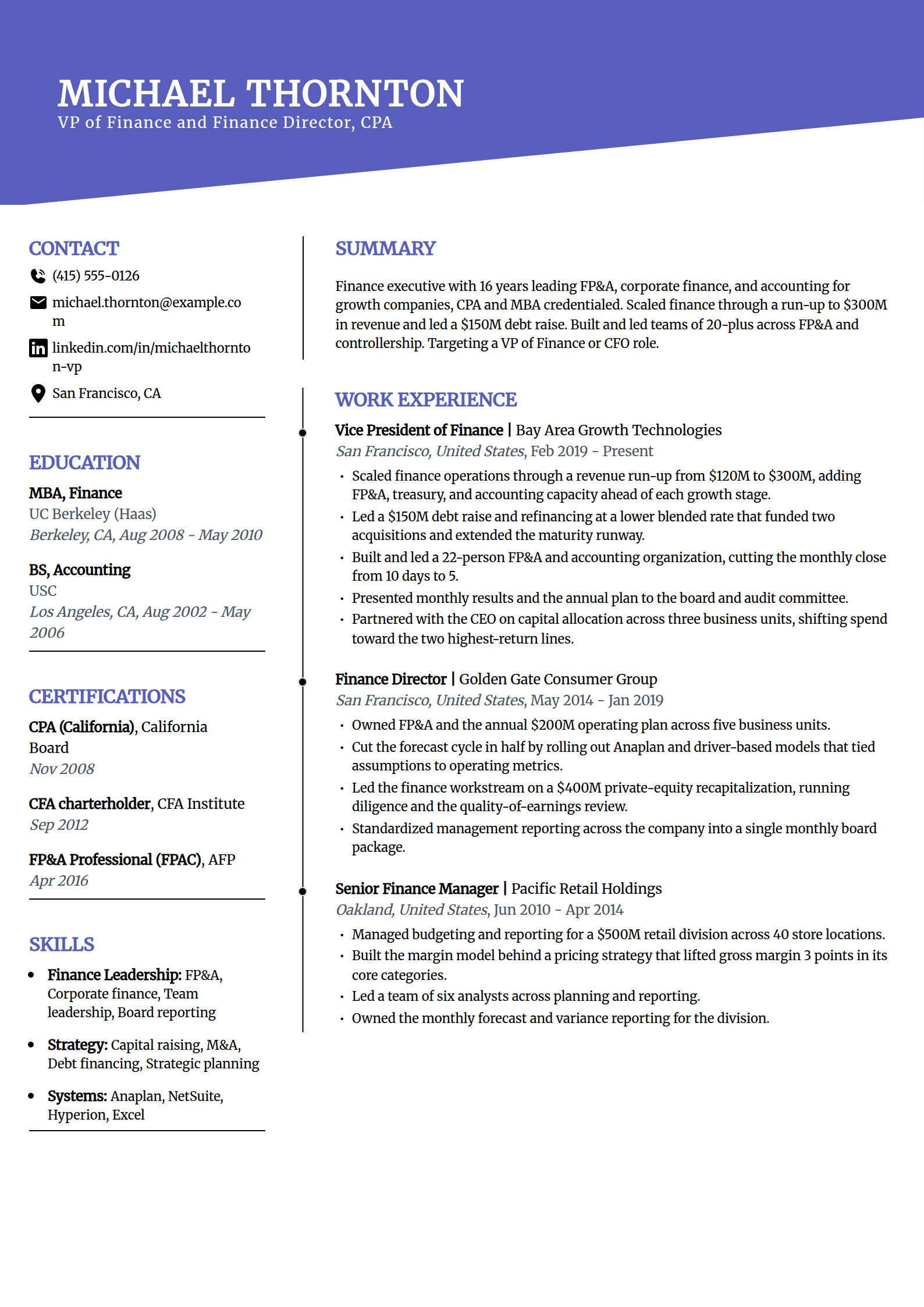
Finance Director & VP Resume Template
Why this resume example works?
- Leads with scale, a run-up to $300M in revenue and a $150M debt raise, the executive-level results.
- Names the CPA, the CFA charter, and an MBA, the credential set a VP of Finance role expects.
- Shows team-building to 22 people, the leadership scope a finance executive is judged on.
- Names Anaplan and NetSuite alongside board reporting, pairing systems with governance.
- Uses a two-column layout that separates leadership scope from the credential sidebar cleanly.
Build your finance resume
Pick a template above and the editor keeps the layout parser-safe while you swap in your own function, credentials, tools, and numbers.
Build my resumeHow to write a finance resume in 2026
A finance resume gets read twice: a fast human skim for scope and results, then an ATS keyword match against the posting. These moves satisfy both without padding.
Lead with a summary that names your function, credential, and one number
Write two to three sentences that open with your title and finance function, state your CFA, CPA, or license status, and land on one result a hiring manager cares about. Students and MBA candidates use the same shape with an internship or a campus-fund number in place of years.
Financial analyst with 6 years in corporate FP&A, currently a CFA Level II candidate, who built a three-statement model that supported a $40M acquisition and improved forecast accuracy to within 4%.
Quantify impact with the numbers finance actually tracks
Lead each bullet with a verb, then attach the result. Finance impact is measurable, so use the metric your function owns.
- Modeling and deals: built a DCF that supported a $40M acquisition, or an LBO for a $500M buyout.
- Planning and accuracy: improved forecast accuracy to within 4%, or held a $120M budget within 2% of plan.
- Banking and credit: managed a $180M portfolio under 1% default, or grew fee income 15% through cross-sell.
- Close and reporting: cut the monthly close by three days, or delivered a clean audit for four straight years.
State your credentials and licenses precisely
Finance credentials are a screen, not a footnote. Phrase each one the way the profession does and keep it near the top.
- CFA: state the exact stage. Write "CFA Level II Candidate" or "Passed CFA Level I" while you study, and "CFA charterholder" only once the charter is awarded. Never "CFA certified".
- CPA: it is a state license. Write "Certified Public Accountant (CPA), Texas" with the state, and keep it near the top for controller and accounting-leaning roles.
- FINRA licenses: list the exams you hold with the regulator, such as "Series 7 and 63 (FINRA)". An exam is sat once, so never write "currently sitting for" a Series exam.
- Other credentials: FMVA, FRM, CTP, and Bloomberg Market Concepts (BMC) all belong here, each with its issuing body.
Name your tools, terminals, and modeling skills
An applicant tracking system matches the exact software and skill the posting lists, so write them out by name where they are true.
- Modeling and valuation: Excel (advanced), three-statement modeling, DCF, LBO, and comparable-company analysis.
- Data and terminals: Bloomberg Terminal, Capital IQ, FactSet, and PitchBook, named exactly as the posting lists them.
- Systems and analytics: SQL, Tableau or Power BI, SAP, Oracle Hyperion, and VBA where they are true.
- Accounting and reporting: GAAP, variance analysis, and financial-statement analysis for corporate and controller roles.
Keep the format ATS-safe and the length tight
Finance resumes get filtered by software before a person reads them, and the field prizes a short, dense page.
- Keep it to one page for analysts, students, and MBA candidates; use two pages only for a director or a long deal list that earns the space.
- Use a single-column, standard-heading layout so a parser reads your credentials, tools, and dates in order.
- Put your CFA, CPA, or Series licenses and a technical-skills block in the top third where a screener looks first.
- Save as a PDF unless the application asks for Word, and run the draft through the ATS resume checker before you send it.
Common finance resume mistakes
- Writing "CFA certified" or burying an in-progress charter. State the exact stage: CFA Level II Candidate, Passed CFA Level I, or CFA charterholder.
- Listing duties instead of results. "Built financial models" is a task; "built a DCF that supported a $40M acquisition" is proof.
- Naming a generic "financial software" instead of the tool. Write Excel, Bloomberg, Capital IQ, or FactSet so the ATS matches.
- Running an analyst or MBA resume to two pages. Keep it to one, and cut old coursework and duty-style bullets before you add a page.
- Claiming a metric out of scope for the role. A teller does not run an LBO and an analyst does not own the close; match the number to the job.
Frequently asked questions
What should a finance resume include?
A two to three sentence summary that names your function, credential status, and one result; a work section where every bullet leads with a verb and a number; your CFA, CPA, or license status; a skills block that names your tools such as Excel, Bloomberg, Capital IQ, and FactSet; and your education. Keep it to one page for analysts, students, and MBA candidates, and put credentials in the top third.
How do I put the CFA or a FINRA Series license on a resume?
State the exact stage near the top, not buried in a list. For the CFA, write "CFA Level II Candidate" or "Passed CFA Level I" while you are studying, and "CFA charterholder" only once the charter is awarded, never "CFA certified". For FINRA licenses, write the exams you hold with the regulator, such as "Series 7 and 63 (FINRA)". A Series exam is sat once on a date, so never write that you are currently sitting for it.
What skills and keywords should I list on a finance resume?
Balance the tools you use with the methods you know, and name both outright. List your modeling skills (three-statement modeling, DCF, LBO, comparable-company analysis), your terminals and data tools (Bloomberg Terminal, Capital IQ, FactSet, PitchBook), your analytics stack (Excel, SQL, Tableau or Power BI, SAP, Oracle Hyperion), and the accounting terms your role uses (GAAP, variance analysis). Make sure the tools in your skills block also appear in your experience bullets.
How long should a finance resume be?
One page for analysts, students, MBA candidates, and anyone with under about ten years of experience. Investment banking and MBA recruiters expect one page and read a longer resume as a weaker one. Two pages are fine for a finance director or VP with a long deal and leadership list, but only if the second page earns its space with real results.
How do I write an investment banking analyst resume?
Lead with your deal and modeling work, then keep it to one page. Name the LBO, DCF, and three-statement models you built and the deal sizes you worked on, and list the tools by name, such as Capital IQ, FactSet, and pitch books. Show your GPA and school near the top, state your CFA stage precisely if you have started it, and put your strongest transaction first. Tight, quantified bullets matter more than the layout.
What does an MBA finance resume look like?
One page, led by your pre-MBA experience and your business school. Show your MBA program and concentration with your undergraduate degree and GPA, then your work history with quantified bullets, such as a portfolio you managed or a model you built. Add the campus signals employers look for, like a case-competition win or a student-fund role, and state your CFA stage as a candidate level if you are studying for it.
More finance resume resources
Build your finance resume
Pick a template above and the editor keeps the layout parser-safe while you swap in your own function, credentials, tools, and numbers.