Executive Resume Templates Built for the C-Suite and VP
- ATS Friendly
- Executive Specific
- 17 Real Examples
A board or hiring committee skims an executive resume for scope in seconds: the size of the P&L you own, the revenue you have grown, and the number of people you lead. Pick a clean template below, then model your own on a real example built for your seat, from the C-suite to a VP or general manager role. Every example leads with strategic results and one modest number a leader can verify.


540k+ resumes created
Executive resume templates, sorted by role and level
Each template below is a real executive resume laid out in that format, grouped by function and seniority. Choose one, then swap in your own P&L, revenue growth, headcount, and the systems and board work you own. Every layout keeps your name, title, and dates clean so a hiring committee reads your results in one pass and an applicant tracking system parses it without trouble.
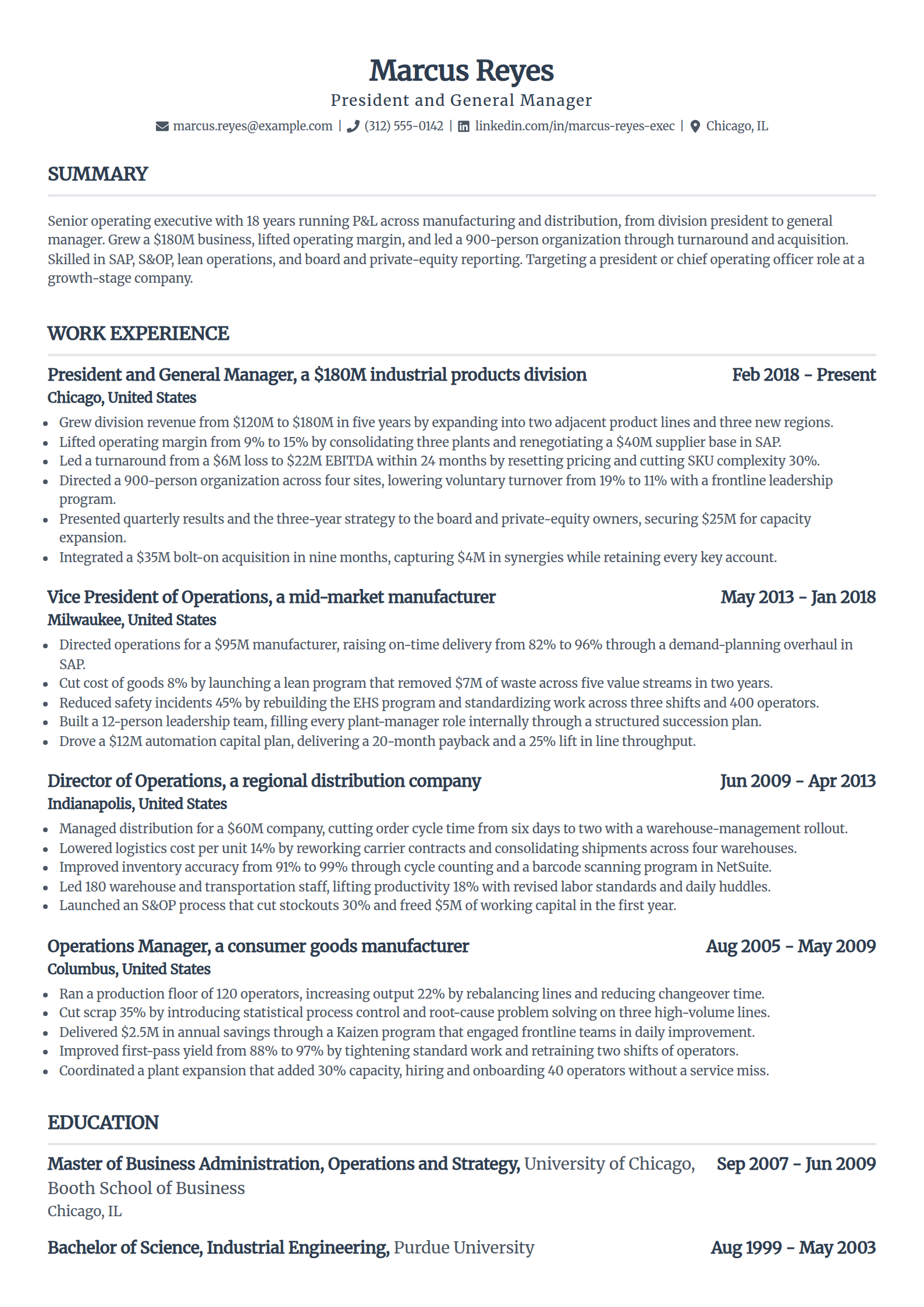
Executive Resume Template (Senior Leader)
Why this resume example works?
- Opens with the scope a board reads first, an 18-year record running P&L up to a $180M division.
- Leads each bullet with a strong verb and one modest number, like a turnaround from a $6M loss to $22M EBITDA.
- Names the systems and work a posting screens for, SAP, S&OP, lean operations, and private-equity reporting.
- Shows the full arc of a senior leader, from operations manager to president, so the progression is clear.
- Uses a clean single-column layout that carries an executive-length history on one ATS-safe page.
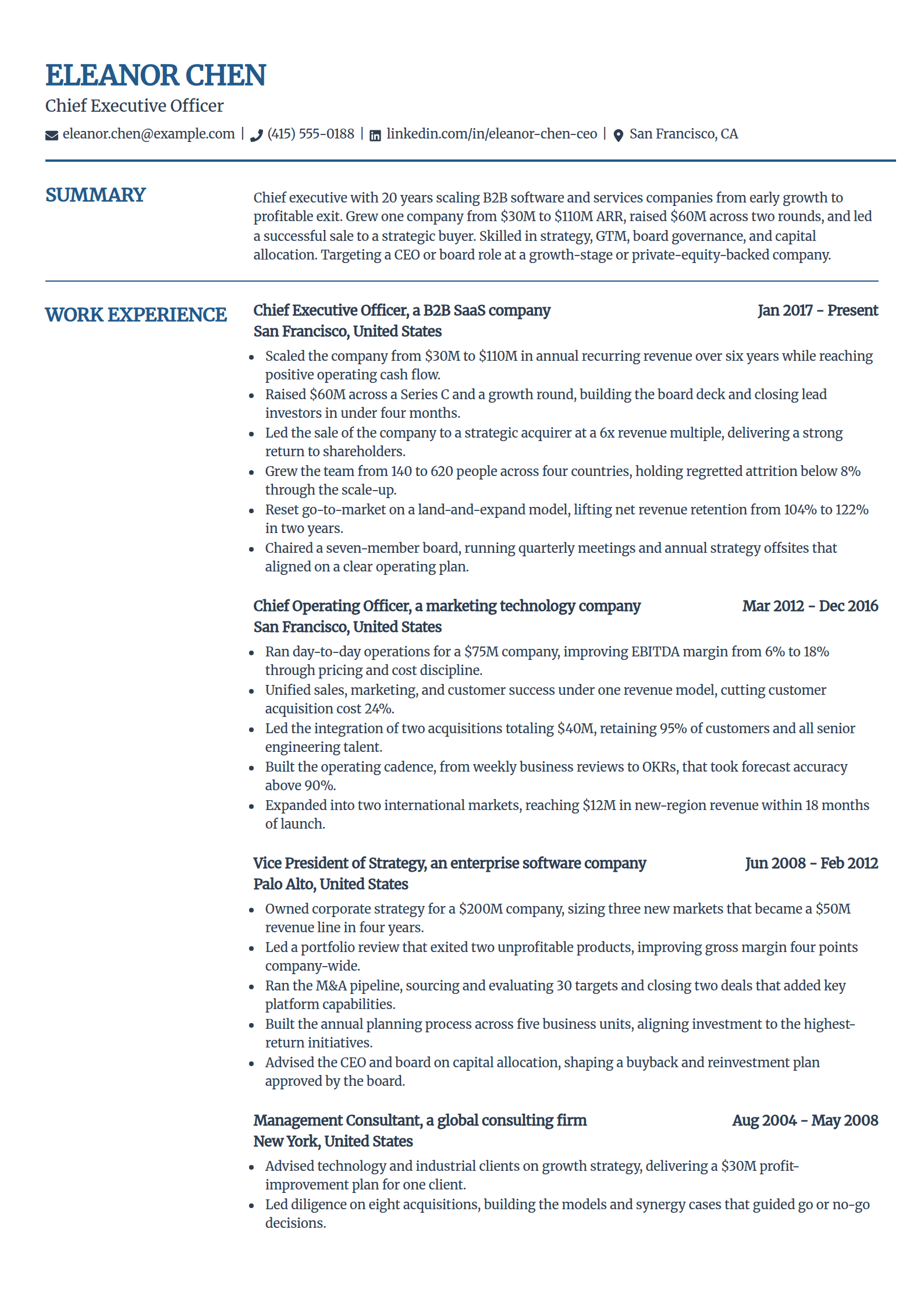
CEO Resume Template
Why this resume example works?
- Leads with the outcome a board hires a CEO for, scaling revenue from $30M to $110M in annual recurring revenue.
- Shows the capital work this seat owns, a $60M raise and a company sale at a 6x revenue multiple.
- Keeps the scaling concrete, growing the team from 140 to 620 while holding regretted attrition below 8%.
- Names board governance and go-to-market, the language a CEO search and its investors screen for.
- Uses a modern two-column layout that carries a full C-suite history on one page.
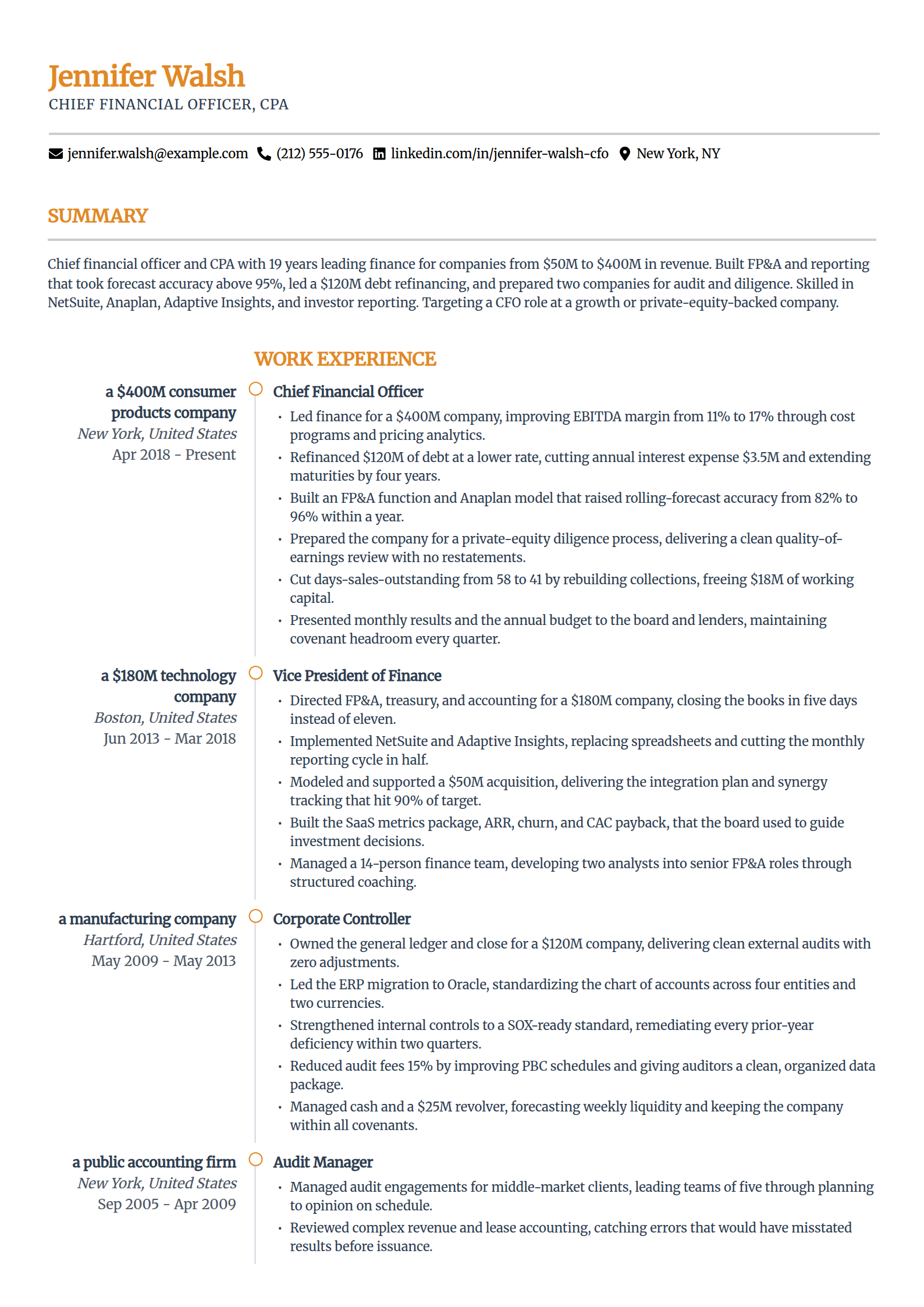
CFO Resume Template
Why this resume example works?
- Opens with the credential and scope a board wants in a CFO, a CPA leading finance for a $400M company.
- Shows the finance work this seat owns, a $120M debt refinancing that cut annual interest expense $3.5M.
- Keeps the discipline visible, forecast accuracy taken above 95% and a clean private-equity diligence process.
- Names NetSuite, Anaplan, and Adaptive Insights, the systems a CFO posting lists.
- Uses a modern two-column layout that fits a full finance-leadership history on one page.
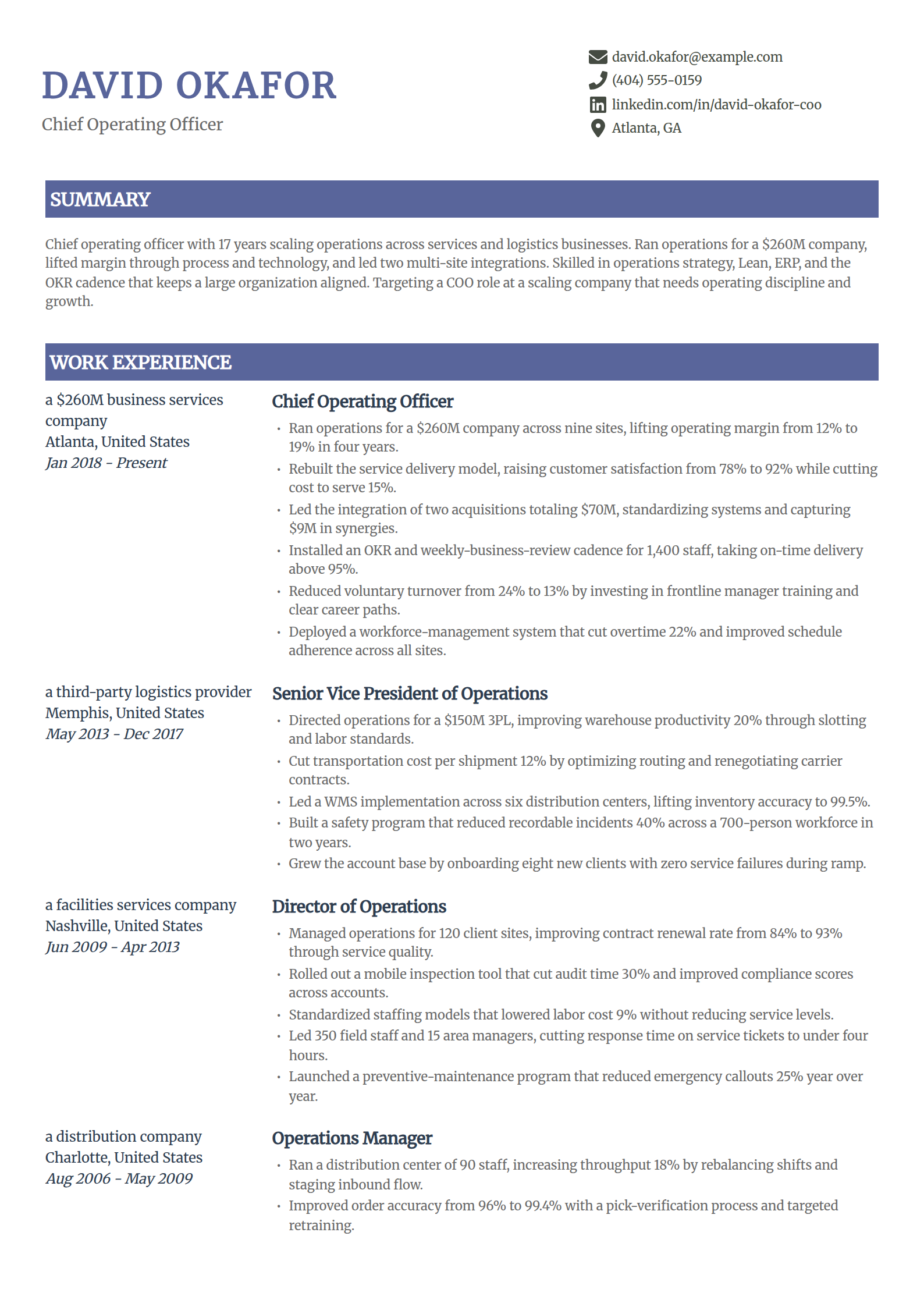
COO Resume Template
Why this resume example works?
- Frames operating scope a board reads, running a $260M company across nine sites and 1,400 staff.
- Shows the margin work this seat owns, operating margin lifted from 12% to 19% in four years.
- Keeps the discipline concrete, an OKR and business-review cadence that took on-time delivery above 95%.
- Names Lean Six Sigma and M&A integration, the methods a COO posting screens for.
- Uses a visually rich two-column layout that fits a dense operations history on one page.
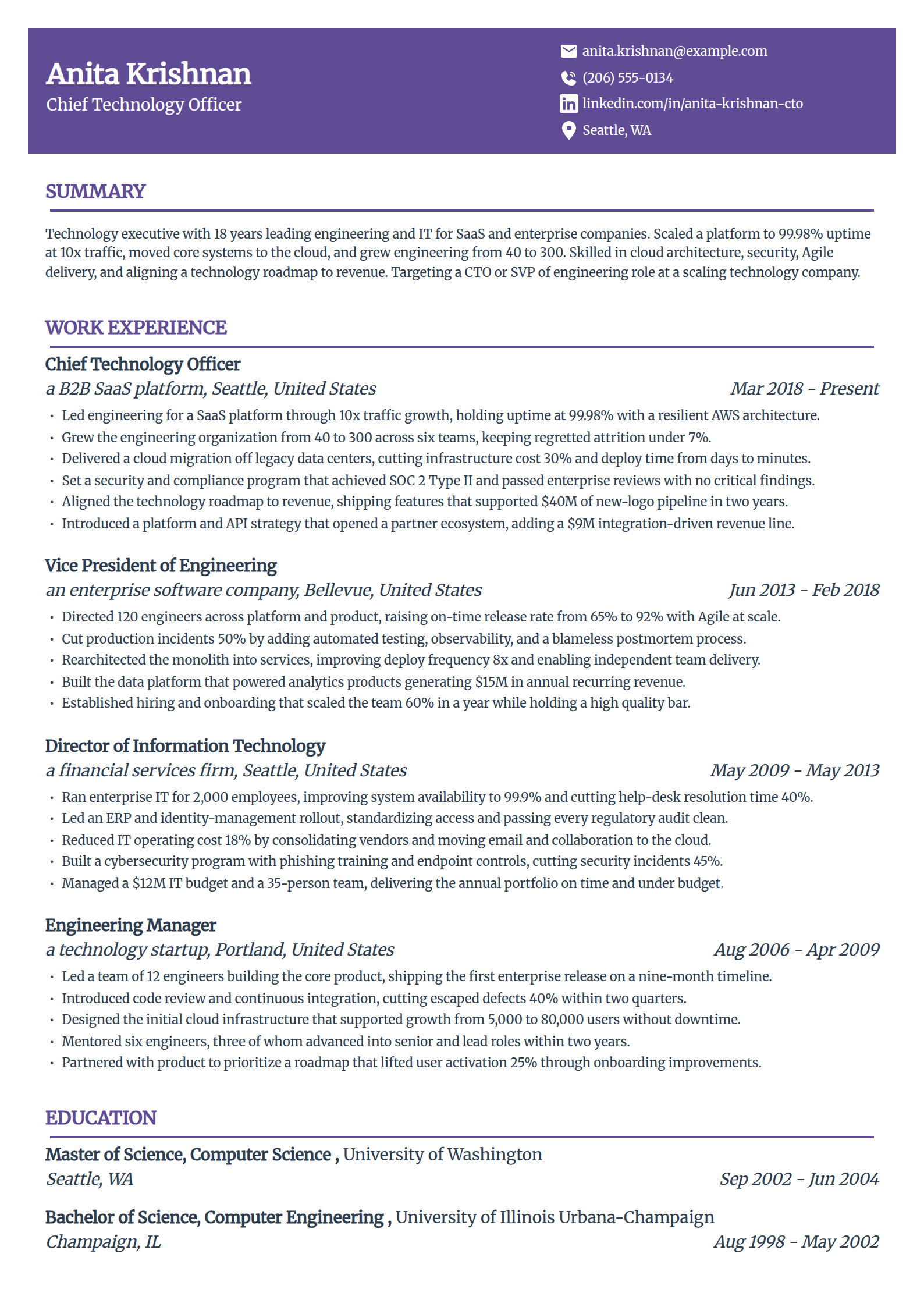
IT Executive (CTO) Resume Template
Why this resume example works?
- Opens with the reliability an IT executive is measured on, 99.98% uptime through 10x traffic growth.
- Shows the leadership scale, growing engineering from 40 to 300 across six teams.
- Keeps the business tie concrete, a cloud migration that cut infrastructure cost 30% and sped deploys.
- Names AWS, SOC 2, and Agile at scale, the exact terms an IT executive posting lists.
- Uses a modern layout that carries a full engineering and IT leadership history on one page.
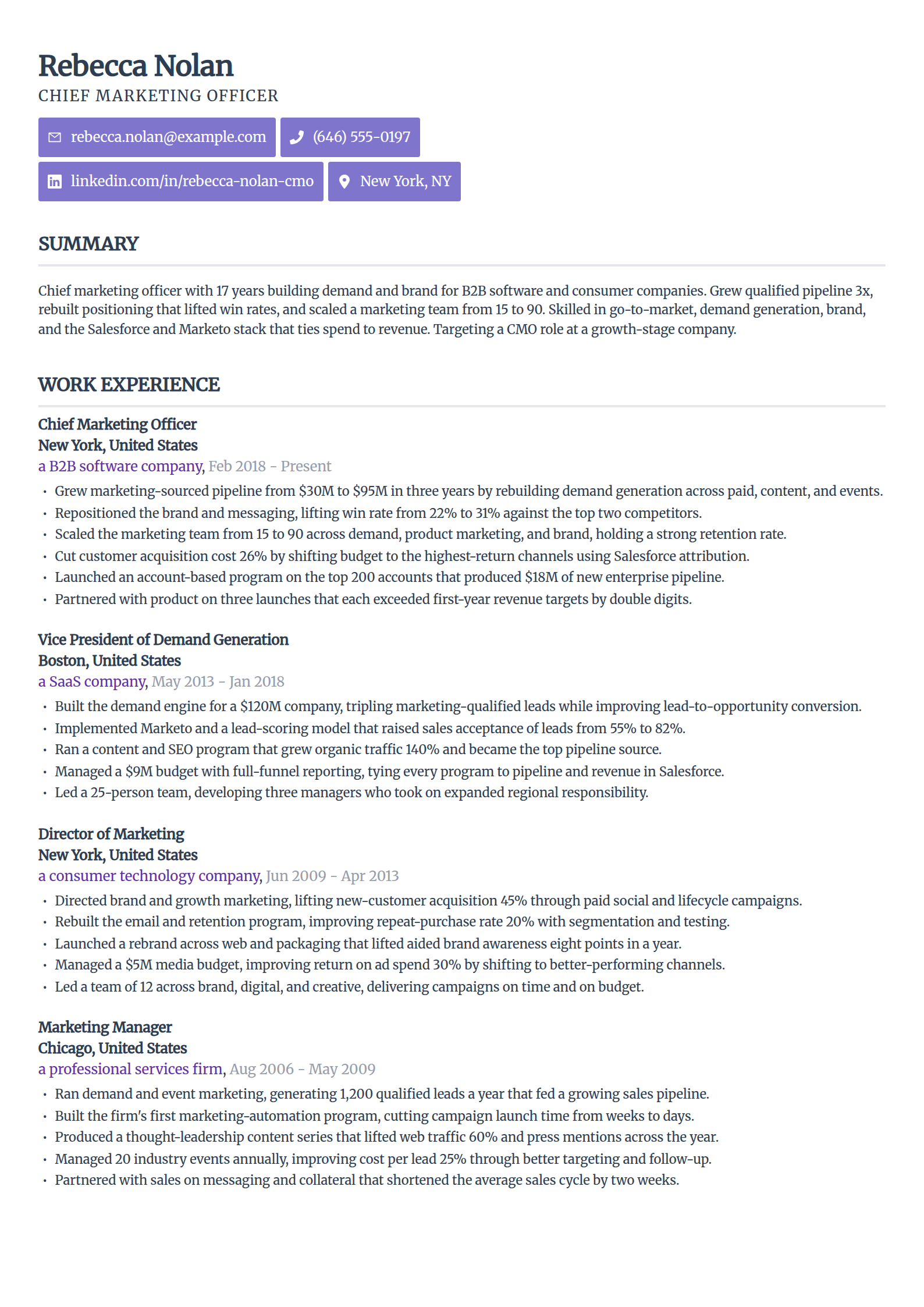
CMO Resume Template
Why this resume example works?
- Leads with the pipeline a CMO is hired to grow, marketing-sourced pipeline from $30M to $95M in three years.
- Shows the brand work behind the number, positioning that lifted win rate from 22% to 31%.
- Keeps efficiency visible, customer acquisition cost cut 26% using Salesforce attribution.
- Names Marketo, HubSpot, and account-based marketing, the stack a CMO posting screens for.
- Uses a clean, modern layout that fits a full marketing-leadership history on one page.
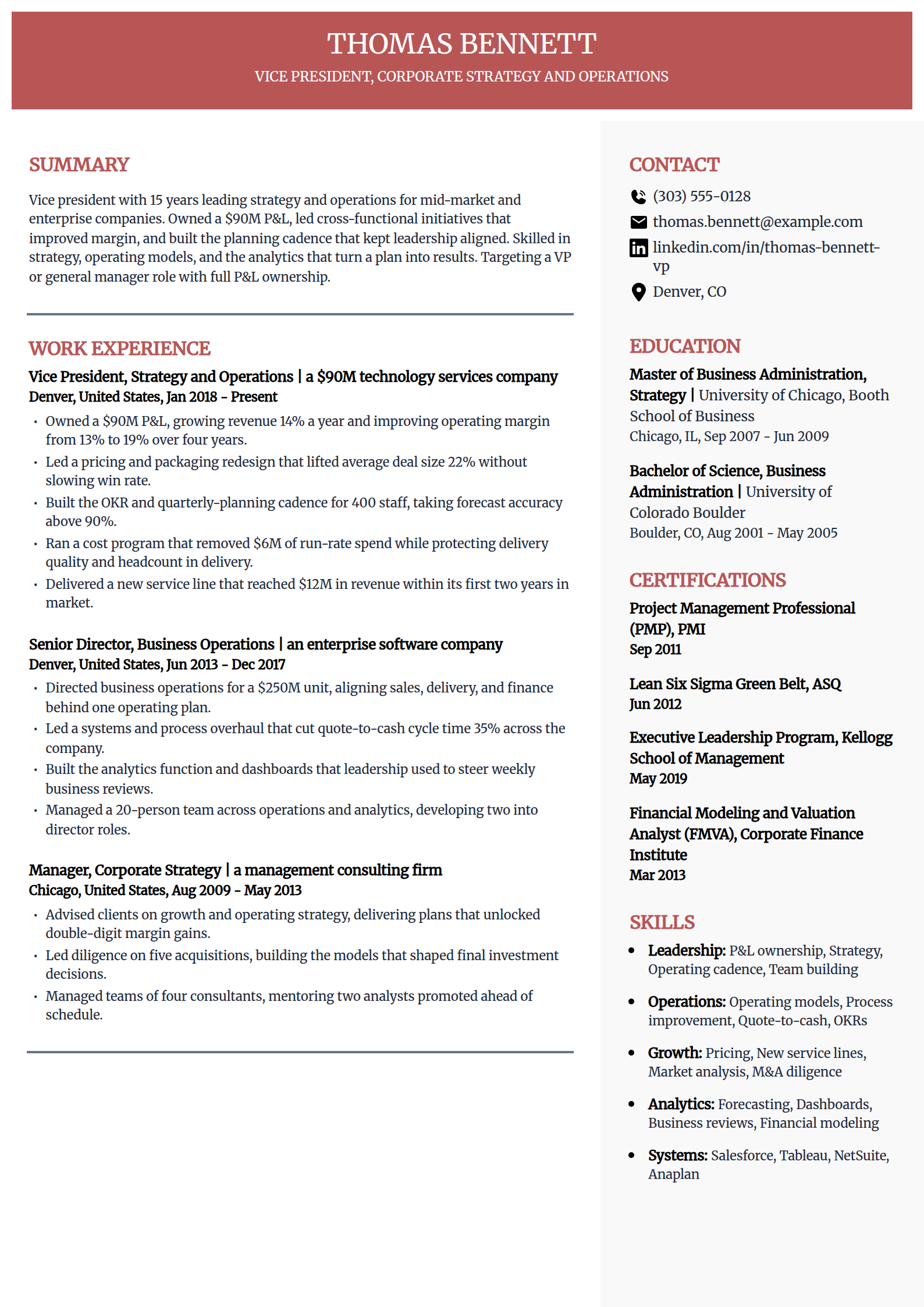
Vice President (VP) Resume Template
Why this resume example works?
- Opens with full P&L ownership, a $90M business grown 14% a year with margin lifted from 13% to 19%.
- Shows the operating work a VP owns, a pricing redesign that lifted average deal size 22%.
- Keeps the cadence concrete, an OKR and quarterly-planning rhythm that took forecast accuracy above 90%.
- Names strategy, operating models, and analytics, the scope a VP posting expects.
- Uses a refined layout that fits a fifteen-year leadership record cleanly on one page.
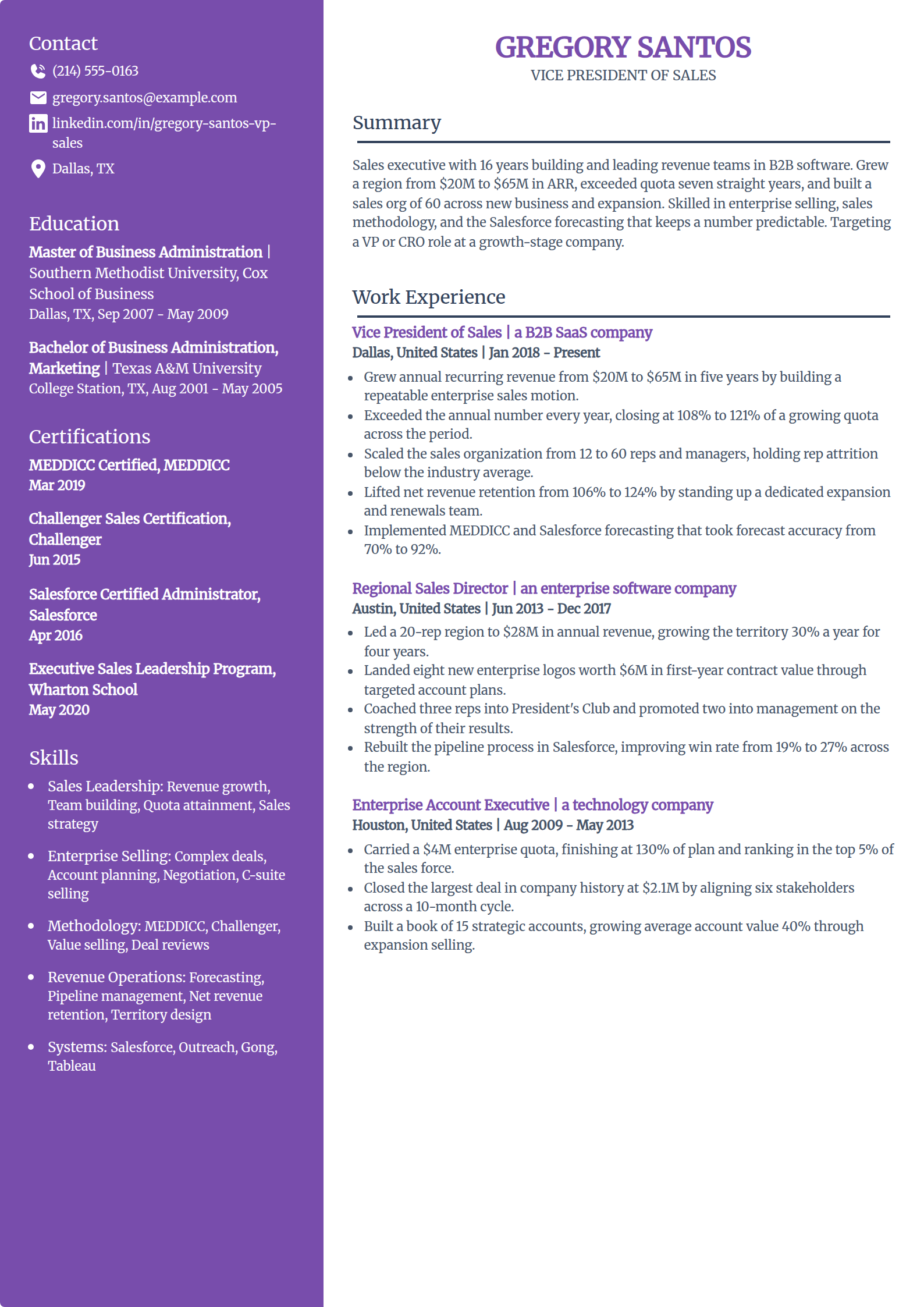
VP of Sales Resume Template
Why this resume example works?
- Leads with the number a sales leader is hired for, ARR grown from $20M to $65M in five years.
- Shows quota credibility directly, exceeding the number every year at 108% to 121% of plan.
- Keeps the retention concrete, net revenue retention lifted from 106% to 124%.
- Names MEDDICC and Salesforce forecasting, the methodology and system a sales posting screens for.
- Uses a modern layout that carries a full revenue-leadership history on one page.
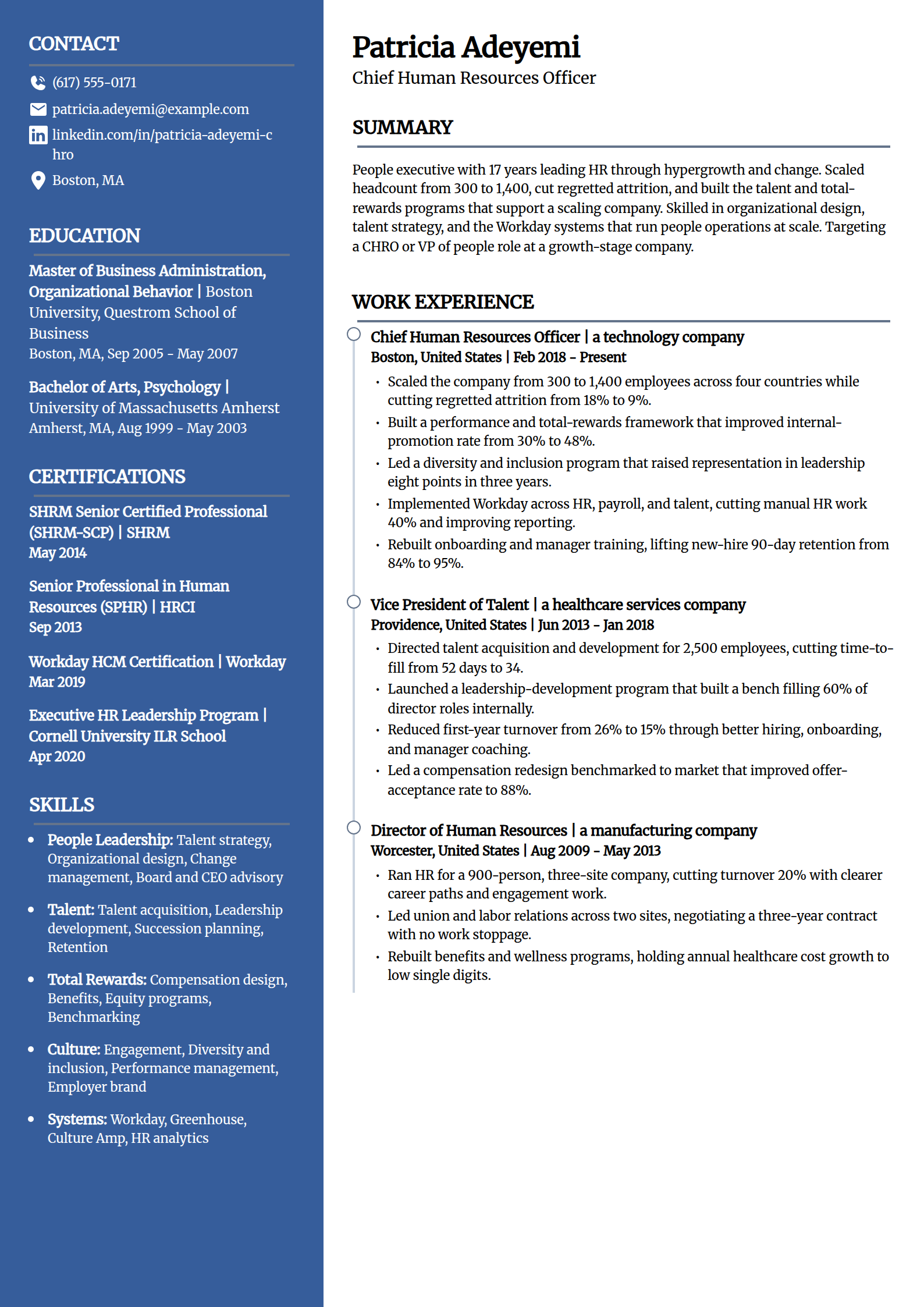
HR Executive (CHRO) Resume Template
Why this resume example works?
- Opens with the scaling a people executive owns, headcount from 300 to 1,400 while cutting regretted attrition to 9%.
- Shows a talent result a board reads, internal-promotion rate lifted from 30% to 48%.
- Keeps the systems concrete, a Workday rollout that cut manual HR work 40%.
- Names SHRM-SCP and total rewards, the credential and scope a CHRO posting screens for.
- Uses a distinctive layout that stays easy to skim in one pass.
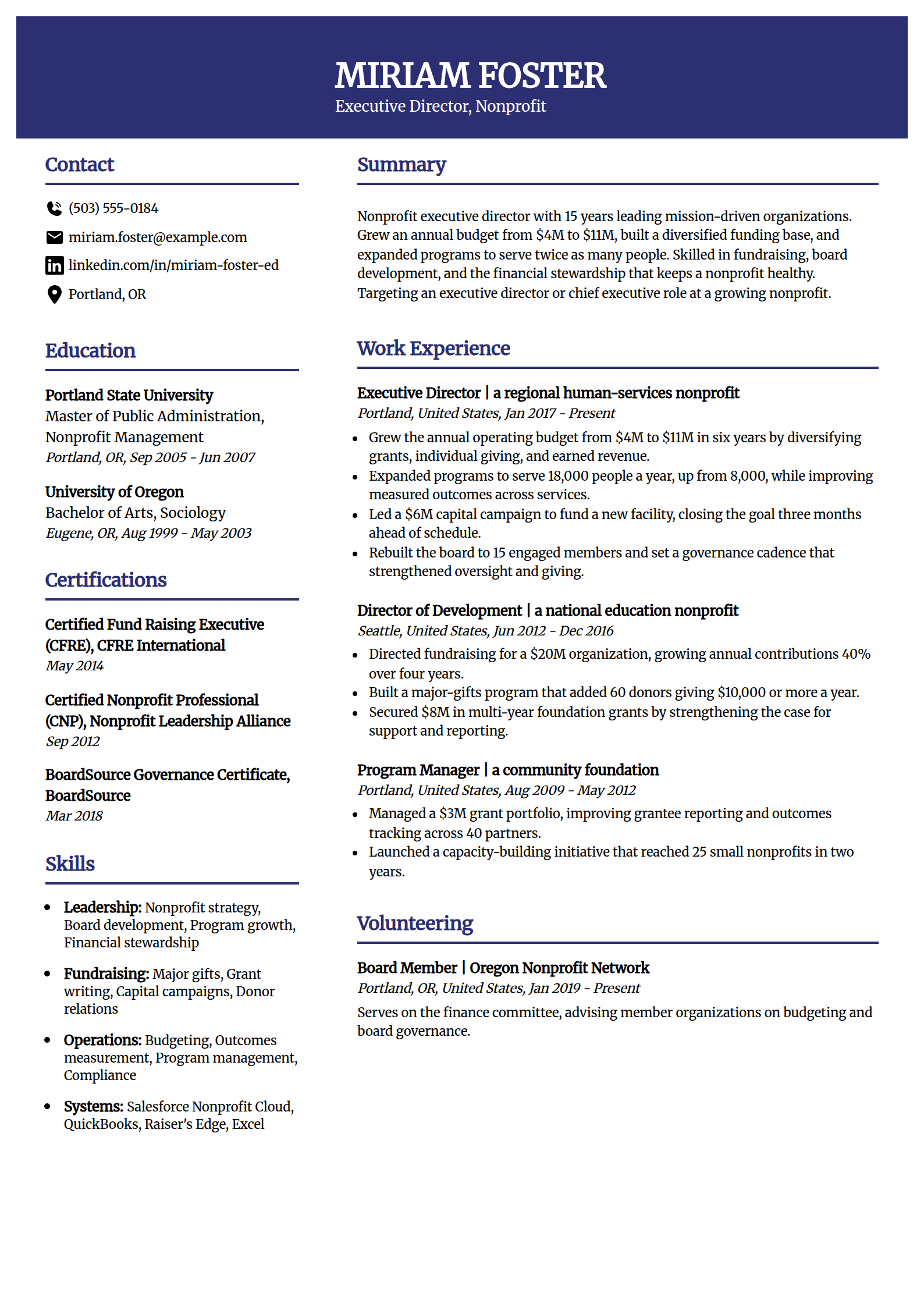
Nonprofit Executive Director Resume Template
Why this resume example works?
- Frames mission scope a board reads, growing an annual budget from $4M to $11M in six years.
- Shows the impact behind the money, doubling people served to 18,000 a year.
- Keeps fundraising concrete, a $6M capital campaign closed three months ahead of schedule.
- Names board development and a CFRE credential, the work a nonprofit executive posting values.
- Uses a roomy two-column layout with a filled sidebar so the page reads complete.
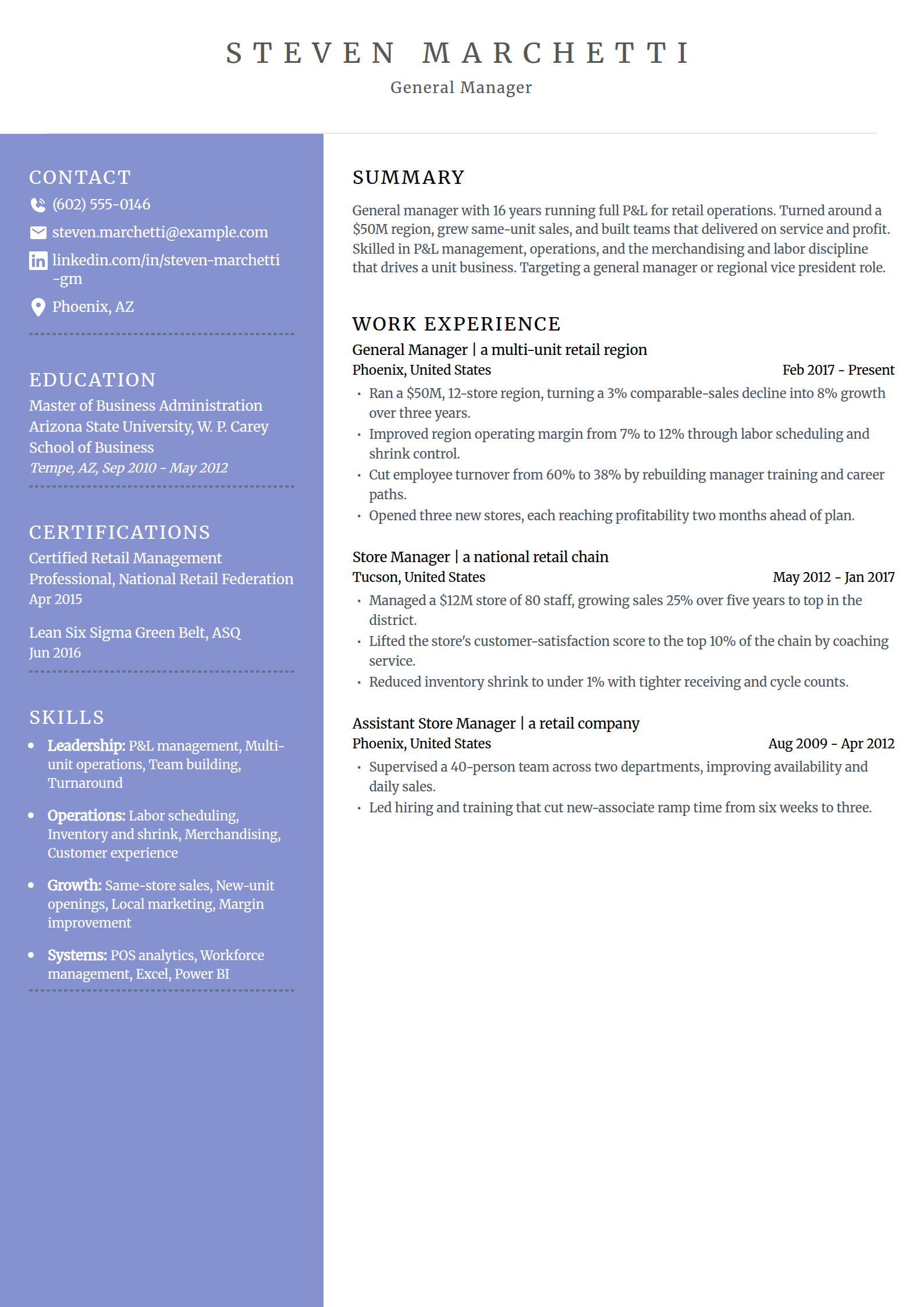
General Manager Resume Template
Why this resume example works?
- Opens with full P&L, a $50M, 12-store region turned from a 3% sales decline to 8% growth.
- Shows the profit work a GM owns, operating margin lifted from 7% to 12%.
- Keeps the people result concrete, turnover cut from 60% to 38% with better manager training.
- Names labor scheduling, shrink control, and merchandising, the levers a GM posting lists.
- Uses a roomy two-column layout with a filled sidebar so a unit-leader record reads complete.
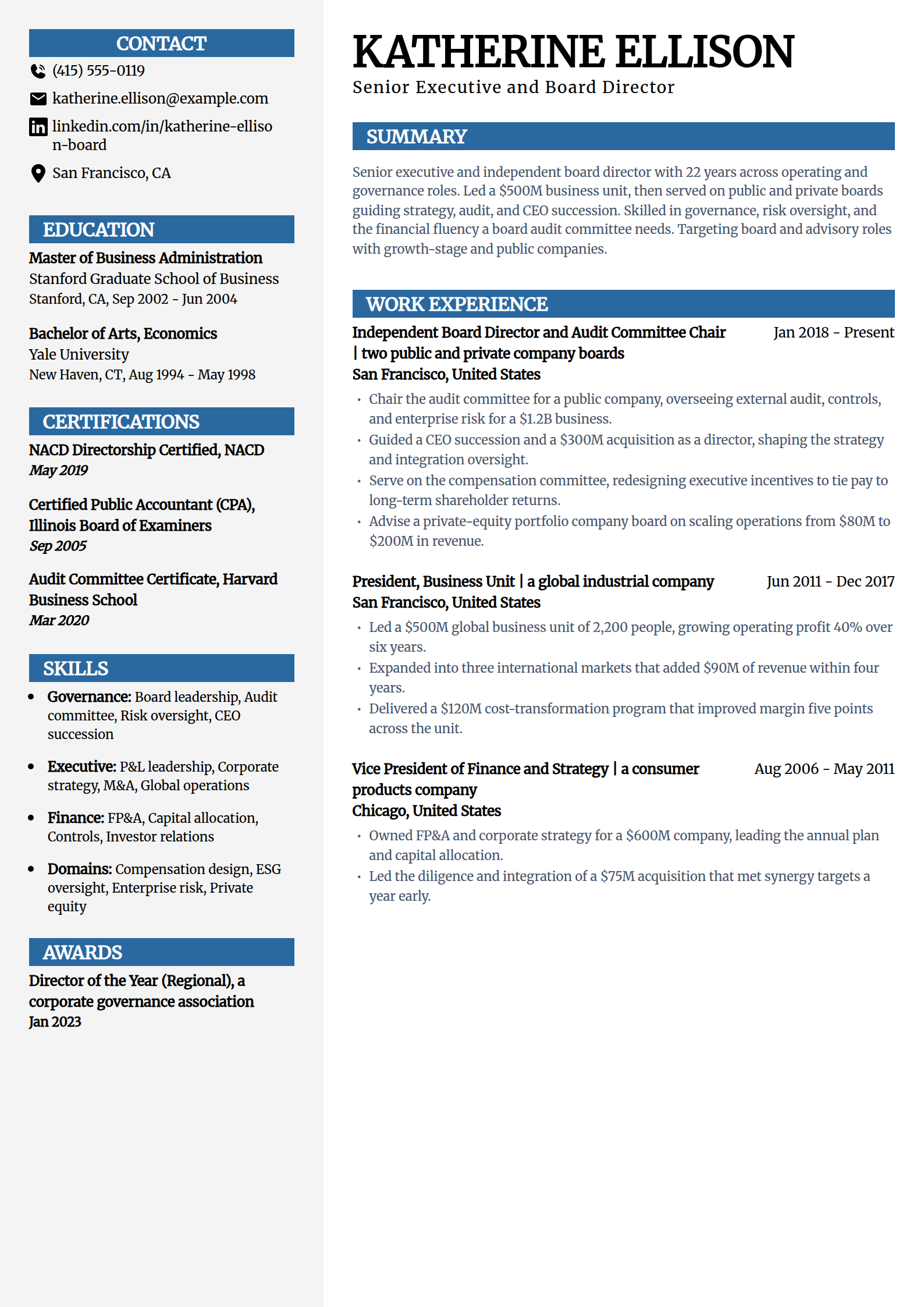
Board Director & Senior Executive Resume Template
Why this resume example works?
- Opens with governance scope a nominating committee reads, chairing the audit committee of a $1.2B public company.
- Blends the two records a director needs, board service plus a $500M operating business unit.
- Keeps the board work concrete, guiding a CEO succession and a $300M acquisition.
- Names audit, risk, and compensation oversight, the committee language a board search screens for.
- Uses a visually rich layout that separates governance and operating experience cleanly.
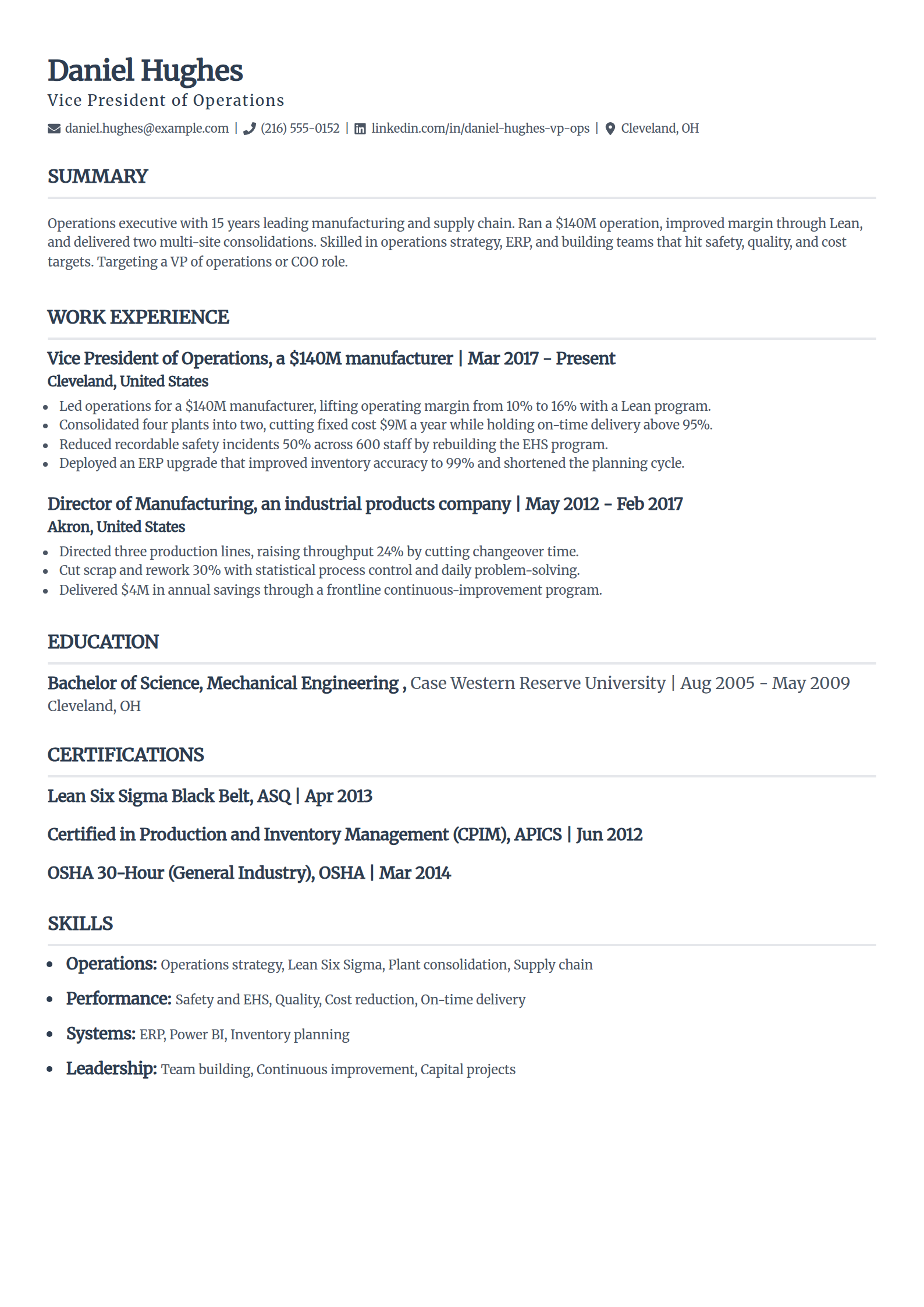
Operations Executive Resume Template
Why this resume example works?
- Leads with the margin work a VP of operations owns, lifted from 10% to 16% with a Lean program.
- Shows a hard structural result, four plants consolidated into two, cutting $9M of fixed cost a year.
- Keeps safety visible, recordable incidents cut 50% across 600 staff.
- Names Lean Six Sigma and ERP, the methods and systems a manufacturing posting lists.
- Uses a tight, ATS-safe single-column layout that fills the page without padding.
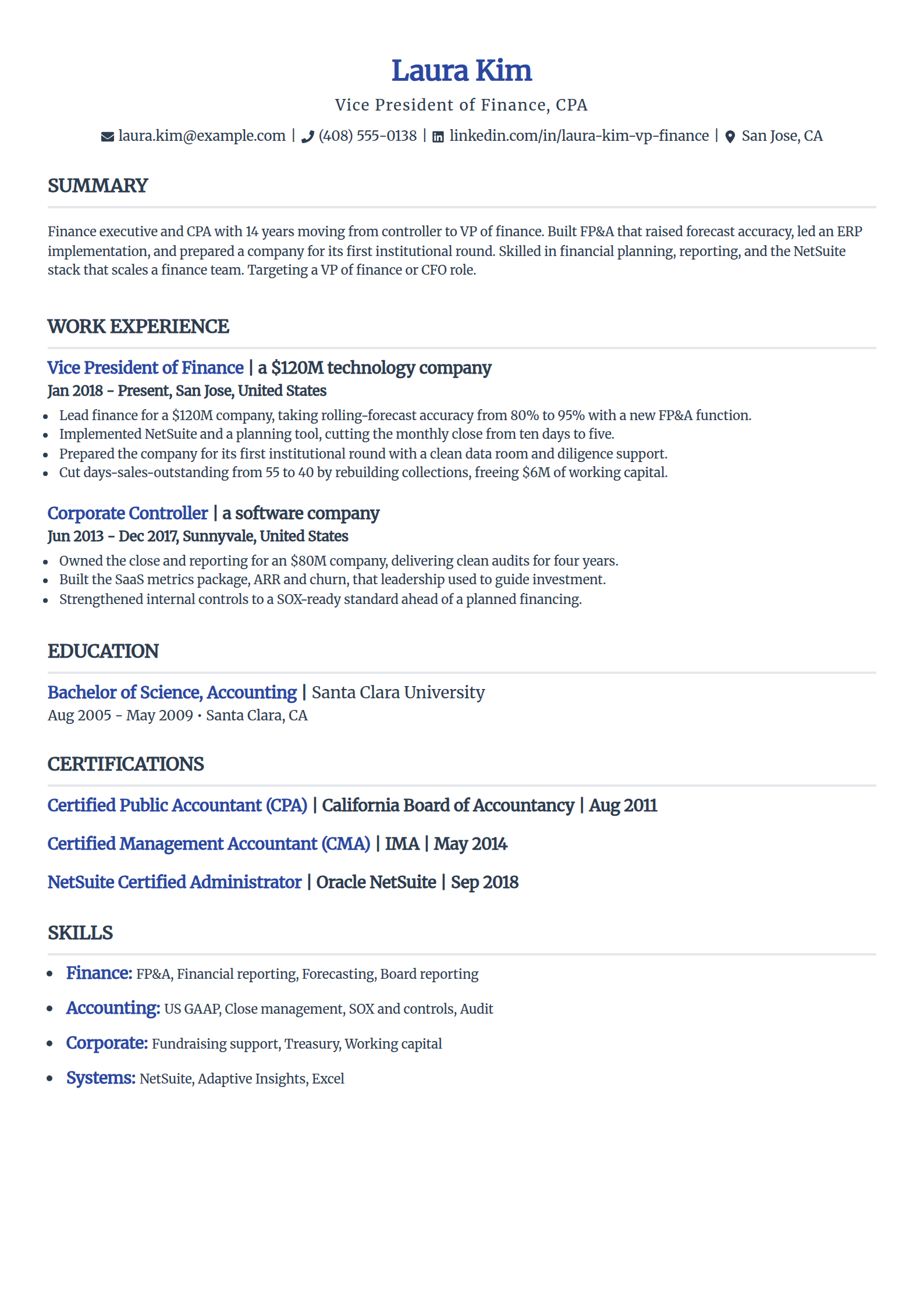
Finance Executive Resume Template
Why this resume example works?
- Written for the controller-to-VP path, it leads with the CPA and a step up to leading finance for a $120M company.
- Shows the FP&A work behind the promotion, forecast accuracy taken from 80% to 95%.
- Keeps the systems concrete, a NetSuite rollout that cut the monthly close from ten days to five.
- Names fundraising support and SOX controls, the work a VP of finance posting screens for.
- Uses a clean, parser-friendly layout that reads complete for a focused finance record.
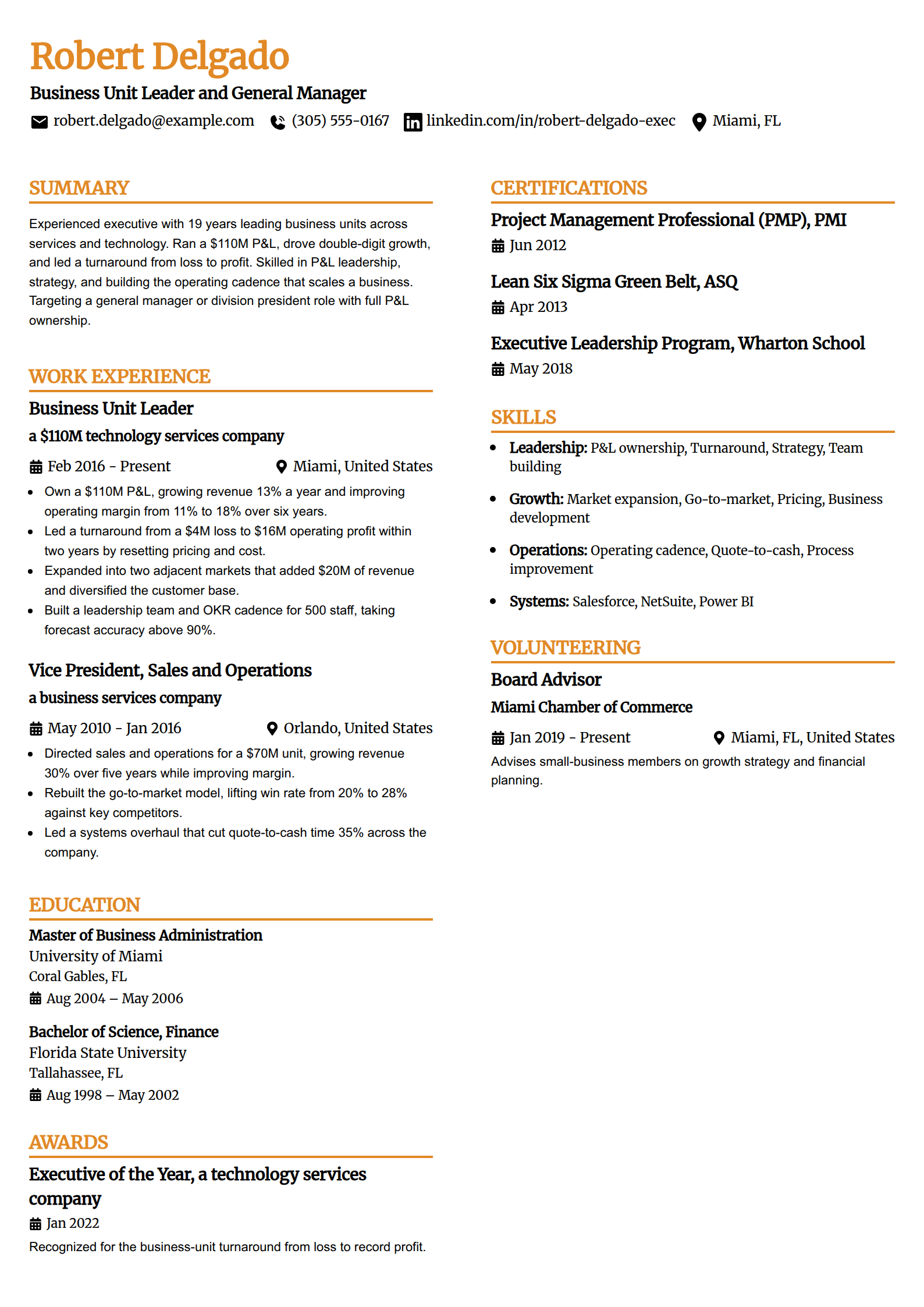
Experienced Executive Resume Template
Why this resume example works?
- Makes the P&L case directly, owning a $110M business grown 13% a year with margin lifted from 11% to 18%.
- Shows the turnaround a board reads, a $4M loss moved to $16M operating profit in two years.
- Keeps growth concrete, two adjacent markets that added $20M of revenue.
- Names go-to-market and operating cadence, the scope a general manager posting expects.
- Uses a two-column layout with a filled sidebar so a focused senior record reads complete.
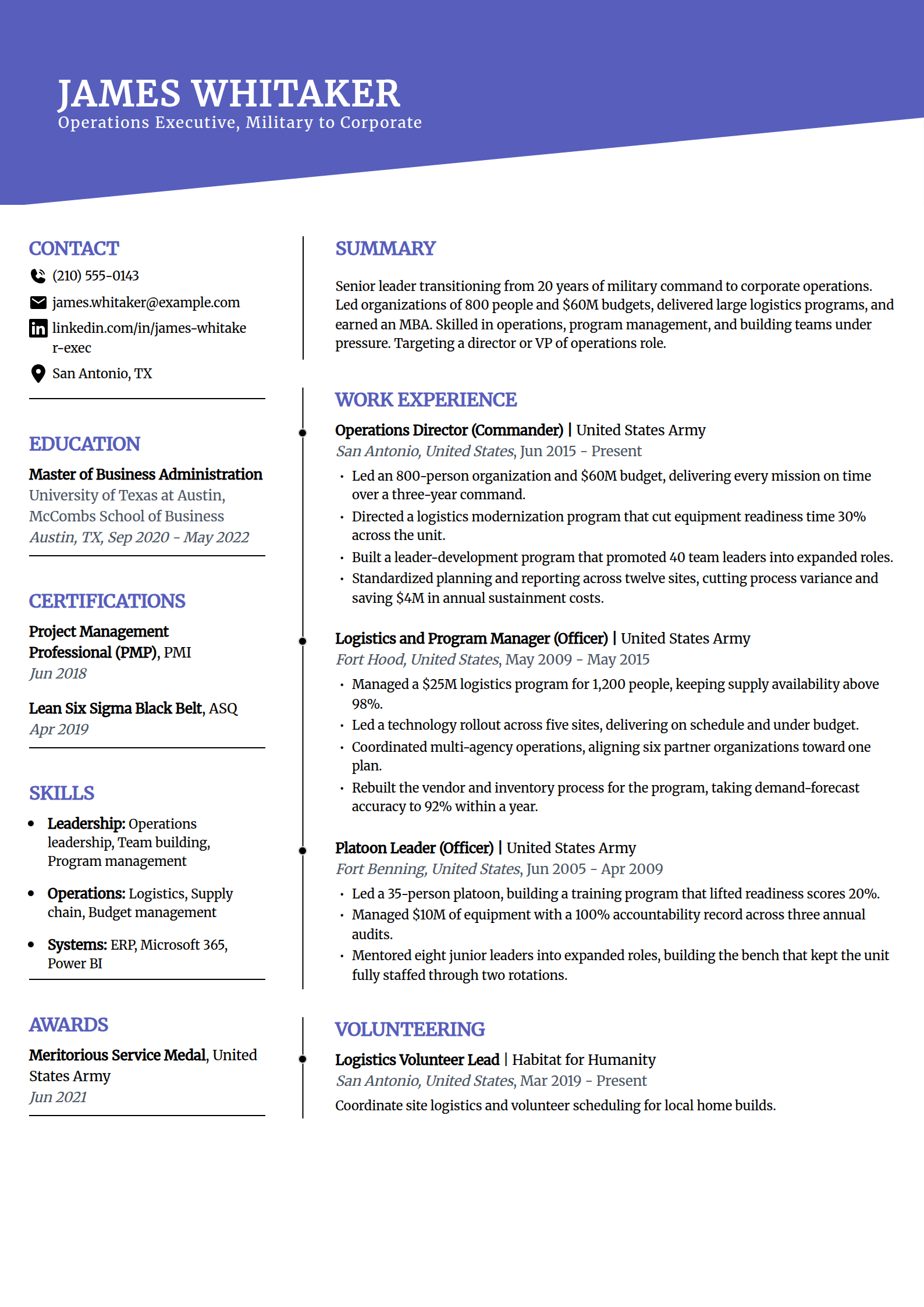
Career-Change Executive Resume Template
Why this resume example works?
- Names the move openly, a military commander stepping into corporate operations with a fresh MBA.
- Reframes command experience in business terms, leading 800 people and a $60M budget.
- Shows transferable results, a logistics modernization that cut equipment readiness time 30%.
- Names PMP and Lean Six Sigma, the credentials that translate command into corporate operations.
- Uses a two-column layout with a full sidebar so a first corporate resume still reads complete.
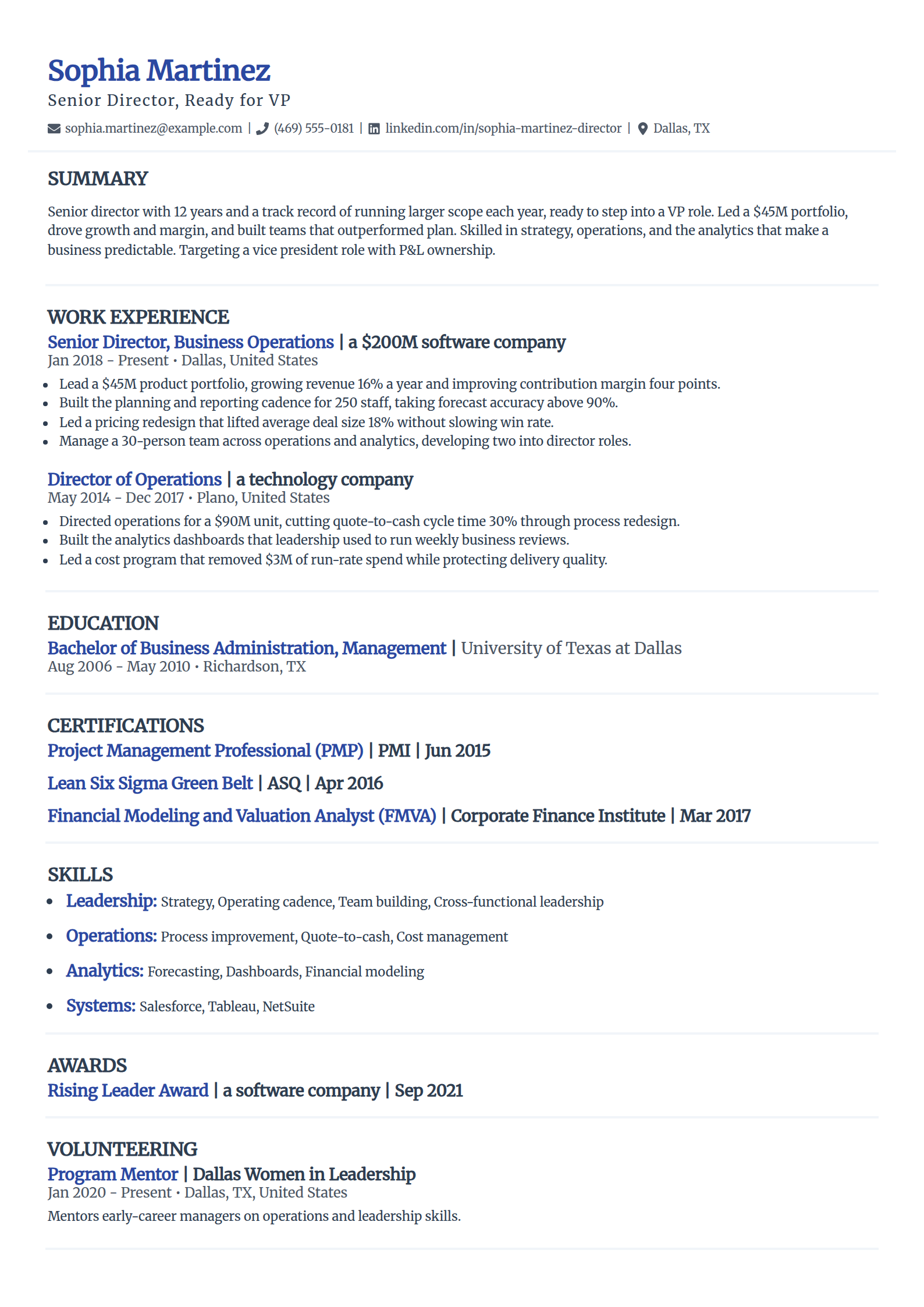
Emerging Executive Resume Template
Why this resume example works?
- Written for the director ready for VP, it leads with a $45M portfolio grown 16% a year.
- Shows widening scope, a pricing redesign that lifted average deal size 18%.
- Keeps the cadence concrete, a planning rhythm that took forecast accuracy above 90%.
- Names strategy, operations, and analytics, the scope a VP posting screens for.
- Uses a refined two-column layout with a filled sidebar so a focused record reads complete.
Build your executive resume
Pick a template above and the editor keeps your layout clean and ATS-safe while you swap in your own P&L, revenue growth, headcount, and board work.
Build my resumeHow to write an executive resume in 2026
An executive resume is read by a board member or hiring committee who checks two things fast: the scope you have run and the results you drove there. Lead with the P&L, revenue, and headcount you own, then attach one modest number to each line. These moves make yours easy to skim and easy for an applicant tracking system to parse.
Open with an executive summary that states your scope
Write three to four sentences that name your years and level, the size of the P&L or business you run, one or two headline results, and the role you are targeting. Say what you have led and grown, not what you want from the employer. This is the leadership profile a board reads first, so make the strongest number visible in the opening lines.
Chief financial officer and CPA with 19 years leading finance for companies from $50M to $400M in revenue. Built FP&A that took forecast accuracy above 95%, led a $120M debt refinancing, and prepared two companies for diligence. Skilled in NetSuite, Anaplan, and investor reporting. Targeting a CFO role at a private-equity-backed company.
Lead experience with P&L, revenue, and headcount
The work an executive resume is hired for is measurable, so name it and attach one modest number to each bullet. Open every line with a strong verb, never "Responsible for".
- Scope: state the P&L or business size, like running operations for a $260M company across nine sites.
- Growth: name the result, such as scaling revenue from $30M to $110M in annual recurring revenue.
- Profit: show the margin, like lifting operating margin from 12% to 19% over four years.
- People and board: quantify it, such as leading a 900-person organization or preparing a nine-member board.
List education, an MBA, and executive credentials
For most executives the degree supports the record rather than carrying it, so keep this section tight and match it to your function.
- List an MBA or advanced degree if you have one; it helps at the senior level but experience leads.
- Match the credential to the seat: a CFO lists a CPA or CFA, an HR executive a SHRM-SCP or SPHR.
- For operations or delivery, a PMP or Lean Six Sigma certification signals discipline a posting looks for.
- For a board target, a governance credential such as an NACD directorship program stands out.
Put your core competencies in the posting's language
An executive skills or core-competencies block should read like the mandate. Split it so a board member and a parser both find what they need.
- Leadership: P&L ownership, strategy, board and investor relations, and organizational design.
- Function: name your domain outright, like M&A, go-to-market, FP&A, or supply chain, matching the role.
- Systems: name the platform, such as SAP, NetSuite, Salesforce, Workday, or Anaplan.
- Growth: market expansion, turnaround, pricing, and capital allocation where they fit your record.
How long should an executive resume be? (the honest answer)
Job boards will tell you executives can run three pages, and a long C-suite history sometimes earns a second page. For almost everyone, two pages is the ceiling and a padded resume hurts more than it helps.
- Most executives, including VPs and directors, are strongest at one to two pages led by recent results.
- A long, multi-company C-suite record can justify a second page; it rarely justifies a third.
- Summarize or drop roles older than about 15 years to make room for the scope and numbers that matter now.
- A board skims for signal, so a tight two pages beats a three-page resume that buries the results.
Keep the format clean and ATS-safe
Most companies and executive search firms run applicant tracking systems, so a clean layout with standard headings is the standard even at the top.
- Use a single-column or simple two-column layout with headings a parser recognizes.
- Lead with your most recent role in reverse-chronological order and keep dates clean.
- Save as a PDF so the layout holds, then run it through our ATS resume checker for a format and keyword pass.
- Swap the numbers in the templates above for your own P&L, revenue, and headcount; do not copy them as is.
Common executive resume mistakes
- Writing vague duties like "led company operations". Say what changed: "lifted operating margin from 12% to 19% in four years".
- Leaving out the scope. P&L size, revenue, headcount, and budget are the first things a board reads, so name them early.
- Padding to three pages. A long C-suite record can earn a second page, but a third usually buries the results that matter.
- Listing responsibilities instead of results. A board hires on outcomes: growth, margin, turnaround, and successful deals.
- Hiding the numbers in prose. One modest, verifiable figure per bullet reads stronger than a paragraph of adjectives.
Frequently asked questions
How long should an executive resume be?
One to two pages for almost every executive, including VPs and directors. A long, multi-company C-suite record can justify a second page, but a third page rarely helps and usually buries the results a board is scanning for. Lead with your most recent roles and strongest numbers, then summarize or drop positions older than about 15 years to make room for the scope and results that matter now. A tight two pages beats a padded three-page resume every time.
What should an executive resume include?
An executive resume needs your contact details, a short executive summary or leadership profile, a core-competencies block, work history in reverse-chronological order, education, and credentials. Lead each role with the scope you owned, the P&L or business size, revenue, and headcount, then attach one modest number to each achievement: growth, margin improvement, turnaround, cost savings, or a completed deal. Name the systems a posting lists, such as SAP, NetSuite, Salesforce, or Workday, and add board or investor work where it fits.
What is the best format for an executive resume?
A reverse-chronological format with a clean single-column or simple two-column layout and standard section headings. This keeps your name, titles, and dates in the order a hiring committee expects and parses cleanly in the applicant tracking systems that executive search firms use. Open with an executive summary that states your scope and strongest result, follow with a short core-competencies block, then let your experience carry the resume with quantified achievements. Save it as a PDF so the layout holds.
How do I write a CEO or C-level resume?
Lead with the outcomes a board hires a C-level leader for: revenue scaled, profit or EBITDA improved, capital raised, a company sold, or a turnaround delivered. State the size of the business you ran and the number of people you led, and keep board, investor, and governance work visible near the top. Hold each achievement to one modest, verifiable number rather than a paragraph of strategy language. The CEO, CFO, and COO examples above are built this way, and a board-director example shows how to present governance experience.
How do I write an IT executive or CTO resume?
Keep the focus on the business impact of technology, not the tools alone. Lead with the scale and reliability you delivered: uptime through traffic growth, the size of the engineering organization you led, and cost saved through cloud migration or consolidation. Tie the roadmap to revenue where you can, and name the platforms and standards a posting screens for, such as AWS, SOC 2, and Agile at scale. The IT executive example above shows the shape, leading with a 99.98% uptime record and a team scaled from 40 to 300.
Should an executive resume use a summary or an objective?
Use an executive summary, also called a leadership profile, never an objective. A resume carries one or the other, and at the executive level a summary lets you lead with proof: your scope, your strongest results, and the role you are targeting. An objective reads junior and asks what you want from the employer, which is the opposite of what a board is scanning for. Keep the summary to three or four sentences and put your best number in the opening lines.
More executive resume resources
Build your executive resume
Pick a template above and the editor keeps your layout clean and ATS-safe while you swap in your own P&L, revenue growth, headcount, and board work.