16 Consulting Resume Examples, Analyst to Principal
- ATS Friendly
- One-Page MBB Format
- 16 Real Examples
Consulting firms screen on two things: whether you fit one clean page and whether every bullet proves impact with a number. Start from a layout below, then model your own on a real example built for your track, from an undergrad business analyst to a principal. The management-consultant example follows the single-column, one-page MBB standard.


540k+ resumes created
Editable consulting resume templates
Each template below is a real consulting resume laid out in that format, sorted by track and seniority across strategy, operations, technology, and advisory. Choose one, then swap in your own engagements, savings, and tools. Every layout keeps your name, headline, and dates clean so a hiring manager reads your impact at a glance and an applicant tracking system parses it without trouble.
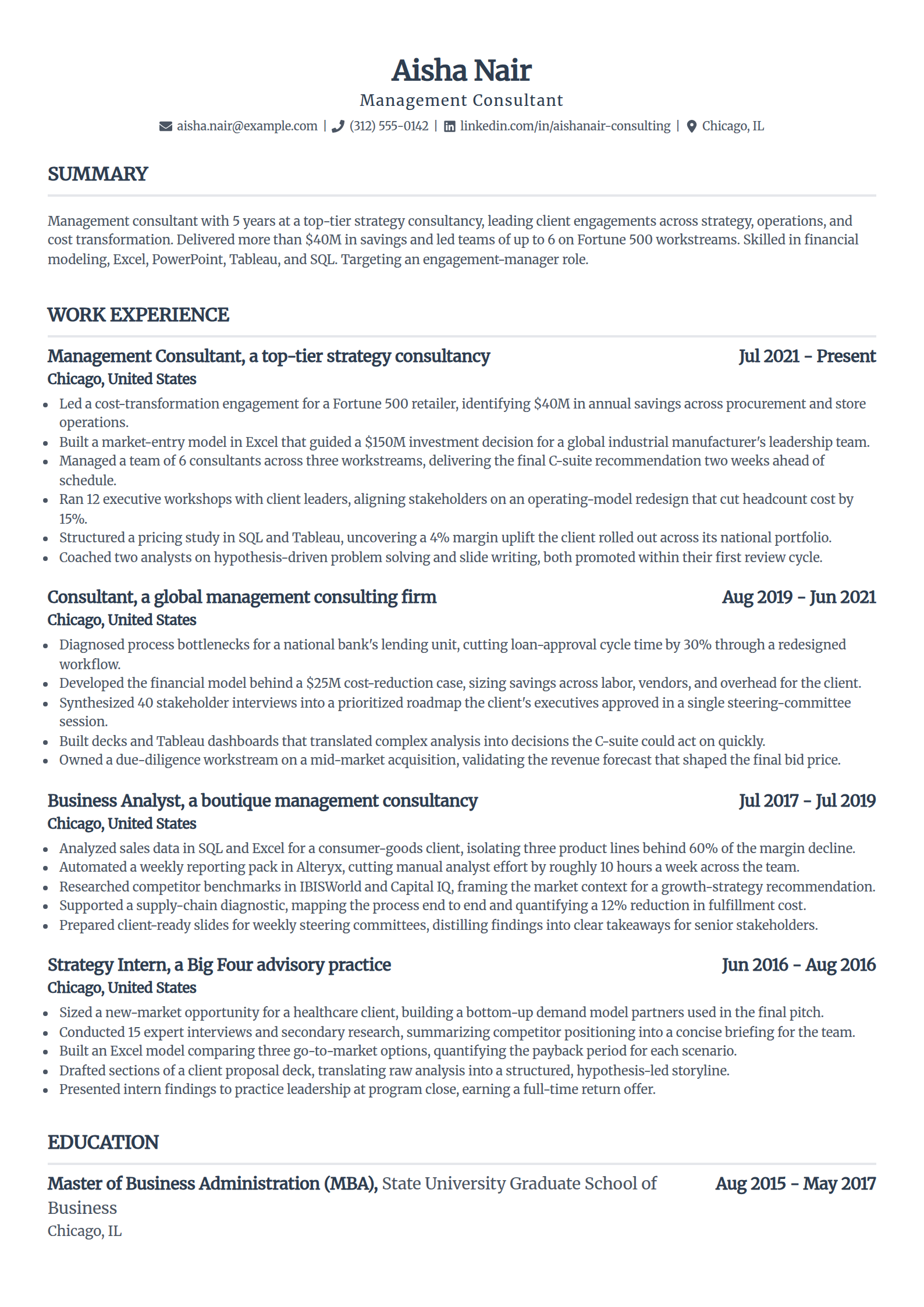
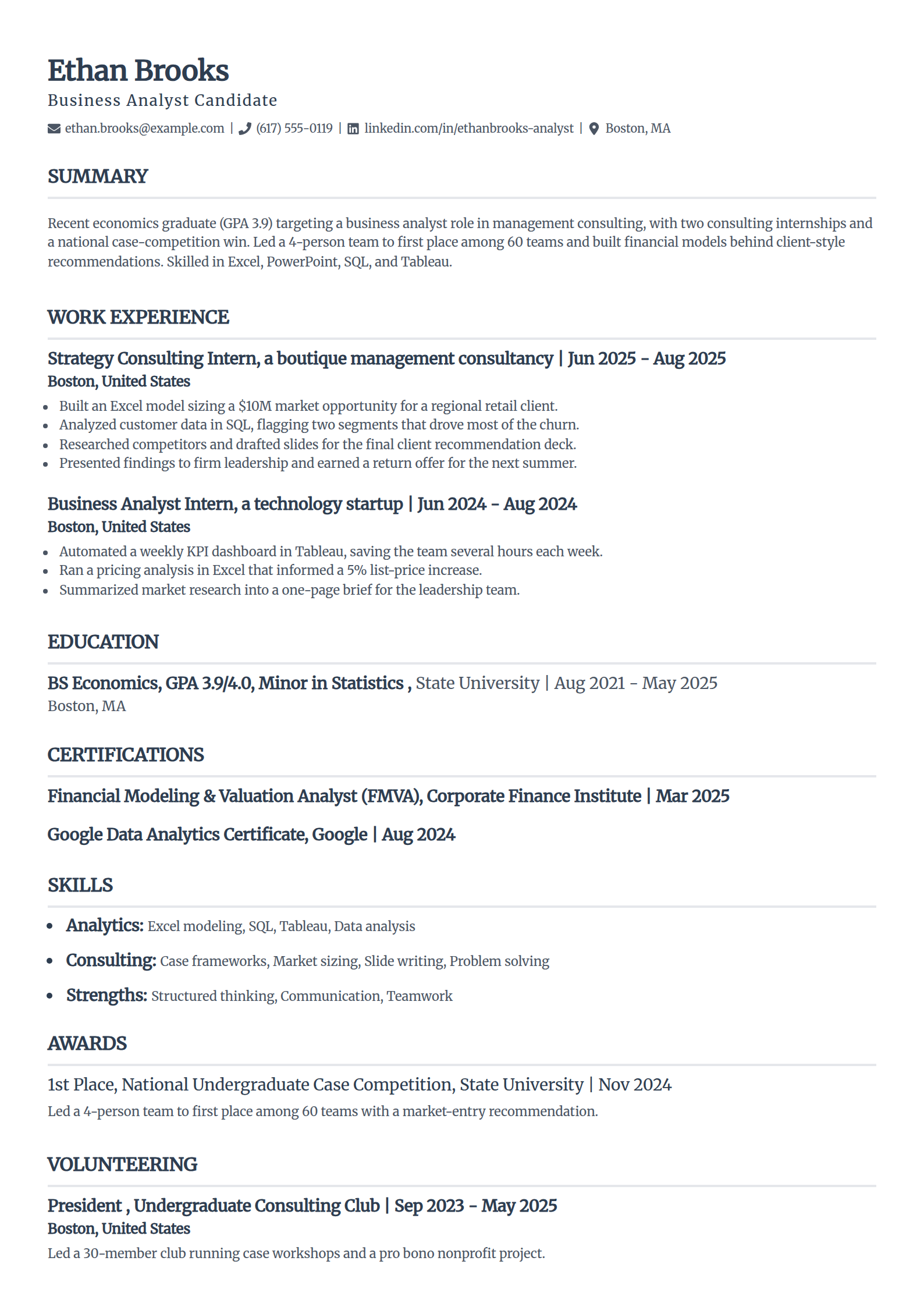
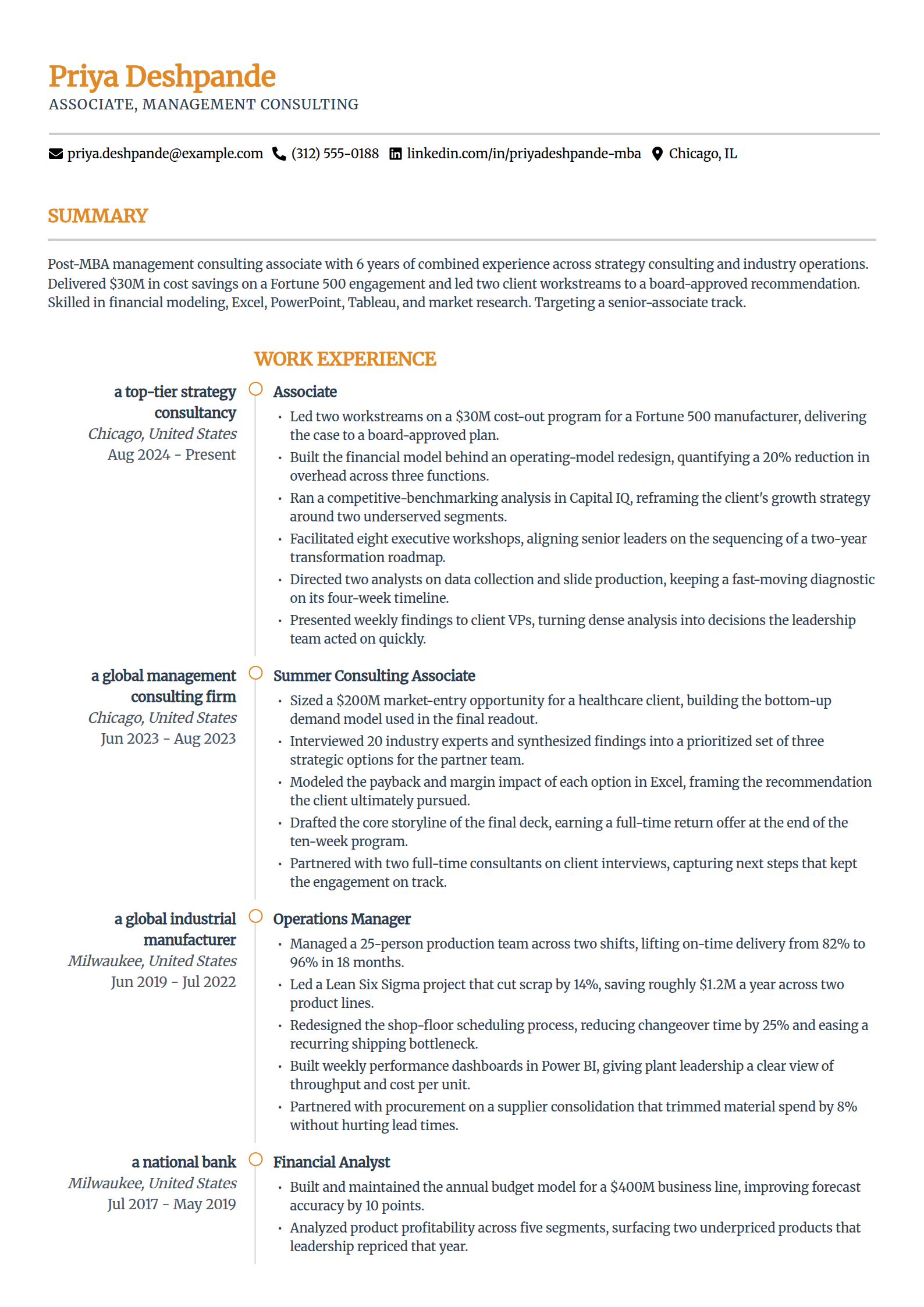
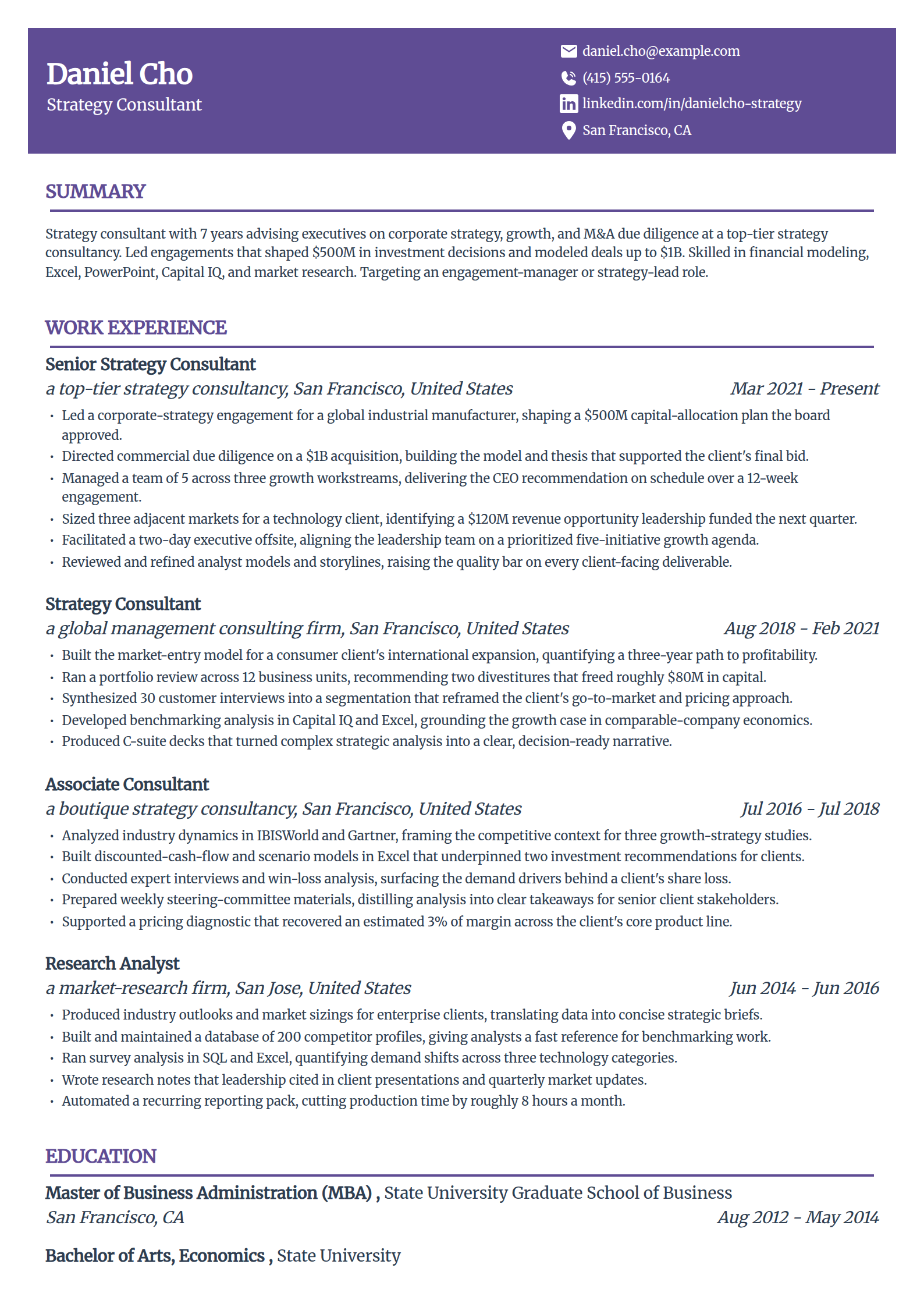
Management Consultant Resume Template
Why this resume example works?
- Opens with a summary that names 5 years, a $40M savings figure, and teams of up to 6 on Fortune 500 workstreams.
- Follows the MBB standard: a single-column, one-page layout an applicant tracking system and a conservative firm both parse cleanly.
- Leads each bullet with a strong verb and one number, like $40M in savings or a $150M investment decision guided by the model.
- Names the tools consultants run on, Excel, SQL, Tableau, and Alteryx, as applicant-tracking keywords.
- Balances strategy, cost, and analytics work so the resume reads as a well-rounded generalist, not a one-trick specialist.
Entry-Level Consulting Resume Template (Business Analyst)
Why this resume example works?
- Written for a new grad, leading with a 3.9 GPA, two internships, and a first-place national case-competition win.
- Leans on believable early-career proof, case wins and internship projects, rather than inflated dollar-impact claims.
- Keeps every intern bullet concrete, like sizing a $10M opportunity in Excel or flagging churn segments in SQL.
- Fills the page honestly with a consulting-club presidency and a case-competition award instead of padding.
- Uses a tight, ATS-safe single-column layout that fits a beginner's record without empty space.
MBA Consulting Resume Template (Post-MBA Associate)
Why this resume example works?
- Frames a post-MBA associate with 6 years across consulting and industry, up top with a $30M cost-out result.
- Puts the MBA to work, pairing the summer consulting internship with pre-MBA operations and finance roles.
- Shows the associate scope firms expect, leading two workstreams and running eight executive workshops.
- Carries level-accurate numbers, a 20% overhead reduction and an 18-month delivery lift, one per bullet.
- Uses a modern one-page layout that fits a combined industry-and-consulting record without crowding.
Strategy Consultant Resume Template
Why this resume example works?
- Leads with strategy scope, 7 years shaping a $500M capital-allocation plan and diligence on a $1B acquisition.
- Shows the corporate-strategy work an interviewer expects, market entry, portfolio review, and growth sizing.
- Names the research stack, Capital IQ, IBISWorld, and Gartner, that a strategy posting lists as keywords.
- Keeps each achievement to one credible number so the seniority reads as earned rather than inflated.
- Uses a clean, modern layout that carries a deep strategy history on one page.
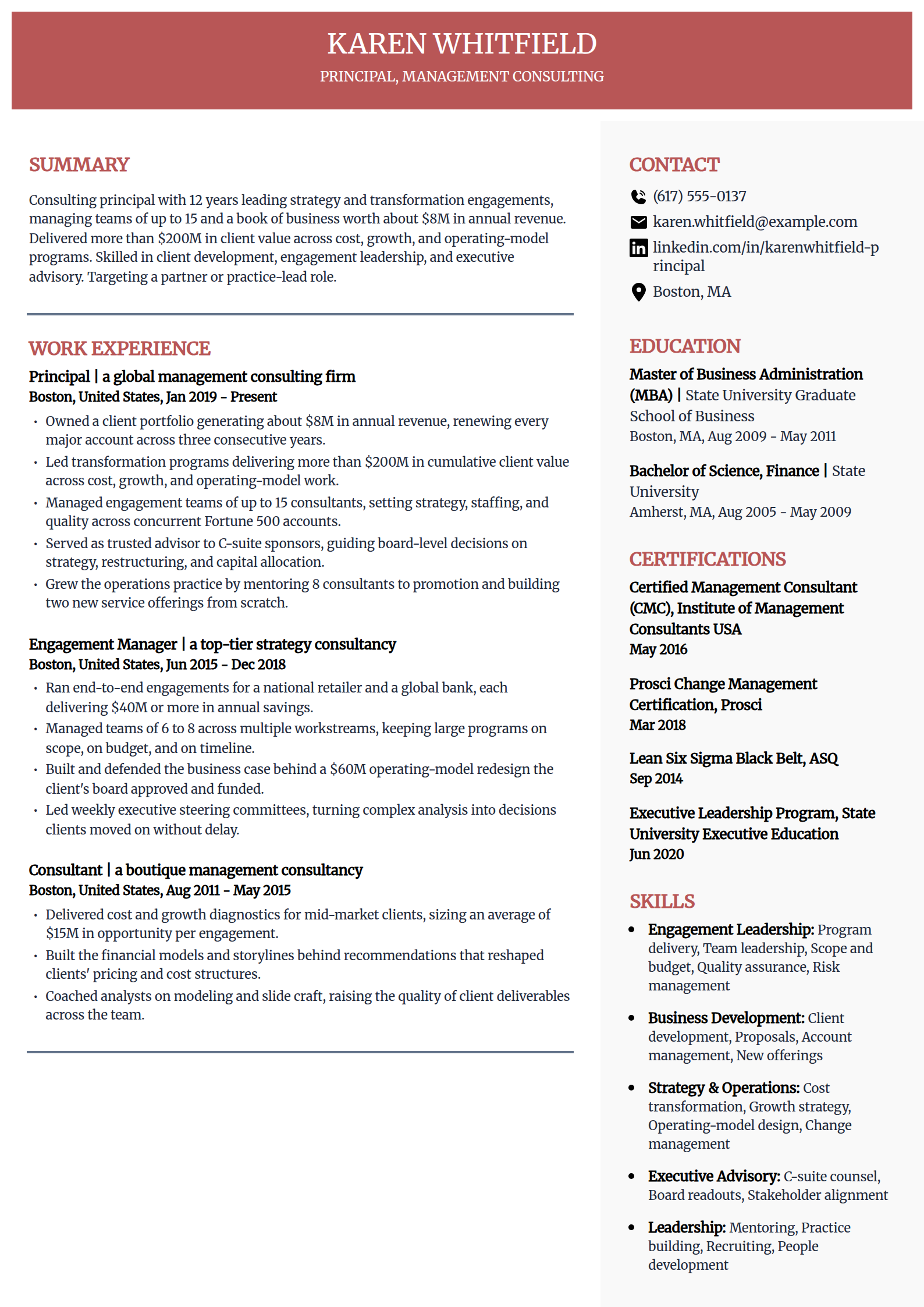
Principal & Senior Manager Consulting Resume Template
Why this resume example works?
- Leads with principal scope, a book worth about $8M a year and more than $200M in cumulative client value.
- Turns delivery into leadership, managing teams of up to 15 and mentoring 8 consultants to promotion.
- Shows the business-development work a partner track rewards, renewing every major account for three years.
- Keeps three focused senior roles tight and readable instead of padding a long history.
- Uses a refined, executive layout that fits a senior consulting record cleanly on one page.
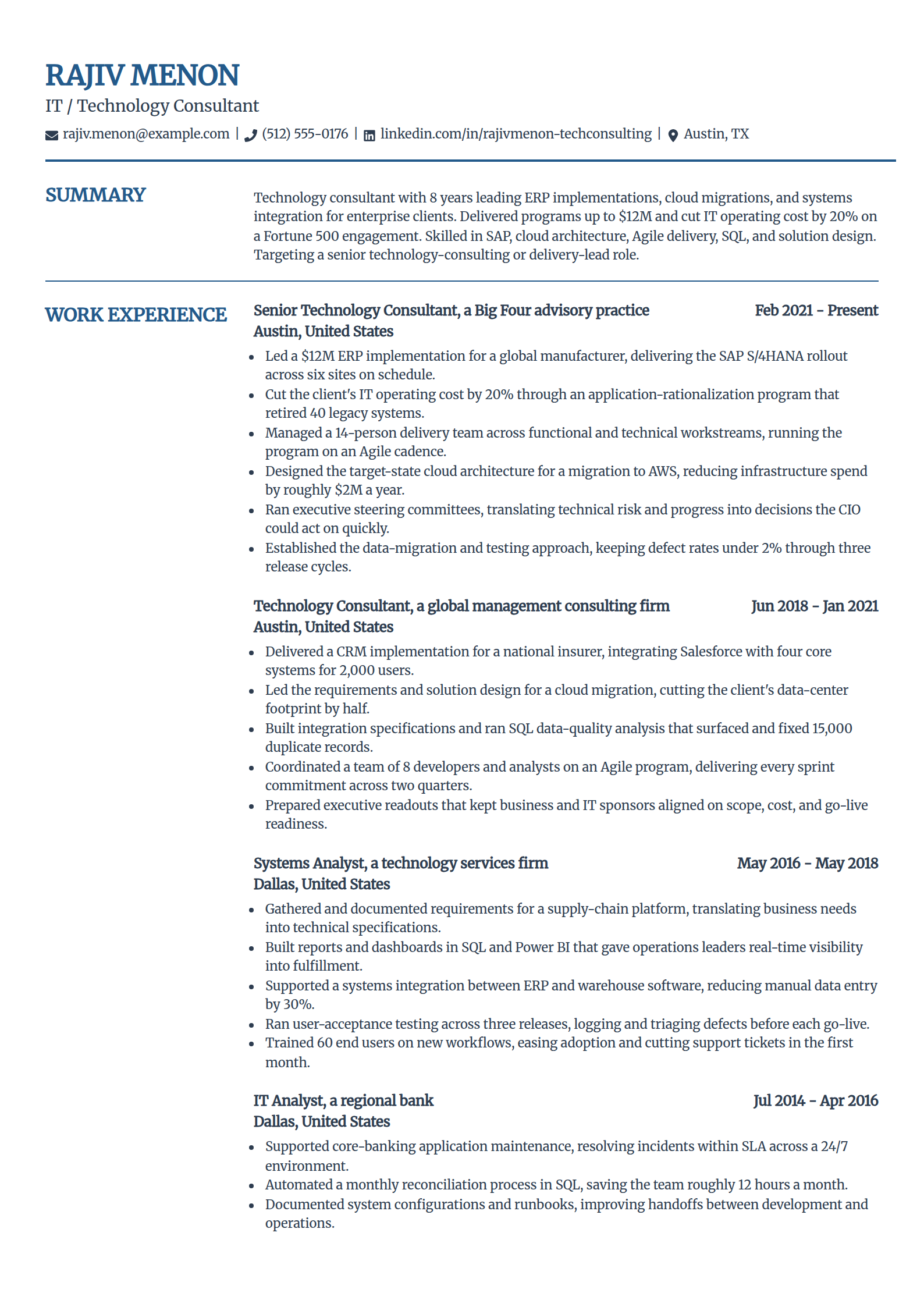
IT & Technology Consultant Resume Template
Why this resume example works?
- Opens with delivery scale, a $12M ERP program and a 20% cut in IT operating cost on a Fortune 500 account.
- Names the technology stack a posting screens for, SAP S/4HANA, AWS, Salesforce, and Agile delivery.
- Shows measurable outcomes, retiring 40 legacy systems and holding defect rates under 2% across releases.
- Backs the work with certifications a firm recognizes, SAP, AWS Solutions Architect, and Certified ScrumMaster.
- Uses a modern layout that carries a dense technology-consulting history on one clean page.
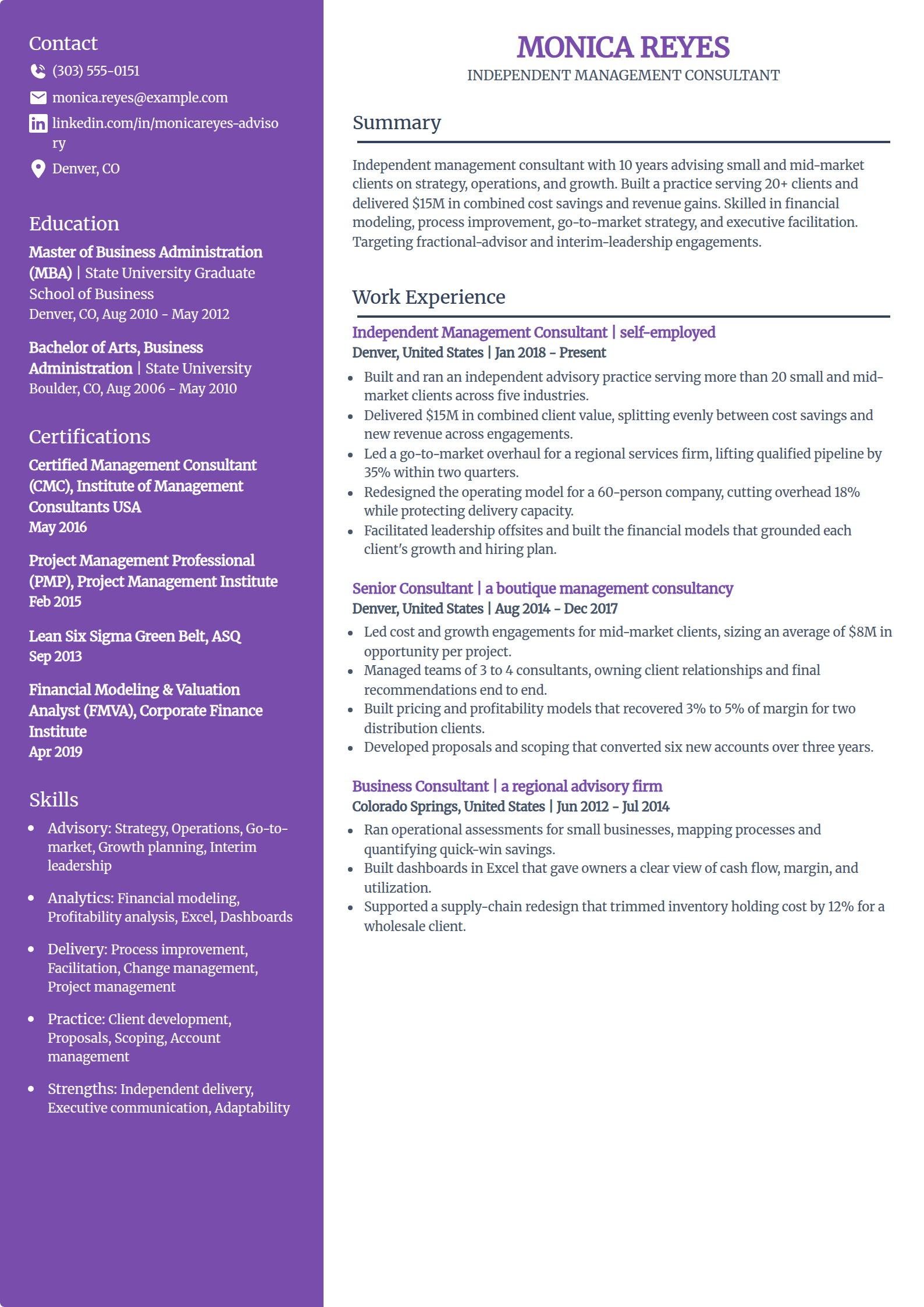
Independent Consultant Resume Template
Why this resume example works?
- Frames a self-employed practice honestly, serving 20+ clients and delivering $15M in combined savings and growth.
- Splits impact between cost and revenue so the independent record reads as balanced, not one-sided.
- Shows the range a fractional advisor needs, go-to-market redesign, operating-model work, and facilitation.
- Keeps each engagement bullet to one number, like a 35% pipeline lift or an 18% overhead cut.
- Uses a Medium layout that fits a ten-year independent record without empty space.
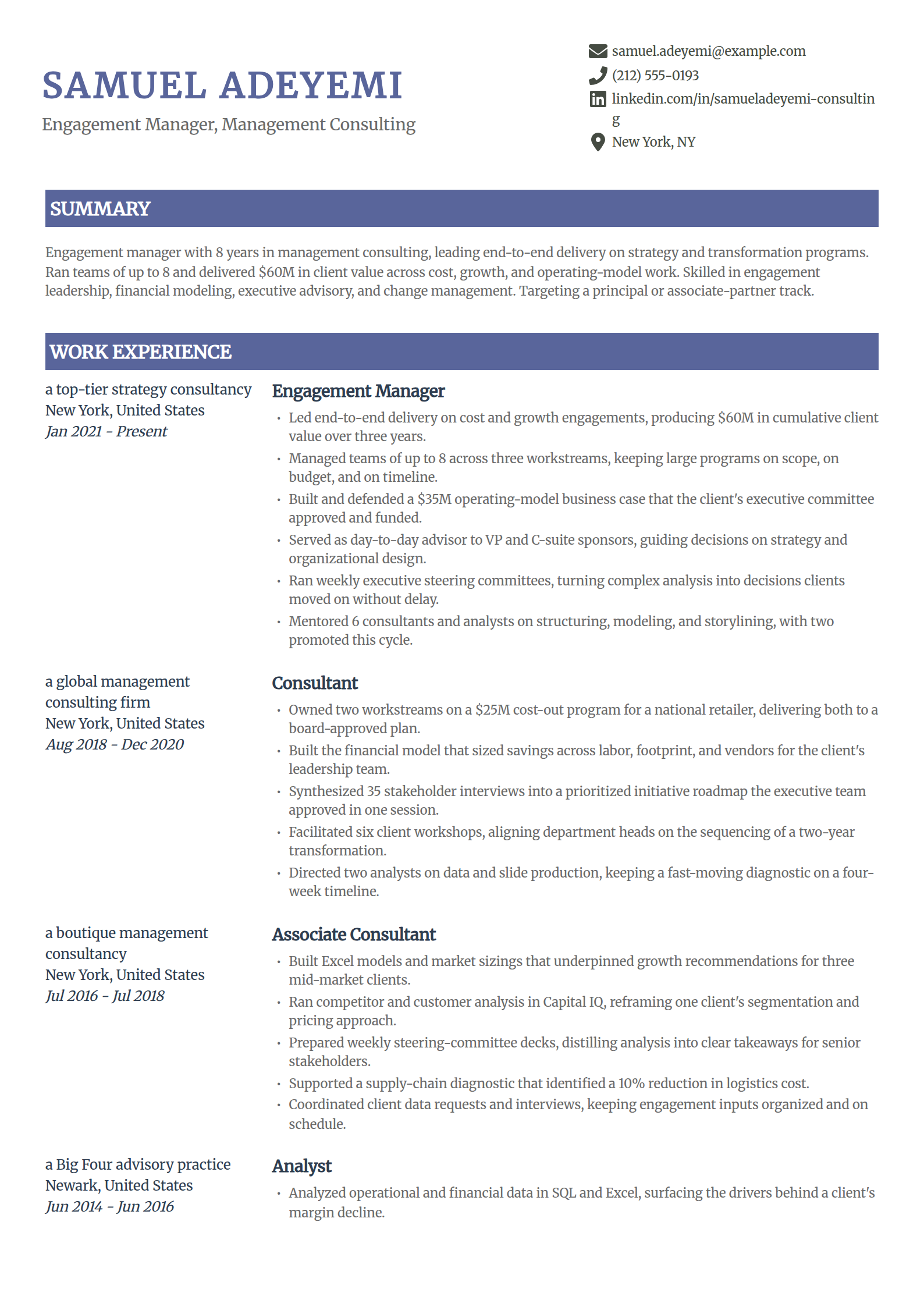
Engagement Manager Resume Template
Why this resume example works?
- Leads with end-to-end delivery, teams of up to 8 and $60M in cumulative client value over three years.
- Shows the manager scope firms promote for, defending a $35M business case to the executive committee.
- Balances client advisory and people leadership, mentoring 6 consultants with two promoted this cycle.
- Keeps every bullet results-first with one modest number so the seniority reads as real.
- Keeps a clean, results-first layout that stays easy to skim in one pass.
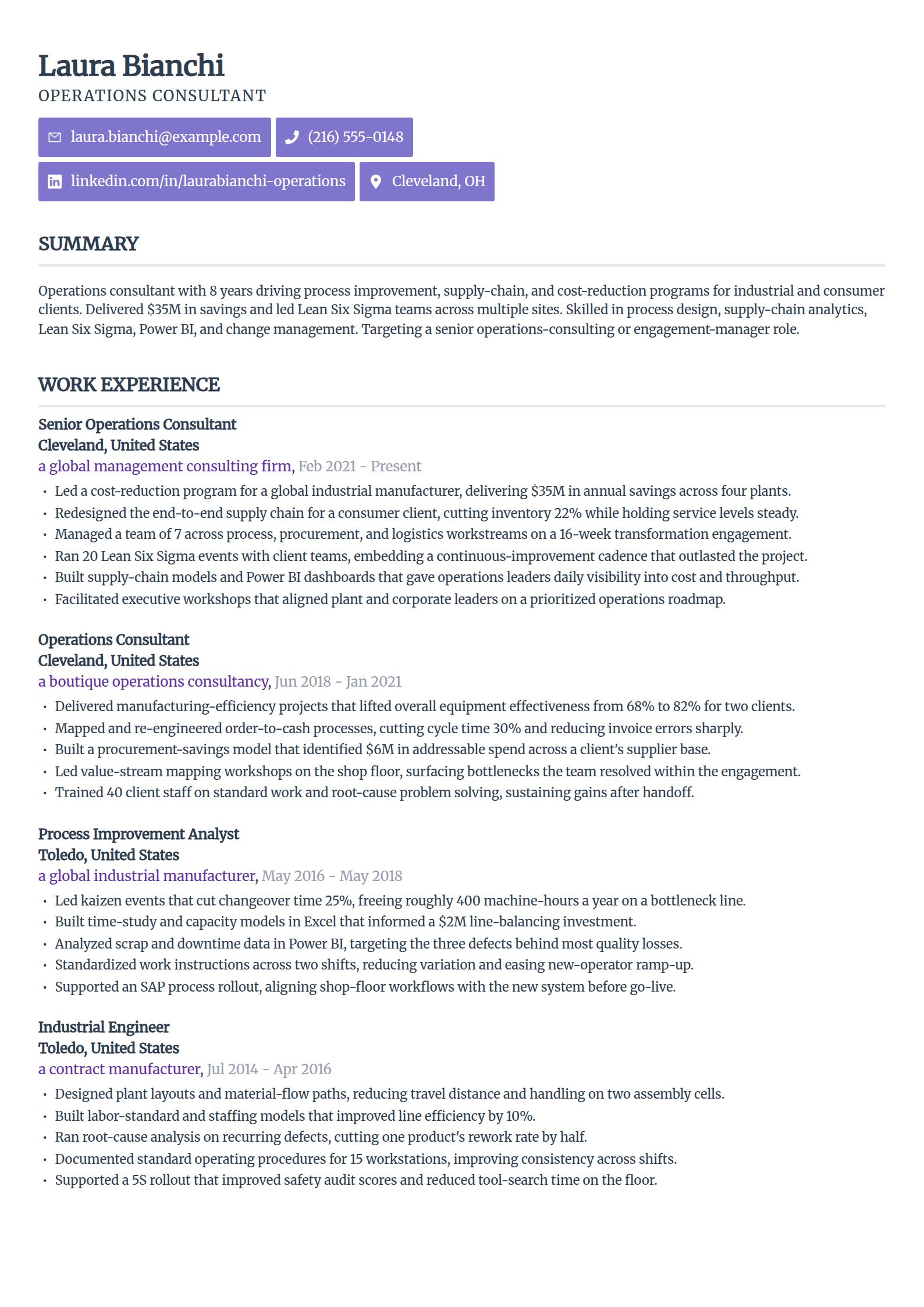
Operations Consultant Resume Template
Why this resume example works?
- Opens with operations scope, $35M in savings across four plants and a 22% cut in inventory.
- Names the operations toolkit a posting lists, Lean Six Sigma, value-stream mapping, and Power BI.
- Shows floor-level results, lifting equipment effectiveness from 68% to 82% and cutting cycle time 30%.
- Backs the work with a Six Sigma Black Belt and APICS CSCP, credentials an operations team recognizes.
- Uses a clean, modern layout that carries a dense operations history on one page.
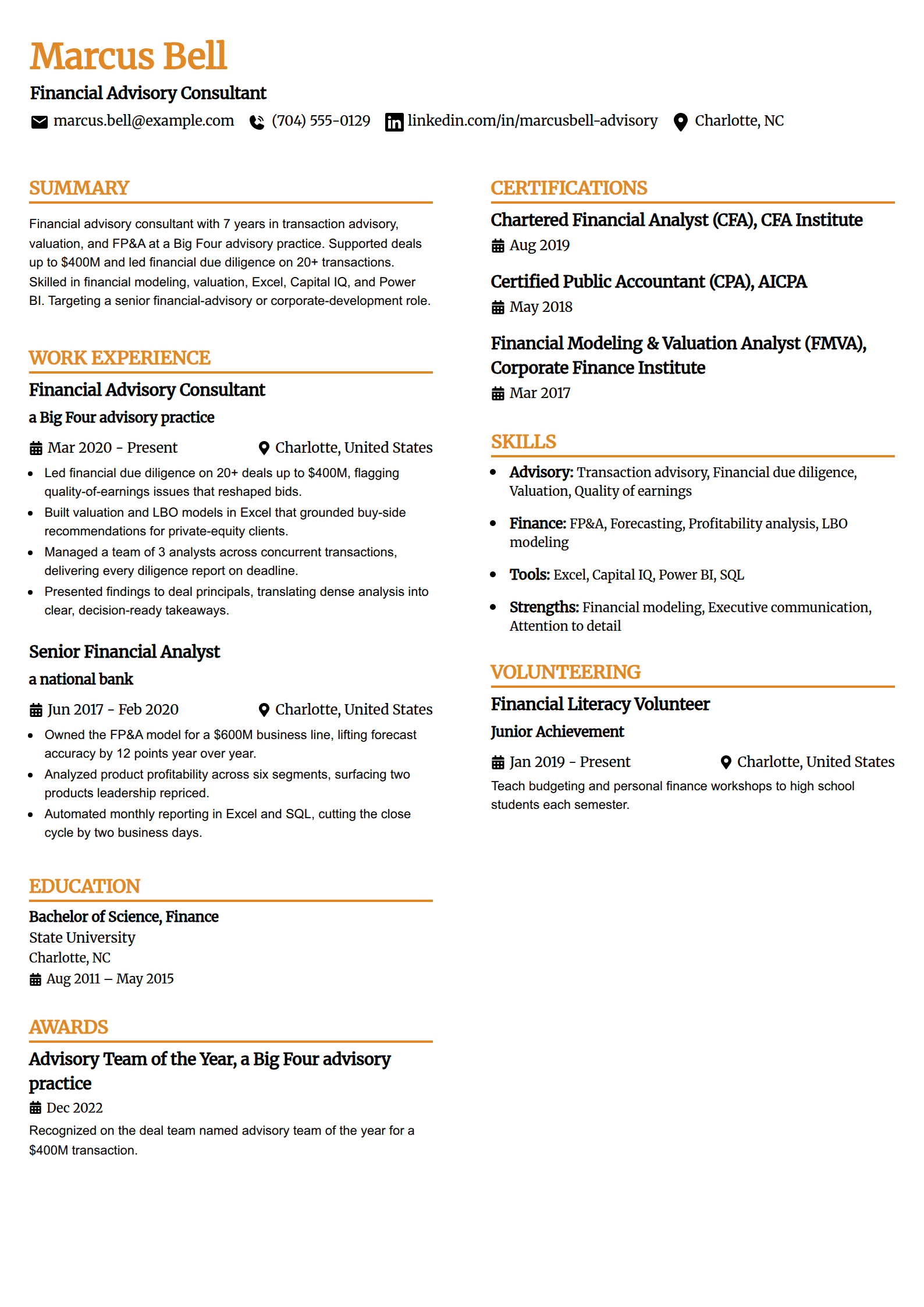
Financial & Advisory Consultant Resume Template
Why this resume example works?
- Leads with advisory scope, diligence on 20+ deals up to $400M and quality-of-earnings issues that reshaped bids.
- Names the finance credentials a posting screens for, a CFA and a CPA, alongside financial-modeling work.
- Shows the transaction and FP&A work an interviewer expects, valuation, LBO models, and forecasting.
- Keeps two focused roles tight and readable, with the sidebar filled by an award and a volunteer role.
- Uses a refined layout that fits a focused advisory record on one clean page.
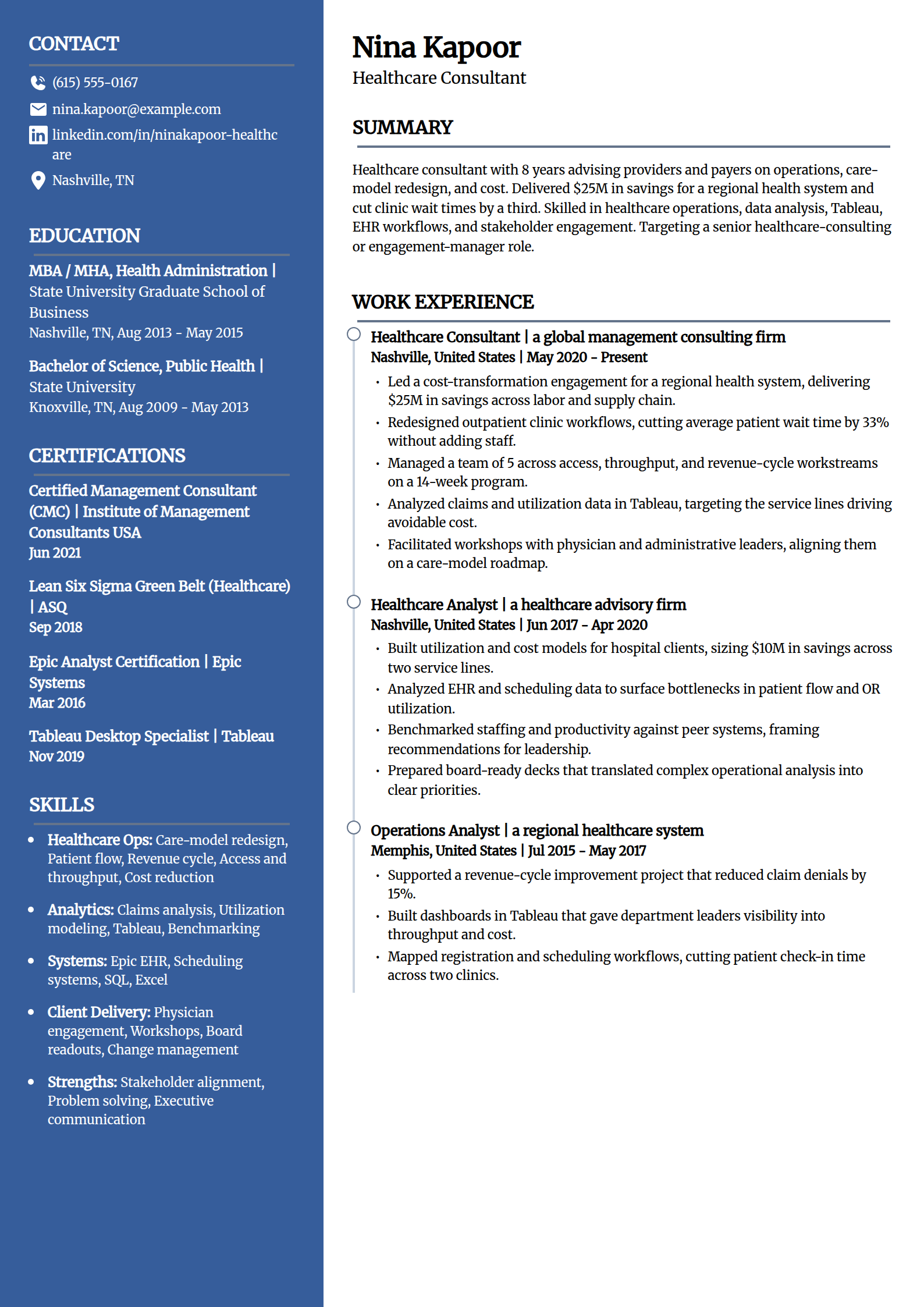
Healthcare Consultant Resume Template
Why this resume example works?
- Opens with healthcare scope, $25M in savings for a health system and a 33% cut in clinic wait times.
- Names the systems a healthcare posting lists, Epic EHR, claims and utilization analysis, and Tableau.
- Shows the provider work an interviewer expects, care-model redesign, patient flow, and revenue cycle.
- Keeps every result modest and believable for a provider setting, one number per bullet.
- Uses a distinctive layout that still reads cleanly for a hiring partner.
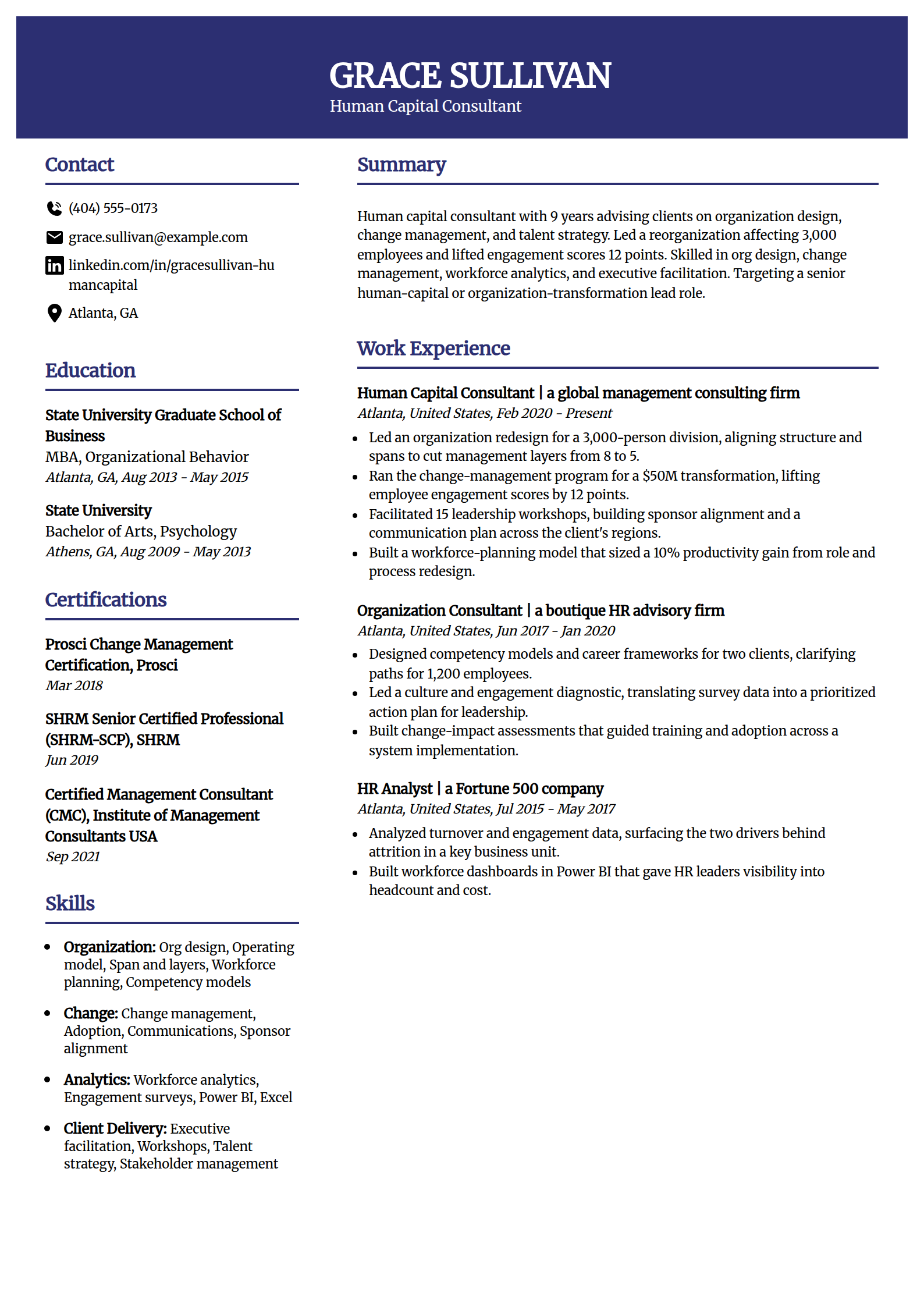
Human Capital & HR Consultant Resume Template
Why this resume example works?
- Frames human-capital scope, a 3,000-person reorganization and a 12-point lift in engagement scores.
- Shows the org and change work firms hire for, span-and-layer redesign and a $50M transformation.
- Names the credentials a human-capital team screens for, Prosci change management and SHRM-SCP.
- Uses a roomy layout with the sidebar filled so the one-page record reads complete.
- Keeps each metric modest and believable for an organization-design role.
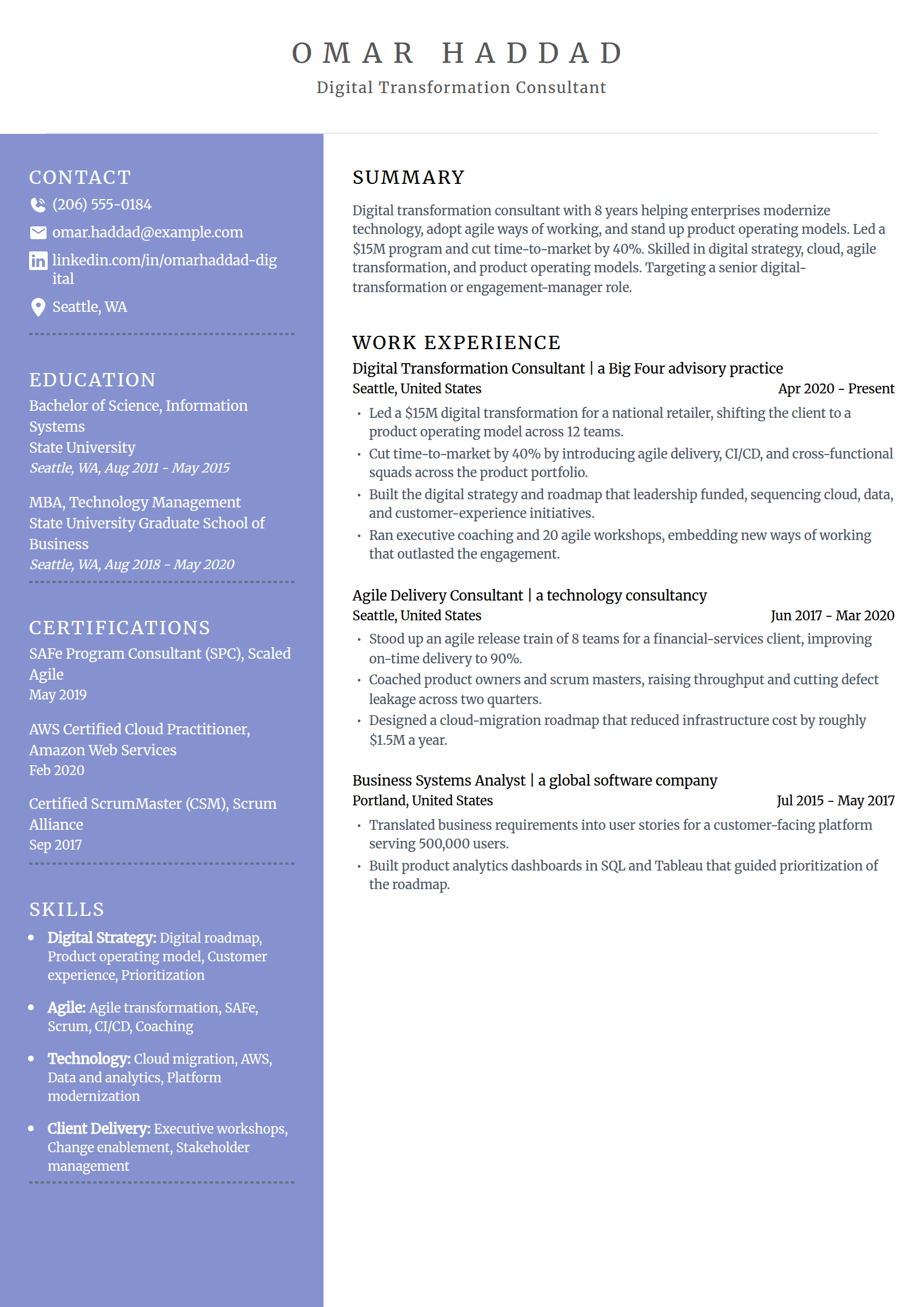
Digital Transformation Consultant Resume Template
Why this resume example works?
- Opens with transformation scope, a $15M program and a 40% cut in time-to-market across 12 teams.
- Names the modern stack a posting lists, product operating model, SAFe, Scrum, and cloud migration.
- Shows results a client values, an agile release train hitting 90% on-time delivery.
- Backs the work with SAFe Program Consultant and AWS credentials that fit the role.
- Uses a roomy layout with a filled sidebar so a focused record still looks full.
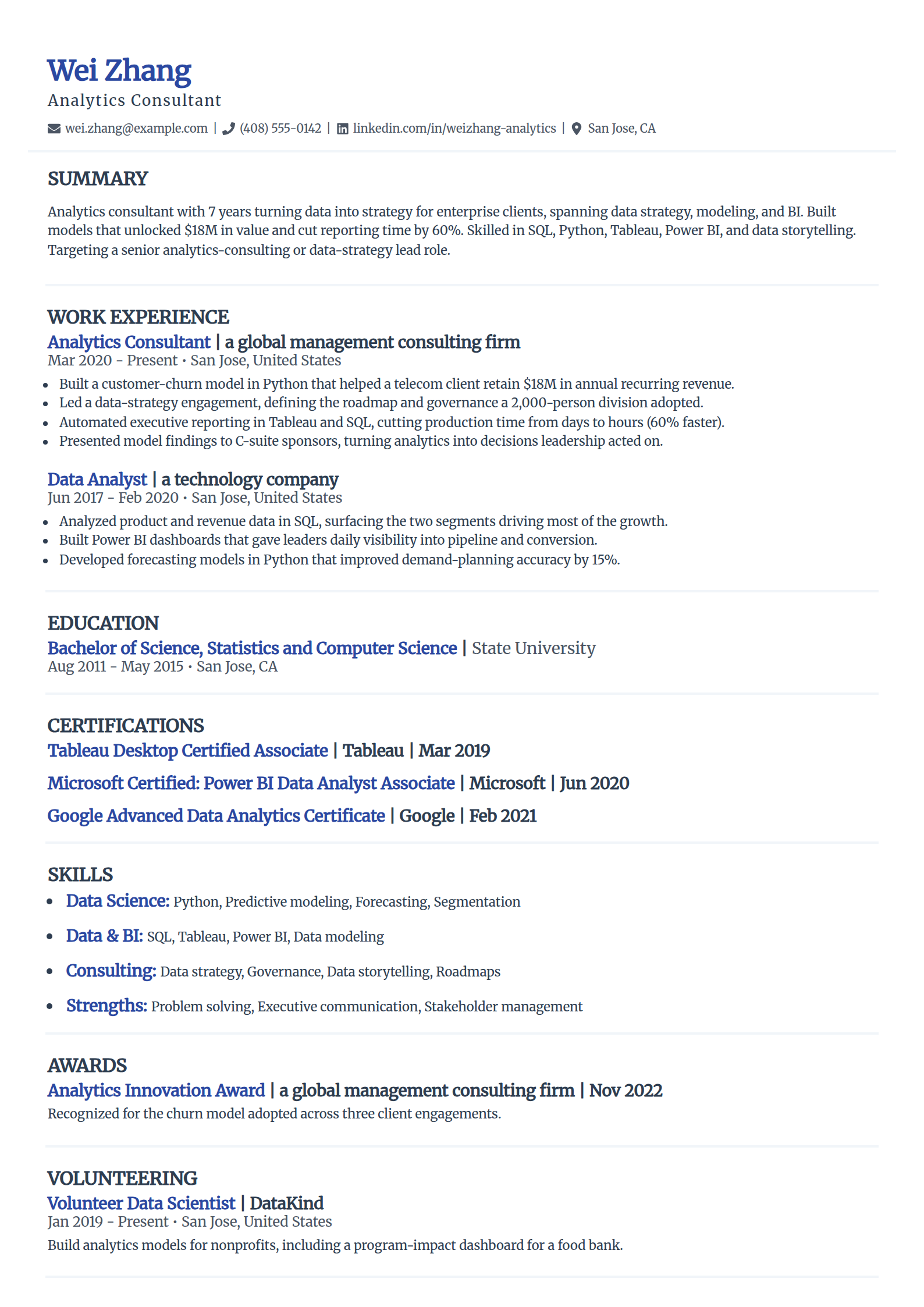
Analytics & Data Consultant Resume Template
Why this resume example works?
- Leads with analytics impact, a churn model that retained $18M in revenue and reporting cut 60% faster.
- Names the data stack a posting screens for, Python, SQL, Tableau, and Power BI.
- Shows consulting-grade work, defining a data strategy a 2,000-person division adopted.
- Keeps two roles tight, with the sidebar filled by an innovation award and a volunteer data-science role.
- Uses a refined, uncluttered layout that keeps the focus on models and results.
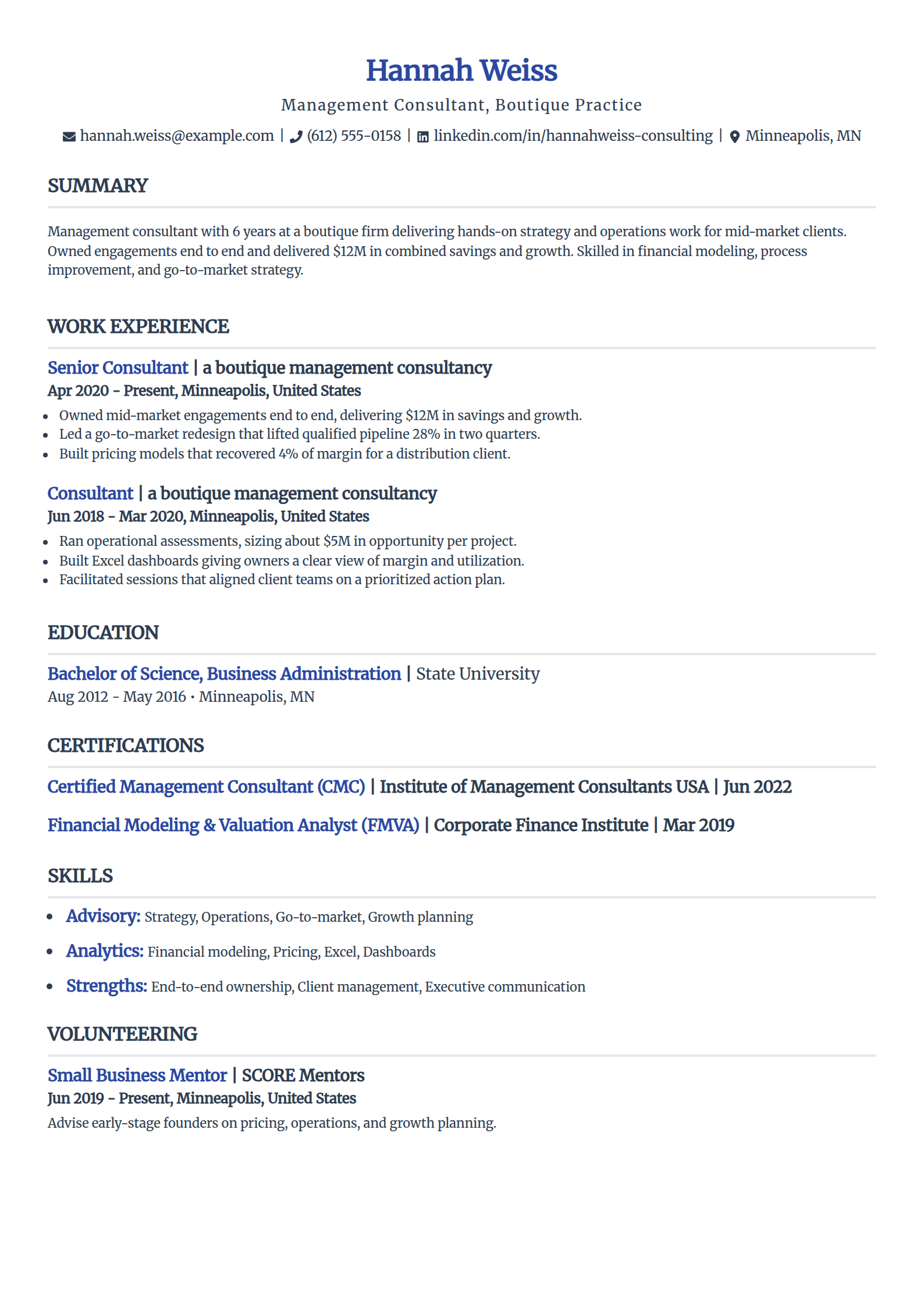
Boutique Consultant Resume Template
Why this resume example works?
- Written for a boutique-firm generalist, leading with $12M in combined savings and growth for mid-market clients.
- Shows the hands-on, end-to-end ownership boutiques hire for, from pricing models to go-to-market redesign.
- Keeps each bullet concrete, like a 28% pipeline lift or 4% of margin recovered.
- Fills the page with a mentor role and a client-impact award rather than padding.
- Uses a plain, ATS-safe layout that fits a six-year boutique record on one page.
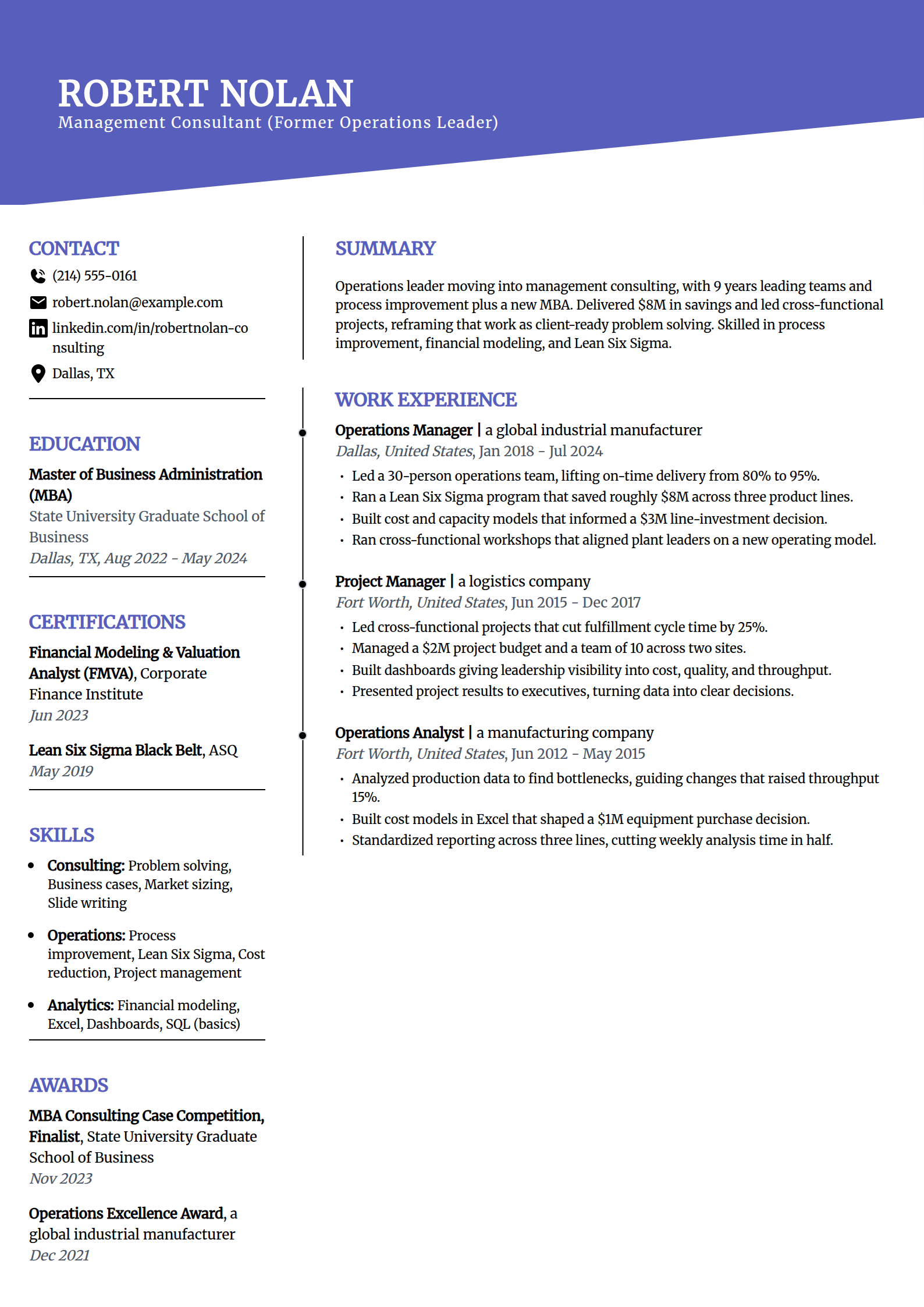
Career-Change Consulting Resume Template
Why this resume example works?
- Names the pivot openly, reframing 9 years of operations leadership as client-ready problem solving.
- Shows recent commitment with a new MBA and a consulting case-competition finalist finish.
- Pulls transferable wins forward, an $8M Lean Six Sigma saving and a 25% cycle-time cut.
- Leads the skills list with consulting basics, problem solving, business cases, and market sizing.
- Lists awards without long descriptions, keeping the layout clean and balanced.
Build your consulting resume
Pick a template above and the editor keeps your layout clean, single-column, and ATS-safe while you swap in your own engagements, savings, and tools.
Build my resumeHow to write a consulting resume in 2026
A consulting resume is read fast by someone testing two things: can you structure a problem, and does every claim carry a number. Lead with a tight summary, prove each role with one quantified result, and hold the whole thing to one clean page. These moves make yours easy to skim and easy for an applicant tracking system to parse.
Open with a short consulting summary
Write three to four sentences that name your years and track, your strongest number, the tools a posting lists, and the role you are targeting. Lead with what you delivered, not what you want from the firm. Keep it to about 60 words so it never spills past the top of the page.
Management consultant with 5 years at a top-tier strategy consultancy, leading engagements across strategy and cost transformation. Delivered $40M in savings and led teams of up to 6 on Fortune 500 workstreams. Skilled in financial modeling, Excel, SQL, and Tableau. Targeting an engagement-manager role.
Lead experience with cases, impact, and the number
The work a consulting resume is hired for is measurable, so name the case and attach one credible number to each bullet. Open every line with a strong verb, never "Responsible for".
- Impact: state the result and the number, like identifying $40M in annual savings across procurement and store operations.
- Scope: name the team and workstreams you led, such as managing 6 consultants across three workstreams to a C-suite recommendation.
- Method: name the tool or approach, like building the market-entry model in Excel that guided a $150M investment decision.
- Client work: use outcomes a firm can own, such as executive workshops run, decisions aligned, or a margin uplift rolled out.
Show your education, MBA, and certifications
Consulting screens hard on the top of the resume, so make education and credentials easy to find.
- List your degree and any MBA with dates; post-MBA associates put the MBA up front, and undergrad applicants lead with GPA and honors.
- Add certifications a firm recognizes: CMC for management consulting, FMVA or CFA for finance, Lean Six Sigma for operations, SAFe or cloud for technology.
- Entry-level candidates carry case-competition results, quant coursework, and leadership roles in place of years of impact.
- Keep dates and titles clean and reverse-chronological so a parser and a recruiter both read them at a glance.
Match skills to the tools and keywords a firm screens for
A consulting skills list should read like the job description. Split it so a hiring manager and a parser both find what they need.
- Analytics: financial modeling, Excel, SQL, Tableau, Power BI, Alteryx, and Python for the analytics-heavy tracks.
- Strategy and operations: market entry, growth strategy, cost reduction, operating-model design, Lean Six Sigma, and change management.
- Research: Capital IQ, IBISWorld, Gartner, expert interviews, benchmarking, and market sizing.
- Delivery: executive workshops, C-suite presentations, storylining, stakeholder management, and workstream ownership.
Keep it to one clean, single-column page (the MBB standard)
Consulting is a conservative-format field, and firms run applicant tracking systems, so a clean one-page resume is the standard for nearly every candidate.
- Use a single-column or simple layout with standard headings a parser recognizes; skip heavy graphics, photos, and color blocks.
- Hold it to one page and lead with your most recent role; even principals keep it to one page unless a book of business demands two.
- Save as a PDF so the formatting holds, then run it through the ATS resume checker for a quick format pass.
- Swap the numbers in the templates above for your own engagements, savings, and tools; do not copy them as is.
Common consulting resume mistakes
- Writing vague lines like "advised clients" or "worked on projects" with no number. Say what changed: "identified $40M in annual savings across procurement".
- Running to two pages for a non-partner role. Consulting expects one clean page for nearly every candidate, so cut older, unrelated roles to make room.
- Choosing a busy, graphics-heavy design that buries your results. Consulting rewards a clean, results-first layout that parses cleanly, and for MBB and strategy roles a single-column page is the safest choice.
- Inflating metrics. A first-place case win and a summer internship are believable for a new grad; a $10M savings claim on an entry-level resume is not.
- Listing tools with no result. Tie Excel, SQL, or Tableau to what you produced, like a model that guided a $150M investment decision.
Frequently asked questions
How do you write a consulting resume?
Lead with a three-to-four-sentence summary that names your years, track, strongest number, and target role. Under each job, write results-first bullets that open with a strong verb and carry one credible number, like identifying $40M in savings or guiding a $150M investment decision. Name the tools a posting lists, such as Excel, SQL, Tableau, and PowerPoint, and put your education, MBA, and certifications where a recruiter reads them first. Keep the whole resume to one clean, single-column page.
Should a consulting resume be one page?
Yes. One page is the standard for nearly every consulting candidate, from an undergrad business analyst to a principal. Consulting is a conservative-format field, firms run applicant tracking systems, and screeners read fast, so a single, skimmable page led by your most recent role is what they expect. Only a very senior consultant with a large book of business runs to two pages, and never longer. Cut older, unrelated roles to make room for engagements, savings, and the tools the posting names.
What is the MBB or management consulting resume format?
The MBB format, used at McKinsey, BCG, Bain, and firms that hire like them, is a clean, single-column, one-page resume in reverse-chronological order. It leads with education for students and recent MBAs and with experience for lateral hires, then an additional section for skills, languages, and leadership. Every bullet is a quantified accomplishment: an action verb, the result, and the number that proves it. There are no photos, colors, or heavy graphics, because the format is judged on structure and impact, not design. The management-consultant example above follows this standard.
How do I write a consulting resume with no experience?
Lead with the proof you do have. A new grad targeting a business analyst role leads with GPA, quant coursework, internships, and case-competition results, then shows real work from those internships with one number each. A case-competition win, a consulting-club leadership role, and a strong internship project carry more weight than an inflated dollar figure, which reads as invented to a screener. Fill the page honestly with leadership and a relevant award rather than padding. The entry-level and career-change examples above show the shape.
What skills and tools should go on a consulting resume?
Match the posting, then group your skills so a parser and a recruiter both find them. Analytics tracks list financial modeling, Excel, SQL, Tableau, Power BI, Alteryx, and Python. Strategy and operations list market entry, growth strategy, cost reduction, operating-model design, Lean Six Sigma, and change management. Add research tools like Capital IQ, IBISWorld, and Gartner, and delivery skills like executive workshops, C-suite presentations, and stakeholder management. Name the specific tools you actually use rather than a generic list.
How do I quantify results on a consulting resume without exaggerating?
Use one modest, credible number per bullet and keep it level-accurate. Experienced consultants can own cost savings ($X to XXM), revenue uplift in percent, engagements and teams led, workstreams owned, and EBITDA impact. Entry-level and undergrad candidates should not claim $M impact; use case-competition placements, GPA, internship project results, and leadership size instead. Attach the number to a method or tool so it reads as real, like a 4% margin uplift found in a SQL and Tableau pricing study. When you are unsure a figure is believable, round it down or drop it.
More consulting resume resources
Build your consulting resume
Pick a template above and the editor keeps your layout clean, single-column, and ATS-safe while you swap in your own engagements, savings, and tools.